The big picture
Psalm 110 is only seven verses, yet The Book of Psalms compresses throne, enemies, willing people, divine oath, priesthood, judgment, and renewed strength into that small space. The ruler does not seize his position; the LORD tells him to sit at the right hand and promises to deal with his enemies. Then a second extraordinary identity appears: “a priest for ever after the order of Melchizedek.” The royal and priestly lines meet because God swears that they do. Later New Testament writers repeatedly return to this language when speaking about Jesus, especially the right hand and the enduring priesthood. Within the psalm itself, authority remains received, opposition remains real, and the chapter ends with a raised head after judgment and refreshment along the way.
In this chapter
- The Throne Is Given, Not Seized Psalms 110:1-2
The opening of Psalm 110 turns on a distinction the English typography tries to preserve.
- The Morning Gathers a Willing People Psalms 110:3
Verse 3 is one of the most compressed lines in Psalm 110.
- The King Is Also Named a Priest Psalms 110:4
The center of Psalm 110 is an oath, and that changes everything around it.
- The Raised Head Follows Judgment and the Brook Psalms 110:5-7
The closing scene of Psalm 110 is severe.

Scripture beside the summary
Psalms · King James Version · 7Psalms 110:1-2
The Throne Is Given, Not Seized
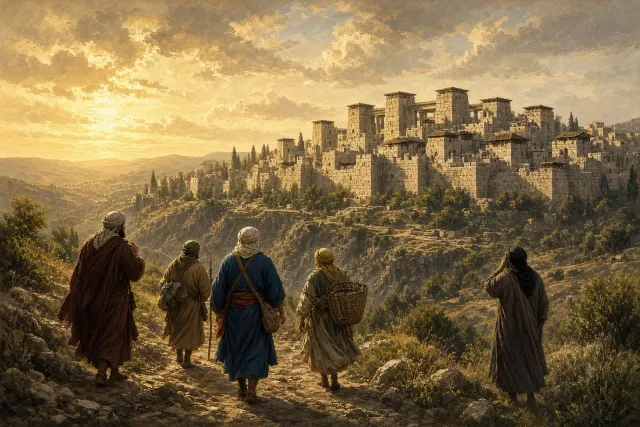
The opening of Psalm 110 turns on a distinction the English typography tries to preserve. “The LORD” represents the divine name, while “my Lord” is the addressed ruler. The Book of Psalms does not present that ruler as grabbing a throne. He is told to sit at God’s right hand, and the subjection of enemies is promised to him. That makes authority a gift before it becomes an exercise of power. The command to rule “in the midst” of enemies is equally important. Opposition has not vanished when his rule begins. Zion sends out the rod into contested space. Matthew later makes David’s address to this figure central to Jesus’ question about the Messiah and Davidic descent. The force lies not in treating one title as a magic proof, but in attending to who speaks, who is addressed, and where the addressed ruler is placed.

Deep dive
The two occurrences of "Lord" do not translate the same Hebrew expression. The KJV's "LORD" represents the divine name, while adoni means "my lord," a title of recognized authority. The distinction establishes a speaker and an addressed ruler; the title by itself does not settle every question about the ruler's identity. What makes the opening extraordinary is the place granted to him and the promise that his enemies will be placed beneath his feet.
The command to rule "in the midst" of enemies matters. The ruler's authority does not begin only after opposition has vanished. Zion becomes the point from which the scepter extends into contested space. Matthew 22:41–46 explicitly turns on David's address to this figure as his lord when Jesus questions an account of the Messiah limited to Davidic descent. The later argument attends closely to the psalm's relationship between the royal figure and David, rather than treating "lord" as an isolated dictionary proof.
Words to trace: LORD, enemies, footstool, hand, midst, right
Verse-by-verse path
- Psalms 110:1
“The LORD said” is ne’um YHWH, “the oracle of the LORD”, the formula the prophets use for “saith the LORD” and very rare in the Psalms. This verse is quoted or alluded to in the New Testament more than any other line of the Old. Egyptian kings had their footstools carved with bound foreign captives, and Joshua had his captains set their feet on the necks of five kings (Joshua 10:24).
- Psalms 110:2
“Rod” is matteh, a sceptre or staff, the same word as Aaron’s rod that budded in the tent of meeting (Numbers 17:8), a staff that proved a priesthood; the association fits a psalm that turns to priesthood in verse 4. The rule begins in Zion and reaches out into enemy ground.
Psalms 110:1-2
King James Version1The LORD said unto my Lord, Sit thou at my right hand, until I make thine enemies thy footstool.
2The LORD shall send the rod of thy strength out of Zion: rule thou in the midst of thine enemies.
Psalms 110:3
The Morning Gathers a Willing People
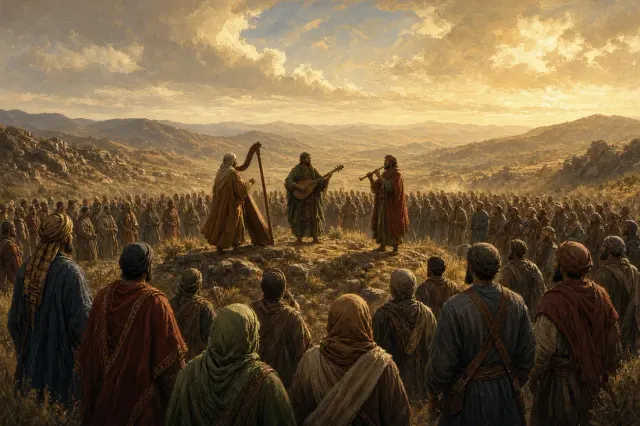
Verse 3 is one of the most compressed lines in Psalm 110. The ruler’s people are “willing in the day of thy power,” which distinguishes their allegiance from the enemies who will be subdued. The Book of Psalms surrounds them with the language of holiness, dawn, birth, youth, and dew. The image is radiant, but its grammar is difficult enough that careful reading should resist pretending every detail is obvious. “Dew of thy youth” may point toward fresh vigor in the ruler or toward a multitude of youthful followers appearing like morning dew. Either way, the verse contributes life and readiness to a chapter otherwise dominated by throne, oath, and conflict. The people are not pictured as merely crushed into compliance. Their presence has the quality of willing emergence, like a morning scene arriving full rather than being dragged into place.
Deep dive
The people are described as willing in the day of the ruler's power. Their presence differs from the enemies placed underfoot: allegiance and subjection are not treated as the same relationship. The surrounding language of holiness gives their gathering a consecrated character, though the verse does not supply enough detail to reconstruct uniforms, a ceremony, or a particular day of battle.
The second half is among the psalm's most difficult expressions. The "dew of thy youth" has been read as the ruler's fresh vigor or as a host of youthful followers appearing like abundant morning dew. The imagery of birth from the dawn supports freshness and emergence without decisively resolving every grammatical question. A careful reading can retain that radiance without pretending the Hebrew presents an ordinary, fully transparent description. The verse contributes living readiness to a psalm otherwise dominated by throne, oath, and conflict.
Words to trace: beauties, holiness, morning, people, power, willing
Verse-by-verse path
- Psalms 110:3
“Willing” is nedavot, freewill offerings: literally “thy people are freewill offerings”, as in Judges 5:2, where “the people willingly offered themselves” for battle. “Womb of the morning” uses mishchar, dawn, found only here. The ancient Greek read “from the womb before the morning star I begat thee”, taking “thy youth” as “I have begotten thee”, as in Psalm 2:7.
Psalms 110:3
King James Version3Thy people shall be willing in the day of thy power, in the beauties of holiness from the womb of the morning: thou hast the dew of thy youth.
Psalms 110:4
The King Is Also Named a Priest
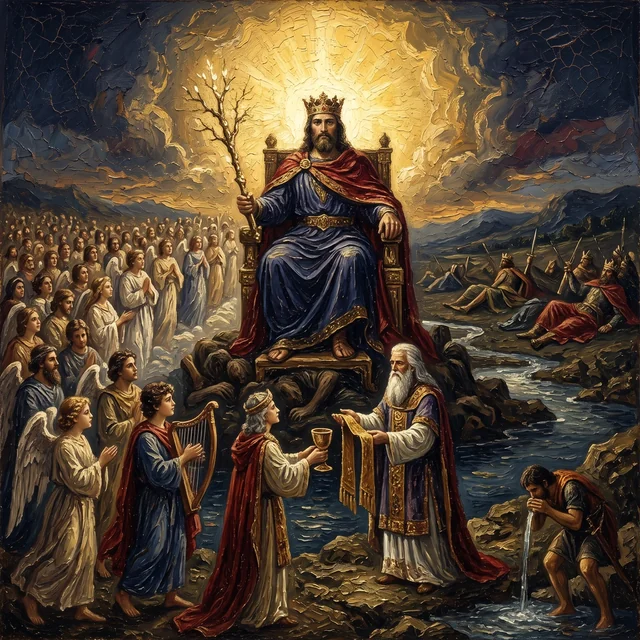
The center of Psalm 110 is an oath, and that changes everything around it. “The LORD hath sworn, and will not repent” means the priesthood is not a title the ruler claims for himself or an honor the congregation decides to grant. The Book of Psalms grounds it in divine commitment. Melchizedek brings together kingship and priesthood from Genesis, but this verse does not explain a normal hereditary succession. It simply declares “a priest for ever” after that order. Hebrews later makes this wording central to its account of Jesus, emphasizing the oath, the different order, and the permanence of the priesthood. Even without that later argument, the line is startling. A royal figure already seated at the right hand is now given an enduring priestly identity, and the union of those offices rests on God’s sworn word rather than on ordinary institutional inheritance.
Deep dive
The oath is the chapter's central declaration. It is not a wish spoken by the congregation or a claim the ruler makes for himself. The LORD swears and will not revoke the commitment. The title "priest for ever" therefore stands on a different basis from an office maintained merely through ordinary succession. Its permanence is part of what the oath asserts.
Genesis 14:18–20 identifies Melchizedek as king of Salem and priest of the most high God. Psalm 110 invokes that combination without retelling his encounter with Abraham or specifying a chain of descendants. Hebrews 7:11–22 later makes this verse central to its account of Jesus' priesthood, contrasting a priest appointed through an oath with the Levitical arrangement. That argument follows the psalm's distinctive wording: another order of priesthood, a sworn appointment, and an enduring office. The royal and priestly roles are brought together in one addressed figure, and the text presents their union as God's act.
Words to trace: LORD, Melchizedek, order, priest, repent, sworn
Verse-by-verse path
- Psalms 110:4
Melchizedek appears in only two places in the Old Testament: here and Genesis 14:18, where he meets Abram with bread and wine as “king of Salem” and “priest of the most high God”. Psalm 76:2 identifies Salem with Zion. “Will not repent” echoes Numbers 23:19: “God is not a man... neither the son of man, that he should repent.”
Psalms 110:4
King James Version4The LORD hath sworn, and will not repent, Thou art a priest for ever after the order of Melchizedek.
Psalms 110:5-7
The Raised Head Follows Judgment and the Brook
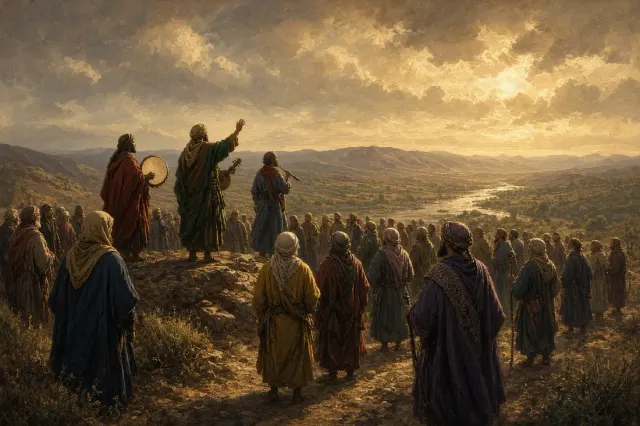
The closing scene of Psalm 110 is severe. Kings are struck, judgment moves among nations, and dead bodies fill the field. The Book of Psalms does not soften the language into a decorative metaphor for mild political inconvenience. Yet the final image suddenly becomes small: a drink from a brook along the way, followed by a lifted head. That shift gives the ending its strange power. Overwhelming judgment and ordinary refreshment occupy the same final movement. The repeated right-hand language also creates a striking exchange. The ruler sits at God’s right hand in the opening, while the Lord is now described at the ruler’s right hand in the conflict. Interpreters debate some of the shifting references, but support, victory, and renewed strength remain clear. The psalm closes not with a throne room speech, but with the head raised after the road’s exertion.
Deep dive
The return to the "right hand" creates a striking exchange of positions: the opening ruler sits at God's right hand, while the closing scene speaks of the Lord at the ruler's right hand. The language presents divine support in judgment, although interpreters differ over some of the shifting referents. The overthrow of kings and the presence of dead bodies keep the judgment imagery severe. It is not simply a decorative way of saying that opposition becomes inconvenient.
The final drink from a brook is much smaller in scale than the preceding battlefield. It is commonly understood as refreshment taken in the course of victory, followed by the lifting of the head. The verse does not identify the brook, describe a particular journey, or explain every part of the image. Its clear movement is from drinking to renewed elevation. The psalm ends with a raised head, answering the earlier image of enemies beneath the ruler's feet.
Words to trace: bodies, brook, countries, dead, drink, fill
Verse-by-verse path
- Psalms 110:5
“Strike through” is machats, to smash, the verb for Jael’s blow through Sisera’s temples (Judges 5:26) and for Balaam’s star that “shall smite the corners of Moab” (Numbers 24:17). “The day of his wrath” is the kind of day Zephaniah 1:15 describes as “a day of wrath”.
- Psalms 110:6
“Wound the heads” is machats again: Psalm 68:21 says “God shall wound the head of his enemies”. The Hebrew “head” is singular, rosh al erets rabbah, so it may mean a chief ruler over a wide land rather than many heads. “Dead bodies” is geviyyot, corpses.
- Psalms 110:7
The line is the most puzzling in the psalm. Gideon chose his men by how they drank at the water (Judges 7:5–6), and some interpreters connect the brook with the Gihon spring, where Solomon was anointed king (1 Kings 1:38–39), a coronation rite; both links are guesses. Heads were shattered in verse 6; this head is lifted up.
Psalms 110:5-7
King James Version5The Lord at thy right hand shall strike through kings in the day of his wrath.
6He shall judge among the heathen, he shall fill the places with the dead bodies; he shall wound the heads over many countries.
7He shall drink of the brook in the way: therefore shall he lift up the head.
Questions to keep in mind while reading
- Follow the speaker, images, parallel lines, questions, and emotional movement.
- Notice where tension or suffering resists an easy answer.
- Read a saying as wisdom for faithful discernment, not as a mechanical promise detached from context.
Text first
Where readers differ
The chapter summary begins with what the passage says and how its parts fit together. It does not assume one denomination has already settled every question. Where a conclusion depends on a tradition, literary theory, or historical reconstruction, that dependence is named openly.
The KJV text is presented first. Interpretive conclusions are labeled, and differences are introduced only when they help a reader understand why serious communities do not always reach the same answer.
Comparative interpretive notes for this chapter are in preparation. Until reviewed notes are ready, this page separates the KJV text from summary and application without claiming that serious readers agree on every question.
Questions beneath the surface
- What account of God, human freedom, responsibility, and the good life emerges from Psalms 110?
- Which tension does the chapter refuse to resolve quickly?
- What changes when the chapter is read as part of the whole canon rather than as an isolated moral lesson?
- Where might a sincere reader confuse a familiar tradition with something the text states directly?
Questions for serious personal contemplation
These open-ended questions make room for tension, honest response, prayer, and conclusions that remain accountable to the chapter.
Observe without rushing
What part of Psalms 110 makes you stop, feel unsettled, or feel surprised, and why?
Which detail in the passage would be easiest to overlook? How does that detail change your understanding?
Where do you see tension between what happens and this focus: Psalms 110 develops its own movement around LORD, enemies, hand, right, beauties?
What important question does the passage leave open instead of resolving quickly?
Examine your inner life honestly
Which person, response, fear, or desire in the passage feels most like your own life right now?
What assumption about God, other people, or yourself does this text challenge?
Which part would you rather soften, avoid, or explain away too quickly? What might that reaction reveal?
If this Scripture could ask you one direct question, what do you think it would ask?
Respond with wisdom and courage
What do you need to remember, confess, grieve, thank God for, or trust after reading this passage?
How might another faithful person read this situation differently without ignoring the text?
What obedient response would be costly, uncomfortable, or slow, yet still faithful to Scripture?
What question will you carry into prayer this week, and which verses will you keep in front of you?
Music and video connected to the passage
Related media appears when its Scripture reference overlaps this study. Music and video can illuminate a theme while the biblical text remains the foundation.