The big picture
Song Of Solomon 4 turns sustained praise into an invitation. The woman is described through a moving sequence of doves, goats, washed sheep, scarlet, pomegranate, a fortified tower, and young roes. Each comparison contributes a quality without pretending to be a literal measurement of the person being praised. Fragrance then expands into mountains of myrrh and frankincense, while Lebanon, lions, and leopards make the imagined distance both beautiful and dangerous. The speaker finally admits that the praise has reversed its own advantage: one glance is enough to captivate him. Wine, honey, milk, spice, and the scent of Lebanon measure the effect of her presence. The chapter closes with the enclosed garden, at once protected and overflowing. Crucially, the woman answers the description herself, calls the winds over her garden, and invites the beloved to enter.
In this chapter
- A Landscape Contributes to the Praise Song of Solomon 4:1-5
The praise is deliberately cumulative.
- From Fragrant Hills to Dangerous Heights Song of Solomon 4:6-8
Fragrance expands until it becomes geography.
- One Glance Is Enough to Reverse the Advantage Song of Solomon 4:9-11
The praise finally admits what it has been doing to the speaker.
- The Enclosed Garden Receives a Spoken Welcome Song of Solomon 4:12-16
The enclosed garden begins with protection: a garden shut in, a spring closed, a fountain sealed.

Scripture beside the summary
Song of Solomon · King James Version · 16Song of Solomon 4:1-5
A Landscape Contributes to the Praise
The praise is deliberately cumulative. Doves' eyes, goats on Gilead, washed sheep, scarlet, pomegranate, a tower hung with shields, and twin young roes do not combine into one literal body. Each image contributes a different quality and then yields to the next. The flock of goats gives movement and abundance to the hair; washed, paired sheep suggest brightness and completeness in the teeth. Scarlet and pomegranate add colour, while the mention of comely speech makes the woman's voice part of what is admired. Then the neck becomes the tower of David, bringing strength, poise, and even military scale into the description. The young roes among lilies restore softness and symmetry. The Song Of Solomon is comfortable placing fortress and animal life in the same field of praise because it is not taking measurements. It is gathering a world varied enough to express beauty through movement, colour, completeness, strength, delicacy, and the pleasure of sustained attention.
Deep dive
The repeated declaration of beauty slows the opening into sustained attention. Doves’ eyes give way to hair compared with goats appearing on Gilead, then to newly washed sheep for the teeth. Each image contributes something different. A hillside flock can suggest the dark movement and abundance of hair; washed, paired sheep make brightness and completeness visible. The comments about twins and none being barren belong to that last comparison, not to a prediction about the woman’s future children. The poem is not building a composite creature from its list of animals.
Scarlet lips, attractive speech, and a divided pomegranate introduce colour and the woman’s own voice. The neck as a fortified tower adds poise and impressive strength; the shields make the image more formidable than a compliment confined to delicacy. The twin young roes then bring the sequence back toward living softness and symmetry. The effect depends on movement between images, not on treating them as measurements. The beloved is praised through a world rich enough to contain both a fortress and young animals among lilies. The variety is the point, not a problem that a single literal portrait must solve.
Words to trace: fair, flock, locks, twins, within, appear
Verse-by-verse path
- Song of Solomon 4:1
“Within thy locks” is tsammah, which most versions now read as “behind thy veil”; Isaiah 47:2 uses the same word when it tells Babylon to “uncover thy locks”. Gilead is the pasture land east of the Jordan, and “appear” is a rare verb for goats streaming down a hillside.
- Song of Solomon 4:2
“Even shorn” is ketsuvot, clipped to the same length. Sheep were washed before shearing and climbed out of the pool clean and white. “Bear twins” means each tooth has its match on the other side. The whole comparison returns in 6:6, nearly word for word.
- Song of Solomon 4:3
“A thread of scarlet” is chut hashani, the very phrase used for the “line of scarlet thread” Rahab tied in her window (Joshua 2:18). “Speech” may mean the mouth itself. “Temples” is raqqah, the cheek, flushed like a split pomegranate showing its red seeds.
- Song of Solomon 4:4
No “tower of David” is known from any other text. “Armoury” is talpiyyot, a word found only here and of uncertain meaning, perhaps courses of stone. Ezekiel 27:11 describes the soldiers of Tyre hanging “their shields upon thy walls round about”, the same display of round shields on a wall.
- Song of Solomon 4:5
“Young roes that are twins” is literally twin fawns of a gazelle, matched and soft. They “feed among the lilies”, the phrase used of the beloved himself in 2:16. The comparison is repeated in 7:3.
Song of Solomon 4:1-5
King James Version1Behold, thou art fair, my love; behold, thou art fair; thou hast doves’ eyes within thy locks: thy hair is as a flock of goats, that appear from mount Gilead.
2Thy teeth are like a flock of sheep that are even shorn, which came up from the washing; whereof every one bear twins, and none is barren among them.
3Thy lips are like a thread of scarlet, and thy speech is comely: thy temples are like a piece of a pomegranate within thy locks.
4Thy neck is like the tower of David builded for an armoury, whereon there hang a thousand bucklers, all shields of mighty men.
5Thy two breasts are like two young roes that are twins, which feed among the lilies.
Song of Solomon 4:6-8
From Fragrant Hills to Dangerous Heights
Fragrance expands until it becomes geography. The mountain of myrrh and hill of frankincense continue the Song Of Solomon's habit of letting scent occupy more space than ordinary description would permit. The reference to daybreak and fleeing shadows also recalls earlier language, linking this new movement with a familiar rhythm of time and distance. Then the praise gathers itself into the declaration, "Thou art all fair, my love; there is no spot in thee." This is lover's language of complete admiration, not a doctrinal statement about sinlessness. The next invitation is explicitly bridal: "Come with me from Lebanon, my spouse." Northern heights follow, along with lions' dens and mountains of leopards. Magnificence and danger are held together. The woman need not literally be living among predators for the image to work. The landscape makes distance formidable, and the call to come with him becomes a movement toward nearness across heights the poem has made beautiful, remote, and threatening.
Deep dive
The reference to the day and retreating shadows recalls the ending of chapter 2, while the mountain of myrrh and hill of frankincense carry fragrance into landscape. These hills may continue the imagery of the woman’s body or extend the setting of the lovers’ meeting; the poem does not require the alternatives to be separated as sharply as prose geography would. The following declaration of complete beauty gathers the preceding details into a whole. The absence of a spot is the language of the lover’s praise, not an argument that the woman has never sinned.
The address "my spouse" gives the relationship explicitly bridal language. The invitation then names Lebanon and northern heights together with lions’ dens and leopards’ mountains. Beauty is not restricted to a domesticated garden: the imagined landscape is magnificent and dangerous. The call to come with him can be heard as drawing the beloved away from inaccessible or threatening places. It does not, by itself, establish that she has literally been living in a lion’s den. The strength of the passage lies in bringing desire for nearness across distances that the poetry has made imposing.
Words to trace: Lebanon, Amana, break, dens, fair, flee
Verse-by-verse path
- Song of Solomon 4:6
The man takes up the words she spoke in 2:17, “until the day break, and the shadows flee away”, and answers them: this time he is the one who goes. Mor, “myrrh”, and levonah, “frankincense”, may carry a play on Moriah and Lebanon, the temple mount and the northern mountains.
- Song of Solomon 4:7
“Spot” is mum, blemish, the word Leviticus 22:20 uses for a defect that disqualifies an animal for sacrifice, and 2 Samuel 14:25 uses when it says there was “no blemish” in Absalom. Here it is the lover’s total verdict: nothing to fault.
- Song of Solomon 4:8
“My spouse” is kallah, bride, the first of six times the word appears in 4:8–5:1. Amana is a peak of the Anti-Lebanon; Shenir is the Amorite name for Hermon (Deuteronomy 3:9). Lions and leopards still roamed those heights in biblical times.
Song of Solomon 4:6-8
King James Version6Until the day break, and the shadows flee away, I will get me to the mountain of myrrh, and to the hill of frankincense.
7Thou art all fair, my love; there is no spot in thee.
8Come with me from Lebanon, my spouse, with me from Lebanon: look from the top of Amana, from the top of Shenir and Hermon, from the lions’ dens, from the mountains of the leopards.
Song of Solomon 4:9-11
One Glance Is Enough to Reverse the Advantage
The praise finally admits what it has been doing to the speaker. After describing the woman's neck as an armed tower and ranging across impressive landscapes, he says that one glance and one chain have overcome his heart. The imbalance is the point. A whole catalogue of beauty is answered by the confession that a single detail is enough to reverse the advantage. The KJV's "ravished my heart" names captivation, not violence. From there, the familiar measures return: her love surpasses wine, her ointments surpass spices, and honey and milk lie under her tongue. Even the smell of her garments is compared with Lebanon. The Song Of Solomon is now sharing imagery between the lovers. Wine and fragrance first appeared in the woman's speech, and they return in the man's answer. His praise is expansive, but its centre is not an abstract ideal. It is the effect of one person's glance, speech, scent, and nearness on the one addressing her.

Deep dive
The man who has compared the woman’s neck to an armed tower now describes himself as overcome by one of her eyes and one chain of her neck. The scale is deliberately uneven. An entire catalogue of beauty has preceded a confession that a single glance or ornament is enough. The KJV’s "ravished my heart" describes being captivated, not an act of violence against her. Praise has moved from what he sees to what her presence does to him.
The paired address "my sister, my spouse" brings kinship language into the expression of intimacy. It is not accompanied by a genealogy identifying biological siblings; chapter 8 will in fact imagine how different public affection would be if the beloved were like a brother. Wine and fragrance return from chapter 1, now in the man’s answering speech. The lovers are sharing a vocabulary rather than delivering unrelated lists of compliments. Honey and milk place sweetness in her speech and nearness, while Lebanon gives even her garments the freshness of a larger landscape. His praise is expansive, but its attention remains directed toward one person.
Words to trace: smell, spouse, heart, love, ravished, sister
Verse-by-verse path
- Song of Solomon 4:9
“Ravished my heart” is a single verb built from lev, heart: you have taken my heart, you have unhearted me. “My sister” was the ordinary endearment for a lover in ancient Egyptian love poems, where lovers call one another “my sister” and “my brother”.
- Song of Solomon 4:10
“How much better” is mah tovu, the words that open Balaam’s blessing in Numbers 24:5, “How goodly are thy tents, O Jacob”. The man uses her first compliment of 1:2 back on her: now it is her love that is better than wine.
- Song of Solomon 4:11
Proverbs 5:3 uses the same image for the forbidden woman: “the lips of a strange woman drop as an honeycomb”. The Song gives it back to a bride. “Honey and milk” reverses the promised land’s “milk and honey” (Exodus 3:8), as if she were a land flowing with them.
Song of Solomon 4:9-11
King James Version9Thou hast ravished my heart, my sister, my spouse; thou hast ravished my heart with one of thine eyes, with one chain of thy neck.
10How fair is thy love, my sister, my spouse! how much better is thy love than wine! and the smell of thine ointments than all spices!
11Thy lips, O my spouse, drop as the honeycomb: honey and milk are under thy tongue; and the smell of thy garments is like the smell of Lebanon.
Song of Solomon 4:12-16
The Enclosed Garden Receives a Spoken Welcome
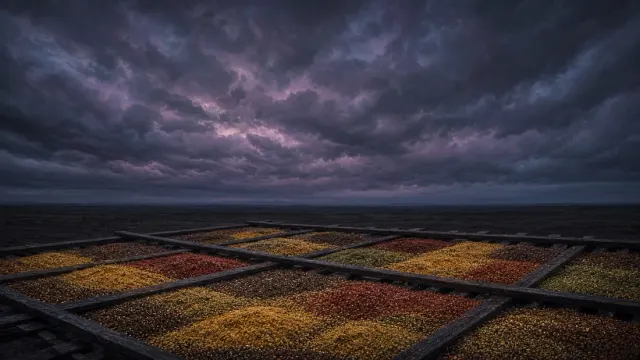
The enclosed garden begins with protection: a garden shut in, a spring closed, a fountain sealed. Yet the next movement refuses to let enclosure mean barrenness. Pomegranates, henna, spikenard, saffron, calamus, cinnamon, frankincense, myrrh, aloes, and other spices fill the space with almost excessive life. The Song Of Solomon does not ask each plant to carry a separate hidden code. Their accumulation creates abundance, fragrance, and richness inside what has been guarded. The water imagery develops in the same direction. A sealed fountain becomes living waters and streams from Lebanon, so privacy is paired with continuing vitality rather than stagnation. Then the woman speaks, and the image changes ownership within her invitation. She calls north and south winds over "my garden" so its spices may flow out, then says, "Let my beloved come into his garden." That shift matters because it is voiced by her. The garden becomes shared through welcome, not through description imposed on a silent person.
Deep dive
The enclosed garden, shut spring, and sealed fountain establish guarded intimacy. Yet enclosure is immediately followed by an exuberant list of fruit, flowers, and spices. The place is not empty because it is protected. Pomegranates, henna, spikenard, saffron, cinnamon, frankincense, myrrh, and aloes make the imagined garden almost extravagantly alive. No single emblem can carry the whole description, and assigning a separate hidden doctrine to every plant would miss the accumulation of scent and abundance.
The water images also develop. A sealed fountain becomes a well of living waters and streams from Lebanon, combining privacy with continuing life rather than stagnation. Then the woman speaks. She calls the winds over her garden and invites the beloved into his garden. That possessive change does not occur through his description alone; it occurs within her invitation. The bridal and bodily meaning of the garden is therefore relational, not merely a claim of ownership made over a silent person. The chapter’s last movement belongs to her voice, and the response at the beginning of chapter 5 will answer it directly.
Words to trace: garden, fountain, fruits, pleasant, spices, spikenard
Verse-by-verse path
- Song of Solomon 4:12
“Inclosed” is na’ul, bolted or locked. A well mouth was covered with a stone, as at Haran in Genesis 29:3, and a private spring could be sealed. Proverbs 5:15–18 uses the same waters for faithful marriage: “Drink waters out of thine own cistern... let thy fountain be blessed.”
- Song of Solomon 4:13
“Orchard” is pardes, the Persian word for a walled park that also appears in Ecclesiastes 2:5. “Plants” is shelachayikh, which may mean shoots or irrigation channels, since shelach is a water conduit. The garden has both.
- Song of Solomon 4:14
Saffron (karkom, found only here), calamus and cinnamon were imports; calamus and cinnamon are in the holy anointing oil of Exodus 30:23. “Aloes” is eaglewood, joined with myrrh in the royal wedding of Psalm 45:8. No real garden in Israel grew all of these; this one is made of the world’s treasures.
- Song of Solomon 4:15
“Living waters” is mayim chayyim, running spring water as opposed to still water in a cistern, the phrase of Jeremiah 2:13, “the fountain of living waters”. The streams from Lebanon are the snowmelt of Hermon, the springs that feed the Jordan.
- Song of Solomon 4:16
“Awake” is uri, from the same root as the refrain “stir not up, nor awake” (2:7, 3:5). The one who charged others not to wake love now wakes the winds herself. The north wind brings cool clear weather and the south brings warmth; she calls both.
Song of Solomon 4:12-16
King James Version12A garden inclosed is my sister, my spouse; a spring shut up, a fountain sealed.
13Thy plants are an orchard of pomegranates, with pleasant fruits; camphire, with spikenard,
14Spikenard and saffron; calamus and cinnamon, with all trees of frankincense; myrrh and aloes, with all the chief spices:
15A fountain of gardens, a well of living waters, and streams from Lebanon.
16Awake, O north wind; and come, thou south; blow upon my garden, that the spices thereof may flow out. Let my beloved come into his garden, and eat his pleasant fruits.
Questions to keep in mind while reading
- Follow the speaker, images, parallel lines, questions, and emotional movement.
- Notice where tension or suffering resists an easy answer.
- Read a saying as wisdom for faithful discernment, not as a mechanical promise detached from context.
Text first
Where readers differ
The chapter summary begins with what the passage says and how its parts fit together. It does not assume one denomination has already settled every question. Where a conclusion depends on a tradition, literary theory, or historical reconstruction, that dependence is named openly.
The KJV text is presented first. Interpretive conclusions are labeled, and differences are introduced only when they help a reader understand why serious communities do not always reach the same answer.
Comparative interpretive notes for this chapter are in preparation. Until reviewed notes are ready, this page separates the KJV text from summary and application without claiming that serious readers agree on every question.
Questions beneath the surface
- What account of God, human freedom, responsibility, and the good life emerges from Song of Solomon 4?
- Which tension does the chapter refuse to resolve quickly?
- What changes when the chapter is read as part of the whole canon rather than as an isolated moral lesson?
- Where might a sincere reader confuse a familiar tradition with something the text states directly?
Questions for serious personal contemplation
These open-ended questions make room for tension, honest response, prayer, and conclusions that remain accountable to the chapter.
Observe without rushing
What part of Song of Solomon 4 makes you stop, feel unsettled, or feel surprised, and why?
Which detail in the passage would be easiest to overlook? How does that detail change your understanding?
Where do you see tension between what happens and this focus: Song of Solomon 4 develops its own movement around spouse, fair, Lebanon, love, garden?
What important question does the passage leave open instead of resolving quickly?
Examine your inner life honestly
Which person, response, fear, or desire in the passage feels most like your own life right now?
What assumption about God, other people, or yourself does this text challenge?
Which part would you rather soften, avoid, or explain away too quickly? What might that reaction reveal?
If this Scripture could ask you one direct question, what do you think it would ask?
Respond with wisdom and courage
What do you need to remember, confess, grieve, thank God for, or trust after reading this passage?
How might another faithful person read this situation differently without ignoring the text?
What obedient response would be costly, uncomfortable, or slow, yet still faithful to Scripture?
What question will you carry into prayer this week, and which verses will you keep in front of you?
Music and video connected to the passage
Related media appears when its Scripture reference overlaps this study. Music and video can illuminate a theme while the biblical text remains the foundation.