The big picture
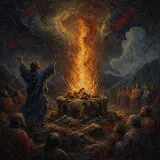
The return of rain is promised before Elijah appears before Ahab, so Carmel is not a device for forcing the drought to end. The chapter first shows the famine’s pressure through Ahab’s search for grass and Obadiah’s dangerous work of preserving the LORD’s prophets. When Ahab calls Elijah Israel’s troubler, Elijah turns the accusation back on the royal abandonment of the LORD. At Carmel, the people initially say nothing. Baal’s prophets cry, leap, and wound themselves for hours, but no voice answers. Elijah repairs a broken altar with twelve stones, drenches the offering, and prays briefly. Fire consumes not only the sacrifice but the wood, stones, dust, and water. The people finally speak: the LORD is God. Baal’s prophets are killed at Kishon. Only then does repeated watching toward the sea end with a hand-sized cloud, darkened skies, and great rain.
Central truth
At Carmel, the Lord answers Elijah by consuming the drenched offering and turns the people's confession toward himself before sending the promised rain.

The study notes have a page of their own
The movement by movement analysis, the words to trace, the verse by verse notes and where readers differ are written for someone studying alone. They are on the Deep Personal Reflections page for this chapter. This page is the lesson.
A chapter-specific teaching brief
These anchors come from this chapter itself. They help a teacher use the Level 1 overview, the Level 2 study, and the Scripture text as one lesson.
Open with the chapter’s first image
1 Kings 18:1: “And it came to pass after many days, that the word of the LORD came to Elijah in the third year, saying, Go, shew thyself unto Ahab; and I will send rain…”
Slow down at the turning point
1 Kings 18:22: “Then said Elijah unto the people, I, even I only, remain a prophet of the LORD; but Baal’s prophets are four hundred and fifty men.”
Keep this word trail visible
LORD, Elijah, Ahab, prophets, people, Israel
What to explain, in order
Teach the passage in this order. Each step names the verses it rests on, so every point can be shown in the text before it is applied.
1 Kings 18:1-16
The promise, and a faithful man in a hard place
Begin with 18:1: God has already promised rain. Everything that follows happens inside that promise. Then introduce Obadiah, steward of Ahab's house, who fears the LORD and has hidden a hundred prophets. Read his frightened conversation with Elijah, and let the class feel his danger. Explain that Jezebel's killing of prophets is mentioned without detail; keep it that way. Teach this first so that learners see faithful people already at work, and so that Elijah's later sense of being alone is heard against the facts.
1 Kings 18:17-24
Who is the troubler, and how long will you limp
Read the meeting of king and prophet, and Elijah's reply in 18:18. Then the gathering on Carmel and Elijah's question in 18:21: "How long halt ye between two opinions?" Explain halt as to limp, as if hopping between two branches. Point out the silence of the people. Then explain the terms of the test, "the God that answereth by fire, let him be God". Baal was the storm god, believed to hurl lightning; the test is on his own ground. Teach this as the heart of the challenge before the action begins.
1 Kings 18:25-29
No voice, no answer
Read the prophets' long day of calling. Explain that they "leaped upon the altar", a ritual dance, and that their self-cutting was part of their worship (Leviticus 19:28 forbade it in Israel). Mention it in a sentence, without lingering. Read Elijah's mockery in 18:27 and explain its edge: he is exposing the emptiness of the idol, not laughing at the people's pain. Then read the threefold silence of 18:29. Teach this step so the contrast is complete before Elijah's altar is built: a whole day of effort and no one listening.
1 Kings 18:30-39
Twelve stones, water and fire
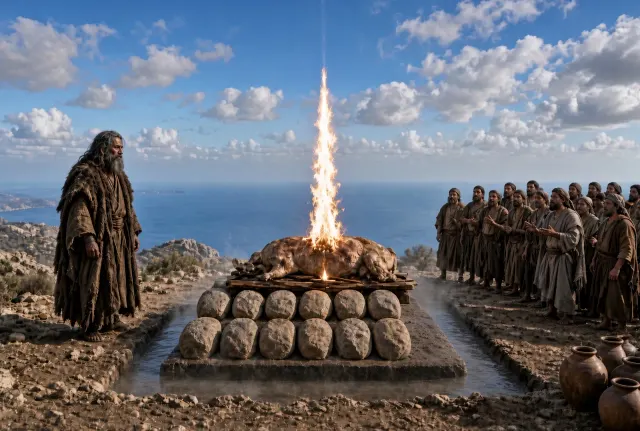
Elijah draws the people near and repairs the broken altar of the LORD. Explain the twelve stones as a claim on all Israel, north and south. Then the water poured three times and the trench filled. Read his short, quiet prayer in 18:36-37 aloud and contrast it with the long cries of the morning. Then 18:38, fire that consumes the sacrifice, wood, stones, dust and water. End with the people on their faces crying "The LORD, he is the God". This is the climax of the unit, so let it be read without commentary first.
1 Kings 18:40
The prophets of Baal at the Kishon
Read this verse plainly and do not hurry past it or dramatise it. Explain that the Law of Moses required death for prophets who led Israel to other gods (Deuteronomy 13:1-5), and that Elijah acts within Israel's covenant law at a moment of national judgment. Make clear that this is not an example for believers today. Jesus rebuked his disciples when they wanted to call fire down on a village (Luke 9:54-55). Teach this here, in its own step, so the class can ask its questions honestly and the lesson does not gloss over violence.
1 Kings 18:41-46
A cloud like a man's hand
Finish with rain. Elijah tells Ahab to eat and drink, then goes to pray, bowing low. Read the seven trips of the servant and the little cloud. Explain that the promise of 18:1 is being fulfilled, and that Elijah prays for what God has already said he will do. Read James 5:17-18. Then the storm, Ahab's chariot and Elijah running ahead to Jezreel under "the hand of the LORD". Teach this last because the chapter's real answer to Baal is not only fire but rain: the LORD alone sends it.
Where learners get stuck
The misreadings this passage tends to produce, and how to answer each from the text.
"Elijah was the only faithful person left in Israel."
Elijah says "I, even I only, remain a prophet of the LORD" (18:22), but the chapter has already told us about Obadiah and the hundred prophets he hid (18:4, 13). In 19:18 God will speak of seven thousand who have not bowed to Baal. Elijah's sense of isolation was real but not accurate. Use this to encourage learners who feel alone in their faith: God usually has more people than we can see.
"Elijah's mockery means it is fine to ridicule people of other religions."
Elijah's taunt in 18:27 exposes a false god at a moment of public decision for Israel. It is aimed at the idol's emptiness. Scripture elsewhere calls believers to give an answer "with meekness and fear" (1 Peter 3:15) and to speak with grace. The passage shows the LORD's supremacy over idols; it does not license contempt for our neighbours, and the lesson should model respect.
"Christians today should deal with false teachers the way Elijah did at the Kishon."
Verse 40 belongs to Israel's covenant law for a nation under God's direct rule, where Deuteronomy 13 required death for those who led the people to other gods. The New Testament never gives the church that sword. Jesus rebukes the wish to call down fire (Luke 9:54-55), and Paul says our weapons are not carnal (2 Corinthians 10:4). Teach this plainly, especially to youth.
"If we pray seven times, God has to answer."
God had promised rain in 18:1 before Elijah ever prayed. Elijah's persistence was faith in a promise already given, not a method that forces God's hand. Seven is a number of completeness, and the servant's report of nothing six times shows real waiting. James 5:17-18 commends earnest prayer. Encourage persistence, and do not attach a number or a guarantee to it.
Learning objectives
- Identify Obadiah's hidden service to endangered prophets.
- Explain the dispute over who troubles Israel.
- Trace the contrast between unanswered cries and Elijah's prayer.
- Identify the twelve stones and repeated drenching.
- State the purpose Elijah gives for the sign.
- Connect the small cloud with the promised rain.
Teacher preparation
- Read 18:1 before the contest; establish that God promises rain before Elijah gathers the people.
- Locate Carmel, Kishon, and Jezreel without inventing the unreported source of the water.
- Distinguish the 450 Baal prophets from the 400 grove prophets requested in 18:19; do not total every later action as 850.
- Explain 'halt' as waver or limp between alternatives and 'dress' the bullock as prepare it.
- Plan non-graphic treatment of self-injury and execution; use no fire experiments, blades, or violent reenactments.
Evidence and interpretation checks
Explicit
Read 18:36–38: Elijah says he acts at God's word and asks that the people know the Lord, who answers with consuming fire.
Scripture-supported
Compare the promised rain in 18:1 with its arrival in 18:45 and James 5:18; prayer and God's prior word belong together.
Strong inference
Infer a claim about the whole covenant people from the twelve stones in 18:31, despite the politically divided kingdom.
Possible or traditional reading
Read Elijah's 'I only' in 18:22 as possibly identifying his solitary public position at Carmel; 18:4 already records a hundred other prophets preserved.
Limit
Do not convert 18:40 into authority for present violence, or 18:24 into permission to demand miraculous tests whenever someone disputes a belief.
Discussion with answer guidance
1. What does Obadiah's care reveal before Elijah claims to stand alone?
What a good answer contains
Obadiah "feared the LORD greatly" (18:3), and when Jezebel was killing the prophets of the LORD he "took an hundred prophets, and hid them by fifty in a cave, and fed them with bread and water" (18:4). He reminds Elijah of it himself in 18:13. So when Elijah says "I, even I only, remain a prophet of the LORD" (18:22), the reader already knows a hundred others are alive. A good answer gives Obadiah credit for quiet, dangerous faithfulness inside Ahab's house. A weak answer writes him off as a compromiser because he works for the king.
Show teacher guidance
Use 18:3–4, 12–13: he fears the Lord and feeds hidden prophets. Correct portrayals that equate his dangerous court position with simple unbelief.
2. Why does Elijah reject Ahab's label of troublemaker?
What a good answer contains
Ahab calls him "he that troubleth Israel" (18:17). Elijah answers "I have not troubled Israel; but thou, and thy father's house, in that ye have forsaken the commandments of the LORD, and thou hast followed Baalim" (18:18). The drought is the consequence; the cause is the king's apostasy. A good answer sees that the one who names the problem is not the one who made it. A weak answer agrees with Ahab that the prophet who announced the drought is responsible for it.
Show teacher guidance
Read 18:17–18: he locates Israel's trouble in forsaken commandments and Baal worship. Distinguish announcing a consequence from causing the underlying unfaithfulness.
3. How does the chapter make Baal's silence unmistakable?
What a good answer contains
The text repeats the silence three ways. From morning to noon they cry "O Baal, hear us. But there was no voice, nor any that answered" (18:26). Elijah mocks them at noon, they cry louder and cut themselves (18:27-28), and by evening "there was neither voice, nor any to answer, nor any that regarded" (18:29). A good answer notices the growing effort and the unchanging silence. A weak answer enjoys the mockery too much and turns it into scorn for people of other faiths today, which the lesson must avoid.
Show teacher guidance
Trace 18:26–29: repeated cries, escalating activity, and repeated absence of response. Let the textual irony work without encouraging ridicule of neighbours.
4. Why count twelve stones and repeat the water three times?
What a good answer contains
Elijah takes "twelve stones, according to the number of the tribes of the sons of Jacob" (18:31), rebuilding the broken altar of the LORD for all Israel, though the kingdom is divided. Then he has four barrels of water poured three times, until "the water ran round about the altar; and he filled the trench also with water" (18:35). A good answer says the stones claim the whole people for the LORD and the water removes any doubt about trickery. A weak answer invents a meaning for each barrel the text does not give.
Show teacher guidance
Use 18:31–35. The stones name Israel's tribes; the water leaves the offering thoroughly drenched. Avoid invented symbolism for each barrel.
5. What does Elijah want the people to know when fire falls?
What a good answer contains
His prayer states it: "let it be known this day that thou art God in Israel, and that I am thy servant, and that I have done all these things at thy word" (18:36), and "that this people may know that thou art the LORD God, and that thou hast turned their heart back again" (18:37). The people answer "The LORD, he is the God" (18:39). A good answer names three things to know: who God is, who his servant is, and that God turns hearts. A weak answer makes the fire a display of Elijah's power.
Show teacher guidance
Read 18:36–39: the Lord is God, Elijah is his servant, and hearts are turned back. The goal is not the prophet's entertainment value.
6. How do the seven searches and small cloud complete the opening promise?
What a good answer contains
God promised rain in 18:1: "I will send rain upon the earth". Elijah prays on Carmel with his face between his knees and sends his servant seven times. The first six bring "There is nothing" (18:43); at the seventh "there ariseth a little cloud out of the sea, like a man's hand" (18:44), and then "there was a great rain" (18:45). A good answer links the persistent prayer to the promise already given, as James 5:17-18 does. A weak answer makes seven a formula for getting prayers answered.
Show teacher guidance
Follow 18:1, 41–46. Rain begins after repeated looking; the small cloud precedes a darkened sky and heavy rain, not a promised timetable for every prayer.
Responsible application
Heart and habits
Ask learners to distinguish noisy effort from attention to God's word, using the two prayers rather than ranking people's worship styles.
Relationships and community
Have groups identify quiet protective service in Obadiah's actions and propose a safe, nonviolent parallel in an invented community.
Conviction without coercion
Ask the class to explain why reading this ancient judgment does not authorize threatening, humiliating, or harming people with different beliefs.
Session plans
Two timings of the same lesson. The shorter keeps the reading, the central discussion and one response; the longer gives the confusions and the application their own time.
45 minutes
The promise first
Read 18:1-2 and say that God has already promised rain.
Obadiah
Read 18:3-16 in summary and take question one and confusion one.
Troubler and limping
Read 18:17-24 and take question two. Ask the class what halting between two opinions looks like.
Silence
Read 18:25-29 and take question three, then confusion two.
Fire
Read 18:30-39 and take questions four and five. Read 18:40 and confusion three in plain words.
Rain
Read 18:41-46 and take question six with confusion four, then read the key verse.
90 minutes
Limping between two
Ask what it looks like to want two things that cannot both be had. Then read 18:21.
Obadiah in Ahab's house
Read 18:1-16 and take question one and confusion one.
The troubler of Israel
Read 18:17-24 and take question two. Explain Baal as the storm god and the terms of the test.
A day of calling
Read 18:25-29 and take question three and confusion two, with 1 Peter 3:15.
Twelve stones and fire
Read 18:30-39 and take questions four and five. Compare the length of the two prayers.
The Kishon
Read 18:40 and work through confusion three with Deuteronomy 13:1-5, Luke 9:54-55 and 2 Corinthians 10:4.
The little cloud
Read 18:41-46 and James 5:17-18. Take question six and confusion four.
Handout and prayer
Read the key verse together and pray for undivided hearts.
Adapting the lesson
Children
Tell children that God promised rain at the very beginning. Act out the contest with two altars made of blocks, but no real fire and no knives. Let children call out to a pretend god and hear nothing, then pray quietly together and say God hears. Show the little cloud with a hand shape. Mention the end of the prophets of Baal in one sentence, saying they were punished for leading Israel away from God.
Youth
Read 18:21 and ask youth where they see people limping between two opinions. Let them talk about what they are tempted to trust besides God. Spend real time on 18:40 and confusion three, because youth will ask about it; make clear that the church does not use violence against those who disagree. Use Obadiah to encourage those who live out quiet faith in difficult places.
Adults
Adults can explore the contest as a challenge to Baal on his own terms, fire and rain. Discuss Obadiah's position in a hostile court. Give 18:40 its own time and connect it with Deuteronomy 13, Luke 9:54-55 and 2 Corinthians 10:4, so the group sees how the covenant setting differs from the church's calling. Avoid applying Carmel to modern nations or political conflicts.
One to one
Read 18:21 together and ask the person honestly whether they are halting between two opinions. Listen. If they feel alone in their faith, read 18:4 and 19:18. If they have been praying a long time for something God has promised, read 18:43-44 and pray together, with no promise about timing.
Song and video learning lab
A song or video may interpret, compress, or dramatize the text. Its value becomes clearer when its choices are compared with Scripture.
- Before the media: the exact passage and its central movement.
- During the media: the words, people, events, and emotions the artist emphasizes.
- After the media: what it clarifies, what it leaves out, and what belongs back in the biblical text.
Handout
One page for learners to take home. The print button prints this section alone.
1 Kings 18:1–46
The passage in brief
In the third year of drought, God sends Elijah back to Ahab and promises rain. Ahab's steward Obadiah, who secretly protected a hundred prophets, brings the king to Elijah. On Mount Carmel, Elijah challenges the people to stop wavering between the LORD and Baal. The prophets of Baal call all day with no answer. Elijah rebuilds the LORD's altar with twelve stones, soaks it with water and prays, and fire falls. The people cry that the LORD is God. Then Elijah prays and the rain comes.
A verse to keep
And Elijah came unto all the people, and said, How long halt ye between two opinions? if the LORD be God, follow him: but if Baal, then follow him. And the people answered him not a word.
1 Kings 18:21 · King James Version
Questions to take home
What did Obadiah do for the prophets of the LORD in 18:4?
What question did Elijah ask the people in 18:21, and how did they answer?
What did the people say when the fire fell in 18:39?
This week
Name one thing you are trying to trust alongside God, and give it to him in prayer this week.
Music and video connected to the passage
Related media appears when its Scripture reference overlaps this study. Music and video can illuminate a theme while the biblical text remains the foundation.