The big picture
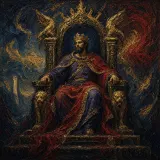
David dies after charging Solomon to keep the law of Moses and to deal with several obligations his reign leaves unfinished. That mixture sets the tone for a chapter where covenant language, personal memory, political consolidation, and bloodshed repeatedly overlap. Adonijah’s request for Abishag is interpreted by Solomon as a renewed claim to the throne and ends in his death. Abiathar is judged worthy of death but spared because of his service to David, while his removal from the priesthood is explicitly tied to the older judgment on Eli’s house. Joab seeks refuge at the altar, yet Solomon orders his execution for the killings of Abner and Amasa, then gives the army to Benaiah and the priesthood to Zadok. Shimei receives a clear restriction, keeps it for three years, and dies after knowingly leaving Jerusalem. The chapter begins and ends by calling Solomon’s kingdom established, but it refuses to make that establishment look clean or automatic. It is built through obedience demanded, loyalties remembered, conditions imposed, offices reassigned, and old accounts finally settled.
Central truth
The Book of 1 Kings establishes Solomon's throne through David's public authorization and the removal of rival claimants, while placing royal power under covenant responsibility.

The study notes have a page of their own
The movement by movement analysis, the words to trace, the verse by verse notes and where readers differ are written for someone studying alone. They are on the Deep Personal Reflections page for this chapter. This page is the lesson.
A chapter-specific teaching brief
These anchors come from this chapter itself. They help a teacher use the Level 1 overview, the Level 2 study, and the Scripture text as one lesson.
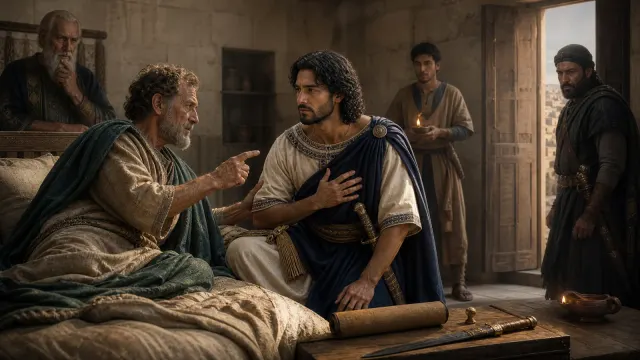
Open with the chapter’s first image
1 Kings 2:1: “Now the days of David drew nigh that he should die; and he charged Solomon his son, saying,”
Slow down at the turning point
1 Kings 2:23: “Then king Solomon sware by the LORD, saying, God do so to me, and more also, if Adonijah have not spoken this word against his own life.”
Keep this word trail visible
king, LORD, Solomon, David, Shimei, Joab
What to explain, in order
Teach the passage in this order. Each step names the verses it rests on, so every point can be shown in the text before it is applied.
1 Kings 1:1-10
An old king and a self-made one
Begin with the weakness of 1:1-4, read plainly: the king who killed Goliath cannot keep warm. Then put 1:5 beside it: Adonijah "exalted himself, saying, I will be king". Explain that the verb is the whole problem; nobody appoints him. Note 1:6, that his father had never crossed him, and let the class connect it with Absalom without building a theory. Close the step with the two lists of 1:7-10, supporters and absentees. This comes first because every later scene answers the question these verses raise: who has the right to say who reigns.
1 Kings 1:11-31
Nathan and Bathsheba remind the king
Walk through the plan in the order it is carried out. Nathan tells Bathsheba her life and her son's life are at risk (1:12); she goes in and reminds David of his oath; Nathan arrives and confirms her words. Explain "counted offenders" in 1:21 as being treated as traitors once a rival holds the throne. Point out that both speakers press the same fact, that David has not spoken while someone else acts. Teach this step before the anointing so learners hear that the decision rests on David's sworn word "by the LORD God of Israel" (1:30), not on a clever palace plot.
1 Kings 1:32-53
The mule, the trumpet and an emptied feast
Read David's instructions in 1:33-35 and then their exact fulfilment in 1:38-40, so the class sees the order carried out item by item. Explain Gihon as a spring close to the city and the mule as the king's own mount, lent as a sign. The noise of 1:40, so that "the earth rent with the sound of them", carries into Adonijah's feast, and Jonathan's report empties it. End with Adonijah holding the horns of the altar and Solomon's conditional mercy in 1:52-53. This is the hinge of the unit: authority is now public and settled.
1 Kings 2:1-12
The charge before the instructions
Slow down here. David's last words begin with "be thou strong therefore, and shew thyself a man" and go straight to the law of Moses (2:2-3). Explain that 2:4 repeats God's promise from 2 Samuel 7 with its condition stated: the throne continues as David's sons walk "in truth with all their heart". Then read 2:5-9 honestly; David names Joab, Barzillai's family and Shimei. Do not soften the instructions and do not admire them. Teach the charge first because it is the measure the Book of 1 Kings will hold over every king that follows, beginning with Solomon in 11:4.
1 Kings 2:13-25
A small petition with a large meaning
Read the conversation slowly: Bathsheba asks whether Adonijah comes peaceably, he admits the kingdom was turned from him "for it was his from the LORD" (2:15), and then asks for Abishag. Note the honour Solomon shows his mother, rising and setting a seat at his right hand (2:19), before the request is even heard. Explain why a dead king's attendant could signal a claim, using 2 Samuel 16:21-22. Then read 2:22-25 without dramatising Benaiah's act. Keep the teaching on what Solomon says he hears in the request, and be clear that Abishag's own view is never given.
1 Kings 2:26-46
Four outcomes, one established kingdom
Take the remaining cases one at a time. Abiathar is removed to Anathoth, and 2:27 links that to the word spoken over the house of Eli (1 Samuel 2:31-35). Joab clings to the altar, and Exodus 21:14 shows why the altar does not shelter deliberate murder. Shimei agrees to stay in Jerusalem, breaks the terms after three years and is held to his oath. Close on the refrain of 2:46, "the kingdom was established in the hand of Solomon". Teach these last and briefly, because they are reported decisions of a king, not instructions for the class.
Where learners get stuck
The misreadings this passage tends to produce, and how to answer each from the text.
"Adonijah was the oldest surviving son, so the throne was rightfully his."
Solomon himself calls Adonijah "mine elder brother" in 2:22, so age is not in dispute. But the Book of 1 Kings never treats age as the deciding claim. David swore that Solomon would reign (1:13, 17, 30), and Adonijah admits in 2:15 that the kingdom "was his from the LORD". Show the class that Israel's throne passes by the king's appointment under God's promise, which is exactly why 1:5 is phrased as self-exaltation.
"Bathsheba and Nathan manipulated a confused old man."
The text gives no hint that David's mind has gone; it says his body is cold. When he hears the two reports, he remembers his oath clearly and acts at once (1:29-30), naming the people, the place and the order of the ceremony. Nathan and Bathsheba do plan their approach, and the class may notice that, but they remind David of something he had sworn. Let the text set the limit: careful advocacy is not the same thing as deceit.
"Holding the horns of the altar should have saved Joab."
Read Exodus 21:14: a man who kills his neighbour deliberately is to be taken even from God's altar. Solomon's reason in 2:31-32 is the innocent blood of Abner and Amasa, "two men more righteous and better than he". The altar was a place of refuge for the person whose guilt was uncertain or accidental, not a shield for known bloodshed. Teach this calmly and without graphic detail; the point is that holy furniture does not cancel accountability.
"Solomon's executions show that God approves of ruthless leaders."
The Book of 1 Kings reports these decisions and the reasons Solomon gives, but it does not hold them up as a model for anyone listening. The measure it sets over the king is the charge of 2:3-4, and the same book will judge Solomon severely in chapter 11. Keep apart what a king did in a dynastic crisis and what disciples are called to do. Never let these chapters become a warrant for revenge in a family or a church.
Learning objectives
- Distinguish Adonijah's claim from David's authorization.
- Explain the significance of David's mule.
- Trace Nathan and Bathsheba's coordinated intervention.
- Identify David's covenant charge to Solomon.
- Compare the treatment of Solomon's opponents.
- Separate reported royal judgments from commands for believers.
Teacher preparation
- Read both chapters; mark the transition from public anointing to consolidation of power.
- List Adonijah's supporters and the people excluded from his feast in 1:7–10.
- Explain altar horns using Exodus 21:14; sanctuary does not automatically cancel accountability.
- Read 2 Samuel 16:21–22 before discussing the political implications of Abishag's requested marriage.
- Prepare non-graphic explanations of executions; do not stage violence or romanticize palace politics.
Evidence and interpretation checks
Explicit
Anchor Solomon's authorization in David's commands about the mule, anointing, trumpet, and throne in 1:32–35, not merely popular enthusiasm.
Scripture-supported
Compare Joab's appeal to the altar in 2:28–34 with Exodus 21:14; intentional bloodshed is not sheltered by sacred furniture.
Strong inference
Infer calculated rivalry from Adonijah's selective invitations in 1:9–10 and his later request in 2:13–22; identify the inference as such.
Possible or traditional reading
Present Abishag's marriage as a possible renewed throne claim; Solomon reads it that way in 2:22, but Adonijah's private intention remains unstated.
Limit
Do not claim every execution receives an independent divine command; 2:25–46 reports Solomon's decisions and stated reasons without making them classroom precedents.
Discussion with answer guidance
1. Who is missing from Adonijah's feast, and why does that matter?
What a good answer contains
Read the guest list of 1:9 against the list of the absent in 1:8 and 1:10. Adonijah calls "all his brethren the king's sons" and the men of Judah, with Joab and Abiathar, but "Nathan the prophet, and Benaiah, and the mighty men, and Solomon his brother, he called not." The missing names are the prophet, the commander of the guard and the brother with a known claim. A good answer sees that the invitations draw a line around a faction; a weak answer calls it a family barbecue that happened to be badly timed.
Show teacher guidance
Use 1:7–10: Nathan, Benaiah, the mighty men, and Solomon are excluded. Correct answers that describe an ordinary family celebration.
2. What makes the mule procession more than a competing parade?
What a good answer contains
The order comes from David himself: "cause Solomon my son to ride upon mine own mule" (1:33), with anointing by priest and prophet, the trumpet, and the plain sentence "I have appointed him to be ruler over Israel and over Judah" (1:35). Adonijah has chariots, runners and a feast; Solomon has the king's own animal and the king's word. A strong answer names the mule as a public sign of transferred authority. A weak one treats the two events as rival parties decided by which one was louder.
Show teacher guidance
Point to David's own mule and explicit appointment in 1:33–35. The louder party does not create the rightful succession.
3. How does Jonathan's report overturn Adonijah's expectation of good news?
What a good answer contains
Adonijah greets Jonathan with "thou art a valiant man, and bringest good tidings" (1:42), and the reply undoes him line by line: David has made Solomon king, the priest and prophet have anointed him, "Solomon sitteth on the throne of the kingdom" (1:46), and the old king has bowed in worship on his bed. Then the guests "were afraid, and rose up, and went every man his way" (1:49). Good answers notice that the report gets worse with every "and also"; the humour is in the pile-up, not in any joke the teacher adds.
Show teacher guidance
Follow 1:42–49 from anticipated reassurance to Solomon enthroned and guests scattering. Let the abrupt reversal supply its own dry humor.
4. What charge precedes David's instructions about particular men?
What a good answer contains
Before any name is mentioned David says "keep the charge of the LORD thy God, to walk in his ways" (2:3), tying the throne's future to the promise of 2:4 that a man will not fail on the throne if his sons "take heed to their way". Only after that come Joab, Barzillai's sons and Shimei in 2:5-9. A good answer keeps the order and lets the charge govern how the rest is heard. A weak answer summarises David's last words as a list of scores to settle and leaves out the law of Moses altogether.
Show teacher guidance
Read 2:2–4 before 2:5–9. Expect obedience to the law of Moses; do not reduce David's final words to settling scores.
5. Why does Solomon react so strongly to the request for Abishag?
What a good answer contains
Adonijah has just said "the kingdom was mine, and that all Israel set their faces on me" (2:15), and now he asks for the young woman who attended the late king. Solomon hears the request as a claim: "ask for him the kingdom also; for he is mine elder brother" (2:22). Background in 2 Samuel 16:21-22 helps explain why a king's household mattered politically. A careful answer says this is Solomon's reading of the request and notes that Abishag is never asked what she wants; the text records nothing about her wishes.
Show teacher guidance
Read 2:22 with Adonijah's earlier claim in 2:15. Distinguish Solomon's political interpretation from information about Abishag's wishes, which is absent.
6. How do Adonijah, Abiathar, Joab, and Shimei receive different treatment?
What a good answer contains
They are four different cases. Adonijah is first spared on condition, "If he will shew himself a worthy man" (1:52), and later put to death after the request (2:25). Abiathar is spared death for his service with the ark and removed from the priesthood (2:26-27). Joab dies for "the innocent blood, which Joab shed" against Abner and Amasa (2:31-32). Shimei is confined to Jerusalem under an oath, leaves for Gath and dies for breaking it (2:36-46). A good answer keeps the distinctions; a weak one says Solomon simply killed his enemies.
Show teacher guidance
Compare 1:52–53; 2:25–27, 31–34, 36–46. Identify initial mercy, removal, bloodguilt, and a broken restriction rather than flattening every case.
Responsible application
Heart and habits
Ask the class to contrast Adonijah's self-appointment with accountable authorization; use an invented leadership transition, not personal grievances.
Relationships and community
Have groups propose ways to protect vulnerable people during a leadership change, beginning with Bathsheba's concern in 1:21.
Power under a charge
Ask learners to explain why 2:3–4 belongs above, not beneath, a king's practical agenda.
Session plans
Two timings of the same lesson. The shorter keeps the reading, the central discussion and one response; the longer gives the confusions and the application their own time.
45 minutes
Two claims to the throne
Read 1:5 and 1:35 aloud, one after the other. Ask who speaks in each verse and write self-exalted and appointed on the board.
The feast and the visit
Read 1:7-10 and 1:11-21. Take question one, then confusion two, and mark who goes in to David and in what order.
The mule and the noise
Read 1:32-49. Take questions two and three together, and let the class hear how Jonathan's report builds before the guests scatter.
The charge first
Read 2:1-4. Take question four and then confusion one, using 2:15 to let Adonijah answer it himself.
Four outcomes
Read 2:22-25 and 2:46. Use question six as a quick four-column table, and address confusion four in a sentence before moving on.
Handout
Read the key verse together and point to the take-home line.
90 minutes
Who has the right
Ask the group how a leader should be chosen when the old one is failing. Keep the answers visible, then read 1:1-6 and 1:5.
Supporters and absentees
Read 1:7-10 and take question one. Draw two columns of names and ask what the absent people have in common.
The reminder
Read 1:11-31. Work through confusion two, and have the class find each place where the oath is quoted.
Gihon and the emptied feast
Read 1:32-53. Take questions two and three, and explain the mule, Gihon and the horns of the altar.
The charge and its condition
Read 2:1-12 with 2 Samuel 7:12-16. Take question four and confusion one, and hold the condition of 2:4 next to 11:4.
Abishag and the four cases
Read 2:13-46 in sections. Take questions five and six, then confusion three with Exodus 21:14, and confusion four last.
Application
Use the application on protecting vulnerable people during a change, starting from Bathsheba's fear in 1:21.
Handout and prayer
Read the key verse together and pray for leaders who will keep the charge of the LORD.
Adapting the lesson
Children
Use a paper crown and name cards. Let one child pick up the crown himself and say I will be king, then show that David's word is what decides, by giving the crown to Solomon with the mule and the trumpet. Children enjoy the noise of 1:40 and the guests slipping away. Summarise the deaths in chapter 2 in one sentence, without acting anything out, and keep the lesson on who rightly decides.
Youth
Start with the guest list. Ask what you can tell about a plan from who is not invited, then read 1:9-10. Youth are quick to see image management, so let them compare Adonijah's chariots and runners with the borrowed mule. Give real time to 2:2-3, a father telling his son what being a man means, and handle the executions as reported history with questions, not as a thriller. Leave room for those whose own families are in conflict.
Adults
Adults can carry the political detail and the moral questions together. Give them 2 Samuel 7:12-16 and 16:21-22 beside these chapters, and let them sort what David commands, what Solomon decides and what God promises. The executions will trouble some; let that discomfort stand rather than explaining it away, and point to the book's own measure in 2:3-4 and its later verdict on Solomon. Keep any comparison with present leaders general and avoid naming parties or offices.
One to one
Read 1:5 and 1:35 together and ask which kind of authority the person would rather live under. Then read David's charge in 2:2-3 slowly and ask what keeping the charge of the LORD would look like in their present responsibilities. If they are walking through a family succession, a church transition or a workplace change, listen before teaching, and do not use Joab or Shimei as stand-ins for anyone they know.
Song and video learning lab
A song or video may interpret, compress, or dramatize the text. Its value becomes clearer when its choices are compared with Scripture.
- Before the media: the exact passage and its central movement.
- During the media: the words, people, events, and emotions the artist emphasizes.
- After the media: what it clarifies, what it leaves out, and what belongs back in the biblical text.
Handout
One page for learners to take home. The print button prints this section alone.
1 Kings 1:1–2:46
The passage in brief
1 Kings opens with King David old and weak. His son Adonijah declares himself king and throws a feast, leaving out the prophet Nathan, the guard and his brother Solomon. Nathan and Bathsheba remind David of his oath, and David has Solomon anointed and seated on his throne. Before he dies, David charges Solomon to keep God's law. Solomon then deals with Adonijah, Abiathar, Joab and Shimei, and the kingdom is established in his hand.
A verse to keep
And keep the charge of the LORD thy God, to walk in his ways, to keep his statutes, and his commandments, and his judgments, and his testimonies, as it is written in the law of Moses, that thou mayest prosper in all that thou doest, and whithersoever thou turnest thyself:
1 Kings 2:3 · King James Version
Questions to take home
Who did Adonijah leave off his guest list in 1:10, and what does that tell you?
What did David give Solomon in 1:33-35 that Adonijah never had?
What does David put first in his last words to Solomon in 2:2-4?
This week
Before you take up any responsibility this week, read 2:3 and ask what keeping the charge of the LORD looks like there.
Music and video connected to the passage
Related media appears when its Scripture reference overlaps this study. Music and video can illuminate a theme while the biblical text remains the foundation.