The big picture
For forty days Goliath has taught both armies to read the valley his way: one enormous champion, one mountain of bronze, one bargain that turns a national battle into a single contest. David arrives carrying bread and cheese, hears exactly the words everyone else has heard, and assigns them a different meaning. Where the soldiers see a terrifying man and a royal reward, David hears defiance of "the armies of the living God." His confidence is not detached from experience. He argues from the lion and bear, rejects armour he has never tested, and walks out with tools he actually knows. The Book of 1 Samuel spends far more time on the speeches than on the strike itself, because the speeches explain what the brief combat is supposed to mean. One stone ends the champion's advance, Goliath's own sword completes his defeat, and the frightened army becomes a pursuing one. The chapter closes not with David announcing his anointing, but with Saul asking whose son the young victor is.
Central truth
David confronts the champion who defies Israel's God, and his victory turns a frightened army into pursuers while declaring that the battle belongs to the Lord.

The study notes have a page of their own
The movement by movement analysis, the words to trace, the verse by verse notes and where readers differ are written for someone studying alone. They are on the Deep Personal Reflections page for this chapter. This page is the lesson.
A chapter-specific teaching brief
These anchors come from this chapter itself. They help a teacher use the Level 1 overview, the Level 2 study, and the Scripture text as one lesson.
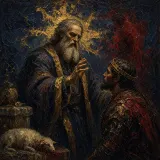
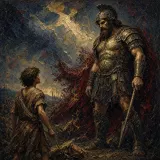
Open with the chapter’s first image
1 Samuel 17:1: “Now the Philistines gathered together their armies to battle, and were gathered together at Shochoh, which belongeth to Judah, and pitched between Shochoh…”
Slow down at the turning point
1 Samuel 17:29: “And David said, What have I now done? Is there not a cause?”
Keep this word trail visible
David, Philistine, Saul, Israel, Philistines, battle
What to explain, in order
Teach the passage in this order. Each step names the verses it rests on, so every point can be shown in the text before it is applied.
1 Samuel 17:1-11
The champion in the valley
Set the scene: two armies on two hills with the valley of Elah between them. Describe Goliath briefly, using the King James measurements without pretending to give an exact modern height. Explain "champion" as the man who fights between the lines, and "target of brass" as a javelin or small shield carried on the back. Then read his challenge and its terms. End on 17:11: Saul and all Israel "were dismayed, and greatly afraid". Teach this first so learners feel the forty days of fear before David arrives. Saul, the tall king, is the obvious man to fight, and he does not.
1 Samuel 17:12-30
A shepherd with cheeses
Introduce David again as Jesse's youngest, still going back and forth to the sheep. Jesse sends him with grain, loaves and cheeses for his brothers and their captain. Explain "carriage" as baggage. David arrives as the armies form up, hears Goliath, and asks what will be done for the man who kills him. Then Eliab's anger: "I know thy pride, and the naughtiness of thine heart" (17:28). Teach this step to show that David comes on an errand, that he speaks of the living God, and that his own brother misjudges him, as Samuel nearly misjudged in 16:6.
1 Samuel 17:31-40
The lion, the bear and the armour
Saul sends for David and says he is only a youth. David answers with the lion and the bear and draws the conclusion of 17:37. Saul blesses him and dresses him in his own armour, which David removes. Then he chooses "five smooth stones out of the brook" and his sling. Explain that a sling was a serious weapon in skilled hands (Judges 20:16), not a toy. Teach this step to show David going with what God has trained him to use, and not to make the five stones symbolic, since the text gives no reason for the number.
1 Samuel 17:41-47
In the name of the LORD of hosts
Read the exchange of words. Goliath disdains David, curses him by his gods and threatens to feed him to the birds. David answers with the centre of the chapter, 17:45-47. Point out his contrasts: sword, spear and shield against "the name of the LORD of hosts". Then his purpose: that all the earth may know there is a God in Israel, and Israel may know the LORD does not save by weapons. Teach this step as the theological heart of the chapter, and connect it to Jonathan's words in 14:6 and Hannah's in 2:9.
1 Samuel 17:48-54
A stone and a fleeing army
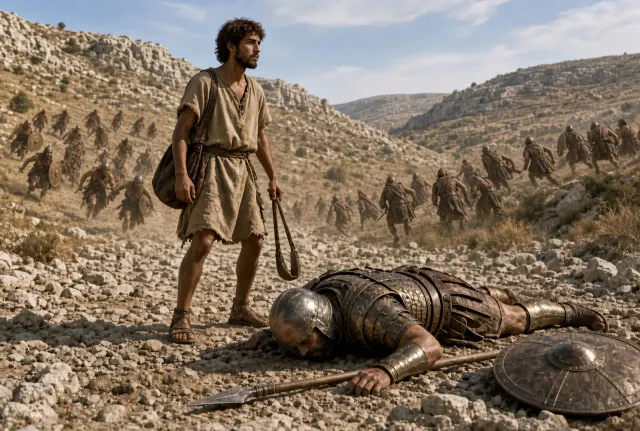
Read the fight briefly and without dwelling on injury. David runs toward the Philistine, slings a stone, and Goliath falls on his face, like Dagon before the ark in 5:3. Note 17:50, "there was no sword in the hand of David". The Philistines flee and Israel pursues. Describe the aftermath plainly: the champion is killed with his own sword, and the armour is kept. Teach this step to show the victory as the LORD's and the army's release, not as a display of violence.
1 Samuel 17:55-58
Whose son is this?
Close with Saul's question to Abner, "whose son is this youth?" and David's answer, "I am the son of thy servant Jesse the Beth-lehemite." Learners will ask how Saul could not know David after 16:21. Explain that readers suggest several answers: Saul asks about David's family because of his promise in 17:25, or the account arranges events by theme rather than strict order. Do not claim one answer settles it. Teach this last because it brings David into Saul's household for good and sets up Jonathan's covenant in 18:1.
Where learners get stuck
The misreadings this passage tends to produce, and how to answer each from the text.
"This chapter teaches that I can beat any giant in my life if I have faith."
David's speech is about God's name and reputation: "that all the earth may know that there is a God in Israel" (17:46). The text does not promise that every believer will defeat every opponent, illness or problem. Some faithful people in Scripture suffer and die without visible victory (Hebrews 11:35-38). Teach learners to face fear with David's trust in the LORD who delivers, and to leave the outcome with him. Christian readers also see in David a picture of a champion who wins for a helpless people.
"David was a little boy against a giant."
David is called "a youth" (17:33, 42), not a small child. He has killed a lion and a bear (17:34-36), and he was already described as "a mighty valiant man, and a man of war" in 16:18. The contrast is between an untried young man with a sling and a lifelong soldier in heavy armour (17:33). Teach the real contrast. It keeps the account from becoming a children's fable and makes David's trust in God more striking, not less.
"David didn't wear Saul's armour because it was too big."
The text gives a different reason: "I cannot go with these; for I have not proved them" (17:39). He had not tested them. Size may have been a factor, but the Book of 1 Samuel does not say so. This matters as a reading habit: teach learners to notice what the text actually says before repeating familiar retellings. The reason David gives also has a lesson: go with what God has trained you to use.
"The five stones mean David expected to fight Goliath's four brothers."
The text does not say why David chose five stones (17:40). A later passage mentions other giants from Gath (2 Samuel 21:15-22), and some readers connect them, but 1 Samuel 17 makes no such link. A careful teacher can say that a sensible slinger takes spares. Use this confusion to teach the class not to build doctrine on details the text leaves unexplained.
Learning objectives
- Describe the representative terms of Goliath's challenge.
- Contrast the army's response with David's stated concern.
- Explain David's appeal to earlier deliverance.
- Identify his stated reason for removing Saul's armor.
- Connect the victory to knowledge of the Lord.
- Distinguish the chapter's claims from popular additions.
Teacher preparation
- Read chapter 17; select the challenge, David's speeches, and the army's response rather than lingering over weapon measurements.
- Retain the KJV's six cubits and a span in 17:4 without presenting a guessed modern conversion as exact.
- Gloss 'carriage' as baggage in 17:22 and 'proved' as tested in 17:39.
- Compare 16:19–23 with 17:55–58; note that Saul asks whose son David is, but do not claim this removes every question about their earlier acquaintance.
- Plan non-graphic treatment of 17:49–54 and no sling-making or combat reenactment.
Evidence and interpretation checks
Explicit
Read 17:45–47: David names the Lord, identifies Goliath's defiance, and states that the outcome will make God's reality and saving power known.
Scripture-supported
Join 17:37 with 14:6, 23: confidence rests in the Lord's deliverance rather than Israel's military sufficiency.
Strong inference
Infer from 17:11, 24, 51–52 that the champion's defeat releases the wider army from paralysis into pursuit.
Possible or traditional reading
Present David's representative victory in 17:8–9, 49–52 as a possible Christian typological comparison with Christ's victory; avoid making every stone, garment, or number symbolic.
Limit
State that 17:40 does not explain why David chose five stones, name four waiting opponents, or promise that every believer will defeat every earthly adversary.
Discussion with answer guidance
1. What does Goliath propose should depend on one fight?
What a good answer contains
The whole war's outcome and which people will serve which. He says, "choose you a man for you, and let him come down to me. If he be able to fight with me, and to kill me, then will we be your servants: but if I prevail against him, and kill him, then shall ye be our servants, and serve us" (17:8-9). Then, "I defy the armies of Israel this day" (17:10). A good answer sees representative combat: one man fights for a nation. A weak answer reduces it to two men settling a personal quarrel and misses why Israel's terror is so great.
Show teacher guidance
Read 17:8–10: the contest concerns the armies' and peoples' submission, not merely two men's personal reputations.
2. How does David describe the challenge differently from the frightened soldiers?
What a good answer contains
The soldiers see a giant; David sees an insult to God. The men of Israel say, "surely to defy Israel is he come up" (17:25), and flee "sore afraid" (17:24). David asks, "who is this uncircumcised Philistine, that he should defy the armies of the living God?" (17:26). To Goliath he says, "I come to thee in the name of the LORD of hosts, the God of the armies of Israel, whom thou hast defied" (17:45). A good answer notices "living God" and "whom thou hast defied". A weak answer says only that David was braver.
Show teacher guidance
Compare 17:24–26 with 17:45: he identifies defiance of the living God, not only an unusually intimidating opponent.
3. Why does David recount the lion and bear to Saul?
What a good answer contains
To show that the LORD has delivered him before. "Thy servant kept his father's sheep, and there came a lion, and a bear, and took a lamb out of the flock" (17:34). David rescued the lamb and killed the attacker. Then the conclusion: "The LORD that delivered me out of the paw of the lion, and out of the paw of the bear, he will deliver me out of the hand of this Philistine" (17:37). A good answer sees that David's confidence rests on the LORD's past faithfulness in his ordinary work. A weak answer hears boasting about his own strength.
Show teacher guidance
Use 17:34–37: he points to the Lord's prior deliverance through his shepherding work. Do not turn the speech into confidence detached from God.
4. Why does David remove Saul's armor?
What a good answer contains
Because he has not tested it. The text says "he assayed to go; for he had not proved it. And David said unto Saul, I cannot go with these; for I have not proved them. And David put them off him" (17:39). "Assayed" means tried and "proved" means tested. A good answer gives that reason: unfamiliar equipment is a liability in a fight. It may also note that Saul's armour is Saul's way, not David's. A weak answer says the armour was too big, which the text does not say.
Show teacher guidance
Require the reason in 17:39: he has not tested it. Correct the familiar addition that the passage explicitly says it is too large.
5. Who is supposed to learn something from the outcome?
What a good answer contains
Everyone. David tells Goliath that the outcome will show "that all the earth may know that there is a God in Israel" (17:46), and "all this assembly shall know that the LORD saveth not with sword and spear: for the battle is the LORD's" (17:47). The lesson is for the nations and for Israel's own army. A good answer keeps that double audience and the focus on God. A weak answer makes the chapter about David proving his brothers and Saul wrong, which is part of the scene but not his stated purpose.
Show teacher guidance
Identify all the earth and this assembly in 17:46–47. Keep the lesson larger than David proving doubters wrong.
6. What changes in Israel after Goliath falls?
What a good answer contains
The army is set free. The text says that "when the Philistines saw their champion was dead, they fled. And the men of Israel and of Judah arose, and shouted, and pursued the Philistines" (17:51-52). The men who had fled from Goliath for forty days now chase his army to Ekron and Gath. A good answer sees the representative victory release the people from fear into action. Mention the aftermath soberly. A weak answer ends with the stone and forgets that David's victory was for the whole army.
Show teacher guidance
Follow 17:51–53: the Philistines flee and Israel pursues. Mention the aftermath soberly; do not reduce the chapter to one dramatic stone.
Responsible application
Heart and habits
Ask learners to compare remembering received help with pretending a hard task has no real dangers, using David's speech rather than personal testimony.
Relationships and community
Use a fictional group paralyzed by intimidation to discuss supporting responsible action without promising an identical battlefield outcome.
Refuse added details
Have learners correct a sample retelling that supplies oversized armor, symbolic stones, or guaranteed success; replace additions with the chapter's stated reasons.
Session plans
Two timings of the same lesson. The shorter keeps the reading, the central discussion and one response; the longer gives the confusions and the application their own time.
45 minutes
The challenge
Read 17:1-11. Ask question one.
David arrives
Read 17:17-30. Ask question two and note Eliab's misjudgment.
Lion, bear and armour
Read 17:31-40. Take questions three and four and confusions two and three.
The name of the LORD
Read 17:41-47 twice. Ask question five and use confusion one.
The army pursues
Read 17:48-53 soberly. Ask question six and use confusion four.
Handout
Read the key verse together and give out the handout. Pray for courage rooted in God.
90 minutes
What we are afraid of
Ask what makes people freeze in fear. Take a few answers, then read 17:1-3.
Forty days of fear
Read 17:4-16. Take question one. Explain the champion and keep the measurements in the King James form.
An errand to the camp
Read 17:17-30. Take question two and discuss Eliab's words beside 16:6-7.
The lion and the bear
Read 17:31-40. Take questions three and four and confusions two and three.
The battle is the LORD's
Read 17:41-47 with 14:6 and 2:9. Take question five and confusion one.
The stone and the pursuit
Read 17:48-54 without dwelling on injury. Take question six and confusion four.
Whose son?
Read 17:55-58 and discuss the question of Saul's knowledge of David.
Handout and prayer
Read the key verse together, point to the take-home line, and pray.
Adapting the lesson
Children
Tell the account with excitement but without violence. Mark out Goliath's height on the wall with tape, then let a child stand next to it. Read David's words, "the battle is the LORD's", and let the children shout them. Show a sling but do not make or use one. For the ending, say Goliath fell down and the Philistines ran away. Avoid the details of 17:51 and 17:54.
Youth
Ask what giants they face: pressure, fear, mockery. Then show that David's focus was God's honour, not his own reputation. Read 17:28 and talk about being misjudged by family. Spend time on 17:39: going with what God has trained you to use rather than borrowed armour. Avoid any combat reenactment and keep the ending sober.
Adults
Discuss representative victory and its meaning, including the Christian reading of David as a picture of Christ, without making every detail symbolic. Give time to the source of David's confidence in 17:37 and its roots in ordinary work. Address the question of 17:55-58 honestly. Some adults are facing illness or loss; avoid promising that faith will remove every giant.
One to one
Read 17:32-37 together and ask what the LORD has delivered them from in the past. Let that become a reason to trust him now. If they feel misjudged by family, read 17:28-29. Do not promise victory over whatever they are facing; pray with them in David's words that the battle is the LORD's, and leave it with him.
Song and video learning lab
A song or video may interpret, compress, or dramatize the text. Its value becomes clearer when its choices are compared with Scripture.
- Before the media: the exact passage and its central movement.
- During the media: the words, people, events, and emotions the artist emphasizes.
- After the media: what it clarifies, what it leaves out, and what belongs back in the biblical text.
Handout
One page for learners to take home. The print button prints this section alone.
1 Samuel 17:1–58
The passage in brief
The Philistine champion Goliath challenges Israel to send one man to fight him, and for forty days Saul's army is terrified. David, the youngest son of Jesse, brings food to his brothers and hears the challenge. He says no one should defy the armies of the living God. He tells Saul that the LORD who saved him from a lion and a bear will save him now. Without armour, with a sling and a stone, David defeats Goliath in the name of the LORD, and the Philistines run while Israel pursues.
A verse to keep
Then said David to the Philistine, Thou comest to me with a sword, and with a spear, and with a shield: but I come to thee in the name of the LORD of hosts, the God of the armies of Israel, whom thou hast defied.
1 Samuel 17:45 · King James Version
Questions to take home
Why did David say Goliath must be faced (17:26, 36)?
What reason did David give for trusting God against Goliath (17:37)?
What did David say all the earth would learn (17:46-47)?
This week
Remember one time God has helped you before, and let it give you courage for what you face this week.
Music and video connected to the passage
Related media appears when its Scripture reference overlaps this study. Music and video can illuminate a theme while the biblical text remains the foundation.