The big picture
The new tablets make restoration concrete. God does not issue a revised covenant after the calf; the same words are written again and placed in the ark. Aaron dies, Eleazar succeeds him, and Levi's ministry continues, showing that priestly service outlives a particular officeholder. Moses then compresses the covenant's demand into fear, love, service, obedience, and a heart no longer stiffnecked. The LORD owns heaven and earth yet chose Israel's fathers, so election becomes a reason for inward change rather than complacency. Divine greatness is then described through impartial justice and care for the vulnerable. God loves the stranger with food and clothing, and Israel must love the stranger because it remembers being one in Egypt. The chapter joins restored covenant, continuing ministry, transformed allegiance, and practical justice in one movement.
Central truth
Moses strips Israel of claims to superior numbers, self-made wealth, and deserved righteousness, calling the people sustained through rebellion to remember the Lord, obey him, and love the stranger.

The study notes have a page of their own
The movement by movement analysis, the words to trace, the verse by verse notes and where readers differ are written for someone studying alone. They are on the Deep Personal Reflections page for this chapter. This page is the lesson.
A chapter-specific teaching brief
These anchors come from this chapter itself. They help a teacher use the Level 1 overview, the Level 2 study, and the Scripture text as one lesson.
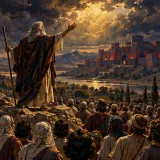
Open with the chapter’s first image
Deuteronomy 10:1: “At that time the LORD said unto me, Hew thee two tables of stone like unto the first, and come up unto me into the mount, and make thee an ark of wood.”
Slow down at the turning point
Deuteronomy 10:13: “To keep the commandments of the LORD, and his statutes, which I command thee this day for thy good?”
Keep this word trail visible
LORD, tables, first, mount, time, fathers
What to explain, in order
Teach the passage in this order. Each step names the verses it rests on, so every point can be shown in the text before it is applied.
Deuteronomy 7:1-11
The ban, named honestly
Begin with the hardest verses, because learners will find them and should hear them from you first. Read 7:1-5 plainly: seven nations, "utterly destroy them", no covenant, no marriages, altars and images destroyed. Explain that "utterly destroy" translates the Hebrew herem, devoting to destruction. Readers hold different views: some read it as a unique judgement on the nations' wickedness (9:5); some note that the ban on marriages in 7:3 suggests the language of total destruction is partly the idiom of ancient war speech; many Christian readers since the early church have also read it as a picture of rooting out idolatry. Set these out without choosing. Then let 7:6-8 answer pride: chosen because loved, not because many. No one may use this text to justify violence today.
Deuteronomy 7:12-26
Blessing, fear, and by little and little
Read the promises of 7:12-15 as covenant blessings on the people in the land, and caution the class against diagnosing anyone's illness or childlessness from them. Then address fear: "These nations are more than I" (7:17) is answered by memory of Egypt. Explain the hornet of 7:20 as a disputed image, whether literal insects or a figure for panic. Note 7:22, "by little and little", which shows a gradual process. Close with 7:25-26: even the silver on the idols is a snare.
Deuteronomy 8:1-20
Hunger, manna, and a full table
This is the chapter to read whole. Move from the wilderness (8:2-6), where God humbled and fed them, to the good land (8:7-10), a list of brooks, wheat, figs and iron, and then to the danger (8:11-17), where full houses and multiplied silver lift the heart. Explain "prove thee" in 8:2 as testing to reveal what was in the heart. Point out that 8:3 is the verse Jesus answers the tempter with in Matthew 4:4. End on 8:18: power to get wealth is itself a gift.
Deuteronomy 9:1-10:11
Not for thy righteousness
Read 9:4-6 as the turn of the unit: three times Moses denies that the land is a reward for virtue. Explain "stiffnecked" as an ox that will not bend to the yoke. Then tell the golden calf from Moses' side: forty days on the mountain, the people quickly turned aside, the tables broken, the calf ground "as small as dust", and Moses on his face for forty days. Give the intercession of 9:26-29 its full weight; Moses appeals to God's own name and promise. Close with the new tables and the ark (10:1-5): failure is not the end of the covenant.
Deuteronomy 10:12-22
What doth the LORD require
Move from history to the heart. Read 10:12-13 as the summary of the law: fear, walk, love, serve, keep, "for thy good". Explain the command to circumcise "the foreskin of your heart" (10:16) as a call for an inward change that matches the outward sign, and point forward to 30:6, where God promises to do it. Then the portrait of God in 10:17-18: great and mighty, yet one who takes no bribes and feeds the orphan, widow and stranger. Teach 10:19 as the direct command it is.
Deuteronomy 11:1-32
Rain from heaven, and two mountains
Show how chapter 11 gathers the unit: love and obey (11:1), remember what your own eyes saw (11:2-7), and live in a land watered by rain rather than by your foot (11:10-12). Read 11:18-21 as the Shema's command repeated, now addressed in the plural to the whole people. Close with 11:26-32, the blessing and the curse set before them and the two mountains, Gerizim and Ebal, which prepare for chapter 27. The unit ends on a choice.
Where learners get stuck
The misreadings this passage tends to produce, and how to answer each from the text.
"This passage means God approves of wiping out whole peoples."
The command in 7:1-5 is given to one people at one moment, for a stated reason, the wickedness of these nations (9:5) and the danger of idolatry (7:4). The same book protects Edom, Moab and Ammon (2:5-19) and commands love for the stranger (10:19). Readers differ on how literally to take the language of total destruction and on how it fits the whole Bible, and you should present those views honestly. What no reading permits is using this text to justify violence or contempt toward any people today.
"Being chosen means Israel was better than other nations."
Moses says the opposite twice. Israel was "the fewest of all people" (7:7), and three times in 9:4-6 the land is not given "for thy righteousness". Chosen people are reminded of the golden calf before they receive anything. Election in Deuteronomy is love and responsibility, never superiority, and a lesson that leaves anyone feeling ethnically superior has misread the chapter.
"If I am sick or poor, God must be punishing me for disobedience."
The blessings of 7:12-15 and the rain of 11:13-17 describe the covenant life of the nation in the land. They are not a tool for reading an individual's illness, infertility or hardship as a verdict. Job, the Psalms and Jesus in John 9:1-3 refuse that inference. Be very careful with learners who carry these questions; answer from the text and with kindness.
"Hard work earns me what I have, so I owe no one thanks."
Moses does not despise work, but he names the boast of 8:17 as forgetting, and answers it with 8:18: the LORD gives the power to get wealth. The command to bless God after eating (8:10) builds thankfulness into the meal. Pair this with 10:18-19, where the grateful are told to feed and clothe the stranger.
Learning objectives
- Identify the stated grounds of Israel's election in 7:7–8.
- Explain the lesson attached to hunger and manna.
- Refute the claim that prosperity proves self-sufficiency.
- Explain how the golden calf contradicts national self-righteousness.
- Connect renewed tablets with the call for an inwardly changed heart.
- Describe the relationship between covenant allegiance and the land's rain.
Teacher preparation
- Read Deuteronomy 7–11; select readings on love, provision, rebellion, renewal, and dependence.
- Name the commanded destruction in 7:1–6 without euphemism; distinguish its covenant setting from any permission for present-day violence or ethnic contempt.
- Explain 'stiffnecked' through resistance to direction, and the heart language in 10:16 as a demand for inward responsiveness.
- Mark 8:17, 9:4, and 10:19 as three contrasting statements about self-credit, deserved land, and treatment of strangers.
- Prepare the golden-calf sequence from 9:8–21 and 10:1–5; do not lose the replacement tablets beneath the account of the broken ones.
Evidence and interpretation checks
Explicit
Read Deuteronomy 7:7–8 and 9:4–6: election is not explained by Israel's size, and possession is explicitly denied as a reward for Israel's righteousness.
Scripture-supported
Compare Deuteronomy 10:18–19 with Exodus 22:21. The Lord's care for the stranger and Israel's own experience in Egypt support the command to love the stranger.
Strong inference
Infer from Deuteronomy 8:10–18 that blessing the Lord after eating counters self-credit; the power to produce wealth is itself received, not independent achievement.
Possible or traditional reading
Present the hornet in Deuteronomy 7:20 as a disputed detail: literal hornets and figurative terror have been proposed. Do not identify a particular invading nation as the text's stated meaning.
Limit
State that Deuteronomy 7:12–15 and 11:13–17 concern Israel's covenant life in the land; they do not authorize diagnosing an individual's illness or infertility as proof of disobedience.
Discussion with answer guidance
1. What explanations for Israel's favored position does Moses remove?
What a good answer contains
Moses removes size and goodness. "The LORD did not set his love upon you, nor choose you, because ye were more in number than any people; for ye were the fewest of all people" (7:7). And "Not for thy righteousness, or for the uprightness of thine heart, dost thou go to possess their land" (9:5). What remains is "because the LORD loved you, and because he would keep the oath" (7:8), and the wickedness of the nations (9:5). A strong answer names both removals and both reasons left. A weak answer keeps one boast alive.
Show teacher guidance
Compare 7:7–8 and 9:4–6. Name both numbers and righteousness; retain the Lord's love, ancestral oath, and judgment on the nations.
2. Why does the wilderness lesson include both hunger and manna?
What a good answer contains
Because the hunger was the teacher and the manna the lesson. God "humbled thee, and suffered thee to hunger, and fed thee with manna", and did it "that he might make thee know that man doth not live by bread only" (8:3). The same verses note that clothing did not wear out (8:4) and call the whole experience a father's discipline (8:5). A good answer keeps both halves: the lack exposed dependence, and the provision proved God's word reliable. A weak answer says food does not matter, which 8:7-10 refutes.
Show teacher guidance
Use 8:2–5, 15–16. Explain dependence on the Lord's word and provision, not a claim that food is unnecessary.
3. How does Moses answer the owner who credits only his own hand for wealth?
What a good answer contains
The owner says, "My power and the might of mine hand hath gotten me this wealth" (8:17). Moses does not deny the work; he names its source: "it is he that giveth thee power to get wealth" (8:18). The remedy begins earlier, in 8:10, "When thou hast eaten and art full, then thou shalt bless the LORD thy God". A strong answer distinguishes honest labour from the claim that the labour was self-made. A weak answer either despises work or lets the boast stand.
Show teacher guidance
Read 8:10–18. Distinguish genuine work from claiming its power and results independently of the giver.
4. Why recall the golden calf while Israel is preparing to receive land?
What a good answer contains
Because the people about to receive the land need to know they did not earn it. Moses follows "thou art a stiffnecked people" (9:6) with a record: "ye have been rebellious against the LORD" (9:7), the molten calf at Horeb (9:12-16), the broken tables (9:17), and his forty days of intercession, including for Aaron (9:18-20, 25-29). A good answer sees that memory of failure protects against pride. A weak answer misses the intercession and the renewal, which are the point of the retelling.
Show teacher guidance
Read 9:4–7, 12–21, and 25–29. Let documented rebellion dismantle the claim of deserved superiority; notice Moses' intercession for Israel and Aaron.
5. What connects the new tablets with the command to love the stranger?
What a good answer contains
Both are acts of renewal after failure. God has the tables rewritten "according to the first writing" (10:4) and kept in the ark. Then Moses asks what the LORD requires (10:12), commands "Circumcise therefore the foreskin of your heart" (10:16), and describes a God who "loveth the stranger, in giving him food and raiment" (10:18), ending with "Love ye therefore the stranger: for ye were strangers in the land of Egypt" (10:19). A strong answer sees that a renewed covenant produces a renewed heart that imitates God's care.
Show teacher guidance
Trace 10:1–5 and 12–19. Identify renewed covenant responsibility, an unresisting heart, and imitation of the Lord's impartial care.
6. Why contrast Egypt's watering with the land that drinks rain?
What a good answer contains
In Egypt the farmer "wateredst it with thy foot" (11:10), working irrigation channels from the Nile. The new land "drinketh water of the rain of heaven", and it is a land "which the LORD thy God careth for" (11:11-12). Rain will come or be withheld in connection with covenant loyalty (11:13-17). A good answer sees dependence built into the landscape itself. A weak answer applies 11:17 to every drought or illness as a judgement on particular people, which the passage does not license.
Show teacher guidance
Use 11:10–17. Explain dependence and covenant allegiance; do not turn the passage into a judgment on every modern drought.
Responsible application
Heart and habits
Rewrite the boast in 8:17 so it acknowledges work without erasing the giver in 8:18.
Relationships and community
Ask a fictional prosperous village to apply 10:18–19 to newcomers needing food and clothing, not merely a polite welcome.
Remembering failure honestly
Design a community anniversary statement that includes both provision and the golden calf; distinguish truthful gratitude from flattering public relations.
Session plans
Two timings of the same lesson. The shorter keeps the reading, the central discussion and one response; the longer gives the confusions and the application their own time.
45 minutes
The speech Moses refuses
Read 9:4-6 aloud. Ask what boast Moses forbids, and keep the answer on the board.
Loved, not impressive
Read 7:1-11. Name the ban plainly, take confusion one briefly, then question one and confusion two.
Hungry and full
Read 8:2-18. Take questions two and three, and confusion four.
The calf and the new tables
Summarise 9:7-21, read 9:25-29 and 10:1-5. Take question four.
A heart for the stranger
Read 10:12-19 and 11:10-17. Take questions five and six, with confusion three if it comes up.
Handout
Read the key verse together and point to the take-home line.
90 minutes
Three boasts
Write on the board: we were bigger, we earned it, we deserved it. Ask the class which they hear most often today.
The ban and the love
Read 7:1-11 with care. Take confusion one fully, setting out the readings of the ban, then question one and confusion two.
Fear and the hornet
Read 7:17-26. Note the disputed hornet and "by little and little". Take confusion three on 7:12-15.
The wilderness school
Read chapter 8. Take questions two and three, and read Matthew 4:1-4 beside 8:3.
The golden calf retold
Read 9:4-10:11, with Exodus 32 summarised. Take question four. Ask what Moses' prayer in 9:26-29 appeals to.
What the LORD requires
Read 10:12-22. Take question five and confusion four. Point ahead to 30:6.
Rain and two mountains
Read 11:10-32. Take question six and preview chapter 27.
Application
Use the second application on caring for newcomers, or the first on rewriting 8:17.
Handout and prayer
Read the key verse together and pray a thanksgiving for gifts received and not earned.
Adapting the lesson
Children
Use two baskets, one empty and one full. With the empty basket tell how God fed his people manna in the desert; with the full one read 8:10 and say thank you to God. Tell the golden calf simply: the people made a pretend god, Moses prayed for them, and God gave the tables again. Do not describe the battles of chapter 7 in detail; say that God was bringing his people into the land and wanted them to stay away from idols.
Youth
Ask whether success proves someone is a better person, then read 9:4-6. Let them examine the boast of 8:17 in sport, school or social media. The ban of 7:1-5 will raise questions; let them ask, present the main readings fairly, and say plainly that the text gives no permission for violence or hatred now. Close with 10:19 and ask who the stranger is in their school.
Adults
Give time to the ban and its readings, and do not hurry the discussion. Then examine institutional pride: a church or family that tells its history only as success. Compare 9:7-29 with Exodus 32 and discuss Moses' intercession. Spend the last part on 10:18-19 and concrete care for newcomers, with food and clothing, not just welcome.
One to one
Read 8:2-5 together and ask whether they have known a hungry season that taught them something. Do not force a lesson out of hardship. If they feel unworthy, read 7:7-8 and 9:5: God's love was never based on worth. If they carry a hard question about chapter 7, listen first and present the readings honestly.
Song and video learning lab
A song or video may interpret, compress, or dramatize the text. Its value becomes clearer when its choices are compared with Scripture.
- Before the media: the exact passage and its central movement.
- During the media: the words, people, events, and emotions the artist emphasizes.
- After the media: what it clarifies, what it leaves out, and what belongs back in the biblical text.
Handout
One page for learners to take home. The print button prints this section alone.
Deuteronomy 7:1–11:32
The passage in brief
Moses tells Israel that God chose them not because they were many or good but because he loved them and kept his promise. In the wilderness God humbled and fed them so they would learn that people live by every word of the LORD. When they are full in the good land they must not say they made themselves rich. Moses reminds them of the golden calf and how he prayed for them, and God gave the commandments again. He asks them to love God and love the stranger.
A verse to keep
And he humbled thee, and suffered thee to hunger, and fed thee with manna, which thou knewest not, neither did thy fathers know; that he might make thee know that man doth not live by bread only, but by every word that proceedeth out of the mouth of the LORD doth man live.
Deuteronomy 8:3 · King James Version
Questions to take home
Why did God choose Israel, according to 7:7-8?
What does 8:17-18 say about where the power to get wealth comes from?
What does God do for the stranger in 10:18, and what must his people do in 10:19?
This week
After a meal this week, thank God for one thing you enjoy that you did not make.
Music and video connected to the passage
Related media appears when its Scripture reference overlaps this study. Music and video can illuminate a theme while the biblical text remains the foundation.