The big picture
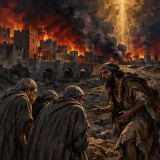
Jerusalem is called the bloody city, and Ezekiel's indictment refuses to isolate the problem in one office or one kind of sin. Violence, idolatry, sexual wrongdoing, exploitation, dishonest gain, contempt for vulnerable people, and profanation of holy things all appear within the same civic life. The repeated phrase 'in thee' makes the location of the failure impossible to outsource. Princes use power for bloodshed, priests erase distinctions they are supposed to preserve, prophets cover lies with divine language, and the people themselves practice oppression. Even gathering into Jerusalem becomes threatening, because the city is pictured as a furnace and its inhabitants as dross collected for melting. The chapter ends with a search for someone to repair the breach and stand in the gap for the land. None is found, and the closing judgment answers the city's own ways rather than an unexplained divine hostility.
Central truth
Through exile signs, exposed lies, covenant accusations, and the dated siege, the Lord dismantles Jerusalem’s excuses for refusing his word while still calling the people to turn. The Lord confronts Israel’s elders with repeated rebellion, exposes the corruption of the whole community, and announces Jerusalem’s siege while preserving his purpose to gather a purified people.

The study notes have a page of their own
The movement by movement analysis, the words to trace, the verse by verse notes and where readers differ are written for someone studying alone. They are on the Deep Personal Reflections page for this chapter. This page is the lesson.
A chapter-specific teaching brief
These anchors come from this chapter itself. They help a teacher use the Level 1 overview, the Level 2 study, and the Scripture text as one lesson.
Open with the chapter’s first image
Ezekiel 22:1: “Moreover the word of the LORD came unto me, saying,”
Slow down at the turning point
Ezekiel 22:14: “Can thine heart endure, or can thine hands be strong, in the days that I shall deal with thee? I the LORD have spoken it, and will do it.”
Keep this word trail visible
midst, LORD, blood, shed, gather, become
What to explain, in order
Teach the passage in this order. Each step names the verses it rests on, so every point can be shown in the text before it is applied.
Ezekiel 12:1–24:27
Ezekiel 12:1-28
The baggage, the hole and the proverb
Open the section with Ezekiel packing a bag "by day in their sight" (12:3), digging through the wall at evening, and going out with his face covered. Explain "stuff for removing" as an exile's bundle. Then read the explanation in 12:10-13: the prince in Jerusalem will flee the same way and be taken blind to Babylon. Add the trembling meal of 12:17-20. End with the two proverbs of 12:22 and 12:27, both of which say the warnings are for later. Teach this first because the whole section answers that excuse.
Ezekiel 13:1-14:11
Whitewash and idols in the heart
Read 13:10-14 and draw a wall with cracks and a thick white coat over it. Explain "untempered morter" as a coating that looks solid and is not. The prophets cry "Peace" when there is no peace, and they "have seen nothing" of God's word. Mention briefly the women of 13:17-23 who traded false comfort for handfuls of barley. Then turn to 14:1-6: elders sit before Ezekiel with idols in their hearts. Explain the hard line in 14:9 carefully: God gives the false prophet over to his own deception and judges him (14:10). Teach these together because speaker and hearer share the blame.
Ezekiel 14:12-15:8
Noah, Daniel, Job and the useless vine
Read 14:14: even "Noah, Daniel, and Job" would "deliver but their own souls". Explain that no one can lean on another's righteousness; the Daniel here may be Ezekiel's contemporary or an ancient righteous man known in the region, and readers differ. Then read chapter 15. Ask what a vine is good for if it bears no fruit; the answer in 15:3-5 is nothing, not even a peg. So Jerusalem, chosen to bear fruit, has become fuel. Teach this step here because it removes two false hopes: righteous friends and special status.
Ezekiel 16-19
Betrayal, eagles and a lament for princes
Cover this stretch as a map, not a reading. Say that chapter 16 is the long indictment of Jerusalem as an unfaithful wife, to be taught in its own unit with care. Read 17:12-21, where the riddle of the eagles is explained: Babylon set up a king, the king rebelled and turned to Egypt, and he will die in Babylon for breaking his oath. Then read 17:22-24, God planting a tender shoot. Note chapter 18 as its own unit. End with the lament of chapter 19: the lions and the vine are the kings of Judah, now without a sceptre.
Ezekiel 20-23
History retold, the sword, the bloody city
Again give the shape rather than every verse. Chapter 20 retells Israel's rebellion from Egypt to the present and refuses the elders' enquiry; chapter 21 is the drawn sword of Babylon; chapter 22 lists the sins of "the bloody city"; chapter 23 is the account of the two sisters. Read only 22:30, God's search for "a man among them, that should make up the hedge, and stand in the gap", and the answer "but I found none". These chapters receive fuller study in the next units, so here show how they press toward a single point: the siege is certain.
Ezekiel 24:1-27
The day is written down
Close with the date. Ezekiel writes "the name of the day" (24:2), the day Babylon's siege began, and every excuse about the distant future is gone. Read 24:15-18 gently. His wife dies at evening; he is told not to mourn publicly. Explain that this is a sign for that moment and that people, not a rule for grieving: the temple, the people's delight, is about to fall, and grief will be too great for the usual rites (24:21-24). End with 24:27: when the news comes, his mouth will be opened. Teach this last because it ties the whole section to its fulfilment.
Ezekiel 20:1–24:27
Ezekiel 20:1-4
The elders come to enquire
Start with the date in 20:1, the seventh year, almost a year after the visions of chapters 8-11. Elders sit before Ezekiel again, as in 8:1 and 14:1. God refuses to be consulted and instead tells Ezekiel to "cause them to know the abominations of their fathers" (20:4). Explain that the history which follows is not a lecture about the past; it is an exposure of the present. Teach this first because the whole chapter is God's answer to a question he will not answer in the form it was asked.
Ezekiel 20:5-26
Four rounds of the same rebellion
Draw four boxes in a row: Egypt, wilderness parents, wilderness children, the land. In each, write gift, rebellion, threat, restraint. Read the refrain "I wrought for my name's sake" in 20:9, 20:14 and 20:22. Explain that God's name means his reputation and character before the nations. Then read the hard verses 20:25-26 honestly: "I gave them also statutes that were not good". Many readers understand this as God handing them over to the destructive customs they chose, including child sacrifice, as in Romans 1:24-28; say that the wording is difficult and that God elsewhere condemns these rites (Jeremiah 7:31).
Ezekiel 20:27-44
Not like the nations, and the wilderness again
Read 20:30-32 and the people's wish in 20:32: to be "as the heathen, as the families of the countries, to serve wood and stone." God refuses to let them go. Then read the promise of 20:34-38: a new exodus, a new wilderness, passing "under the rod" like sheep counted by a shepherd, and a purging of the rebels. Read 20:40-44 for accepted worship and humbled remembrance. Teach this here so the class sees that judgment and restoration are both acts of the same God who will not give his people up.
Ezekiel 21:1-32
The sword is drawn
Explain that 20:45-49 and chapter 21 belong together: fire in the south forest, then the sword. Read 21:3-5: the sword cuts off "the righteous and the wicked", meaning that the invasion will sweep across the whole land. Do not let the class conclude that God makes no distinction; the point is the scale of the catastrophe. Then read 21:19-27 and draw the fork in the road. Explain the three divination methods in 21:21. End with 21:27 and its waiting phrase, "until he come whose right it is", often read with Genesis 49:10 as a messianic hope.
Ezekiel 22:1-31
The bloody city and the gap
Read 22:1-12 selectively to hear the list: bloodshed, contempt of parents, oppression of the stranger, the fatherless and the widow, sabbaths profaned, bribes taken. Then read 22:18-22 and explain "dross" as the waste left after refining metal: Israel has become slag. Read 22:25-29 slowly and list the four groups on the board. Close the step with 22:30-31. Explain "make up the hedge" as repairing a breach in a wall. Teach this here because it shows that the corruption reached every level and that no one stood in the breach.
Ezekiel 23:36-49 and 24:1-27
The sisters judged and the pot boiled dry
Summarise chapter 23 without reading its imagery, and read only 23:36-39 for the charge. Then move to chapter 24. Read the parable of the pot in 24:3-5 and its meaning in 24:6-13. Explain "scum" as the rust or filth that clings to the pot and will not come out. Then read 24:15-18 slowly and without comment, and 24:21-24 for its meaning. Teach this last because chapter 24 ends the first half of the book: the siege has begun, the news will come, and Ezekiel's mouth will be opened (24:27).
Where learners get stuck
The misreadings this passage tends to produce, and how to answer each from the text.
Ezekiel 12:1–24:27
"God's warnings are for some far-off future, not for us now."
That is the proverb God rejects: "The vision that he seeth is for many days to come, and he prophesieth of the times that are far off" (12:27). The answer is, "There shall none of my words be prolonged any more" (12:28), and twelve chapters later the siege has a date (24:2). Some prophecies do look far ahead, but the habit of filing every warning under later is exactly what this section exposes. Ask learners what warning in their own lives they have postponed, but do not make anyone answer aloud.
"If my parents or a godly friend are righteous, God will spare me for their sake."
The Book of Ezekiel says the opposite: "Though these three men, Noah, Daniel, and Job, were in it, they should deliver but their own souls by their righteousness" (14:14). Chapter 18 says the same from the other side: "The son shall not bear the iniquity of the father" (18:20). No one rides on another's faith. This is hard news for some and good news for others; those from godless homes are not doomed, and those from godly homes are not covered.
"Ezekiel's wife's death shows that grieving is a lack of faith."
God's instruction in 24:16-17 is given to Ezekiel alone, and it is explained as a sign: "Thus Ezekiel is unto you a sign" (24:24). The point is that Jerusalem's fall will be a grief beyond the usual mourning customs. Elsewhere Scripture honours mourning; Jesus wept at Lazarus' tomb (John 11:35). Never use this passage to silence a grieving person. Notice too the tenderness of the phrase "the desire of thine eyes" (24:16): Ezekiel loved his wife, and the sign cost him that love.
"False prophets are always obvious and easy to spot."
The prophets of chapter 13 said "The LORD saith" (13:6) and offered "visions of peace" (13:16). They were popular because they said what people wanted to hear, and the elders of 14:3 came to the prophet while holding idols in their hearts. The test the passage gives is whether the word matches God's actual warning, not whether it sounds spiritual. Teach learners to ask what a message leaves out, especially when it promises peace without repentance.
Ezekiel 20:1–24:27
"God gave Israel bad laws, so we can't trust his laws."
Read 20:25-26 beside 20:11: God's own statutes are those "which if a man do, he shall even live in them". The hard verses come after repeated refusal, and the next clause speaks of their causing children "to pass through the fire", which God elsewhere says he never commanded (Jeremiah 7:31). Many readers understand 20:25 as judicial abandonment: God gave them over to the customs they preferred. Admit that the wording is hard and readers differ. Do not soften the text, and do not let it overturn what the chapter says about God's good law.
"The king of Babylon used divination, and it worked, so divination is fine."
The passage reports what Nebuchadnezzar did: "he made his arrows bright, he consulted with images, he looked in the liver" (21:21). It never commends it. Deuteronomy 18:10-12 forbids every such practice. The point is that God rules even over the means a pagan king uses, as he does over Babylon's whole campaign (21:19). The lot fell where God had already said the sword would go. Teach God's sovereignty, not the method.
"Standing in the gap just means praying for my country."
Prayer is part of it, as Moses shows in Psalm 106:23. But in 22:30 the gap is in a wall broken by the sins listed in 22:25-29: bloodshed, dishonest gain, false prophecy, oppression of the poor and the stranger. The one who stands in the gap repairs the hedge, which includes turning from these things and confronting them. God "found none" (22:30). Keep prayer and justice together, and keep this application away from party politics.
"Ezekiel was not allowed to mourn, so Christians should not grieve openly."
The restriction in 24:16-17 is a sign for one moment: "Thus Ezekiel is unto you a sign" (24:24). The people will be stunned beyond the usual rites when the temple falls, and Ezekiel's silence pictures that. It is never presented as a rule. Scripture elsewhere honours open lament, and Jesus wept (John 11:35). Notice the tenderness of "the desire of thine eyes" (24:16). Never use this passage against anyone who is grieving.
Learning objectives
- Explain Ezekiel’s baggage and covered-face sign.
- Connect false peace with the badly coated wall.
- Identify idols concealed in the elders’ hearts.
- Trace royal failure through the vine, eagles, and lament.
- Distinguish covenant privilege from permission to betray it.
- Follow postponed warnings to the dated siege announcement.
- Trace the generations reviewed in chapter 20.
- Explain the repeated concern for the Lord’s name.
- Locate Jerusalem at the Babylonian king’s fork in the road.
- Identify the community-wide failures listed in chapter 22.
- Connect Jerusalem’s conduct with Samaria’s earlier betrayal.
- Explain the dated pot sign and Ezekiel’s restricted mourning.
Teacher preparation
- Read chapters 12–24 fully; prepare a passage map and selected readings, not a thirteen-chapter classroom read-through.
- Map 12–14 as rejected warning, 15–19 as exposed confidence, and 20–24 as indictment reaching siege.
- Explain “stuff for removing” as exile belongings and “untempered morter” as an inadequate wall coating.
- Prepare 14:9 with 13:6–7 and 14:10; retain its difficult judicial-deception language without excusing false prophets.
- Plan restrained summaries of chapters 16 and 23 and 24:15–24; avoid graphic detail, reenactment, or required disclosure.
- Read chapters 20–24 fully; prepare a historical sequence and selected close readings for the fifty-minute lesson.
- Chart Egypt, wilderness parents, wilderness children, land, and present elders in 20:5–31.
- Prepare 20:25–26 alongside 20:11,21 and Jeremiah 7:31; do not quietly replace the difficult wording.
- Explain “dross” as refuse in metalworking and “scum” as the pot’s persistent contamination in 22:18–22 and 24:6–13.
- Plan sober summaries of chapters 21 and 23; treat 24:15–24 as bereavement, not a dramatic prop.
Evidence and interpretation checks
Explicit
Anchor the baggage sign in 12:10–13: it concerns Jerusalem’s prince and people, including captivity in Babylon and the prince’s inability to see it. Locate the current charge in 20:30–31: the elders’ generation repeats the defilement it might prefer to assign only to its fathers.
Scripture-supported
Compare 13:10–16 with 22:28: unsupported peace and false prophetic speech cover danger instead of repairing it. Use 20:34–38,40–44 to show that promised gathering includes separation from rebellion, accepted worship, and humbled remembrance, not merely relocation.
Strong inference
Infer from 14:1–6 that seeking religious advice can coexist with refusing correction; approaching a prophet is not proof of an undivided heart. Infer from 22:25–29 that the crisis is mutually sustaining: corrupt leaders, false reassurance, and popular oppression reinforce rather than cancel each other.
Possible or traditional reading
Present the tender cedar planting in 17:22–24 as traditionally read messianically alongside Isaiah 11:1–10; distinguish that connection from the explicitly explained political eagles. Present 20:25–26 as commonly read as judicial handing over to destructive practices, compared with Romans 1:24–28; retain the wording and acknowledge the interpretive difficulty.
Limit
Do not treat 24:16–24 as a general command against mourning or use chapter 14 to claim automatic immunity through association with righteous people. Do not turn 21:21 into approval of divination or 24:16–24 into a universal ban on tears; these verses describe this judgment and this prophetic sign.
Discussion with answer guidance
1. What does the audience learn when Ezekiel explains his packed belongings and covered face?
What a good answer contains
That the sign is about Jerusalem, not about Ezekiel. When they ask, "What doest thou?" (12:9), he answers, "This burden concerneth the prince in Jerusalem, and all the house of Israel that are among them" (12:10), and, "I am your sign: like as I have done, so shall it be done unto them: they shall remove and go into captivity" (12:11). The prince will dig through the wall, cover his face, and be brought "to Babylon to the land of the Chaldeans; yet shall he not see it, though he shall die there" (12:13), which came true when Zedekiah was blinded (2 Kings 25:7). A good answer ties every action to its meaning. A weak answer thinks Ezekiel is moving house or offering a way of escape.
Show teacher guidance
Use 12:3–13: exile concerns Jerusalem and its prince. Distinguish the enacted warning from a voluntary move or escape guarantee.
2. How do the coated wall and heart-idols expose two sides of false reassurance?
What a good answer contains
The wall shows the speakers' side and the heart-idols show the hearers'. The false prophets "seduced my people, saying, Peace; and there was no peace" (13:10); one man builds a flimsy wall and "others daubed it with untempered morter", plaster that hides the cracks but cannot hold. The storm will expose it (13:11-14). In 14:3 the elders who come to enquire have "set up their idols in their heart", and the LORD answers by calling them to "Repent, and turn yourselves from your idols" (14:6). A good answer keeps both: lying prophets and divided listeners feed each other. A weak answer blames only the prophets.
Show teacher guidance
Read 13:10–16 and 14:1–6. Expect invented peace from speakers and concealed allegiance in hearers; responsibility is not one-sided.
3. What happens to confidence in royal strength across the vine, eagles, and lament?
What a good answer contains
It is burned, broken and uprooted. The vine is useless wood, good only for fuel, and "so will I give the inhabitants of Jerusalem" (15:6). In chapter 17 the king who broke his oath to Babylon will die there: "mine oath that he hath despised, and my covenant that he hath broken, even it will I recompense upon his own head" (17:19). The lament of chapter 19 ends with the vine "planted in the wilderness" and with "no strong rod to be a sceptre to rule" (19:13-14). A good answer also reads 17:22-24, where God himself plants "a tender one" on a high mountain. A weak answer misses that promise.
Show teacher guidance
Use 15:6–8, 17:12–21, and 19:9–14. Trace judgment, broken oath, and lost rule; preserve 17:22–24’s distinct promise.
4. How do chapters 16 and 23 identify the betrayal beneath impressive alliances?
What a good answer contains
By naming what the gifts were turned into. Jerusalem took "thy fair jewels of my gold and of my silver, which I had given thee, and madest to thyself images" (16:17), set "mine oil and mine incense" before them (16:18), and sacrificed "thy sons and thy daughters, whom thou hast borne unto me" (16:20). Chapter 23 names the sisters, "Samaria is Aholah, and Jerusalem Aholibah" (23:4), and the charge, "thou hast forgotten me, and cast me behind thy back" (23:35). A good answer names stolen gifts, idols, child sacrifice and a forgotten covenant. A weak answer retells the imagery and loses the charge. The full treatment belongs to the unit on chapters 16 and 23.
Show teacher guidance
Use 16:15–22 and 23:4–7,35–39. Name misused gifts, idols, bloodshed, and forgotten covenant, rather than retelling the explicit imagery.
5. Why does repeated ancestral rebellion not eliminate the call to turn?
What a good answer contains
Because each generation stands before God for itself. "The soul that sinneth, it shall die. The son shall not bear the iniquity of the father" (18:20), and the wicked who turns "shall surely live, he shall not die" (18:21). God asks, "Have I any pleasure at all that the wicked should die?" (18:23), and appeals, "wherefore turn yourselves, and live ye" (18:32). Then in 20:30-31 the present generation is found doing what its fathers did. A good answer says both: they are not doomed by the past, and not excused by it either. A weak answer chooses one.
Show teacher guidance
Place 18:20–23,30–32 beside 20:30–31. Present conduct matters; reject both inherited innocence and the excuse that the past makes change pointless.
6. What becomes of the claim that Ezekiel’s warnings concern a remote future?
What a good answer contains
It collapses. The people said, "The vision that he seeth is for many days to come" (12:27), and God replied, "There shall none of my words be prolonged any more" (12:28). In 24:1-2 Ezekiel is told, "write thee the name of the day, even of this same day: the king of Babylon set himself against Jerusalem this same day." The siege has begun. Then his wife, "the desire of thine eyes" (24:16), dies, and he is forbidden to mourn as a sign that the temple, the people's own "desire of your eyes" (24:21), will be profaned. A good answer marks the date and the cost. A weak answer either skips the bereavement or makes it a spectacle.
Show teacher guidance
Read 12:27–28 beside 24:1–2,13–14. The siege is dated; include 24:18–24’s costly sign without making bereavement a classroom illustration to perform.
7. Why does the Lord refuse the elders’ inquiry?
What a good answer contains
Because the men who come to ask are doing what their fathers did. They "came to enquire of the LORD, and sat before me" (20:1), and God answers at once, "As I live, saith the Lord GOD, I will not be enquired of by you" (20:3). The reason comes at the end of the history: "when ye make your sons to pass through the fire, ye pollute yourselves with all your idols, even unto this day: and shall I be enquired of by you, O house of Israel?" (20:31). A good answer joins 20:3 and 20:31: asking for guidance while keeping idols is not seeking God. A weak answer thinks God is simply unwilling to talk.
Show teacher guidance
Read 20:1–4 and 20:30–31 together. Their current conduct repeats the very rebellion being reviewed; seeking an answer is not the same as turning.
8. What repeats across Egypt and the wilderness, and what restrains destruction?
What a good answer contains
The same four beats repeat: God gives, Israel rebels, God threatens wrath, and God holds back "for my name's sake". In Egypt they would not cast away their idols (20:7-8); "But I wrought for my name's sake, that it should not be polluted before the heathen" (20:9). In the wilderness he gave statutes "which if a man do, he shall even live in them" (20:11) and sabbaths as "a sign between me and them" (20:12), and they rebelled (20:13), and again he spared them for his name (20:14). The children did the same (20:21-22). A good answer names the pattern and the reason for restraint. A weak answer mistakes God's patience for approval.
Show teacher guidance
Trace 20:7–22. Identify divine gifts, rebellion, threatened wrath, and action for the Lord’s name; do not describe patience as approval.
9. What do the two roads and removed crown announce?
What a good answer contains
That Babylon's sword is coming to Jerusalem and that the throne of Judah will be overturned. The king of Babylon stands "at the parting of the way, at the head of the two ways, to use divination" (21:21), one road to Rabbah, the other to Jerusalem, and the lot falls on Jerusalem (21:22). Then: "Remove the diadem, and take off the crown" (21:26), and "I will overturn, overturn, overturn, it: and it shall be no more, until he come whose right it is" (21:27). A good answer sees God ruling over a pagan king's divination without approving it. A weak answer thinks the passage endorses arrows and livers as ways to know God's will.
Show teacher guidance
Use 21:19–27. Jerusalem faces Babylon’s sword and overturned rule; distinguish the king’s divination from God’s authorization of it as a practice.
10. Who participates in the corruption of the bloody city?
What a good answer contains
Everyone. The prophets are "like a roaring lion ravening the prey" (22:25), the priests "have violated my law" and "put no difference between the holy and profane" (22:26), the princes are "like wolves ravening the prey, to shed blood, and to destroy souls, to get dishonest gain" (22:27), the prophets whitewash it all (22:28), and "The people of the land have used oppression, and exercised robbery, and have vexed the poor and needy" (22:29). Then 22:30: God sought a man to "stand in the gap before me for the land, that I should not destroy it: but I found none." A good answer names all four groups. A weak answer makes standing in the gap a matter of prayer words alone, apart from justice.
Show teacher guidance
Read 22:25–30. Name prophets, priests, princes, and people; do not reduce “standing in the gap” to words detached from their failures.
11. Why does Jerusalem’s imitation of Samaria deepen the indictment?
What a good answer contains
Because Jerusalem saw Samaria's fall and went further. In this section the account of the sisters names the deeper crimes: "they have committed adultery, and blood is in their hands, and with their idols have they committed adultery, and have also caused their sons, whom they bare unto me, to pass for them through the fire" (23:37). Then "they have defiled my sanctuary in the same day, and have profaned my sabbaths" (23:38), coming from child sacrifice straight into the temple (23:39). A good answer sees worship and murder on the same day. A weak answer retells the sexual imagery instead of naming the charge.
Show teacher guidance
Read 23:4–11,35–39. Jerusalem has a prior example yet repeats betrayal, bloodshed, and sanctuary defilement; summarize without graphic elaboration.
12. How do the contaminated pot and the loss of Ezekiel’s wife end postponement?
What a good answer contains
By fixing the date and making the loss personal. Ezekiel writes "the name of the day" when Babylon set itself against Jerusalem (24:2). The pot full of choice pieces, boiled until its rust and scum burn away, is "the bloody city" (24:6, 24:9), and God says, "because I have purged thee, and thou wast not purged, thou shalt not be purged from thy filthiness any more" (24:13). Then Ezekiel's wife dies, and he must not mourn publicly, as a sign that the temple will be profaned (24:16-21). A good answer sees that there is no more delay. A weak answer turns his restriction into a rule for all who grieve.
Show teacher guidance
Read 24:1–2,6,13–24. The siege is dated and the sanctuary’s loss is announced through a costly sign; do not universalize his mourning restrictions.
Responsible application
Heart and habits
Ask learners to revise a fictional teacher’s reassuring message that omits the wrongdoing the passage actually names.
Relationships and community
Use 22:25–29 to discuss shared institutional responsibility when religious speech conceals exploitation of poor people and strangers.
Follow images into explanations
Have pairs attach the baggage, wall, and eagle images to their interpreting verses; resist decoding what the Book of Ezekiel already explains.
Leave room for grief
Have the class explain why Ezekiel’s particular instructions in 24:16–24 cannot be used to demand emotional silence from bereaved people.
Session plans
Two timings of the same lesson. The shorter keeps the reading, the central discussion and one response; the longer gives the confusions and the application their own time.
Ezekiel 12:1–24:27
45 minutes
The packed bag
Read 12:3-7 and act out the sign briefly with a small bag. Ask what the people thought he was doing.
The meaning
Read 12:10-13 and 12:27-28. Take questions one and six in part, and confusion one.
Whitewash and heart idols
Read 13:10-14 and 14:1-6. Take question two and confusion four.
Vine, eagles and turning
Read 15:6, 17:19-24 and 18:20-23. Take questions three and five, and confusion two.
The written day
Read 24:1-2 and 24:15-18 with care. Finish question six and use confusion three.
Handout
Read the key verse together and give out the sheet. Point to the passage map for further reading at home.
90 minutes
The passage map
Hand out a one-page map of chapters 12 to 24 in three sections. Ask the group to guess why the chapters are full of excuses.
Signs of exile
Read chapter 12 in selected verses and take question one. Read the two proverbs and confusion one.
Wall and heart
Read 13:1-16 and 14:1-11. Take question two and confusion four, and handle 14:9 carefully.
No borrowed righteousness
Read 14:12-23 and chapter 15. Take confusion two and discuss Noah, Daniel and Job.
Kings, oaths and a tender shoot
Read 17:11-24 and 19:10-14. Take question three and draw out the promise of 17:22-24.
Betrayal and turning
Summarise chapters 16 and 23 without detail, then read 18:20-32 and 20:30-31. Take questions four and five.
The day is written
Read 22:30, 24:1-2 and 24:15-24 slowly. Take question six and confusion three. Allow silence.
Application and prayer
Use the application on revising a reassuring message that omits the wrong. Read the key verse together and pray.
Ezekiel 20:1–24:27
45 minutes
Elders refused
Read 20:1-4 and 20:30-31. Take question one.
The pattern
Read 20:5-14 and 20:21-22. Build the four boxes and take question two. Mention confusion one briefly.
Sword and crossroads
Read 21:19-27. Take question three and confusion two.
The gap
Read 22:25-31. Take question four and confusion three.
The pot and the date
Summarise 23:36-39 and read 24:1-2 and 24:15-18. Take questions five and six briefly.
Handout
Read the key verse together and give out the sheet.
90 minutes
History as mirror
Ask the group why a family or nation might prefer to blame its ancestors. Read 20:1-4.
Four rounds
Read 20:5-26. Build the four boxes and take question two. Take confusion one carefully.
The new wilderness
Read 20:30-44. Take question one and discuss accepted worship and humbled remembrance.
The sword
Read 21:1-7 and 21:18-27. Take question three and confusion two, and note Genesis 49:10.
The bloody city
Read 22:1-12 selectively, 22:17-22 and 22:23-31. Take question four and confusion three.
The sisters and the pot
Read 23:36-39 and 24:1-14. Take questions five and six.
The sign of grief
Read 24:15-27 and take confusion four, with care for anyone bereaved.
Handout and prayer
Read the key verse together and pray that God would find people who stand in the gap.
Adapting the lesson
Ezekiel 12:1–24:27
Children
Use the packed bag sign: let a child carry a small bag across the room while you explain that Ezekiel did this so the people would understand they were going to be taken far away. Use the wall and whitewash with a drawing: a wall that looks strong but falls in rain. Say God wants true words, not nice-sounding untrue ones. Leave out chapters 16 and 23, the sword, and the death of Ezekiel's wife.
Youth
Ask how people react when someone warns them about something that seems far off. Read the two proverbs of chapter 12. Use the whitewashed wall to talk about voices that tell us everything is fine. Read 14:14 and 18:20 and talk about faith that is your own, not your family's. Mention Ezekiel's wife with care, and do not let anyone joke about it. Skip the details of chapters 16 and 23.
Adults
Use the passage map and choose depth over coverage. Give time to the false prophets and to 14:9, which is hard, and let the group wrestle with it beside 14:10 and 1 Kings 22. Discuss Zedekiah's broken oath and why God holds a king to an oath made to a pagan ruler. Handle 24:15-24 with great tenderness; some adults will have lost a spouse. Point ahead to the units on chapters 16, 18, 20 and 23.
One to one
Ask the person which excuse in these chapters sounds most like their own: it is for later, my family will cover me, someone told me it was fine. Read the matching verse together. If they are grieving, read 24:16 and say plainly that Ezekiel's restriction was a unique sign, and that God sees their sorrow. Pray together for honest ears.
Ezekiel 20:1–24:27
Children
Tell children that God reminded his people how many times he had been kind to them and how many times they had turned away. Use a simple picture: a wall with a hole in it and God looking for someone to fix it. Ask how we can help fix what is broken. Leave out the sword, the bloody city, the pot, chapter 23, and the death of Ezekiel's wife.
Youth
Start with how people blame earlier generations for problems they still keep going. Read 20:30-31. Draw the crossroads of 21:19-22 and talk about God ruling over powerful people. Spend time on 22:30 and ask what standing in the gap looks like in their school or community. Skip the imagery of chapter 23 and handle Ezekiel's wife with gentleness.
Adults
Give time to the shape of Israel's history in chapter 20, the hard verses 20:25-26, and the new exodus of 20:34-44. Discuss the corruption of leaders and people together in chapter 22 and what it means for any community. Read 21:27 with Genesis 49:10. Treat chapter 23 only by its charge, and give 24:15-24 a slow, tender reading.
One to one
Read 20:30-31 and ask whether there is any pattern in their own life they recognise from an earlier generation. Then read 20:44, "when I have wrought with you for my name's sake, not according to your wicked ways", and let God's mercy be heard. If they are bereaved, read 24:16 and assure them that Ezekiel's restriction was a sign, not a rule.
Song and video learning lab
A song or video may interpret, compress, or dramatize the text. Its value becomes clearer when its choices are compared with Scripture.
- Before the media: the exact passage and its central movement.
- During the media: the words, people, events, and emotions the artist emphasizes.
- After the media: what it clarifies, what it leaves out, and what belongs back in the biblical text.
Handout
One page for learners to take home. The print button prints this section alone.
Ezekiel 12:1–24:27
The passage in brief
In these chapters Ezekiel acts out the coming exile by packing a bag and digging through a wall. God exposes prophets who promised peace when there was none, and leaders who came to ask God's advice while keeping idols in their hearts. Jerusalem is compared to a useless vine and its kings to broken branches, yet God promises to plant a new shoot. Each person is called to turn and live. Finally the siege of Jerusalem begins on a day Ezekiel writes down, and his own grief becomes a sign.
A verse to keep
Therefore say unto them, Thus saith the Lord GOD; There shall none of my words be prolonged any more, but the word which I have spoken shall be done, saith the Lord GOD.
Ezekiel 12:28 · King James Version
Questions to take home
What did the people say about Ezekiel's visions in 12:27, and how did God answer?
What is wrong with a wall covered in untempered morter (13:10-14)?
Why can Noah, Daniel and Job not save anyone but themselves (14:14)?
What did Ezekiel write down in 24:2, and why did it matter?
This week
Name one warning from God's word you have been putting off, and act on it before the week is out.
Ezekiel 20:1–24:27
The passage in brief
When the elders came to ask God's advice, he refused and instead retold Israel's history: again and again he was kind, and again and again they rebelled, yet he spared them for his name's sake. Now Babylon's sword was coming, the leaders and people of Jerusalem were all corrupt, and God could find no one to stand in the gap. On the day Babylon began its siege, Ezekiel wrote down the date, and his own wife died as a sign of the grief that was coming.
A verse to keep
And I sought for a man among them, that should make up the hedge, and stand in the gap before me for the land, that I should not destroy it: but I found none.
Ezekiel 22:30 · King James Version
Questions to take home
Why did God refuse to answer the elders in 20:3 and 20:31?
What phrase repeats in 20:9, 20:14 and 20:22, and what does it tell us about God?
Which four groups are named in 22:25-29, and what had each done?
This week
Ask God this week to show you one gap you could help repair, and take one step to stand in it.
Music and video connected to the passage
Related media appears when its Scripture reference overlaps this study. Music and video can illuminate a theme while the biblical text remains the foundation.