The big picture
Forgiveness, fellowship, fasting, healing, and opposition all crowd into Matthew 9. A paralyzed man receives forgiveness before movement, and the visible healing serves as evidence for the invisible claim that provokes the scribes. Matthew then leaves the customs station, and a meal with publicans and sinners becomes the setting for Jesus’ physician image and Hosea’s language of mercy. A question about fasting is answered through the bridegroom, new cloth, and new wine, making timing and presence central. The chapter’s healings then interlock: one daughter is restored on the way to another, blind men invoke the Son of David, and restored speech produces opposite explanations from crowds and Pharisees. The closing view is not triumphal crowd counting but compassion and a shortage of workers.
Central truth
Jesus’ authority reaches sickness, the storm, demons, sin, and death, while his welcome of Matthew and other sinners joins that authority to mercy and culminates in compassion for the shepherdless crowds.

The study notes have a page of their own
The movement by movement analysis, the words to trace, the verse by verse notes and where readers differ are written for someone studying alone. They are on the Deep Personal Reflections page for this chapter. This page is the lesson.
A chapter-specific teaching brief
These anchors come from this chapter itself. They help a teacher use the Level 1 overview, the Level 2 study, and the Scripture text as one lesson.
Open with the chapter’s first image
Matthew 9:1: “And he entered into a ship, and passed over, and came into his own city.”
Slow down at the turning point
Matthew 9:22: “But Jesus turned him about, and when he saw her, he said, Daughter, be of good comfort; thy faith hath made thee whole. And the woman was made whole from…”
Keep this word trail visible
Jesus, disciples, house, arose, bottles, garment
What to explain, in order
Teach the passage in this order. Each step names the verses it rests on, so every point can be shown in the text before it is applied.
Matthew 8:1-17
Touched, spoken to, raised up
Begin with three healings that show who Jesus reaches. A leper, unclean and untouchable, is touched: “I will; be thou clean” (8:3). A Gentile officer's servant is healed by a word from a distance. Peter's mother-in-law is raised and immediately serves. Explain leprosy as a range of skin diseases that cut a person off from worship and community (Leviticus 13:45-46). Then read 8:17 and Isaiah 53:4. Teach this first because it sets the pattern for both chapters: Jesus' authority, heard in the sermon, now reaches the people the sermon described as needy.
Matthew 8:18-22
The cost of following
Pause on the two would-be followers, because they keep the miracles from becoming spectacle. The scribe is told that “the Son of man hath not where to lay his head”. The disciple who asks to bury his father hears, “let the dead bury their dead”. Explain that readers differ on whether the father had just died or whether the man meant waiting until a parent's death, possibly years. Do not settle it. Teach the point: following Jesus comes before every other claim. Explain Son of man as Jesus' favourite title for himself, drawn from Daniel 7:13-14.
Matthew 8:23-34
Wind, sea and legion
Take the storm and the Gergesenes together. In the boat Jesus sleeps; the disciples cry, “Lord, save us: we perish”. He rebukes their little faith, then the wind and sea. Their question is the centre of the chapter. Across the lake, two men possessed by demons meet him. Explain that the demons know who he is and fear judgment “before the time”. The swine rush into the sea. Then the hardest line: the whole city begs him to leave. Teach this as a warning that power alone does not produce welcome.
Matthew 9:1-8
Forgiveness proved by healing
Read the scene in its order. Friends carry a paralysed man; Jesus sees their faith and says, “Son, be of good cheer; thy sins be forgiven thee”. Explain why the scribes object: only God forgives sins. Then Jesus' question and the healing. Note the crowd's response in 9:8: they glorify God who had given “such power unto men”. Spend time here, because this is the passage's clearest claim about Jesus' authority. Be careful that the class does not conclude that illness is always caused by personal sin; John 9:2-3 is useful if they do.
Matthew 9:9-17
A tax collector at the table
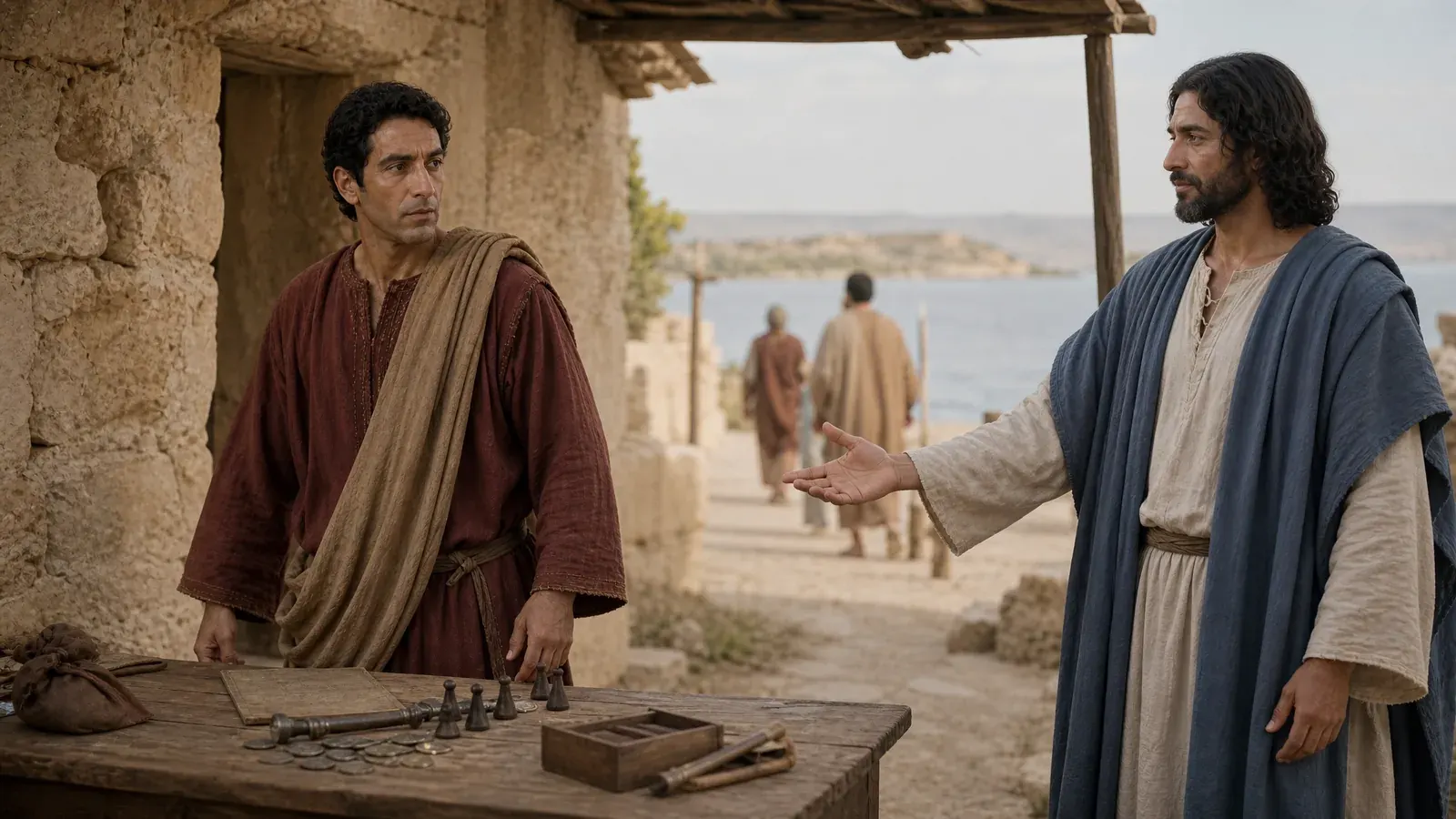
Read Matthew's own call in one verse. Explain “the receipt of custom” as a tax booth and publicans as tax collectors working for Rome, despised as traitors and cheats. He rises and follows. Then the meal with many publicans and sinners, the Pharisees' objection and the physician saying. Explain Hosea 6:6 in its setting: God wants loyal love more than ritual. Move to the fasting question and the images of cloth and wineskins. Explain bottles as leather skins. Teach this as the reason the new thing Jesus brings creates tension with those who expect him to fit old patterns.
Matthew 9:18-34
A daughter, a woman and the blind
Read the interwoven account of the ruler's daughter and the woman with an issue of blood. Explain that her bleeding made her ritually unclean for twelve years (Leviticus 15:25). She touches the hem; he turns and calls her “Daughter”. Then the girl: “the maid is not dead, but sleepeth”, and he takes her hand. Then two blind men crying “Thou Son of David” and a dumb man freed. Notice the contrasting responses in 9:33-34: wonder from the crowd, accusation from the Pharisees. Teach this as people who reach for Jesus and are not turned away.
Matthew 9:35-38
Compassion and the harvest
End on the summary and the compassion. Verse 35 repeats 4:23 almost word for word, framing everything since as one ministry of word and deed. Then 9:36: Jesus sees crowds harassed and scattered like sheep without a shepherd (Ezekiel 34:5). Explain “fainted” as worn out or harassed. The response is not a strategy but a prayer: ask the Lord of the harvest for labourers. Teach it last because it turns the class from watching Jesus work to joining his concern, and because the very next chapter sends out the twelve.
Where learners get stuck
The misreadings this passage tends to produce, and how to answer each from the text.
“If you have enough faith, like the centurion, God will always heal.”
The centurion's faith is commended (8:10), but the passage does not make faith a technique for securing outcomes. Peter's mother-in-law is healed without any recorded faith (8:14-15), and the demon-possessed men do not ask for help at all. Jesus heals out of compassion (9:36) and as a sign of the kingdom. Be careful with learners who live with illness: their condition is not a measure of their faith.
“The paralysed man must have sinned to be paralysed.”
Jesus forgives the man's sins first (9:2), but he does not say the sins caused the paralysis. He heals the body to prove his authority to forgive (9:6). Elsewhere Jesus explicitly denies a direct link between a man's blindness and his sin (John 9:2-3). Every person needs forgiveness; not every illness is a punishment. Speak gently if anyone in the room has been told otherwise.
“Jesus ate with sinners, so he did not care how people lived.”
He calls himself a physician who comes to the sick (9:12), and says he came to call sinners “to repentance” (9:13). Matthew left his tax booth (9:9). The welcome is real and costly, and it is a welcome into change. The Pharisees' error was to see the sinners only as contamination, not to care about righteousness.
“The townspeople in 8:34 were right to ask Jesus to leave because he destroyed their pigs.”
The text reports their request without approving it. They had seen two terrifying men freed and restored, and they asked the one who did it to depart. Matthew places their response beside the disciples' awe (8:27) and the demons' recognition (8:29). Let the class feel the loss: valuing property or comfort above the presence of Jesus is a choice people still make.
Learning objectives
- Compare the centurion’s confidence with the disciples’ fear.
- Trace the authority displayed across the separate encounters.
- Explain why forgiving the paralysed man provokes objection.
- Interpret the physician image at Matthew’s meal.
- Connect the bridegroom and new-wine images to the fasting question.
- Explain how compassion leads to the prayer for labourers.
Teacher preparation
- Read Matthew 8:1–9:38; prepare a scene index that keeps the individual encounters distinct.
- Gloss receipt of custom as a tax collection place, publicans as tax collectors, and bottles in 9:17 as wineskins.
- Mark Capernaum and the sea crossing; preserve the KJV’s Gergesenes wording without claiming an exact landing site.
- Note two demon-afflicted men in 8:28 and two blind men in 9:27; do not import a single-person version from another Gospel.
- Prepare non-stigmatizing language for illness and disability; resist assigning every condition the same spiritual cause.
Evidence and interpretation checks
Explicit
Locate the centurion’s appeal to authority, the stilled storm, and the forgiveness claim in Matthew 8:8–13, 23–27, and 9:2–8.
Scripture-supported
Read Matthew 9:13 with Hosea 6:6 to establish mercy as Jesus’ scriptural answer to criticism of his meal.
Strong inference
Compare Matthew 8:27, 29 and 9:3, 8, 34; infer that the accumulating responses press the question of Jesus’ identity, not merely the usefulness of his acts.
Possible or traditional reading
Present immediate burial and longer family-obligation readings of Matthew 8:21–22 as proposals; the passage does not disclose the father’s circumstances.
Limit
State that Matthew 8:1–9:38 does not promise every present illness will be healed on demand or explain illness as proof of personal sin.
Discussion with answer guidance
1. Why does the centurion think Jesus need not enter his house?
What a good answer contains
He understands authority. “For I am a man under authority, having soldiers under me” (8:9): he gives orders and they are carried out at a distance. So he says, “speak the word only, and my servant shall be healed” (8:8). Jesus marvels and says, “I have not found so great faith, no, not in Israel” (8:10). A good answer sees humility and trust in Jesus' word together. A weak answer hears his “I am not worthy” as a refusal of help.
Show teacher guidance
Follow his command-and-obedience comparison in 8:8–9. Jesus commends his faith in 8:10; do not turn the officer’s sense of unworthiness into a refusal of help.
2. What answers begin to emerge when the disciples ask what manner of man Jesus is?
What a good answer contains
After the storm the disciples ask, “What manner of man is this” (8:27), since wind and sea obey him, which in Psalm 107:29 is God's work. Across the lake the demons answer before anyone else: “Jesus, thou Son of God” (8:29). The townspeople then beg him to leave (8:34). A strong answer keeps three responses side by side: awe, recognition by enemies, and rejection. A weak answer blends the two scenes into one.
Show teacher guidance
Compare the obedient wind and sea in 8:26–27 with the demons’ recognition in 8:29. Keep the two encounters distinct and include the town’s unwelcome response in 8:34.
3. Why does Jesus tell the paralysed man to rise after declaring forgiveness?
What a good answer contains
To show something invisible by something visible. Anyone can say “thy sins be forgiven thee” (9:2), and the scribes call it blasphemy (9:3). So Jesus heals “that ye may know that the Son of man hath power on earth to forgive sins” (9:6). The healing is evidence for the forgiveness. A good answer keeps the order: forgiveness first, healing as proof. A weak answer says the man's paralysis was caused by a specific sin.
Show teacher guidance
Use the stated purpose in 9:6: that they may know his authority to forgive sins. Do not say the man’s paralysis proves a particular sin caused his condition.
4. How does the physician image answer the objection to eating with Matthew’s companions?
What a good answer contains
“They that be whole need not a physician, but they that are sick” (9:12). A doctor belongs with the sick. Jesus adds Hosea 6:6, “I will have mercy, and not sacrifice”, and his purpose: “I am not come to call the righteous, but sinners to repentance” (9:13). A strong answer keeps both welcome and repentance. A weak answer reads the meal as approval of whatever the guests did, or forgets that Matthew himself left his table to follow (9:9).
Show teacher guidance
Read 9:9–13: need explains the physician’s presence, and Jesus calls sinners to repentance. Welcome is neither approval of every action nor a reward for already appearing respectable.
5. Why do the bridegroom, cloth, and wineskins belong beside the fasting question?
What a good answer contains
They answer one question from three angles. While the bridegroom is present, guests do not fast; when he is “taken from them”, they will (9:15). New cloth on an old garment tears it, and new wine bursts old wineskins (9:16-17). A good answer sees that Jesus' coming brings something new that cannot simply be stitched onto old habits. A weak answer treats the sayings as household tips or ignores the hint of his death in 9:15.
Show teacher guidance
Read 9:14–17 together. Jesus distinguishes the bridegroom’s presence from his future removal and warns against ill-fitting combinations; these are not unrelated household tips.
6. What movement carries the chapter from individual healings to harvest labourers?
What a good answer contains
Matthew moves from a ruler's dead daughter and the woman who touched his garment (9:18-26), to two blind men and a dumb man (9:27-33), to a summary of teaching, preaching and healing (9:35). Then the climax: “he was moved with compassion on them, because they fainted, and were scattered abroad, as sheep having no shepherd” (9:36). A strong answer ends with the command to pray for labourers (9:38), which leads to chapter 10. A weak answer ends with the miracles.
Show teacher guidance
Follow 9:18–35 into compassion for the fainting, scattered crowds in 9:36–38. Include the restored girl and women and men healed; conclude with prayer for workers rather than spectacle.
Responsible application
Heart and habits
Ask how a fictional reader can seek help without treating the centurion’s faith as a technique for controlling outcomes.
Relationships and community
Evaluate an imaginary welcome policy through the physician image, keeping hospitality and repentance together without labelling real attendees.
Compassion that seeks workers
Design a fictional community response to overlooked needs and connect concern, prayer, and participation through Matthew 9:36–10:1.
Session plans
Two timings of the same lesson. The shorter keeps the reading, the central discussion and one response; the longer gives the confusions and the application their own time.
45 minutes
Authority in action
Read 8:1-4 and 8:5-13. Take question one.
Storm and demons
Read 8:23-34. Take question two and confusion four.
Forgiveness and healing
Read 9:1-8. Take question three and confusion two.
The physician
Read 9:9-17. Take questions four and five briefly.
Daughter, woman and harvest
Read 9:18-26 and 9:35-38. Take question six. Handle confusion one with care.
Response and handout
Ask each person to pray silently for one person they know who is harassed and helpless. Read the key verse together and give out the sheet.
90 minutes
Who Jesus reaches
List on the board the people Jesus meets in these two chapters. Ask which group might have been hardest to approach.
Leper, centurion, mother-in-law
Read 8:1-17 with Isaiah 53:4. Take question one and confusion one.
Following
Read 8:18-22. Discuss the two would-be followers and the readings of 8:21-22.
Storm and legion
Read 8:23-34 with Psalm 107:28-30. Take question two and confusion four.
Forgiveness and power
Read 9:1-8 with John 9:2-3. Take question three and confusion two.
Matthew's table
Read 9:9-17 with Hosea 6:6. Take questions four and five and confusion three.
Reaching for Jesus
Read 9:18-34. Note the contrasting responses in 9:33-34.
Compassion and labourers
Read 9:35-38 with Ezekiel 34:5. Take question six. Pray together for labourers.
Handout
Read the key verse together and point to the take-home line.
Adapting the lesson
Children
Make a simple picture book with five pages: a sick man, a boat in a storm, a man lowered to Jesus, a little girl, and a shepherd with sheep. Ask on each page what Jesus did. Teach that Jesus is powerful and kind, and that he cares about people who are sick or sad. Leave out the details of the demons and the pigs, and do not suggest that sick people lack faith.
Youth
Use the question of 8:27 as the frame: what kind of man is this? Let them gather evidence from each scene. Spend time on Matthew at the table with people others despised, and ask who their school or town treats like publicans. Discuss the townspeople who sent Jesus away and why people still prefer comfort to change.
Adults
Explore the claim of 9:6 and what it says about who Jesus is. Discuss Hosea 6:6 and how religious communities can value correctness over mercy. Be pastorally careful with healing: some adults have prayed for healing that has not come. End with 9:36-38 and ask how the group can share Jesus' compassion in concrete ways.
One to one
Ask which person in these chapters they feel most like: the leper, the centurion, the frightened disciple, the paralysed man, Matthew, the woman who reached out. Read that scene together slowly. If they are ill or carrying guilt, let 9:2 and 9:22 be heard as Jesus' own words of welcome. Pray together for them and for one person they know who is scattered and weary.
Song and video learning lab
A song or video may interpret, compress, or dramatize the text. Its value becomes clearer when its choices are compared with Scripture.
- Before the media: the exact passage and its central movement.
- During the media: the words, people, events, and emotions the artist emphasizes.
- After the media: what it clarifies, what it leaves out, and what belongs back in the biblical text.
Handout
One page for learners to take home. The print button prints this section alone.
Matthew 8:1–9:38
The passage in brief
Jesus heals a leper, a centurion's servant and Peter's mother-in-law. He calms a storm, and the disciples ask what kind of man he is. He frees two men from demons. He forgives a paralysed man's sins and then heals him to prove he has authority to forgive. He calls Matthew the tax collector and eats with sinners, saying the sick need a doctor. He raises a girl, heals a woman, the blind and the mute. Seeing the crowds like sheep without a shepherd, he tells his disciples to pray for workers.
A verse to keep
But when he saw the multitudes, he was moved with compassion on them, because they fainted, and were scattered abroad, as sheep having no shepherd. Then saith he unto his disciples, The harvest truly is plenteous, but the labourers are few; Pray ye therefore the Lord of the harvest, that he will send forth labourers into his harvest.
Matthew 9:36-38 · King James Version
Questions to take home
What does the centurion understand about Jesus' authority in 8:8-9?
Why does Jesus heal the paralysed man in 9:6?
What does Jesus feel and say when he sees the crowds in 9:36-38?
This week
Pray every day this week for one weary person by name, and ask God how you might help them.
Music and video connected to the passage
Related media appears when its Scripture reference overlaps this study. Music and video can illuminate a theme while the biblical text remains the foundation.