
O panorama
1 Reis 8 abre com “Then Solomon assembled the elders of Israel, and all the heads of the tribes, the chief…”, muda perto do versículo 33 com “When thy people Israel be smitten down before the enemy, because they have sinned…” e termina com “On the eighth day he sent the people away: and they blessed the king, and went unto…”. Esses pontos traçam o movimento próprio do capítulo, da abertura à conclusão.
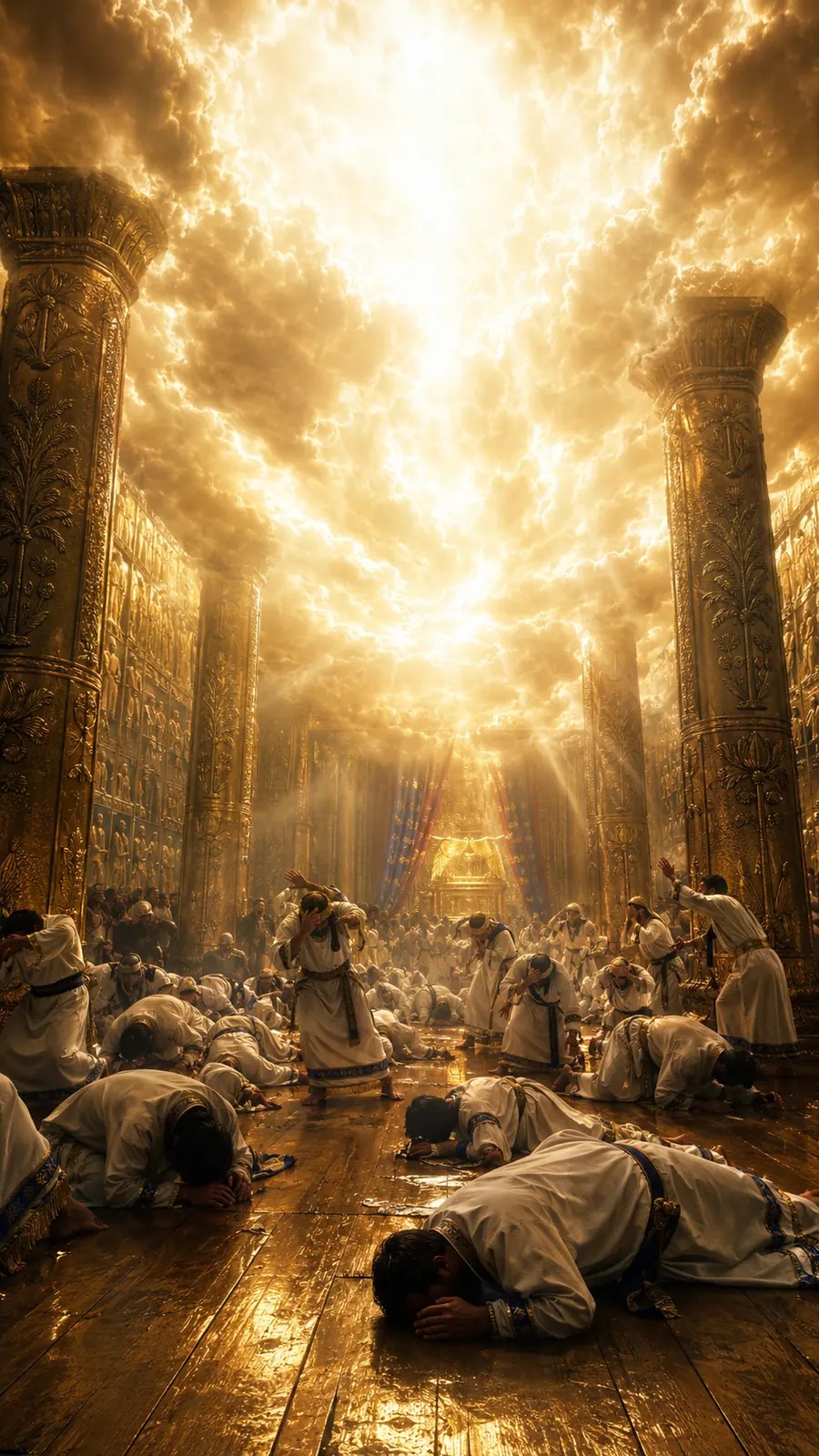
A Escritura ao lado do resumo
1 Reis · Versão King James · 661 Reis 8:1-8
Versículos 1–8: Solomon assembled the elders of Israel, and all the heads of the tribes…
1 Reis 8:1–8 abre com “Then Solomon assembled the elders of Israel, and all the heads of the tribes, the chief of the…” e chega a “And they drew out the staves, that the ends of the staves were seen out in the holy place before…” no último versículo. Esse percurso desenvolve Acompanhe as escolhas, a oposição, o livramento e os fracassos que aprofundam o conflito em 1 Reis.
Estudo aprofundado
1 Reis 8:1–8 forma uma unidade literária. Abre com “Then Solomon assembled the elders of Israel, and all the heads of the tribes, the chief of…”, muda perto do versículo 4 com “And they brought up the ark of the LORD , and the tabernacle of the congregation, and all…” e chega a “And they drew out the staves, that the ends of the staves were seen out in the holy place…”. O narrador cria sentido por meio de quem inicia cada ação, quem responde, o que muda e quais consequências permanecem. Uma ação relatada não é automaticamente aprovada. Como verificação textual, a passagem fonte KJV contém 0 marcadores de fala, 0 perguntas, 0 contrastes e 3 versículos que nomeiam o LORD ou Deus. Esses traços também podem ser comparados com uma tradução bíblica confiável em português.
Cada observação se relaciona ao foco da aula, Acompanhe as escolhas, a oposição, o livramento e os fracassos que aprofundam o conflito em 1 Reis. Algumas afirmações são diretas, outras reúnem vários versículos e outras devem continuar identificadas como interpretação.
Os nomes ou termos que sustentam a cena são Israel, Solomon, David, Ethanim, Jerusalem, Levites. A linguagem numérica inclui two. A mudança mais próxima do centro aparece no versículo 1: “Then Solomon assembled the elders of Israel, and all the heads of the tribes, the chief of the fathers of the children of Israel…” Esse detalhe ajuda a distinguir o ponto de partida do que acontece depois.
Percurso versículo por versículo
- 1 Kings 8:1
“Then Solomon assembled the elders of Israel, and all the heads of the tribes, the chief of the fathers of the children…” A linguagem de promessa, bênção ou aliança precisa de seu destinatário e alcance. Esses detalhes impedem que uma palavra pessoal da história seja separada do contexto.
- 1 Kings 8:2
“And all the men of Israel assembled themselves unto king Solomon at the feast in the month Ethanim, which is the…” Nomear Ethanim e Israel mantém o relato ligado a pessoas ou lugares concretos. Acompanhe onde o nome retorna e o que muda ao redor dele.
- 1 Kings 8:3
“And all the elders of Israel came, and the priests took up the ark.” Nomear Israel mantém o relato ligado a pessoas ou lugares concretos. Acompanhe onde o nome retorna e o que muda ao redor dele.
- 1 Kings 8:4
“And they brought up the ark of the LORD , and the tabernacle of the congregation, and all the holy vessels that were…” Nomear Levites mantém o relato ligado a pessoas ou lugares concretos. Acompanhe onde o nome retorna e o que muda ao redor dele.
- 1 Kings 8:5
“And king Solomon, and all the congregation of Israel, that were assembled unto him, were with him before the ark…” Nomear Israel e Solomon mantém o relato ligado a pessoas ou lugares concretos. Acompanhe onde o nome retorna e o que muda ao redor dele.
- 1 Kings 8:6
“And the priests brought in the ark of the covenant of the LORD unto his place, into the oracle of the house, to the…” A linguagem de promessa, bênção ou aliança precisa de seu destinatário e alcance. Esses detalhes impedem que uma palavra pessoal da história seja separada do contexto.
- 1 Kings 8:7
“For the cherubims spread forth their two wings over the place of the ark, and the cherubims covered the ark and the…” Esta linha fornece uma razão, resultado ou conclusão. Ela deve permanecer ligada à afirmação ou ação que lhe dá sentido.
- 1 Kings 8:8
“And they drew out the staves, that the ends of the staves were seen out in the holy place before the oracle, and they…” Os termos próprios desta linha incluem seen, staves, drew. A relação com os versículos 7 permite verificar sua função na passagem.
1 Reis 8:1-8
Versão King James1Then Solomon assembled the elders of Israel, and all the heads of the tribes, the chief of the fathers of the children of Israel, unto king Solomon in Jerusalem, that they might bring up the ark of the covenant of the LORD out of the city of David, which is Zion.
2And all the men of Israel assembled themselves unto king Solomon at the feast in the month Ethanim, which is the seventh month.
3And all the elders of Israel came, and the priests took up the ark.
4And they brought up the ark of the LORD , and the tabernacle of the congregation, and all the holy vessels that were in the tabernacle, even those did the priests and the Levites bring up.
5And king Solomon, and all the congregation of Israel, that were assembled unto him, were with him before the ark, sacrificing sheep and oxen, that could not be told nor numbered for multitude.
6And the priests brought in the ark of the covenant of the LORD unto his place, into the oracle of the house, to the most holy place, even under the wings of the cherubims.
7For the cherubims spread forth their two wings over the place of the ark, and the cherubims covered the ark and the staves thereof above.
8And they drew out the staves, that the ends of the staves were seen out in the holy place before the oracle, and they were not seen without: and there they are unto this day.
1 Reis 8:9-16
Versículos 9–16: There was nothing in the ark save the two tables of stone, which Moses…
1 Reis 8:9–16 abre com “There was nothing in the ark save the two tables of stone, which Moses put there at Horeb, when…” e chega a “Since the day that I brought forth my people Israel out of Egypt, I chose no city out of all the…” no último versículo. Esse percurso desenvolve Acompanhe as escolhas, a oposição, o livramento e os fracassos que aprofundam o conflito em 1 Reis.
Estudo aprofundado
1 Reis 8:9–16 forma uma unidade literária. Abre com “There was nothing in the ark save the two tables of stone, which Moses put there at Horeb…”, muda perto do versículo 12 com “Then spake Solomon, The LORD said that he would dwell in the thick darkness.” e chega a “Since the day that I brought forth my people Israel out of Egypt, I chose no city out of all…”. O narrador cria sentido por meio de quem inicia cada ação, quem responde, o que muda e quais consequências permanecem. Uma ação relatada não é automaticamente aprovada. Como verificação textual, a passagem fonte KJV contém 2 marcadores de fala, 0 perguntas, 1 contrastes e 5 versículos que nomeiam o LORD ou Deus. Esses traços também podem ser comparados com uma tradução bíblica confiável em português.
Cada observação se relaciona ao foco da aula, Acompanhe as escolhas, a oposição, o livramento e os fracassos que aprofundam o conflito em 1 Reis. Algumas afirmações são diretas, outras reúnem vários versículos e outras devem continuar identificadas como interpretação.
Os nomes ou termos que sustentam a cena são Israel, David, Egypt, Blessed, God, Horeb. A linguagem numérica inclui two. A mudança mais próxima do centro aparece no versículo 12: “Then spake Solomon, The LORD said that he would dwell in the thick darkness.” Esse detalhe ajuda a distinguir o ponto de partida do que acontece depois.
Percurso versículo por versículo
- 1 Kings 8:9
“There was nothing in the ark save the two tables of stone, which Moses put there at Horeb, when the LORD made a…” A linguagem de promessa, bênção ou aliança precisa de seu destinatário e alcance. Esses detalhes impedem que uma palavra pessoal da história seja separada do contexto.
- 1 Kings 8:10
“And it came to pass, when the priests were come out of the holy place, that the cloud filled the house of the LORD ,” Esse conhecido sinal narrativo faz o tempo avançar. O que segue é uma nova cena, consequência ou resposta a uma tensão anterior.
- 1 Kings 8:11
“So that the priests could not stand to minister because of the cloud: for the glory of the LORD had filled the house…” Esta linha fornece uma razão, resultado ou conclusão. Ela deve permanecer ligada à afirmação ou ação que lhe dá sentido.
- 1 Kings 8:12
“Then spake Solomon, The LORD said that he would dwell in the thick darkness.” Nomear Solomon mantém o relato ligado a pessoas ou lugares concretos. Acompanhe onde o nome retorna e o que muda ao redor dele.
- 1 Kings 8:13
“I have surely built thee an house to dwell in, a settled place for thee to abide in for ever.” Os termos próprios desta linha incluem abide, built, dwell. A relação com os versículos 12 e 14 permite verificar sua função na passagem.
- 1 Kings 8:14
“And the king turned his face about, and blessed all the congregation of Israel: (and all the congregation of Israel…” Nomear Israel mantém o relato ligado a pessoas ou lugares concretos. Acompanhe onde o nome retorna e o que muda ao redor dele.
- 1 Kings 8:15
“And he said, Blessed be the LORD God of Israel, which spake with his mouth unto David my father, and hath with his…” Nomear Blessed e David mantém o relato ligado a pessoas ou lugares concretos. Acompanhe onde o nome retorna e o que muda ao redor dele.
- 1 Kings 8:16
“Since the day that I brought forth my people Israel out of Egypt, I chose no city out of all the tribes of Israel to…” Nomear Israel e David mantém o relato ligado a pessoas ou lugares concretos. Acompanhe onde o nome retorna e o que muda ao redor dele.
1 Reis 8:9-16
Versão King James9There was nothing in the ark save the two tables of stone, which Moses put there at Horeb, when the LORD made a covenant with the children of Israel, when they came out of the land of Egypt.
10And it came to pass, when the priests were come out of the holy place, that the cloud filled the house of the LORD ,
11So that the priests could not stand to minister because of the cloud: for the glory of the LORD had filled the house of the LORD .
12Then spake Solomon, The LORD said that he would dwell in the thick darkness.
13I have surely built thee an house to dwell in, a settled place for thee to abide in for ever.
14And the king turned his face about, and blessed all the congregation of Israel: (and all the congregation of Israel stood;)
15And he said, Blessed be the LORD God of Israel, which spake with his mouth unto David my father, and hath with his hand fulfilled it, saying,
16Since the day that I brought forth my people Israel out of Egypt, I chose no city out of all the tribes of Israel to build an house, that my name might be therein; but I chose David to be over my people Israel.
1 Reis 8:17-24
Versículos 17–24: It was in the heart of David my father to build an house for the name of…
1 Reis 8:17–24 abre com “And it was in the heart of David my father to build an house for the name of the LORD God of…” e chega a “Who hast kept with thy servant David my father that thou promisedst him: thou spakest also with…” no último versículo. Esse percurso desenvolve Acompanhe as escolhas, a oposição, o livramento e os fracassos que aprofundam o conflito em 1 Reis.
Estudo aprofundado
1 Reis 8:17–24 forma uma unidade literária. Abre com “And it was in the heart of David my father to build an house for the name of the LORD God of…”, muda perto do versículo 20 com “And the LORD hath performed his word that he spake, and I am risen up in the room of David…” e chega a “Who hast kept with thy servant David my father that thou promisedst him: thou spakest also…”. O narrador cria sentido por meio de quem inicia cada ação, quem responde, o que muda e quais consequências permanecem. Uma ação relatada não é automaticamente aprovada. Como verificação textual, a passagem fonte KJV contém 3 marcadores de fala, 0 perguntas, 1 contrastes e 6 versículos que nomeiam o LORD ou Deus. Esses traços também podem ser comparados com uma tradução bíblica confiável em português.
Cada observação se relaciona ao foco da aula, Acompanhe as escolhas, a oposição, o livramento e os fracassos que aprofundam o conflito em 1 Reis. Algumas afirmações são diretas, outras reúnem vários versículos e outras devem continuar identificadas como interpretação.
Os nomes ou termos que sustentam a cena são Israel, David, God, Egypt, Nevertheless, Solomon. A mudança mais próxima do centro aparece no versículo 19: “Nevertheless thou shalt not build the house; but thy son that shall come forth out of thy loins, he shall build the house unto my…” Esse detalhe ajuda a distinguir o ponto de partida do que acontece depois.
Percurso versículo por versículo
- 1 Kings 8:17
“And it was in the heart of David my father to build an house for the name of the LORD God of Israel.” Nomear David mantém o relato ligado a pessoas ou lugares concretos. Acompanhe onde o nome retorna e o que muda ao redor dele.
- 1 Kings 8:18
“And the LORD said unto David my father, Whereas it was in thine heart to build an house unto my name, thou didst well…” Nomear David e Whereas mantém o relato ligado a pessoas ou lugares concretos. Acompanhe onde o nome retorna e o que muda ao redor dele.
- 1 Kings 8:19
“Nevertheless thou shalt not build the house; but thy son that shall come forth out of thy loins, he shall build the…” A ordem não pode ser entendida apenas pelo verbo. O destinatário, o propósito e seu lugar na aliança ou argumento definem a responsabilidade.
- 1 Kings 8:20
“And the LORD hath performed his word that he spake, and I am risen up in the room of David my father, and sit on the…” Nomear Israel e David mantém o relato ligado a pessoas ou lugares concretos. Acompanhe onde o nome retorna e o que muda ao redor dele.
- 1 Kings 8:21
“And I have set there a place for the ark, wherein is the covenant of the LORD , which he made with our fathers, when…” A linguagem de promessa, bênção ou aliança precisa de seu destinatário e alcance. Esses detalhes impedem que uma palavra pessoal da história seja separada do contexto.
- 1 Kings 8:22
“And Solomon stood before the altar of the LORD in the presence of all the congregation of Israel, and spread forth his…” Nomear Israel e Solomon mantém o relato ligado a pessoas ou lugares concretos. Acompanhe onde o nome retorna e o que muda ao redor dele.
- 1 Kings 8:23
“And he said, LORD God of Israel, there is no God like thee, in heaven above, or on earth beneath, who keepest covenant…” A linguagem de promessa, bênção ou aliança precisa de seu destinatário e alcance. Esses detalhes impedem que uma palavra pessoal da história seja separada do contexto.
- 1 Kings 8:24
“Who hast kept with thy servant David my father that thou promisedst him: thou spakest also with thy mouth, and hast…” Nomear David mantém o relato ligado a pessoas ou lugares concretos. Acompanhe onde o nome retorna e o que muda ao redor dele.
1 Reis 8:17-24
Versão King James17And it was in the heart of David my father to build an house for the name of the LORD God of Israel.
18And the LORD said unto David my father, Whereas it was in thine heart to build an house unto my name, thou didst well that it was in thine heart.
19Nevertheless thou shalt not build the house; but thy son that shall come forth out of thy loins, he shall build the house unto my name.
20And the LORD hath performed his word that he spake, and I am risen up in the room of David my father, and sit on the throne of Israel, as the LORD promised, and have built an house for the name of the LORD God of Israel.
21And I have set there a place for the ark, wherein is the covenant of the LORD , which he made with our fathers, when he brought them out of the land of Egypt.
22And Solomon stood before the altar of the LORD in the presence of all the congregation of Israel, and spread forth his hands toward heaven:
23And he said, LORD God of Israel, there is no God like thee, in heaven above, or on earth beneath, who keepest covenant and mercy with thy servants that walk before thee with all their heart:
24Who hast kept with thy servant David my father that thou promisedst him: thou spakest also with thy mouth, and hast fulfilled it with thine hand, as it is this day.
1 Reis 8:25-32
Versículos 25–32: Therefore now, LORD God of Israel, keep with thy servant David my father…
1 Reis 8:25–32 abre com “Therefore now, LORD God of Israel, keep with thy servant David my father that thou promisedst…” e chega a “Then hear thou in heaven, and do, and judge thy servants, condemning the wicked, to bring his…” no último versículo. Esse percurso desenvolve Acompanhe as escolhas, a oposição, o livramento e os fracassos que aprofundam o conflito em 1 Reis.
Estudo aprofundado
1 Reis 8:25–32 forma uma unidade literária. Abre com “Therefore now, LORD God of Israel, keep with thy servant David my father that thou…”, muda perto do versículo 28 com “Yet have thou respect unto the prayer of thy servant, and to his supplication, O LORD my…” e chega a “Then hear thou in heaven, and do, and judge thy servants, condemning the wicked, to bring…”. O narrador cria sentido por meio de quem inicia cada ação, quem responde, o que muda e quais consequências permanecem. Uma ação relatada não é automaticamente aprovada. Como verificação textual, a passagem fonte KJV contém 1 marcadores de fala, 1 perguntas, 2 contrastes e 4 versículos que nomeiam o LORD ou Deus. Esses traços também podem ser comparados com uma tradução bíblica confiável em português.
Cada observação se relaciona ao foco da aula, Acompanhe as escolhas, a oposição, o livramento e os fracassos que aprofundam o conflito em 1 Reis. Algumas afirmações são diretas, outras reúnem vários versículos e outras devem continuar identificadas como interpretação.
Os nomes ou termos que sustentam a cena são God, Israel, David, Yet. A mudança mais próxima do centro aparece no versículo 27: “But will God indeed dwell on the earth? behold, the heaven and heaven of heavens cannot contain thee; how much less this house…” Esse detalhe ajuda a distinguir o ponto de partida do que acontece depois.
Percurso versículo por versículo
- 1 Kings 8:25
“Therefore now, LORD God of Israel, keep with thy servant David my father that thou promisedst him, saying, There shall…” Esta linha fornece uma razão, resultado ou conclusão. Ela deve permanecer ligada à afirmação ou ação que lhe dá sentido.
- 1 Kings 8:26
“And now, O God of Israel, let thy word, I pray thee, be verified, which thou spakest unto thy servant David my father.” Nomear David mantém o relato ligado a pessoas ou lugares concretos. Acompanhe onde o nome retorna e o que muda ao redor dele.
- 1 Kings 8:27
“But will God indeed dwell on the earth? behold, the heaven and heaven of heavens cannot contain thee; how much less…” A pergunta desacelera a passagem. Observe quem precisa responder, o que ela pressupõe e se as linhas seguintes apresentam uma resposta.
- 1 Kings 8:28
“Yet have thou respect unto the prayer of thy servant, and to his supplication, O LORD my God, to hearken unto the cry…” Nomear Yet mantém o relato ligado a pessoas ou lugares concretos. Acompanhe onde o nome retorna e o que muda ao redor dele.
- 1 Kings 8:29
“That thine eyes may be open toward this house night and day, even toward the place of which thou hast said, My name…” A ordem não pode ser entendida apenas pelo verbo. O destinatário, o propósito e seu lugar na aliança ou argumento definem a responsabilidade.
- 1 Kings 8:30
“And hearken thou to the supplication of thy servant, and of thy people Israel, when they shall pray toward this place…” A ordem não pode ser entendida apenas pelo verbo. O destinatário, o propósito e seu lugar na aliança ou argumento definem a responsabilidade.
- 1 Kings 8:31
“If any man trespass against his neighbour, and an oath be laid upon him to cause him to swear, and the oath come…” A linguagem de promessa, bênção ou aliança precisa de seu destinatário e alcance. Esses detalhes impedem que uma palavra pessoal da história seja separada do contexto.
- 1 Kings 8:32
“Then hear thou in heaven, and do, and judge thy servants, condemning the wicked, to bring his way upon his head; and…” Os termos próprios desta linha incluem condemning, head, hear. A relação com os versículos 31 permite verificar sua função na passagem.
1 Reis 8:25-32
Versão King James25Therefore now, LORD God of Israel, keep with thy servant David my father that thou promisedst him, saying, There shall not fail thee a man in my sight to sit on the throne of Israel; so that thy children take heed to their way, that they walk before me as thou hast walked before me.
26And now, O God of Israel, let thy word, I pray thee, be verified, which thou spakest unto thy servant David my father.
27But will God indeed dwell on the earth? behold, the heaven and heaven of heavens cannot contain thee; how much less this house that I have builded?
28Yet have thou respect unto the prayer of thy servant, and to his supplication, O LORD my God, to hearken unto the cry and to the prayer, which thy servant prayeth before thee to day:
29That thine eyes may be open toward this house night and day, even toward the place of which thou hast said, My name shall be there: that thou mayest hearken unto the prayer which thy servant shall make toward this place.
30And hearken thou to the supplication of thy servant, and of thy people Israel, when they shall pray toward this place: and hear thou in heaven thy dwelling place: and when thou hearest, forgive.
31If any man trespass against his neighbour, and an oath be laid upon him to cause him to swear, and the oath come before thine altar in this house:
32Then hear thou in heaven, and do, and judge thy servants, condemning the wicked, to bring his way upon his head; and justifying the righteous, to give him according to his righteousness.
1 Reis 8:33-40
Versículos 33–40: When thy people Israel be smitten down before the enemy, because they…
1 Reis 8:33–40 abre com “When thy people Israel be smitten down before the enemy, because they have sinned against thee…” e chega a “That they may fear thee all the days that they live in the land which thou gavest unto our…” no último versículo. Esse percurso desenvolve Acompanhe as escolhas, a oposição, o livramento e os fracassos que aprofundam o conflito em 1 Reis.
Estudo aprofundado
1 Reis 8:33–40 forma uma unidade literária. Abre com “When thy people Israel be smitten down before the enemy, because they have sinned against…”, muda perto do versículo 36 com “Then hear thou in heaven, and forgive the sin of thy servants, and of thy people Israel…” e chega a “That they may fear thee all the days that they live in the land which thou gavest unto our…”. O narrador cria sentido por meio de quem inicia cada ação, quem responde, o que muda e quais consequências permanecem. Uma ação relatada não é automaticamente aprovada. Como verificação textual, a passagem fonte KJV contém 0 marcadores de fala, 0 perguntas, 0 contrastes e 0 versículos que nomeiam o LORD ou Deus. Esses traços também podem ser comparados com uma tradução bíblica confiável em português.
Cada observação se relaciona ao foco da aula, Acompanhe as escolhas, a oposição, o livramento e os fracassos que aprofundam o conflito em 1 Reis. Algumas afirmações são diretas, outras reúnem vários versículos e outras devem continuar identificadas como interpretação.
Os nomes ou termos que sustentam a cena são Israel. A mudança mais próxima do centro aparece no versículo 36: “Then hear thou in heaven, and forgive the sin of thy servants, and of thy people Israel, that thou teach them the good way wherein…” Esse detalhe ajuda a distinguir o ponto de partida do que acontece depois.
Percurso versículo por versículo
- 1 Kings 8:33
“When thy people Israel be smitten down before the enemy, because they have sinned against thee, and shall turn again…” A ordem não pode ser entendida apenas pelo verbo. O destinatário, o propósito e seu lugar na aliança ou argumento definem a responsabilidade.
- 1 Kings 8:34
“Then hear thou in heaven, and forgive the sin of thy people Israel, and bring them again unto the land which thou…” Nomear Israel mantém o relato ligado a pessoas ou lugares concretos. Acompanhe onde o nome retorna e o que muda ao redor dele.
- 1 Kings 8:35
“When heaven is shut up, and there is no rain, because they have sinned against thee; if they pray toward this place…” Os termos próprios desta linha incluem afflictest, confess, heaven. A relação com os versículos 34 e 36 permite verificar sua função na passagem.
- 1 Kings 8:36
“Then hear thou in heaven, and forgive the sin of thy servants, and of thy people Israel, that thou teach them the good…” Nomear Israel mantém o relato ligado a pessoas ou lugares concretos. Acompanhe onde o nome retorna e o que muda ao redor dele.
- 1 Kings 8:37
“If there be in the land famine, if there be pestilence, blasting, mildew, locust, or if there be caterpiller; if their…” Os termos próprios desta linha incluem land, besiege, blasting. A relação com os versículos 36 e 38 permite verificar sua função na passagem.
- 1 Kings 8:38
“What prayer and supplication soever be made by any man, or by all thy people Israel, which shall know every man the…” A ordem não pode ser entendida apenas pelo verbo. O destinatário, o propósito e seu lugar na aliança ou argumento definem a responsabilidade.
- 1 Kings 8:39
“Then hear thou in heaven thy dwelling place, and forgive, and do, and give to every man according to his ways, whose…” Os termos próprios desta linha incluem knowest, children, dwelling. A relação com os versículos 38 e 40 permite verificar sua função na passagem.
- 1 Kings 8:40
“That they may fear thee all the days that they live in the land which thou gavest unto our fathers.” Os termos próprios desta linha incluem days, fathers, fear. A relação com os versículos 39 permite verificar sua função na passagem.
1 Reis 8:33-40
Versão King James33When thy people Israel be smitten down before the enemy, because they have sinned against thee, and shall turn again to thee, and confess thy name, and pray, and make supplication unto thee in this house:
34Then hear thou in heaven, and forgive the sin of thy people Israel, and bring them again unto the land which thou gavest unto their fathers.
35When heaven is shut up, and there is no rain, because they have sinned against thee; if they pray toward this place, and confess thy name, and turn from their sin, when thou afflictest them:
36Then hear thou in heaven, and forgive the sin of thy servants, and of thy people Israel, that thou teach them the good way wherein they should walk, and give rain upon thy land, which thou hast given to thy people for an inheritance.
37If there be in the land famine, if there be pestilence, blasting, mildew, locust, or if there be caterpiller; if their enemy besiege them in the land of their cities; whatsoever plague, whatsoever sickness there be;
38What prayer and supplication soever be made by any man, or by all thy people Israel, which shall know every man the plague of his own heart, and spread forth his hands toward this house:
39Then hear thou in heaven thy dwelling place, and forgive, and do, and give to every man according to his ways, whose heart thou knowest; (for thou, even thou only, knowest the hearts of all the children of men;)
40That they may fear thee all the days that they live in the land which thou gavest unto our fathers.
1 Reis 8:41-48
Versículos 41–48: Moreover concerning a stranger, that is not of thy people Israel, but…
1 Reis 8:41–48 abre com “Moreover concerning a stranger, that is not of thy people Israel, but cometh out of a far…” e chega a “And so return unto thee with all their heart, and with all their soul, in the land of their…” no último versículo. Esse percurso desenvolve Acompanhe as escolhas, a oposição, o livramento e os fracassos que aprofundam o conflito em 1 Reis.
Estudo aprofundado
1 Reis 8:41–48 forma uma unidade literária. Abre com “Moreover concerning a stranger, that is not of thy people Israel, but cometh out of a far…”, muda perto do versículo 44 com “If thy people go out to battle against their enemy, whithersoever thou shalt send them, and…” e chega a “And so return unto thee with all their heart, and with all their soul, in the land of their…”. O narrador cria sentido por meio de quem inicia cada ação, quem responde, o que muda e quais consequências permanecem. Uma ação relatada não é automaticamente aprovada. Como verificação textual, a passagem fonte KJV contém 1 marcadores de fala, 0 perguntas, 2 contrastes e 1 versículos que nomeiam o LORD ou Deus. Esses traços também podem ser comparados com uma tradução bíblica confiável em português.
Cada observação se relaciona ao foco da aula, Acompanhe as escolhas, a oposição, o livramento e os fracassos que aprofundam o conflito em 1 Reis. Algumas afirmações são diretas, outras reúnem vários versículos e outras devem continuar identificadas como interpretação.
Os nomes ou termos que sustentam a cena são Israel, Hear, Moreover, Yet. A mudança mais próxima do centro aparece no versículo 45: “Then hear thou in heaven their prayer and their supplication, and maintain their cause.” Esse detalhe ajuda a distinguir o ponto de partida do que acontece depois.
Percurso versículo por versículo
- 1 Kings 8:41
“Moreover concerning a stranger, that is not of thy people Israel, but cometh out of a far country for thy name’s sake;” Nomear Israel e Moreover mantém o relato ligado a pessoas ou lugares concretos. Acompanhe onde o nome retorna e o que muda ao redor dele.
- 1 Kings 8:42
“(For they shall hear of thy great name, and of thy strong hand, and of thy stretched out arm;) when he shall come and…” A ordem não pode ser entendida apenas pelo verbo. O destinatário, o propósito e seu lugar na aliança ou argumento definem a responsabilidade.
- 1 Kings 8:43
“Hear thou in heaven thy dwelling place, and do according to all that the stranger calleth to thee for: that all people…” Nomear Hear e Israel mantém o relato ligado a pessoas ou lugares concretos. Acompanhe onde o nome retorna e o que muda ao redor dele.
- 1 Kings 8:44
“If thy people go out to battle against their enemy, whithersoever thou shalt send them, and shall pray unto the LORD…” A ordem não pode ser entendida apenas pelo verbo. O destinatário, o propósito e seu lugar na aliança ou argumento definem a responsabilidade.
- 1 Kings 8:45
“Then hear thou in heaven their prayer and their supplication, and maintain their cause.” Os termos próprios desta linha incluem cause, hear, heaven. A relação com os versículos 44 e 46 permite verificar sua função na passagem.
- 1 Kings 8:46
“If they sin against thee, (for there is no man that sinneth not,) and thou be angry with them, and deliver them to the…” Os termos próprios desta linha incluem enemy, angry, captives. A relação com os versículos 45 e 47 permite verificar sua função na passagem.
- 1 Kings 8:47
“Yet if they shall bethink themselves in the land whither they were carried captives, and repent, and make supplication…” A ordem não pode ser entendida apenas pelo verbo. O destinatário, o propósito e seu lugar na aliança ou argumento definem a responsabilidade.
- 1 Kings 8:48
“And so return unto thee with all their heart, and with all their soul, in the land of their enemies, which led them…” Os termos próprios desta linha incluem land, built, captive. A relação com os versículos 47 permite verificar sua função na passagem.
1 Reis 8:41-48
Versão King James41Moreover concerning a stranger, that is not of thy people Israel, but cometh out of a far country for thy name’s sake;
42(For they shall hear of thy great name, and of thy strong hand, and of thy stretched out arm;) when he shall come and pray toward this house;
43Hear thou in heaven thy dwelling place, and do according to all that the stranger calleth to thee for: that all people of the earth may know thy name, to fear thee, as do thy people Israel; and that they may know that this house, which I have builded, is called by thy name.
44If thy people go out to battle against their enemy, whithersoever thou shalt send them, and shall pray unto the LORD toward the city which thou hast chosen, and toward the house that I have built for thy name:
45Then hear thou in heaven their prayer and their supplication, and maintain their cause.
46If they sin against thee, (for there is no man that sinneth not,) and thou be angry with them, and deliver them to the enemy, so that they carry them away captives unto the land of the enemy, far or near;
47Yet if they shall bethink themselves in the land whither they were carried captives, and repent, and make supplication unto thee in the land of them that carried them captives, saying, We have sinned, and have done perversely, we have committed wickedness;
48And so return unto thee with all their heart, and with all their soul, in the land of their enemies, which led them away captive, and pray unto thee toward their land, which thou gavest unto their fathers, the city which thou hast chosen, and the house which I have built for thy name:
1 Reis 8:49-56
Versículos 49–56: Hear thou their prayer and their supplication in heaven thy dwelling…
1 Reis 8:49–56 abre com “Then hear thou their prayer and their supplication in heaven thy dwelling place, and maintain…” e chega a “Blessed be the LORD , that hath given rest unto his people Israel, according to all that he…” no último versículo. Esse percurso desenvolve Acompanhe as escolhas, a oposição, o livramento e os fracassos que aprofundam o conflito em 1 Reis.
Estudo aprofundado
1 Reis 8:49–56 forma uma unidade literária. Abre com “Then hear thou their prayer and their supplication in heaven thy dwelling place, and…”, muda perto do versículo 52 com “That thine eyes may be open unto the supplication of thy servant, and unto the supplication…” e chega a “Blessed be the LORD , that hath given rest unto his people Israel, according to all that he…”. O narrador cria sentido por meio de quem inicia cada ação, quem responde, o que muda e quais consequências permanecem. Uma ação relatada não é automaticamente aprovada. Como verificação textual, a passagem fonte KJV contém 0 marcadores de fala, 0 perguntas, 0 contrastes e 3 versículos que nomeiam o LORD ou Deus. Esses traços também podem ser comparados com uma tradução bíblica confiável em português.
Cada observação se relaciona ao foco da aula, Acompanhe as escolhas, a oposição, o livramento e os fracassos que aprofundam o conflito em 1 Reis. Algumas afirmações são diretas, outras reúnem vários versículos e outras devem continuar identificadas como interpretação.
Os nomes ou termos que sustentam a cena são Israel, Egypt, Moses, Blessed, Lord, Solomon. A linguagem numérica inclui one. A mudança mais próxima do centro aparece no versículo 49: “Then hear thou their prayer and their supplication in heaven thy dwelling place, and maintain their cause,” Esse detalhe ajuda a distinguir o ponto de partida do que acontece depois.
Percurso versículo por versículo
- 1 Kings 8:49
“Then hear thou their prayer and their supplication in heaven thy dwelling place, and maintain their cause,” Os termos próprios desta linha incluem cause, dwelling, hear. A relação com os versículos 50 permite verificar sua função na passagem.
- 1 Kings 8:50
“And forgive thy people that have sinned against thee, and all their transgressions wherein they have transgressed…” Os termos próprios desta linha incluem compassion, captive, carried. A relação com os versículos 49 e 51 permite verificar sua função na passagem.
- 1 Kings 8:51
“For they be thy people, and thine inheritance, which thou broughtest forth out of Egypt, from the midst of the furnace…” Esta linha fornece uma razão, resultado ou conclusão. Ela deve permanecer ligada à afirmação ou ação que lhe dá sentido.
- 1 Kings 8:52
“That thine eyes may be open unto the supplication of thy servant, and unto the supplication of thy people Israel, to…” Nomear Israel mantém o relato ligado a pessoas ou lugares concretos. Acompanhe onde o nome retorna e o que muda ao redor dele.
- 1 Kings 8:53
“For thou didst separate them from among all the people of the earth, to be thine inheritance, as thou spakest by the…” Esta linha fornece uma razão, resultado ou conclusão. Ela deve permanecer ligada à afirmação ou ação que lhe dá sentido.
- 1 Kings 8:54
“And it was so, that when Solomon had made an end of praying all this prayer and supplication unto the LORD , he arose…” Nomear Solomon mantém o relato ligado a pessoas ou lugares concretos. Acompanhe onde o nome retorna e o que muda ao redor dele.
- 1 Kings 8:55
“And he stood, and blessed all the congregation of Israel with a loud voice, saying,” Nomear Israel mantém o relato ligado a pessoas ou lugares concretos. Acompanhe onde o nome retorna e o que muda ao redor dele.
- 1 Kings 8:56
“Blessed be the LORD , that hath given rest unto his people Israel, according to all that he promised: there hath not…” A linguagem de promessa, bênção ou aliança precisa de seu destinatário e alcance. Esses detalhes impedem que uma palavra pessoal da história seja separada do contexto.
1 Reis 8:49-56
Versão King James49Then hear thou their prayer and their supplication in heaven thy dwelling place, and maintain their cause,
50And forgive thy people that have sinned against thee, and all their transgressions wherein they have transgressed against thee, and give them compassion before them who carried them captive, that they may have compassion on them:
51For they be thy people, and thine inheritance, which thou broughtest forth out of Egypt, from the midst of the furnace of iron:
52That thine eyes may be open unto the supplication of thy servant, and unto the supplication of thy people Israel, to hearken unto them in all that they call for unto thee.
53For thou didst separate them from among all the people of the earth, to be thine inheritance, as thou spakest by the hand of Moses thy servant, when thou broughtest our fathers out of Egypt, O Lord GOD .
54And it was so, that when Solomon had made an end of praying all this prayer and supplication unto the LORD , he arose from before the altar of the LORD , from kneeling on his knees with his hands spread up to heaven.
55And he stood, and blessed all the congregation of Israel with a loud voice, saying,
56Blessed be the LORD , that hath given rest unto his people Israel, according to all that he promised: there hath not failed one word of all his good promise, which he promised by the hand of Moses his servant.
1 Reis 8:57-64
Versículos 57–64: The LORD our God be with us, as he was with our fathers: let him not…
1 Reis 8:57–64 abre com “The LORD our God be with us, as he was with our fathers: let him not leave us, nor forsake us:” e chega a “The same day did the king hallow the middle of the court that was before the house of the LORD …” no último versículo. Esse percurso desenvolve Acompanhe as escolhas, a oposição, o livramento e os fracassos que aprofundam o conflito em 1 Reis.
Estudo aprofundado
1 Reis 8:57–64 forma uma unidade literária. Abre com “The LORD our God be with us, as he was with our fathers: let him not leave us, nor forsake…”, muda perto do versículo 60 com “That all the people of the earth may know that the LORD is God, and that there is none else.” e chega a “The same day did the king hallow the middle of the court that was before the house of the…”. O narrador cria sentido por meio de quem inicia cada ação, quem responde, o que muda e quais consequências permanecem. Uma ação relatada não é automaticamente aprovada. Como verificação textual, a passagem fonte KJV contém 0 marcadores de fala, 0 perguntas, 0 contrastes e 7 versículos que nomeiam o LORD ou Deus. Esses traços também podem ser comparados com uma tradução bíblica confiável em português.
Cada observação se relaciona ao foco da aula, Acompanhe as escolhas, a oposição, o livramento e os fracassos que aprofundam o conflito em 1 Reis. Algumas afirmações são diretas, outras reúnem vários versículos e outras devem continuar identificadas como interpretação.
Os nomes ou termos que sustentam a cena são God, Israel, Solomon. A linguagem numérica inclui two, twenty, thousand, hundred. A mudança mais próxima do centro aparece no versículo 60: “That all the people of the earth may know that the LORD is God, and that there is none else.” Esse detalhe ajuda a distinguir o ponto de partida do que acontece depois.
Percurso versículo por versículo
- 1 Kings 8:57
“The LORD our God be with us, as he was with our fathers: let him not leave us, nor forsake us:” O versículo nomeia God em vez de deixar a ação sem uma fonte. Observe se a linha seguinte continua, responde ou contrasta essa ação.
- 1 Kings 8:58
“That he may incline our hearts unto him, to walk in all his ways, and to keep his commandments, and his statutes, and…” A ordem não pode ser entendida apenas pelo verbo. O destinatário, o propósito e seu lugar na aliança ou argumento definem a responsabilidade.
- 1 Kings 8:59
“And let these my words, wherewith I have made supplication before the LORD , be nigh unto the LORD our God day and…” A ordem não pode ser entendida apenas pelo verbo. O destinatário, o propósito e seu lugar na aliança ou argumento definem a responsabilidade.
- 1 Kings 8:60
“That all the people of the earth may know that the LORD is God, and that there is none else.” O versículo nomeia God em vez de deixar a ação sem uma fonte. Observe se a linha seguinte continua, responde ou contrasta essa ação.
- 1 Kings 8:61
“Let your heart therefore be perfect with the LORD our God, to walk in his statutes, and to keep his commandments, as…” O versículo nomeia God em vez de deixar a ação sem uma fonte. Observe se a linha seguinte continua, responde ou contrasta essa ação.
- 1 Kings 8:62
“And the king, and all Israel with him, offered sacrifice before the LORD .” Nomear Israel mantém o relato ligado a pessoas ou lugares concretos. Acompanhe onde o nome retorna e o que muda ao redor dele.
- 1 Kings 8:63
“And Solomon offered a sacrifice of peace offerings, which he offered unto the LORD , two and twenty thousand oxen, and…” O número two torna o relato concreto. Antes de decidir seu peso, observe se mede tempo, pessoas, distância, repetição ou totalidade.
- 1 Kings 8:64
“The same day did the king hallow the middle of the court that was before the house of the LORD : for there he offered…” Os termos próprios desta linha incluem offerings, burnt, LORD. A relação com os versículos 63 permite verificar sua função na passagem.
1 Reis 8:57-64
Versão King James57The LORD our God be with us, as he was with our fathers: let him not leave us, nor forsake us:
58That he may incline our hearts unto him, to walk in all his ways, and to keep his commandments, and his statutes, and his judgments, which he commanded our fathers.
59And let these my words, wherewith I have made supplication before the LORD , be nigh unto the LORD our God day and night, that he maintain the cause of his servant, and the cause of his people Israel at all times, as the matter shall require:
60That all the people of the earth may know that the LORD is God, and that there is none else.
61Let your heart therefore be perfect with the LORD our God, to walk in his statutes, and to keep his commandments, as at this day.
62And the king, and all Israel with him, offered sacrifice before the LORD .
63And Solomon offered a sacrifice of peace offerings, which he offered unto the LORD , two and twenty thousand oxen, and an hundred and twenty thousand sheep. So the king and all the children of Israel dedicated the house of the LORD .
64The same day did the king hallow the middle of the court that was before the house of the LORD : for there he offered burnt offerings, and meat offerings, and the fat of the peace offerings: because the brasen altar that was before the LORD was too little to receive the burnt offerings, and meat offerings, and the fat of the peace offerings.
1 Reis 8:65-66
Versículos 65–66: At that time Solomon held a feast, and all Israel with him, a great…
1 Reis 8:65–66 abre com “And at that time Solomon held a feast, and all Israel with him, a great congregation, from the…” e chega a “On the eighth day he sent the people away: and they blessed the king, and went unto their tents…” no último versículo. Esse percurso desenvolve Acompanhe as escolhas, a oposição, o livramento e os fracassos que aprofundam o conflito em 1 Reis.
Estudo aprofundado
1 Reis 8:65–66 forma uma unidade literária. Abre com “And at that time Solomon held a feast, and all Israel with him, a great congregation, from…”, muda perto do versículo 65 com “And at that time Solomon held a feast, and all Israel with him, a great congregation, from…” e chega a “On the eighth day he sent the people away: and they blessed the king, and went unto their…”. O narrador cria sentido por meio de quem inicia cada ação, quem responde, o que muda e quais consequências permanecem. Uma ação relatada não é automaticamente aprovada. Como verificação textual, a passagem fonte KJV contém 0 marcadores de fala, 0 perguntas, 0 contrastes e 2 versículos que nomeiam o LORD ou Deus. Esses traços também podem ser comparados com uma tradução bíblica confiável em português.
Cada observação se relaciona ao foco da aula, Acompanhe as escolhas, a oposição, o livramento e os fracassos que aprofundam o conflito em 1 Reis. Algumas afirmações são diretas, outras reúnem vários versículos e outras devem continuar identificadas como interpretação.
Os nomes ou termos que sustentam a cena são Israel, David, Egypt, God, Hamath, Solomon. A linguagem numérica inclui seven. A mudança mais próxima do centro aparece no versículo 65: “And at that time Solomon held a feast, and all Israel with him, a great congregation, from the entering in of Hamath unto the…” Esse detalhe ajuda a distinguir o ponto de partida do que acontece depois.
Percurso versículo por versículo
- 1 Kings 8:65
“And at that time Solomon held a feast, and all Israel with him, a great congregation, from the entering in of Hamath…” O número seven torna o relato concreto. Antes de decidir seu peso, observe se mede tempo, pessoas, distância, repetição ou totalidade.
- 1 Kings 8:66
“On the eighth day he sent the people away: and they blessed the king, and went unto their tents joyful and glad of…” Nomear David e Israel mantém o relato ligado a pessoas ou lugares concretos. Acompanhe onde o nome retorna e o que muda ao redor dele.
1 Reis 8:65-66
Versão King James65And at that time Solomon held a feast, and all Israel with him, a great congregation, from the entering in of Hamath unto the river of Egypt, before the LORD our God, seven days and seven days, even fourteen days.
66On the eighth day he sent the people away: and they blessed the king, and went unto their tents joyful and glad of heart for all the goodness that the LORD had done for David his servant, and for Israel his people.
Recursos reunidos para este capítulo
O mapa narrativo e a reflexão aprofundada ficam disponíveis como recursos distintos junto deste plano de ensino. Cada um abre em sua própria página.
Guia de ensino específico do capítulo
Estes pontos nascem do próprio capítulo. Eles ajudam a unir o mapa narrativo do Nível 1, a análise do Nível 2 e o texto bíblico em uma só aula.
Comece com a primeira imagem do capítulo
1 Kings 8:1: “Then Solomon assembled the elders of Israel, and all the heads of the tribes, the chief of the fathers of the children of Israel, unto king Solomon in…”
Diminua o ritmo no ponto de mudança
1 Kings 8:32: “Then hear thou in heaven, and do, and judge thy servants, condemning the wicked, to bring his way upon his head; and justifying the righteous, to give him…”
Mantenha este caminho de palavras visível
LORD, Israel, house, people, place, heaven
Observação e orientação de ensino
- Acompanhe quem age, quem fala, quem é afetado e o que muda.
- Observe promessas, fracassos, livramentos e consequências repetidas.
- Não suponha que o narrador aprove toda ação que relata.
Primeiro o texto
Onde os leitores divergem
O resumo começa com o que a passagem diz e como suas partes se relacionam. Ele não presume que uma denominação já resolveu todas as questões. A dependência de uma tradição, teoria literária ou reconstrução histórica é claramente identificada.
O texto KJV aparece primeiro. As conclusões interpretativas são identificadas, e as diferenças surgem quando ajudam a explicar por que comunidades sérias nem sempre chegam à mesma resposta.
As notas interpretativas comparativas deste capítulo estão em preparação. Até que as notas revisadas estejam prontas, esta página separa o texto KJV do resumo e da aplicação sem afirmar que leitores responsáveis concordam em todas as questões.
Objetivos de aprendizagem
- Localizar 1 Reis 8 dentro de 1 Reis 8 e explicar sua função em 1 Reis.
- Descrever com evidências como a passagem desenvolve este foco: Acompanhe as escolhas, a oposição, o livramento e os fracassos que aprofundam o conflito em 1 Reis..
- Diferenciar uma afirmação explícita, uma conclusão apoiada pelas Escrituras e uma interpretação.
- Explicar como o gênero narrativa orienta uma leitura responsável.
- Comparar uma música ou vídeo relacionado com a passagem e voltar ao texto para conferência.
- Formular uma resposta pessoal e comunitária que não ultrapasse a evidência bíblica.
Preparação do professor
- Leia 1 Reis 8 duas vezes e leia também o que vem imediatamente antes e depois.
- Revise o movimento do livro: 1 Reis 8 (1 Reis 8).
- Marque falantes, ações, palavras repetidas, ordens, contrastes, promessas e consequências.
- Assista ou ouça previamente a mídia relacionada e anote onde ela resume, interpreta ou dramatiza o texto.
- Prepare uma forma de participação que permita responder sem exigir relatos pessoais.
Verificação de evidência e interpretação
Explícito
Registre duas afirmações que 1 Reis 8 declara diretamente e cite os versículos.
Apoiado pelas Escrituras
Formule uma conclusão que reúna várias partes de 1 Reis 8. Explique cada passo.
Inferência forte
Identifique uma conclusão que acompanha o texto de perto, embora não apareça em uma única frase.
Leitura possível ou tradicional
Se houver leituras responsáveis diferentes, apresente a diferença sem transformá-la em certeza.
Limite
Não use especulação como conclusão de ensino.
Discussão com orientação de resposta
1. O que 1 Reis 8 declara diretamente sobre Deus, as pessoas ou a situação?
Mostrar orientação do professor
Comece com palavras e ações da passagem. Peça uma referência exata antes de aceitar uma conclusão.
2. Como este foco se desenvolve na passagem: Acompanhe as escolhas, a oposição, o livramento e os fracassos que aprofundam o conflito em 1 Reis.?
Mostrar orientação do professor
Acompanhe o começo, a mudança e o resultado. Não dependa de uma frase isolada quando a unidade apresenta uma sequência.
3. Qual palavra, ação, contraste ou resposta se repete, e qual é sua função?
Mostrar orientação do professor
A repetição pode marcar estrutura ou ênfase, mas seu sentido deve ser explicado no contexto.
4. Como esta unidade contribui para o movimento 1 Reis 8?
Mostrar orientação do professor
Compare a unidade com o que vem antes e depois no mesmo livro.
5. Que cuidado o gênero narrativa exige?
Mostrar orientação do professor
Acompanhe o narrador, as escolhas, suas consequências e o que Deus faz sem supor que toda ação relatada recebe aprovação.
6. Que resposta fiel surge da passagem para a pessoa e para a comunidade?
Mostrar orientação do professor
Formule uma ação concreta e proporcional. Não transforme descrição em ordem sem evidência.
Aplicação responsável
Coração e hábitos
Identifique uma crença, desejo ou prática que 1 Reis 8 corrige, fortalece ou redireciona.
Relacionamentos e comunidade
Formule uma ação que proteja dignidade, verdade, justiça, misericórdia ou fidelidade em uma relação real.
Adoração e oração
Escreva uma oração usando o vocabulário e as preocupações da passagem.
Serviço e testemunho
Escolha uma resposta observável para esta semana e uma pessoa que possa acompanhá-lo.
Adaptações por público
Crianças
Use uma seção curta, um mapa de pessoas e ações e uma resposta concreta. Explique palavras difíceis antes da leitura.
Jovens
Peça que identifiquem pressão, lealdade, poder e consequências. Permita respostas escritas sem exposição pública.
Adultos
Acrescente contexto literário e histórico, compare interpretações responsáveis e peça evidência para cada afirmação.
Grupo entre gerações
Forme duplas de idades diferentes, atribua observação antes da interpretação e encerre com oração compartilhada.
On-line ou em casa
Envie a referência com antecedência, use a mídia como pausa de observação e reúna respostas em um documento comum.
Percurso completo de ensino em 75 minutos
Um grupo com menos tempo pode omitir a discussão ampliada, mas deve manter a leitura bíblica, a verificação de evidências e a resposta final.
Orientação
Apresente o livro, 1 Reis 8, o gênero e a pergunta central. Explique que toda conclusão será conferida no texto.
Leitura completa
Leia a unidade em voz alta ou em silêncio. Os participantes marcam falantes, repetições, ordens, contrastes e mudanças.
Leitura em blocos
Percorra as seções guiadas. Resuma cada bloco em uma frase e anote o versículo que sustenta o resumo.
Música ou vídeo
Use um recurso relacionado. Compare suas ênfases e omissões com a passagem.
Discussão com evidências
Use as perguntas e peça uma referência bíblica para cada resposta importante.
Aplicação
Desenvolva uma resposta pessoal e outra comunitária. Evite promessas ou ordens que o texto não estabelece.
Resumo e oração
Cada pessoa completa uma frase sobre a passagem. Ore com as palavras e preocupações do texto.
Laboratório de músicas e vídeos
Use a mídia depois de ler a passagem. Uma música ou um vídeo pode interpretar, resumir ou dramatizar o texto, por isso deve ser comparado com as Escrituras.
- Antes: leia a passagem exata e identifique seu movimento central.
- Durante: observe quais palavras, pessoas, acontecimentos ou emoções o artista destaca.
- Depois: identifique o que a mídia esclarece, o que deixa de fora e o que precisa ser conferido no texto.