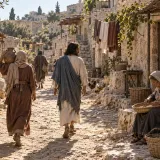
The big picture
The debate over Jesus, the teacher who speaks of God as his Father, grows sharper. He teaches at the temple, the place of worship in Jerusalem, the chief Jewish city. Some religious leaders try to trap him with a charge against a woman. Later arguments turn on his right to speak for God. Even people who begin to believe resist his claim that they need freedom. By the end, his words about his own life provoke a threat to kill him.
In this chapter
- The Accusers Leave the Woman John 8:1-11
After a night on the mount of Olives, a nearby hill, Jesus resumes teaching.
- Light and Two Witnesses John 8:12-20
Calling himself the world's light, Jesus promises life to those who follow him.
- His Origin and His Departure John 8:21-30
Warning that he will leave, Jesus says his opponents cannot follow him.
- Freedom Through the Son John 8:31-38
Addressing Jews who have begun to believe, Jesus says real followers remain with his teaching.
- Conduct Reveals a Different Father John 8:39-47
His opponents repeat their claim to Abraham as their father.
- A Claim Older Than Abraham John 8:48-59
The opponents insult Jesus as a Samaritan, a person from the neighbouring region of Samaria.
Central truth
Jesus offers mercy and freedom while exposing the guilt of people who reject his words and claim to know God.
Scripture beside the summary
John · King James Version · 59John 8:1-11
The Accusers Leave the Woman
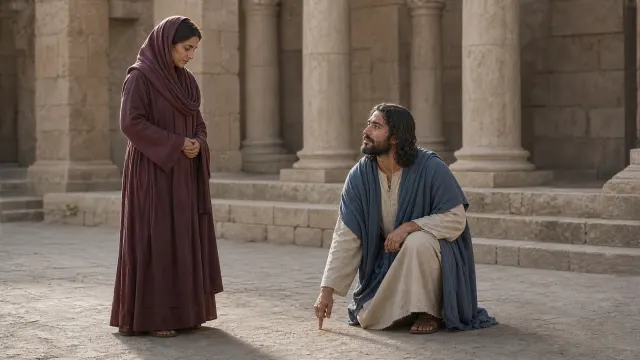
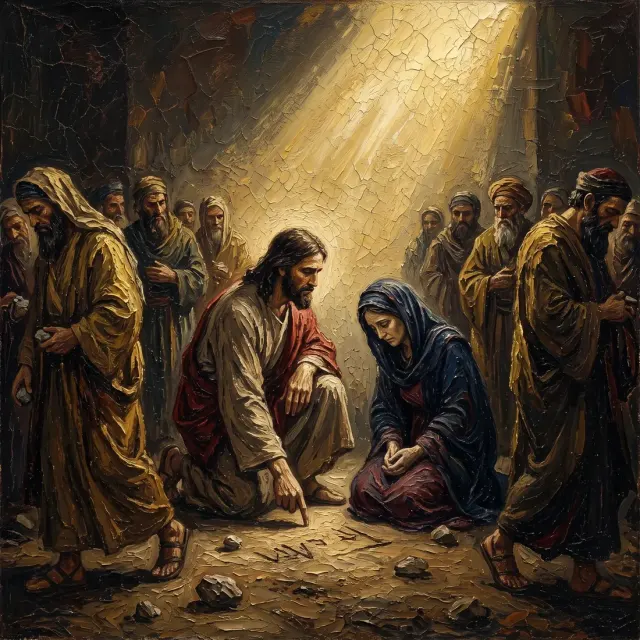
After a night on the mount of Olives, a nearby hill, Jesus resumes teaching. Scribes, teachers of religious law, and Pharisees, a strict religious group, bring a woman before him. They say she was caught in adultery. They cite the stoning penalty in the law of Moses, the leader who gave their ancestors God's commands. Their question seeks grounds to accuse Jesus. He writes on the ground, then tells anyone without sin to throw first. One by one they leave. No accuser remains. Jesus does not condemn her, but tells her to leave her sin behind.
In everyday life
An ethics-panel chair listens as members demand that a neighbour lose her place in their association. He asks each member to disclose their own concealed breaches before signing the charge. Pens stay on the table. The meeting ends without the threatened penalty. Jesus also speaks directly to the woman's sin and her future.
Notice
John 8:7 The test turns toward those holding the charge. Jesus does not deny the woman's sin; he makes her accusers face their own before they act.
John 8:1-11
King James Version1Jesus went unto the mount of Olives.
2And early in the morning he came again into the temple, and all the people came unto him; and he sat down, and taught them.
3And the scribes and Pharisees brought unto him a woman taken in adultery; and when they had set her in the midst,
4They say unto him, Master, this woman was taken in adultery, in the very act.
5Now Moses in the law commanded us, that such should be stoned: but what sayest thou?
6This they said, tempting him, that they might have to accuse him. But Jesus stooped down, and with his finger wrote on the ground, as though he heard them not.
7So when they continued asking him, he lifted up himself, and said unto them, He that is without sin among you, let him first cast a stone at her.
8And again he stooped down, and wrote on the ground.
9And they which heard it, being convicted by their own conscience, went out one by one, beginning at the eldest, even unto the last: and Jesus was left alone, and the woman standing in the midst.
10When Jesus had lifted up himself, and saw none but the woman, he said unto her, Woman, where are those thine accusers? hath no man condemned thee?
11She said, No man, Lord. And Jesus said unto her, Neither do I condemn thee: go, and sin no more.
John 8:12-20
Light and Two Witnesses
Calling himself the world's light, Jesus promises life to those who follow him. The Pharisees object that his own claim cannot prove his case. He answers that he knows where he came from and where he is going. Their judgement rests on human limits. His judgement agrees with the Father who sent him. Their law accepts the word of two witnesses. Jesus names himself and his Father as those witnesses. When they ask where his Father is, he links knowing God with knowing him. No one arrests him yet, because his time has not come.
In everyday life
A cave guide checks his map beside a visitor who doubts the marked exit. The guide has walked the whole route with the surveyor who drew it. The visitor sees only the chamber around them. Their knowledge is not equal, though both stand in the same dark place. Jesus claims knowledge of God, not superior survey skills.
Notice
John 8:19 Their question treats the Father as someone they can locate apart from Jesus. His answer makes their failure to know him a failure to know God.
John 8:12-20
King James Version12Then spake Jesus again unto them, saying, I am the light of the world: he that followeth me shall not walk in darkness, but shall have the light of life.
13The Pharisees therefore said unto him, Thou bearest record of thyself; thy record is not true.
14Jesus answered and said unto them, Though I bear record of myself, yet my record is true: for I know whence I came, and whither I go; but ye cannot tell whence I come, and whither I go.
15Ye judge after the flesh; I judge no man.
16And yet if I judge, my judgment is true: for I am not alone, but I and the Father that sent me.
17It is also written in your law, that the testimony of two men is true.
18I am one that bear witness of myself, and the Father that sent me beareth witness of me.
19Then said they unto him, Where is thy Father? Jesus answered, Ye neither know me, nor my Father: if ye had known me, ye should have known my Father also.
20These words spake Jesus in the treasury, as he taught in the temple: and no man laid hands on him; for his hour was not yet come.
John 8:21-30
His Origin and His Departure
Warning that he will leave, Jesus says his opponents cannot follow him. They wonder whether he means to kill himself. He explains the deeper difference: they belong to this world, while he comes from above. Without belief in who he is, they will die with their sins unresolved. They ask his identity again. He keeps speaking what he has heard from the Father, though they miss that meaning. Lifting up the Son of man, Jesus' name for himself, will reveal who he is. Many hear this and believe.
In everyday life
An embassy courier presents travel papers to a passenger stranded at a border gate. The passenger keeps asking which local desk issued them. The courier points to the country that sent him and the authority on the seal. Refusing that source leaves the passenger without a route home. Jesus speaks of sin and his death, not travel clearance.
Notice
John 8:28 Being lifted up points toward Jesus' coming death. The act meant to remove him will instead disclose his relation to the Father who sent him.
John 8:21-30
King James Version21Then said Jesus again unto them, I go my way, and ye shall seek me, and shall die in your sins: whither I go, ye cannot come.
22Then said the Jews, Will he kill himself? because he saith, Whither I go, ye cannot come.
23And he said unto them, Ye are from beneath; I am from above: ye are of this world; I am not of this world.
24I said therefore unto you, that ye shall die in your sins: for if ye believe not that I am he, ye shall die in your sins.
25Then said they unto him, Who art thou? And Jesus saith unto them, Even the same that I said unto you from the beginning.
26I have many things to say and to judge of you: but he that sent me is true; and I speak to the world those things which I have heard of him.
27They understood not that he spake to them of the Father.
28Then said Jesus unto them, When ye have lifted up the Son of man, then shall ye know that I am he, and that I do nothing of myself; but as my Father hath taught me, I speak these things.
29And he that sent me is with me: the Father hath not left me alone; for I do always those things that please him.
30As he spake these words, many believed on him.
John 8:31-38
Freedom Through the Son
Addressing Jews who have begun to believe, Jesus says real followers remain with his teaching. His truth brings freedom. They appeal to Abraham, their nation's forefather, and deny that they need release from slavery. Jesus shifts the question from family status to sin. Anyone ruled by sin is enslaved, whatever their descent. A servant lacks the son's lasting place in a household. The Son can therefore grant true freedom. Jesus accepts their family link to Abraham. Yet their wish to kill him shows that his word has found no room within them.
In everyday life
A debt adviser sits with a shop owner who proudly displays the deed to his premises. Then they open the unpaid loan notices stacked beneath the till. Owning the building has not freed him from demands that govern each week's choices. He needs release from those claims. Jesus offers freedom from sin rather than a revised payment plan.
Notice
John 8:35 The contrast concerns a secure place in the household. A son's lasting place explains why the freedom Jesus gives differs from a temporary escape.
John 8:31-38
King James Version31Then said Jesus to those Jews which believed on him, If ye continue in my word, then are ye my disciples indeed;
32And ye shall know the truth, and the truth shall make you free.
33They answered him, We be Abraham’s seed, and were never in bondage to any man: how sayest thou, Ye shall be made free?
34Jesus answered them, Verily, verily, I say unto you, Whosoever committeth sin is the servant of sin.
35And the servant abideth not in the house for ever: but the Son abideth ever.
36If the Son therefore shall make you free, ye shall be free indeed.
37I know that ye are Abraham’s seed; but ye seek to kill me, because my word hath no place in you.
38I speak that which I have seen with my Father: and ye do that which ye have seen with your father.
John 8:39-47
Conduct Reveals a Different Father
His opponents repeat their claim to Abraham as their father. Jesus answers that their acts do not match Abraham's. They seek to kill a man who tells them truth from God. They next claim God as their Father. Jesus says that love for him would follow if this were so. Instead, their lies and murderous intent resemble the devil, God's enemy and the source of lies. This charge addresses these opponents and their conduct, not an ethnic group. Jesus asks who can prove him guilty of sin. Their refusal to hear God's words exposes their claim.
In everyday life
A beekeeper's son boasts of the careful methods his father taught him. Beside the hives, he sprays a harsh mixture his father always refused to use. The family name remains on the jars, but his actions contradict the practice he claims to inherit. Jesus tests a claim to God by love and truth, not a trade tradition.
Notice
John 8:42 Jesus tests their claim to love God through their response to God's sent Son. An honoured family claim cannot cancel their hostility toward him.
John 8:39-47
King James Version39They answered and said unto him, Abraham is our father. Jesus saith unto them, If ye were Abraham’s children, ye would do the works of Abraham.
40But now ye seek to kill me, a man that hath told you the truth, which I have heard of God: this did not Abraham.
41Ye do the deeds of your father. Then said they to him, We be not born of fornication; we have one Father, even God.
42Jesus said unto them, If God were your Father, ye would love me: for I proceeded forth and came from God; neither came I of myself, but he sent me.
43Why do ye not understand my speech? even because ye cannot hear my word.
44Ye are of your father the devil, and the lusts of your father ye will do. He was a murderer from the beginning, and abode not in the truth, because there is no truth in him. When he speaketh a lie, he speaketh of his own: for he is a liar, and the father of it.
45And because I tell you the truth, ye believe me not.
46Which of you convinceth me of sin? And if I say the truth, why do ye not believe me?
47He that is of God heareth God’s words: ye therefore hear them not, because ye are not of God.
John 8:48-59
A Claim Older Than Abraham
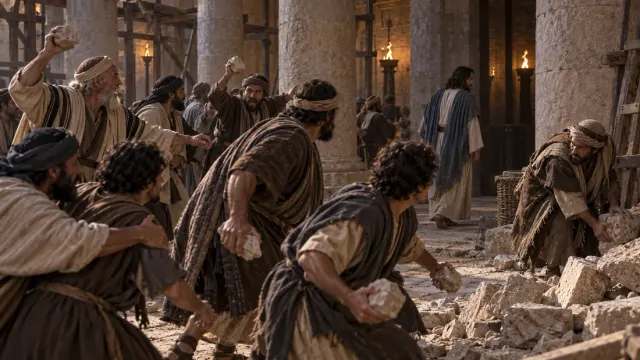
The opponents insult Jesus as a Samaritan, a person from the neighbouring region of Samaria. They also accuse him of having a devil. He denies this and says he honours his Father. Whoever keeps his word will not meet death as a final defeat. They object that Abraham and the prophets, God's earlier messengers, all died. Jesus says his Father grants him honour, and Abraham rejoiced to see his day. They mock his age. Jesus claims existence before Abraham. They take up stones against him, but he leaves the temple unseen.
In everyday life
An archive visitor challenges a witness whose account reaches further back than the date on a display. The witness brings out records that change the whole proposed timeline. The visitor must now face a larger claim than the one first under debate. Jesus claims personal existence before Abraham, something old papers cannot prove for a modern witness.
Notice
John 8:58 Jesus does not merely place himself after Abraham in a family line. His claim reaches before Abraham's life, which makes the following threat intelligible.
John 8:48-59
King James Version48Then answered the Jews, and said unto him, Say we not well that thou art a Samaritan, and hast a devil?
49Jesus answered, I have not a devil; but I honour my Father, and ye do dishonour me.
50And I seek not mine own glory: there is one that seeketh and judgeth.
51Verily, verily, I say unto you, If a man keep my saying, he shall never see death.
52Then said the Jews unto him, Now we know that thou hast a devil. Abraham is dead, and the prophets; and thou sayest, If a man keep my saying, he shall never taste of death.
53Art thou greater than our father Abraham, which is dead? and the prophets are dead: whom makest thou thyself?
54Jesus answered, If I honour myself, my honour is nothing: it is my Father that honoureth me; of whom ye say, that he is your God:
55Yet ye have not known him; but I know him: and if I should say, I know him not, I shall be a liar like unto you: but I know him, and keep his saying.
56Your father Abraham rejoiced to see my day: and he saw it, and was glad.
57Then said the Jews unto him, Thou art not yet fifty years old, and hast thou seen Abraham?
58Jesus said unto them, Verily, verily, I say unto you, Before Abraham was, I am.
59Then took they up stones to cast at him: but Jesus hid himself, and went out of the temple, going through the midst of them, and so passed by.
Details worth noticing
The opening image
John 8:1 begins with “Jesus went unto the mount of Olives.”
Where the chapter turns
John 8:31 forms a natural hinge: “Then said Jesus to those Jews which believed on him, If ye continue in my word, then are ye my disciples indeed;”
The final note
John 8:59 leaves the reader with “Then took they up stones to cast at him: but Jesus hid himself, and went out of the temple, going through the midst of them, and so passed by.”
A word trail through the chapter
The words Father, Jesus, know, Abraham, truth, verily help reveal the chapter’s repeated concerns.
KJV words made clear
- adultery
- Sex with someone other than the person one has married.
- bondage
- The state of being enslaved or held under another power.
Music and video connected to the passage
Related media appears when its Scripture reference overlaps this study. Music and video can illuminate a theme while the biblical text remains the foundation.