The big picture
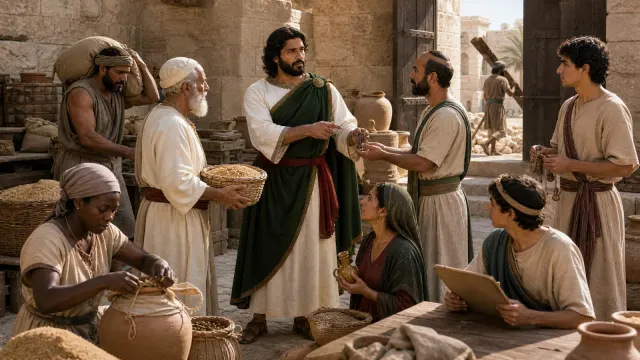
The great feast ends, but Hezekiah's reform becomes more concrete after the crowd goes home. Participants destroy rival worship sites across Judah, Benjamin, Ephraim, and Manasseh, then return to their own cities. Hezekiah turns from exceptional celebration to recurring service: priestly and Levitical courses, daily offerings, sabbaths, new moons, feasts, and the regular material support required to sustain them. The people's response creates literal heaps of grain, wine, oil, honey, animals, and consecrated goods. When the king sees the abundance, he does not merely admire it. He asks whether the ministers are being fed, and the chief priest explains that they have enough and the visible heaps are the surplus. Storehouses and named administrators then turn abundance into accountable distribution, including the priestly cities and families living away from Jerusalem. The chapter closes with genealogies, ages, wives, sons, daughters, and daily portions. Hezekiah's wholehearted seeking of God is shown here not through one dramatic prayer but through storage rooms, registers, fair portions, and the ordinary machinery that keeps worship functioning.
In this chapter
- The Festival Ends; the Work Does Not 2 Chronicles 31:1-4
The festival crowd does not simply disperse with a good memory.
- The Question Is Whether Anyone Is Being Fed 2 Chronicles 31:5-10
The offerings arrive with the smell and weight of the land: grain, wine, oil, honey, livestock, and other consecrated goods.
- Names Attached to the Keys and the Portions 2 Chronicles 31:11-15
Hezekiah orders chambers prepared, and the heaps become an administered store.
- The Registers Include the Household 2 Chronicles 31:16-21
The registers widen the picture from ministers to households.

Scripture beside the summary
2 Chronicles · King James Version · 212 Chronicles 31:1-4
The Festival Ends; the Work Does Not
The festival crowd does not simply disperse with a good memory. Those who have gathered go out into Judah, Benjamin, Ephraim, and Manasseh and destroy images, groves, high places, and altars before returning to their own cities. The movement carries the reform beyond Jerusalem into the places where the participants actually live. Then Hezekiah addresses the harder question of what happens after an exceptional feast. Priests and Levites are assigned by courses, offerings return to the repeating rhythm of mornings, evenings, sabbaths, new moons, and appointed feasts, and the king provides his own portion from his substance. He also commands regular support for the ministers so they can be encouraged in the law of the LORD. The Book of 2 Chronicles has shifted from crowds and loud instruments to calendars and provisions. That is not a loss of spiritual intensity. It is the form restoration must take if worship is to survive ordinary weeks after the great gathering has ended and everyone has gone home.
Deep dive
The opening extends the clearing of Jerusalem into Judah, Benjamin, Ephraim, and Manasseh. Those who have gathered for Passover act beyond the city in which they celebrated it. Their return to their own possessions and cities comes after this destruction of images, groves, high places, and altars. The order links the festival with a change in the places to which the participants are going back.
Hezekiah then addresses what must happen when the exceptional gathering is over. Priests and Levites have assigned courses, while offerings follow the recurring calendar of mornings, evenings, sabbaths, new moons, and appointed feasts. The king supplies his portion from his own resources and commands support for the ministers. The stated purpose is their engagement with the law of the LORD. This is not a second account of one magnificent day. It concerns the provisions that allow the restored service to continue on ordinary days as well.
Words to trace: offerings, burnt, Levites, LORD, priests, appointed
Verse-by-verse path
- 2 Chronicles 31:1
The northerners join in, and the shrines of Ephraim and Manasseh fall too, in land now under Assyrian control. 2 Kings 18:4 adds that Hezekiah broke the bronze serpent Moses had made, which people were burning incense to, and called it Nehushtan, “a piece of brass”. Chronicles leaves that out. “Possession” is ahuzzah, a family’s inherited land.
- 2 Chronicles 31:2
“The tents of the LORD” is literally “the camps of the LORD”, the wilderness word for Israel’s encampment around the tabernacle, applied to the temple courts; 1 Chronicles 9:18–19 speaks the same way of the gatekeepers. The courses are the rotation David set up.
- 2 Chronicles 31:3
Ezekiel’s vision of the restored temple makes this the ruler’s duty: “it shall be the prince’s part to give burnt offerings... in the feasts, and in the new moons, and in the sabbaths” (Ezekiel 45:17). The calendar itself is the one set out in Numbers 28–29.
- 2 Chronicles 31:4
“Encouraged” is hazaq, to be strong: the portions let priests and Levites hold fast to the law instead of scattering to farm. Nehemiah 13:10 shows the alternative, when the portions stopped and “the Levites and the singers... were fled every one to his field.”
2 Chronicles 31:1-4
King James Version1Now when all this was finished, all Israel that were present went out to the cities of Judah, and brake the images in pieces, and cut down the groves, and threw down the high places and the altars out of all Judah and Benjamin, in Ephraim also and Manasseh, until they had utterly destroyed them all. Then all the children of Israel returned, every man to his possession, into their own cities.
2And Hezekiah appointed the courses of the priests and the Levites after their courses, every man according to his service, the priests and Levites for burnt offerings and for peace offerings, to minister, and to give thanks, and to praise in the gates of the tents of the LORD.
3He appointed also the king’s portion of his substance for the burnt offerings, to wit, for the morning and evening burnt offerings, and the burnt offerings for the sabbaths, and for the new moons, and for the set feasts, as it is written in the law of the LORD.
4Moreover he commanded the people that dwelt in Jerusalem to give the portion of the priests and the Levites, that they might be encouraged in the law of the LORD.
2 Chronicles 31:5-10
The Question Is Whether Anyone Is Being Fed
The offerings arrive with the smell and weight of the land: grain, wine, oil, honey, livestock, and other consecrated goods. They do not appear in one spectacular afternoon. The heaps begin in the third month and continue growing until the seventh, turning generosity into a sustained pattern across a season. When Hezekiah and the princes see the abundance, they bless the LORD and the people, but the king also asks a practical question about what he is looking at. Azariah the chief priest answers that the ministers have eaten enough and that the great store is what remains. That distinction matters. A large pile can represent either healthy provision or failed distribution. Here the people responsible for service are being fed, and the visible surplus is precisely surplus. The abundance is attributed to the LORD's blessing of the people, not to depriving those who receive support. The next problem is therefore mundane and essential: where to store what remains and how to make sure it reaches the people entitled to it.
Deep dive
The list gives the offerings the texture of the land: grain, wine, oil, honey, livestock, and other consecrated gifts. The accumulation takes place across months, not during a single dramatic collection. Israelites and Judeans living in Judah's cities both participate, continuing the preceding chapter's concern with a community wider than one regional label.
Hezekiah and the princes bless God and the people when they see the heaps, but the king also asks about them. Azariah's answer distinguishes a large collection from a functioning provision. The ministers have had enough to eat; the visible stock is what remains. The abundance is attributed to God's blessing of the people rather than to the deprivation of those receiving support. The practical problem has become where to put the surplus, which the next verse answers with prepared chambers. The account has moved from the sound of a great feast to the less musical, but necessary, question of storage.
Words to trace: heaps, LORD, Israel, people, tithe, began
Verse-by-verse path
- 2 Chronicles 31:5
Firstfruits of grain, wine and oil are the priests’ due in Deuteronomy 18:4. Honey is unusual: it could not be burned on the altar, but it could be given as firstfruits (Leviticus 2:11–12). Most scholars take it to mean date syrup as well as bees’ honey.
- 2 Chronicles 31:6
The tithe of cattle and sheep is the rule of Leviticus 27:32, every tenth animal “that passeth under the rod”. The Judeans of the countryside bring theirs too, not only the city folk addressed in verse 4. “By heaps” is literally “heaps, heaps”.
- 2 Chronicles 31:7
The third month brought the grain harvest and the Feast of Weeks; the seventh brought the vintage, the fruit and the Feast of Tabernacles. The heaps grew with the whole agricultural year, laid down course by course like the foundation of a building.
- 2 Chronicles 31:8
Blessing the people as well as the LORD is what David did when the ark came to Jerusalem (1 Chronicles 16:2) and Solomon at the dedication (6:3). The king and princes come to look, and what they see prompts praise before any question is asked.
- 2 Chronicles 31:9
“Questioned” is darash, the verb that the book uses for seeking the LORD; here it is simply a king making inquiries. Hezekiah goes to the people who manage the heaps rather than drawing conclusions from their size.
- 2 Chronicles 31:10
Azariah is identified with the house of Zadok, the line Solomon made sole high priests when he removed Abiathar (1 Kings 2:35). His answer has three parts: we have eaten, there is plenty over, and the LORD has blessed. The surplus is itself the evidence.
2 Chronicles 31:5-10
King James Version5And as soon as the commandment came abroad, the children of Israel brought in abundance the firstfruits of corn, wine, and oil, and honey, and of all the increase of the field; and the tithe of all things brought they in abundantly.
6And concerning the children of Israel and Judah, that dwelt in the cities of Judah, they also brought in the tithe of oxen and sheep, and the tithe of holy things which were consecrated unto the LORD their God, and laid them by heaps.
7In the third month they began to lay the foundation of the heaps, and finished them in the seventh month.
8And when Hezekiah and the princes came and saw the heaps, they blessed the LORD, and his people Israel.
9Then Hezekiah questioned with the priests and the Levites concerning the heaps.
10And Azariah the chief priest of the house of Zadok answered him, and said, Since the people began to bring the offerings into the house of the LORD, we have had enough to eat, and have left plenty: for the LORD hath blessed his people; and that which is left is this great store.
2 Chronicles 31:11-15
Names Attached to the Keys and the Portions
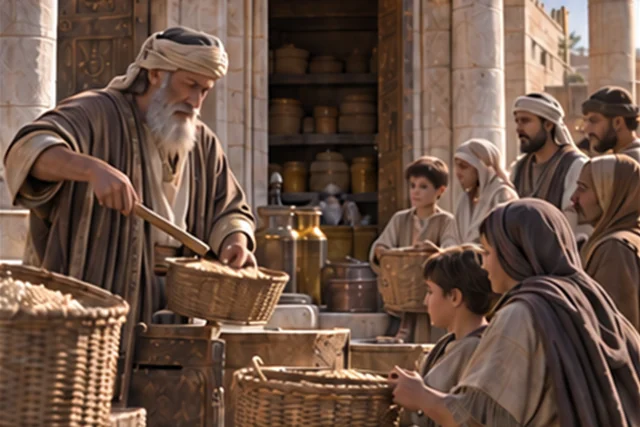
Hezekiah orders chambers prepared, and the heaps become an administered store. The Book of 2 Chronicles begins naming the people who hold responsibility for it: Cononiah, Shimei, a line of overseers beneath them, Kore at the east gate, and additional men serving in the priestly cities. The names matter because abundance can become disorder if nobody is accountable for receiving, keeping, and distributing it. Offerings and tithes are brought in faithfully, and the administration is shared under both royal and temple authority. Kore's role moves the material outward again. The goods are not collected merely to create impressive storerooms at Jerusalem; they are distributed to brethren serving by courses in other cities. "As well to the great as to the small" removes status as a reason to skip an entitled recipient. The chapter's long attention to logistics is not a distraction from worship. It shows how worship survives materially. Food must pass from field to gift, from gift to storehouse, and from storehouse to the people whose appointed service depends on it.
Deep dive
The repeated names establish responsibility. Cononiah has oversight, Shimei serves beneath him, and other appointed men administer the goods under their direction. The offerings, tithes, and dedicated things are brought in faithfully. A heap has become an entrusted store, with identifiable people answerable for its care.
Kore's work concerns distribution, and his associates serve in the cities of the priests. The arrangement therefore does not end at a well-stocked temple in Jerusalem. It carries portions to the communities whose members serve by courses. The phrase "as well to the great as to the small" makes differing standing no reason to omit an entitled recipient. These details explain how the abundance described earlier becomes actual support. The chapter's long attention to administration is not a detour from the restored worship; it describes the means by which the people responsible for that worship are maintained.
Words to trace: brother, Cononiah, Hezekiah, house, Levite, LORD
Verse-by-verse path
- 2 Chronicles 31:11
“Chambers” are the storerooms built round the temple courts, part of the plan David gave Solomon (1 Chronicles 28:12). Nehemiah later found one of these tithe rooms emptied and lent to Tobiah the Ammonite, and threw out his furniture (Nehemiah 13:4–9).
- 2 Chronicles 31:12
Cononiah, better Conaniah, means “the LORD has established”. Shimei is “the next”, mishneh, second in rank. “Faithfully” is beemunah, the word Jehoshaphat used in charging his judges (19:9): honest handling of goods is set on the same footing as honest judgment.
- 2 Chronicles 31:13
Ten overseers serve under the two brothers. A Mahath and a Jehiel were among the Levites who cleansed the temple in 29:12–14; if these are the same men, the cleaners became the storekeepers. Authority runs in two lines, from the king and from Azariah, “ruler of the house of God”.
- 2 Chronicles 31:14
The east gate was the king’s gate (1 Chronicles 9:18). Kore’s name recurs in the Korahite gatekeeping family, which had guarded the entry since the wilderness (1 Chronicles 9:19). “The most holy things” are the portions of the most holy offerings that only priests could eat (Numbers 18:9–10).
- 2 Chronicles 31:15
The priests’ cities were thirteen towns in Judah, Benjamin and Simeon (Joshua 21:4, 19), and most priests lived there between their turns of service. Jeshua is a form of Joshua, the name later borne by Jesus. Six men carry the stores out to them.
2 Chronicles 31:11-15
King James Version11Then Hezekiah commanded to prepare chambers in the house of the LORD; and they prepared them,
12And brought in the offerings and the tithes and the dedicated things faithfully: over which Cononiah the Levite was ruler, and Shimei his brother was the next.
13And Jehiel, and Azaziah, and Nahath, and Asahel, and Jerimoth, and Jozabad, and Eliel, and Ismachiah, and Mahath, and Benaiah, were overseers under the hand of Cononiah and Shimei his brother, at the commandment of Hezekiah the king, and Azariah the ruler of the house of God.
14And Kore the son of Imnah the Levite, the porter toward the east, was over the freewill offerings of God, to distribute the oblations of the LORD, and the most holy things.
15And next him were Eden, and Miniamin, and Jeshua, and Shemaiah, Amariah, and Shecaniah, in the cities of the priests, in their set office, to give to their brethren by courses, as well to the great as to the small:
2 Chronicles 31:16-21
The Registers Include the Household
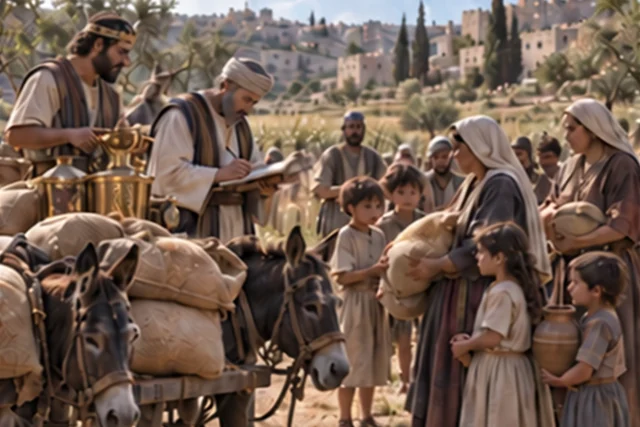
The registers widen the picture from ministers to households. Males from three years old appear in the arrangements for portions, while Levites from twenty years old are identified in relation to assigned service. The younger age therefore cannot sensibly be read as toddlers officiating at the altar. Wives, sons, daughters, and little ones are explicitly included because the support system reaches families, not only the adult men standing in public roles. Provision also extends to priests living in fields around their cities, with named distributors responsible for reaching them. Residence away from Jerusalem does not make a household disappear from the account. Genealogy here is not decorative ancestry. It is administrative memory, establishing who belongs within the network of service and support. The closing commendation gathers all of this into Hezekiah's wholehearted seeking of God. "Good and right and truth" are visible in ordered courses, food portions, records, and fair distribution. The chapter ends with prosperity, but it has shown whom that prosperity feeds and how carefully it is moved into their hands.
Deep dive
The references to ages and genealogies are compressed and can be difficult to follow. Males from three years old are mentioned within the arrangements for portions, while Levites from twenty years old are identified in relation to their assigned service. The smaller age is not a claim that toddlers officiated at the altar. The explicit inclusion of wives, sons, daughters, and little ones shows that these records concern supported households as well as working ministers.
Provision also reaches priests living in the fields around their cities. Named men distribute portions there, so residence away from Jerusalem does not make a household disappear from the arrangement. Genealogies establish the relevant relationships and responsibilities; they are serving an immediate purpose rather than merely preserving ancestral information.
The final commendation gathers this work into Hezekiah's good, right, and faithful conduct before God. His whole heart is visible here through ordered service and distributed food, not only through the public joy of Passover. The account ends with prosperity, but it has shown where part of that prosperity goes and whom it feeds.
Words to trace: genealogy, house, priests, charges, courses, Levites
Verse-by-verse path
- 2 Chronicles 31:16
“From three years old” is puzzling, and several scholars suggest reading “thirty”, the age of full service in Numbers 4:3; the two Hebrew words differ slightly. Read as three, it may mean that boys were counted for a share from that age while their fathers served.
- 2 Chronicles 31:17
The priests are registered by fathers’ houses, the Levites by age. Numbers 4:3 set Levitical service at thirty, Numbers 8:24 at twenty-five, and David lowered it to twenty (1 Chronicles 23:24–27); Hezekiah keeps David’s rule.
- 2 Chronicles 31:18
“For in their set office they sanctified themselves in holiness” is literally “in their faithfulness they made themselves holy”. The families of the ministers shared their standing: because the household kept itself holy, the household was fed from holy things.
- 2 Chronicles 31:19
Only males of priestly descent could eat the most holy portions (Numbers 18:10, “every male shall eat it”). Named men are sent even to priests living out in the pasture lands round their towns, the farthest edge of the system.
- 2 Chronicles 31:20
“Good and right and truth” is a triple found nowhere else as a king’s verdict. 2 Kings 18:5–6 praises Hezekiah instead for trust: “He trusted in the LORD God of Israel... For he clave to the LORD.” The verdict is placed immediately before Sennacherib’s invasion at the opening of chapter 32.
- 2 Chronicles 31:21
“Prospered” is tsalah, the word promised to Uzziah “as long as he sought the LORD” (26:5). Every sphere is listed, the service of the house, the law and the commandments. Chapter 32 opens “after these things”, and the next test comes to a king who has done everything asked.
2 Chronicles 31:16-21
King James Version16Beside their genealogy of males, from three years old and upward, even unto every one that entereth into the house of the LORD, his daily portion for their service in their charges according to their courses;
17Both to the genealogy of the priests by the house of their fathers, and the Levites from twenty years old and upward, in their charges by their courses;
18And to the genealogy of all their little ones, their wives, and their sons, and their daughters, through all the congregation: for in their set office they sanctified themselves in holiness:
19Also of the sons of Aaron the priests, which were in the fields of the suburbs of their cities, in every several city, the men that were expressed by name, to give portions to all the males among the priests, and to all that were reckoned by genealogies among the Levites.
20And thus did Hezekiah throughout all Judah, and wrought that which was good and right and truth before the LORD his God.
21And in every work that he began in the service of the house of God, and in the law, and in the commandments, to seek his God, he did it with all his heart, and prospered.
Questions to keep in mind while reading
- Track who acts, who speaks, who is affected, and what changes.
- Notice repeated promises, failures, rescues, and consequences.
- Do not assume the account approves every action that is reported.
Text first
Where readers differ
The chapter summary begins with what the passage says and how its parts fit together. It does not assume one denomination has already settled every question. Where a conclusion depends on a tradition, literary theory, or historical reconstruction, that dependence is named openly.
The KJV text is presented first. Interpretive conclusions are labeled, and differences are introduced only when they help a reader understand why serious communities do not always reach the same answer.
Comparative interpretive notes for this chapter are in preparation. Until reviewed notes are ready, this page separates the KJV text from summary and application without claiming that serious readers agree on every question.
Questions beneath the surface
- What account of God, human freedom, responsibility, and the good life emerges from 2 Chronicles 31?
- Which tension does the chapter refuse to resolve quickly?
- What changes when the chapter is read as part of the whole canon rather than as an isolated moral lesson?
- Where might a sincere reader confuse a familiar tradition with something the text states directly?
Questions for serious personal contemplation
These open-ended questions make room for tension, honest response, prayer, and conclusions that remain accountable to the chapter.
Observe without rushing
What part of 2 Chronicles 31 makes you stop, feel unsettled, or feel surprised, and why?
Which detail in the passage would be easiest to overlook? How does that detail change your understanding?
Where do you see tension between what happens and this focus: 2 Chronicles 31 develops its own movement around LORD, offerings, priests, house, Hezekiah?
What important question does the passage leave open instead of resolving quickly?
Examine your inner life honestly
Which person, response, fear, or desire in the passage feels most like your own life right now?
What assumption about God, other people, or yourself does this text challenge?
Which part would you rather soften, avoid, or explain away too quickly? What might that reaction reveal?
If this Scripture could ask you one direct question, what do you think it would ask?
Respond with wisdom and courage
What do you need to remember, confess, grieve, thank God for, or trust after reading this passage?
How might another faithful person read this situation differently without ignoring the text?
What obedient response would be costly, uncomfortable, or slow, yet still faithful to Scripture?
What question will you carry into prayer this week, and which verses will you keep in front of you?
Music and video connected to the passage
Related media appears when its Scripture reference overlaps this study. Music and video can illuminate a theme while the biblical text remains the foundation.