The big picture
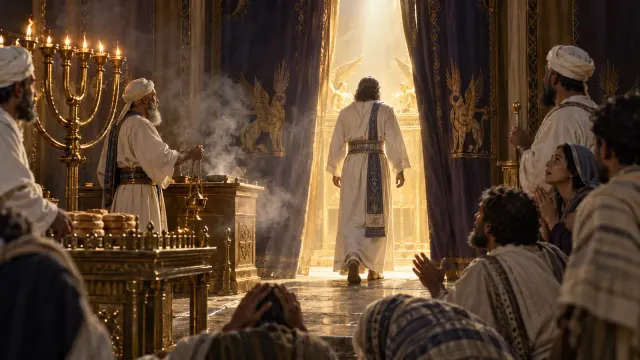
The Book of Hebrews walks through the tabernacle in order to show where the boundary is. Lamps, bread, ark, mercyseat, and sacred furnishings matter, but the second veil matters more because access beyond it is narrow, annual, and blood-marked. The earthly arrangement is real worship, yet its repetition and restriction expose what it cannot complete, especially at the level of conscience. Christ answers that limitation with his own blood, a once-for-all entrance, and eternal redemption. The chapter then layers covenant, testament, inheritance, death, and sacrificial blood until they converge in the necessity of Christ's self-offering. Even the first covenant was inaugurated with blood, so the argument is not importing sacrifice from nowhere. The final paragraph gives the chapter its temporal shape: Christ has appeared to put away sin, now appears in God's presence for his people, and will appear again for salvation. Those appearances are distinct, and none requires a second sacrifice. His future coming does not reopen work already completed.
In this chapter
- The Furnishings Matter, but the Boundary Matters More Hebrews 9:1-5
The Book of Hebrews inventories the sanctuary without becoming trapped in the inventory.
- A Repeated Service That Cannot Finish the Conscience Hebrews 9:6-10
Movement exposes the limitation.
- The Cleansing Reaches the Place the Former Rites Could Not Hebrews 9:11-14
"But Christ" changes everything the previous paragraph could not change.
- An Inheritance Made Available Through Death Hebrews 9:15-17
The new covenant reaches backward as well as forward.
- Even the First Covenant Began with Blood Hebrews 9:18-22
The first covenant also began under blood.
- Three Appearances, but No Second Sacrifice Hebrews 9:23-28
The chapter ends by separating three appearances that can easily be collapsed.
Scripture beside the summary
Hebrews · King James Version · 28Hebrews 9:1-5
The Furnishings Matter, but the Boundary Matters More
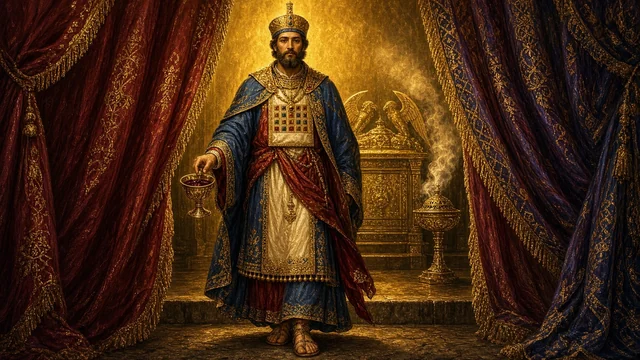
The Book of Hebrews inventories the sanctuary without becoming trapped in the inventory. Lampstand, table, shewbread, veil, censer, ark, manna, Aaron's rod, covenant tables, cherubim, and mercyseat all belong to a divinely ordered place of worship. Calling it "worldly" identifies it with the earthly order, not with moral corruption. The furnishings therefore establish reality and dignity, not fraud. Yet the decisive object in the paragraph is almost the empty space between rooms. The second veil creates a boundary. Everything after it belongs to the Holiest of all, where access will become the next question. The exact placement or association of the golden censer has been debated for centuries, but the Book of Hebrews itself says it cannot now speak of these things particularly. That restraint reveals the point. The author is not writing a museum guide to the tabernacle. The sacred objects locate the worship; the boundary prepares the argument about who can enter, how often, and with what.
Deep dive
The opening description is respectful and exact in its purpose. "Worldly" means belonging to this earthly order, not morally corrupt. The lampstand, table, bread, veil, ark, and mercyseat belong to an arrangement of divine service. Their presence establishes that the former covenant possessed genuine institutions for worship; Hebrews is not comparing Christ with an empty religious fraud.
The second veil is the crucial dividing line. The KJV describes a golden censer associated with the inner sanctuary, then the ark with its remembered signs of provision, priestly appointment, and covenant. Discussions of the precise relation of the censer or incense altar to this space belong to a longstanding interpretive difficulty, but the present argument turns on access rather than a complete floor plan. Hebrews itself declines to discuss the furnishings in detail. That restraint is instructive about the paragraph's purpose: the objects locate the worship, while the next verses explain what the pattern of entry signifies.
Words to trace: covenant, first, golden, sanctuary, tabernacle, Aaron’s
Verse-by-verse path
- Hebrews 9:1
“Ordinances” is dikaiomata, regulations for right conduct, and the same word comes back in verse 10 as “carnal ordinances”, so the paragraph is bracketed by it. “Then verily” opens with a Greek particle that sets up a contrast to come: this was the first covenant’s arrangement, and “But Christ” in verse 11 will answer it.
- Hebrews 9:2
The letter describes the tent of the wilderness, never the temple in Jerusalem, and reads Moses’ plan straight from Exodus 25–26. The “candlestick” held no candles; it was the seven-branched lampstand burning olive oil. “Shewbread” is Tyndale’s word, built on Luther’s Schaubrot, for the twelve loaves set out before the LORD each sabbath (Leviticus 24:5–9).
- Hebrews 9:3
There were two curtains: a screen at the door of the tent (Exodus 26:36) and the inner veil that hid the ark (26:31–33). “Holiest of all” copies the Hebrew way of making a superlative by repetition, qodesh haqqodashim, literally “holy of holies”, as “King of kings” means the highest king.
- Hebrews 9:4
Exodus 16:33 mentions only “a pot” for the manna; the Greek Old Testament made it golden, and Hebrews follows it. By Solomon’s day the ark held nothing but the two tables of stone (1 Kings 8:9), so the jar and Aaron’s rod belong to the wilderness. The censer belongs with the inner room by its use: on the Day of Atonement incense was carried behind the veil (Leviticus 16:12–13).
- Hebrews 9:5
“Cherubims” doubles the plural, adding an English s to the Hebrew -im. “Mercyseat” is Tyndale’s coinage for the gold lid of the ark; the Greek here is hilasterion, the word Paul uses in Romans 3:25 for Christ as “propitiation”. “Particularly” means piece by piece, kata meros, one item at a time.
Hebrews 9:1-5
King James Version1Then verily the first covenant had also ordinances of divine service, and a worldly sanctuary.
2For there was a tabernacle made; the first, wherein was the candlestick, and the table, and the shewbread; which is called the sanctuary.
3And after the second veil, the tabernacle which is called the Holiest of all;
4Which had the golden censer, and the ark of the covenant overlaid round about with gold, wherein was the golden pot that had manna, and Aaron’s rod that budded, and the tables of the covenant;
5And over it the cherubims of glory shadowing the mercyseat; of which we can not now speak particularly.
Hebrews 9:6-10
A Repeated Service That Cannot Finish the Conscience
Movement exposes the limitation. Ordinary priests repeatedly enter the first compartment, while the high priest alone enters the second, only once each year, and never without blood. The Book of Hebrews sees theological meaning in that restricted traffic. The Holy Ghost is said to signify through the arrangement that the way into the holiest has not yet been made manifest in the fuller sense now under discussion. The worship is genuine, but access remains narrow. The limitation is then located with unusual precision in the conscience. Gifts and sacrifices cannot bring the worshipper to the final perfection there. Foods, drinks, washings, and fleshly ordinances belong to a temporary arrangement "until the time of reformation." That word does not point to a later European church movement. It names the setting-right that Christ's ministry brings. The Book of Hebrews is not accusing earlier worshippers of insincerity. It is identifying what repeated external service, by design, could not finish.
Deep dive
The contrast is between regular priestly movement and the narrowly restricted approach beyond the veil. The high priest goes alone in the annual rite, and he goes with blood for himself as well as the people. Access is real, but it is neither common nor unrestricted. Hebrews assigns interpretive agency to the Holy Ghost: the arrangement signifies that the way into the holiest has not yet been made manifest in the manner now under discussion.
The limitation is then located in the conscience. Gifts and sacrifices could not perfect the worshipper in that respect. Verse 10 describes food, drink, washings, and outward regulations as imposed until a time of reformation. "Reformation" here names the setting-right anticipated in Christ's ministry, not a later period of church history. The contrast does not require the conclusion that every earlier worshipper was insincere or that the ordinances had no effect. It identifies the final work they could not accomplish. The next paragraph answers exactly that deficiency rather than merely announcing a more magnificent sanctuary.
Words to trace: first, offered, service, tabernacle, time, accomplishing
Verse-by-verse path
- Hebrews 9:6
“Always” means continually: the lamps trimmed evening and morning, incense burned twice a day (Exodus 30:7–8), the bread changed weekly. The Greek verbs are present tense, “the priests go in”, which some take as a hint that temple service was still running when the letter was written, before AD 70; others read it as the vivid present of a text being expounded.
- Hebrews 9:7
The Day of Atonement actually required the high priest to pass the veil several times, with incense, then the bullock’s blood, then the goat’s (Leviticus 16:12–15); “once every year” means on one day a year. “Errors” is agnoemata, sins committed in ignorance. Numbers 15:30 left the defiant sin, done “presumptuously”, without any sacrifice at all.
- Hebrews 9:8
The Spirit is presented as reading the floor plan: the arrangement itself is a sign. “While as the first tabernacle was yet standing” renders a phrase that means “while it still has standing”, echousa stasin, so the point may be the outer tent’s continuing status, not only its walls being upright.
- Hebrews 9:9
“Figure” is parabole, the word used of Jesus’ parables: the tent was a parable in cloth and gold. The King James supplies “then”; the Greek says “for the present time”, which may mean the writer’s own day. “Him that did the service” is the worshipper, not only the priest. “Conscience” appears five times in Hebrews, twice in this chapter.
- Hebrews 9:10
“Drinks” covers rules such as the Nazirite’s abstinence and the ban on priests drinking wine on duty (Leviticus 10:9). “Washings” is baptismois, the word behind “the doctrine of baptisms” in 6:2. “Imposed” pictures a load laid on. “Reformation”, diorthosis, is a straightening, a word Greek medical writers used for setting a broken limb.
Hebrews 9:6-10
King James Version6Now when these things were thus ordained, the priests went always into the first tabernacle, accomplishing the service of God.
7But into the second went the high priest alone once every year, not without blood, which he offered for himself, and for the errors of the people:
8The Holy Ghost this signifying, that the way into the holiest of all was not yet made manifest, while as the first tabernacle was yet standing:
9Which was a figure for the time then present, in which were offered both gifts and sacrifices, that could not make him that did the service perfect, as pertaining to the conscience;
10Which stood only in meats and drinks, and divers washings, and carnal ordinances, imposed on them until the time of reformation.
Hebrews 9:11-14
The Cleansing Reaches the Place the Former Rites Could Not
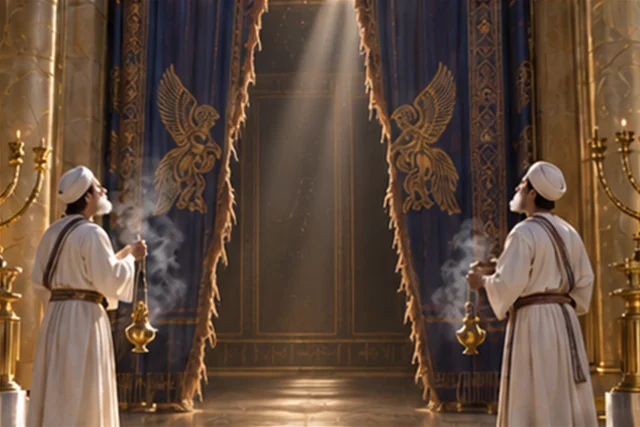
"But Christ" changes everything the previous paragraph could not change. The Book of Hebrews moves from a sanctuary made with hands to a greater tabernacle, and from animal blood to the priest's own blood. The one entering is also the one giving himself. His entrance happens once, and the redemption obtained is called eternal, so the result does not expire at the next annual cycle. Yet the argument does not ridicule the former purifications. It reasons from their recognized effect. If animal blood and the ashes of a heifer could sanctify to the purifying of the flesh, "how much more" can Christ's self-offering reach the conscience. That is the place the previous paragraph left unfinished. The cleansing also has a direction: from dead works "to serve the living God." The Book of Hebrews makes the offering morally personal as well as sacrificial. Christ offers himself "without spot" through the eternal Spirit, not as interchangeable ritual material but as the willing, holy giver of his own life.
Deep dive
"But Christ" marks the decisive turn. The greater tabernacle is not made by human hands, and the blood is not borrowed from another creature. Hebrews joins the priest's entrance to his own self-offering and describes the redemption obtained as eternal. The annual return to the same task is replaced by an entrance whose effect does not expire with the next ceremonial year.
The comparison with animal blood and the heifer's ashes acknowledges the purification they provided before arguing for something greater. It is an argument from their recognized effect to Christ's greater effect, not a claim that the entire earlier system was imaginary. The endpoint is the conscience cleansed from dead works in order to serve the living God. That contrast gives purification a direction: release from what belongs to death opens into living service. Christ offers himself "without spot" through the eternal Spirit, making the moral quality and willing character of the offering inseparable from its efficacy. The person who gives himself is not interchangeable with the material brought to an altar.
Words to trace: blood, Christ, eternal, goats, ashes, building
Verse-by-verse path
- Hebrews 9:11
Some of the oldest manuscripts read “good things that have come” instead of “good things to come”; the King James follows the reading that matches 10:1. “Not of this building” translates “not of this creation”, ktisis, so the greater tent is outside the created order altogether, not merely a larger structure.
- Hebrews 9:12
On the Day of Atonement a bullock was killed for the priest and a goat for the people (Leviticus 16:3, 5, 15). “Once” is ephapax, once for all, stronger than the plain “once” of verse 7. “Obtained” is a middle verb, found or secured by his own act; the words “for us” are supplied by the translators and printed in italics in the King James.
- Hebrews 9:13
The heifer is the red heifer of Numbers 19, burned whole outside the camp, its ashes kept to mix with running water. That water cleansed people who had touched a corpse. The purification was for the uncleanness of death, which is why the next verse speaks of “dead works”.
- Hebrews 9:14
“Without spot” is amomos, the word the Greek Old Testament uses for an unblemished victim, including the heifer of Numbers 19:2. “The eternal Spirit” occurs nowhere else in the New Testament; some read it as the Holy Spirit, others as Christ’s own spirit. “Serve” is latreuein, the verb for priestly worship: the cleansed conscience is fitted for temple service.
Hebrews 9:11-14
King James Version11But Christ being come an high priest of good things to come, by a greater and more perfect tabernacle, not made with hands, that is to say, not of this building;
12Neither by the blood of goats and calves, but by his own blood he entered in once into the holy place, having obtained eternal redemption for us.
13For if the blood of bulls and of goats, and the ashes of an heifer sprinkling the unclean, sanctifieth to the purifying of the flesh:
14How much more shall the blood of Christ, who through the eternal Spirit offered himself without spot to God, purge your conscience from dead works to serve the living God?
Hebrews 9:15-17
An Inheritance Made Available Through Death
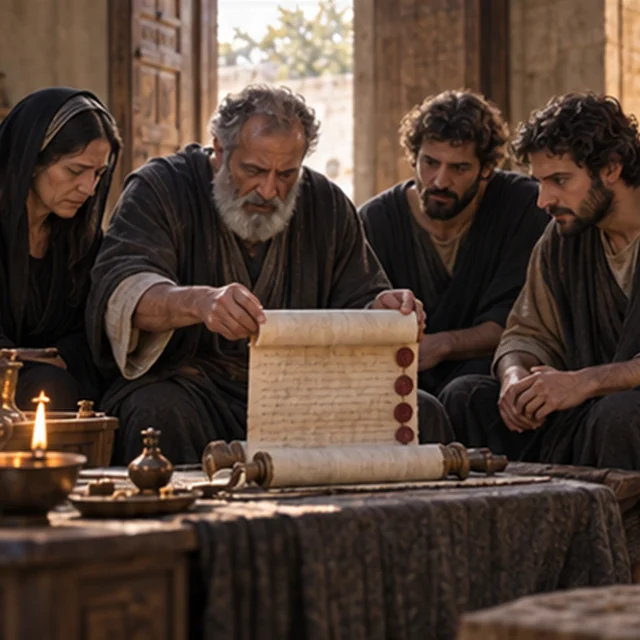
The new covenant reaches backward as well as forward. The Book of Hebrews says Christ's death redeems transgressions committed under the first testament and makes the promised eternal inheritance available to those called. That prevents the two covenants from becoming unrelated systems with unrelated problems. One death addresses liabilities that predate it. Then the language becomes famously double-edged because the Greek term can carry the sense of covenant or testament. The KJV speaks of a "testator" whose death is necessary before a testament takes effect, a natural analogy once inheritance has entered the sentence. Other interpreters keep covenantal ratification in view and understand death through sacrificial inauguration. The Book of Hebrews does not pause to settle modern lexical debates before moving on. What remains unmistakable is that death is necessary to the logic, and the next paragraph immediately returns to blood under the first covenant. Inheritance, covenant, and sacrificial death are being drawn toward the same center.
Deep dive
The new covenant's reach extends backward as well as forward. Hebrews relates Christ's death to transgressions committed under the first covenant, then to the inheritance received by those called. The transition prevents the contrast between covenants from becoming a simple division between unrelated peoples with unrelated means of salvation. The death being discussed addresses the unresolved liability of the earlier arrangement.
The Greek word diatheke can mean covenant or testament. The KJV's "testator" in verses 16–17 presents the familiar analogy of a will taking effect through death. Many interpreters understand a deliberate turn to that meaning because the preceding verse has spoken of inheritance. Others retain the covenant sense throughout and understand the death in terms of sacrificial ratification. Both readings recognize that death is necessary to the argument, but they explain its immediate logic differently. Hebrews then returns unmistakably to the blood that inaugurated the former covenant. The analogy should illuminate that movement without being expanded into a complete modern account of inheritance law.
Words to trace: testament, death, testator, cause, dead, eternal
Verse-by-verse path
- Hebrews 9:15
“Redemption” is apolytrosis, release on payment of a ransom. “They which are called” picks up the “heavenly calling” of 3:1, and “promise of eternal inheritance” returns to the heirs of promise in 6:12–17. Christ is “mediator” here for the second of three times in the letter (8:6, 12:24).
- Hebrews 9:16
“Testator” is the participle of the verb that makes a diatheke, the one who arranged it. “Must also of necessity be” translates a verb meaning “be brought forward”, pheresthai, which some read in the legal sense of producing proof: before a will is executed, the death has to be established.
- Hebrews 9:17
“Of force” is bebaios, legally valid, the word used in 2:2 for the word spoken by angels that “was stedfast”. The second clause can be punctuated as a question, “Does it ever have force while the testator lives?” Wills in the Greek papyri of the period worked exactly so: nothing passed until the owner died.
Hebrews 9:15-17
King James Version15And for this cause he is the mediator of the new testament, that by means of death, for the redemption of the transgressions that were under the first testament, they which are called might receive the promise of eternal inheritance.
16For where a testament is, there must also of necessity be the death of the testator.
17For a testament is of force after men are dead: otherwise it is of no strength at all while the testator liveth.
Hebrews 9:18-22
Even the First Covenant Began with Blood
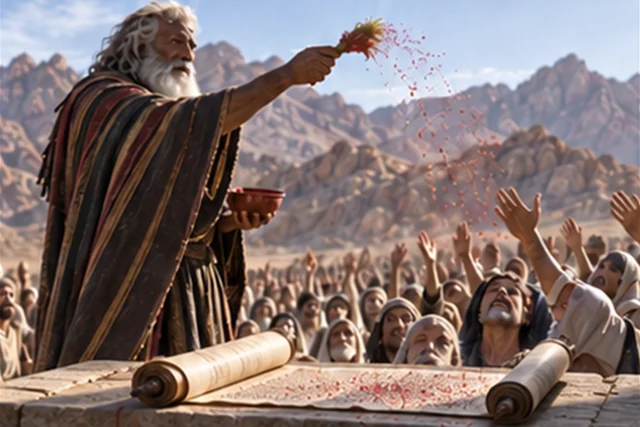
The first covenant also began under blood. The Book of Hebrews returns to Moses so that Christ's death cannot be mistaken for a foreign principle suddenly imposed on covenantal life. Precepts are spoken, blood is applied, and the people, book, tabernacle, and vessels are drawn into a blood-marked inauguration. Word and blood belong together in the scene. The covenant is neither a bare idea nor an unexplained ritual. Verse 22 then offers a broad conclusion with one important guardrail: "almost all things" are purified with blood. The small word "almost" matters because the law includes exceptions, and the Book of Hebrews does not erase them for rhetorical neatness. At the same time, the wider statement about remission keeps sacrificial death at the center of the argument. The point is not that every cleansing act was identical, but that forgiveness and covenant access are not detached from death. The paragraph prepares the stronger contrast in which Christ brings his own better offering into the heavenly reality.
Deep dive
The movement back to Moses shows why the discussion of death is not a departure from covenant. The first covenant also had a blood-marked inauguration. Hebrews recalls the proclamation and sprinkling associated with Exodus 24:3–8 and places the tabernacle's vessels within its wider description of consecration. The word declared and the blood applied belong together: the covenant was not introduced only as an idea for consideration.
The small word "almost" in verse 22 deserves to remain visible. Hebrews does not say that every prescribed purification under the law used blood without exception. Its broader conclusion concerns remission and the sacrificial death at the centre of the argument. Removing the qualification would make the statement more absolute than Hebrews makes it. Conversely, treating the blood as decorative would miss the sustained claim that covenantal access and forgiveness involve death. The paragraph prepares the greater contrast that follows: earthly patterns were consecrated through such means, while Christ's heavenly ministry rests on his own better offering.
Words to trace: blood, both, people, sprinkled, testament, book
Verse-by-verse path
- Hebrews 9:18
“Dedicated” is enkainizo, to inaugurate, the root of the Greek name for Hanukkah, ta enkainia, which John 10:22 calls “the feast of the dedication”. The argument shifts from the will back to the covenant at Sinai, and “neither the first” concedes that the old order also began with a death.
- Hebrews 9:19
Exodus 24:5–8 mentions only oxen, and blood thrown on the altar and the people. The water, scarlet wool and hyssop come from other cleansing rites, the leper’s (Leviticus 14:4–7) and the red heifer’s (Numbers 19:6, 18), and Exodus never says the book was sprinkled. Hebrews gathers the purification rites of the law into one picture.
- Hebrews 9:20
Exodus 24:8 has Moses say “Behold the blood of the covenant”. Hebrews quotes it as “This is the blood of the testament”, wording that stands very close to Jesus’ words over the cup in Matthew 26:28, “this is my blood of the new testament”. Many commentators hear the echo as deliberate.
- Hebrews 9:21
Exodus 24 comes before the tabernacle was built, and Exodus 40:9 consecrates it with oil, not blood. Hebrews reflects a wider tradition; Josephus also says Moses purified the tent and its vessels with blood (Antiquities 3.206), and Leviticus 8:15 has blood put on the altar at the priests’ consecration.
- Hebrews 9:22
The law’s exceptions include the handful of flour a poor man could bring as a sin offering (Leviticus 5:11–13), and metal purged by fire and water (Numbers 31:22–23). “Shedding of blood” is one Greek word, haimatekchusia, not found in any earlier surviving text. The Talmud states the same rule: there is no atonement except with blood (Yoma 5a).
Hebrews 9:18-22
King James Version18Whereupon neither the first testament was dedicated without blood.
19For when Moses had spoken every precept to all the people according to the law, he took the blood of calves and of goats, with water, and scarlet wool, and hyssop, and sprinkled both the book, and all the people,
20Saying, This is the blood of the testament which God hath enjoined unto you.
21Moreover he sprinkled with blood both the tabernacle, and all the vessels of the ministry.
22And almost all things are by the law purged with blood; and without shedding of blood is no remission.
Hebrews 9:23-28
Three Appearances, but No Second Sacrifice
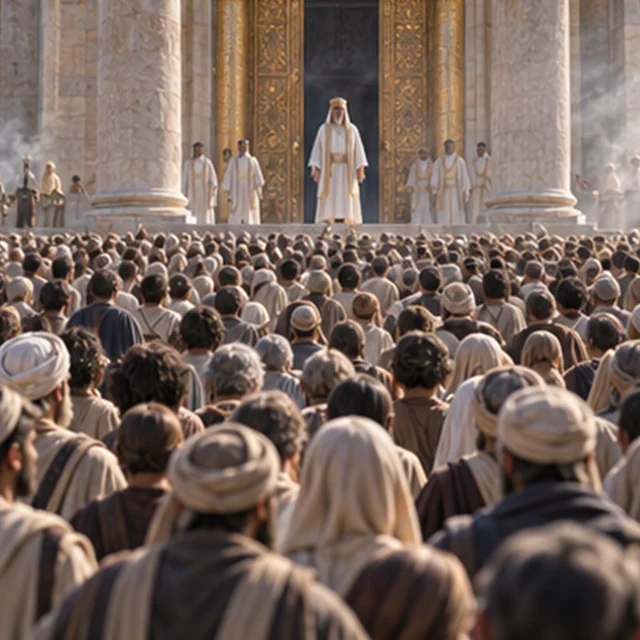
The chapter ends by separating three appearances that can easily be collapsed. The Book of Hebrews says Christ appeared in the past to put away sin through the sacrifice of himself, appears now in the presence of God "for us," and will appear again to those who look for him. Past offering, present representation, and future salvation belong together, but they are not the same event repeated. That distinction explains why the annual high-priestly pattern cannot be copied mechanically onto Christ. If his offering had to recur, he would have needed to suffer repeatedly from the foundation of the world. Instead, "once" governs the sacrifice. The difficult language about heavenly things being purified has been read in terms of consecration or cleansing connected with sin, but verse 24 makes the practical center plain: Christ is in God's presence on behalf of his people. His second appearing is "without sin" because it is not another sin-bearing sacrifice. The necessary offering has already happened.
Deep dive
Verse 23's language about heavenly things requiring purification is difficult. It has been read as consecration of the heavenly sanctuary for the new covenant's access, or as cleansing in relation to the defilement of sin. Hebrews does not explain a physical mechanism or invite a picture of ordinary dirt in heaven. Verse 24 clarifies the controlling reality: Christ appears in God's presence on behalf of his people.
The paragraph then arranges Christ's work through different appearances. He has appeared to put away sin through his sacrifice; he now appears before God; he will appear again to those awaiting him. These actions are related but not interchangeable. The repeated annual entrance with another creature's blood supplies the contrast, not the pattern for repeated suffering by Christ. His offering belongs to the decisive completion described as the end of the age.
The human sequence of death and judgment reinforces the nonrepeating character of the offering. The second appearing is "without sin," meaning not another occasion to bear sin through sacrifice, rather than implying that Christ was previously sinful. Hebrews has already insisted on his spotlessness. The conclusion therefore leaves the people waiting, but not waiting for the necessary sacrifice to be attempted again. They await the salvation toward which the accomplished offering leads.
Words to trace: once, appear, Christ, holy, often, world
Verse-by-verse path
- Hebrews 9:23
“Patterns” is hypodeigmata, copies, the “example and shadow” of 8:5. “Better sacrifices” is plural although Christ offered once; the plural answers “these” and names a class of sacrifice rather than counting them. The whole verse depends on the Exodus instruction that the tent be made after a pattern shown on the mount.
- Hebrews 9:24
“Figures” is antitypa, antitypes. Here the earthly copy is the antitype of a heavenly original, the reverse of the later habit of calling the fulfilment the antitype (compare 1 Peter 3:21). “In the presence of God” is literally “to the face of God”; the high priest entered behind a cloud of incense lest he die (Leviticus 16:13).
- Hebrews 9:25
“Blood of others” is haima allotrion, blood belonging to another, the word used for a stranger or a foreigner. The high priest brought what was not his; the contrast turns on that single adjective against “his own blood” in verse 12.
- Hebrews 9:26
The reasoning is a reductio: repeated offering would have required repeated suffering stretching back to creation. “In the end of the world” renders “at the consummation of the ages”, the phrase Matthew uses in 13:39 and 28:20. “Put away” is athetesis, annulment, the noun behind the “disannulling” of the commandment in 7:18.
- Hebrews 9:27
“Appointed” is apokeitai, laid up or reserved, the verb of 2 Timothy 4:8, “there is laid up for me a crown”. The comparison is drawn from ordinary human life: one death, then a verdict, and neither is repeated. The “as” here is completed by the “so” that opens the next verse.
- Hebrews 9:28
“To bear the sins of many” takes up Isaiah 53:12, “he bare the sin of many”. The picture behind the last clause is the crowd outside on the Day of Atonement, waiting for the high priest to come out alive; Sirach 50:5–7 describes the glory of that moment. “Look for” is apekdechomai, eager expectation, as in Romans 8:19–25.
Hebrews 9:23-28
King James Version23It was therefore necessary that the patterns of things in the heavens should be purified with these; but the heavenly things themselves with better sacrifices than these.
24For Christ is not entered into the holy places made with hands, which are the figures of the true; but into heaven itself, now to appear in the presence of God for us:
25Nor yet that he should offer himself often, as the high priest entereth into the holy place every year with blood of others;
26For then must he often have suffered since the foundation of the world: but now once in the end of the world hath he appeared to put away sin by the sacrifice of himself.
27And as it is appointed unto men once to die, but after this the judgment:
28So Christ was once offered to bear the sins of many; and unto them that look for him shall he appear the second time without sin unto salvation.
Questions to keep in mind while reading
- Identify the audience, problem, argument, command, and pastoral purpose.
- Follow connecting words so that one sentence remains inside the author’s reasoning.
- Distinguish a universal theological claim from an instruction shaped by a particular situation.
Text first
Where readers differ
The chapter summary begins with what the passage says and how its parts fit together. It does not assume one denomination has already settled every question. Where a conclusion depends on a tradition, literary theory, or historical reconstruction, that dependence is named openly.
The KJV text is presented first. Interpretive conclusions are labeled, and differences are introduced only when they help a reader understand why serious communities do not always reach the same answer.
Comparative interpretive notes for this chapter are in preparation. Until reviewed notes are ready, this page separates the KJV text from summary and application without claiming that serious readers agree on every question.
Questions beneath the surface
- What account of God, human freedom, responsibility, and the good life emerges from Hebrews 9?
- Which tension does the chapter refuse to resolve quickly?
- What changes when the chapter is read as part of the whole canon rather than as an isolated moral lesson?
- Where might a sincere reader confuse a familiar tradition with something the text states directly?
Questions for serious personal contemplation
These open-ended questions make room for tension, honest response, prayer, and conclusions that remain accountable to the chapter.
Observe without rushing
What part of Hebrews 9 makes you stop, feel unsettled, or feel surprised, and why?
Which detail in the passage would be easiest to overlook? How does that detail change your understanding?
Where do you see tension between what happens and this focus: The tabernacle rooms, furnishings, priests, blood, and yearly entrance used to explain the need for final cleansing?
What important question does the passage leave open instead of resolving quickly?
Examine your inner life honestly
Which person, response, fear, or desire in the passage feels most like your own life right now?
What assumption about God, other people, or yourself does this text challenge?
Which part would you rather soften, avoid, or explain away too quickly? What might that reaction reveal?
If this Scripture could ask you one direct question, what do you think it would ask?
Respond with wisdom and courage
What do you need to remember, confess, grieve, thank God for, or trust after reading this passage?
How might another faithful person read this situation differently without ignoring the text?
What obedient response would be costly, uncomfortable, or slow, yet still faithful to Scripture?
What question will you carry into prayer this week, and which verses will you keep in front of you?
Music and video connected to the passage
Related media appears when its Scripture reference overlaps this study. Music and video can illuminate a theme while the biblical text remains the foundation.