The big picture
The Book of 1 Kings widens from the temple to Solomon’s royal building complex, then returns to the sanctuary through the hands of Hiram the craftsman. Solomon’s palace buildings take thirteen years and include spaces for display, judgment, residence, and Pharaoh’s daughter, placing royal architecture beside the seven-year temple project without supplying a simplistic verdict on the comparison. Hiram then demonstrates another form of wisdom through metalwork. He makes the two named pillars, the great bronze sea on twelve oxen, ten matching wheeled stands with lavers, and a long series of vessels whose measurements and ornament receive patient attention. The account preserves practical details because sacred service depends on practical objects. Lions, palms, cherubim, flowers, brass, and gold unite beauty with use, while the final inventory reaches all the way to utensils and hinges. David’s dedicated treasures are brought in at the end, joining two reigns within the completed work. The building and furnishings are now ready, but the ark still waits outside, keeping dedication distinct from construction.
Central truth
The temple and royal buildings display extraordinary craftsmanship, but God's word interrupts the construction account to make obedience, not architectural magnificence, the condition of his pledged presence.
The study notes have a page of their own
The movement by movement analysis, the words to trace, the verse by verse notes and where readers differ are written for someone studying alone. They are on the Deep Personal Reflections page for this chapter. This page is the lesson.
A chapter-specific teaching brief
These anchors come from this chapter itself. They help a teacher use the Level 1 overview, the Level 2 study, and the Scripture text as one lesson.
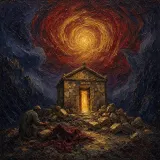
Open with the chapter’s first image
1 Kings 7:1: “But Solomon was building his own house thirteen years, and he finished all his house.”
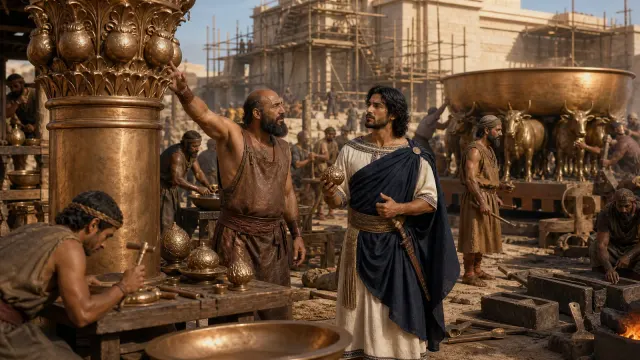
Slow down at the turning point
1 Kings 7:37: “After this manner he made the ten bases: all of them had one casting, one measure, and one size.”
Keep this word trail visible
cubits, pillars, house, work, round, Solomon
What to explain, in order
Teach the passage in this order. Each step names the verses it rests on, so every point can be shown in the text before it is applied.
1 Kings 6:1-10
Date it, measure it, and keep it quiet
Begin with the date in 6:1: the four hundred and eightieth year after the exodus. Explain that the Book of 1 Kings ties the temple to Israel's deliverance from Egypt, so the house is a sequel to the exodus. Then give the basic plan in cubits, sixty long, twenty wide, thirty high, with a porch and side chambers. Do not convert every measure; one approximate conversion is enough. Close with 6:7 and the silence of the building site. This comes first because it gives learners a mental floor plan and the right mood for everything after it.
1 Kings 6:11-14
The word in the middle of the work
Stop the tour at 6:11 and read God's word in full. Explain that it repeats the conditions of 2:3-4 and 3:14 and adds the promise that God will dwell among Israel. Put the weight on what the house cannot do by itself: walls do not guarantee presence, obedience is the condition. Then read 6:14, "So Solomon built the house, and finished it", and note the same line in 6:9. Teach this second, before the gold, so the class carries this word into the splendour rather than finding it afterward.
1 Kings 6:15-38
Cedar, gold and the most holy place
Now walk inward. Cedar covers every wall so "there was no stone seen" (6:18); carvings of gourds, open flowers, palm trees and cherubim cover the surfaces; gold covers the cedar. Explain the oracle as the most holy place and show its cube shape. Read the cherubim of 6:23-28 and connect them with Exodus 25:18-22 and with the cherubim guarding Eden in Genesis 3:24. The palm trees and flowers suggest a garden. Finish with the seven years of 6:38. This is the centre of the unit, so give it time.
1 Kings 7:1-12
Solomon's own house
Read 7:1 with its opening But, then move through the palace buildings quickly: the house of the forest of Lebanon, the porch of pillars, the porch of judgment where the king sat to judge, his own house, and a house for Pharaoh's daughter. Explain that the house of the forest of Lebanon took its name from rows of cedar pillars. Keep the thirteen years beside the seven, ask what learners make of it, and accept more than one answer. Teach this here because the Book of 1 Kings places the palace between the temple and its furnishings on purpose.
1 Kings 7:13-47
Hiram the craftsman and the bronze
Introduce the second Hiram from 7:13-14 and stress his gift of wisdom and skill. Then describe the bronze works in order: the pillars and their capitals with lily work and pomegranates, the names Jachin and Boaz (often understood as he will establish and in him is strength), the great sea on twelve oxen, the wheeled bases and lavers. Explain chapiters as capitals. Keep it visual and brief; a sketch helps more than numbers. End with 7:47, bronze so plentiful that it was never weighed. This shows the scale of the gift without asking learners to calculate it.
1 Kings 7:48-51
Gold inside, and David's gifts brought in
Finish inside the house with the gold furniture: the altar, the table of the shewbread, ten lampstands, and the small tools of service. Explain shewbread as the bread set before the LORD each week (Leviticus 24:5-9). Read 7:51, "So was ended all the work", and note that Solomon brings in the treasures David had dedicated, so the father's devotion is honoured in the son's house. Teach this last because it leaves the house complete but still empty of the ark, which is what chapter 8 will bring.
Where learners get stuck
The misreadings this passage tends to produce, and how to answer each from the text.
"No tools were used to build the temple."
Verse 7 says no hammer, axe or iron tool was heard in the house while it was being built, because the stones were made ready before they arrived. Chapter 5 shows plenty of tools at the quarry: hewers, stonesquarers and great stones cut to measure (5:15-18). The quiet belongs to the building site, not the whole project. Teach it as reverent preparation, not as a miracle or a ban on tools.
"Because Solomon built such a beautiful house, God had to live there."
The interruption of 6:11-13 answers this directly. God's presence among Israel is tied to walking in his statutes, not to cedar and gold. Solomon himself will say in 8:27 that heaven cannot contain God, much less this house, and 9:6-9 warns that the house can become a ruin. Acts 7:47-50 makes the same point. Beauty honours God, but it does not bind him.
"Solomon cared more about his palace than about God's house."
The text gives the numbers, seven years and thirteen, and opens 7:1 with But, which invites a comparison. It does not state a judgment. The palace complex included several large public buildings, and the temple was prepared in advance with materials David gathered. Let learners notice the contrast and hold it as a question. The Book of 1 Kings will give its verdict on Solomon's heart plainly in chapter 11, so there is no need to force it here.
"The numbers and measurements contain a hidden code."
The measurements describe a real building, recorded carefully because the house mattered. Some proportions do carry meaning, such as the cube of the most holy place, and the cherubim echo Exodus and Eden. But the text does not invite numerology. Teach the sizes as signs of care and magnificence, notice where Scripture itself makes a connection, and stop there.
Learning objectives
- Distinguish the temple from the royal complex.
- Locate the inner sanctuary and its purpose.
- Identify materials and workmanship actually described.
- Explain the absence of iron-tool noise onsite.
- Recognize the covenant word within the building account.
- Separate architectural observations from speculative symbolism.
Teacher preparation
- Prepare a plain labeled plan from 6:2–10, 16–20; mark reconstructed details as uncertain.
- Explain 'oracle' as the inner sanctuary, 'chapiters' as pillar capitals, and 'cunning' as skilled workmanship.
- Distinguish Hiram the craftsman in 7:13–14 from Hiram the king in chapter 5.
- Keep dimensions in cubits; label modern conversions approximate and avoid unsupported engineering diagrams.
- Mark 6:11–13 before teaching materials; compare the seven-year temple build with the thirteen-year royal project.
Evidence and interpretation checks
Explicit
Use 6:7 to explain quiet construction: stones were prepared before delivery, so iron tools were not heard in the house while it was built.
Scripture-supported
Read 6:12–13 alongside 9:4–9; covenant obedience, rather than the mere existence of the building, governs the stated relationship.
Strong inference
Infer substantial advance planning from the prepared stones in 6:7 and matching cast bases in 7:37; do not invent machinery.
Possible or traditional reading
Discuss the seven-year and thirteen-year contrast in 6:38–7:1 as a possible invitation to scrutiny, not proof of a motive the verses do not state.
Limit
Do not claim secret meanings for every pomegranate or an exhaustive floor plan; 6:29 and 7:18–22 describe decoration without decoding each feature.
Discussion with answer guidance
1. Why does the building site lack the sound of iron tools?
What a good answer contains
Verse 7 gives the reason: the house "was built of stone made ready before it was brought thither: so that there was neither hammer nor axe nor any tool of iron heard in the house, while it was in building." The cutting happened at the quarry, as 5:17-18 has already shown. A good answer says the quiet was deliberate, a mark of reverence for the place, and links it to the hewed stones prepared in chapter 5. A weak answer says no tools were used at all or that the stones shaped themselves, which the verse does not claim.
Show teacher guidance
Point to 6:7: preparation happens before stones arrive. Correct claims that no tools were used anywhere or that the construction was effortless.
2. What interrupts the description of walls and chambers?
What a good answer contains
After ten verses of cubits and chambers, "the word of the LORD came to Solomon" (6:11). God says that if Solomon walks in his statutes and keeps his commandments, "then will I perform my word with thee" and "I will dwell among the children of Israel, and will not forsake my people Israel" (6:12-13). A good answer sees that the Book of 1 Kings stops the building to say what really secures God's presence. A weak answer treats the interruption as an aside and goes back to measurements as though they were the point.
Show teacher guidance
Read 6:11–13 aloud. Expect God's conditional word about obedience and dwelling among Israel; let this interruption govern the discussion of grandeur.
3. What makes the 'oracle' different from the surrounding rooms?
What a good answer contains
The oracle is the inner sanctuary, "even for the most holy place" (6:16), prepared "to set there the ark of the covenant of the LORD" (6:19). It is a perfect cube, twenty cubits each way, overlaid with pure gold (6:20), with two olive wood cherubim whose wings touch wall to wall (6:23-27). A good answer explains that the word means the place where God speaks, not an object that speaks. A weak answer pictures a fortune telling device, which the King James word can suggest to modern ears.
Show teacher guidance
Use 6:16–20: it is the most holy place prepared for the ark. Do not mistake the KJV term for a speaking object.
4. What can the seven and thirteen years tell us?
What a good answer contains
The temple took seven years (6:38) and Solomon's own house took thirteen (7:1). Those are the facts, and the verse begins with "But". A good answer sets the two numbers side by side and asks what the reader is meant to notice, while admitting that the text makes no accusation. Some readers see a hint of misplaced priority; others note the palace complex was simply larger. A weak answer either ignores the contrast or turns it into a firm charge the Book of 1 Kings does not make.
Show teacher guidance
Compare 6:38 with 7:1. Establish the reported durations first; distinguish questions about royal priorities from an explicit accusation absent here.
5. Which Hiram makes the metalwork, and what qualifies him?
What a good answer contains
This Hiram is a craftsman, not the king of chapter 5. He was "a widow's son of the tribe of Naphtali, and his father was a man of Tyre, a worker in brass", and "he was filled with wisdom, and understanding, and cunning to work all works in brass" (7:14). Explain cunning as skill. A good answer names his mixed family, his skill and the same words, wisdom and understanding, used of Solomon in 4:29. A weak answer confuses the two Hirams or treats craft as less spiritual than kingship.
Show teacher guidance
Read 7:13–14: the widow's son from Tyre has wisdom, understanding, and skill. He is not the king negotiating cedar supplies.
6. How do pillars, sea, lavers, and gold vessels complete the account?
What a good answer contains
They fill the house with what worship needs. The two bronze pillars named Jachin and Boaz stand at the porch (7:21); the molten sea rests on twelve oxen facing the four directions (7:23-25); ten bases and ten lavers hold water for washing (7:38); and Solomon makes the gold altar, table, candlesticks and vessels for inside (7:48-50). The account ends with David's dedicated treasures brought in (7:51). A good answer sorts outside bronze from inside gold. A weak answer turns every number into a secret code.
Show teacher guidance
Locate 7:21–26, 38–51. Distinguish named furnishings and their placement; do not let the class turn every measurement into a hidden code.
Responsible application
Heart and habits
Ask groups to contrast a beautifully presented project with faithful conduct, using the interruption in 6:11–13 as their anchor.
Relationships and community
Have learners explain how public recognition could include craftspeople and preparatory workers rather than only the person funding a building.
Careful visual imagination
Ask the class to label a proposed temple illustration 'stated,' 'reconstructed,' or 'unsupported' before accepting its details.
Session plans
Two timings of the same lesson. The shorter keeps the reading, the central discussion and one response; the longer gives the confusions and the application their own time.
45 minutes
Date and plan
Read 6:1-7 and sketch the floor plan in cubits. Take question one and confusion one together.
The word in the middle
Read 6:11-14 aloud, slowly. Take question two and then confusion two, with 8:27 read beside it.
Into the most holy place
Read 6:15-28 selectively. Take question three, and point out the cherubim, palm trees and gold.
Seven years and thirteen
Read 6:38 and 7:1-8. Take question four and confusion three, accepting more than one answer.
Bronze and gold
Read 7:13-14, 21-26 and 48-51. Take questions five and six, sorting bronze outside from gold inside.
Handout
Read the key verse together and give out the sheet.
90 minutes
A house for whom
Ask the group what makes a building holy. List the answers, then read 6:1 and 6:7.
Measuring the house
Read 6:1-10 and draw the plan together. Take question one and confusion one.
God's interruption
Read 6:11-14. Take question two and confusion two, and set 2:3-4, 3:14 and 6:12 side by side.
Cedar, gold and cherubim
Read 6:15-38. Take question three and compare Exodus 25:18-22 and Genesis 3:24.
The palace
Read 7:1-12 and take question four. Discuss confusion three openly and leave the verdict to chapter 11.
Hiram's bronze
Read 7:13-47 selectively and take question five. Sketch the pillars, sea and lavers, and use confusion four.
The vessels and the gifts
Read 7:48-51 and take question six. Explain the shewbread with Leviticus 24:5-9.
Application and handout
Ask each person to write one sentence on what 6:12-13 says about where God's presence is found. Read the key verse and pray.
Adapting the lesson
Children
Build the temple together with boxes: a porch, a long room, and a small cube at the back for the most holy place. Let children add gold paper and drawings of palm trees and flowers. Read 6:7 and have everyone build in silence for one minute. Introduce Hiram as a man God made good with his hands. Keep the measurements to one or two and finish with 6:13, God wanting to live among his people.
Youth
Ask youth what they would spend seven years building. Then read 6:11-13 and talk about how easy it is to think impressive work proves faithfulness. Let them compare seven and thirteen years and argue about it without forcing an answer. Give Hiram some attention, since young people with practical skills seldom hear that their craft can serve God, and 7:14 uses the same words for him as for Solomon.
Adults
Adults can handle the architecture and the theology together. Use a plain plan, Exodus 25 and Genesis 3:24, and let them trace the garden imagery in the carvings. Spend real time on 6:11-13 and connect it with Acts 7:47-50. Discuss the palace honestly, and note that the house of the forest of Lebanon later holds the king's gold shields (10:17). Avoid speculation about the temple's exact appearance beyond what the text gives.
One to one
Read 6:11-13 together and ask where the person is building something large just now, a career, a family, a ministry. Ask what God's word in the middle of that work would sound like. If they have practical skills, read 7:14 and let them hear that God fills craftsmen with wisdom. Keep the measurements out of the conversation unless they want them.
Song and video learning lab
A song or video may interpret, compress, or dramatize the text. Its value becomes clearer when its choices are compared with Scripture.
- Before the media: the exact passage and its central movement.
- During the media: the words, people, events, and emotions the artist emphasizes.
- After the media: what it clarifies, what it leaves out, and what belongs back in the biblical text.
Handout
One page for learners to take home. The print button prints this section alone.
1 Kings 6:1–7:51
The passage in brief
In the four hundred and eightieth year after the exodus, Solomon begins to build the house of the LORD. The stones are prepared away from the site, so the building is quiet. In the middle of the work, God tells Solomon that his presence depends on obedience, not on the building. The house is lined with cedar and gold, with cherubim in the most holy place. Solomon also builds his own palace, and Hiram the craftsman makes the bronze pillars, the sea and the vessels.
A verse to keep
Concerning this house which thou art in building, if thou wilt walk in my statutes, and execute my judgments, and keep all my commandments to walk in them; then will I perform my word with thee, which I spake unto David thy father: And I will dwell among the children of Israel, and will not forsake my people Israel.
1 Kings 6:12-13 · King James Version
Questions to take home
Why was there no sound of hammer or axe at the building site in 6:7?
What does God say in 6:12-13 about how he will dwell among Israel?
How long did the temple take, and how long Solomon's house, in 6:38 and 7:1?
This week
In the middle of your busiest work this week, stop once and read 6:12-13 aloud.
Music and video connected to the passage
Related media appears when its Scripture reference overlaps this study. Music and video can illuminate a theme while the biblical text remains the foundation.