
The big picture
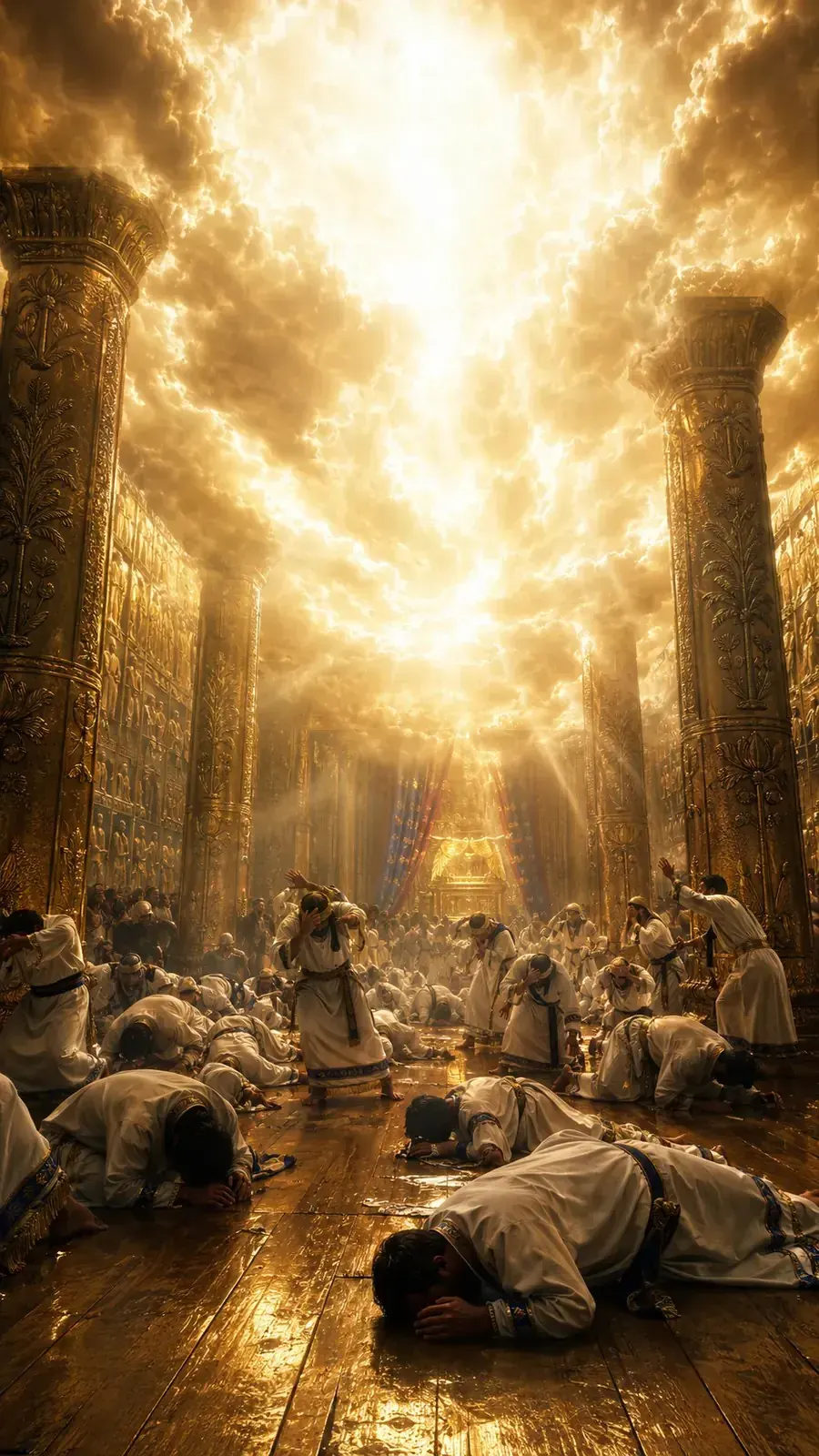
The temple becomes a sanctuary when the ark enters it and the glory of the LORD fills the house so completely that the priests cannot continue ministering. Solomon then interprets the building through promise rather than possession. David desired to build, Solomon was appointed to complete the work, and the ark at the center carries the covenant made after the Exodus. In the prayer that follows, Solomon states the temple’s limit as clearly as its significance: even heaven cannot contain God, so the house is a place toward which prayer is directed while God hears from heaven. The petitions move through legal disputes, defeat, drought, famine, disease, foreigners, warfare, sin, and eventual captivity. The dedication therefore looks far beyond its own moment of prosperity. It imagines people praying from situations in which the temple cannot function as a charm against consequences. Solomon asks for forgiveness, justice, instruction, compassion, and wholehearted allegiance. The chapter closes with sacrifices and a fourteen-day feast so abundant that extra court space is needed, and the people depart joyful. Celebration and warning stand together without canceling each other.
Central truth
At the temple dedication, God's glory fills the house while Solomon asks the God whom heaven cannot contain to hear, forgive, and make his name known among all peoples.

The study notes have a page of their own
The movement by movement analysis, the words to trace, the verse by verse notes and where readers differ are written for someone studying alone. They are on the Deep Personal Reflections page for this chapter. This page is the lesson.
A chapter-specific teaching brief
These anchors come from this chapter itself. They help a teacher use the Level 1 overview, the Level 2 study, and the Scripture text as one lesson.
Open with the chapter’s first image
1 Kings 8:1: “Then Solomon assembled the elders of Israel, and all the heads of the tribes, the chief of the fathers of the children of Israel, unto king Solomon in…”
Slow down at the turning point
1 Kings 8:32: “Then hear thou in heaven, and do, and judge thy servants, condemning the wicked, to bring his way upon his head; and justifying the righteous, to give him…”
Keep this word trail visible
LORD, Israel, house, people, place, heaven
What to explain, in order
Teach the passage in this order. Each step names the verses it rests on, so every point can be shown in the text before it is applied.
1 Kings 8:1-11
The ark comes home and the cloud fills the house
Begin with movement: elders, priests and people bring the ark up from the city of David into the new house at the feast of the seventh month. Explain staves as carrying poles, left in place. Read 8:9 slowly so the class knows what is in the ark, then 8:10-11, the cloud. Set Exodus 40:34-35 beside it so learners hear the same moment repeated at the tabernacle. Teach this first because it is the event the whole chapter answers: God has filled the house before Solomon says a word.
1 Kings 8:12-21
Solomon blesses and remembers
Read Solomon's first words, "The LORD said that he would dwell in the thick darkness", and explain the thick darkness as the cloud of Sinai (Exodus 20:21). Then let him turn to the people and tell the history: God chose David, David wanted to build, God said his son would. Point to the refrain "spake with his mouth" and "with his hand fulfilled it" (8:15, 24). Teach this second because it frames the house as promise kept, not royal achievement, and because the prayer that follows rests on that faithfulness.
1 Kings 8:22-30
The God who cannot be contained
Stand where Solomon stands, before the altar with hands spread toward heaven (8:22). Read his praise in 8:23, "there is no God like thee", and the plea for David's line in 8:25-26. Then read 8:27 aloud twice. Explain that Solomon builds a house and in the same breath denies that it can hold God. The answer is 8:29-30: the house is where God's name is, and prayer made toward it is heard in heaven. This is the key that opens every petition after it, so teach it before the list.
1 Kings 8:31-40
Disputes, defeat, drought and plague
Walk through the petitions as headings on the board: an oath in a dispute, defeat in battle, drought, famine and plague, each followed by "hear thou in heaven". Point out that most of them begin with sin and end with forgiveness. Read 8:38-39 slowly: each person knows "the plague of his own heart", and God alone knows the hearts of all. Pastorally, do not let the class connect anyone's present suffering with a particular sin; Solomon is praying for repentance where it is needed, not diagnosing.
1 Kings 8:41-53
The stranger and the captive
Give these two petitions their own time. The foreigner who comes for God's name receives the same hearing as Israel, so that all peoples may know God (8:41-43). Then the captives far away: if they repent in the land of their enemies, God will forgive and give them compassion in the sight of their captors (8:46-50). Explain "the furnace of iron" in 8:51 as Egypt remembered. Connect 8:46-50 with Daniel 6:10, where Daniel prays toward Jerusalem in exile. Teach these last among the petitions because they stretch the prayer furthest in place and time.
1 Kings 8:54-66
Blessing, charge and joy
Finish with Solomon rising from his knees and blessing the people. Read 8:56, "there hath not failed one word of all his good promise", and let it land. Then 8:57-61: a prayer that God will incline their hearts, and a charge that their hearts be "perfect", whole and undivided. Mark that word, because 11:4 will say Solomon's own heart was not perfect. End with the vast sacrifices and the fourteen days of feasting, and with the people going home glad. Teach the charge before the joy so the gladness has its proper root.
Where learners get stuck
The misreadings this passage tends to produce, and how to answer each from the text.
"God lived inside the temple, so Israel could not pray anywhere else."
Solomon says the opposite in 8:27: heaven cannot contain God, much less this house. The prayer itself pictures people praying toward the house from battlefields (8:44) and from exile in a foreign land (8:47-48), and God hears them in heaven. The temple is the place God chose for his name and for Israel's worship. It focuses prayer; it does not confine God or limit where he hears.
"The dedication worked because of the thousands of sacrifices."
The sacrifices were real worship, and 8:63 gives the numbers. But the chapter puts its weight elsewhere: on God's glory filling the house before any of it (8:10-11), on God's promise kept (8:15, 56), and on prayer heard and sin forgiven (8:30). The offerings express devotion and fellowship. They do not buy God's presence, which arrived as a gift.
"Solomon's prayer says suffering always means you have sinned."
Several petitions do begin with sin, because Israel's covenant warned of drought and defeat for unfaithfulness (Deuteronomy 28). But Solomon also prays for a man wronged in a dispute (8:31-32), for soldiers sent out by God (8:44-45) and for a foreigner with an unnamed need (8:41-43). And 8:39 leaves the judging of hearts to God alone. Do not let the class use this chapter to diagnose anyone's illness or disaster.
"Foreigners could only come to God if they became Israelites first."
Solomon asks God to answer the stranger "according to all that the stranger calleth to thee for" (8:43), so that all peoples may know his name. The prayer welcomes the foreigner as a worshipper of Israel's God, and 8:60 states the purpose for every nation. Isaiah 56:6-7 and Jesus in Mark 11:17 pick up the same hope, a house of prayer for all people. Keep the welcome as wide as Solomon makes it.
Learning objectives
- Trace the ark's arrival and the cloud's effect.
- Identify the covenant tablets within the ark.
- Distinguish God's presence from confinement in a building.
- Organize the situations named in Solomon's prayer.
- Explain the prayer's provision for the foreigner.
- Connect the final celebration with covenant responsibility.
Teacher preparation
- Divide the chapter into arrival, blessing, prayer, concluding charge, and celebration before selecting readings.
- Explain 'staves' as carrying poles and 'stranger' in 8:41 as someone outside Israel.
- Mark every appeal for God to hear in heaven; prepare headings for the prayer's situations.
- Read Exodus 40:34–35; distinguish this chapter's cloud from details supplied in other dedication accounts.
- Prepare to discuss sin, disaster, and exile without diagnosing the suffering of anyone in the room.
Evidence and interpretation checks
Explicit
Establish from 8:9–11 that the ark contains the two stone tablets and the glory-filled cloud prevents the priests from continuing their ministry.
Scripture-supported
Read 8:27 beside Acts 7:47–50; Scripture itself prevents treating Solomon's temple as a container large enough to enclose God.
Strong inference
Infer that dedication anticipates future failure from 8:33–50; Solomon includes defeat and captivity rather than assuming the new building guarantees safety.
Possible or traditional reading
Treat a present congregation's building dedication as an analogy to this occasion, not an identical covenant event; 8:20–21 names Israel's particular history.
Limit
Do not make 8:35–40 a diagnosis of every modern illness or drought, or promise that every request will receive its preferred answer.
Discussion with answer guidance
1. What occupies the ark, and what fills the house?
What a good answer contains
Verse 9 says "There was nothing in the ark save the two tables of stone, which Moses put there at Horeb". Verses 10-11 say the cloud filled the house, "for the glory of the LORD had filled the house of the LORD", so the priests could not stand to minister. A good answer keeps the two apart: the ark holds the covenant words, and the house is filled with God's glory. The covenant is at the centre and God's presence surrounds it. A weak answer blends them, as though the glory were inside the box.
Show teacher guidance
Use 8:9–11: the covenant tablets are inside the ark; the cloud of God's glory fills the house. Keep the two observations distinct.
2. How can Solomon build a dwelling and deny that it contains God?
What a good answer contains
Solomon says both things. In 8:13 he says "I have surely built thee an house to dwell in", and in 8:27 he asks "will God indeed dwell on the earth?" and answers that "the heaven and heaven of heavens cannot contain thee; how much less this house". The resolution is in 8:29: the house is the place where God has said "My name shall be there", the place toward which prayer is made. A good answer says the temple is where God chooses to meet his people, not a box that holds him.
Show teacher guidance
Read 8:13 with 8:27–30. Expect a house associated with God's name and prayer, while heaven itself cannot contain him.
3. What does the repeated request to hear in heaven establish?
What a good answer contains
Solomon asks again and again, "hear thou in heaven" (8:30, 32, 34, 36, 39, 43, 45, 49). Each request is followed by forgive, judge, maintain their cause, or bring them again. The house is the place prayer is directed toward; heaven is where it is heard and answered. A good answer says the whole prayer depends on God listening and forgiving rather than on the building. A weak answer turns the temple into a place where prayer works automatically because of where it is said.
Show teacher guidance
Trace 8:30, 32, 34, 36, 39, 43, 45, 49. God's hearing, judgment, and forgiveness matter more than the building's impressive presence.
4. Why does Solomon include a foreigner's prayer in Israel's dedication?
What a good answer contains
Solomon prays for the stranger "that is not of thy people Israel, but cometh out of a far country for thy name's sake" (8:41), and asks God to answer him "that all people of the earth may know thy name, to fear thee, as do thy people Israel" (8:43). Verse 60 repeats the horizon: "That all the people of the earth may know that the LORD is God". A good answer sees that Israel's house was meant to draw the nations, as Isaiah 56:7 later says. A weak answer reads the prayer as Israel's private privilege.
Show teacher guidance
Use 8:41–43 and 8:60: the desired horizon includes all peoples knowing God's name. Correct any answer that makes access merely ethnic privilege.
5. Why talk about captivity on a day of national celebration?
What a good answer contains
Because Solomon is honest that "there is no man that sinneth not" (8:46). He looks ahead to a day when the people are carried captive, and prays that if they "bethink themselves" and repent, saying "We have sinned, and have done perversely" (8:47), God will hear and forgive. A good answer sees realism, not gloom: the day of celebration includes a plan for failure and a hope of mercy. A weak answer calls it a prediction meant to spoil the feast, or skips the paragraph entirely.
Show teacher guidance
Follow 8:46–50: universal sinfulness and possible exile require repentance and mercy. The prayer looks farther ahead than the festivities.
6. What should the people carry home besides a memory of celebration?
What a good answer contains
Solomon's blessing gives them three things to take home: "there hath not failed one word of all his good promise" (8:56), a prayer that God will "incline our hearts unto him" (8:58), and the charge "Let your heart therefore be perfect with the LORD our God" (8:61). Then they go home "joyful and glad of heart for all the goodness that the LORD had done" (8:66). A good answer holds the promise, the charge and the joy together. A weak answer remembers only the size of the sacrifices.
Show teacher guidance
Join 8:56–61 to 8:65–66. Expect God's fulfilled promises, an undivided heart expressed in obedience, and the reported gladness of the people.
Responsible application
Heart and habits
Ask groups to compose a brief prayer outline drawn from hearing, forgiveness, and obedience, without requiring anyone to disclose a sin.
Relationships and community
Use 8:41–43 to evaluate whether an invented community gathering makes room for an unfamiliar visitor without making that person a spectacle.
Celebration that remembers limits
Have learners explain how a community can celebrate an achievement while acknowledging dependence, possible failure, and responsibility.
Session plans
Two timings of the same lesson. The shorter keeps the reading, the central discussion and one response; the longer gives the confusions and the application their own time.
45 minutes
The cloud
Read 8:1-11. Take question one and set Exodus 40:34-35 beside 8:10-11.
Promise kept
Read 8:12-21 and mark the phrases about God's mouth and hand.
Heaven cannot contain him
Read 8:22-30. Take question two and confusion one, reading 8:27 aloud twice.
Hear thou in heaven
Read 8:31-53 in sections, listing each situation on the board. Take questions three, four and five, and handle confusion three with care.
Charge and joy
Read 8:54-66 and take question six. Mark the word perfect in 8:61 for chapter 11.
Handout
Read the key verse together and close with 8:56.
90 minutes
A house for God
Ask where people feel closest to God and why. Then read 8:10-11 aloud.
Ark and cloud
Read 8:1-11 with Exodus 40:34-35. Take question one and explain the staves and the tablets.
God's mouth and hand
Read 8:12-21. Trace the promise from 2 Samuel 7 to Solomon's words, and take confusion two.
Builder and doubter
Read 8:22-30. Take question two and confusion one, and give learners time with 8:27.
Prayers for every need
Read 8:31-40. Take question three and confusion three, writing each situation as a heading.
Strangers and captives
Read 8:41-53. Take questions four and five and confusion four, with Isaiah 56:6-7 and Daniel 6:10.
Rest, charge and gladness
Read 8:54-66 and take question six. Compare 8:61 with 11:4 for the class to keep in mind.
Handout and prayer
Read the key verse together and pray one petition from the chapter for the group.
Adapting the lesson
Children
Make a cloud from cotton wool and place it over a paper house when you read 8:10-11. Explain that God's glory was so bright the priests could not stay inside. Then teach the refrain hear thou in heaven as a phrase the children repeat after each kind of trouble you name, such as no rain or being far from home. Keep captivity and plague simple, and finish with the people going home glad.
Youth
Ask youth whether God can be in a building. Let them argue, then read 8:13 and 8:27 together and show that Solomon said both. Use the list of petitions to talk about honest prayer: Solomon expects failure and plans for forgiveness. The stranger of 8:41-43 can open a conversation about who belongs in church, kept to the text rather than to current debates.
Adults
Adults can trace the structure of the prayer and its roots in Deuteronomy 28 and 30. Give them the petitions as a handout and let them notice the pattern of sin, turning, prayer and forgiveness. Spend time on 8:46-50 and its later echo in Daniel 9 and Nehemiah 1. Be careful in a group where people are suffering; 8:39 leaves the judgment of hearts to God, and so should the class.
One to one
Read 8:27-30 together and ask where the person prays, and whether they think God hears there. Then choose one petition from 8:31-50 that fits their life and pray it with them in your own words. If they feel far from God, read 8:47-49 as a picture of prayer from a distant place being heard. Leave the sacrifices and the measurements aside.
Song and video learning lab
A song or video may interpret, compress, or dramatize the text. Its value becomes clearer when its choices are compared with Scripture.
- Before the media: the exact passage and its central movement.
- During the media: the words, people, events, and emotions the artist emphasizes.
- After the media: what it clarifies, what it leaves out, and what belongs back in the biblical text.
Handout
One page for learners to take home. The print button prints this section alone.
1 Kings 8:1–66
The passage in brief
When the temple is finished, the priests bring the ark of the covenant into the most holy place, and the cloud of God's glory fills the house. Solomon blesses the people and praises God for keeping his promise to David. Then he prays: though heaven cannot contain God, he asks God to hear prayers made toward this house and to forgive, whether the people face defeat, drought, plague or exile, and to answer foreigners too, so that all peoples may know him.
A verse to keep
Blessed be the LORD, that hath given rest unto his people Israel, according to all that he promised: there hath not failed one word of all his good promise, which he promised by the hand of Moses his servant.
1 Kings 8:56 · King James Version
Questions to take home
What filled the house of the LORD in 8:10-11, and what did the priests do?
How can Solomon build a house for God and say in 8:27 that it cannot contain him?
Who does Solomon pray for in 8:41-43, and why?
This week
Pray once this week for someone far from God, using Solomon's words, hear thou in heaven.
Music and video connected to the passage
Related media appears when its Scripture reference overlaps this study. Music and video can illuminate a theme while the biblical text remains the foundation.