The big picture
Abraham seeks a wife for Isaac from his wider kin while insisting that Isaac remain connected to the promised land. A trusted servant travels, prays and watches. Rebekah's hospitality and her own decision to leave are central to the outcome.
Central truth
The LORD's guidance through Abraham's servant, Rebekah's generous actions, and her willingness to go brings her to Isaac as his wife and carries the promised family forward after Sarah's death.


The study notes have a page of their own
The movement by movement analysis, the words to trace, the verse by verse notes and where readers differ are written for someone studying alone. They are on the Deep Personal Reflections page for this chapter. This page is the lesson.
A chapter-specific teaching brief
These anchors come from this chapter itself. They help a teacher use the Level 1 overview, the Level 2 study, and the Scripture text as one lesson.
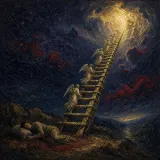
Open with the chapter’s first image
Genesis 24:1: “And Abraham was old, and well stricken in age: and the LORD had blessed Abraham in all things.”
Slow down at the turning point
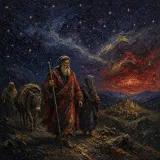
Genesis 24:33: “And there was set meat before him to eat: but he said, I will not eat, until I have told mine errand. And he said, Speak on.”
Keep this word trail visible
LORD, master, camels, drink, servant, Rebekah
What to explain, in order
Teach the passage in this order. Each step names the verses it rests on, so every point can be shown in the text before it is applied.
Genesis 24:1-9
The oath and its limits
Begin with Abraham old and blessed (24:1) and the commission to his senior servant. Explain the hand under the thigh as a solemn oath gesture tied to descendants. Then lay out the three limits: no Canaanite wife, a wife from his kindred, and never return Isaac to Mesopotamia. Teach why the last matters: the promise is attached to this land (24:7). Note that Abraham expects God's angel to go before the servant, yet he allows for refusal (24:8). Starting here shows that the whole journey is driven by faith in God's promise.
Genesis 24:10-27
Prayer, a sign and a generous woman
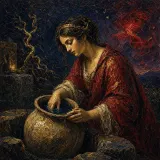
Follow the servant to the well at evening. Read his prayer in 24:12-14, a servant asking the God of his master for guidance, and note its content: kindness to Abraham, and a sign that tests character, not a random signal. Then show the answer arriving "before he had done speaking" (24:15). Explain the effort of watering ten camels. Point to the servant's silence and his question about her family, and finish on 24:26-27, where he worships and says "I being in the way, the LORD led me". Teach this as the heart of the chapter.
Genesis 24:28-49
The errand retold
Rebekah runs home and Laban runs out. Note quietly that Laban comes after seeing the gold (24:30); his later dealings with Jacob will make that detail matter. Then read the servant's long speech. Explain that the Book of Genesis repeats the events so the reader hears them again through the servant's eyes, with every step credited to the LORD. Point out small changes, such as describing the gifts after her answer rather than before (24:47). Teach this here because the family needs the whole account before they can decide.
Genesis 24:50-61
Consent and departure
Laban and Bethuel answer, "The thing proceedeth from the LORD" (24:50), and agree. The servant worships again and gives gifts. The next morning the family wants a delay, and the decision is put to Rebekah. Explain the importance of her question and answer in 24:58: her consent is sought and given. Then read the family's blessing in 24:60, which echoes God's promise to Abraham in 22:17 about possessing the gate of enemies. Teach this before the meeting so the class sees Rebekah's courage and her place in the promise.
Genesis 24:62-67
Evening in the field and comfort in the tent
End with Isaac at evening, walking or meditating in the field near the well Lahai-roi, Hagar's well from 16:14. Rebekah sees him, alights and veils herself, a sign of modesty before the bridegroom. The servant tells Isaac everything. Then read 24:67 slowly, verse by verse: the tent of Sarah, the marriage, Isaac's love for her, and comfort after his mother's death. Close by noting that a household began in grief in chapter 23 and is renewed here, with the promise carried forward into the next generation.
Where learners get stuck
The misreadings this passage tends to produce, and how to answer each from the text.
"We should ask God for a sign like the servant did before every decision."
The servant prays in a specific setting: he is under oath on a mission given by Abraham, he asks for a sign that tests generosity and character (24:14), and he still checks her family before giving thanks (24:21-27). Genesis records what happened rather than commanding a method for every choice. Encourage learners to pray for guidance as he did, and to look for godly character and to use wisdom and counsel, rather than demanding signs from God for each decision.
"Rebekah had no choice; she was handed over like property."
Abraham made provision for refusal in 24:8, and the family asks her directly: "Wilt thou go with this man?" She answers, "I will go" (24:58). The bride gifts of 24:53 are part of an honourable marriage custom, not a purchase. Ancient marriages were arranged differently from modern ones, but the text deliberately gives Rebekah a voice. Let learners see her as an active, courageous figure, as she is at the well, where she runs and decides for herself.
"The servant's success shows that faith always makes things go smoothly."
The servant faces real uncertainty: he fears the woman may refuse (24:5), he waits in silence not knowing (24:21), and the family tries to delay him (24:55). God guides him through these, as he testifies in 24:27, but the guidance comes through prayer, watching and persistence. Later chapters show Isaac and Rebekah's marriage facing barrenness (25:21) and deep division over their sons. Teach guidance as faithfulness in the steps, not a promise of a problem free life.
"Isaac is passive and does nothing in this chapter, so he does not matter."
Isaac is absent for most of the chapter because his father insists he must not leave the land (24:6, 8). He appears at the end walking in the field at evening (24:63), receives Rebekah, marries her, and loves her (24:67). The verse that says "he loved her" is the first time Scripture says a husband loved his wife. His comfort after Sarah's death shows his grief. Let the class see Isaac as the heir guarded in the land and a man capable of tenderness.
Learning objectives
- Identify the servant's oath and the limits Abraham sets.
- Describe the requested sign and Rebekah's actual response.
- Explain how prayer, observation, and family inquiry work together.
- Trace the purpose of the servant's extended retelling.
- Locate Rebekah's answer within the departure decision.
- Connect the marriage and Isaac's comfort with the prior chapter.
Teacher preparation
- Read Genesis 22:20–23 and 23:1–2 to identify Rebekah's family and the grief behind the chapter's close.
- Read all sixty-seven verses beforehand; mark instructions, well encounter, household report, departure, and arrival rather than treating repetition as filler.
- Explain the oath gesture in 24:2 and 9 as a solemn pledge; acknowledge that its symbolism is not explained here.
- Explain "good speed" as success, "provender" as animal feed, and "lighted off" as dismounted; keep the servant unnamed.
- Prepare ten camel marks to make Rebekah's offer concrete without inventing exact gallons, jar sizes, or labor duration.
Evidence and interpretation checks
Explicit
Locate Genesis 24:8 and 57–58: Abraham allows for the woman's unwillingness, and Rebekah herself says she will go when asked.
Scripture-supported
Compare Genesis 24:7 with 12:7 and 22:16–18; the servant's assignment rests on the already stated land and descendants promise.
Strong inference
Read Genesis 24:14, 19–21, and 23–27 together: the requested response reveals practical generosity, followed by observation and inquiry rather than instant assumption.
Possible or traditional reading
Identify the servant as Eliezer only as a traditional inference from Genesis 15:2; Genesis 24:2 and 34 do not name him.
Limit
State that Genesis 24:1–67 gives no universal sign-seeking method, exact camel-water total, or guarantee that every marriage will follow this sequence.
Discussion with answer guidance
1. Which limits must Abraham's servant honor even if finding Isaac's wife proves difficult?
What a good answer contains
Abraham binds the servant by oath to three limits: no wife "of the daughters of the Canaanites" (24:3), a wife from "my country, and to my kindred" (24:4), and under no circumstances to take Isaac back: "Beware thou that thou bring not my son thither again" (24:6, repeated in 24:8). He also allows for refusal: "if the woman will not be willing to follow thee, then thou shalt be clear from this my oath" (24:8). A good answer sees that Abraham trusts God's angel to go ahead (24:7) and still respects the woman's freedom to say no.
Show teacher guidance
Read verses 3–8: seek Abraham's kindred, do not return Isaac, and acknowledge possible unwillingness. Confidence does not erase these boundaries.
2. What does Rebekah offer beyond the drink requested from her?
What a good answer contains
The servant asks only for "a little water of thy pitcher" (24:17). Rebekah gives him drink, then says, "I will draw water for thy camels also, until they have done drinking" (24:19), and she runs repeatedly to the well until all ten camels are satisfied (24:20). Thirsty camels drink a great deal, so this is hard and generous work. The answer matches the sign the servant prayed for in 24:14 exactly. A strong answer notices both: the prayer answered, and the character of the woman revealed in her energy and kindness.
Show teacher guidance
Compare verses 17–20 with the prayer in verse 14. Ten camels make this rather more than a polite extra cup.
3. Why does the servant keep watching and then ask about her family?
What a good answer contains
The verse says "the man wondering at her held his peace, to wit whether the LORD had made his journey prosperous or not" (24:21). He does not jump to conclusions from one generous act; the sign answered his prayer, but he still needs to know whether she is of Abraham's kindred, as the oath requires (24:4). So he asks, "Whose daughter art thou?" (24:23). When she names Bethuel, son of Nahor, he bows and worships (24:26-27). A good answer sees the balance of prayer, watching and checking before he gives thanks.
Show teacher guidance
Read verses 21–27. He seeks to know whether the journey has prospered and whether she belongs to the required household.
4. Why give the long report before accepting the meal?
What a good answer contains
Because the family must decide with full knowledge. The servant refuses food: "I will not eat, until I have told mine errand" (24:33). He tells them of Abraham's blessing, Isaac's birth and inheritance, the oath, the prayer and its answer (24:34-48), and then asks them to decide plainly: "if ye will deal kindly and truly with my master, tell me: and if not, tell me" (24:49). A strong answer sees how the retelling credits the LORD at each step, and how it lets Laban and Bethuel conclude, "The thing proceedeth from the LORD" (24:50).
Show teacher guidance
Compare verses 33–49 with earlier events. The family must hear the commission, promise, request, and apparent answer before deciding.
5. What exactly is Rebekah asked, and what does she answer?
What a good answer contains
When the family wants ten more days and the servant wants to leave, they say, "We will call the damsel, and enquire at her mouth" (24:57). They ask her, "Wilt thou go with this man?", and she answers, "I will go" (24:58). Her answer matches the freedom Abraham allowed in 24:8. A good answer gives Rebekah her own voice and decision, and notices that her readiness to leave her home for a promise echoes Abraham's own departure in 12:1-4.
Show teacher guidance
Read verses 54–58 alongside verse 8. Her willingness to depart is explicitly sought; do not replace her words with only her family's agreement.
6. How does the final meeting complete more than a travel assignment?
What a good answer contains
Isaac meets Rebekah in the field at evening (24:63-65), the servant reports all that happened (24:66), and then: "Isaac brought her into his mother Sarah's tent, and took Rebekah, and she became his wife; and he loved her: and Isaac was comforted after his mother's death" (24:67). The journey ends in a marriage, in love, and in comfort for grief. A strong answer sees how the chapter moves from Sarah's death in chapter 23 to a new household in her tent, and the promise passing to the next generation.
Show teacher guidance
Read verses 62–67. Include marriage, Isaac's love, and comfort after Sarah's death; Rebekah is not merely cargo successfully delivered.
Responsible application
Heart and habits
Ask learners to compare a fictional decision based on one striking coincidence with one that also considers responsibilities, character, and clear information.
Relationships and community
Rewrite a fictional family decision that speaks over the person most affected; make room for the person's actual answer.
Faithful reporting
Have learners summarize the servant's mission so another person can evaluate it without pressure disguised as certainty about God's will.
Session plans
Two timings of the same lesson. The shorter keeps the reading, the central discussion and one response; the longer gives the confusions and the application their own time.
45 minutes
The oath
Read 24:1-9 and take question one, listing the limits of the oath on the board.
At the well
Read 24:10-27. Take questions two and three, then confusion one on asking for signs.
The errand told again
Summarise 24:28-49, reading 24:33 and 24:49 aloud. Take question four.
Rebekah answers
Read 24:50-61. Take question five and confusion two, putting her words I will go on the board.
Comfort in the tent
Read 24:62-67 and take question six.
Handout and prayer
Read the key verse and pray for guidance in a decision someone is facing.
90 minutes
After the grave
Recall Sarah's burial in chapter 23 and ask what Abraham still needs before he dies.
The oath
Read 24:1-9. Take question one and explain the oath gesture and why Isaac must stay in the land.
Prayer at the well
Read 24:10-27. Take questions two and three and confusion one. Let a volunteer estimate how much water ten camels would need.
The errand retold
Read 24:28-49 in full. Take question four and ask what changes in the servant's retelling.
I will go
Read 24:50-61. Take question five and confusion two, and compare 24:60 with 22:17.
The meeting
Read 24:62-67. Take question six and confusion four, and note the well Lahai-roi from 16:14.
Guidance today
Take confusion three and discuss how God guides through prayer, character and steps of obedience.
Handout and prayer
Read the key verse together and pray for those waiting on God in decisions about marriage, work or moving.
Adapting the lesson
Children
Children will enjoy the camels, so bring a cup and a bucket and let them count how many cups ten camels might need. Tell how the servant prayed and how Rebekah was kind and worked hard. Talk about how God helped the servant find the right person. Keep the marriage part simple: Isaac and Rebekah were married, he loved her, and he was comforted after his mother died.
Youth
Youth will connect with the question of how God guides big choices. Read the servant's prayer and his careful checking, and talk about the difference between asking God for help and demanding signs. Highlight Rebekah's character and her own decision, I will go. Avoid turning the chapter into dating advice; keep it about trusting God and looking for kindness and faithfulness.
Adults
Adults can explore the chapter's careful structure, the retelling in 24:34-49, and the theme of God's providence through ordinary means. Discuss how arranged marriage differs from modern practice while the text still values consent. Consider Laban's first appearance. Some adults may be single, widowed or in difficult marriages; frame the chapter around God's faithfulness rather than marriage as everyone's goal.
One to one
Ask the person what decision they are facing and read the servant's prayer in 24:12-14 together. Talk about how he prayed, watched, asked questions and then gave thanks. If they are grieving, read 24:67 and notice that Isaac found comfort after his mother's death. Pray with them for guidance and for the courage Rebekah showed.
Song and video learning lab
A song or video may interpret, compress, or dramatize the text. Its value becomes clearer when its choices are compared with Scripture.
- Before the media: the exact passage and its central movement.
- During the media: the words, people, events, and emotions the artist emphasizes.
- After the media: what it clarifies, what it leaves out, and what belongs back in the biblical text.
Handout
One page for learners to take home. The print button prints this section alone.
Genesis 24:1-67
The passage in brief
Abraham sends his oldest servant to find a wife for Isaac among his relatives. At a well, the servant prays for a sign, and Rebekah offers water to him and to all his camels. She is from Abraham's family. The servant tells her family how God has guided him, and Rebekah agrees to go. When she meets Isaac, they marry, Isaac loves her, and he is comforted after his mother's death.
A verse to keep
And he said, Blessed be the LORD God of my master Abraham, who hath not left destitute my master of his mercy and his truth: I being in the way, the LORD led me to the house of my master’s brethren.
Genesis 24:27 · King James Version
Questions to take home
What did the servant pray for in 24:12-14, and how was it answered?
What did Rebekah say when she was asked if she would go?
How was Isaac comforted at the end of the chapter?
This week
This week, pray specifically about one decision and then keep walking faithfully, watching for how God leads.
Music and video connected to the passage
Related media appears when its Scripture reference overlaps this study. Music and video can illuminate a theme while the biblical text remains the foundation.