The big picture
Abraham seeks a wife for Isaac from his wider kin while insisting that Isaac remain connected to the promised land. A trusted servant travels, prays and watches. Rebekah's hospitality and her own decision to leave are central to the outcome.
In this chapter
- A Commission with Limits Genesis 24:1-14
Abraham charges his servant not to take Isaac back to the former homeland.
- Water, Recognition and Testimony Genesis 24:15-49
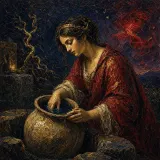
Rebekah offers water to the servant and the camels, a demanding task.
- Consent and a New Household Genesis 24:50-67
The family acknowledges the matter, but a discussion about departure follows.

Scripture beside the summary
Genesis · King James Version · 67Genesis 24:1-14
A Commission with Limits
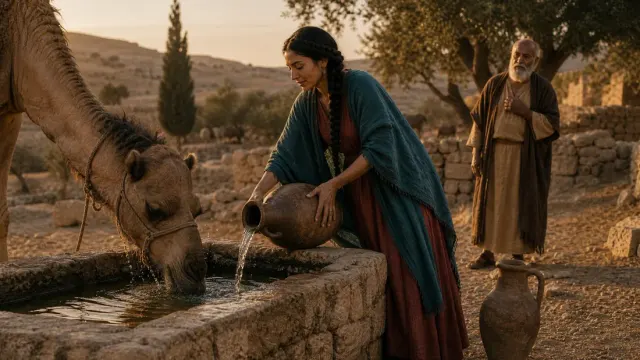
Abraham charges his servant not to take Isaac back to the former homeland. The servant recognizes that a woman may decline to come, and the oath allows for that possibility. At the well he prays for guidance through a concrete act of generous hospitality.
Deep dive
The servant is described by his seniority and authority over Abraham’s possessions, not by a personal name. Identifying him as Eliezer from chapter 15 is a traditional inference rather than an identification supplied here. His responsibility is substantial: the continuation of the household now depends upon the errand entrusted to him.
The oath joins two restrictions. Isaac is not to marry from the local Canaanite population, and he is not to be taken back to the land Abraham left. Kinship matters, but the promised land matters too. The journey is to bring a wife into the location of the promise, not to reverse Abraham’s departure by relocating his son.
The servant immediately identifies a practical difficulty: the woman may not be willing to follow him. Abraham allows release from the oath in that circumstance while repeating the prohibition on taking Isaac back. Confidence that God will send his angel ahead does not erase the woman’s possible refusal. The agreement establishes the purpose of the mission without making success an excuse for forcing its completion.
The prayer is specific to the errand and asks for kindness toward Abraham. Its proposed sign concerns more than a spoken identification: the woman is to offer water for the camels without being asked. Genesis has counted ten of them. Rebekah’s offer therefore entails repeated labor, and the account follows her hurrying, emptying the pitcher, and running back to the well. This is hospitality with considerable work attached.
Before the servant finishes speaking, Rebekah appears. Her genealogy is supplied immediately, allowing the reader to recognize Abraham’s kin while the servant still needs to ask. Her beauty and unmarried state are noted, but neither is the action named in the prayer. The test being observed concerns what she does for a stranger and his animals.
The servant does not interrupt her effort with an immediate announcement that everything is settled. He watches silently, seeking to know whether the LORD has prospered his journey. Prayer and attention remain together. The account gives divine guidance a recognizable sequence of events and verification rather than replacing all observation with a sudden private certainty.
Words to trace: Abraham, land, LORD, servant, wife, follow, master, camels, water, city, drink
Verse-by-verse path
- Genesis 24:1
“Well stricken in age” is literally “come into days”. Isaac marries at forty (25:20), so Abraham is about a hundred and forty. “In all things” renders a single word, bakkol, and the verse sums up a life before its last errand: nothing is left to Abraham but to see his son married.
- Genesis 24:2
“Eldest” is zaqen, elder, a title of rank rather than a statement of age. The hand under the thigh is an oath gesture found only here and when Jacob makes Joseph swear to bury him in Canaan (47:29). The thigh stands for the loins, so the oath is likely sworn on Abraham’s descendants; that is an inference, but a common one.
- Genesis 24:3
“The God of heaven, and the God of the earth” is a title found nowhere else in this form. “God of heaven” returns in verse 7 and then grows rare until Ezra, Nehemiah and Daniel, which use it often. Genesis gives no reason here for refusing a Canaanite wife; the grief Esau’s Hittite wives cause in 26:35 shows what the fear looked like.
- Genesis 24:4
“My country” and “my kindred” are the very words of 12:1, where Abraham was told to leave his country and his kindred. The servant is sent back to exactly what Abraham left, to bring one person out of it on the same road.
- Genesis 24:5
“Peradventure” is the word Abraham used six times bargaining for Sodom (18:24–32), perhaps. The servant’s question has two halves: the woman may refuse, and if she does, may he take Isaac back to her? It is the second half Abraham answers first.
- Genesis 24:6
“Beware thou” is the first word of Abraham’s reply, and it is a sharp one. Whatever else fails, the son of the promise is not to leave the land of the promise. Abraham never went back to Haran himself.
- Genesis 24:7
“Took me” is laqach, the same verb the servant is told to do with the wife, take. “Sware unto me” reaches back to the oath of 22:16. These are Abraham’s last recorded words in Genesis, and he gives the LORD’s part in the errand before the servant’s part.
- Genesis 24:8
“Clear” is naqi, innocent or free of liability. The release covers only the woman’s refusal; there is no release from the second condition, which Abraham repeats as the last line he speaks in the book: only bring not my son thither again.
- Genesis 24:9
The oath is sworn in exactly the terms of verse 2, the hand placed where Abraham asked. “Concerning that matter” binds the servant to both conditions at once, the wife from the kindred and Isaac kept in the land.
- Genesis 24:10
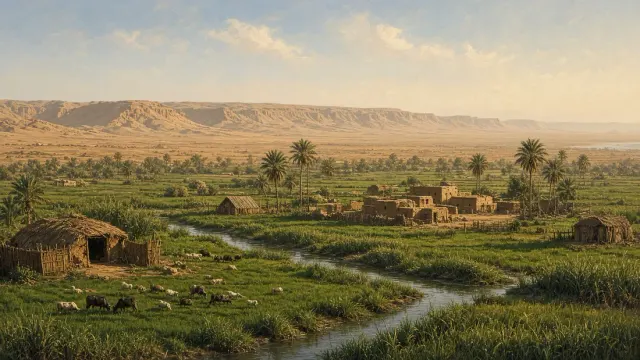
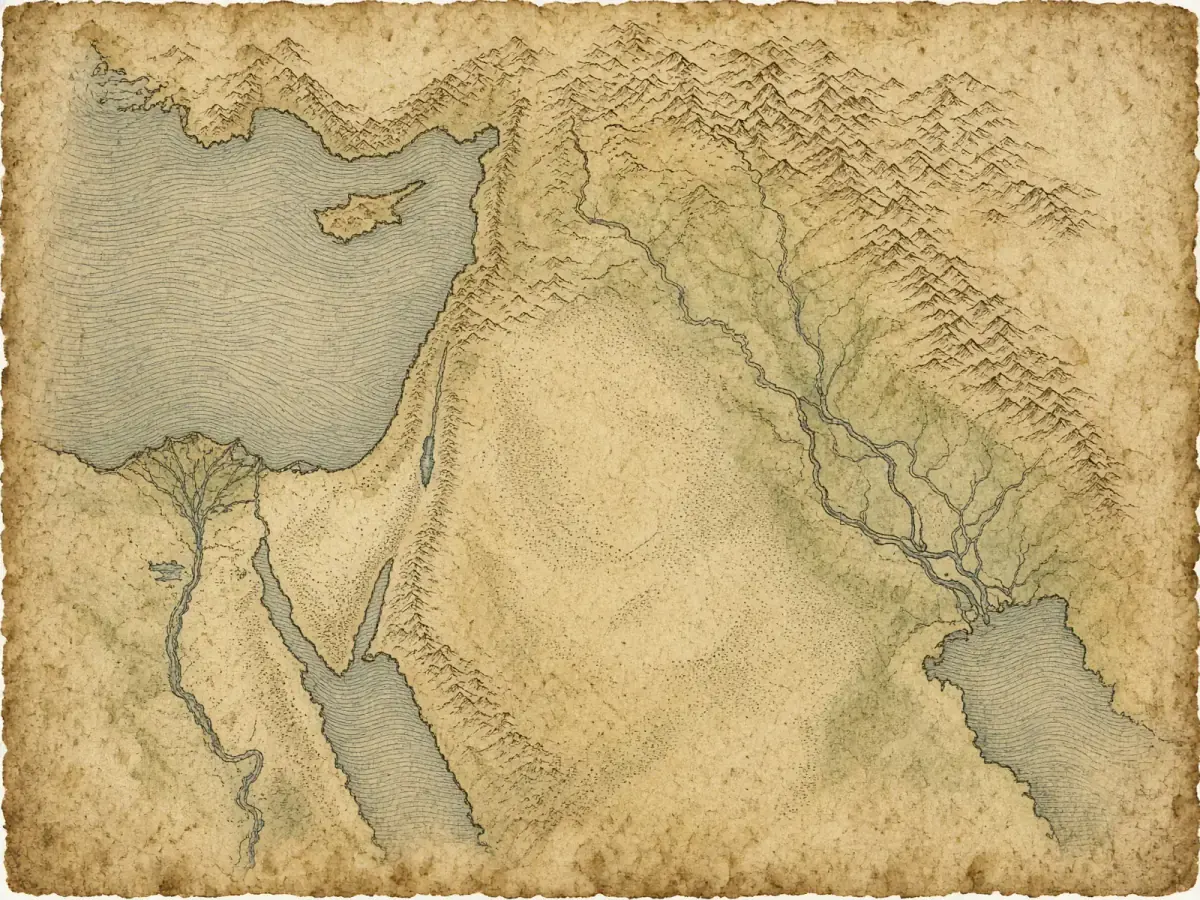
Ten camels is wealth on display, and the gifts they carry are meant to be seen. Mesopotamia is Aram-naharaim, Aram of the two rivers. “The city of Nahor” may mean the town where Nahor lived, Haran, or a town named Nahur, which appears in texts from Mari on the upper Euphrates.
- Genesis 24:11
“Made his camels to kneel” is barakh, from the same root as “bless”, since the Hebrew for knee is berekh. Evening was when the day’s water was drawn, and the servant waits where he knows the young women will come.
- Genesis 24:12
“Send me good speed” is hiqreh, make it happen, from the root that describes Ruth’s “hap” in lighting on Boaz’s field (Ruth 2:3). He asks for kindness, chesed, not to himself but to Abraham, and he addresses God as his master’s God.
- Genesis 24:13
A stranger meeting a young woman at a well recurs with Jacob and Rachel (29:2–12) and Moses and Zipporah (Exodus 2:15–21), each ending in marriage. Robert Alter called it a betrothal type-scene, a literary reading, but the repeated elements are plainly there in all three.
- Genesis 24:14
The Hebrew consonants for “damsel” here are naar, the masculine form, while the vowels read naarah. The Five Books of Moses spell the word that way almost everywhere, a scribal peculiarity the reading tradition corrects. “Appointed” is hokhachta, adjudged or decided, a word more at home in a court than at a well.
Genesis 24:1-14
King James Version1And Abraham was old, and well stricken in age: and the LORD had blessed Abraham in all things.
2And Abraham said unto his eldest servant of his house, that ruled over all that he had, Put, I pray thee, thy hand under my thigh:
3And I will make thee swear by the LORD, the God of heaven, and the God of the earth, that thou shalt not take a wife unto my son of the daughters of the Canaanites, among whom I dwell:
4But thou shalt go unto my country, and to my kindred, and take a wife unto my son Isaac.
5And the servant said unto him, Peradventure the woman will not be willing to follow me unto this land: must I needs bring thy son again unto the land from whence thou camest?
6And Abraham said unto him, Beware thou that thou bring not my son thither again.
7The LORD God of heaven, which took me from my father’s house, and from the land of my kindred, and which spake unto me, and that sware unto me, saying, Unto thy seed will I give this land; he shall send his angel before thee, and thou shalt take a wife unto my son from thence.
8And if the woman will not be willing to follow thee, then thou shalt be clear from this my oath: only bring not my son thither again.
9And the servant put his hand under the thigh of Abraham his master, and sware to him concerning that matter.
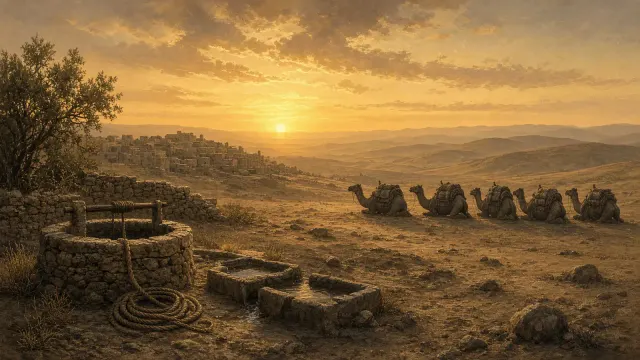
10And the servant took ten camels of the camels of his master, and departed; for all the goods of his master were in his hand: and he arose, and went to Mesopotamia, unto the city of Nahor.
11And he made his camels to kneel down without the city by a well of water at the time of the evening, even the time that women go out to draw water.
12And he said, O LORD God of my master Abraham, I pray thee, send me good speed this day, and shew kindness unto my master Abraham.
13Behold, I stand here by the well of water; and the daughters of the men of the city come out to draw water:
14And let it come to pass, that the damsel to whom I shall say, Let down thy pitcher, I pray thee, that I may drink; and she shall say, Drink, and I will give thy camels drink also: let the same be she that thou hast appointed for thy servant Isaac; and thereby shall I know that thou hast shewed kindness unto my master.
Genesis 24:15-49
Water, Recognition and Testimony
Rebekah offers water to the servant and the camels, a demanding task. Her family connection is discovered, and the servant worships. In the household he retells the journey, prayer and encounter at length, interpreting the events as the Lord's guidance.
Deep dive
The prayer is specific to the errand and asks for kindness toward Abraham. Its proposed sign concerns more than a spoken identification: the woman is to offer water for the camels without being asked. Genesis has counted ten of them. Rebekah’s offer therefore entails repeated labor, and the account follows her hurrying, emptying the pitcher, and running back to the well. This is hospitality with considerable work attached.
Before the servant finishes speaking, Rebekah appears. Her genealogy is supplied immediately, allowing the reader to recognize Abraham’s kin while the servant still needs to ask. Her beauty and unmarried state are noted, but neither is the action named in the prayer. The test being observed concerns what she does for a stranger and his animals.
The servant does not interrupt her effort with an immediate announcement that everything is settled. He watches silently, seeking to know whether the LORD has prospered his journey. Prayer and attention remain together. The account gives divine guidance a recognizable sequence of events and verification rather than replacing all observation with a sudden private certainty.
The question about Rebekah’s father produces the kinship connection on which the mission depends. Her further assurance about room and animal feed extends the generosity already shown at the well. The servant responds by bowing in worship and naming the LORD’s mercy and truth toward Abraham. The result is interpreted through a relationship of faithfulness, not through the mere convenience of finding lodging.
Laban enters after seeing the jewelry and hearing Rebekah’s report. The order makes the gifts noticeable, but Genesis does not explicitly state that greed is his motive for running out. He prepares hospitality, and the visitors and animals receive the care Rebekah had promised.
When food is placed before the servant, he refuses to eat until he has explained the errand. The hospitality will have to accommodate a substantial speech before dinner. That delay characterizes his priorities through a concrete choice: the household’s business comes before his own refreshment. It also prepares the long repeated account that follows, now addressed to people who were not present for the oath or the prayer.
Much of the material is familiar because Genesis has already recorded it happening. Its second appearance changes its audience and purpose. Abraham’s wealth establishes the circumstances of the proposed household; Sarah’s late birth identifies Isaac as the heir; the oath explains why the servant has come here rather than sought a local marriage. The repeated details build a case, not a second introduction for an inattentive reader.
The servant adds that his prayer had been spoken in his heart. Rebekah’s actions were therefore not a response to hearing him announce the sign he hoped to receive. His report joins the silent request, the offered water, and the verified family connection into an account of guidance. The earlier description brings out the jewelry before recording his questions, while his report puts their placement after her answer. The two tellings arrange the details differently without changing the identity of the woman or the evidence he presents.
He ends by asking whether the family will deal kindly and truly with Abraham, echoing the mercy and truth he has already attributed to the LORD. Divine faithfulness now frames a requested human answer. He asks for either acceptance or refusal so that he can determine his next direction. The full speech is designed to reach that decision, rather than to prolong admiration of the journey.
Words to trace: pitcher, drink, water, camels, draw, hasted, house, LORD, room, blessed, bracelets, master, wife
Verse-by-verse path
- Genesis 24:15
Her pedigree is given before her name has finished being spoken: Bethuel, son of Milcah, wife of Nahor. That route runs through the principal wife and not the concubine Reumah of 22:24. The pitcher, kad, sits on her shoulder, the way women carried water jars across the region.
- Genesis 24:16
Betulah could mean a young woman of marriageable age as well as a virgin, so the verse adds “neither had any man known her” to settle it. “Went down... came up” shows the kind of well it was: a spring reached by steps cut down into the ground.
- Genesis 24:17
“Let me drink a little” is hagmiini, let me sip, from a verb found elsewhere only in Job 39:24, of a warhorse that swallows the ground. He asks for the smallest thing possible. The servant runs; the rest of the chapter’s running belongs to Rebekah and Laban.
- Genesis 24:18
“My lord” is adoni, the courtesy she gives a stranger she has never seen. She lowers the jar from her shoulder “upon her hand” so he can drink from it directly. Two verbs of speed, hasted and let down, mark her from the first.
- Genesis 24:19
She waits until he has done drinking before she offers more, so the offer is not a reflex. A thirsty camel can take in over twenty gallons, so ten could need a couple of hundred; if her jar held perhaps three gallons, that means dozens of trips down the steps. The figures are estimates, but the scale is real.
- Genesis 24:20
“Emptied” is arah, to pour out or lay bare, and it is a vivid choice: she tips the whole jar into the trough rather than filling it by cupfuls. “Ran again” turns the offer of verse 19 into labour. Jacob will water flocks at troughs in 30:38.
- Genesis 24:21
“Wondering” translates mishtaeh, gazing, staring in astonishment, a rare form of the verb. “To wit” here means “to know”. He watches the whole process through in silence, and his question is about the LORD, not about her.
- Genesis 24:22
Half a shekel is a beka, the exact weight later set as each Israelite’s half-shekel for the tabernacle in Exodus 38:26. The bracelets weigh ten shekels, twenty times as much. The gifts are measured out before he knows whether she is kin.
- Genesis 24:23
Two questions, and the first is the one that matters: whose daughter? The second asks for a single night, lun, to lodge; the servant will end up eating, staying and taking the daughter away, all before a week has passed.
- Genesis 24:24
She answers with three generations and names her grandmother. That is the name Abraham’s household would recognise, since Milcah was Abraham’s niece, the daughter of his brother Haran (11:29). Rebekah is his kin on both sides of her father’s family.
- Genesis 24:25
Straw, teven, was chopped straw used as fodder and mixed with barley; it is the same word as the straw Israel has to gather for bricks in Exodus 5:7. She answers the question he asked and then offers more room than he asked for.
- Genesis 24:26
“Bowed down his head, and worshipped” pairs two verbs, qadad and shachah, a pairing that recurs when Israel hears of its deliverance in Exodus 4:31 and 12:27. He has not yet told her who he is.
- Genesis 24:27
“Mercy and truth” is chesed ve-emet, the first appearance of a pair that becomes a fixed description of God, as in Exodus 34:6, “abundant in goodness and truth”. The Hebrew of the last clause puts “I” first: I, being on the road, the LORD led me.
- Genesis 24:28
“Her mother’s house” is the term used in Ruth 1:8 and Song of Solomon 3:4 for the women’s side of a household. Rebekah’s father is barely present in this chapter; her mother and brother act for the family throughout.
- Genesis 24:29
Laban’s name means white, and it is how the reader meets a man who will take up much of chapters 29 to 31. His first act is to run, like his sister before him. Whether he runs for the man or the gold is the question verse 30 leaves open.
- Genesis 24:30
The order is jewels first, words second, which makes readers suspicious of Laban. That suspicion comes from what he does to Jacob later, not from anything this verse says. The servant, meanwhile, has not moved: he is still standing by the camels at the well.
- Genesis 24:31
Laban uses the divine name, the LORD, as does his family in verse 50; the same Laban will invoke it at Mizpah in 31:49. “I have prepared” is pinnah, to clear or turn out, the same verb as “prepare ye the way” in Isaiah 40:3.
- Genesis 24:32
The Hebrew “he” who ungirds the camels is most naturally Laban, acting as host. Water for the feet is what Abraham offered his visitors in 18:4. This is also the first mention that the servant had men with him, who have been there all along.
- Genesis 24:33
“Meat” in 1611 meant food of any kind, not flesh; the “meat offering” of Leviticus is grain. The man who has travelled for days and watered ten camels refuses to eat, and Laban’s “Speak on” is one Hebrew word, daber.
- Genesis 24:34
Three Hebrew words, “servant of Abraham, I”. He begins with whose he is and never once gives his own name. After the questions about whose daughter Rebekah is, he answers the same question about himself.
- Genesis 24:35
The inventory of flocks, herds, silver, gold, servants, camels and asses echoes the wealth Pharaoh gave Abram in 12:16, but the servant credits all of it to the LORD. He is describing the household Rebekah would enter.
- Genesis 24:36
“When she was old” is “after her old age”, the miracle told in four words. “Unto him hath he given all that he hath” is a statement about inheritance, and 25:5 confirms it. For a family weighing a marriage, this is the sentence that counts.
- Genesis 24:37
The servant tells the household that he is under oath. That changes their position: if they refuse, he goes home released, and they know it. He leaves out Abraham’s grand title for God in verse 3.
- Genesis 24:38
Abraham said “my country, and my kindred” in verse 4. The servant makes it “my father’s house”, narrowing the command until it points at this family and no other. The change is small, and it is well aimed.
- Genesis 24:39
He repeats his worry that the woman may not follow, but drops the question about taking Isaac back and Abraham’s refusal of it. Telling this family that the groom will never come to them would not help; that is an inference, but the omission is certain.
- Genesis 24:40
“Before whom I walk” is new here and echoes 17:1, where God told Abraham to walk before him. The angel sent “before thee” in verse 7 becomes an angel “with thee”, and a promise that he will “prosper thy way” is added.
- Genesis 24:41
A new condition appears: “if they give not thee one”. In verse 8 the refusal was the woman’s; here it is the family’s, and the family is listening. The word for “oath” also changes, from shevuah to alah, an oath that carries a curse.
- Genesis 24:42
“This day” covers the whole journey from Canaan in a phrase and puts him at the well today. His prayer is retold as a condition, “if now thou do prosper my way”, which makes the household the witnesses to how it was answered.
- Genesis 24:43
The word for “virgin” here is almah, not the betulah of verse 16. Almah means a young woman of marriageable age, and it is the word in Isaiah 7:14 that the Greek rendered parthenos, virgin. Genesis uses both words of the same girl within a few verses.
- Genesis 24:44
“Both drink thou” uses gam, also, twice: also you, also your camels. “Appointed out” is again the court word, hokhiach, adjudged. The servant presents Rebekah to her family as a verdict already given.
- Genesis 24:45
The account of what happened is compressed. In verse 17 he ran to meet her; here he simply speaks. He leaves out his long silent staring from verse 21, which would do nothing to persuade the household.
- Genesis 24:46
The labour of watering ten camels shrinks to four Hebrew words, “and the camels she watered too”. The family has seen the camels in their yard and can do the arithmetic themselves.
- Genesis 24:47
“Upon her face” shows that the “earring” of verse 22 was a nose ring, nezem, like the nose jewels of Isaiah 3:21. He also names Nahor before Milcah here, where Rebekah put Milcah first: the household hears the lineage in the order it would give it.
- Genesis 24:48
“The right way” is derekh emet, the way of truth. “My master’s brother’s daughter” is loose, since Rebekah is Nahor’s granddaughter; “brother” covers a kinsman in Hebrew, as when Lot, Abraham’s nephew, is called his brother in 14:14.
- Genesis 24:49
“Kindly and truly” repeats chesed ve-emet from verse 27, asking the family to do what God has already done. “Right hand, or to the left” is an idiom for a new direction. Rashi read it as the servant going to seek a wife from the families of Ishmael or Lot.
Genesis 24:15-49
King James Version15And it came to pass, before he had done speaking, that, behold, Rebekah came out, who was born to Bethuel, son of Milcah, the wife of Nahor, Abraham’s brother, with her pitcher upon her shoulder.
16And the damsel was very fair to look upon, a virgin, neither had any man known her: and she went down to the well, and filled her pitcher, and came up.
17And the servant ran to meet her, and said, Let me, I pray thee, drink a little water of thy pitcher.
18And she said, Drink, my lord: and she hasted, and let down her pitcher upon her hand, and gave him drink.
19And when she had done giving him drink, she said, I will draw water for thy camels also, until they have done drinking.
20And she hasted, and emptied her pitcher into the trough, and ran again unto the well to draw water, and drew for all his camels.
21And the man wondering at her held his peace, to wit whether the LORD had made his journey prosperous or not.
22And it came to pass, as the camels had done drinking, that the man took a golden earring of half a shekel weight, and two bracelets for her hands of ten shekels weight of gold;
23And said, Whose daughter art thou? tell me, I pray thee: is there room in thy father’s house for us to lodge in?
24And she said unto him, I am the daughter of Bethuel the son of Milcah, which she bare unto Nahor.
25She said moreover unto him, We have both straw and provender enough, and room to lodge in.
26And the man bowed down his head, and worshipped the LORD.
27And he said, Blessed be the LORD God of my master Abraham, who hath not left destitute my master of his mercy and his truth: I being in the way, the LORD led me to the house of my master’s brethren.
28And the damsel ran, and told them of her mother’s house these things.
29And Rebekah had a brother, and his name was Laban: and Laban ran out unto the man, unto the well.
30And it came to pass, when he saw the earring and bracelets upon his sister’s hands, and when he heard the words of Rebekah his sister, saying, Thus spake the man unto me; that he came unto the man; and, behold, he stood by the camels at the well.
31And he said, Come in, thou blessed of the LORD; wherefore standest thou without? for I have prepared the house, and room for the camels.
32And the man came into the house: and he ungirded his camels, and gave straw and provender for the camels, and water to wash his feet, and the men’s feet that were with him.
33And there was set meat before him to eat: but he said, I will not eat, until I have told mine errand. And he said, Speak on.
34And he said, I am Abraham’s servant.
35And the LORD hath blessed my master greatly; and he is become great: and he hath given him flocks, and herds, and silver, and gold, and menservants, and maidservants, and camels, and asses.
36And Sarah my master’s wife bare a son to my master when she was old: and unto him hath he given all that he hath.
37And my master made me swear, saying, Thou shalt not take a wife to my son of the daughters of the Canaanites, in whose land I dwell:
38But thou shalt go unto my father’s house, and to my kindred, and take a wife unto my son.
39And I said unto my master, Peradventure the woman will not follow me.
40And he said unto me, The LORD, before whom I walk, will send his angel with thee, and prosper thy way; and thou shalt take a wife for my son of my kindred, and of my father’s house:
41Then shalt thou be clear from this my oath, when thou comest to my kindred; and if they give not thee one, thou shalt be clear from my oath.
42And I came this day unto the well, and said, O LORD God of my master Abraham, if now thou do prosper my way which I go:
43Behold, I stand by the well of water; and it shall come to pass, that when the virgin cometh forth to draw water, and I say to her, Give me, I pray thee, a little water of thy pitcher to drink;
44And she say to me, Both drink thou, and I will also draw for thy camels: let the same be the woman whom the LORD hath appointed out for my master’s son.
45And before I had done speaking in mine heart, behold, Rebekah came forth with her pitcher on her shoulder; and she went down unto the well, and drew water: and I said unto her, Let me drink, I pray thee.
46And she made haste, and let down her pitcher from her shoulder, and said, Drink, and I will give thy camels drink also: so I drank, and she made the camels drink also.
47And I asked her, and said, Whose daughter art thou? And she said, The daughter of Bethuel, Nahor’s son, whom Milcah bare unto him: and I put the earring upon her face, and the bracelets upon her hands.
48And I bowed down my head, and worshipped the LORD, and blessed the LORD God of my master Abraham, which had led me in the right way to take my master’s brother’s daughter unto his son.
49And now if ye will deal kindly and truly with my master, tell me: and if not, tell me; that I may turn to the right hand, or to the left.
Genesis 24:50-67
Consent and a New Household
The family acknowledges the matter, but a discussion about departure follows. Rebekah is asked and says she will go. She travels to Canaan, meets Isaac and becomes his wife. Isaac loves her and is comforted after his mother's death.
Deep dive
Laban and Bethuel interpret the reported sequence as proceeding from the LORD. Their statement that they cannot speak bad or good expresses their refusal to oppose what they understand to have been divinely directed. They agree that Rebekah should become Isaac’s wife.
The servant’s first recorded response is worship, not the immediate unpacking of further valuables. The gifts then go to Rebekah and to members of her family. Genesis distinguishes those recipients rather than treating the entire exchange as a single unexplained payment. The chapter does not provide a complete legal description from which every marriage custom can be reconstructed.
Eating and drinking finally follow the completion of the errand’s central negotiation. The sequence returns to the meal set aside in verse 33 and closes the delay deliberately. Yet agreement between the men is not the last word before departure. The next morning will introduce a proposed delay and an answer from Rebekah herself.
Rebekah’s brother and mother ask that she remain for further days. The servant presses to depart because the LORD has prospered his way. The disagreement concerns timing after the marriage has been agreed, and the household calls Rebekah to answer whether she will go with him.
Her reply, “I will go,” has its own place in the account. It should neither disappear behind the family’s agreement nor be expanded into a claim that the entire arrangement followed modern assumptions about courtship. Genesis records a direct willingness to undertake the journey. That answer resolves the concern the servant first raised before leaving Abraham: the possibility that the woman would not follow him.
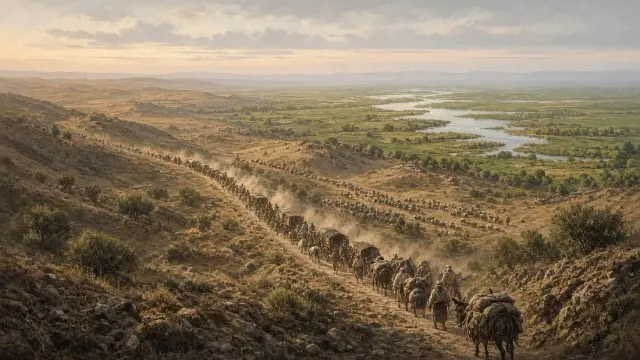
The farewell blessing speaks of multiplied descendants and possession of enemies’ gates, recalling the promise of chapter 22. Rebekah enters the movement toward that future as someone addressed by blessing, not merely as an item successfully collected. She leaves with her nurse and other women, and the camels that first occasioned her labor now carry her toward the new household. Like Abraham before her, she departs from kin toward the land of the promise.
Isaac comes from the direction of the well Lahairoi, a location already associated with Hagar’s encounter. At evening he goes into the field to meditate. The rare Hebrew verb suach, rendered “meditate,” has been understood as reflection or prayer and, by some interpreters, as walking about; the precise activity is disputed. The scene does not require a detailed reconstruction of his private thoughts.
Both Isaac and Rebekah lift their eyes. He sees the approaching camels; she sees him and asks his identity. The matching movements bring the two sides of the long journey into one scene. Rebekah descends and covers herself, and the servant gives Isaac an account of what he has done. The mission has reached the person whose future gave it its purpose.
The closing movement enters Sarah’s tent. Isaac takes Rebekah as his wife, loves her, and is comforted after his mother’s death. Love is expressly recorded here, but love before the meeting is not invented. The location and final notice join the marriage to the bereavement of chapter 23. A household marked by death receives another living relationship, and the account permits affection and comfort to be its concluding words.
Words to trace: LORD, gave, jewels, Rebekah, servant, Abraham’s, damsel, mother, sister, abide, Isaac, eyes, field, lifted
Verse-by-verse path
- Genesis 24:50
Bethuel speaks only here, after his son, and then vanishes from the account. “We cannot speak unto thee bad or good” is an idiom for having nothing to say against it. God uses the same idiom to warn Laban not to speak to Jacob “either good or bad” in 31:24.
- Genesis 24:51
“Take her, and go” uses the same two verbs as Pharaoh handing Sarah back to Abraham in 12:19: “take her, and go thy way”. There a wife was restored to Abraham’s house; here one is given to it.
- Genesis 24:52
This is the servant’s third act of worship in the chapter, after verses 26 and 48, and the fullest: he bows himself right down to the earth. Each one comes at the moment the answer arrives, not later.
- Genesis 24:53
Rebekah receives silver, gold and clothing. Her brother and mother receive “precious things”, migdanot, choice gifts, the customary presents to the bride’s family. Bethuel is not among them, and some readers take that as a sign he was aged or that his name in verse 50 is a later addition.
- Genesis 24:54
“Send me away” is shalach, and the verb runs through the next few verses: send me away, send me away, they sent away. Only now does the servant eat the food he turned down in verse 33. By morning he is ready to leave.
- Genesis 24:55
The Hebrew is “days or ten”, yamim o asor. The King James takes it as a few days, at least ten; Rashi read the days as a year and the ten as ten months. Either way, the mother and brother want time with her before she goes.
- Genesis 24:56
“Hinder me not” is al teacharu, do not hold me back. His reason is theological: the LORD has already prospered the way, and delay would treat the answer as provisional.
- Genesis 24:57
“Enquire at her mouth” is literally ask her mouth, hear it from her own lips. Some scholars have cited contracts from Nuzi, where a woman given in marriage by her brother states her own consent; E. A. Speiser drew that comparison, though how far it applies is debated.
- Genesis 24:58
“I will go” is a single Hebrew word, elekh. The question has the same verb, “wilt thou go?”, so her answer takes it and gives it straight back. She does not ask for the ten days.
- Genesis 24:59
The nurse goes unnamed until she dies, when 35:8 calls her Deborah and records her burial under an oak below Bethel. She was still with the family when Jacob returned from Haran, a lifetime later.
- Genesis 24:60
“Thousands of millions” is literally “thousands of ten thousands”, myriads, the largest Hebrew number word. The second half, possessing the gate of the enemy, repeats the oath God swore to Abraham in 22:17, spoken by a family who had not heard it.
- Genesis 24:61
“Her damsels” shows Rebekah went with maids of her own, as Leah and Rachel later go with Zilpah and Bilhah (29:24, 29). “Followed the man” is literally went after him. She rides the camels she watered.
- Genesis 24:62
Lahai-roi is the well where Hagar met the angel in 16:14, “the well of him that liveth and seeth me”. Isaac settles there after Abraham’s death (25:11). The “south country” is the Negev, the dry land south of Hebron.
- Genesis 24:63
“At the eventide” is literally the turning of the evening. The servant reached the well at evening in verse 11, so the chapter’s two meetings happen at the same hour. “Lifted up his eyes, and saw” is how Abraham saw the ram in 22:13.
- Genesis 24:64
“Lighted off” is 1611 English for alighted, getting down; the Hebrew verb is naphal, to fall, and it is abrupt. She is down from the camel before she has asked who he is.
- Genesis 24:65
The word for vail, tsaiph, appears only here and in 38:14 and 38:19, where Tamar veils herself. A bride came to her husband veiled, which is part of how Laban’s switch of Leah for Rachel in 29:23–25 goes unnoticed; that link is an inference.
- Genesis 24:66
The servant tells Isaac “all things”, and the reader is spared a third telling. His name has never been given, and this is his last appearance.
- Genesis 24:67
The Hebrew reads awkwardly, “into the tent, Sarah his mother”, and some scholars think the name was added to clarify. This is the first time Scripture says a man loved a woman; the earlier “love” in 22:2 was Abraham’s for Isaac. “Comforted” is nicham, the root in Noah’s name (5:29).
Genesis 24:50-67
King James Version50Then Laban and Bethuel answered and said, The thing proceedeth from the LORD: we cannot speak unto thee bad or good.
51Behold, Rebekah is before thee, take her, and go, and let her be thy master’s son’s wife, as the LORD hath spoken.
52And it came to pass, that, when Abraham’s servant heard their words, he worshipped the LORD, bowing himself to the earth.
53And the servant brought forth jewels of silver, and jewels of gold, and raiment, and gave them to Rebekah: he gave also to her brother and to her mother precious things.
54And they did eat and drink, he and the men that were with him, and tarried all night; and they rose up in the morning, and he said, Send me away unto my master.
55And her brother and her mother said, Let the damsel abide with us a few days, at the least ten; after that she shall go.
56And he said unto them, Hinder me not, seeing the LORD hath prospered my way; send me away that I may go to my master.
57And they said, We will call the damsel, and enquire at her mouth.
58And they called Rebekah, and said unto her, Wilt thou go with this man? And she said, I will go.
59And they sent away Rebekah their sister, and her nurse, and Abraham’s servant, and his men.
60And they blessed Rebekah, and said unto her, Thou art our sister, be thou the mother of thousands of millions, and let thy seed possess the gate of those which hate them.
61And Rebekah arose, and her damsels, and they rode upon the camels, and followed the man: and the servant took Rebekah, and went his way.
62And Isaac came from the way of the well Lahai-roi; for he dwelt in the south country.
63And Isaac went out to meditate in the field at the eventide: and he lifted up his eyes, and saw, and, behold, the camels were coming.
64And Rebekah lifted up her eyes, and when she saw Isaac, she lighted off the camel.
65For she had said unto the servant, What man is this that walketh in the field to meet us? And the servant had said, It is my master: therefore she took a vail, and covered herself.
66And the servant told Isaac all things that he had done.
67And Isaac brought her into his mother Sarah’s tent, and took Rebekah, and she became his wife; and he loved her: and Isaac was comforted after his mother’s death.
Questions to keep in mind while reading
- Track who acts, who speaks, who is affected, and what changes.
- Notice repeated promises, failures, rescues, and consequences.
- Do not assume the account approves every action that is reported.
Text first
Where readers differ
The chapter summary begins with what the passage says and how its parts fit together. It does not assume one denomination has already settled every question. Where a conclusion depends on a tradition, literary theory, or historical reconstruction, that dependence is named openly.
The KJV text is presented first. Interpretive conclusions are labeled, and differences are introduced only when they help a reader understand why serious communities do not always reach the same answer.
Does Genesis endorse every family arrangement it describes?
No. Polygamy, concubinage, enslavement, favoritism and inheritance disputes are narrated with their consequences. The fact that an ancestor participates in a practice is not a command for later readers. Genesis repeatedly exposes pain and injustice within the chosen household.
Keep the creation account's shared human dignity in view. Hear Leah's longing, Hagar's affliction, Rebekah's decision, Tamar's claim and the silence around Dinah's own response. Where the Book of Genesis does not record a person's consent or thoughts, do not invent them.
Genesis 1:27 · Genesis 16:6 · Genesis 24:58 · Genesis 29:31-35 · Genesis 34:1-31 · Genesis 38:26
Questions beneath the surface
- What account of God, human freedom, responsibility, and the good life emerges from Genesis 24?
- Which tension does the chapter refuse to resolve quickly, especially around guidance, hospitality, family?
- What changes when the chapter is read as part of the whole canon rather than as an isolated moral lesson?
- Where might a sincere reader confuse a familiar tradition with something the text states directly?
Questions for serious personal contemplation
These open-ended questions make room for tension, honest response, prayer, and conclusions that remain accountable to the chapter.
Observe without rushing
What part of Genesis 24 makes you stop, feel unsettled, or feel surprised, and why?
Which detail in the passage would be easiest to overlook? How does that detail change your understanding?
Where do you see tension between what happens and this focus: Rebekah chooses the journey?
What important question does the passage leave open instead of resolving quickly?
Examine your inner life honestly
Which person, response, fear, or desire in the passage feels most like your own life right now?
What assumption about God, other people, or yourself does this text challenge?
Which part would you rather soften, avoid, or explain away too quickly? What might that reaction reveal?
If this Scripture could ask you one direct question, what do you think it would ask?
Respond with wisdom and courage
What do you need to remember, confess, grieve, thank God for, or trust after reading this passage?
How might another faithful person read this situation differently without ignoring the text?
What obedient response would be costly, uncomfortable, or slow, yet still faithful to Scripture?
What question will you carry into prayer this week, and which verses will you keep in front of you?
Music and video connected to the passage
Related media appears when its Scripture reference overlaps this study. Music and video can illuminate a theme while the biblical text remains the foundation.