

The big picture
The chapter begins with people demanding a sign while failing to read the significance of what is already before them, then turns to disciples who have seen two great feedings and are still preoccupied with missing bread. From that muddle comes one of the clearest confessions in the Book of Matthew: Peter names Jesus as the Christ, the Son of the living God, and receives words about the rock, the church, the keys, and authority. Yet the confession is immediately tested by the meaning of the title. Jesus begins to speak plainly of Jerusalem, suffering, death, and resurrection, and Peter tries to reject that path. The man just blessed is now called an obstacle because he wants a Messiah without the announced suffering. Jesus then extends the shape of the cross to those who follow him, placing the apparent gain of the whole world beside the possible loss of the self and setting present cost under the horizon of the Son of man’s coming glory.
Central truth
Peter identifies Jesus as the Christ and Son of the living God, but Jesus rejects Peter’s attempt to prevent his suffering and teaches that following him requires the self-denial of the cross.
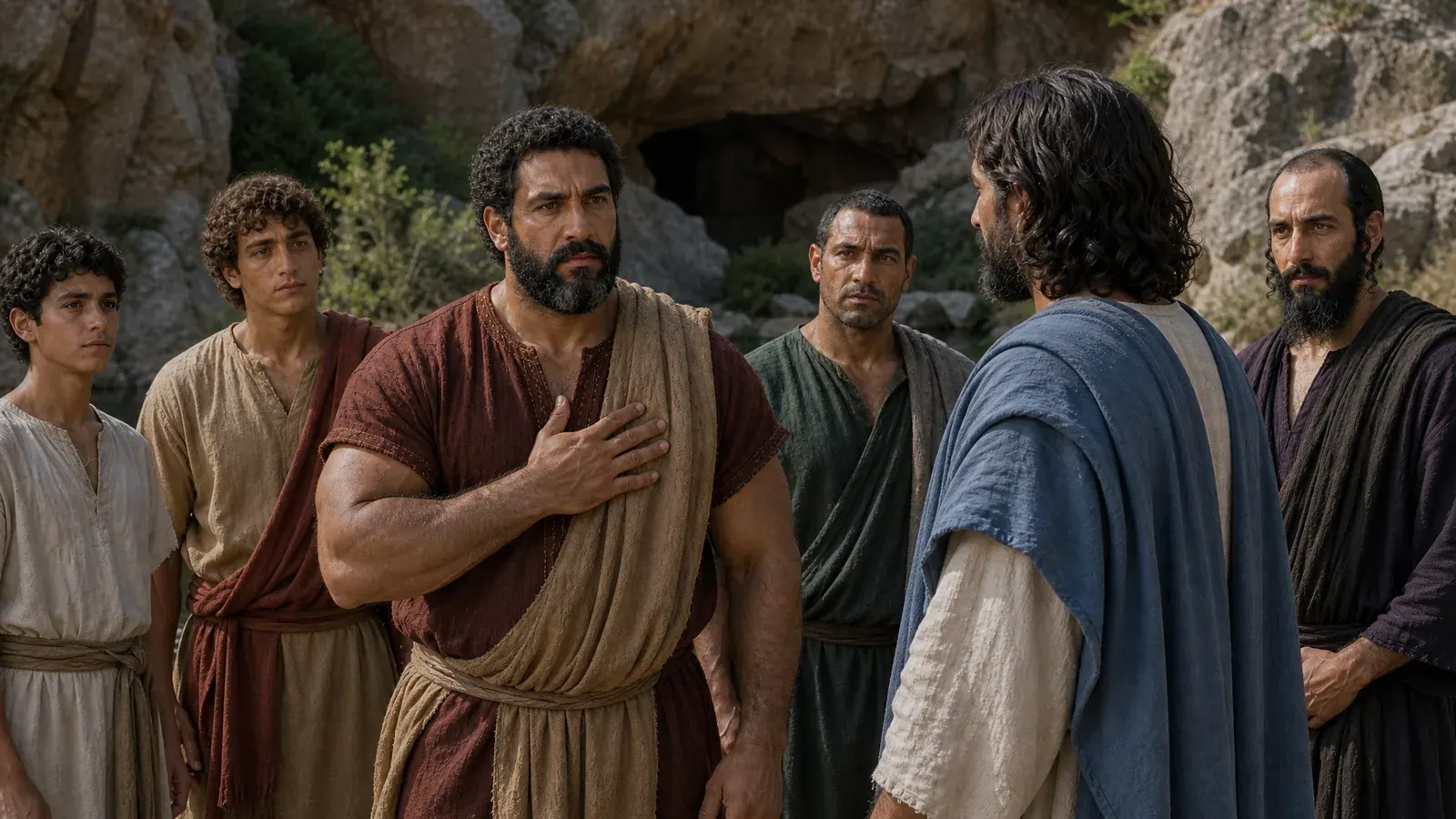

The study notes have a page of their own
The movement by movement analysis, the words to trace, the verse by verse notes and where readers differ are written for someone studying alone. They are on the Deep Personal Reflections page for this chapter. This page is the lesson.
A chapter-specific teaching brief
These anchors come from this chapter itself. They help a teacher use the Level 1 overview, the Level 2 study, and the Scripture text as one lesson.
Open with the chapter’s first image
Matthew 16:1: “The Pharisees also with the Sadducees came, and tempting desired him that he would shew them a sign from heaven.”
Slow down at the turning point
Matthew 16:13: “When Jesus came into the coasts of Caesarea Philippi, he asked his disciples, saying, Whom do men say that I the Son of man am?”
Keep this word trail visible
Jesus, bread, disciples, heaven, Peter, Pharisees
What to explain, in order
Teach the passage in this order. Each step names the verses it rests on, so every point can be shown in the text before it is applied.
Matthew 16:1-12
A sign refused and a warning missed
Begin with the opponents, because the chapter opens with two groups who rarely agree, Pharisees and Sadducees, asking together for "a sign from heaven". Jesus answers that they read the red sky well enough and cannot read "the signs of the times", and he offers only "the sign of the prophet Jonas", which points to his death and rising (compare 12:40). Then the boat scene: explain leaven as yeast, the small thing that works through the whole loaf. Teach this first because it shows two kinds of blindness, hostile and anxious, before Peter is given sight.
Matthew 16:13-17
Two questions at Caesarea Philippi
Jesus asks two questions, and the order matters: what others say, then what you say. Read the crowd's answers as honest respect; nobody is insulting him. Then read Peter's confession slowly and explain both halves. Christ is the Greek form of Messiah, the anointed king of David's line promised in the prophets. The Son of the living God goes further, and Jesus does not correct it. Put the weight of this step on 16:17: Peter is blessed because the Father revealed it. The confession is received before it is spoken, which is why it cannot be a boast.
Matthew 16:18-20
The rock, the keys, and the silence
Explain the play on words: Peter's name means a stone, and Jesus says "upon this rock I will build my church". Readers in different traditions take the rock as Peter himself, as Peter's confession, or as Christ, and each has reasons; set them out without choosing for the room. What all can hold together is in the verse itself: Jesus is the builder, the church is his, and "the gates of hell shall not prevail against it". Explain the keys from Isaiah 22:22 as authority over a household, and note that binding and loosing reappear in 18:18. Then the order to tell no man shows the title still needs the cross to explain it.
Matthew 16:21-23
From that time forth
Mark the phrase "From that time forth" as a turning point; the same words opened Jesus' preaching in 4:17. Now he begins to speak of Jerusalem, suffering, death and the third day. Read Peter's protest with sympathy, because it comes from love and from a picture of the Messiah that has no room for a cross. Then read the rebuke. Explain "Get thee behind me" as a command to take a follower's place again, and "offence" as a stumbling stone, a grim echo of the rock in verse 18. The man who was given a revelation now speaks the tempter's lines, and that should sober every learner.
Matthew 16:24-28
The disciple's road and the coming King
Now apply the announcement to the disciples, as Jesus does. Explain the three verbs in 16:24: deny himself, take up his cross, follow me. Self-denial here is not self-hatred; it is giving up the right to set the route. Take verses 25-26 as an argument about value: a whole world gained cannot buy back a soul. Close on verses 27-28, the Son of man coming in his Father's glory with reward for every man according to his works. Say plainly that readers connect verse 28 with the Transfiguration that follows, with the resurrection, or with later events, and that Matthew 17:1 begins six days later on a mountain.
Where learners get stuck
The misreadings this passage tends to produce, and how to answer each from the text.
"Peter was the hero of this chapter, so whatever Peter said was right."
The chapter will not allow it. The same man who confesses "Thou art the Christ" in 16:16 is told "thou art an offence unto me" in 16:23. His confession was revealed by the Father (16:17); his protest came from thinking the things "of men". Teach learners to honour Peter's confession and to notice his correction in the same breath. The disciples are never the measure in Matthew; Jesus is.
"Calling Peter Satan means Peter was possessed or became evil."
Jesus addresses the suggestion Peter has just made. In 4:10 he answered the tempter with "Get thee hence, Satan" when offered the kingdoms without the cross; here he hears the same offer from a friend. The explanation follows at once: Peter savours "those that be of men". Peter remains a disciple, is taken up the mountain in 17:1, and is restored after his later denial. The rebuke is about a way of thinking, not a change in what Peter is.
"Taking up your cross means putting up with an annoying neighbour or a sore knee."
In Jesus' world a man carrying a cross was walking to his death. The saying in 16:24 follows the announcement of 16:21, so it means following Jesus on a road that may cost life itself (16:25). That is not every irritation. It is also not a call to seek pain for its own sake; the aim is to follow him, and the promise is that whoever loses his life "for my sake shall find it".
"The rock verse settles once for all which church is the true church."
Christians read 16:18 in more than one way, and the verse alone does not end those debates. Teach what it plainly says: Jesus names Peter, promises to build his own church, and says the gates of hell shall not prevail. Let learners see that Peter's role is real and that the foundation of everything is the confession of 16:16, revealed by the Father. Leave the questions of later church order to the traditions represented in the room, with respect for each.
Learning objectives
- Explain why the leaven warning is not about missing bread.
- Distinguish public guesses from Peter’s confession.
- Identify the source Jesus gives for Peter’s recognition.
- Separate explicit promises from debated readings of the rock.
- Explain the reversal from Peter’s blessing to his rebuke.
- Connect taking the cross with the announced suffering of Jesus.
Teacher preparation
- Read Matthew 16:1–17:9; keep the suffering announcement beside the following revelation of glory.
- Locate Caesarea Philippi without imposing an asserted archaeological backdrop on every saying.
- Gloss leaven as yeast, savour in verse 23 as setting one’s mind on, and offence as a stumbling obstacle.
- Record the feeding totals from chapters 14–15 to correct the missing-bread interpretation.
- List major rock interpretations; distinguish them from Jesus’ explicit building promise and authorization of Peter.
Evidence and interpretation checks
Explicit
Identify Peter’s confession, the Father’s revelation, the suffering announcement, and Peter’s rebuke in Matthew 16:16–23.
Scripture-supported
Compare Matthew 16:19 with 18:18; binding and loosing recur in instruction about the disciple community, though the settings differ.
Strong inference
Read Matthew 16:16 beside 22–23; infer that correct recognition of Jesus’ identity has not yet produced acceptance of his messianic path.
Possible or traditional reading
Present Peter, Peter’s confession, and Christ as major readings of the rock in Matthew 16:18; do not claim the verse alone resolves every later church-authority dispute.
Limit
State that Matthew 16:28 does not explicitly name the event in which its promised sight occurs; distinguish proposals from its actual wording.
Discussion with answer guidance
1. Why does Jesus recall the baskets when the disciples worry about bread?
What a good answer contains
Because the disciples hear "leaven" and think of lunch, while Jesus is talking about teaching. He points them to their own memory: "the five loaves of the five thousand" and "the seven loaves of the four thousand" (16:9-10), with baskets left over both times. Men who watched bread multiply twice should not be anxious about one forgotten loaf. A good answer ends where verse 12 ends: the warning was against "the doctrine of the Pharisees and of the Sadducees". A weak answer stops at their forgetfulness and misses the danger Jesus actually named.
Show teacher guidance
Use 16:8–12: their own experience should redirect them from food supply to doctrine. The missing lunch has their attention; the dangerous teaching is the subject Jesus actually raised.
2. How does Peter’s answer differ from the guesses about John, Elijah, or Jeremiah?
What a good answer contains
The crowds rank Jesus among the great: John the Baptist, Elias, Jeremias, "or one of the prophets" (16:14). Every guess is a compliment, and every guess places him in a line of messengers. Peter answers in another category: "Thou art the Christ, the Son of the living God" (16:16). The strong answer keeps both titles, the anointed king Israel waited for and the Son of the living God, and notices that Jesus asks "But whom say ye", making the question personal. A weak answer treats Peter as simply more enthusiastic than the crowd.
Show teacher guidance
Compare 16:14 with 16:16: Peter confesses Christ and Son of the living God, not simply another prophet. Retain both titles rather than reducing the answer to admiration.
3. What does Jesus affirm before speaking about the rock and keys?
What a good answer contains
He first says where Peter's answer came from: "flesh and blood hath not revealed it unto thee, but my Father which is in heaven" (16:17). Peter is blessed, but the insight is a gift, not an achievement. Only then come the name Peter, the rock, the church, the keys and binding and loosing (16:18-19). A good answer keeps that order: revelation first, commission second. It also separates what the verses say plainly, that Jesus will build his church and that hell's gates will not prevail, from the later debates about what the rock is.
Show teacher guidance
Read 16:17: the Father has revealed this, not flesh and blood. Then distinguish the explicit building promise and address to Peter from conclusions requiring further interpretation.
4. Why must discussion of the rock remain connected to the rest of the chapter?
What a good answer contains
Because the same Peter who is blessed in 16:17 is called Satan in 16:23, six verses later. If the rock saying is read alone, it can be made to mean that Peter could not be wrong, or argued down until Peter has no role at all. Matthew sets the two scenes together so that neither move works. A good answer says Peter receives a real promise and still needs correction, and that the promise of 16:18 rests on the confession of 16:16, which the Father gave. A weak answer settles the rock debate and forgets the rebuke.
Show teacher guidance
Hold 16:18–19 alongside 16:21–23. Peter receives a significant promise yet immediately needs correction; neither denying his role nor making every opinion of his authoritative fits both scenes.
5. What exactly does Peter oppose, and why is the correction so severe?
What a good answer contains
Peter opposes the cross. Jesus has just said he "must go unto Jerusalem, and suffer many things", be killed, "and be raised again the third day" (16:21). Peter takes him aside and says "this shall not be unto thee" (16:22). He hears the suffering and not the resurrection. The correction is severe because Peter is now repeating the tempter's offer of 4:8-10, glory without the cross, and Jesus names it: "thou savourest not the things that be of God, but those that be of men" (16:23). A good answer says Peter thinks like men here; it does not say Peter became a demon.
Show teacher guidance
Read 16:21–23: he resists the announced suffering and death, within an announcement also promising resurrection. Jesus names the conflict with God’s purposes; do not describe Peter as literally becoming Satan.
6. How does taking the cross in verse 24 follow from Jesus’ announcement?
What a good answer contains
The road Jesus announces in 16:21 becomes the road he invites others onto in 16:24: "let him deny himself, and take up his cross, and follow me". A cross was not a nuisance; it was the instrument of an execution. Verses 25-26 give the logic: whoever saves his life loses it, and the whole world is a poor trade for a soul. Verse 27 sets it all before the Son of man's coming. A good answer keeps the order, Jesus goes first and the disciple follows, and does not make suffering the goal or turn the cross into any ordinary inconvenience.
Show teacher guidance
Connect 16:21 with 24–27: following includes costly allegiance rather than protecting life at any price. Avoid reducing the cross to a minor inconvenience or making suffering itself the goal.
Responsible application
Heart and habits
Ask how a fictional reader could confess Jesus’ title yet attempt to edit his announced mission, keeping the critique on Peter’s recorded exchange.
Relationships and community
Discuss how an imagined teacher can receive correction without either discarding genuine responsibility or demanding unquestioned agreement.
Read promises with correction
Have learners place Matthew 16:17–19 and 21–23 together in a teaching outline rather than selecting only the reassuring half.
Session plans
Two timings of the same lesson. The shorter keeps the reading, the central discussion and one response; the longer gives the confusions and the application their own time.
45 minutes
Bread and leaven
Read 16:1-12. Ask question one and have the group recall the two feedings from chapters 14 and 15 before anyone explains leaven.
Whom say ye
Read 16:13-17. Write the crowd's guesses in one column and Peter's answer in another. Take questions two and three.
The rock and the keys
Read 16:18-20. Set out the three main readings of the rock briefly, then confusion four. Keep to what the verse plainly promises.
Blessed, then rebuked
Read 16:21-23 straight after verse 17. Take questions four and five and confusions one and two.
The cross and the follower
Read 16:24-28 and question six. Use confusion three to say what cross-bearing is and is not.
Handout and prayer
Read the key verse together and close by praying Peter's confession back to God.
90 minutes
Opening question
Ask the group what people today say about Jesus. Write every answer up without judging it; you will return to the list at verse 15.
Signs and leaven
Read 16:1-12. Explain the sign of Jonas with 12:39-40, then question one. Draw the two basket totals on the board.
The confession
Read 16:13-17. Return to the opening list, then questions two and three. Explain Christ and Son of the living God with Psalm 2:7 and 2 Samuel 7:12-14.
Rock, church and keys
Read 16:18-20 with Isaiah 22:22 and Matthew 18:18. Present the readings of the rock fairly and take confusion four.
The turn toward Jerusalem
Read 16:21-23 and then 4:8-10. Take questions four and five, then confusions one and two.
Deny, take up, follow
Read 16:24-28. Question six and confusion three. Ask learners what verse 26 would cost them to believe.
Application
In pairs, take the application on reading promises with correction and write one sentence linking 16:17 and 16:23.
Handout and prayer
Read the key verse aloud together, point to the take-home line, and pray for grace to follow where Jesus leads.
Adapting the lesson
Children
Play a gentle guessing game: describe a friend and let them guess who it is. Then tell how Jesus asked his friends who he was, and let them shout Peter's answer from a card. Explain the rebuke simply: Peter loved Jesus but did not want him to be hurt, and Jesus said God's plan was bigger. Leave the cross saying as following Jesus even when it is hard.
Youth
Ask what their friends would answer if asked who Jesus is, then read 16:15 as the question no one else can answer for them. Let them feel the whiplash of Peter going from blessed to rebuked in a few verses. Discuss what it looks like to want Jesus without his cross. Keep testimonies voluntary and avoid turning the cross saying into a contest of who suffers most.
Adults
Give the rock and keys their due with the main readings and their evidence, and set Isaiah 22:22 beside 16:19. Spend equal time on 16:21-23, since adults are often better at confession than at accepting Jesus' route. Ask where the group, like Peter, has a picture of how God should act that leaves no room for suffering. Let verse 26 address ambition and security plainly.
One to one
Ask the person the question of 16:15 directly and give them time to answer in their own words. If they are struggling with suffering, read Peter's protest as an honest reaction and Jesus' reply as an invitation, not a scolding. Read 16:25 together and ask what they are trying to save. Pray for them by name with the words of 16:16.
Song and video learning lab
A song or video may interpret, compress, or dramatize the text. Its value becomes clearer when its choices are compared with Scripture.
- Before the media: the exact passage and its central movement.
- During the media: the words, people, events, and emotions the artist emphasizes.
- After the media: what it clarifies, what it leaves out, and what belongs back in the biblical text.
Handout
One page for learners to take home. The print button prints this section alone.
Matthew 16
The passage in brief
Religious leaders ask Jesus for a sign, and he warns his disciples about their teaching, which he calls leaven. At Caesarea Philippi he asks who people say he is, and then who the disciples say he is. Peter answers that he is the Christ, the Son of the living God, and Jesus says the Father revealed this to him. When Jesus begins to speak of suffering, death and rising again, Peter objects and is sharply corrected. Jesus then says that anyone who follows him must deny himself and take up his cross.
A verse to keep
Then said Jesus unto his disciples, If any man will come after me, let him deny himself, and take up his cross, and follow me.
Matthew 16:24 · King James Version
Questions to take home
What do the crowds say about Jesus in 16:14, and how is Peter's answer in 16:16 different?
Who revealed Peter's answer to him, according to 16:17?
Why do you think Peter did not want Jesus to suffer in 16:22?
This week
Write down in one sentence who you say Jesus is, and keep it where you will see it this week.
Music and video connected to the passage
Related media appears when its Scripture reference overlaps this study. Music and video can illuminate a theme while the biblical text remains the foundation.
 Upon This RockMatthew 16:13-20Listen to related music →
 Thou Art the ChristMatthew 16:13-28; Mark 8:27-38; Luke 9:18-27Listen to related music →He Is RisenMatthew 28:1-10; Mark 16:1-11; Luke 24:1-12; John 20:1-18Listen to related music →Go Into All the WorldMatthew 28:16-20; Mark 16:14-18Listen to related music →