
The big picture
Stephen, a witness to Jesus, has been killed. Saul, a man who approved his death, now attacks the wider church. Jesus is the risen Lord these believers proclaim. The pressure drives many from Jerusalem, the chief Jewish city, but they carry their message with them. Philip, one of the men chosen for practical service, speaks in another region and later meets a traveller on a lonely road. Both encounters show the message crossing old boundaries.
In this chapter
- Flight Carries the Message Outward Acts 8:1-8
Saul approves Stephen's killing.
- Simon Sees a Different Power Acts 8:9-13
Simon, a man known for sorcery in the city, has long claimed great status.
- God’s Gift Cannot Be Bought Acts 8:14-25
The apostles send Peter and John, two of their number, to the new believers.
- A Reader Invites a Guide Acts 8:26-31
An angel, God's messenger, sends Philip to the desert road toward Gaza, a southern town.
- The Scripture Leads to Jesus Acts 8:32-35
The lines describe someone led like a sheep to slaughter, silent under humiliation.
- Water Beside the Road Acts 8:36-40
As they travel, the official sees water and asks what prevents his baptism.
Central truth
Persecution scatters believers but spreads their witness, as Philip brings news of Jesus to a city and a searching traveller.

Scripture beside the summary
Acts · King James Version · 40Acts 8:1-8
Flight Carries the Message Outward
Saul approves Stephen's killing. Devout men bury Stephen and mourn deeply, while a severe attack strikes the church. The apostles, Jesus' chosen messengers, remain in Jerusalem. Others scatter through Judæa and Samaria, surrounding regions. Saul searches houses and sends men and women to prison. Those driven away keep speaking God's message. Philip enters a city in Samaria and proclaims the Christ, God's promised ruler. Crowds listen and see his signs. Evil spirits leave people, and those unable to walk or move are healed. The city fills with joy even as the earlier loss remains real.
In everyday life
A displaced teacher unpacks a small box of books in a temporary flat after threats force her from home. Neighbours ask what she taught, and soon a few gather to hear her lessons. The departure cost her dearly, yet the work reaches people she had not met. Philip brings healing and news of Jesus through persecution's forced dispersal.
Notice
Acts 8:4 The scattered believers do not leave their message behind. Acts records the spread of witness without calling the violence that displaced them good.
Acts 8:1-8
King James Version1And Saul was consenting unto his death. And at that time there was a great persecution against the church which was at Jerusalem; and they were all scattered abroad throughout the regions of Judæa and Samaria, except the apostles.
2And devout men carried Stephen to his burial, and made great lamentation over him.
3As for Saul, he made havock of the church, entering into every house, and haling men and women committed them to prison.
4Therefore they that were scattered abroad went every where preaching the word.
5Then Philip went down to the city of Samaria, and preached Christ unto them.
6And the people with one accord gave heed unto those things which Philip spake, hearing and seeing the miracles which he did.
7For unclean spirits, crying with loud voice, came out of many that were possessed with them: and many taken with palsies, and that were lame, were healed.
8And there was great joy in that city.
Acts 8:9-13
Simon Sees a Different Power
Simon, a man known for sorcery in the city, has long claimed great status. People of every rank have treated his magic as divine power. Philip's message brings a different focus: God's kingdom and Jesus Christ's name. Men and women believe and receive baptism, washing in water as followers of Jesus. Simon also believes and is baptized. He stays close to Philip, amazed by the signs and deeds he sees. The man who once held the crowd's wonder now watches another's work with wonder himself. His later response will expose what he still misunderstands.
In everyday life
A street illusionist watches a rescue medic restore a collapsed visitor's breathing. The surrounding crowd leaves his display and makes room for care with a result he cannot produce by sleight of hand. He follows the medic afterward, full of questions. The change in attention unsettles his old place. Philip's signs accompany faith in Jesus, not clinical skill.
Notice
Acts 8:13 Simon moves from being the object of amazement to feeling it himself. Baptism does not mean every mistaken desire in his heart has already disappeared.
Acts 8:9-13
King James Version9But there was a certain man, called Simon, which beforetime in the same city used sorcery, and bewitched the people of Samaria, giving out that himself was some great one:
10To whom they all gave heed, from the least to the greatest, saying, This man is the great power of God.
11And to him they had regard, because that of long time he had bewitched them with sorceries.
12But when they believed Philip preaching the things concerning the kingdom of God, and the name of Jesus Christ, they were baptized, both men and women.
13Then Simon himself believed also: and when he was baptized, he continued with Philip, and wondered, beholding the miracles and signs which were done.
Acts 8:14-25
God’s Gift Cannot Be Bought
The apostles send Peter and John, two of their number, to the new believers. They pray and lay hands on them, and the people receive the Holy Ghost, God's Spirit. They had already been baptized in Jesus' name. Christian traditions understand this sequence and its later practice differently. Simon offers money for the ability to give the Spirit this way. Peter sharply rejects the offer. God's gift cannot be purchased; Simon's heart is wrong and bound by sin. He must repent and seek forgiveness. Simon asks for prayer. The apostles then preach in nearby villages as they return.
In everyday life
A wealthy collector offers a birth registrar money to give him the power to make anyone a member of a family. He treats a bond of belonging as another service he can own and sell. She refuses the premise as well as the cash. No fee can make that authority his possession. Peter defends the Spirit as God's unpurchasable gift.
Notice
Acts 8:20 Peter identifies the error as treating God's gift like a purchasable power. The objection concerns Simon's view of the gift, not the size of his offer.
Acts 8:14-25
King James Version14Now when the apostles which were at Jerusalem heard that Samaria had received the word of God, they sent unto them Peter and John:
15Who, when they were come down, prayed for them, that they might receive the Holy Ghost:
16(For as yet he was fallen upon none of them: only they were baptized in the name of the Lord Jesus.)
17Then laid they their hands on them, and they received the Holy Ghost.
18And when Simon saw that through laying on of the apostles’ hands the Holy Ghost was given, he offered them money,
19Saying, Give me also this power, that on whomsoever I lay hands, he may receive the Holy Ghost.
20But Peter said unto him, Thy money perish with thee, because thou hast thought that the gift of God may be purchased with money.
21Thou hast neither part nor lot in this matter: for thy heart is not right in the sight of God.
22Repent therefore of this thy wickedness, and pray God, if perhaps the thought of thine heart may be forgiven thee.
23For I perceive that thou art in the gall of bitterness, and in the bond of iniquity.
24Then answered Simon, and said, Pray ye to the Lord for me, that none of these things which ye have spoken come upon me.
25And they, when they had testified and preached the word of the Lord, returned to Jerusalem, and preached the gospel in many villages of the Samaritans.
Acts 8:26-31
A Reader Invites a Guide
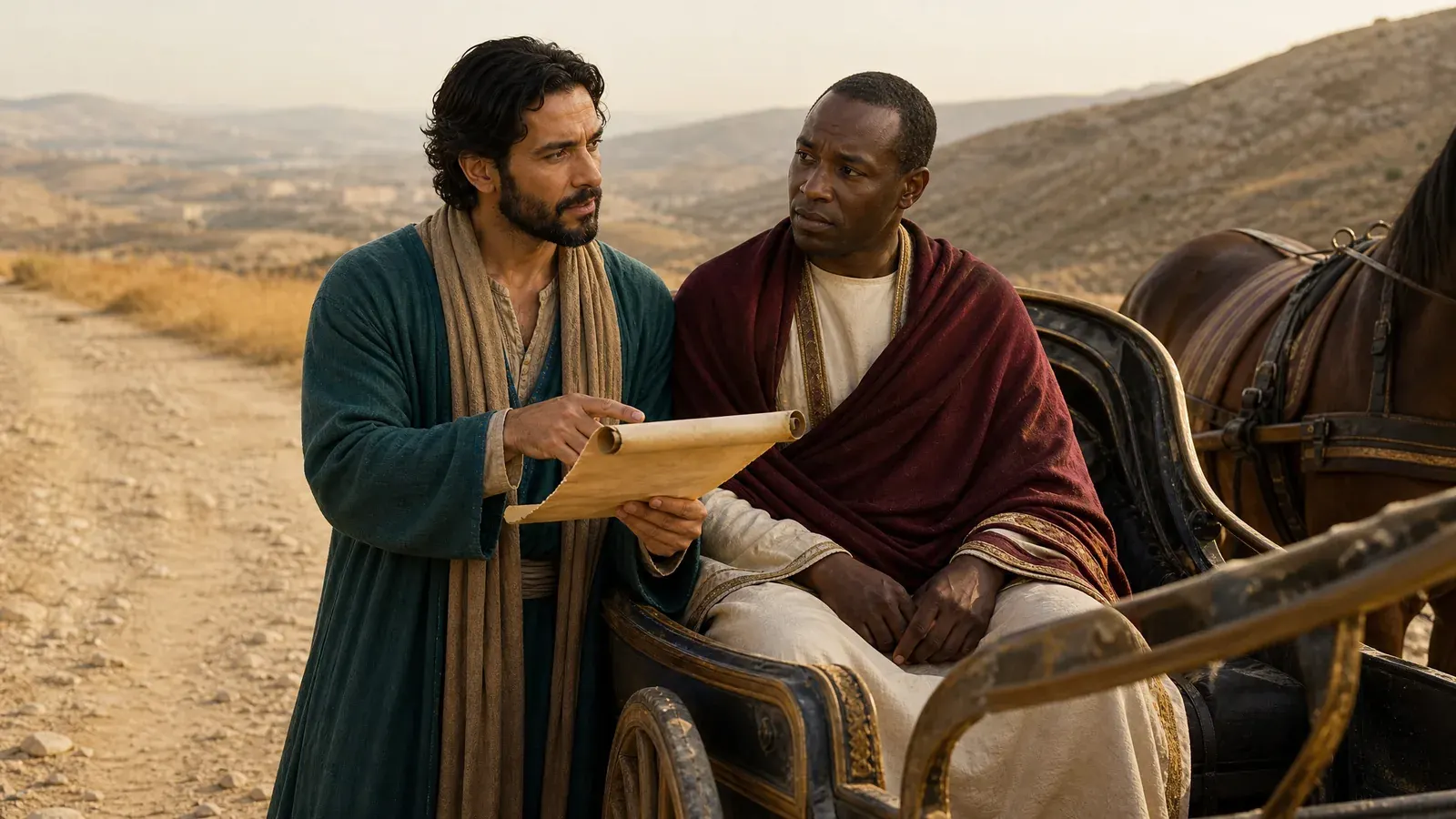
An angel, God's messenger, sends Philip to the desert road toward Gaza, a southern town. There he meets an Ethiopian, a man from a land south of Egypt. This eunuch manages the treasury of Candace, his queen. Returning from worship, he reads Esaias, an earlier prophet, in his chariot. The Spirit directs Philip to approach. Hearing the reading, Philip asks whether he understands it. The official admits that he needs a guide and invites Philip to sit with him. High public office does not stop him from acknowledging that he needs help with Scripture.
In everyday life
A finance director sits on a train reading an old handwritten lease. A fellow passenger notices her tracing the same line repeatedly and asks whether the wording is clear. She admits that her skill with accounts does not settle this document's meaning and offers the empty seat. The official's reading concerns God's promise, and the Spirit brings his guide.
Notice
Acts 8:31 The official's question makes room for instruction without hiding his lack of understanding. His rank does not keep him from inviting a stranger to help.
Acts 8:26-31
King James Version26And the angel of the Lord spake unto Philip, saying, Arise, and go toward the south unto the way that goeth down from Jerusalem unto Gaza, which is desert.
27And he arose and went: and, behold, a man of Ethiopia, an eunuch of great authority under Candace queen of the Ethiopians, who had the charge of all her treasure, and had come to Jerusalem for to worship,
28Was returning, and sitting in his chariot read Esaias the prophet.
29Then the Spirit said unto Philip, Go near, and join thyself to this chariot.
30And Philip ran thither to him, and heard him read the prophet Esaias, and said, Understandest thou what thou readest?
31And he said, How can I, except some man should guide me? And he desired Philip that he would come up and sit with him.
Acts 8:32-35
The Scripture Leads to Jesus
The lines describe someone led like a sheep to slaughter, silent under humiliation. Fair judgement is taken from him, and his life is removed from the earth. The official asks a precise question: is the prophet speaking about himself or another person? Philip begins at those words and announces Jesus. He does not leave the suffering figure as an unsolved image. The reading becomes the starting point for news about the one who suffered and now brings salvation. The official's question directs the conversation toward the identity of that person.
In everyday life
A letter reader pauses over an unnamed sufferer in a wartime letter. She asks the archivist whether the writer means himself or someone else. The archivist begins with that sentence and brings out the record that identifies its subject. The words gain a face through careful explanation. Philip announces Jesus through Scripture rather than matching an ordinary historical file.
Notice
Acts 8:35 Philip begins where the reader already is. The explanation grows from the quoted Scripture and its question, then leads directly to Jesus.
Acts 8:32-35
King James Version32The place of the scripture which he read was this, He was led as a sheep to the slaughter; and like a lamb dumb before his shearer, so opened he not his mouth:
33In his humiliation his judgment was taken away: and who shall declare his generation? for his life is taken from the earth.
34And the eunuch answered Philip, and said, I pray thee, of whom speaketh the prophet this? of himself, or of some other man?
35Then Philip opened his mouth, and began at the same scripture, and preached unto him Jesus.
Acts 8:36-40
Water Beside the Road
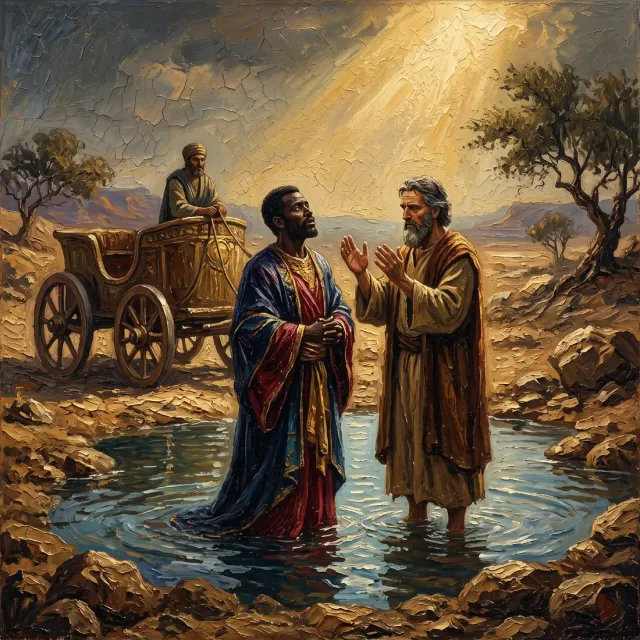
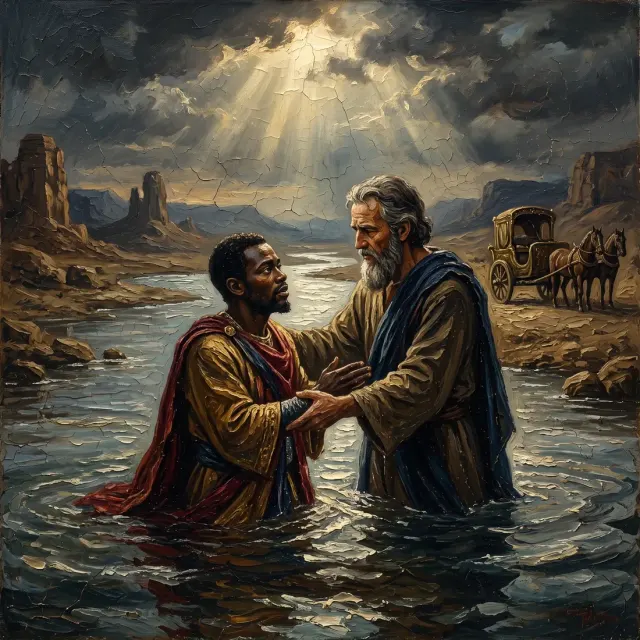
As they travel, the official sees water and asks what prevents his baptism. Philip asks for wholehearted belief, and the man affirms Jesus Christ as God's Son. They stop the chariot, enter the water, and Philip baptizes him. On coming out, Philip is taken away by the Spirit. The official no longer sees him but continues with joy. Philip appears at Azotus, a coastal town, and preaches through the towns toward Cæsarea, a coastal city. The traveller carries faith onward even when the person who explained it is no longer beside him.
In everyday life
A distance learner signs her first completed work beside the mentor who has guided her through it. The mentor catches his train, while she continues home holding the result with relief and resolve. His departure does not undo what she has received. The official's baptism expresses faith in Jesus, and the Spirit removes Philip from the meeting.
Notice
Acts 8:39 The official continues with joy after Philip disappears. His new life is not tied to keeping the guide physically present at every next step.
Acts 8:36-40
King James Version36And as they went on their way, they came unto a certain water: and the eunuch said, See, here is water; what doth hinder me to be baptized?
37And Philip said, If thou believest with all thine heart, thou mayest. And he answered and said, I believe that Jesus Christ is the Son of God.
38And he commanded the chariot to stand still: and they went down both into the water, both Philip and the eunuch; and he baptized him.
39And when they were come up out of the water, the Spirit of the Lord caught away Philip, that the eunuch saw him no more: and he went on his way rejoicing.
40But Philip was found at Azotus: and passing through he preached in all the cities, till he came to Cæsarea.
Details worth noticing
The opening image
Acts 8:1 begins with “And Saul was consenting unto his death. And at that time there was a great persecution against the church which was at Jerusalem; and they were all…”
Where the chapter turns
Acts 8:20 forms a natural hinge: “But Peter said unto him, Thy money perish with thee, because thou hast thought that the gift of God may be purchased with money.”
The final note
Acts 8:40 leaves the reader with “But Philip was found at Azotus: and passing through he preached in all the cities, till he came to Cæsarea.”
A word trail through the chapter
The words Philip, baptized, eunuch, Jerusalem, Lord, preached help reveal the chapter’s repeated concerns.
KJV words made clear
- haling
- Dragging or forcibly taking people away to custody.
- sorcery
- The practice of magic presented as a source of spiritual power.
- eunuch
- A castrated man, a term also used for certain court officials.
Music and video connected to the passage
Related media appears when its Scripture reference overlaps this study. Music and video can illuminate a theme while the biblical text remains the foundation.