The big picture
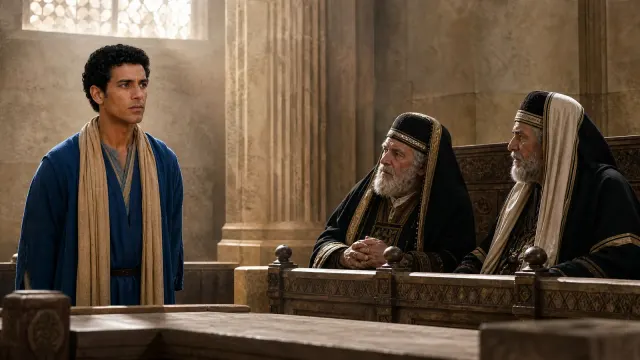
Stephen, a believer chosen to help care for the community, stands before the religious council. False witnesses have accused him of attacking God's law and the temple, the chief place of worship. Asked whether the charges are true, he retells his people's history. God has met their ancestors in many places, and his chosen servants have often been rejected. Stephen finally turns that pattern toward his hearers. Their response is rage, while his final words appeal to the Jesus he sees in heaven.
In this chapter
- Land and Children Still Awaited Acts 7:1-8
Stephen begins with Abraham, the forefather of his people.
- The Rejected Brother Preserves the Family Acts 7:9-16
Jealous brothers sell Joseph, one of Jacob's sons, into Egypt, a foreign country.
- Moses Is Preserved and Rejected Acts 7:17-29
As the people grow in Egypt, a new king oppresses them and forces their infants into exposure and death.
- The Rescuer Is Sent and Resisted Acts 7:30-43
Forty years later, near mount Sina, a wilderness mountain, God calls Moses from a burning bush.
- God Is Larger Than the Temple Acts 7:44-50
Their ancestors carried the tabernacle, a tent made for worship according to God's pattern.
- Stephen Turns the Charge Around Acts 7:51-53
Stephen now directly accuses the council of stubborn hearts and closed ears.
- A Vision and a Final Prayer Acts 7:54-60
The council erupts in rage.
Central truth
Stephen shows God's work beyond one sacred place and a repeated rejection of his servants, then dies witnessing to the risen Jesus.
Scripture beside the summary
Acts · King James Version · 60Acts 7:1-8
Land and Children Still Awaited
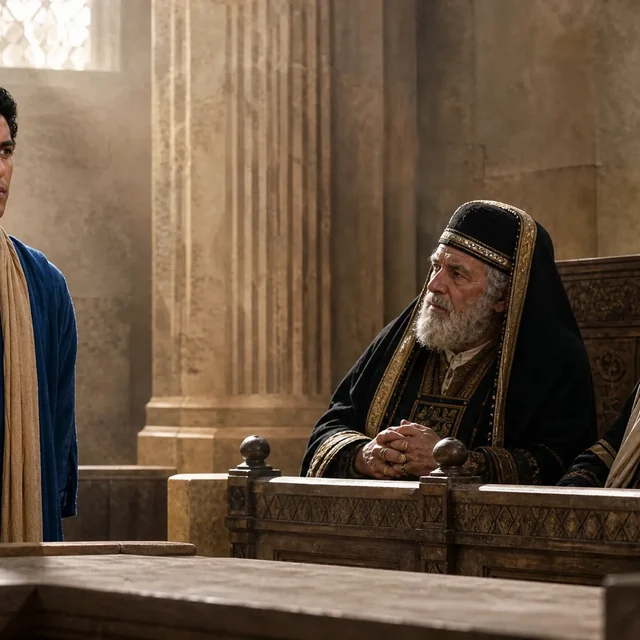
Stephen begins with Abraham, the forefather of his people. God appeared to him in Mesopotamia, an eastern region, before he lived in Charran, a town on his route. God called him away from his family and later brought him to the land of Stephen's hearers. Abraham owned none of it and had no child when God promised both land and descendants. Their future included slavery, mistreatment, rescue, and worship. God gave circumcision, the cutting of the male foreskin, as the covenant sign. Abraham's son Isaac fathered Jacob, whose twelve sons became the tribal fathers.
In everyday life
A migrant father holds an agreement promising his family a future home while they still rent one small room. No child has yet been born, and no key lies in his hand. The promise reaches further than his present possessions. He begins arranging his life around it. Abraham receives God's covenant rather than a human housing agreement.
Notice
Acts 7:5 The promise comes before Abraham owns land or has a child. Stephen begins with God's initiative rather than with an already secure place of worship.
Acts 7:1-8
King James Version1Then said the high priest, Are these things so?
2And he said, Men, brethren, and fathers, hearken; The God of glory appeared unto our father Abraham, when he was in Mesopotamia, before he dwelt in Charran,
3And said unto him, Get thee out of thy country, and from thy kindred, and come into the land which I shall shew thee.
4Then came he out of the land of the Chaldæans, and dwelt in Charran: and from thence, when his father was dead, he removed him into this land, wherein ye now dwell.
5And he gave him none inheritance in it, no, not so much as to set his foot on: yet he promised that he would give it to him for a possession, and to his seed after him, when as yet he had no child.
6And God spake on this wise, That his seed should sojourn in a strange land; and that they should bring them into bondage, and entreat them evil four hundred years.
7And the nation to whom they shall be in bondage will I judge, said God: and after that shall they come forth, and serve me in this place.
8And he gave him the covenant of circumcision: and so Abraham begat Isaac, and circumcised him the eighth day; and Isaac begat Jacob; and Jacob begat the twelve patriarchs.
Acts 7:9-16
The Rejected Brother Preserves the Family
Jealous brothers sell Joseph, one of Jacob's sons, into Egypt, a foreign country. God stays with him through trouble and gives him favour with Pharaoh, its king. Joseph becomes governor. Famine then reaches Egypt and Chanaan, the family's homeland. Jacob sends his sons to seek grain. On their second visit Joseph reveals who he is, and his family becomes known to the king. He brings Jacob and seventy-five relatives to Egypt. Stephen then recalls their deaths and burial in Sychem, a town tied to an ancestral burial purchase. Rejection has not defeated God's care through Joseph.
In everyday life
A shipping clerk receives an urgent order from relatives who once forced him out of the family firm. He now controls the supply they need and arranges delivery instead of withholding it. Their survival depends on help from the person they rejected. The reversal exposes the cost of their old judgement. Joseph was sold into slavery and raised by God's care.
Notice
Acts 7:9 The brothers' envy and God's presence appear together. Being sold away from home does not place Joseph outside the reach of God's help.
Acts 7:9-16
King James Version9And the patriarchs, moved with envy, sold Joseph into Egypt: but God was with him,
10And delivered him out of all his afflictions, and gave him favour and wisdom in the sight of Pharaoh king of Egypt; and he made him governor over Egypt and all his house.
11Now there came a dearth over all the land of Egypt and Chanaan, and great affliction: and our fathers found no sustenance.
12But when Jacob heard that there was corn in Egypt, he sent out our fathers first.
13And at the second time Joseph was made known to his brethren; and Joseph’s kindred was made known unto Pharaoh.
14Then sent Joseph, and called his father Jacob to him, and all his kindred, threescore and fifteen souls.
15So Jacob went down into Egypt, and died, he, and our fathers,
16And were carried over into Sychem, and laid in the sepulchre that Abraham bought for a sum of money of the sons of Emmor the father of Sychem.
Acts 7:17-29
Moses Is Preserved and Rejected
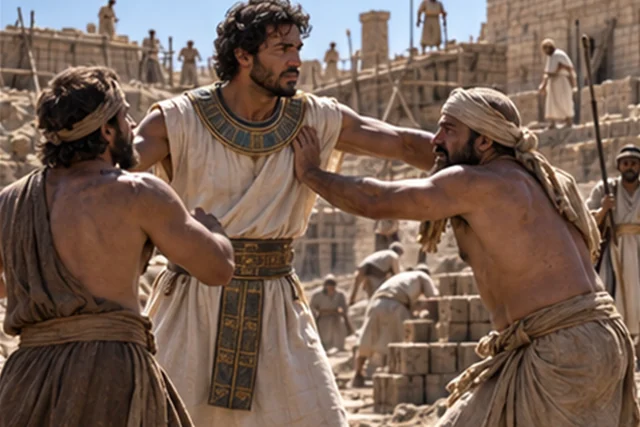
As the people grow in Egypt, a new king oppresses them and forces their infants into exposure and death. Moses, the future deliverer, is born during this cruelty. The king's daughter raises him after he is put out, and he learns Egypt's wisdom. At forty he visits his own people. He kills an Egyptian who is mistreating one of them, expecting them to recognise God's rescue through him. Next day he tries to stop a quarrel between two of his people. One rejects his authority and mentions the killing. Moses flees to Madian, a foreign region, and has two sons.
In everyday life
A family-history researcher reads the surviving papers of a child placed in another household during a period of state cruelty. Later records show his failed attempt to return and help his birth community. She records the rescue, rejection, and exile without smoothing them into steady success. Moses' account also includes his killing of an oppressor and God's later call.
Acts 7:17-29
King James Version17But when the time of the promise drew nigh, which God had sworn to Abraham, the people grew and multiplied in Egypt,
18Till another king arose, which knew not Joseph.
19The same dealt subtilly with our kindred, and evil entreated our fathers, so that they cast out their young children, to the end they might not live.
20In which time Moses was born, and was exceeding fair, and nourished up in his father’s house three months:
21And when he was cast out, Pharaoh’s daughter took him up, and nourished him for her own son.
22And Moses was learned in all the wisdom of the Egyptians, and was mighty in words and in deeds.
23And when he was full forty years old, it came into his heart to visit his brethren the children of Israel.
24And seeing one of them suffer wrong, he defended him, and avenged him that was oppressed, and smote the Egyptian:
25For he supposed his brethren would have understood how that God by his hand would deliver them: but they understood not.
26And the next day he shewed himself unto them as they strove, and would have set them at one again, saying, Sirs, ye are brethren; why do ye wrong one to another?
27But he that did his neighbour wrong thrust him away, saying, Who made thee a ruler and a judge over us?
28Wilt thou kill me, as thou diddest the Egyptian yesterday?
29Then fled Moses at this saying, and was a stranger in the land of Madian, where he begat two sons.
Acts 7:30-43
The Rescuer Is Sent and Resisted
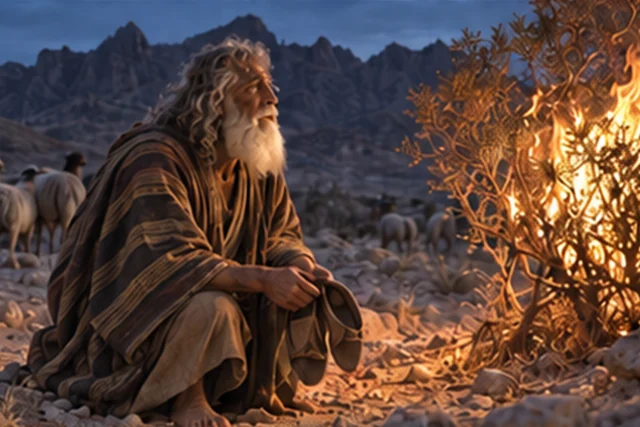
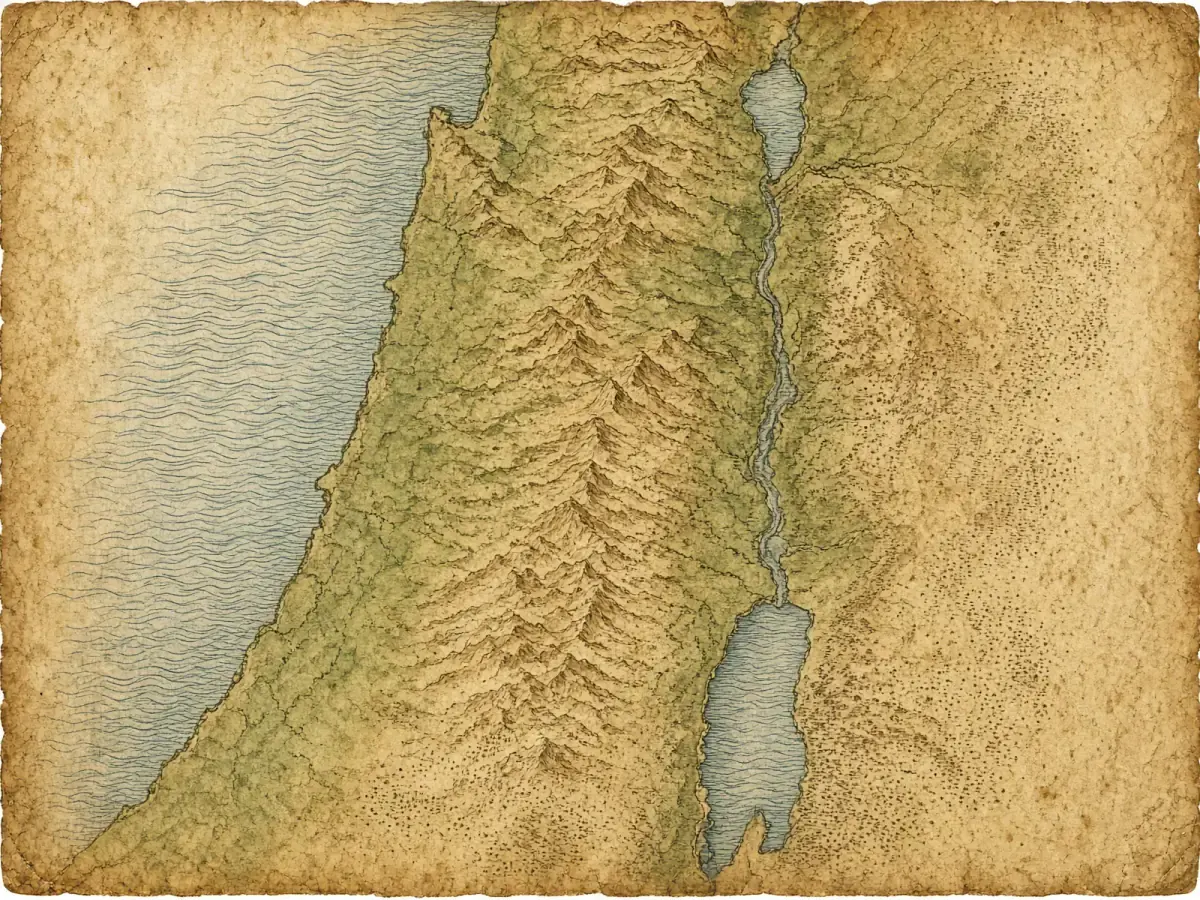
Forty years later, near mount Sina, a wilderness mountain, God calls Moses from a burning bush. The rejected man is sent back to rescue the people. Signs accompany their release and forty years in the wilderness. Moses receives God's living words and promises another prophet whom they must hear. Yet the people reject him again. They ask Aaron, Moses' companion and brother, to make gods and worship a calf they made. God gives them over to false worship. Stephen recalls the prophets' charge about idols and a coming exile beyond Babylon, a foreign city. Rescue did not produce steady obedience.
In everyday life
A heritage restorer finds a community's signed rescue plan beneath a display honouring the very practices it once renounced. Old meeting notes show repeated refusal of the worker who helped them recover. The evidence records more than one brief lapse. Receiving help did not ensure loyalty to its source. Stephen names God's rescue and judgement, not a civic repair scheme.
Notice
Acts 7:35 Stephen repeats that the rejected Moses is the man God sends as ruler and rescuer. Human refusal does not overturn God's choice of his servant.
Acts 7:30-43
King James Version30And when forty years were expired, there appeared to him in the wilderness of mount Sina an angel of the Lord in a flame of fire in a bush.
31When Moses saw it, he wondered at the sight: and as he drew near to behold it, the voice of the Lord came unto him,
32Saying, I am the God of thy fathers, the God of Abraham, and the God of Isaac, and the God of Jacob. Then Moses trembled, and durst not behold.
33Then said the Lord to him, Put off thy shoes from thy feet: for the place where thou standest is holy ground.
34I have seen, I have seen the affliction of my people which is in Egypt, and I have heard their groaning, and am come down to deliver them. And now come, I will send thee into Egypt.
35This Moses whom they refused, saying, Who made thee a ruler and a judge? the same did God send to be a ruler and a deliverer by the hand of the angel which appeared to him in the bush.
36He brought them out, after that he had shewed wonders and signs in the land of Egypt, and in the Red sea, and in the wilderness forty years.
37This is that Moses, which said unto the children of Israel, A prophet shall the Lord your God raise up unto you of your brethren, like unto me; him shall ye hear.
38This is he, that was in the church in the wilderness with the angel which spake to him in the mount Sina, and with our fathers: who received the lively oracles to give unto us:
39To whom our fathers would not obey, but thrust him from them, and in their hearts turned back again into Egypt,
40Saying unto Aaron, Make us gods to go before us: for as for this Moses, which brought us out of the land of Egypt, we wot not what is become of him.
41And they made a calf in those days, and offered sacrifice unto the idol, and rejoiced in the works of their own hands.
42Then God turned, and gave them up to worship the host of heaven; as it is written in the book of the prophets, O ye house of Israel, have ye offered to me slain beasts and sacrifices by the space of forty years in the wilderness?
43Yea, ye took up the tabernacle of Moloch, and the star of your god Remphan, figures which ye made to worship them: and I will carry you away beyond Babylon.
Acts 7:44-50
God Is Larger Than the Temple
Their ancestors carried the tabernacle, a tent made for worship according to God's pattern. It entered the land under the leader here called Jesus, meaning Joshua rather than Jesus Christ. The tent remained through the time of David, the king who sought a dwelling for God. Solomon, David's son, built the temple. Yet Stephen says the Most High does not live confined within human buildings. A prophet calls heaven God's throne and earth his footstool. God made all these things. A house made from them cannot contain their maker.
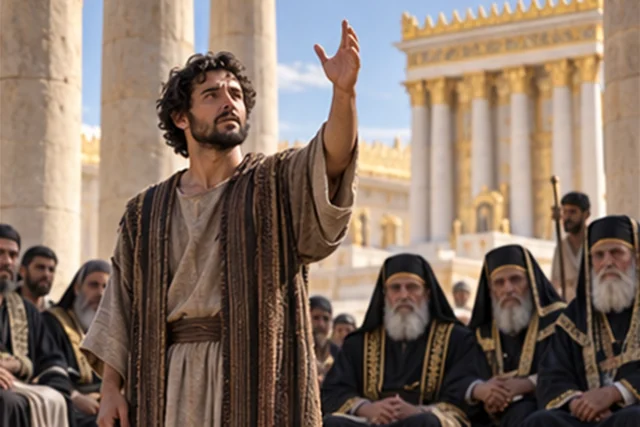
In everyday life
A photographer hangs one framed view of the coast in a visitor centre. A guest mistakes the display for the whole reserve until she opens the door toward miles of shore. The image has a real purpose but does not contain what it represents. Stephen speaks of the creator's freedom beyond a temple, not a landscape beyond a photograph.
Notice
Acts 7:48 The statement follows an account of the temple's proper building. Stephen does not need to deny that history to deny that the building contains God.
Acts 7:44-50
King James Version44Our fathers had the tabernacle of witness in the wilderness, as he had appointed, speaking unto Moses, that he should make it according to the fashion that he had seen.
45Which also our fathers that came after brought in with Jesus into the possession of the Gentiles, whom God drave out before the face of our fathers, unto the days of David;
46Who found favour before God, and desired to find a tabernacle for the God of Jacob.
47But Solomon built him an house.
48Howbeit the most High dwelleth not in temples made with hands; as saith the prophet,
49Heaven is my throne, and earth is my footstool: what house will ye build me? saith the Lord: or what is the place of my rest?
50Hath not my hand made all these things?
Acts 7:51-53
Stephen Turns the Charge Around
Stephen now directly accuses the council of stubborn hearts and closed ears. They resist the Holy Ghost, God's Spirit, as their ancestors did. Those ancestors persecuted prophets and killed messengers who foretold the righteous one. The present leaders have betrayed and murdered that promised one, Jesus. They received God's law through angels, his heavenly messengers, yet failed to keep it. The defence becomes an indictment. The men accusing Stephen of dishonouring the law must face their own disobedience to the God who gave it.
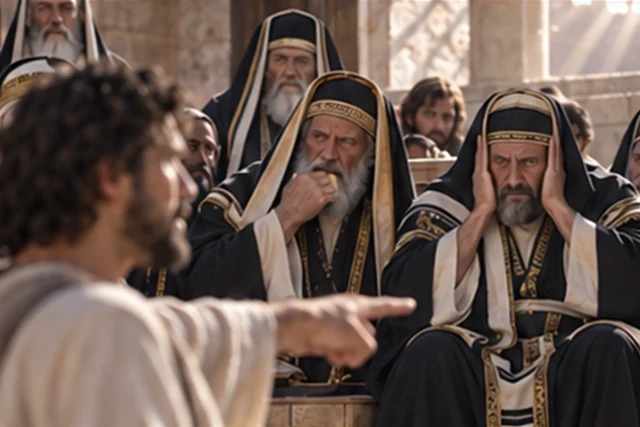
In everyday life
A safeguarding reviewer faces trustees who accuse a witness of harming their charter. She places ignored warnings beside the charter's duty to protect and asks who has actually broken it. Holding the document has not meant following its terms. The review turns from the witness's reputation to the trustees' conduct. Stephen charges resistance to God's Spirit and murder of Jesus.
Notice
Acts 7:53 Receiving the law is set against failing to keep it. Stephen separates possession of a sacred gift from obedience to the God who gave it.
Acts 7:51-53
King James Version51Ye stiffnecked and uncircumcised in heart and ears, ye do always resist the Holy Ghost: as your fathers did, so do ye.
52Which of the prophets have not your fathers persecuted? and they have slain them which shewed before of the coming of the Just One; of whom ye have been now the betrayers and murderers:
53Who have received the law by the disposition of angels, and have not kept it.
Acts 7:54-60
A Vision and a Final Prayer
The council erupts in rage. Filled with the Spirit, Stephen sees God's glory and Jesus standing beside God. He declares this vision of the Son of man, Jesus' title for himself. His hearers cover their ears, rush him, and drive him outside the city. They stone him. Witnesses leave their garments with Saul, a young man watching. Stephen asks Jesus to receive his spirit. Kneeling, he asks that this sin not be charged against his killers. Then he dies. His last appeal is for those killing him, even as he entrusts himself to Jesus.
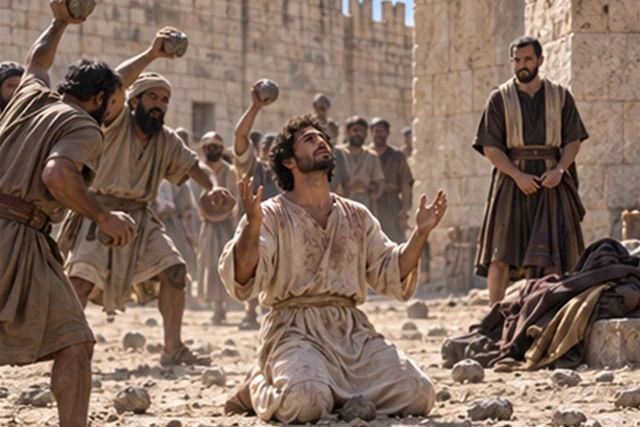
In everyday life
A memorial volunteer transcribes a murdered aid worker's last letter. Beside the record of threats, she preserves his appeal that anger should not consume those left behind. The document refuses to let the attackers own every final word about his life. Stephen prays for his killers while seeing Jesus and entrusting his spirit to him.
Notice
Acts 7:60 Stephen names the killing as sin while asking that it not be charged to the killers. Forgiveness does not require calling the act harmless or right.
Acts 7:54-60
King James Version54When they heard these things, they were cut to the heart, and they gnashed on him with their teeth.
55But he, being full of the Holy Ghost, looked up stedfastly into heaven, and saw the glory of God, and Jesus standing on the right hand of God,
56And said, Behold, I see the heavens opened, and the Son of man standing on the right hand of God.
57Then they cried out with a loud voice, and stopped their ears, and ran upon him with one accord,
58And cast him out of the city, and stoned him: and the witnesses laid down their clothes at a young man’s feet, whose name was Saul.
59And they stoned Stephen, calling upon God, and saying, Lord Jesus, receive my spirit.
60And he kneeled down, and cried with a loud voice, Lord, lay not this sin to their charge. And when he had said this, he fell asleep.
Details worth noticing
The opening image
Acts 7:1 begins with “Then said the high priest, Are these things so?”
Where the chapter turns
Acts 7:29 forms a natural hinge: “Then fled Moses at this saying, and was a stranger in the land of Madian, where he begat two sons.”
The final note
Acts 7:60 leaves the reader with “And he kneeled down, and cried with a loud voice, Lord, lay not this sin to their charge. And when he had said this, he fell asleep.”
A word trail through the chapter
The words fathers, Egypt, Moses, land, Jacob, Lord help reveal the chapter’s repeated concerns.
KJV words made clear
- dearth
- A shortage of food, often caused by famine.
- patriarchs
- Founding fathers of the tribes or families of a people.
- lively oracles
- Living words from God, received to guide his people.
- stiffnecked
- Stubbornly refusing to yield or listen to correction.
Music and video connected to the passage
Related media appears when its Scripture reference overlaps this study. Music and video can illuminate a theme while the biblical text remains the foundation.