
The big picture
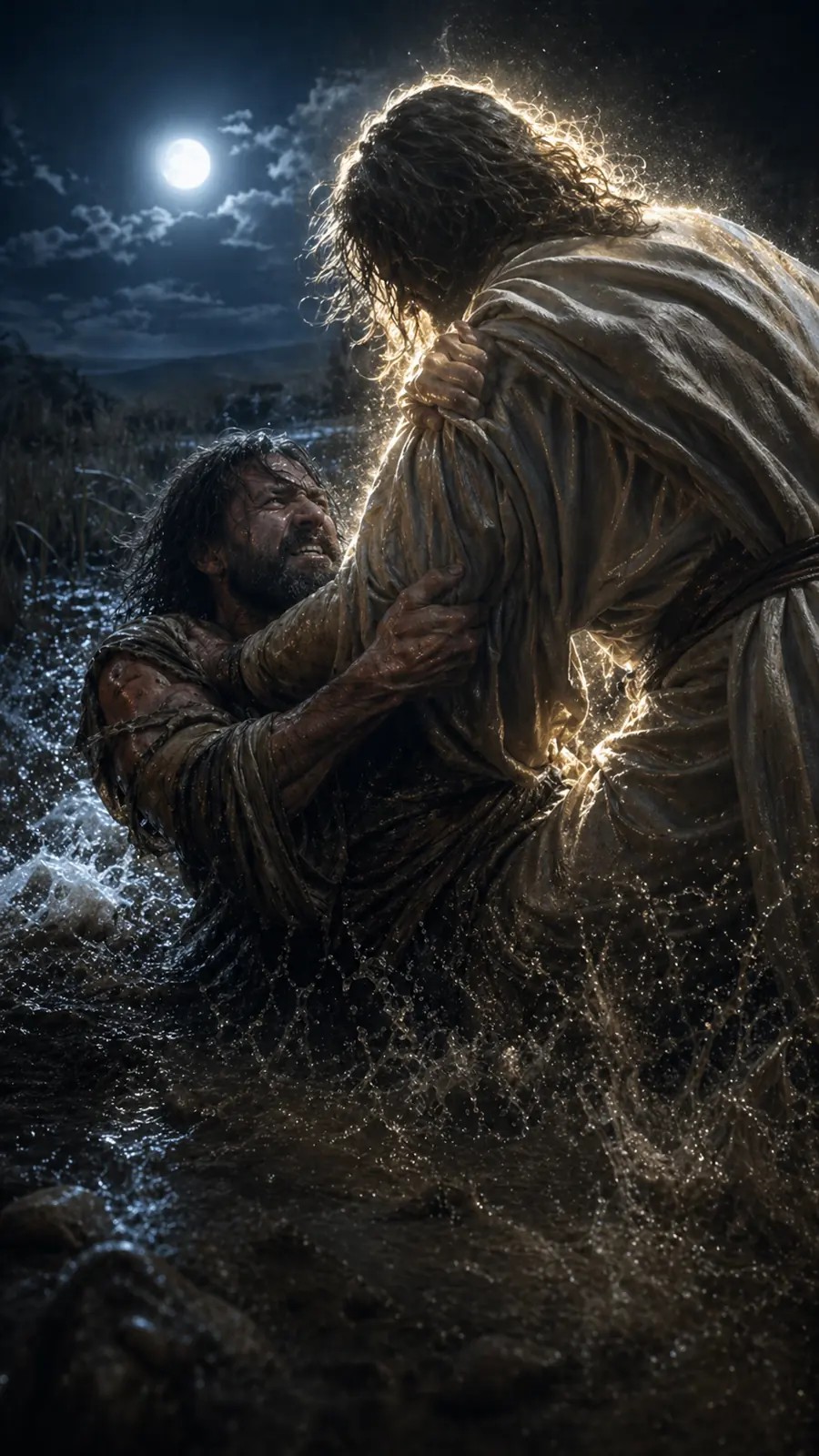
Returning to the land means facing Esau. Jacob arranges gifts and divides his company, then prays by recalling God's promise. Alone at night, he wrestles with a mysterious opponent and receives a new name along with a lasting wound.
Scripture beside the summary
Genesis · King James Version · 32Genesis 32:1-12
Preparing to meet Esau
Angels meet Jacob, yet news that Esau approaches with four hundred men leaves him afraid. He divides the camp and prays, confessing unworthiness and asking for deliverance. The prayer places his fear inside the promise of return and abundant descendants.
Context that brings the passage to life
“And Jacob went on his way, and the angels of God met him.” Naming Jacob keeps the account rooted in particular people or places. Follow where the name returns and what changes around it.
“And he commanded them, saying, Thus shall ye speak unto my lord Esau; Thy servant Jacob saith thus, I have sojourned…” The command cannot be understood from the verb alone. Its recipient, purpose, and place in the larger covenant or argument define the responsibility.
“Then Jacob was greatly afraid and distressed: and he divided the people that was with him, and the flocks, and herds…” The number two makes the report concrete. Ask whether it measures time, people, distance, repetition, or completeness before deciding what weight it carries.
“I am not worthy of the least of all the mercies, and of all the truth, which thou hast shewed unto thy servant; for…” The number two makes the report concrete. Ask whether it measures time, people, distance, repetition, or completeness before deciding what weight it carries.
“And thou saidst, I will surely do thee good, and make thy seed as the sand of the sea, which cannot be numbered for…” The line’s distinctive content terms include good, multitude, numbered. Its relationship to verses 11 shows what work it does in this passage.
The movement opens with “And Jacob went on his way, and the angels of God met him.” By verse 3, the text has turned to “And Jacob sent messengers before him to Esau his brother unto the land of Seir, the country…” It lands on “And the messengers returned to Jacob, saying, We came to thy brother Esau, and also he…” The distance between those lines matters as much as any isolated phrase. The passage has a voice and pulse of its own, including 1 verse with a speech marker, 2 verses naming the LORD or God. Those features reveal where the narrative slows down, speaks directly, or changes direction.
Genesis 32:1-12
King James Version1And Jacob went on his way, and the angels of God met him.
2And when Jacob saw them, he said, This is God’s host: and he called the name of that place Mahanaim.
3And Jacob sent messengers before him to Esau his brother unto the land of Seir, the country of Edom.
4And he commanded them, saying, Thus shall ye speak unto my lord Esau; Thy servant Jacob saith thus, I have sojourned with Laban, and stayed there until now:
5And I have oxen, and asses, flocks, and menservants, and womenservants: and I have sent to tell my lord, that I may find grace in thy sight.
6And the messengers returned to Jacob, saying, We came to thy brother Esau, and also he cometh to meet thee, and four hundred men with him.
7Then Jacob was greatly afraid and distressed: and he divided the people that was with him, and the flocks, and herds, and the camels, into two bands;
8And said, If Esau come to the one company, and smite it, then the other company which is left shall escape.
9And Jacob said, O God of my father Abraham, and God of my father Isaac, the LORD which saidst unto me, Return unto thy country, and to thy kindred, and I will deal well with thee:
10I am not worthy of the least of all the mercies, and of all the truth, which thou hast shewed unto thy servant; for with my staff I passed over this Jordan; and now I am become two bands.
11Deliver me, I pray thee, from the hand of my brother, from the hand of Esau: for I fear him, lest he will come and smite me, and the mother with the children.
12And thou saidst, I will surely do thee good, and make thy seed as the sand of the sea, which cannot be numbered for multitude.
Genesis 32:13-21
Gifts sent ahead
Jacob sends successive groups of animals with carefully repeated messages. He hopes the gifts will appease Esau before they meet. Practical preparation accompanies prayer, but the elaborate arrangement also displays his uncertainty about whether his brother will receive him.
Context that brings the passage to life
This block contains 1 explicit questions. They are more than punctuation: they reveal where a voice is searching, challenging, afraid, or trying to understand.
“And he lodged there that same night; and took of that which came to his hand a present for Esau his brother;” Naming Esau keeps the account rooted in particular people or places. Follow where the name returns and what changes around it.
“Thirty milch camels with their colts, forty kine, and ten bulls, twenty she asses, and ten foals.” The number thirty makes the report concrete. Ask whether it measures time, people, distance, repetition, or completeness before deciding what weight it carries.
“And he commanded the foremost, saying, When Esau my brother meeteth thee, and asketh thee, saying, Whose art thou? and…” The question slows the passage down. Notice who is being pressed to answer, what the question assumes, and whether the next lines provide a response.
Genesis 32:13-21
King James Version13And he lodged there that same night; and took of that which came to his hand a present for Esau his brother;
14Two hundred she goats, and twenty he goats, two hundred ewes, and twenty rams,
15Thirty milch camels with their colts, forty kine, and ten bulls, twenty she asses, and ten foals.
16And he delivered them into the hand of his servants, every drove by themselves; and said unto his servants, Pass over before me, and put a space betwixt drove and drove.
17And he commanded the foremost, saying, When Esau my brother meeteth thee, and asketh thee, saying, Whose art thou? and whither goest thou? and whose are these before thee?
18Then thou shalt say, They be thy servant Jacob’s; it is a present sent unto my lord Esau: and, behold, also he is behind us.
19And so commanded he the second, and the third, and all that followed the droves, saying, On this manner shall ye speak unto Esau, when ye find him.
20And say ye moreover, Behold, thy servant Jacob is behind us. For he said, I will appease him with the present that goeth before me, and afterward I will see his face; peradventure he will accept of me.
21So went the present over before him: and himself lodged that night in the company.
Genesis 32:22-32
A blessing and a limp
After sending his household across the Jabbok, Jacob wrestles until daybreak. His hip is injured, he persists in seeking a blessing, and he receives the name Israel. He names the place Peniel and leaves limping. The encounter changes his name and bodily condition without making him invulnerable.
Context that brings the passage to life
This block contains 2 explicit questions. They are more than punctuation: they reveal where a voice is searching, challenging, afraid, or trying to understand.
“And he rose up that night, and took his two wives, and his two womenservants, and his eleven sons, and passed over the…” The number two makes the report concrete. Ask whether it measures time, people, distance, repetition, or completeness before deciding what weight it carries.
“And Jacob was left alone; and there wrestled a man with him until the breaking of the day.” Naming Jacob keeps the account rooted in particular people or places. Follow where the name returns and what changes around it.
“And he said, Let me go, for the day breaketh. And he said, I will not let thee go, except thou bless me.” The promise, blessing, or covenant language needs its named recipient and scope. Those details prevent a personal word in the story from becoming a promise detached from context.
“And he said, Thy name shall be called no more Jacob, but Israel: for as a prince hast thou power with God and with…” The command cannot be understood from the verb alone. Its recipient, purpose, and place in the larger covenant or argument define the responsibility.
Genesis 32:22-32
King James Version22And he rose up that night, and took his two wives, and his two womenservants, and his eleven sons, and passed over the ford Jabbok.
23And he took them, and sent them over the brook, and sent over that he had.
24And Jacob was left alone; and there wrestled a man with him until the breaking of the day.
25And when he saw that he prevailed not against him, he touched the hollow of his thigh; and the hollow of Jacob’s thigh was out of joint, as he wrestled with him.
26And he said, Let me go, for the day breaketh. And he said, I will not let thee go, except thou bless me.
27And he said unto him, What is thy name? And he said, Jacob.
28And he said, Thy name shall be called no more Jacob, but Israel: for as a prince hast thou power with God and with men, and hast prevailed.
29And Jacob asked him, and said, Tell me, I pray thee, thy name. And he said, Wherefore is it that thou dost ask after my name? And he blessed him there.
30And Jacob called the name of the place Peniel: for I have seen God face to face, and my life is preserved.
31And as he passed over Penuel the sun rose upon him, and he halted upon his thigh.
32Therefore the children of Israel eat not of the sinew which shrank, which is upon the hollow of the thigh, unto this day: because he touched the hollow of Jacob’s thigh in the sinew that shrank.
Details worth noticing
The opening image
Genesis 32:1 begins with “And Jacob went on his way, and the angels of God met him.”
Where the chapter turns
Genesis 32:17 forms a natural hinge: “And he commanded the foremost, saying, When Esau my brother meeteth thee, and asketh thee, saying, Whose art thou? and whither goest thou? and whose are…”
The final note
Genesis 32:32 leaves the reader with “Therefore the children of Israel eat not of the sinew which shrank, which is upon the hollow of the thigh, unto this day: because he touched the hollow of…”
A word trail through the chapter
The words Jacob, Esau, name, brother, thigh, hand help reveal the chapter’s repeated concerns.
How does Jacob's prayer differ from self-confidence?
He admits fear and unworthiness, appeals to God's words and asks to be rescued.
What accompanies the blessing?
A wound and a limp. The narrative joins dependence with the new identity.
KJV words made clear
- behold
- look, or pay close attention
- unto
- to
- thee
- you
- thou
- you
- thy
- your
Text first
Where readers differ
The chapter summary begins with what the passage says and how its parts fit together. It does not assume one denomination has already settled every question. Where a conclusion depends on a tradition, literary theory, or historical reconstruction, that dependence is named openly.
The KJV text is presented first. Interpretive conclusions are labeled, and differences are introduced only when they help a reader understand why serious communities do not always reach the same answer.
The opponent is initially called a man; Jacob speaks of seeing God, and Hosea later refers to an angel. Preserve the textual complexity instead of supplying an unsupported physical portrait of God.