
The big picture
The religious council takes Jesus, the arrested teacher, to Pilate, the Roman governor. Accusations of rebellion lead to a second hearing before Herod, ruler of Galilee, the northern region. Neither finds a crime deserving death, yet public pressure secures crucifixion, death on a cross. Jesus warns mourners, prays for forgiveness, and promises hope to a condemned man beside him. His death draws a confession of innocence and grief from the crowd. A dissenting council member then gives him a careful burial.
In this chapter
- Pilate Hears Charges He Cannot Confirm Luke 23:1-7
The council accuses Jesus before Pilate of misleading the nation, forbidding tax to Cæsar, the Roman emperor, and claiming royal status as Christ.
- Herod Seeks a Wonder and Gets Silence Luke 23:8-12
Herod is pleased to see Jesus because he has long wanted a miracle from him.
- The Crowd’s Demand Overrules the Verdict Luke 23:13-25
Pilate tells the leaders and people that neither he nor Herod has found a capital offence.
- Jesus Warns the Women Who Mourn Luke 23:26-32
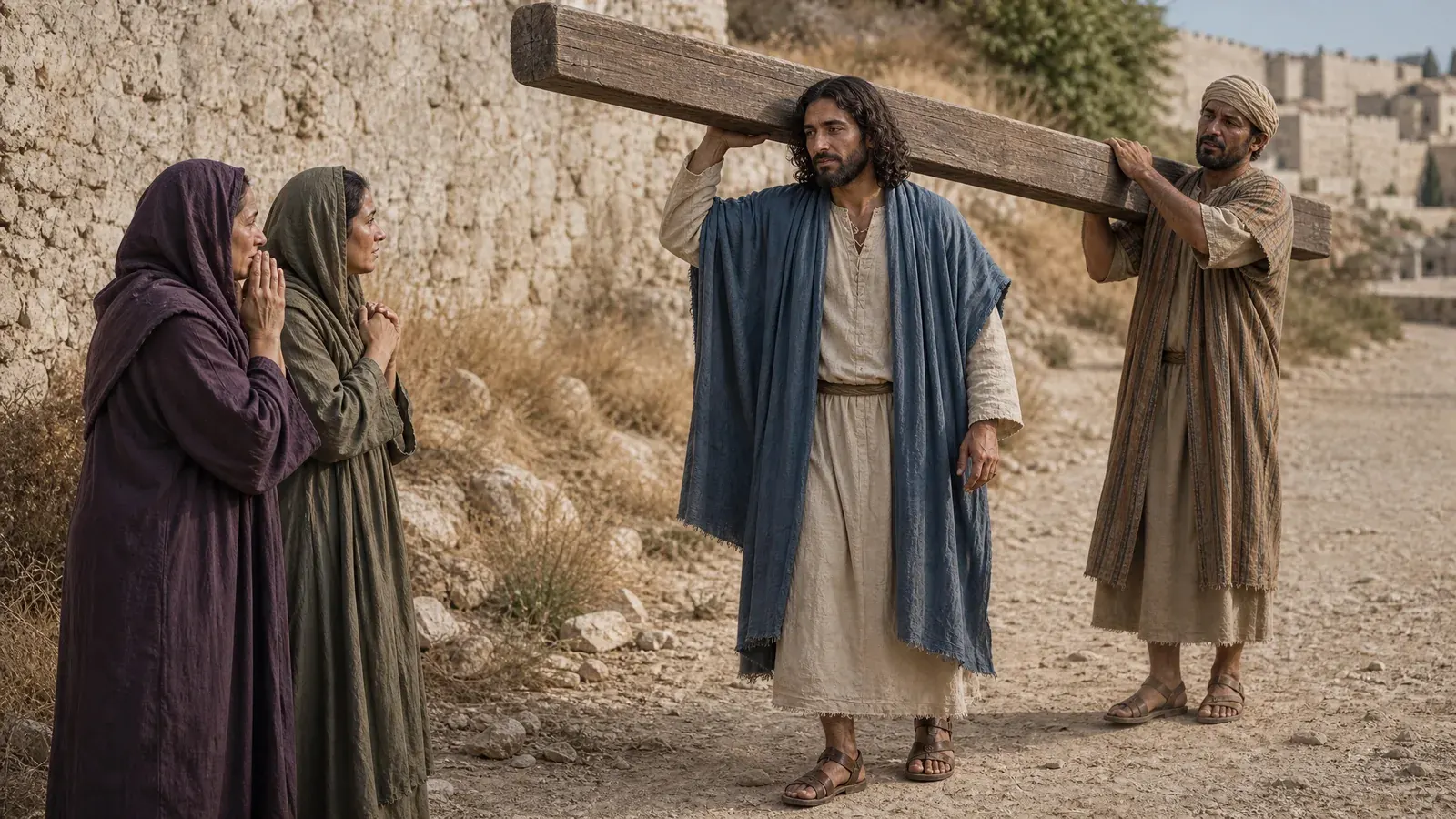
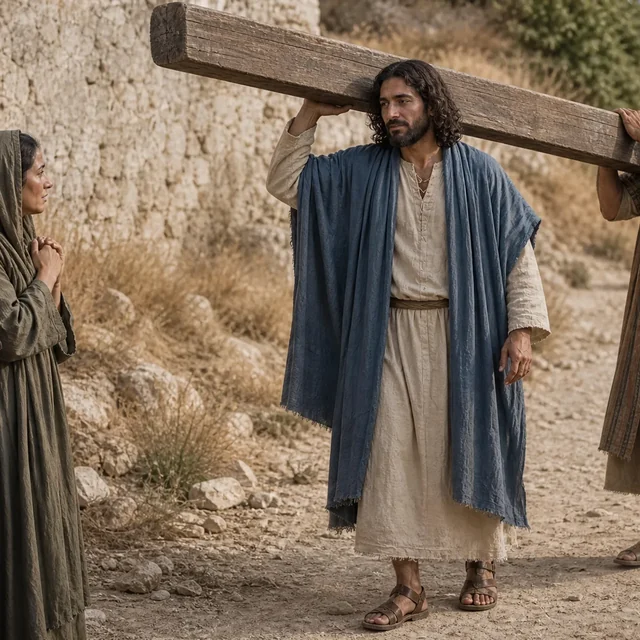
On the way to execution, soldiers seize Simon, a passerby from Cyrene in North Africa, to carry the cross behind Jesus.
- Forgiveness Is Spoken Amid Mockery Luke 23:33-38
At Calvary, the execution place, Jesus is crucified with one criminal on each side.
- A Condemned Man Receives a Promise Luke 23:39-43
One criminal insults Jesus and demands that he save himself and both of them if he is the Christ.
- Jesus Entrusts His Spirit to the Father Luke 23:44-49
Darkness covers the land from about noon until three.
- Joseph Gives Jesus an Unused Tomb Luke 23:50-56
Joseph, a council member from the town of Arimathæa, is described as good and upright.
Central truth
Jesus is condemned despite repeated declarations of innocence, yet offers forgiveness and hope while facing death on the cross.

Scripture beside the summary
Luke · King James Version · 56Luke 23:1-7
Pilate Hears Charges He Cannot Confirm
The council accuses Jesus before Pilate of misleading the nation, forbidding tax to Cæsar, the Roman emperor, and claiming royal status as Christ. The tax accusation misrepresents his earlier teaching. Pilate asks whether he is king of the Jews, the people whose leaders accuse him. Jesus affirms the words, and Pilate says he finds no fault. The accusers insist that his teaching stirs people from Galilee to Jerusalem, the temple city. Learning his regional origin, Pilate sends him to Herod, who is visiting Jerusalem and rules Galilee. The case moves between officials without a finding that supports the demand for death.
In everyday life
A court registrar watches a complaint move to another jurisdiction after the first official finds no evidence for its central charge. The accusers add force to their language without adding proof. A transfer keeps the case alive but does not make it sound. Jesus faces a deadly political accusation, not merely a misfiled civil dispute.
Notice
Luke 23:4 Pilate's first stated finding is that Jesus is not guilty. Luke records this before the later pressure that changes the governor's action.
Luke 23:1-7
King James Version1And the whole multitude of them arose, and led him unto Pilate.
2And they began to accuse him, saying, We found this fellow perverting the nation, and forbidding to give tribute to Cæsar, saying that he himself is Christ a King.
3And Pilate asked him, saying, Art thou the King of the Jews? And he answered him and said, Thou sayest it.
4Then said Pilate to the chief priests and to the people, I find no fault in this man.
5And they were the more fierce, saying, He stirreth up the people, teaching throughout all Jewry, beginning from Galilee to this place.
6When Pilate heard of Galilee, he asked whether the man were a Galilæan.
7And as soon as he knew that he belonged unto Herod’s jurisdiction, he sent him to Herod, who himself also was at Jerusalem at that time.
Luke 23:8-12
Herod Seeks a Wonder and Gets Silence
Herod is pleased to see Jesus because he has long wanted a miracle from him. He questions him at length, but Jesus gives no reply. The chief priests and scribes, teachers of God's law, continue their accusations. Herod and his soldiers then treat him with contempt, mock him, and dress him in a splendid robe. They send him back to Pilate. That day the two rulers become friends after earlier hostility. Jesus does not turn his power into entertainment for a curious ruler. Their new friendship forms around his humiliation rather than a careful search for what is right.
In everyday life
A visiting benefactor demands that a recovering patient display an unusual ability for the room. When the patient refuses, the host turns the refusal into a joke and bonds with the guest over it. Their amusement ignores the person before them. Herod mocks Jesus under threat of execution, with far greater power than these visitors possess.
Notice
Luke 23:9 Jesus answers none of Herod's many questions. The ruler's desire to see a miracle does not produce the spectacle he hopes to command.
Luke 23:8-12
King James Version8And when Herod saw Jesus, he was exceeding glad: for he was desirous to see him of a long season, because he had heard many things of him; and he hoped to have seen some miracle done by him.
9Then he questioned with him in many words; but he answered him nothing.
10And the chief priests and scribes stood and vehemently accused him.
11And Herod with his men of war set him at nought, and mocked him, and arrayed him in a gorgeous robe, and sent him again to Pilate.
12And the same day Pilate and Herod were made friends together: for before they were at enmity between themselves.
Luke 23:13-25
The Crowd’s Demand Overrules the Verdict
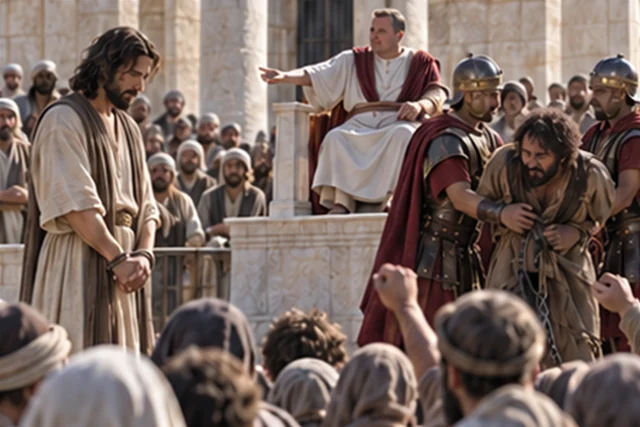
Pilate tells the leaders and people that neither he nor Herod has found a capital offence. He proposes punishment followed by release, though he has declared no guilt. The crowd demands Barabbas instead, a prisoner held for rebellion and murder. Pilate again seeks Jesus' release. Three times he challenges the call for death, but the crowd keeps shouting for crucifixion. Their voices prevail. Pilate orders what they demand, frees the guilty rebel, and hands Jesus over. The ruler gives way to pressure. He has said again and again that Jesus is not guilty. Luke makes the contrast sharp: a man guilty of violent revolt goes free while Jesus receives the demanded sentence.
In everyday life
A case-review solicitor reads three notes stating that an accusation lacks proof, followed by an order granting the accusers' demand. She marks the gap between the official's findings and his final decision. Repetition of a charge has replaced evidence. Pilate's order sends Jesus to death, not only to an adverse legal ruling.
Notice
Luke 23:25 Luke repeats the crimes attached to the released prisoner. His freedom stands in direct contrast to Jesus being handed over despite the absence of proved guilt.
Luke 23:13-25
King James Version13And Pilate, when he had called together the chief priests and the rulers and the people,
14Said unto them, Ye have brought this man unto me, as one that perverteth the people: and, behold, I, having examined him before you, have found no fault in this man touching those things whereof ye accuse him:
15No, nor yet Herod: for I sent you to him; and, lo, nothing worthy of death is done unto him.
16I will therefore chastise him, and release him.
17(For of necessity he must release one unto them at the feast.)
18And they cried out all at once, saying, Away with this man, and release unto us Barabbas:
19(Who for a certain sedition made in the city, and for murder, was cast into prison.)
20Pilate therefore, willing to release Jesus, spake again to them.
21But they cried, saying, Crucify him, crucify him.
22And he said unto them the third time, Why, what evil hath he done? I have found no cause of death in him: I will therefore chastise him, and let him go.
23And they were instant with loud voices, requiring that he might be crucified. And the voices of them and of the chief priests prevailed.
24And Pilate gave sentence that it should be as they required.
25And he released unto them him that for sedition and murder was cast into prison, whom they had desired; but he delivered Jesus to their will.
Luke 23:26-32
Jesus Warns the Women Who Mourn
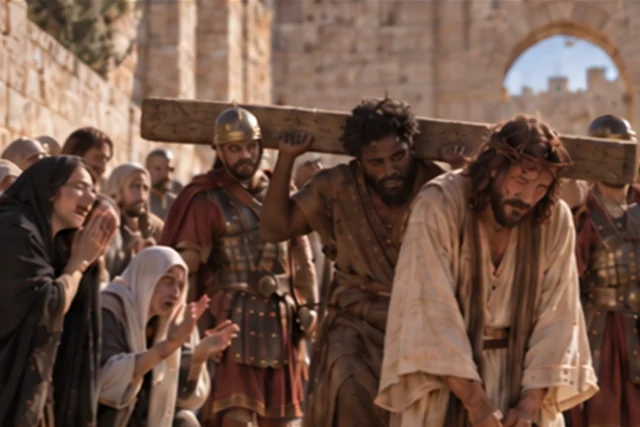
On the way to execution, soldiers seize Simon, a passerby from Cyrene in North Africa, to carry the cross behind Jesus. A large crowd follows, including women mourning for him. Jesus tells the women of Jerusalem to weep for themselves and their children. Days of such distress are coming that childlessness will seem a blessing, and people will wish for hills to cover them. He asks what will happen to dry wood if this happens to green wood, warning of a worse coming judgement. Two condemned criminals are led with him. His own suffering does not prevent him from seeing the city's approaching grief.
In everyday life
A war-loss counsellor hears mourners speak only of one death while reports show a whole neighbourhood facing further danger. She helps families prepare for displacement without taking away space for the grief already present. Care must hold the immediate loss and the wider threat together. Jesus foretells judgement on Jerusalem, not a counsellor's reading of reports.
Notice
Luke 23:28 Jesus redirects the women's grief toward what awaits them and their children. He speaks of their future while he himself is being taken to die.
Luke 23:26-32
King James Version26And as they led him away, they laid hold upon one Simon, a Cyrenian, coming out of the country, and on him they laid the cross, that he might bear it after Jesus.
27And there followed him a great company of people, and of women, which also bewailed and lamented him.
28But Jesus turning unto them said, Daughters of Jerusalem, weep not for me, but weep for yourselves, and for your children.
29For, behold, the days are coming, in the which they shall say, Blessed are the barren, and the wombs that never bare, and the paps which never gave suck.
30Then shall they begin to say to the mountains, Fall on us; and to the hills, Cover us.
31For if they do these things in a green tree, what shall be done in the dry?
32And there were also two other, malefactors, led with him to be put to death.
Luke 23:33-38
Forgiveness Is Spoken Amid Mockery
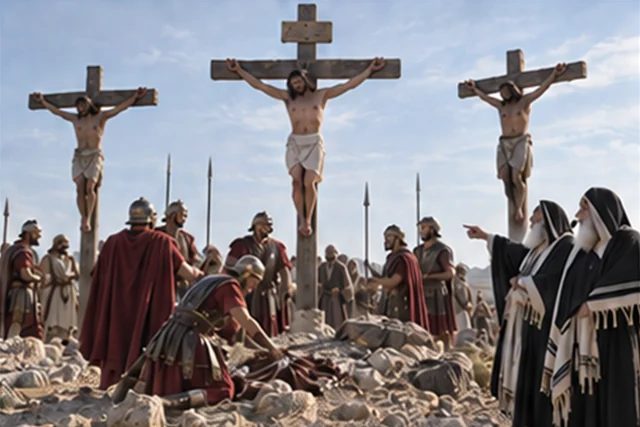
At Calvary, the execution place, Jesus is crucified with one criminal on each side. He asks the Father to forgive those who do not grasp what they are doing. Soldiers divide his clothes by chance while people watch. Leaders mock him, saying that if he is God's chosen Christ he should save himself as he saved others. Soldiers offer sour wine and repeat the royal taunt. A written notice in three languages calls him king of the Jews. Violence, mockery, and the charge of kingship surround a prayer for mercy. Jesus does not wait for his tormentors to show understanding before asking forgiveness.

In everyday life
A victim's relative writes a statement rejecting revenge while a crowd outside demands it. She names the harm truthfully but refuses to let those responsible decide the shape of her own response. Mercy does not mean the wrong was small. Jesus prays for forgiveness during his crucifixion, not after loss from a place of safety.
Notice
Luke 23:34 The prayer names the attackers' lack of understanding without calling their act harmless. Jesus asks mercy in the middle of the wrong being done.
Luke 23:33-38
King James Version33And when they were come to the place, which is called Calvary, there they crucified him, and the malefactors, one on the right hand, and the other on the left.
34Then said Jesus, Father, forgive them; for they know not what they do. And they parted his raiment, and cast lots.
35And the people stood beholding. And the rulers also with them derided him, saying, He saved others; let him save himself, if he be Christ, the chosen of God.
36And the soldiers also mocked him, coming to him, and offering him vinegar,
37And saying, If thou be the king of the Jews, save thyself.
38And a superscription also was written over him in letters of Greek, and Latin, and Hebrew, THIS IS THE KING OF THE JEWS.
Luke 23:39-43
A Condemned Man Receives a Promise
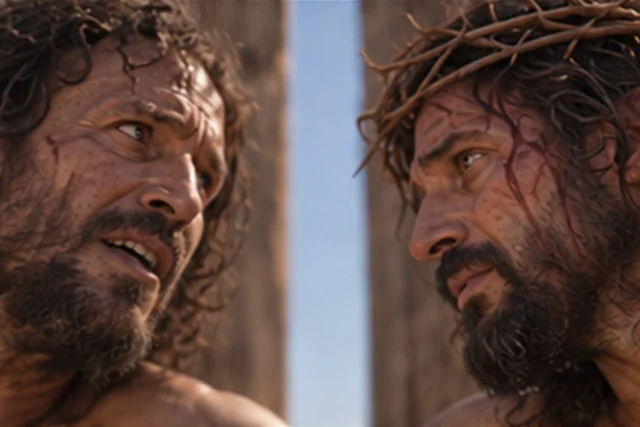
One criminal insults Jesus and demands that he save himself and both of them if he is the Christ. The other rebukes him. They face the same sentence, he says, but their own acts deserve punishment while Jesus has done no wrong. He then asks Jesus to remember him when he comes in his kingdom. Jesus promises that he will be with him in paradise that very day. The man has no time to construct a public record of service. He acknowledges guilt, recognises Jesus' innocence and royal future, and entrusts himself to mercy at the end of his life.
In everyday life
A dying prisoner tells a chaplain that he no longer wants excuses for the harm he caused. He asks whether mercy remains possible when he has no years left to rebuild his reputation. The chaplain listens without calling the wrong good. Jesus can promise paradise with himself that day; a chaplain cannot grant it by personal authority.
Notice
Luke 23:43 Jesus promises presence with him, not only a distant change of circumstances. The hope given to the condemned man centres on being with Jesus.
Luke 23:39-43
King James Version39And one of the malefactors which were hanged railed on him, saying, If thou be Christ, save thyself and us.
40But the other answering rebuked him, saying, Dost not thou fear God, seeing thou art in the same condemnation?
41And we indeed justly; for we receive the due reward of our deeds: but this man hath done nothing amiss.
42And he said unto Jesus, Lord, remember me when thou comest into thy kingdom.
43And Jesus said unto him, Verily I say unto thee, To day shalt thou be with me in paradise.
Luke 23:44-49
Jesus Entrusts His Spirit to the Father
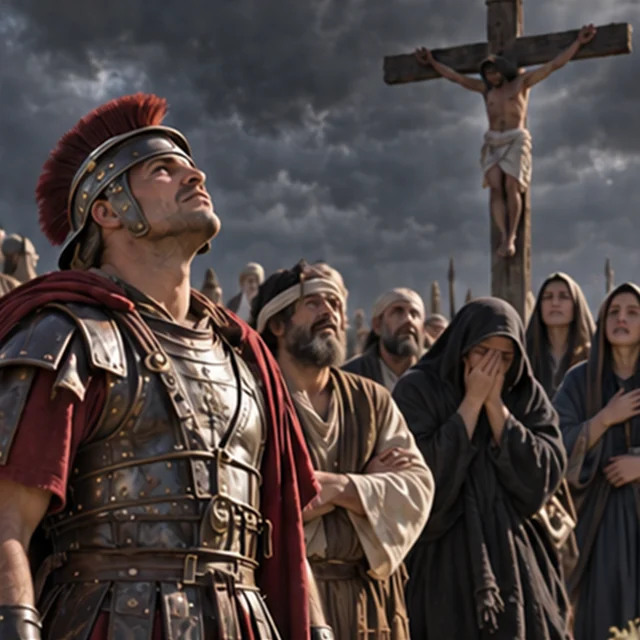
Darkness covers the land from about noon until three. The sun's light fails, and the temple curtain tears. Jesus calls to his Father, entrusts his spirit into the Father's hands, and dies. A centurion, the officer supervising soldiers, praises God and declares him righteous. The watching crowd beats its chest in grief and goes home. Those who knew him and the women who followed from Galilee stand at a distance and witness it. Luke names signs in the sky and what people do below. Jesus' final words are an act of trust, while his death makes bystanders reassess what they have seen.
In everyday life
A palliative-care attendant stands quietly as a dying man speaks a final prayer of trust. A colleague who had known little of him leaves the room with a changed sense of the life he has witnessed. Respect replaces detached routine. Jesus' death includes darkness and the torn temple curtain, not only a moving bedside farewell.
Notice
Luke 23:47 The officer praises God and calls Jesus righteous. A witness from the execution detail joins the earlier declarations that the condemned man is innocent.
Luke 23:44-49
King James Version44And it was about the sixth hour, and there was a darkness over all the earth until the ninth hour.
45And the sun was darkened, and the veil of the temple was rent in the midst.
46And when Jesus had cried with a loud voice, he said, Father, into thy hands I commend my spirit: and having said thus, he gave up the ghost.
47Now when the centurion saw what was done, he glorified God, saying, Certainly this was a righteous man.
48And all the people that came together to that sight, beholding the things which were done, smote their breasts, and returned.
49And all his acquaintance, and the women that followed him from Galilee, stood afar off, beholding these things.
Luke 23:50-56
Joseph Gives Jesus an Unused Tomb
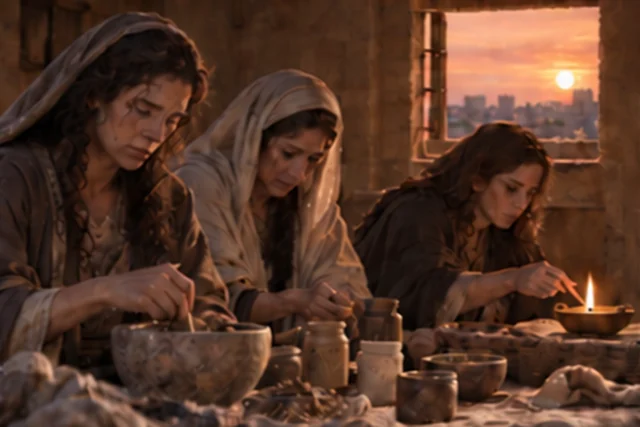
Joseph, a council member from the town of Arimathæa, is described as good and upright. He had not agreed with the council's plan or act and awaited God's kingdom. He asks Pilate for Jesus' body, takes it down, wraps it in linen, and places it in a rock-cut tomb never used before. The sabbath, the holy rest day, is near. Women who came from Galilee follow and see the tomb and the body's placement. They return to prepare spices and ointments, then rest according to the command. Their care pauses for worship's rhythm but leaves them knowing where Jesus has been laid.
In everyday life
A dissenting board member quietly arranges burial for a man harmed by decisions he opposed. Two friends accompany him so they know the grave and can return with flowers. His care does not erase what the group did, but it refuses to join the final neglect. Joseph honours Jesus after execution, not only after an institutional wrong.
Notice
Luke 23:51 Luke explicitly separates Joseph from the council's decision. Membership in the same body does not mean that every person shared the plan to condemn Jesus.
Luke 23:50-56
King James Version50And, behold, there was a man named Joseph, a counsellor; and he was a good man, and a just:
51(The same had not consented to the counsel and deed of them;) he was of Arimathæa, a city of the Jews: who also himself waited for the kingdom of God.
52This man went unto Pilate, and begged the body of Jesus.
53And he took it down, and wrapped it in linen, and laid it in a sepulchre that was hewn in stone, wherein never man before was laid.
54And that day was the preparation, and the sabbath drew on.
55And the women also, which came with him from Galilee, followed after, and beheld the sepulchre, and how his body was laid.
56And they returned, and prepared spices and ointments; and rested the sabbath day according to the commandment.
Details worth noticing
The opening image
Luke 23:1 begins with “And the whole multitude of them arose, and led him unto Pilate.”
Where the chapter turns
Luke 23:28 forms a natural hinge: “But Jesus turning unto them said, Daughters of Jerusalem, weep not for me, but weep for yourselves, and for your children.”
The final note
Luke 23:56 leaves the reader with “And they returned, and prepared spices and ointments; and rested the sabbath day according to the commandment.”
A word trail through the chapter
The words Jesus, Pilate, people, Herod, laid, chief help reveal the chapter’s repeated concerns.
KJV words made clear
- sedition
- An uprising or organised resistance against ruling authority.
- malefactors
- People condemned for criminal wrongdoing, here facing execution.
- paradise
- The blessed place of life with God promised by Jesus.
Music and video connected to the passage
Related media appears when its Scripture reference overlaps this study. Music and video can illuminate a theme while the biblical text remains the foundation.