The big picture
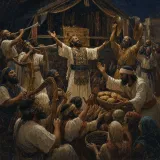
David's establishment in Jerusalem becomes visible through Hiram's materials, skilled builders, and the growth of the royal household, yet David understands the elevation of his kingdom as something done for Israel's sake. The chapter then turns to two Philistine attacks in the same valley. The repetition exposes an important discipline: David asks God both times. The first answer sends him directly against the enemy and produces the name Baal-perazim through the image of God breaking forth. The second answer gives a different route and a signal in the trees. Similar circumstances do not justify reusing the first instruction without fresh inquiry. David's growing fame follows obedience to specific direction, while the Lord remains the one who goes before him and spreads fear among the nations.
In this chapter
- A Palace for a Kingdom Raised for Israel 1 Chronicles 14:1-7
Hiram's timber, masons, and carpenters give David's reign visible permanence in Jerusalem.
- Another Breach, This Time Against the Enemy 1 Chronicles 14:8-12
When the Philistines hear that David has been anointed over all Israel, they go up to seek him.
- The Same Valley, a Different Instruction 1 Chronicles 14:13-17
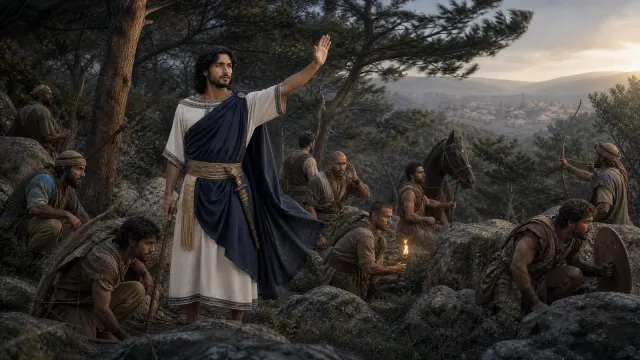
The Philistines return to the same valley, and David does not assume that yesterday's answer can simply be copied into today's battle plan.

Scripture beside the summary
1 Chronicles · King James Version · 171 Chronicles 14:1-7
A Palace for a Kingdom Raised for Israel
Hiram's timber, masons, and carpenters give David's reign visible permanence in Jerusalem. International recognition becomes cedar, skilled labor, and a royal house. David interprets that establishment in a way that shifts the center away from private prestige: he understands that the Lord has confirmed him king and lifted the kingdom on high because of Israel. The palace exists inside a public calling rather than as proof that the king himself is the final object of the kingdom's success. The growing household is then recorded through additional wives, sons, and daughters. The passage does not pause to evaluate every marriage; its immediate concern is the expansion of the royal house in Jerusalem. That expansion also sets up a contrast that will soon matter. David now possesses a substantial residence, while the ark will still be placed in a tent, and the difference between those dwellings will become the starting question of chapter 17.
Deep dive
Hiram's assistance gives David's rule recognition beyond Israel and supplies the practical means for a permanent royal house. Cedar, masons, and carpenters make kingship visible in the city. Yet David's stated recognition is not merely that his personal standing has improved. The kingdom has been lifted up for the sake of the Lord's people Israel.
The additional wives and children record the expansion of his Jerusalem household without pausing to evaluate each marriage. The register marks the growth of the royal house; it offers no separate verdict here on each domestic arrangement. Its immediate function is establishment: king, city, house, and descendants are taking shape. The contrast between this cedar residence and the ark's tent will soon become the starting point of chapter 17.
Words to trace: David, Israel, Jerusalem, king, Beeliada, begat
Verse-by-verse path
- 1 Chronicles 14:1
Tyre was the chief port of Phoenicia, rich from the cedar forests of Lebanon and from shipping. Josephus, citing Tyrian records, dates Hiram’s reign in a way that would put this embassy late in David’s life. Chronicles, following 2 Samuel 5:11, places it here, next to the founding of the city. Masons are literally “craftsmen of the wall”.
- 1 Chronicles 14:2
“Perceived” is the plain verb “knew”. The phrase “on high” is Chronicles’ addition to 2 Samuel 5:12, and it heightens the exaltation. “His people Israel” repeats the phrase “my people Israel” from God’s charge to David in 11:2; the kingdom is raised for the people’s sake.
- 1 Chronicles 14:3
Deuteronomy 17:17 warned that the king must not “multiply wives to himself”, and “more” here is the same verb. 2 Samuel 5:13 mentions “concubines and wives”; Chronicles leaves the concubines out. The family grows in the new capital.
- 1 Chronicles 14:4
Chapter 3:5 says these four were born to Bath-shua, Bathsheba. Solomon, the heir, is listed fourth of her four sons, not first. His brother Nathan shares his name with the prophet who will rebuke David and later help put Solomon on the throne.
- 1 Chronicles 14:5
Elishua is spelled Elishama in 3:6. Elpalet is missing from 2 Samuel 5:15 but present both here and in 3:6, and many think he was a son who died young, his name later given again to Eliphalet in verse 7.
- 1 Chronicles 14:6
Nogah means brightness, and he, too, is absent from 2 Samuel 5:15. Japhia shares a name with the king of Lachish whom Joshua defeated (Joshua 10:3). Nepheg is also the name of a Levite cousin of Korah in Exodus 6:21.
- 1 Chronicles 14:7
Beeliada means “Baal knows”. In 3:8 and 2 Samuel 5:16 the same son is Eliada, “God knows”, the Baal element replaced. Chronicles lists thirteen sons born in Jerusalem, two more than 2 Samuel 5:14–16.
1 Chronicles 14:1-7
King James Version1Now Hiram king of Tyre sent messengers to David, and timber of cedars, with masons and carpenters, to build him an house.
2And David perceived that the LORD had confirmed him king over Israel, for his kingdom was lifted up on high, because of his people Israel.
3And David took more wives at Jerusalem: and David begat more sons and daughters.
4Now these are the names of his children which he had in Jerusalem; Shammua, and Shobab, Nathan, and Solomon,
5And Ibhar, and Elishua, and Elpalet,
6And Nogah, and Nepheg, and Japhia,
7And Elishama, and Beeliada, and Eliphalet.
1 Chronicles 14:8-12
Another Breach, This Time Against the Enemy
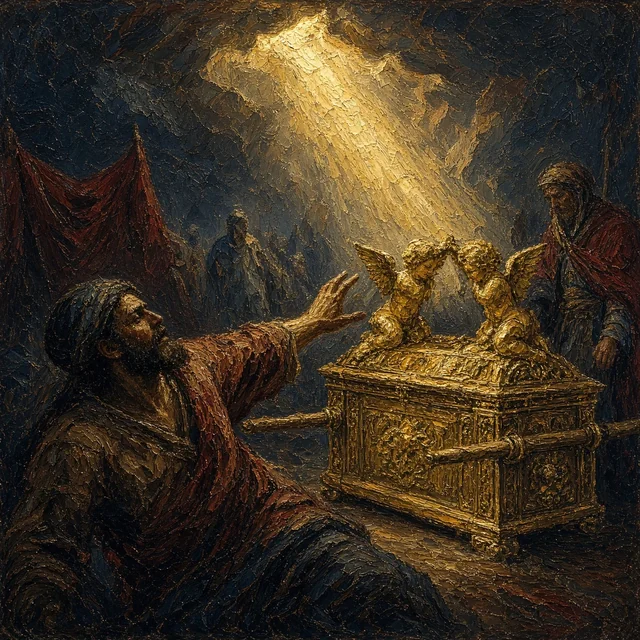
When the Philistines hear that David has been anointed over all Israel, they go up to seek him. David's corresponding movement is to seek direction from God. He asks whether he should go against them and whether they will be delivered into his hand. The answer is specific: go up, and victory is promised. After the battle, David names the place through the image of God breaking upon his enemies like a burst of waters. The language of a breach is striking after the previous chapter's breach against Uzza. Divine power cannot be treated as a royal possession directed at enemies whenever the king wishes. It has disrupted David's procession and now defeats the Philistines. Their abandoned gods are burned rather than collected as sacred trophies. That detail reverses the humiliating image of Saul's remains in Dagon's temple and keeps the book's explanation of victory centered on the Lord rather than on rival religious objects.

Deep dive
The Philistines seek David, and David seeks God's direction. The matching movements distinguish the threat from the response. Rather than assuming that his anointing answers every tactical question in advance, he asks whether to go and whether the enemy will be delivered into his hand.
The naming of Baal-perazim through God's breaking forth recalls the breach against Uzza in the previous chapter. Divine power is not a possession the king can aim wherever he chooses: it has disrupted his procession and now breaks through his enemies. The abandoned Philistine gods are burned at David's command. That detail also reverses the image at the end of Saul's reign, where his head was displayed in Dagon's temple. The Book of 1 Chronicles interprets these victories through the Lord's action, not through the acquisition of rival sacred trophies.
Words to trace: David, Philistines, hand, Baal, deliver, perazim
Verse-by-verse path
- 1 Chronicles 14:8
The Philistines had tolerated David as their vassal at Ziklag, but a king anointed over all Israel was a threat. 2 Samuel 5:17 says David “went down to the hold”; Chronicles says he “went out against them”, turning a retreat into an advance.
- 1 Chronicles 14:9
“Spread themselves” is pashat, the verb for a raid, used of the Amalekites’ raid on Ziklag (1 Samuel 30:1). The Rephaim were an ancient people remembered as giants (Deuteronomy 2:11), and this valley named after them runs to Jerusalem’s south-west edge.
- 1 Chronicles 14:10
David probably enquired by the ephod, through the priest Abiathar, as he did at Keilah and Ziklag (1 Samuel 23:9–12 and 30:7–8): questions framed for a yes or no. His two questions get a direct answer, “Go up”, and the promise, repeated word for word, “deliver them into thine hand”.
- 1 Chronicles 14:11
Baal-perazim means lord of breaches. Isaiah 28:21 looks back to this battle: “the LORD shall rise up as in mount Perazim”, to do his “strange work”, this time against Jerusalem. The breaking of waters is a dam or flood bursting through, sudden and without warning.
- 1 Chronicles 14:12
2 Samuel 5:21 says the Philistines left their images and David and his men “took them away”, as the King James margin notes. Chronicles says they were burned, as Deuteronomy 7:5 orders: “burn their graven images with fire”. The Philistines had carried their gods into battle, as Israel once carried the ark.
1 Chronicles 14:8-12
King James Version8And when the Philistines heard that David was anointed king over all Israel, all the Philistines went up to seek David. And David heard of it, and went out against them.
9And the Philistines came and spread themselves in the valley of Rephaim.
10And David enquired of God, saying, Shall I go up against the Philistines? and wilt thou deliver them into mine hand? And the LORD said unto him, Go up; for I will deliver them into thine hand.
11So they came up to Baal-perazim; and David smote them there. Then David said, God hath broken in upon mine enemies by mine hand like the breaking forth of waters: therefore they called the name of that place Baal-perazim.
12And when they had left their gods there, David gave a commandment, and they were burned with fire.
1 Chronicles 14:13-17
The Same Valley, a Different Instruction
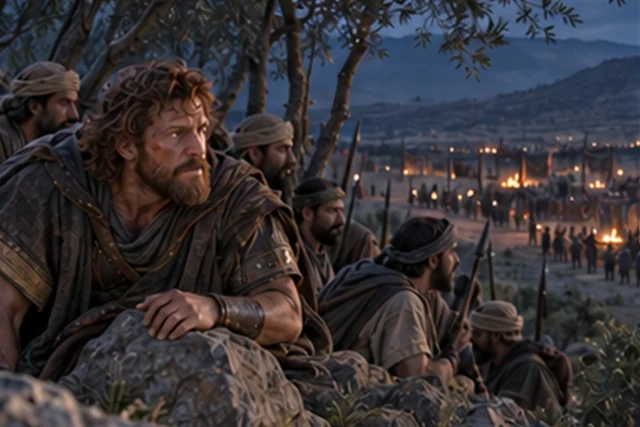
The Philistines return to the same valley, and David does not assume that yesterday's answer can simply be copied into today's battle plan. He inquires again. This time the command is different: do not go straight up after them, but turn aside and approach near the mulberry trees. The sound of movement in the treetops will signal that God has gone before David to strike the Philistine host. The passage does not explain that sound through a visible heavenly army or a natural mechanism. Its function is to mark the moment for action. David does what God commands and wins. The repeated setting with a changed instruction gives the section its force. Faithful response is not mechanical repetition of a former success. The final spread of David's fame is then explained through the Lord's action in placing fear of him upon the nations, keeping reputation as an outcome rather than an independent source of power.
Deep dive
The enemy returns to the valley, but the earlier answer is not simply reused. David inquires again and is told to circle around rather than repeat the previous approach. The setting is similar; the command is not. This repetition with a difference gives the second battle its purpose in the chapter.
The sound of movement in the tops of the mulberry trees marks the moment to act. The passage identifies it as the signal that God has gone before David, without explaining the sound through a visible angelic army or a natural process. David's obedience to that specific direction leads to the defeat. The final spread of his fame is accompanied by the Lord's action in placing fear of him upon the nations. The king's growing reputation remains the result being explained, not the independent power that makes victory inevitable.
Words to trace: David, Philistines, host, mulberry, trees, abroad
Verse-by-verse path
- 1 Chronicles 14:13
The Philistines use the same tactic in the same valley, as if the first rout had been bad luck. “Spread themselves abroad” repeats the raid verb of verse 9. The repetition is what makes the second enquiry matter: the situation looks the same.
- 1 Chronicles 14:14
“Turn away from them” means circle round and come from behind. The “mulberry trees” are beka’im, whose identity is uncertain; they may be balsam shrubs, and the same word lies behind “the valley of Baca” in Psalm 84:6. The attack came through the trees, where the Philistines were not watching.
- 1 Chronicles 14:15
“A sound of going” is the noise of marching, a tread with no one visible. “God is gone forth before thee” is Deborah’s phrase to Barak at Tabor: “is not the LORD gone out before thee?” (Judges 4:14). The signal tells David when the battle has already begun.
- 1 Chronicles 14:16
2 Samuel 5:25 reads “from Geba”; Chronicles has Gibeon. From Gibeon the chase ran down the Beth-horon road to Gezer at the edge of the coastal plain, the same route by which Joshua chased the Amorite kings “from Gibeon” (Joshua 10:10). The Philistines were driven out of the hills.
- 1 Chronicles 14:17
“Fame” is shem, name. The second half echoes God’s word to Moses: “This day will I begin to put the dread of thee and the fear of thee upon the nations” (Deuteronomy 2:25). What was promised for the conquest is said of David’s first victories as king.
1 Chronicles 14:13-17
King James Version13And the Philistines yet again spread themselves abroad in the valley.
14Therefore David enquired again of God; and God said unto him, Go not up after them; turn away from them, and come upon them over against the mulberry trees.
15And it shall be, when thou shalt hear a sound of going in the tops of the mulberry trees, that then thou shalt go out to battle: for God is gone forth before thee to smite the host of the Philistines.
16David therefore did as God commanded him: and they smote the host of the Philistines from Gibeon even to Gazer.
17And the fame of David went out into all lands; and the LORD brought the fear of him upon all nations.
Questions to keep in mind while reading
- Track who acts, who speaks, who is affected, and what changes.
- Notice repeated promises, failures, rescues, and consequences.
- Do not assume the account approves every action that is reported.
Text first
Where readers differ
The chapter summary begins with what the passage says and how its parts fit together. It does not assume one denomination has already settled every question. Where a conclusion depends on a tradition, literary theory, or historical reconstruction, that dependence is named openly.
The KJV text is presented first. Interpretive conclusions are labeled, and differences are introduced only when they help a reader understand why serious communities do not always reach the same answer.
Comparative interpretive notes for this chapter are in preparation. Until reviewed notes are ready, this page separates the KJV text from summary and application without claiming that serious readers agree on every question.
Questions beneath the surface
- What account of God, human freedom, responsibility, and the good life emerges from 1 Chronicles 14?
- Which tension does the chapter refuse to resolve quickly?
- What changes when the chapter is read as part of the whole canon rather than as an isolated moral lesson?
- Where might a sincere reader confuse a familiar tradition with something the text states directly?
Questions for serious personal contemplation
These open-ended questions make room for tension, honest response, prayer, and conclusions that remain accountable to the chapter.
Observe without rushing
What part of 1 Chronicles 14 makes you stop, feel unsettled, or feel surprised, and why?
Which detail in the passage would be easiest to overlook? How does that detail change your understanding?
Where do you see tension between what happens and this focus: David asking the Lord before battle and hearing the appointed sign in the mulberry trees?
What important question does the passage leave open instead of resolving quickly?
Examine your inner life honestly
Which person, response, fear, or desire in the passage feels most like your own life right now?
What assumption about God, other people, or yourself does this text challenge?
Which part would you rather soften, avoid, or explain away too quickly? What might that reaction reveal?
If this Scripture could ask you one direct question, what do you think it would ask?
Respond with wisdom and courage
What do you need to remember, confess, grieve, thank God for, or trust after reading this passage?
How might another faithful person read this situation differently without ignoring the text?
What obedient response would be costly, uncomfortable, or slow, yet still faithful to Scripture?
What question will you carry into prayer this week, and which verses will you keep in front of you?
Music and video connected to the passage
Related media appears when its Scripture reference overlaps this study. Music and video can illuminate a theme while the biblical text remains the foundation.