The big picture
Ezekiel 48 finishes the vision by turning promise into an ordered map of people, sanctuary, city, and ruler. Seven tribal portions are named north of the central offering and five south of it, completing the twelve without letting the sanctuary erase anyone from the inheritance. The central land is carefully divided among priests, Levites, the city, and the prince, with holy portions protected from sale and common civic land treated as a legitimate part of restored life. People from every tribe serve the city, so its maintenance belongs to the reunited community rather than to one tribal estate. The final measurements then move to the city's gates, which bear the names of Israel's tribes. After all the dimensions are stated, the closing name interprets the whole arrangement. Ezekiel ends not with a number but with presence: "The LORD is there."
In this chapter
- The Northern Portions Are Named One by One Ezekiel 48:1-7
The final chapter begins by naming tribes one after another: Dan, Asher, Naphtali, Manasseh, Ephraim, Reuben, and Judah.
- The Central Land Is Not Merchandise Ezekiel 48:8-14
The steady sequence of tribal portions pauses for land that cannot be treated like ordinary property.
- A Common City Inside a Holy Purpose Ezekiel 48:15-22
The city occupies land described as common rather than priestly, and that distinction is important.
- The Southern Portions Complete the People Ezekiel 48:23-29
The southern allotments resume the tribal sequence interrupted by the central offering.
- The Measurements Finish, and the Name Speaks Ezekiel 48:30-35
The final measurements turn from tribal land to city gates.
Scripture beside the summary
Ezekiel · King James Version · 35Ezekiel 48:1-7
The Northern Portions Are Named One by One
The final chapter begins by naming tribes one after another: Dan, Asher, Naphtali, Manasseh, Ephraim, Reuben, and Judah. The repeated east to west pattern makes the arrangement feel almost architectural. Each tribe is given a stated place, and the names that once belonged to a scattered people now sit side by side inside one inheritance. Manasseh and Ephraim receive separate portions, completing the earlier instruction that Joseph have two. Judah lies closest to the central offering on the north, but Ezekiel does not turn that location into a fresh moral ranking of every tribe. The purpose is allocation, not commentary on tribal character. After the extraordinary river of the previous chapter, these lines can sound spare, yet their plainness does important work. Restoration is not left as a collective announcement that Israel has returned. The restored people are named individually and placed within a common order.
Deep dive
Dan, Asher, Naphtali, Manasseh, Ephraim, Reuben, and Judah receive their portions in sequence. The repetition of a portion beside a portion makes the arrangement cumulative. The tribes are no longer merely a scattered set of remembered names. Each is given a stated place within the same land.
Manasseh and Ephraim receive separate allotments, explaining the previous chapter's instruction that Joseph have two portions. Judah lies nearest the central offering on its northern side, but the passage does not turn the sequence into a commentary on each tribe's moral worth. It supplies an ordered grant, not a new ranking of tribal character.
The repeated east-to-west extent gives the chapter a clear pattern before the central area interrupts it. This can look spare after the river's extraordinary imagery, yet it completes a different part of the promise. A gathered people need more than a collective announcement of return. Their place in the restored arrangement is now named.
Words to trace: side, border, east, portion, west, Asher
Verse-by-verse path
- Ezekiel 48:1
“These are the names” are the opening words of Exodus, whose Hebrew title, Shemot, comes from them. Dan takes the far north, where the tribe had moved in Judges 18, founding the city of Dan at the old northern limit, “from Dan even to Beersheba”; its first allotment had been in the south-west.
- Ezekiel 48:2
Asher’s historical land was the northern coast, and Judges 1:31–32 says it never drove out the people of Accho and Zidon. In Ezekiel’s map every tribe receives a full band running “from the east side unto the west side”, so Asher reaches the Jordan as well as the sea.
- Ezekiel 48:3
Naphtali’s old land lay west of the Sea of Galilee, and it was among the first carried off, by Tiglath-pileser in 2 Kings 15:29. Isaiah 9:1 promised that “the land of Naphtali” would see a great light. Here it is simply placed again, a band between Asher and Manasseh.
- Ezekiel 48:4
Manasseh had been divided, half in the hills west of the Jordan and half in Gilead and Bashan to the east (Joshua 13:29–31; 17:1–2). Since Ezekiel’s land ends at the Jordan, the split tribe is given a single band of its own.
- Ezekiel 48:5
Ephraim’s name had stood for the whole northern kingdom, especially in Hosea: “Ephraim is joined to idols” (Hosea 4:17). In 37:16 it was the stick joined to Judah’s. Here it is one band among twelve, no larger than any other.
- Ezekiel 48:6
Reuben was Jacob’s firstborn but lost the firstborn’s rank for his sin (Genesis 49:3–4; 1 Chronicles 5:1). His tribe had settled east of the Jordan (Numbers 32). With Transjordan left out, Reuben is brought west for the first time.
- Ezekiel 48:7
Judah’s historical land lay south of Jerusalem, around Hebron and Bethlehem. In Ezekiel’s map it is moved to the north of the central portion, a sharp break from the old geography that places the royal tribe on the opposite side of the sanctuary from where it once lived.
Ezekiel 48:1-7
King James Version1Now these are the names of the tribes. From the north end to the coast of the way of Hethlon, as one goeth to Hamath, Hazar-enan, the border of Damascus northward, to the coast of Hamath; for these are his sides east and west; a portion for Dan.
2And by the border of Dan, from the east side unto the west side, a portion for Asher.
3And by the border of Asher, from the east side even unto the west side, a portion for Naphtali.
4And by the border of Naphtali, from the east side unto the west side, a portion for Manasseh.
5And by the border of Manasseh, from the east side unto the west side, a portion for Ephraim.
6And by the border of Ephraim, from the east side even unto the west side, a portion for Reuben.
7And by the border of Reuben, from the east side unto the west side, a portion for Judah.
Ezekiel 48:8-14
The Central Land Is Not Merchandise
The steady sequence of tribal portions pauses for land that cannot be treated like ordinary property. The sanctuary stands inside a central offering, with designated areas for the priests and Levites. The sons of Zadok are again identified by their faithfulness to the LORD's charge, so this allocation continues responsibilities established earlier rather than inventing a new privileged class without context. The most important property rule is negative: the land may not be sold, exchanged, or alienated. Its holiness gives it a purpose that later convenience cannot simply cancel. Ezekiel therefore presents secure provision with limits. Those who serve the sanctuary receive land, but they do not receive the authority to convert that sacred grant into whatever arrangement appears profitable. After a book filled with nations taking land, spoil, and advantage from others, this central portion is defined by the giver's purpose and protected from being turned into merchandise.
Deep dive
The pattern of tribal portions pauses for the central offering. The sanctuary stands in its midst, with space assigned to the priests and Levites. The sons of Zadok are again distinguished by having kept the LORD's charge when others went astray. The allocation therefore carries forward the responsibilities established in chapter 44 rather than introducing an unrelated landowning class.
The prohibition on sale, exchange, or alienation gives the arrangement endurance. The firstfruits of the land are holy to the LORD and cannot simply be converted into whatever property arrangement appears advantageous later. The gift has a defined purpose that its recipients are not free to erase.
The distinction also contrasts with the earlier images of nations treating another people's ruined land as available spoil. Here possession is received with limits. The sanctuary's servants are provided for, but their provision remains under the status assigned to it by the giver. Their portion is secure precisely as a dedicated portion.
Words to trace: breadth, five, length, twenty, side, astray
Verse-by-verse path
- Ezekiel 48:8
The central offering runs the full width of the land like every tribal band, “as one of the other parts”, from the Jordan to the sea. It is twenty-five thousand deep from north to south. The sanctuary stands “in the midst of it”.
- Ezekiel 48:9
The Hebrew gives no unit. If the figure is cubits, twenty-five thousand is about thirteen kilometres; if reeds, as the King James supplies, nearer eighty, a large share of the whole land from north to south. The first reading fits a land of twelve bands far better.
- Ezekiel 48:10
In 44:28 the LORD said, “ye shall give them no possession in Israel: I am their possession.” The priests still live on land here, but it is called “this holy oblation”, a strip given to the LORD in which they dwell, not a tribal holding they own.
- Ezekiel 48:11
This is the fourth time the book explains why the sons of Zadok serve at the altar (40:46; 43:19; 44:15; 48:11). “Sanctified” is a passive participle: they are made holy, set apart by another. The contrast with the Levites who went astray is restated even in the final chapter.
- Ezekiel 48:12
“A thing most holy” renders terumiyyah, a unique form of terumah, the word for offering: roughly, “an offering from the offering”. The priests’ strip is set apart within the land already set apart, bordering the Levites’ strip.
- Ezekiel 48:13
The Levites receive a strip of exactly the same size as the priests’: twenty-five thousand by ten thousand, stated twice in one verse. Their office was reduced in 44:10–14, but their land is not.
- Ezekiel 48:14
Leviticus 25:34 said the pasture fields of Levitical cities “may not be sold; for it is their perpetual possession”. “Firstfruits” is reshit, the first and best portion. Neither sale, nor exchange, nor transfer is allowed: the three verbs close every legal route by which land could pass away.
Ezekiel 48:8-14
King James Version8And by the border of Judah, from the east side unto the west side, shall be the offering which ye shall offer of five and twenty thousand reeds in breadth, and in length as one of the other parts, from the east side unto the west side: and the sanctuary shall be in the midst of it.
9The oblation that ye shall offer unto the LORD shall be of five and twenty thousand in length, and of ten thousand in breadth.
10And for them, even for the priests, shall be this holy oblation; toward the north five and twenty thousand in length, and toward the west ten thousand in breadth, and toward the east ten thousand in breadth, and toward the south five and twenty thousand in length: and the sanctuary of the LORD shall be in the midst thereof.
11It shall be for the priests that are sanctified of the sons of Zadok; which have kept my charge, which went not astray when the children of Israel went astray, as the Levites went astray.
12And this oblation of the land that is offered shall be unto them a thing most holy by the border of the Levites.
13And over against the border of the priests the Levites shall have five and twenty thousand in length, and ten thousand in breadth: all the length shall be five and twenty thousand, and the breadth ten thousand.
14And they shall not sell of it, neither exchange, nor alienate the firstfruits of the land: for it is holy unto the LORD.
Ezekiel 48:15-22
A Common City Inside a Holy Purpose
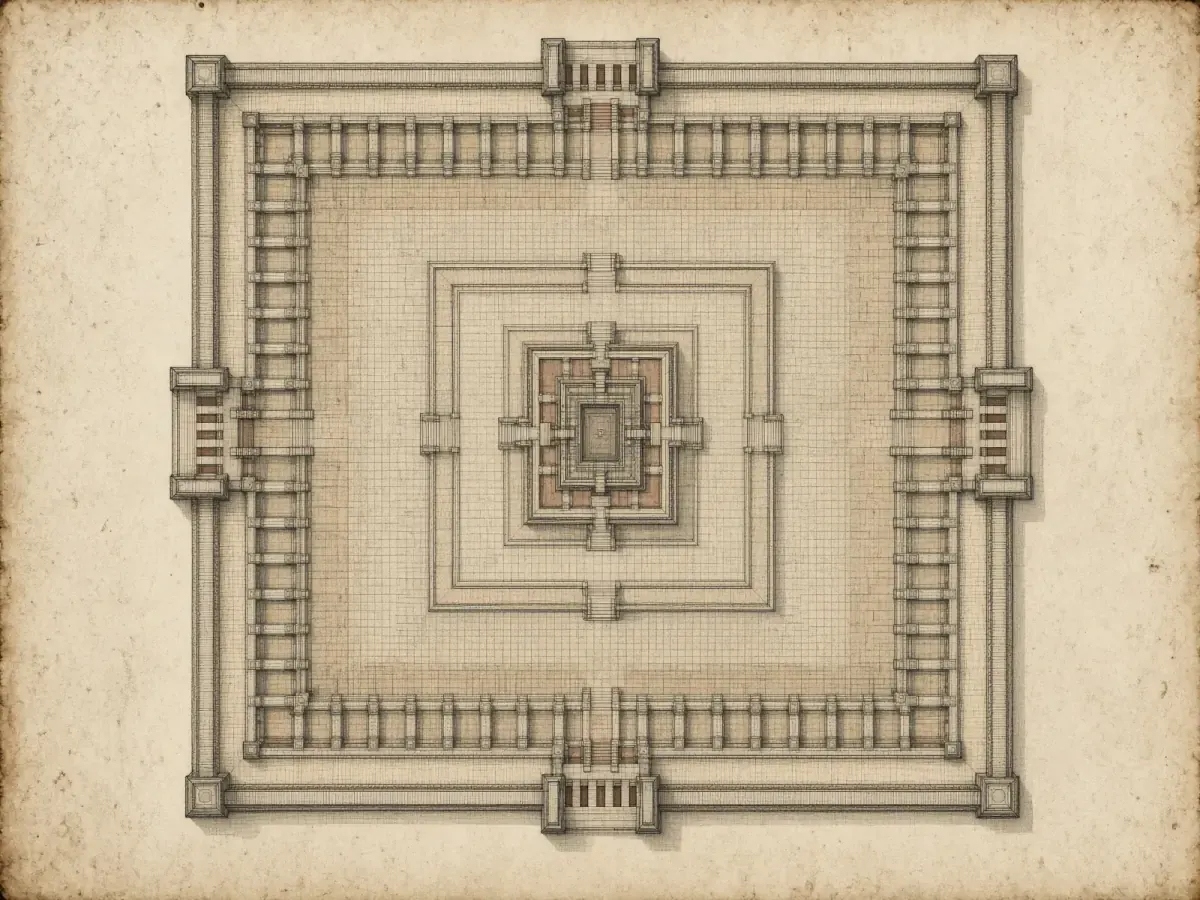
The city occupies land described as common rather than priestly, and that distinction is important. "Profane" here does not make houses, streets, work, or food production morally corrupt. It marks civic space as different from the sanctuary's consecrated portion. Ezekiel's restored order has room for both. Land east and west of the city supplies food for those who serve it, and those servants come from all the tribes of Israel. The city therefore belongs to the shared life of the reunited people rather than functioning as the private extension of one tribe's estate. The prince receives land on both sides of the central allocation, but his holdings do not absorb the sanctuary, the Levites' portion, or the city. Sacred service, civic life, agriculture, and royal provision sit beside one another with boundaries. The plan relates them without allowing any one function to consume the rest.
Deep dive
The city area is called profane, meaning common rather than consecrated for priestly use. That does not make the city corrupt or unwelcome in the vision. Houses, open space, work, and food production belong to the restored arrangement. The distinction preserves the sanctuary's particular holiness without treating ordinary human residence as a defect.
Land on the city's eastern and western sides produces food for those serving it, and those workers come from all the tribes of Israel. The city is therefore not simply the private extension of one tribe's estate. Its maintenance expresses the reunited people's shared life in a particularly practical form: people from across Israel work there and are fed from its provision.
The central square includes both the holy allocation and the city possession, while the prince receives the remainder on its sides. The plan allows each function to be located without allowing the ruler's nearby holdings to swallow the whole. Sacred service, civic work, and royal provision remain related but distinct.
Words to trace: five, city, oblation, holy, side, twenty
Verse-by-verse path
- Ezekiel 48:15
The city strip is five thousand deep, half the width of the priests’ strip. Most reconstructions set it at the southern edge of the central square, so the city stands some distance from the sanctuary. In Solomon’s Jerusalem the temple rose within the city’s walls; here the two are kept apart.
- Ezekiel 48:16
Four thousand five hundred on each side make the city a perfect square. In the Hebrew of this verse the word “five” is written twice in the south-side figure, and the scribes marked the second as written but not to be read, one of a handful of such cases in the Hebrew Bible.
- Ezekiel 48:17
Two hundred and fifty on each side makes the city and its open belt exactly five thousand square: four thousand five hundred plus two hundred and fifty twice. The city fills the width of its strip, fitted into the plan to the last unit.
- Ezekiel 48:18
Ten thousand to the east and ten thousand to the west of the city is farmland. “The increase thereof” means its produce, grown to feed “them that serve the city”, who work its fields and keep it running.
- Ezekiel 48:19
After the exile Nehemiah 11:1 records the people casting lots to bring one family in ten to live in Jerusalem, because the city was underpopulated. Ezekiel’s city is staffed from every tribe, so that no one tribe owns it.
- Ezekiel 48:20
Ten thousand for the priests, ten thousand for the Levites and five thousand for the city make twenty-five thousand. The whole central portion is a square, “foursquare”, the same shape as the sanctuary, the inner court and the altar hearth.
- Ezekiel 48:21
The phrase “in the midst thereof” is used of the sanctuary for the third time in the chapter (verses 8, 10 and 21). The prince’s lands run from the central square to the Jordan on one side and the sea on the other, filling the rest of the central band.
- Ezekiel 48:22
The central band lies “between the border of Judah and the border of Benjamin”. Jerusalem had stood on that very line: Joshua 18:16 and 28 run Benjamin’s border past the Jebusite city and count it as Benjamin’s. The old seam between the two tribes becomes the site of the offering.
Ezekiel 48:15-22
King James Version15And the five thousand, that are left in the breadth over against the five and twenty thousand, shall be a profane place for the city, for dwelling, and for suburbs: and the city shall be in the midst thereof.
16And these shall be the measures thereof; the north side four thousand and five hundred, and the south side four thousand and five hundred, and on the east side four thousand and five hundred, and the west side four thousand and five hundred.
17And the suburbs of the city shall be toward the north two hundred and fifty, and toward the south two hundred and fifty, and toward the east two hundred and fifty, and toward the west two hundred and fifty.
18And the residue in length over against the oblation of the holy portion shall be ten thousand eastward, and ten thousand westward: and it shall be over against the oblation of the holy portion; and the increase thereof shall be for food unto them that serve the city.
19And they that serve the city shall serve it out of all the tribes of Israel.
20All the oblation shall be five and twenty thousand by five and twenty thousand: ye shall offer the holy oblation foursquare, with the possession of the city.
21And the residue shall be for the prince, on the one side and on the other of the holy oblation, and of the possession of the city, over against the five and twenty thousand of the oblation toward the east border, and westward over against the five and twenty thousand toward the west border, over against the portions for the prince: and it shall be the holy oblation; and the sanctuary of the house shall be in the midst thereof.
22Moreover from the possession of the Levites, and from the possession of the city, being in the midst of that which is the prince’s, between the border of Judah and the border of Benjamin, shall be for the prince.
Ezekiel 48:23-29
The Southern Portions Complete the People
The southern allotments resume the tribal sequence interrupted by the central offering. Benjamin, Simeon, Issachar, Zebulun, and Gad each receive an east to west portion, bringing the total together with the seven northern allotments. The center has interrupted the map without displacing a tribe from it. Gad's southern border then returns to the landmarks already used in the previous chapter, joining the detailed portions to the earlier boundary of the land as a whole. The effect is cumulative rather than repetitive. One passage states the extent of the inheritance; the other shows how the restored people inhabit it. The final declaration gathers the names into one conclusion: this is the land divided by lot among the tribes of Israel. Ezekiel does not leave restoration as a shapeless promise. Before the book turns to the city, the people have been named and their places have been assigned.
Deep dive
The tribal sequence resumes with Benjamin and continues southward through Simeon, Issachar, Zebulun, and Gad. Together with the seven northern allotments, these complete the twelve portions. The center has interrupted the arrangement, but it has not displaced any tribe from the inheritance being described.
The southern limit returns to the named boundary points from chapter 47. This correspondence joins the detailed allotments to the earlier description of the land as a whole. Borders and portions are not two separate visions that happen to use similar language; one establishes the extent, and the other sets out the shared occupation within it.
The closing declaration gives the land for division by lot and identifies these as the tribes' portions. The accumulation of names has reached an ordered conclusion. The Book of Ezekiel does not end the people's future with a formless promise that somebody, somewhere, will be restored. It names the people and assigns them places before turning to the city itself.
Words to trace: side, border, east, portion, west, Benjamin
Verse-by-verse path
- Ezekiel 48:23
Benjamin had lived north of Judah, around Gibeah and Bethel. Ezekiel places it south of the centre instead, the only tribe besides Judah to lie beside the holy portion. Benjamin was born on the road to Bethlehem, where Rachel died (Genesis 35:16–19).
- Ezekiel 48:24
Simeon never had a territory of its own: its towns lay “within the inheritance of the children of Judah” (Joshua 19:1, 9), and the tribe faded from view. Here, for the first time, Simeon receives a full band.
- Ezekiel 48:25
Issachar had held the fertile Jezreel valley in the north (Joshua 19:17–23). Genesis 49:15 says he “saw that rest was good, and the land that it was pleasant”. In Ezekiel’s map he is moved far into the south, among the last three bands.
- Ezekiel 48:26
Zebulun’s old land lay in lower Galilee; Genesis 49:13 said he “shall dwell at the haven of the sea”. Since every band runs from the Jordan to the Mediterranean, Zebulun still has its coast, though far to the south of where it once was.
- Ezekiel 48:27
Gad had lived east of the Jordan in Gilead (Numbers 32). Now it is the southernmost tribe. The four tribes descended from the handmaids, Dan and Naphtali from Bilhah, Gad and Asher from Zilpah, are all placed at the far ends, north and south, farthest from the centre.
- Ezekiel 48:28
“At the south side southward” uses two Hebrew words for south: negev, the dry country, and teman, the right hand, since south lies on the right of one facing east. The line repeats the southern border of 47:19 point for point.
- Ezekiel 48:29
“Saith the Lord GOD” occurs here for the last time in the book; the formula has been used over a hundred times since chapter 2. The land division that began in 45:1 and 47:13 is complete.
Ezekiel 48:23-29
King James Version23As for the rest of the tribes, from the east side unto the west side, Benjamin shall have a portion.
24And by the border of Benjamin, from the east side unto the west side, Simeon shall have a portion.
25And by the border of Simeon, from the east side unto the west side, Issachar a portion.
26And by the border of Issachar, from the east side unto the west side, Zebulun a portion.
27And by the border of Zebulun, from the east side unto the west side, Gad a portion.
28And by the border of Gad, at the south side southward, the border shall be even from Tamar unto the waters of strife in Kadesh, and to the river toward the great sea.
29This is the land which ye shall divide by lot unto the tribes of Israel for inheritance, and these are their portions, saith the Lord GOD.
Ezekiel 48:30-35
The Measurements Finish, and the Name Speaks
The final measurements turn from tribal land to city gates. Three gates stand on each side, and each bears a tribal name. Levi appears among the gates even though Levi did not receive an ordinary tribal allotment, while Joseph appears as one name rather than as Ephraim and Manasseh separately. The city therefore represents the whole people in a pattern suited to the city rather than merely copying the land list. Revelation later takes up the twelve gates, tribal names, and threefold arrangement on each side, yet Ezekiel's own ending already carries the emphasis to its destination. The circumference is measured, but the final name matters more than the final number. "The LORD is there" answers the long movement through defilement, departing glory, judgment, and displacement. Walls and allotments do not explain the restored city's life by themselves. The decisive fact is the presence dwelling there.
Deep dive
Three gates stand on each side, and their names represent the tribes. The list differs from the land allotments in an intelligible way: Levi appears among the gates, while Joseph appears as one name rather than as separate Ephraim and Manasseh allotments. The city's naming represents the whole people, including the tribe whose provision took a different form within the land.
Revelation 21:12–13 takes up the twelve gates, tribal names, and threefold arrangement on each side. Yet Revelation 21:22 also says that God and the Lamb are the city's temple. That development prevents the later vision from being treated as a simple photographic copy of Ezekiel's plan. It carries the emphasis upon divine dwelling into its own account of the completed city.
The last measurement states the circumference; the last name states the meaning. "The LORD is there" answers the book's long account of defilement, departing glory, judgment, and displacement. The ending does not claim that walls or tribal organization have repaired everything by themselves. The one whose presence gives the place its life dwells there. After so many measurements, the final fact is not how large the city is, but who is there.
Words to trace: gate, gates, five, side, city, measures
Verse-by-verse path
- Ezekiel 48:30
“Goings out” is totsa’ot, exits. The gates of the city are named first as ways out, as the gates of 46:9 were given as routes through. “Measures” is supplied by the King James; the Hebrew simply gives the number.
- Ezekiel 48:31
The north gates carry three sons of Leah: Reuben the firstborn, Judah the royal tribe and Levi the priestly tribe. The north side faces the sanctuary, so these three gates look toward the holy portion.
- Ezekiel 48:32
The east gates are all of Rachel’s line: Joseph and Benjamin, her two sons, and Dan, the son of her maid Bilhah, whom Rachel herself named (Genesis 30:6). Joseph is one gate here, not two as Ephraim and Manasseh in the land.
- Ezekiel 48:33
The south gates carry the remaining three sons of Leah: Simeon, Issachar and Zebulun. Leah’s six sons thus hold the north and south sides between them, facing each other across the city.
- Ezekiel 48:34
The west gates carry Gad, Asher and Naphtali, sons of the two maids, Zilpah and Bilhah. The twelve gates are grouped by mother, so the city’s walls recall the household of Jacob in Genesis 29 and 30.
- Ezekiel 48:35
The name Jerusalem does not appear anywhere in chapters 40 to 48. Eighteen thousand is four times four thousand five hundred. Jeremiah 33:16 gave the city the name “The LORD our righteousness”; Ezekiel’s last words give it another, YHWH shammah, “The LORD is there”.
Ezekiel 48:30-35
King James Version30And these are the goings out of the city on the north side, four thousand and five hundred measures.
31And the gates of the city shall be after the names of the tribes of Israel: three gates northward; one gate of Reuben, one gate of Judah, one gate of Levi.
32And at the east side four thousand and five hundred: and three gates; and one gate of Joseph, one gate of Benjamin, one gate of Dan.
33And at the south side four thousand and five hundred measures: and three gates; one gate of Simeon, one gate of Issachar, one gate of Zebulun.
34At the west side four thousand and five hundred, with their three gates; one gate of Gad, one gate of Asher, one gate of Naphtali.
35It was round about eighteen thousand measures: and the name of the city from that day shall be, The LORD is there.
Questions to keep in mind while reading
- Identify the historical crisis, covenant failure, warning, and promised hope.
- Distinguish the prophet’s immediate audience from later biblical connections.
- Do not turn present-day headlines into confident fulfillment claims without textual evidence.
Text first
Where readers differ
The chapter summary begins with what the passage says and how its parts fit together. It does not assume one denomination has already settled every question. Where a conclusion depends on a tradition, literary theory, or historical reconstruction, that dependence is named openly.
The KJV text is presented first. Interpretive conclusions are labeled, and differences are introduced only when they help a reader understand why serious communities do not always reach the same answer.
Comparative interpretive notes for this chapter are in preparation. Until reviewed notes are ready, this page separates the KJV text from summary and application without claiming that serious readers agree on every question.
Questions beneath the surface
- What account of God, human freedom, responsibility, and the good life emerges from Ezekiel 48?
- Which tension does the chapter refuse to resolve quickly?
- What changes when the chapter is read as part of the whole canon rather than as an isolated moral lesson?
- Where might a sincere reader confuse a familiar tradition with something the text states directly?
Questions for serious personal contemplation
These open-ended questions make room for tension, honest response, prayer, and conclusions that remain accountable to the chapter.
Observe without rushing
What part of Ezekiel 48 makes you stop, feel unsettled, or feel surprised, and why?
Which detail in the passage would be easiest to overlook? How does that detail change your understanding?
Where do you see tension between what happens and this focus: Ezekiel 48 develops its own movement around side, border, five, east, west?
What important question does the passage leave open instead of resolving quickly?
Examine your inner life honestly
Which person, response, fear, or desire in the passage feels most like your own life right now?
What assumption about God, other people, or yourself does this text challenge?
Which part would you rather soften, avoid, or explain away too quickly? What might that reaction reveal?
If this Scripture could ask you one direct question, what do you think it would ask?
Respond with wisdom and courage
What do you need to remember, confess, grieve, thank God for, or trust after reading this passage?
How might another faithful person read this situation differently without ignoring the text?
What obedient response would be costly, uncomfortable, or slow, yet still faithful to Scripture?
What question will you carry into prayer this week, and which verses will you keep in front of you?
Music and video connected to the passage
Related media appears when its Scripture reference overlaps this study. Music and video can illuminate a theme while the biblical text remains the foundation.