
The big picture
The Book of Hebrews ends by bringing its lofty priesthood into rooms, prisons, marriages, bank balances, leadership relationships, city gates, and ordinary greetings. Brotherly love becomes hospitality and solidarity with people in bonds. Contentment is linked to God's abiding presence. Leaders are remembered through the word they spoke and the course of their faith, while Jesus Christ remains the fixed point "yesterday, and to day, and for ever." The sacrificial argument then moves outside the gate, where Jesus suffered and where identification with him includes reproach rather than established security. Praise, doing good, and sharing are called sacrifices, not as replacements for his sin-bearing offering but as worship flowing from it. Leadership is paired with accountability, and the otherwise commanding voice asks the community for prayer. The closing benediction gathers resurrection, covenant blood, divine workmanship, and the great shepherd before Timothy, travel plans, Italy, greetings, and grace return the dense theological work to an unmistakably human correspondence.
In this chapter
- Brotherly Love Has Room, Money, and Bodily Consequences Hebrews 13:1-6
Brotherly love is given an address, a room, a prison cell, a marriage bed, and a wallet.
- Remembered Leaders, an Unchanged Christ, and Unstable Teaching Hebrews 13:7-9
Leadership is remembered through two measurable things: the word spoken and the life completed.
- Outside the Gate Is Not Outside the Argument Hebrews 13:10-16
The argument goes outside.
- Those Who Watch Must Also Give Account Hebrews 13:17-19
Authority is paired with an audit.
- The Great Shepherd and the Brief Letter Hebrews 13:20-25
The closing prayer compresses the entire letter without turning into a sterile recap.

Scripture beside the summary
Hebrews · King James Version · 25Hebrews 13:1-6
Brotherly Love Has Room, Money, and Bodily Consequences
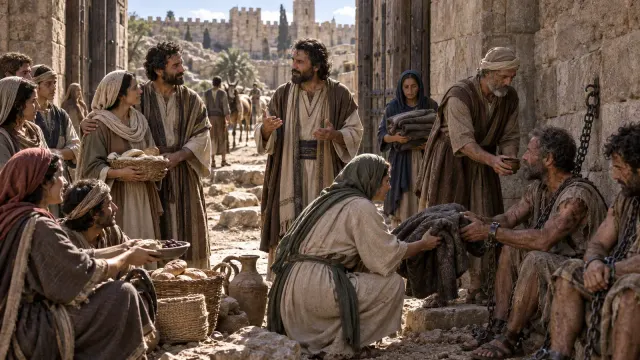
Brotherly love is given an address, a room, a prison cell, a marriage bed, and a wallet. The Book of Hebrews assumes the love already exists and asks for its continuation through concrete forms. Hospitality makes space for strangers, while remembering prisoners "as bound with them" demands an imaginative solidarity rooted in shared bodily vulnerability. The mention of angels recalls biblical hospitality scenes without turning every unfamiliar guest into a disguised heavenly being. Marriage and money then enter the same field of faithfulness. Sexual conduct is placed under God's judgment, and the KJV's "conversation" in verse 5 means manner of life rather than spoken chat. Contentment is not based on pretending every material condition is comfortable. It rests on the promise, "I will never leave thee, nor forsake thee." The Book of Hebrews has already remembered the community losing possessions, so freedom from covetousness is spoken to people who know economic threat. Divine presence, not financial insulation, becomes the ground of confidence.

Deep dive
The opening assumes that brotherly love already exists and calls for its continuation. What follows gives that love concrete locations. Hospitality makes space for strangers; remembrance of prisoners imagines solidarity with their bonds; concern for the afflicted acknowledges shared bodily vulnerability. The possible reception of angels recalls accounts such as Genesis 18–19 without identifying every unfamiliar visitor as an angel.
Marriage and possessions then enter the same discussion of communal faithfulness. Honour toward the marriage bed is placed beside a warning of judgment against sexual wrongdoing. The KJV's "conversation" in verse 5 means conduct or manner of life, not merely spoken conversation. Contentment is connected to God's promised presence, not to a claim that every material circumstance is easy or sufficient in itself.
The scriptural assurance and the response drawn from Psalm 118:6 give the paragraph its confidence. Hebrews has already remembered the actual loss of goods in 10:34. The concern about covetousness therefore stands within a community that knows economic vulnerability, not in an abstract lecture delivered to people whose possessions have never been threatened.
Words to trace: adulterers, adversity, angels, body, boldly, bonds
Verse-by-verse path
- Hebrews 13:1
“Brotherly love” is philadelphia, love within the family of faith. “Continue” is meno, to remain, the verb of 12:27, where the unshakable things “remain”, and of 13:14, where no city “continues”. What survives the shaking includes this love.
- Hebrews 13:2
“Entertain strangers” is philoxenia, love of strangers, set straight after the philadelphia of verse 1. “Unawares” is a Greek idiom, “they escaped notice”. Abraham and Lot are the famous cases, but Gideon and Manoah also hosted the angel of the LORD without knowing it at first (Judges 6:19–22, 13:16).
- Hebrews 13:3
Roman prisons fed their inmates poorly, and prisoners relied on friends to bring food; visiting could mark a person as one of them, as 10:33–34 remembers. “Suffer adversity” is kakoucheomai, the verb of 11:37, “tormented”. “In the body” reminds readers that their own backs can be beaten too.
- Hebrews 13:4
The Greek sentence has no verb, so it can be read as a statement or as a command, “Let marriage be held in honour among all.” “Bed” is koite, the marriage bed itself. Two groups are named: those sexually immoral in general, pornoi, and those who break a marriage, moichoi.
- Hebrews 13:5
“Without covetousness” is aphilargyros, “not money-loving”, the third love-word in five verses after brotherly love and love of strangers. The promise stacks five negatives in Greek, something like “I will never, no never, leave thee”. Its wording is closest to God’s word to Joshua (Joshua 1:5; compare Deuteronomy 31:6).
- Hebrews 13:6
The response is Psalm 118:6 word for word in its Greek form, the psalm of “the stone which the builders refused” and of “Hosanna”. “Boldly” is tharreo, to be of good courage. The quotation turns a divine promise into a human reply: God speaks in verse 5 and his people answer here.
Hebrews 13:1-6
King James Version1Let brotherly love continue.
2Be not forgetful to entertain strangers: for thereby some have entertained angels unawares.
3Remember them that are in bonds, as bound with them; and them which suffer adversity, as being yourselves also in the body.
4Marriage is honourable in all, and the bed undefiled: but whoremongers and adulterers God will judge.
5Let your conversation be without covetousness; and be content with such things as ye have: for he hath said, I will never leave thee, nor forsake thee.
6So that we may boldly say, The Lord is my helper, and I will not fear what man shall do unto me.
Hebrews 13:7-9
Remembered Leaders, an Unchanged Christ, and Unstable Teaching
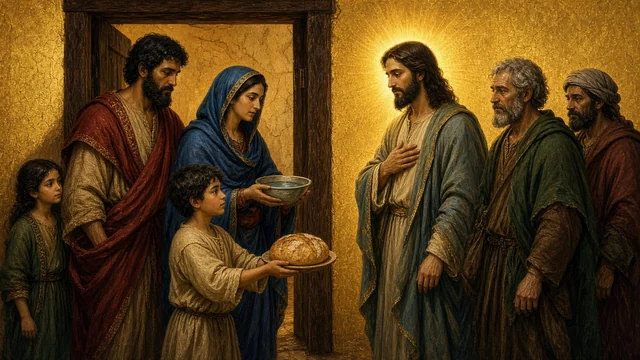
Leadership is remembered through two measurable things: the word spoken and the life completed. The Book of Hebrews tells the community to consider the "end" of its leaders' conduct and imitate their faith, not their every personal habit or preference. Then, between remembered leaders and unstable teaching, comes one of the letter's most concentrated statements: "Jesus Christ the same yesterday, and to day, and for ever." Human leaders pass from view, but the community's defining person does not rotate with each new idea. That constancy gives the warning about "divers and strange doctrines" its center. The issue is not mere unfamiliarity, as though every new explanation were automatically false. The contrast is between a heart established by grace and preoccupation with meats that have not profited those occupied with them. The Book of Hebrews does not supply enough detail to reconstruct the exact food controversy. It does make the effect clear: grace stabilizes where ritual fixation and doctrinal drift carry people about.
Deep dive
Leadership is first described through the word spoken and the life whose course can be considered. The instruction to follow concerns faith, not every preference or personal characteristic of a leader. "The end of their conversation" directs attention to the outcome of their conduct, possibly including the completed course of earlier leaders' lives.
The statement of Christ's constancy stands between that remembered leadership and a warning about varied, strange doctrines. Its placement gives the continuity a practical theological centre. Leaders may pass from the scene, but the community's defining person is not replaced by every new teaching that arrives. The contrast between grace and meats concerns what establishes the heart. Hebrews does not identify the disputed food observances in enough detail to reconstruct the entire controversy. Its explicit judgment concerns their inability to profit those preoccupied with them. The heart is to be grounded by grace rather than carried about by teachings whose novelty or ritual specificity cannot supply that ground.
Words to trace: carried, Christ, considering, conversation, divers, doctrines
Verse-by-verse path
- Hebrews 13:7
“Them which have the rule” is hegoumenoi, leaders, a word used of the congregation’s guides three times in this chapter (7, 17, 24). These ones “have spoken”, past tense, and many take them to be leaders now dead. “Follow” is mimeomai, imitate, as in 6:12, “followers of them who through faith and patience inherit the promises”.
- Hebrews 13:8
There is no verb in the Greek, only the name and three time words. Each one has a history in the letter: “yesterday” recalls “the days of his flesh” (5:7), “to day” repeats the psalm’s “To day if ye will hear his voice” (3:7), and “for ever” is the priest “for ever” of Psalm 110:4. The Son was already called “the same” in 1:12.
- Hebrews 13:9
“Carried about” is paraphero, to be swept off course like driftwood on a current. “Strange” is xenos, foreign, the same root as the “strangers” of verse 2: welcome the stranger, not the strange doctrine. “Established” is bebaioo, made firm, the legal word for a guarantee.
Hebrews 13:7-9
King James Version7Remember them which have the rule over you, who have spoken unto you the word of God: whose faith follow, considering the end of their conversation.
8Jesus Christ the same yesterday, and to day, and for ever.
9Be not carried about with divers and strange doctrines. For it is a good thing that the heart be established with grace; not with meats, which have not profited them that have been occupied therein.
Hebrews 13:10-16
Outside the Gate Is Not Outside the Argument
The argument goes outside. The Book of Hebrews connects the bodies burned beyond the camp after sacrificial blood enters the sanctuary with Jesus suffering "without the gate." The altar language is not explained as a piece of Christian furniture but through access to the offering already developed across the letter. The movement is deliberately uncomfortable because the location of reproach becomes the location of identification. "Let us go forth therefore unto him" places lasting belonging outside the security of an enduring earthly city and points again toward the city to come. That does not require contempt for every earthly home. It does mean that established social respectability cannot define the final place of the people gathered around Christ. Sacrificial vocabulary then changes function. Praise, doing good, and sharing are called sacrifices pleasing to God, but they do not reopen the completed offering for sin. The Book of Hebrews gives them their proper place as grateful worship flowing through the one whose own blood has already made approach possible.
Deep dive
The altar statement is explained through sacrifice and access. Hebrews does not pause to identify a piece of Christian furniture; it distinguishes participation in Christ's offering from continuing reliance on the tabernacle service. Leviticus 16:27 supplies the pattern of sacrificial bodies burned outside the camp after their blood is taken into the sanctuary. Hebrews connects that outside location with Jesus' suffering beyond the gate.
The movement is deliberately uncomfortable for a search for religious respectability. The place of reproach is where the people are directed to identify with Jesus, while the lack of an enduring city recalls the patriarchs' tents and the heavenly city already described. The argument is not contempt for every earthly place. It concerns the location of lasting belonging and the cost of identification with the rejected Christ.
Sacrificial language then continues in a changed form. Praise is offered through Jesus, and doing good and sharing are called sacrifices pleasing to God. The KJV's "communicate" means sharing, not merely talking. This does not add new offerings for the removal of sin after the completed sacrifice. It describes the worship and generosity that proceed through the one whose offering has made approach possible.
Words to trace: blood, camp, altar, bearing, beasts, bodies
Verse-by-verse path
- Hebrews 13:10
Leviticus 6:30 ruled that no sin offering whose blood was brought into the holy place could be eaten; it was burned whole. The priests themselves had no share in it. The verse turns that rule around: Christ is an offering of that kind, one the old priesthood could never eat, and Christians live from it.
- Hebrews 13:11
“Without the camp” is where the unclean were kept and the ashes carried: the carcass of the sin offering was burned there in “a clean place” (Leviticus 4:12), lepers dwelt there (13:46), and the blasphemer was stoned there (24:14). Holiness and rejection shared the same ground outside the tents.
- Hebrews 13:12
John records that Jesus was crucified at a place “nigh to the city” (John 19:20), and executions were carried out beyond the walls. The site lay outside the wall of his day; the wall later built by Herod Agrippa brought it inside. “The people” is laos, the word for Israel as God’s people.
- Hebrews 13:13
“Go forth” is the verb used of Abraham in 11:8, who “went out, not knowing whither he went”. “His reproach” picks up “the reproach of Christ” that Moses chose in 11:26. In Exodus 33:7 Moses pitched the tent of meeting outside the camp, and all who sought the LORD went out to it.
- Hebrews 13:14
“Continuing” is meno again, the verb of verse 1. If the letter was written before AD 70, Jerusalem itself was about to prove the point; if after, the sentence reads as a comment on the ruins. That is an inference about the date, which the letter never gives. “One to come” recalls the city of 11:10 and 12:22.
- Hebrews 13:15
“Sacrifice of praise” is the Greek Old Testament name for the thanksgiving offering of Leviticus 7:12, the todah. “The fruit of our lips” is Hosea 14:2 in its Greek form; the Hebrew reads “the calves of our lips”. “Continually” is the “always” of 9:6, the phrase for the priests’ daily service.
- Hebrews 13:16
“Communicate” translates koinonia, fellowship, used here of material sharing, the word Paul uses for the collection “for the poor saints” in Romans 15:26. “Is well pleased” is euaresteo, the verb that described Enoch in 11:5–6, “he pleased God”.
Hebrews 13:10-16
King James Version10We have an altar, whereof they have no right to eat which serve the tabernacle.
11For the bodies of those beasts, whose blood is brought into the sanctuary by the high priest for sin, are burned without the camp.
12Wherefore Jesus also, that he might sanctify the people with his own blood, suffered without the gate.
13Let us go forth therefore unto him without the camp, bearing his reproach.
14For here have we no continuing city, but we seek one to come.
15By him therefore let us offer the sacrifice of praise to God continually, that is, the fruit of our lips giving thanks to his name.
16But to do good and to communicate forget not: for with such sacrifices God is well pleased.
Hebrews 13:17-19
Those Who Watch Must Also Give Account
Authority is paired with an audit. The Book of Hebrews tells the community to obey and submit to leaders because those leaders "watch for your souls," but the same sentence says they "must give account." The weight therefore runs in both directions. Their role is not ownership of people or immunity from judgment. It is accountable care whose joy or grief has consequences for the community. Then the voice that has spent chapter after chapter issuing dense warnings and confident arguments asks for prayer. The request introduces dependence where readers might expect only authority. A good conscience and a desire to live honestly are mentioned, recalling the letter's repeated concern with conscience now applied to the sender's own conduct. The wish to be "restored" soon implies a relationship disrupted by circumstances the text never fully identifies. The Book of Hebrews gives enough for affection, absence, and mutual responsibility, but not enough to manufacture a location, legal case, or travel history.
Deep dive
The direction concerning obedience and submission is joined to a reason: the leaders watch for souls and must give account. Their authority is not presented as ownership of the people or exemption from examination. The same phrase that gives weight to the community's response places a burden on the leaders. Joy and grief concern the way this accountable work is carried out and its effect on the people.
The speaking voice then asks for prayer and refers to a good conscience and the desire to live honourably. After chapters of confident theological argument, the request is personal and dependent. It also recalls the letter's repeated concern with conscience, now in relation to the sender's own conduct. The request to be restored to the hearers suggests a real relationship interrupted by circumstances the text does not fully explain. Hebrews provides enough to show affection and mutual responsibility, but not enough to name the exact location, cause of absence, or complete travel itinerary.
Words to trace: account, beseech, conscience, good, grief, honestly
Verse-by-verse path
- Hebrews 13:17
“Watch” is agrypneo, to go without sleep, the wakefulness of a shepherd at night. “Give account” recalls 4:13, “him with whom we have to do”, literally “to whom our account is”. “Unprofitable” is alysiteles, of no advantage, an understatement that means it would go badly for the people.
- Hebrews 13:18
The request moves from “us” here to “I” in the next verse, a writer speaking for a group and then for himself. “We trust” is peithometha, we are persuaded. “Honestly” is kalos, well or honourably, the adjective that describes a good life, not only truthful speech.
- Hebrews 13:19
“Restored” is apokathistemi, the verb for the withered hand restored whole in Mark 3:5, and for returning a person to where he belongs. Something is keeping the writer away, and he asks for prayer as though prayer might shorten the delay. “The rather” means all the more.
Hebrews 13:17-19
King James Version17Obey them that have the rule over you, and submit yourselves: for they watch for your souls, as they that must give account, that they may do it with joy, and not with grief: for that is unprofitable for you.
18Pray for us: for we trust we have a good conscience, in all things willing to live honestly.
19But I beseech you the rather to do this, that I may be restored to you the sooner.
Hebrews 13:20-25
The Great Shepherd and the Brief Letter
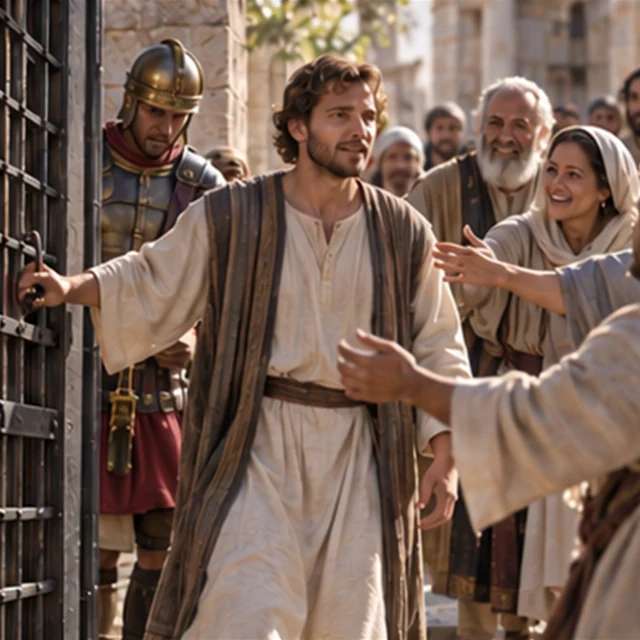
The closing prayer compresses the entire letter without turning into a sterile recap. The Book of Hebrews names "the God of peace," resurrection, "that great shepherd of the sheep," the blood of the everlasting covenant, and God's work of making the hearers complete in every good work. Christ has been the priest who perfects; now the prayer asks God to work within the people toward what is well pleasing in his sight. The shepherd image adds pastoral care without displacing priesthood. Then the sustained theological argument calls itself a "word of exhortation" and, with almost comic modesty after thirteen dense chapters, a letter written "in few words." Timothy's release, a possible visit, greetings to leaders and saints, and salutations from those of Italy bring ordinary human texture back into view. None of those details settles the unnamed writer's identity or exact location with certainty. The Book of Hebrews leaves those questions open and ends where many letters do, with grace for the whole community.
Deep dive
The benediction gathers rather than abandons the theological argument. The God of peace raises the great shepherd, the everlasting covenant is associated with blood, and the desired result is the people's completion in doing God's will. Hebrews has spoken repeatedly of what Christ has perfected; it now prays for God's effective work within those who hear. The shepherd image adds pastoral care to the priestly descriptions without replacing them.
The request to bear with the "word of exhortation" also clarifies the character of the whole work. Its sustained argument has been addressed to people whose endurance matters, not assembled as a detached catalogue of doctrines. Calling it a letter in few words may sound modest after its density, but the brevity is relative to the subjects it has opened and repeatedly declined to exhaust.
Timothy's release, a conditional plan to visit, and greetings from those of Italy give the ending ordinary human particularity. The Italian greeting does not by itself settle whether the letter was written from Italy or sent by Italians elsewhere. Nor does Timothy's name identify the otherwise unnamed sender with certainty. Hebrews leaves those questions open and ends with grace addressed to the whole community.
Words to trace: Amen, Jesus, salute, beseech, blood, brethren
Verse-by-verse path
- Hebrews 13:20
Isaiah 63:11, in its Greek form, asks “Where is he that brought them up out of the sea with the shepherd of his flock?”, the same verb and noun used here of the resurrection. This is the only place Hebrews names the resurrection of Jesus outright. “Everlasting covenant” is the promise of Isaiah 55:3, Jeremiah 32:40 and Ezekiel 37:26.
- Hebrews 13:21
“Make you perfect” is katartizo, the verb of fishermen “mending their nets” in Matthew 4:21: put in working order. “To whom be glory” can refer to God or to Jesus Christ, the nearer name, and grammar alone cannot settle it. This is the only doxology in the letter.
- Hebrews 13:22
“Suffer” means bear with, anechomai. “Word of exhortation” is the phrase the synagogue rulers use in Acts 13:15 when they invite Paul to speak after the readings, and many take Hebrews to be a sermon sent as a letter. “Few words” fits a text that could be read aloud in under an hour.
- Hebrews 13:23
No imprisonment of Timothy is recorded anywhere else. “Set at liberty” is apoluo, released, though some read it as “sent off” on a journey. This is the only named companion in the letter, and it ties the unnamed writer to the circle of Paul, where Timothy is a constant presence.
- Hebrews 13:24
Greeting “all” the leaders and “all” the saints suggests the letter was read to one household group within a larger church, an inference. “They of Italy” uses the construction of Acts 18:2, Aquila “lately come from Italy”. Clement of Rome was quoting Hebrews by about AD 96, the earliest known use.
- Hebrews 13:25
The closing wording is identical to the last line of Titus. The letter has spoken of “the throne of grace” (4:16) and “the Spirit of grace” (10:29), and its last word before the Amen is the same noun, charis, left with every hearer.
Hebrews 13:20-25
King James Version20Now the God of peace, that brought again from the dead our Lord Jesus, that great shepherd of the sheep, through the blood of the everlasting covenant,
21Make you perfect in every good work to do his will, working in you that which is wellpleasing in his sight, through Jesus Christ; to whom be glory for ever and ever. Amen.
22And I beseech you, brethren, suffer the word of exhortation: for I have written a letter unto you in few words.
23Know ye that our brother Timothy is set at liberty; with whom, if he come shortly, I will see you.
24Salute all them that have the rule over you, and all the saints. They of Italy salute you.
25Grace be with you all. Amen.
Questions to keep in mind while reading
- Identify the audience, problem, argument, command, and pastoral purpose.
- Follow connecting words so that one sentence remains inside the author’s reasoning.
- Distinguish a universal theological claim from an instruction shaped by a particular situation.
Text first
Where readers differ
The chapter summary begins with what the passage says and how its parts fit together. It does not assume one denomination has already settled every question. Where a conclusion depends on a tradition, literary theory, or historical reconstruction, that dependence is named openly.
The KJV text is presented first. Interpretive conclusions are labeled, and differences are introduced only when they help a reader understand why serious communities do not always reach the same answer.
Comparative interpretive notes for this chapter are in preparation. Until reviewed notes are ready, this page separates the KJV text from summary and application without claiming that serious readers agree on every question.
Questions beneath the surface
- What account of God, human freedom, responsibility, and the good life emerges from Hebrews 13?
- Which tension does the chapter refuse to resolve quickly?
- What changes when the chapter is read as part of the whole canon rather than as an isolated moral lesson?
- Where might a sincere reader confuse a familiar tradition with something the text states directly?
Questions for serious personal contemplation
These open-ended questions make room for tension, honest response, prayer, and conclusions that remain accountable to the chapter.
Observe without rushing
What part of Hebrews 13 makes you stop, feel unsettled, or feel surprised, and why?
Which detail in the passage would be easiest to overlook? How does that detail change your understanding?
Where do you see tension between what happens and this focus: Hospitality to strangers, care for prisoners, faithful marriage, contentment, leaders finishing well, and praise joined with practical generosity?
What important question does the passage leave open instead of resolving quickly?
Examine your inner life honestly
Which person, response, fear, or desire in the passage feels most like your own life right now?
What assumption about God, other people, or yourself does this text challenge?
Which part would you rather soften, avoid, or explain away too quickly? What might that reaction reveal?
If this Scripture could ask you one direct question, what do you think it would ask?
Respond with wisdom and courage
What do you need to remember, confess, grieve, thank God for, or trust after reading this passage?
How might another faithful person read this situation differently without ignoring the text?
What obedient response would be costly, uncomfortable, or slow, yet still faithful to Scripture?
What question will you carry into prayer this week, and which verses will you keep in front of you?
Music and video connected to the passage
Related media appears when its Scripture reference overlaps this study. Music and video can illuminate a theme while the biblical text remains the foundation.