The big picture
A man born blind receives sight, but the healing creates a problem for people committed to a Sabbath verdict against Jesus. The Book of John follows the man through repeated questioning while his understanding grows. He begins with “a man that is called Jesus,” advances to “a prophet,” argues that the healer must be from God, and finally confesses belief when Jesus finds him after his expulsion. The authorities move in the opposite direction. They investigate the facts, confirm through the parents that the man really was born blind, and still demand a conclusion that fits their prior judgment. The irony becomes sharp enough for the healed man himself to expose it. The chapter closes by reversing the language of sight. Physical blindness was never evidence of personal sin here. The deeper danger is claiming to see while refusing correction from the evidence standing in front of you.
In this chapter
- The Question of Blame Gives Way to the Work of Sight John 9:1-12
The disciples see congenital blindness and immediately ask who should be blamed.
- The Inquiry Cannot Make the Healed Eyes Disappear John 9:13-23
The Sabbath turns a recovered pair of eyes into a theological dispute.
- The Witness Is Asked to Endorse the Verdict John 9:24-34
The second interrogation begins with the verdict already supplied: “we know that this man is a sinner.” The healed man refuses to trade what he knows for what his examiners insist he should conclude.
- Expelled from the Hearing, Found by Jesus John 9:35-41
Being cast out is not the final scene for the healed man.
Scripture beside the summary
John · King James Version · 41John 9:1-12
The Question of Blame Gives Way to the Work of Sight
The disciples see congenital blindness and immediately ask who should be blamed. Jesus rejects both options they offer. In this case, the man’s condition is not explained as punishment for his sin or his parents’ sin, and the encounter turns away from assigning fault toward the work of God becoming visible. The Book of John then makes the healing physical and particular: clay, eyes, a command to wash, and a pool whose name is translated as “Sent.” The man obeys before he possesses a developed account of who Jesus is. When he returns seeing, even his neighbors cannot agree whether he is the same beggar they knew. He has to establish his own identity before explaining the cure. His first testimony is modest and exact. A man called Jesus made clay, gave instructions, and he received sight. He knows what happened before he knows where Jesus is or what title belongs to him.
Deep dive
The disciples offer two possible culprits, the man or his parents, as though the task were to assign an adequate cause to a settled explanation. Jesus refuses that framework for this case. The answer does not provide a universal account of why every disability exists. It identifies what is to be manifested in the encounter before them. The movement is from an argument about blame to an act that gives sight.
Clay, anointing, a command to wash, and the pool called Siloam make the action materially specific. John translates Siloam as "Sent," a fitting detail in a Gospel so concerned with the one sent by the Father. The man obeys without first being able to identify Jesus fully. His knowledge will grow through what follows.
The neighbors' disagreement produces a small but pointed absurdity: people who knew him as a beggar cannot agree whether the man now before them is the same person. He has to insist upon his own identity before he can explain the healing. His first account names "a man that is called Jesus" and reports the actions accurately. He knows what happened; he does not yet know where Jesus is or everything about who he is.
Words to trace: blind, clay, eyes, Jesus, anointed, parents
Verse-by-verse path
- John 9:1
In the King James the previous chapter ended “and so passed by”, and this one opens with Jesus passing by, as though the escape from the temple leads straight to the beggar. “From his birth” is a phrase found only here in the New Testament; no other Gospel healing is of someone born blind.
- John 9:2
Both options had defenders. Exodus 20:5 speaks of the fathers’ iniquity visited on the children, and later rabbis could imagine sin before birth: Genesis Rabbah 63:6 has Esau struggling in the womb to reach the idol temples. “Master” is rabbi.
- John 9:3
The purpose clause has no main verb of its own, and some editors punctuate so that it runs into verse 4: “But that the works of God should be made manifest in him, I must work...” Either way, Jesus answers a question about the past with a statement about what is about to happen.
- John 9:4
The oldest manuscripts read “We must work the works of him that sent me”, drawing the disciples into the task, with “sent me” keeping the mission his. The night will fall in earnest in 13:30, when Judas goes out: “and it was night.”
- John 9:5
The claim of 8:12 is repeated with a condition: whenever I am in the world. Isaiah 42:6–7 joins the two ideas this chapter joins, “a light of the Gentiles; to open the blind eyes”. The saying is about to be proved on a single pair of eyes.
- John 9:6
Spittle was widely thought to heal; Tacitus reports that Vespasian cured a blind man in Alexandria with it, and Mark shows Jesus using it twice (7:33, 8:23). Irenaeus saw in the clay the hand that formed Adam from the dust (Genesis 2:7) completing what had been lacking at birth.
- John 9:7
Siloam was the pool at the south end of the city, fed through Hezekiah’s tunnel from the Gihon spring (2 Kings 20:20); a large stepped pool of this period was uncovered there in 2004. Isaiah 8:6 knew “the waters of Shiloah that go softly”, water sent down a channel, hence the name.
- John 9:8
The best manuscripts read “they which before had seen him that he was a beggar”, not blind. A beggar sat at a known place, often by a temple gate, as the lame man did at the Beautiful gate in Acts 3:2, and people knew him by his spot.
- John 9:9
“I am he” is ego eimi, the same words Jesus uses of himself, here meaning no more than “It’s me.” The ordinary use shows how plain the phrase could be, which is why context alone makes it weighty on Jesus’ lips.
- John 9:10
The question of how his eyes were opened, or who opened them, comes seven times in this chapter (verses 10, 14, 17, 21, 26, 30 and 32). Isaiah 35:5 had promised that in God’s day “the eyes of the blind shall be opened”.
- John 9:11
His account is exact and in order: clay, anointing, command, washing. “Received sight” is anablepo, literally to look up or to see again, a word he uses though he had never seen before.
- John 9:12
“Where is he?” is the question asked of Jesus at the feast (7:11). “I know not” is the first of his admissions of ignorance, and in verse 25 it will stand beside the one thing he does know.
John 9:1-12
King James Version1And as Jesus passed by, he saw a man which was blind from his birth.
2And his disciples asked him, saying, Master, who did sin, this man, or his parents, that he was born blind?
3Jesus answered, Neither hath this man sinned, nor his parents: but that the works of God should be made manifest in him.
4I must work the works of him that sent me, while it is day: the night cometh, when no man can work.
5As long as I am in the world, I am the light of the world.
6When he had thus spoken, he spat on the ground, and made clay of the spittle, and he anointed the eyes of the blind man with the clay,
7And said unto him, Go, wash in the pool of Siloam, (which is by interpretation, Sent.) He went his way therefore, and washed, and came seeing.
8The neighbours therefore, and they which before had seen him that he was blind, said, Is not this he that sat and begged?
9Some said, This is he: others said, He is like him: but he said, I am he.
10Therefore said they unto him, How were thine eyes opened?
11He answered and said, A man that is called Jesus made clay, and anointed mine eyes, and said unto me, Go to the pool of Siloam, and wash: and I went and washed, and I received sight.
12Then said they unto him, Where is he? He said, I know not.
John 9:13-23
The Inquiry Cannot Make the Healed Eyes Disappear
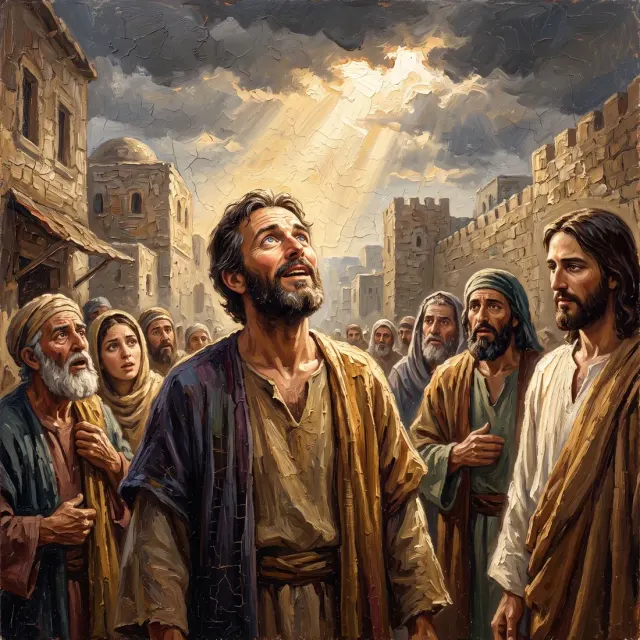
The Sabbath turns a recovered pair of eyes into a theological dispute. Some Pharisees conclude that Jesus cannot be from God because he has acted on the Sabbath, while others ask how a sinner could perform such signs. The Book of John preserves that division instead of portraying every examiner as sharing one response. When the healed man is asked for his own judgment, he moves beyond “a man called Jesus” and says, “He is a prophet.” The inquiry then tries another route by questioning his parents. They confirm the two facts the investigation would most like to unsettle: this is their son, and he was born blind. What they refuse to discuss is how he now sees or who opened his eyes. John supplies their motive directly. They fear exclusion from the synagogue. Their answer, “he is of age; ask him,” is legally tidy and socially safe, but it returns the pressure to the person who cannot distance himself from the evidence.
Deep dive
The Sabbath detail creates an argument among the Pharisees themselves. Some infer that Jesus cannot be from God because of the Sabbath action; others ask how a sinner could perform such signs. John records division rather than a uniform response. The healed man is then asked for his judgment about Jesus and answers that he is a prophet. His understanding has moved beyond the bare identification offered to the neighbors.
The investigation turns to the parents in an attempt to establish whether the man had truly been blind. They confirm both identity and condition. Those facts cannot be removed simply by questioning another witness. Their refusal to explain the healing is then expressly connected with fear of being put out of the synagogue. Unlike many imagined motives attached to biblical figures, this fear is supplied by John himself.
Their appeal to their son's age returns the inquiry to the person best placed to describe what happened. It also leaves him exposed to the pressure they avoid. The scene makes the cost of testimony visible without inventing what either parent privately thinks of Jesus. The established facts and the publicly safe answer have begun to diverge.
Words to trace: blind, eyes, parents, Jews, know, opened
Verse-by-verse path
- John 9:13
The Book of John does not say who brought him or why. The Sabbath detail in the next verse suggests the reason. “Aforetime” is pote, formerly: the book now names him by what he used to be.
- John 9:14
Kneading was one of the thirty-nine kinds of work forbidden on the Sabbath (Mishnah Shabbat 7:2), and making clay from spittle and dust is kneading. A later ruling in the Jerusalem Talmud also forbade putting spittle on the eyes on the Sabbath. As in 5:9, the Sabbath is mentioned only after the healing.
- John 9:15
His third telling is the shortest yet: “He put clay upon mine eyes, and I washed, and do see.” The name of Jesus, the spittle and Siloam have all dropped out. Asked the same question again, he gives them the bare facts.
- John 9:16
“Keepeth not” is present tense, a habit and not a lapse. Deuteronomy 13:1–5 said that a sign-worker who led Israel away from the law was a false prophet whatever his sign, and that is the logic of the first group. The second group reasons the other way, from the sign to the man.
- John 9:17
Asking a witness for his opinion of the accused is an odd step in an inquiry. His answer sets Jesus among the prophets who worked wonders, and Elisha once prayed, “LORD, open the eyes of these men” (2 Kings 6:20).
- John 9:18
The book switches names from “the Pharisees” to “the Jews” for the same examiners. Doubting the blindness means suspecting a switch or a fraud: perhaps this was never the beggar, or he never truly was blind.
- John 9:19
Three questions are packed into one: is this your son, was he born blind, how does he see? The phrase “who ye say” treats the blindness as the parents’ claim, something they have asserted and may now have to retract.
- John 9:20
The chapter is full of people saying what they know. The parents know two things, the Pharisees will “know” that Jesus is a sinner (verse 24), and the son will say “one thing I know” (verse 25). The parents stop exactly where their knowledge becomes dangerous.
- John 9:21
“Of age” means he has reached majority, at thirteen by later Jewish reckoning, and can give testimony in his own right. The Greek has “himself” twice: ask him; he himself will speak about himself.
- John 9:22
“Put out of the synagogue” is aposunagogos, a word found only in the Book of John (here, 12:42 and 16:2). J. Louis Martyn argued it reflects a later exclusion of believers after AD 70; others hold that local expulsions could have happened in Jesus’ lifetime. The dating is disputed.
- John 9:23
The parents’ words are quoted a second time, now as the conclusion of the book’s explanation. On the night before his death Jesus tells the disciples, “They shall put you out of the synagogues” (16:2); the fear that governs the parents here will become the disciples’ experience.
John 9:13-23
King James Version13They brought to the Pharisees him that aforetime was blind.
14And it was the sabbath day when Jesus made the clay, and opened his eyes.
15Then again the Pharisees also asked him how he had received his sight. He said unto them, He put clay upon mine eyes, and I washed, and do see.
16Therefore said some of the Pharisees, This man is not of God, because he keepeth not the sabbath day. Others said, How can a man that is a sinner do such miracles? And there was a division among them.
17They say unto the blind man again, What sayest thou of him, that he hath opened thine eyes? He said, He is a prophet.
18But the Jews did not believe concerning him, that he had been blind, and received his sight, until they called the parents of him that had received his sight.
19And they asked them, saying, Is this your son, who ye say was born blind? how then doth he now see?
20His parents answered them and said, We know that this is our son, and that he was born blind:
21But by what means he now seeth, we know not; or who hath opened his eyes, we know not: he is of age; ask him: he shall speak for himself.
22These words spake his parents, because they feared the Jews: for the Jews had agreed already, that if any man did confess that he was Christ, he should be put out of the synagogue.
23Therefore said his parents, He is of age; ask him.
John 9:24-34
The Witness Is Asked to Endorse the Verdict
The second interrogation begins with the verdict already supplied: “we know that this man is a sinner.” The healed man refuses to trade what he knows for what his examiners insist he should conclude. Whether Jesus fits their moral category is a question he will not pretend to settle for them, but his former blindness and present sight are not negotiable. Repeated questioning only makes the exchange more pointed. When they ask again how it happened, he wonders aloud whether they too want to become Jesus’ disciples. The Book of John lets the irony land without extra explanation. An inquiry designed to discredit Jesus has become so repetitive that it sounds like recruitment. The authorities appeal to Moses and their ignorance of Jesus’ origin, while the man points to the opened eyes as the fact their explanation cannot absorb. In the end they attack his birth and cast him out, returning to the very blame framework Jesus rejected at the chapter’s beginning.

Deep dive
The instruction to give God the praise arrives with the conclusion already attached: the examiners know Jesus is a sinner. The healed man distinguishes that claim from the fact he can attest. His former blindness and present sight are not conclusions supplied by the hearing; they are the evidence that made the hearing necessary. Repeated questioning cannot make them cease to be true.
When asked yet again how his eyes were opened, he wonders whether the questioners wish to become disciples too. The reversal is wonderfully sharp. An examination intended to discredit Jesus has begun to sound, in its persistence, like an enrollment inquiry. The reply is abusive and appeals to Moses, while the man presses the unresolved issue of how someone of supposedly unknown authority has performed this act.
His statement about God hearing the worshiper rather than sinners belongs to his argument in the hearing; it should not be lifted out as an exhaustive rule about every prayer a sinful person ever makes. The immediate point concerns divine authorization for an unprecedented restoration of sight. The authorities finally attack the man's birth and expel him. They end by invoking the very sin-based explanation Jesus rejected at the chapter's beginning.
Words to trace: know, blind, eyes, opened, born, disciples
Verse-by-verse path
- John 9:24
“Give God the praise” is a solemn charge to tell the truth, the words Joshua used to Achan before his confession: “My son, give, I pray thee, glory to the LORD God of Israel, and make confession unto him” (Joshua 7:19). They want a confession that the healing was fraudulent.
- John 9:25
He declines to judge what he cannot know and holds to what he can. John Newton took the last words of the verse into the hymn Amazing Grace in 1772: “was blind, but now I see.”
- John 9:26
This is the fourth time the man has been asked how it happened: by the neighbours (verse 10), by the Pharisees (15), through his parents (19), and now again. The repetition itself suggests the examiners are hoping for a discrepancy.
- John 9:27
“Will ye also” uses a construction that expects the answer no, but the word “also” gives him away: it assumes he is already one. “Ye did not hear” means you did not listen, since they plainly heard the words.
- John 9:28
“Reviled” is loidoreo, to abuse with words. “Moses’ disciples” is how Pharisaic scholars described themselves; the Babylonian Talmud (Yoma 4a) uses the same phrase. The line sets two teachers against each other as rival schools.
- John 9:29
Numbers 12:8 says God spoke with Moses “mouth to mouth”. “This fellow” is simply “this one”, spoken with contempt. At the feast the people of Jerusalem said, “we know this man whence he is” (7:27); now the authorities say they do not know, and both are used against him.
- John 9:30
“A marvellous thing” is thaumaston, the astonishing thing. He turns their own words, “we know not from whence he is”, back on them. The expert examiners are the ones who cannot answer, and the beggar points it out.
- John 9:31
He takes up their “we know” and adds a truth they would own: Psalm 66:18, “If I regard iniquity in my heart, the Lord will not hear me”, and Proverbs 15:29. “Worshipper of God” is theosebes, God-fearing, a word found only here in the New Testament.
- John 9:32
The Old Testament records no one born blind being given sight. Psalm 146:8 reserves the act to God: “The LORD openeth the eyes of the blind.” “Since the world began” is literally “from the age”, from the beginning of time.
- John 9:33
“Of God” is para theou, from God, the conclusion Nicodemus reached in 3:2: “no man can do these miracles that thou doest, except God be with him.” The beggar reaches by argument what a ruler of the Jews had said privately at night.
- John 9:34
“Altogether” is holos, wholly: you were born entirely in sins, an echo of Psalm 51:5. “Cast him out” can mean thrown out of the room or expelled from the synagogue, the penalty named in verse 22, and the Greek does not settle which.
John 9:24-34
King James Version24Then again called they the man that was blind, and said unto him, Give God the praise: we know that this man is a sinner.
25He answered and said, Whether he be a sinner or no, I know not: one thing I know, that, whereas I was blind, now I see.
26Then said they to him again, What did he to thee? how opened he thine eyes?
27He answered them, I have told you already, and ye did not hear: wherefore would ye hear it again? will ye also be his disciples?
28Then they reviled him, and said, Thou art his disciple; but we are Moses’ disciples.
29We know that God spake unto Moses: as for this fellow, we know not from whence he is.
30The man answered and said unto them, Why herein is a marvellous thing, that ye know not from whence he is, and yet he hath opened mine eyes.
31Now we know that God heareth not sinners: but if any man be a worshipper of God, and doeth his will, him he heareth.
32Since the world began was it not heard that any man opened the eyes of one that was born blind.
33If this man were not of God, he could do nothing.
34They answered and said unto him, Thou wast altogether born in sins, and dost thou teach us? And they cast him out.
John 9:35-41
Expelled from the Hearing, Found by Jesus
Being cast out is not the final scene for the healed man. Jesus hears what happened and finds him. That initiative matters after a chapter in which other people have repeatedly summoned, questioned, and dismissed him. Jesus now asks about belief and identifies the Son of God as the one speaking with him. The man’s recognition has developed in visible stages: first a man called Jesus, then a prophet, then someone from God, and finally the object of belief and worship. The Book of John ends the chapter by turning physical sight into a measure for claimed spiritual sight without confusing the two. The man who began blind has come to see who Jesus is. Some who insist that they see are confronted with the responsibility attached to that claim. Jesus does not say blindness itself is sinful. The whole chapter has already refused that equation. The closing problem is certainty that will not allow itself to be corrected.
Deep dive
The man's removal from the hearing is not the end of his place in the account. Jesus hears what happened and finds him. That initiative prepares the shepherd discourse immediately ahead: the person excluded by the authorities is not abandoned by the one who gave him sight. Jesus now asks for belief in the Son of God, as the KJV reads, and identifies himself in answer to the man's request. The movement from "a man" through "a prophet" reaches confession and worship.
Jesus' statement about judgment explains the reversal that has unfolded. The man who began without sight has come to recognize him; some who claim sight have used their claimed knowledge to resist the evidence. This is not a claim that physical blindness makes someone sinful or spiritually deficient. The entire chapter has rejected that equation.
The Pharisees' final question shows that they recognize the accusation may concern them. Jesus answers by connecting their claim to see with remaining sin. Their responsibility is sharpened, not reduced, by professed knowledge. John closes the chapter with a distinction between ignorance that can receive sight and certainty that refuses correction.
Words to trace: Jesus, believe, blind, Lord, both, Dost
Verse-by-verse path
- John 9:35
The oldest manuscripts, including both early papyri of John, read “Son of man” here, not “Son of God”. Jesus has heard what happened and goes looking for him; the one who has been cast out is the one Jesus seeks.
- John 9:36
“Lord” is kurie, and here it probably means “Sir”. The man has never seen Jesus’ face: he was sent to wash at Siloam and received his sight there. He knows the voice perhaps, but not yet the man.
- John 9:37
A man born blind is told he has seen. The perfect tense means he has seen and now sees. “It is he that talketh with thee” echoes what Jesus told the woman at the well: “I that speak unto thee am he” (4:26).
- John 9:38
“Worshipped” is proskuneo, the verb of 4:20–24, and this is the only time in the Book of John that anyone is said to worship Jesus in his lifetime. A few early manuscripts lack this verse and the first words of the next.
- John 9:39
“Judgment” here is krima, a verdict, a word the book uses nowhere else. The saying turns Isaiah 6:9–10, the blinding of eyes that will not see, which the Book of John quotes directly in 12:40.
- John 9:40
Their question has the same form as the man’s in verse 27, a “we also” that expects the answer no. They were “with him”, which may mean they were among the crowd around him, not necessarily hostile.
- John 9:41
“Remaineth” is meno, the verb the book uses for abiding in Christ, here used of sin that abides. John the Baptist used it the same way in 3:36: “the wrath of God abideth on him.” The claim to sight is what keeps the sin in place.
John 9:35-41
King James Version35Jesus heard that they had cast him out; and when he had found him, he said unto him, Dost thou believe on the Son of God?
36He answered and said, Who is he, Lord, that I might believe on him?
37And Jesus said unto him, Thou hast both seen him, and it is he that talketh with thee.
38And he said, Lord, I believe. And he worshipped him.
39And Jesus said, For judgment I am come into this world, that they which see not might see; and that they which see might be made blind.
40And some of the Pharisees which were with him heard these words, and said unto him, Are we blind also?
41Jesus said unto them, If ye were blind, ye should have no sin: but now ye say, We see; therefore your sin remaineth.
Questions to keep in mind while reading
- Watch what Jesus says and does, and how people respond.
- Trace kingdom, discipleship, opposition, cross, and resurrection in the evangelist’s own sequence.
- Let later doctrine clarify the scene without erasing its immediate setting.
Text first
Where readers differ
The chapter summary begins with what the passage says and how its parts fit together. It does not assume one denomination has already settled every question. Where a conclusion depends on a tradition, literary theory, or historical reconstruction, that dependence is named openly.
The KJV text is presented first. Interpretive conclusions are labeled, and differences are introduced only when they help a reader understand why serious communities do not always reach the same answer.
Comparative interpretive notes for this chapter are in preparation. Until reviewed notes are ready, this page separates the KJV text from summary and application without claiming that serious readers agree on every question.
Questions beneath the surface
- What account of God, human freedom, responsibility, and the good life emerges from John 9?
- Which tension does the chapter refuse to resolve quickly?
- What changes when the chapter is read as part of the whole canon rather than as an isolated moral lesson?
- Where might a sincere reader confuse a familiar tradition with something the text states directly?
Questions for serious personal contemplation
These open-ended questions make room for tension, honest response, prayer, and conclusions that remain accountable to the chapter.
Observe without rushing
What part of John 9 makes you stop, feel unsettled, or feel surprised, and why?
Which detail in the passage would be easiest to overlook? How does that detail change your understanding?
Where do you see tension between what happens and this focus: Jesus placing clay on the blind man’s eyes, the man washing at Siloam, and later standing alone before hostile questioners?
What important question does the passage leave open instead of resolving quickly?
Examine your inner life honestly
Which person, response, fear, or desire in the passage feels most like your own life right now?
What assumption about God, other people, or yourself does this text challenge?
Which part would you rather soften, avoid, or explain away too quickly? What might that reaction reveal?
If this Scripture could ask you one direct question, what do you think it would ask?
Respond with wisdom and courage
What do you need to remember, confess, grieve, thank God for, or trust after reading this passage?
How might another faithful person read this situation differently without ignoring the text?
What obedient response would be costly, uncomfortable, or slow, yet still faithful to Scripture?
What question will you carry into prayer this week, and which verses will you keep in front of you?
Music and video connected to the passage
Related media appears when its Scripture reference overlaps this study. Music and video can illuminate a theme while the biblical text remains the foundation.