The big picture
The chapter begins with a woman placed in the middle of a trap and ends with stones raised against Jesus. Between those scenes, the Book of John presses the language of light, witness, freedom, fatherhood, truth, and origin until inherited claims are tested by conduct. Jesus refuses the accusers’ intended use of judgment without pretending adultery is harmless. He calls himself the light of the world, speaks of the Father’s witness, and warns that refusal of his identity leaves people in sin. Even those described as believing are told that discipleship is shown by continuing in his word. Abrahamic descent is acknowledged but denied the power to excuse murderous intent. The dispute finally reaches Abraham himself. When Jesus says, “Before Abraham was, I am,” ordinary chronology can no longer contain the claim, and the response is attempted stoning rather than a softened interpretation.
In this chapter
- The Woman Placed in the Middle John 8:1-11
A woman is placed “in the midst,” but John tells the reader that she is not the real target.
- The Light Does Not Need Their Permission to Shine John 8:12-20
“I am the light of the world” returns the public dispute to the opening language of the Gospel, where life and light belonged to the Word before anyone recognized him.
- Their Speculation Stops at Death; His Words Go Farther John 8:21-30
Jesus speaks of departure, and his hearers imagine suicide.
- A Claim to Freedom Meets the Practice of Slavery John 8:31-38
The promise that “the truth shall make you free” is given to people Jesus has just described as believing, which means the sentence is not a detached slogan about education or information.
- Descent Is Tested by Conduct John 8:39-47
The argument about fathers becomes an argument about resemblance.
- Before Abraham, a Claim Larger Than Ancestry John 8:48-59
Once the argument about conduct becomes difficult, the opponents answer with labels: Samaritan and possessed.

Scripture beside the summary
John · King James Version · 59John 8:1-11
The Woman Placed in the Middle
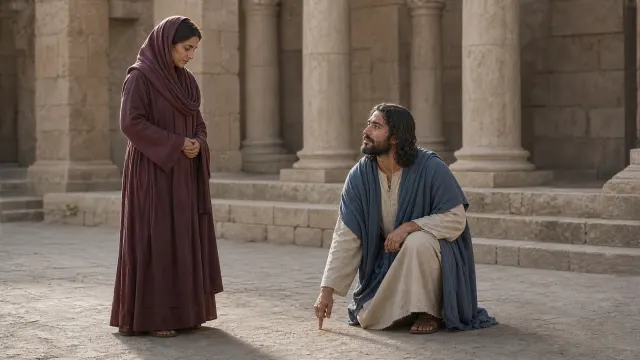
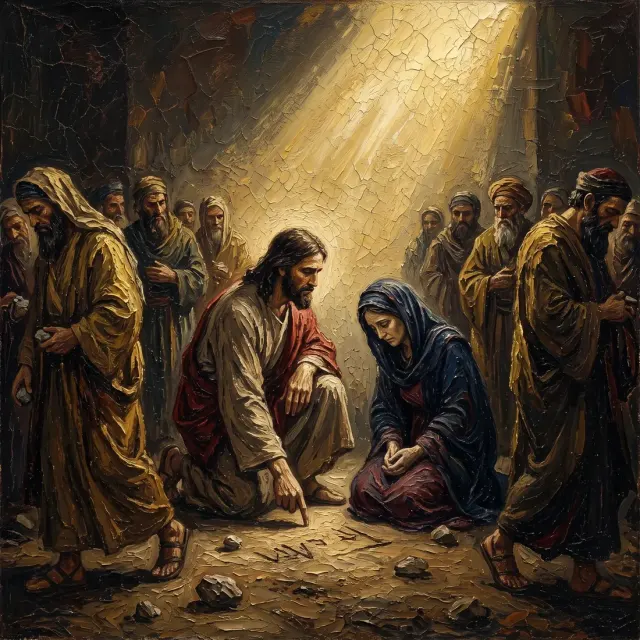
A woman is placed “in the midst,” but John tells the reader that she is not the real target. Her accusers are using the case to create grounds for accusing Jesus. That stated purpose shapes everything that follows. The law addresses both partners in adultery, yet only the woman appears, and the Book of John leaves the man’s absence unexplained rather than inventing a hidden plot. Jesus likewise writes on the ground without revealing what he writes. The famous scene is powerful enough without assigning secret sins to the dust. His answer puts responsibility back onto those who propose the execution, and one by one they leave. When only Jesus and the woman remain, mercy and moral seriousness stay together. He does not condemn her, but neither does he rename adultery as harmless. “Go, and sin no more” refuses both the trap of the accusers and the idea that compassion requires denying wrongdoing.
Deep dive
John states the accusers' purpose: they want something with which to accuse Jesus. The woman is placed in the middle as the means of obtaining it. The allegation concerns an offense for which the law addresses both partners in Leviticus 20:10, yet only the woman appears here. The text does not explain the man's absence, so it exposes an incomplete presentation without supplying a conspiracy the account never describes. Jesus writes on the ground, but the writing's contents remain unknown. Lists of the accusers' secret sins belong to later imagination, not to this passage.
His response places responsibility upon those proposing to throw stones, recalling the witnesses' role in Deuteronomy 17:7. Their withdrawal dismantles the proceeding. The account reports the order in which they leave, beginning with the eldest, but not each person's private reason. Jesus' final address joins the absence of his condemnation with a command to leave sin. Mercy does not require a declaration that adultery is harmless, and seriousness about sin does not require assisting the accusers' trap.
John 7:53–8:11 is absent from several of the earliest surviving Greek witnesses, and some later manuscripts place it elsewhere. Most textual critics regard it as a later addition to John's original text, while its originality has defenders (NET Bible, textual note on John 7:53). The KJV includes the account, and it is read here in that location with the manuscript question made explicit.
Words to trace: Jesus, woman, adultery, ground, lifted, midst
Verse-by-verse path
- John 8:1
Every man went to his own house (7:53); Jesus goes out to the hillside. This is the only time the Mount of Olives is named in the Book of John, which elsewhere speaks only of a garden over the brook Cedron (18:1). Luke 21:37 describes the same nightly habit in almost the same words.
- John 8:2
“Early in the morning” is orthros, dawn, a word Luke uses (Luke 24:1) but John does not elsewhere. “All the people” is laos, where the Book of John usually says ochlos, crowd. Details like these are part of why scholars think the passage came from another hand.
- John 8:3
This is the only place in the Book of John where scribes appear, the professional interpreters of the law who are so common in the other Gospels. They bring the woman into the circle of listeners where the teacher sits, interrupting a lesson already under way.
- John 8:4
“Master” translates didaskale, teacher. “In the very act” is a legal phrase for being caught in the deed itself. The law demanded two or three witnesses (Deuteronomy 17:6), and for adultery that meant witnesses to the act, a standard hard to meet by chance.
- John 8:5
Leviticus 20:10 and Deuteronomy 22:22 require the death of both partners but name no method; stoning is specified in Deuteronomy 22:23–24 for a betrothed woman. Some commentators infer from this that she was betrothed rather than married. The Greek “thou” is emphatic: Moses said this; what do you say?
- John 8:6
The trap had two jaws. Approving a stoning would clash with Rome, which had kept the power of execution to itself (18:31); refusing would set him against Moses. This is the only time the Gospels show Jesus writing. The words “as though he heard them not” are missing from most manuscripts that contain the passage.
- John 8:7
“Continued asking” means they kept pressing him. “Without sin” is anamartetos, a word found only here in the New Testament. The sentence does not abolish the law’s penalty; it asks who among the prosecutors is fit to begin carrying it out.
- John 8:8
The second writing mirrors the first, and he again leaves them to their own thoughts. A few later manuscripts add that he wrote “the sins of each one of them”, which is a scribe’s guess finding its way into the text.
- John 8:9
The words “being convicted by their own conscience” are lacking in many manuscripts of the passage; the King James follows the later ones. The woman is still standing where she was put, “in the midst”. Augustine summed up the scene in four Latin words: relicti sunt duo, misera et misericordia, two were left, wretchedness and mercy.
- John 8:10
“Condemned” is katakrino, a verb found in the Book of John only in these two verses. His question makes her say what has happened: the case has collapsed because no accuser remains to press it.
- John 8:11
“Lord” may be no more than “Sir”. By the test of verse 7, the only one left who could have thrown the first stone is the one who does not. “Sin no more” is the same wording Jesus used to the man healed at the pool (5:14).
John 8:1-11
King James Version1Jesus went unto the mount of Olives.
2And early in the morning he came again into the temple, and all the people came unto him; and he sat down, and taught them.
3And the scribes and Pharisees brought unto him a woman taken in adultery; and when they had set her in the midst,
4They say unto him, Master, this woman was taken in adultery, in the very act.
5Now Moses in the law commanded us, that such should be stoned: but what sayest thou?
6This they said, tempting him, that they might have to accuse him. But Jesus stooped down, and with his finger wrote on the ground, as though he heard them not.
7So when they continued asking him, he lifted up himself, and said unto them, He that is without sin among you, let him first cast a stone at her.
8And again he stooped down, and wrote on the ground.
9And they which heard it, being convicted by their own conscience, went out one by one, beginning at the eldest, even unto the last: and Jesus was left alone, and the woman standing in the midst.
10When Jesus had lifted up himself, and saw none but the woman, he said unto her, Woman, where are those thine accusers? hath no man condemned thee?
11She said, No man, Lord. And Jesus said unto her, Neither do I condemn thee: go, and sin no more.
John 8:12-20
The Light Does Not Need Their Permission to Shine
“I am the light of the world” returns the public dispute to the opening language of the Gospel, where life and light belonged to the Word before anyone recognized him. The Pharisees answer by challenging the validity of self-testimony. Jesus replies that his knowledge of origin and destination gives his witness a basis their judgment lacks, and then invokes the Father as the second witness required by their own legal framework. The Book of John does not introduce the Father as an emergency supporting witness. Every major claim so far has been tied to the one who sent Jesus, to the works given by him, and to the words Jesus speaks from him. Asking “Where is thy Father?” therefore reveals the same problem as earlier arguments about Jesus’ earthly origin. They do not know the Father because they do not know the Son. The setting remains public, and the danger remains real, but the hour still controls the arrest.
Deep dive
The statement about the world's light returns to the opening's language of life and illumination. Following Jesus is described as a movement out of darkness, so light is not merely information about a distant subject. It concerns relation to the person speaking. The Pharisees immediately recast the declaration as a problem of self-testimony. Jesus answers that his knowledge of where he comes from and where he goes is precisely what their judgment lacks.
The appeal to two witnesses does not introduce the Father as a convenient name added to an otherwise solitary claim. Throughout the preceding chapters, Jesus has identified his works and words as inseparable from the one who sent him. Asking where his Father is reveals the same failure of recognition that has governed the dispute about Jesus' origin. Knowing the Son would entail knowing the Father.
The location in the treasury keeps this argument public and specific. Nobody lays hands on him, and John again explains the restraint through the hour that has not yet arrived. Open speech and approaching danger coexist. The absence of immediate arrest is neither a reconciliation nor evidence that the claims have ceased to provoke opposition.
Words to trace: Father, Jesus, record, true, judge, bear
Verse-by-verse path
- John 8:12
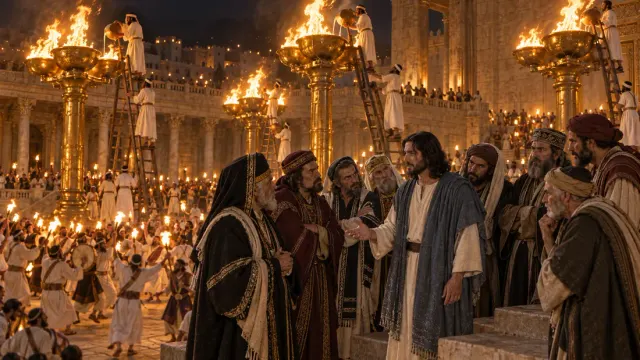
At Tabernacles great golden lampstands were lit in the Court of the Women, and the Mishnah (Sukkah 5:3) says there was no courtyard in Jerusalem that did not reflect their light. Verse 20 sets this saying in the treasury, which stood in that court. This is the second “I am” with an image attached.
- John 8:13
They turn Jesus’ own principle against him. In 5:31 he said, “If I bear witness of myself, my witness is not true.” “Record” here is the same Greek word as “witness” there, martyria, which the King James varies.
- John 8:14
The apparent contradiction with 5:31 is resolved by the ground he gives: there he stated the legal rule, here he claims a knowledge they lack. The verbs are pointed: whence I came, and whither I go; they know neither the start nor the end of the journey.
- John 8:15
“After the flesh” means by outward, human standards, the complaint of 7:24, “according to the appearance”. “I judge no man” fits 3:17 and 12:47, “I came not to judge the world”, though verse 16 immediately shows he can.
- John 8:16
“I am not alone” returns in verse 29 and again on the night of the arrest: “ye shall... leave me alone: and yet I am not alone, because the Father is with me” (16:32). A judge who sits with the Father is not a single witness.
- John 8:17
Deuteronomy 19:15 requires two or three witnesses. Jesus says “your law”, as in 10:34, speaking from outside their use of it. The law speaks of two men; he offers himself and the Father, which turns an argument about human testimony into one from the lesser to the greater.
- John 8:18
“I am one that bear witness” in Greek begins with ego eimi, “I am”, the phrase that runs through this chapter to its last verses. The two witnesses are both on his side of the case, which is precisely what his hearers cannot accept.
- John 8:19
They ask “where”, not “who”. Some readers hear in it an insinuation about his birth, which comes out openly in verse 41. Jesus answers the question as if it were about knowing, not locating.
- John 8:20
The treasury held thirteen trumpet-shaped chests for offerings (Mishnah Shekalim 6:5), where Mark 12:41 sets the widow’s two mites. The council chamber was close by, so he is teaching within earshot of those who want him arrested. The closing words repeat 7:30.
John 8:12-20
King James Version12Then spake Jesus again unto them, saying, I am the light of the world: he that followeth me shall not walk in darkness, but shall have the light of life.
13The Pharisees therefore said unto him, Thou bearest record of thyself; thy record is not true.
14Jesus answered and said unto them, Though I bear record of myself, yet my record is true: for I know whence I came, and whither I go; but ye cannot tell whence I come, and whither I go.
15Ye judge after the flesh; I judge no man.
16And yet if I judge, my judgment is true: for I am not alone, but I and the Father that sent me.
17It is also written in your law, that the testimony of two men is true.
18I am one that bear witness of myself, and the Father that sent me beareth witness of me.
19Then said they unto him, Where is thy Father? Jesus answered, Ye neither know me, nor my Father: if ye had known me, ye should have known my Father also.
20These words spake Jesus in the treasury, as he taught in the temple: and no man laid hands on him; for his hour was not yet come.
John 8:21-30
Their Speculation Stops at Death; His Words Go Farther
Jesus speaks of departure, and his hearers imagine suicide. Their speculation shows how consistently they interpret his words inside the boundaries of ordinary human movement. He answers with a sharper distinction: “Ye are from beneath; I am from above.” The language concerns origin and allegiance, not a denial that he has truly entered the world. The warning about dying in sin is tied directly to refusing who he is. Even when Jesus says he speaks what he has heard from the true sender, the Book of John notes that they still do not understand he means the Father. The coming “lifting up” will become a disclosure they cannot obtain through debate alone. Yet the event will not reveal an independent Son acting apart from God. Jesus immediately returns to what the Father taught him and to the Father’s presence with him. Many believe as he speaks, but the Gospel now asks whether initial belief can survive continued exposure to his word.
Deep dive
The earlier confusion about travel returns in a darker form. Jesus says they cannot come where he goes, and the hearers speculate about his killing himself. Their explanation stays within the terms available to them. Jesus answers with the contrast between below and above, this world and his own origin. These are claims about source and allegiance, not a denial that he has genuinely entered human life.
The warning about dying in sins is tied to refusing his identity. His words come from the truthful sender, yet John says they fail to understand that he is speaking of the Father. The failure persists even while the language grows more explicit. The coming lifting up will reveal what the discussion has not brought them to recognize.
That disclosure will not show a Son acting independently after all. Jesus immediately restates that he speaks what the Father taught him and does what pleases him. The passage ends with many believing as he speaks, but John does not let that sentence conclude the examination of belief. The next section asks what it means to remain in his word after an initial response.
Words to trace: Father, Jesus, sins, world, spake, always
Verse-by-verse path
- John 8:21
“Your sins” is singular in the Greek of this verse, “your sin”, as though there were one sin in view; in verse 24 it becomes plural. “I go my way” is hupago, the verb he uses of going to the Father throughout the farewell discourse.
- John 8:22
At the last feast they guessed he meant to go to the Greeks (7:35); now they wonder whether he will kill himself. Josephus wrote that the souls of suicides go to the darkest part of the underworld (Jewish War 3.375), so the jest implies a place no righteous man would follow.
- John 8:23
“From beneath” and “from above” are literally “from the things below” and “from the things above”. John the Baptist had made the same contrast: “He that cometh from above is above all: he that is of the earth is earthly” (3:31).
- John 8:24
The King James supplies “he”; the Greek says “if ye believe not that I am”, with nothing after it. The sentence has no complement, and that is exactly why the next verse asks, “Who art thou?”
- John 8:25
Jesus’ reply is one of the hardest phrases in the book to translate. It can mean “what I told you from the beginning” (as here), “essentially what I am telling you”, or, as some Greek fathers read it, “why do I speak to you at all?”
- John 8:26
He could say much in judgment, but his task is to pass on what he heard. “He that sent me is true” uses the adjective of 3:33, where anyone who receives his testimony “hath set to his seal that God is true”.
- John 8:27
The aside is brief and pointed. Jesus has spoken of “him that sent me” since 4:34, and in this chapter has named the Father outright in verses 16, 18 and 19. The hearers still do not connect the phrase with God.
- John 8:28
“Lifted up” is hupsoo, both to raise on a cross and to exalt, as in 3:14 and 12:32–33, where the book explains that it signified “what death he should die”. Here the hearers themselves will be the ones who lift him up.
- John 8:29
“Those things that please him” is the phrase of 1 John 3:22, “do those things that are pleasing in his sight”. The verb “hath not left” is past: at no point has the Father left him alone, which answers verse 16 in the form of a history.
- John 8:30
“As he spake” is literally “while he was speaking”: the response comes in the middle of hard sayings about dying in sin. The fuller formula “believed on him” is used here, which the next verse changes.
John 8:21-30
King James Version21Then said Jesus again unto them, I go my way, and ye shall seek me, and shall die in your sins: whither I go, ye cannot come.
22Then said the Jews, Will he kill himself? because he saith, Whither I go, ye cannot come.
23And he said unto them, Ye are from beneath; I am from above: ye are of this world; I am not of this world.
24I said therefore unto you, that ye shall die in your sins: for if ye believe not that I am he, ye shall die in your sins.
25Then said they unto him, Who art thou? And Jesus saith unto them, Even the same that I said unto you from the beginning.
26I have many things to say and to judge of you: but he that sent me is true; and I speak to the world those things which I have heard of him.
27They understood not that he spake to them of the Father.
28Then said Jesus unto them, When ye have lifted up the Son of man, then shall ye know that I am he, and that I do nothing of myself; but as my Father hath taught me, I speak these things.
29And he that sent me is with me: the Father hath not left me alone; for I do always those things that please him.
30As he spake these words, many believed on him.
John 8:31-38
A Claim to Freedom Meets the Practice of Slavery
The promise that “the truth shall make you free” is given to people Jesus has just described as believing, which means the sentence is not a detached slogan about education or information. Freedom is tied to continuing in his word and becoming disciples “indeed.” The reply about Abrahamic descent shifts the discussion toward inherited status, while Jesus shifts it toward practiced bondage. Whoever commits sin is the servant of sin. The household image then makes the Son decisive: a servant’s place is insecure, but the Son abides, and the Son can make free. The Book of John does not deny the hearers’ genealogy. Jesus explicitly says, “I know that ye are Abraham’s seed.” What he denies is that ancestry settles the moral question while they seek to kill the one speaking truth. Descent may be factual and still fail to determine whom a person resembles in conduct.
Deep dive
The address to Jews who have believed him creates a deliberate test of initial reception. Continuing in his word, rather than merely having approved something he said, identifies discipleship. The truth that makes free is not presented as an isolated slogan about any kind of information. It belongs to this relation with Jesus and his word. The response appeals to Abrahamic descent and denies bondage, but Jesus identifies the slavery he means through the practice of sin.
The household image distinguishes a servant's insecure standing from the son's enduring place. Freedom therefore depends on the Son's action, not on asserting the family's ancestry loudly enough. Jesus acknowledges that his hearers are Abraham's seed even while identifying their intention to kill him. Physical descent is granted; its ability to settle the moral question is denied.
The movement from professed belief to murderous opposition raises a real interpretive difficulty. Some understand an inadequate belief being exposed; others see shifts among participants in the wider exchange. John does not label each speaker anew. Either way, the passage itself refuses to equate a claim to belief or descent with the continuing reception of Jesus' word.
Words to trace: free, abideth, Abraham’s, father, Jesus, know
Verse-by-verse path
- John 8:31
The Greek here is “believed him”, the simpler dative, not the “believed on him” of verse 30, and it is a perfect participle. Some see a deliberate step down. “Continue” is meno, abide, and “indeed” is alethos, truly.
- John 8:32
In the Book of John truth is finally a person: “I am the way, the truth, and the life” (14:6). The verb for making free, eleutheroo, appears in the book only here and in verse 36, framing the argument about slavery that runs between them.
- John 8:33
Israel had been slaves in Egypt, captives in Babylon, and was ruled by Rome as they spoke. They may mean an inner freedom no conquest could touch; the Mishnah says “all Israel are the children of kings” (Shabbat 14:4). Either way, the Passover they had just kept celebrated a release from bondage.
- John 8:34
“Servant” is doulos, slave. “Committeth” is poieo, to do or practise. A few old witnesses lack “of sin”, so that the sentence says simply that whoever sins is a slave, and the next verse follows directly from that.
- John 8:35
A slave could be sold or sent away; a son stays. Sarah’s demand in Genesis 21:10, “Cast out this bondwoman and her son”, is the classic case, and Paul used it in Galatians 4:30. With Abraham in the conversation, Ishmael and Isaac are likely in view, though the verse names neither.
- John 8:36
“Indeed” here is ontos, really, a different Greek word from the “indeed” of verse 31. In a household the son and heir had the standing to free a slave; the freedom depends on who grants it.
- John 8:37
“Hath no place” is chorei, to make room or to contain, the verb used of the stone waterpots at Cana “containing two or three firkins” (2:6). His word finds no room in them, as a jar already full takes no more.
- John 8:38
The oldest manuscripts lack both “my” and “your”, so the second half can be read as a command: “do ye therefore what ye have heard from the Father.” Later scribes added the possessives, which set up the contrast of fathers that verse 44 makes explicit.
John 8:31-38
King James Version31Then said Jesus to those Jews which believed on him, If ye continue in my word, then are ye my disciples indeed;
32And ye shall know the truth, and the truth shall make you free.
33They answered him, We be Abraham’s seed, and were never in bondage to any man: how sayest thou, Ye shall be made free?
34Jesus answered them, Verily, verily, I say unto you, Whosoever committeth sin is the servant of sin.
35And the servant abideth not in the house for ever: but the Son abideth ever.
36If the Son therefore shall make you free, ye shall be free indeed.
37I know that ye are Abraham’s seed; but ye seek to kill me, because my word hath no place in you.
38I speak that which I have seen with my Father: and ye do that which ye have seen with your father.
John 8:39-47
Descent Is Tested by Conduct
The argument about fathers becomes an argument about resemblance. Jesus has already acknowledged physical descent from Abraham, so the next step is not genealogy but conduct. Abraham’s children should act like Abraham, yet these hearers seek to kill a man who has told them truth from God. Their claim that God is their Father is tested the same way. If that relationship governed them, they would love the one who came from God. The severe language about the devil is then anchored to specific likenesses: murder and falsehood. The Book of John gives no basis for turning this accusation into a statement about Jewish ethnicity. Jesus and his disciples are Jews, and the same chapter has described Jews believing him. The dispute concerns what people do with truth. By the end, Jesus makes resistance itself part of the evidence. The problem is no longer insufficient explanation. They reject the words precisely while he claims to be speaking truth from God.
Deep dive
The argument turns on what children resemble. Abrahamic descent has already been acknowledged in verse 37, so Jesus is not suddenly disputing genealogy. He contrasts Abraham with people seeking to kill a man who has told them truth heard from God. The claim that God is their Father receives the same kind of test: if that claim governed their response, they would love the one who came from him.
The severe accusation about the devil names murder and falsehood as the relevant likenesses. It must not be turned into a statement about all Jews. Jesus is Jewish, the disciples are Jewish, and the same chapter has described Jews believing him. Within this exchange, moral conduct and resistance to truth are the grounds of the accusation. Ethnic descent is not its logic.
The striking final claim is that Jesus' truthfulness itself provokes their refusal. The issue is no longer presented as a shortage of testimony waiting to be supplied. He asks his opponents to identify sin in him, yet their resistance remains directed at his words. John has tightened the connection between hearing and belonging until a professed relationship to God must be tested by the treatment of God's sent one.
Words to trace: father, truth, Abraham, believe, hear, Jesus
Verse-by-verse path
- John 8:39
They go back to verse 33. The grammar of Jesus’ reply is mixed in the manuscripts, and some read an imperative: “If ye are Abraham’s children, do the works of Abraham.” Either way, sonship is to be read from conduct.
- John 8:40
This is the only place in the Gospels where Jesus calls himself “a man”, anthropos. “This did not Abraham” most likely recalls Abraham running to welcome the three strangers at Mamre (Genesis 18), receiving God’s messengers, though the verse does not name the occasion.
- John 8:41
“We” is emphatic, and some read “we were not born of fornication” as a sneer, “as you were”. Later polemic, preserved in Origen’s Against Celsus, did slander Jesus’ birth. The prophets also used whoredom for idolatry (Hosea 2:4), so it may be a claim of pure worship.
- John 8:42
“Proceeded forth” is exelthon, came out, and “came” is heko, I have arrived and am here. The logic is spelled out in 1 John 5:1: “every one that loveth him that begat loveth him also that is begotten of him.”
- John 8:43
“Speech” is lalia, his manner of speaking, and “word” is logos, what he says. They cannot follow his speech because they cannot bear the message. “Cannot hear” recalls the disciples in 6:60, “who can hear it?”
- John 8:44
“Murderer” is anthropoktonos, man-slayer, a word used only here and in 1 John 3:15. The Wisdom of Solomon 2:24 says “through envy of the devil came death into the world”, and the first lie, “Ye shall not surely die” (Genesis 3:4), led to death. “Of his own” means out of his native resources.
- John 8:45
The Greek “I” is emphatic, set against the liar of verse 44. The word is “because”, not “although”: truth itself is what they refuse, and the conjunction makes the refusal a reaction rather than a misunderstanding.
- John 8:46
“Convinceth” is 1611 English for proves guilty or convicts. The verb is elencho, which Jesus uses of the Spirit in 16:8: “he will reprove the world of sin.” He invites the charge and none is brought.
- John 8:47
The verse is set out like a syllogism: whoever is of God hears; you do not hear; therefore you are not of God. “Words” is rhemata, the specific sayings, the noun Peter used for “the words of eternal life” (6:68).
John 8:39-47
King James Version39They answered and said unto him, Abraham is our father. Jesus saith unto them, If ye were Abraham’s children, ye would do the works of Abraham.
40But now ye seek to kill me, a man that hath told you the truth, which I have heard of God: this did not Abraham.
41Ye do the deeds of your father. Then said they to him, We be not born of fornication; we have one Father, even God.
42Jesus said unto them, If God were your Father, ye would love me: for I proceeded forth and came from God; neither came I of myself, but he sent me.
43Why do ye not understand my speech? even because ye cannot hear my word.
44Ye are of your father the devil, and the lusts of your father ye will do. He was a murderer from the beginning, and abode not in the truth, because there is no truth in him. When he speaketh a lie, he speaketh of his own: for he is a liar, and the father of it.
45And because I tell you the truth, ye believe me not.
46Which of you convinceth me of sin? And if I say the truth, why do ye not believe me?
47He that is of God heareth God’s words: ye therefore hear them not, because ye are not of God.
John 8:48-59
Before Abraham, a Claim Larger Than Ancestry
Once the argument about conduct becomes difficult, the opponents answer with labels: Samaritan and possessed. Jesus does not return insult for insult. He speaks of honoring the Father and refusing to seek his own glory. The dispute then reaches death. If someone keeps Jesus’ saying, he says, that person will not see death. Abraham and the prophets are obvious counterexamples if the claim means ordinary mortality has ceased, so the hearers ask whether Jesus thinks himself greater than Abraham. His answer is larger still. Abraham rejoiced to see his day, and then the discussion of age is broken open by the declaration, “Before Abraham was, I am.” The Book of John does not present that sentence as merely a claim to higher rank. It places Jesus’ existence outside the ordinary chronology the objection assumes. The stones picked up immediately afterward show that his hearers understand the statement as far more than a compliment to his own importance.
Deep dive
The charge that Jesus is a Samaritan and has a devil attempts to discredit him rather than answer his challenge. His reply concerns honoring the Father and refusing the pursuit of personal glory. When he speaks of keeping his word and not seeing death, his opponents return to the obvious deaths of Abraham and the prophets. As in the bread discourse, they hear a statement about life without yet accepting the kind of life he claims to give.
Abraham's rejoicing to see Jesus' day is stated, but the passage does not identify the precise occasion or the manner of that seeing. Attempts to assign it confidently to one moment in Genesis go beyond what John supplies. The objection about Jesus being under fifty again reduces the claim to an ordinary calculation of human age.
The answer changes the grammar of that calculation: Abraham came to be, while Jesus speaks of himself with "I am." In this context, the phrase claims an existence not beginning with Abraham or limited by the biography the opponents think sufficient. It should not be flattened into merely being more important than an ancestor. Their attempt to stone him marks the force with which they receive it. Jesus leaves the temple, and the chapter ends without reducing the declaration to terms they will accept.
Words to trace: Abraham, father, Jesus, know, verily, dead
Verse-by-verse path
- John 8:48
“Say we not well” implies they had been saying it for some time. Calling him a Samaritan may reflect his stay in Sychar (4:40) or his challenge to their claim on Abraham, as Samaritans challenged Judaea’s claims to Jacob. Samaria was also associated with sorcery, as with Simon in Acts 8:9.
- John 8:49
He denies having a devil and says nothing at all about being a Samaritan. After chapter 4, the Book of John shows no interest in rebutting that part of the insult.
- John 8:50
They are seeking to kill him (verses 37 and 40); another is seeking his glory. The verb is the same, zeteo. The one who seeks is also the one who judges, which leaves the verdict between Jesus and his opponents to the Father.
- John 8:51
“See death” is a Hebrew idiom, as in Psalm 89:48, “What man is he that liveth, and shall not see death?” “Keep” is tereo, to guard or hold fast. It is the second “Verily, verily” of the chapter, after verse 34.
- John 8:52
They change his words: he said “see death”, and they repeat it as “taste of death”, an idiom Mark 9:1 also uses. The rephrasing makes the claim sound more bodily and so more absurd, since Abraham and the prophets plainly died.
- John 8:53
“Whom makest thou thyself?” is the charge that runs through the book to the trial: “making himself equal with God” (5:18), “makest thyself God” (10:33), and before Pilate, “he made himself the Son of God” (19:7).
- John 8:54
“Honour” here is doxazo, to glorify, the verb of 17:1 and 17:5, “glorify thou me with thine own self”. Some manuscripts give the last clause in direct speech, “of whom ye say, He is our God.”
- John 8:55
“Liar” is pseustes, the noun used of the devil in verse 44, “he is a liar”. To deny knowledge of the Father would put Jesus in that company. “Keep his saying” is exactly what he asked of them in verse 51.
- John 8:56
“Rejoiced” is the strong word for exulting, followed by the plainer “was glad”. Jewish tradition held that Abraham was shown the ages to come; Genesis Rabbah 44 says God revealed to him this world and the world to come. The verse itself does not say when he saw.
- John 8:57
Fifty was the age at which Levites left their service (Numbers 4:3; 8:25), a round figure for a man not yet old. Irenaeus took the verse to mean that Jesus was over forty. Some early manuscripts read the question the other way round: “hath Abraham seen thee?”
- John 8:58
Psalm 90:2 sets the same contrast: “Before the mountains were brought forth... from everlasting to everlasting, thou art God.” In the Greek of Isaiah 43:13 God says “from the beginning I am”. This is the chapter’s third “Verily, verily”, and its last.
- John 8:59
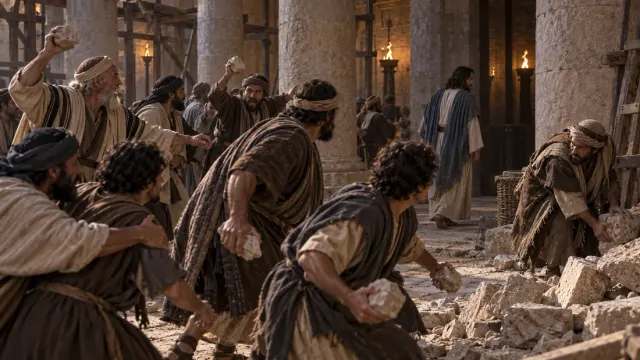
Blasphemy was punished by stoning (Leviticus 24:16). The temple was still being built (2:20), and loose building stones were at hand. The closing words, “going through the midst of them, and so passed by”, are absent from the oldest manuscripts and seem to come from Luke 4:30.
John 8:48-59
King James Version48Then answered the Jews, and said unto him, Say we not well that thou art a Samaritan, and hast a devil?
49Jesus answered, I have not a devil; but I honour my Father, and ye do dishonour me.
50And I seek not mine own glory: there is one that seeketh and judgeth.
51Verily, verily, I say unto you, If a man keep my saying, he shall never see death.
52Then said the Jews unto him, Now we know that thou hast a devil. Abraham is dead, and the prophets; and thou sayest, If a man keep my saying, he shall never taste of death.
53Art thou greater than our father Abraham, which is dead? and the prophets are dead: whom makest thou thyself?
54Jesus answered, If I honour myself, my honour is nothing: it is my Father that honoureth me; of whom ye say, that he is your God:
55Yet ye have not known him; but I know him: and if I should say, I know him not, I shall be a liar like unto you: but I know him, and keep his saying.
56Your father Abraham rejoiced to see my day: and he saw it, and was glad.
57Then said the Jews unto him, Thou art not yet fifty years old, and hast thou seen Abraham?
58Jesus said unto them, Verily, verily, I say unto you, Before Abraham was, I am.
59Then took they up stones to cast at him: but Jesus hid himself, and went out of the temple, going through the midst of them, and so passed by.
Questions to keep in mind while reading
- Watch what Jesus says and does, and how people respond.
- Trace kingdom, discipleship, opposition, cross, and resurrection in the evangelist’s own sequence.
- Let later doctrine clarify the scene without erasing its immediate setting.
Text first
Where readers differ
The chapter summary begins with what the passage says and how its parts fit together. It does not assume one denomination has already settled every question. Where a conclusion depends on a tradition, literary theory, or historical reconstruction, that dependence is named openly.
The KJV text is presented first. Interpretive conclusions are labeled, and differences are introduced only when they help a reader understand why serious communities do not always reach the same answer.
Why the account appears in brackets or notes
John 7:53-8:11. The KJV includes the account of the woman caught in adultery at John 7:53-8:11. The earliest Greek manuscripts of John do not contain it, and later manuscripts place the account in several different locations. Those facts make its original place in John uncertain.
The account has a long history of being read in Christian worship and teaching. Many readers regard it as an ancient tradition about Jesus even while recognizing that the manuscript evidence does not support it as part of the earliest recoverable text of John at this location. Other readers defend its traditional placement and canonical use.
The passage should not be used to make sin unimportant or to excuse a crowd’s selective condemnation. Within the received account, Jesus exposes the accusers, refuses condemnation, and also tells the woman to leave her life of sin.
View source: United States Conference of Catholic Bishops, John 8 and the account’s textual note ↗ · View source: Center for the Study of New Testament Manuscripts, Manuscript locations of John 7:53-8:11 ↗
Questions beneath the surface
- What account of God, human freedom, responsibility, and the good life emerges from John 8?
- Which tension does the chapter refuse to resolve quickly?
- What changes when the chapter is read as part of the whole canon rather than as an isolated moral lesson?
- Where might a sincere reader confuse a familiar tradition with something the text states directly?
Questions for serious personal contemplation
These open-ended questions make room for tension, honest response, prayer, and conclusions that remain accountable to the chapter.
Observe without rushing
What part of John 8 makes you stop, feel unsettled, or feel surprised, and why?
Which detail in the passage would be easiest to overlook? How does that detail change your understanding?
Where do you see tension between what happens and this focus: John 8 develops its own movement around Father, Jesus, know, Abraham, truth?
What important question does the passage leave open instead of resolving quickly?
Examine your inner life honestly
Which person, response, fear, or desire in the passage feels most like your own life right now?
What assumption about God, other people, or yourself does this text challenge?
Which part would you rather soften, avoid, or explain away too quickly? What might that reaction reveal?
If this Scripture could ask you one direct question, what do you think it would ask?
Respond with wisdom and courage
What do you need to remember, confess, grieve, thank God for, or trust after reading this passage?
How might another faithful person read this situation differently without ignoring the text?
What obedient response would be costly, uncomfortable, or slow, yet still faithful to Scripture?
What question will you carry into prayer this week, and which verses will you keep in front of you?
Music and video connected to the passage
Related media appears when its Scripture reference overlaps this study. Music and video can illuminate a theme while the biblical text remains the foundation.