The big picture
The feast of tabernacles becomes a public argument over one man. Jesus’ brothers recommend visibility without belief, crowds divide over whether he is good or deceptive, authorities question his learning and origin, and officers sent to arrest him return impressed by his words. Again and again, supposed knowledge becomes the obstacle. People know Galilee, know what Scripture says about Bethlehem, know what rulers think, or know what lawful procedure should be, yet none of those pieces alone settles Jesus’ identity. His promise of living water points toward the Spirit and the coming glorification, widening the feast’s imagery beyond its immediate setting. The Book of John closes with Nicodemus asking a simple legal question about hearing a man before judging him. The answer he receives is not legal reasoning but contempt, exposing how easily certainty can outrun the process it claims to defend.
In this chapter
- Publicity Is Not the Same as Witness John 7:1-13
Jesus’ brothers give advice that sounds like modern publicity strategy: if these works matter, take them to the larger audience and make yourself known.
- A Whole Man Is Made Whole on the Sabbath John 7:14-24
The surprise at Jesus’ learning produces another question about source.
- Knowing the Town Is Not Knowing the Sender John 7:25-36
Some Jerusalem residents know that leaders want Jesus dead, while others in the wider crowd have denied such a plot.
- The Promise Outgrows the Feast John 7:37-44
On the great day of the feast, Jesus turns public attention toward thirst.
- The Arresting Officers Return with an Assessment John 7:45-53
The officers were sent to arrest Jesus and come back with a review of his speech.

Scripture beside the summary
John · King James Version · 53John 7:1-13
Publicity Is Not the Same as Witness
Jesus’ brothers give advice that sounds like modern publicity strategy: if these works matter, take them to the larger audience and make yourself known. The Book of John immediately undercuts the proposal by saying the brothers do not believe in him. Visibility and witness are therefore not the same thing. Jesus’ timing is governed by an “hour” his family cannot schedule, and the hostility he names is tied to his testimony about the world’s works. When he eventually goes to the feast, he does so without the public entrance they recommended. The result is not silence but divided talk. Some call him good; others call him a deceiver; many are afraid to speak openly. The crowd is never presented as one mind with one settled judgment. Jesus is already the subject of intense attention, yet attention itself solves nothing. The problem is not that too few people know his name. It is that people disagree about who the visible man actually is.
Deep dive
The brothers' proposal sounds practical: someone doing remarkable works should let a larger audience see them. John immediately prevents that advice from being mistaken for faith. They do not yet believe in him. Their recommendation treats public recognition as an obvious good without recognizing the conflict Jesus' testimony provokes. He says that the world hates him because he exposes its evil works. The problem is therefore not a shortage of visibility that better promotion would fix.
In the KJV, Jesus says he is not going up "yet," and later goes without the public display his brothers urged. The difference concerns more than the date of departure. He will teach openly at the feast, but not arrive as the centerpiece of their proposed demonstration. The crowd's muttering then reveals incompatible judgments: some call him good, others a deceiver. Fear restrains open speech. John does not introduce a single crowd with one settled opinion, but a public space in which Jesus is discussed constantly and understood unevenly.
Words to trace: feast, Jews, brethren, openly, time, Galilee
Verse-by-verse path
- John 7:1
“Jewry” is the 1611 word for Judaea, used again in Luke 23:5. “Walked” is imperfect: he kept to Galilee for some months, since the feast of the next verse falls about half a year after the Passover of 6:4. A few manuscripts read that he “had no power” to walk in Judaea, rather than that he would not.
- John 7:2
Tabernacles, Sukkot, fell in the autumn, when Israel lived seven days in booths of branches in memory of the wilderness (Leviticus 23:34–43). Josephus called it the holiest and greatest of the feasts. It was the most crowded and the most joyful of the pilgrim festivals.
- John 7:3
Mark 6:3 names the brothers as James, Joses, Juda and Simon. Their phrase “thy disciples also” implies followers in Judaea who had not seen the Galilean signs. They borrow Jesus’ own word, “works”, which he has used of what the Father gives him to do (5:36).
- John 7:4
“Openly” is parresia, frank and public speech, and the word keeps returning in this chapter (verses 13 and 26). Their maxim is a piece of worldly wisdom about ambition: nobody works in private who wants a public name.
- John 7:5
In Mark 3:21 his family went out to take hold of him, saying “He is beside himself.” Their unbelief did not last: the brothers are with the disciples in the upper room (Acts 1:14), the risen Jesus appeared to James (1 Corinthians 15:7), and James came to lead the Jerusalem church.
- John 7:6
“Time” is kairos, the right or opportune moment, a word the Book of John uses only in this passage; elsewhere it speaks of his “hour”. For the brothers any day will do for travelling up to the feast, because nothing hangs on when they go.
- John 7:7
This is the first time the Book of John says the world hates Jesus. In the farewell discourse the same verb is turned towards the disciples: “If the world hate you, ye know that it hated me before it hated you” (15:18). Their safety now is a sign of how little they are set apart.
- John 7:8
Some copies have “I go not up”, others “I go not up yet”. The pagan critic Porphyry, as Jerome reports, seized on the first reading to charge Jesus with inconsistency, since he went up after all. The verb “go up” is the one used for ascending in 6:62 and 20:17.
- John 7:9
The pattern is the one seen at Cana, where he first declined his mother’s prompting and then acted (2:4–7), and will be seen again when he waits two days before going to Lazarus (11:6). Others’ urging never sets the moment.
- John 7:10
“In secret” is the phrase from the brothers’ maxim in verse 4, that no one does anything in secret who wants to be known. Jesus goes up doing exactly what they said no one does. Travelling apart from the caravan of pilgrims let him arrive unnoticed.
- John 7:11
The question does not use his name: “Where is that man?” The imperfect verb means they kept looking. At a feast where the whole nation was camped in booths around the city, a single Galilean could be hard to find.
- John 7:12
“Murmuring” is the noun from the verb of 6:41. “Deceiveth” is planao, to lead astray, and Deuteronomy 13:5 ordered death for a prophet who led Israel astray. A later rabbinic tradition (Babylonian Talmud, Sanhedrin 43a) says Jesus was executed on precisely that charge.
- John 7:13
“The fear of the Jews” recurs in 9:22, 19:38 and 20:19. The people who fear here are themselves Jews at a Jewish feast, which shows that the Book of John often uses “the Jews” for the Jerusalem authorities rather than the nation.
John 7:1-13
King James Version1After these things Jesus walked in Galilee: for he would not walk in Jewry, because the Jews sought to kill him.
2Now the Jews’ feast of tabernacles was at hand.
3His brethren therefore said unto him, Depart hence, and go into Judæa, that thy disciples also may see the works that thou doest.
4For there is no man that doeth any thing in secret, and he himself seeketh to be known openly. If thou do these things, shew thyself to the world.
5For neither did his brethren believe in him.
6Then Jesus said unto them, My time is not yet come: but your time is alway ready.
7The world cannot hate you; but me it hateth, because I testify of it, that the works thereof are evil.
8Go ye up unto this feast: I go not up yet unto this feast; for my time is not yet full come.
9When he had said these words unto them, he abode still in Galilee.
10But when his brethren were gone up, then went he also up unto the feast, not openly, but as it were in secret.
11Then the Jews sought him at the feast, and said, Where is he?
12And there was much murmuring among the people concerning him: for some said, He is a good man: others said, Nay; but he deceiveth the people.
13Howbeit no man spake openly of him for fear of the Jews.
John 7:14-24
A Whole Man Is Made Whole on the Sabbath
The surprise at Jesus’ learning produces another question about source. His answer is not that he is a self-made genius. The doctrine belongs to the one who sent him, and true teaching seeks the sender’s glory rather than personal recognition. That claim reaches back to his brothers’ invitation to “shew thyself to the world.” Public notice is not the measure of faithful speech. The Sabbath argument then returns to the healing in chapter 5. Circumcision may be performed on the Sabbath so the law’s requirement is kept, yet Jesus is condemned for making “a man every whit whole” on that day. The Book of John does not use Moses as a foil to mercy. Jesus reasons from the law and from accepted practice to expose an inconsistency in the judgment against him. “Judge righteous judgment” therefore closes a specific dispute. It is a demand to assess the whole act rather than condemn it by appearance.
Deep dive
The surprise at Jesus' learning concerns the source of his teaching authority. His answer refuses to make personal originality the credential: the doctrine belongs to the one who sent him. He contrasts seeking one's own glory with seeking the sender's glory. That distinction reaches back to the brothers' proposal, where visibility itself seemed to be the objective. Here the question is whether teaching directs attention faithfully to its source.
Jesus then identifies a murderous intention that some in the crowd deny exists. John has already reported danger in Judea, so the denial reveals differing knowledge among those present rather than exposing a fabricated accusation. The argument about Sabbath healing returns to the work of chapter 5. Circumcision can take place on the Sabbath to preserve the law's requirement; Jesus asks his opponents to consider the significance of making an entire person whole on that day.
The reasoning is conducted from within Scripture and recognized practice. It does not dismiss Moses in order to defend mercy. It challenges the coherence of an interpretation that accommodates one bodily act while condemning comprehensive restoration. The command about righteous judgment therefore closes a specific argument, not a vague appeal to be more open-minded.
Words to trace: Moses, Jesus, sabbath, circumcision, doctrine, glory
Verse-by-verse path
- John 7:14
The feast lasted seven days, so the midst is about the fourth. By then the pilgrims were settled and the temple courts full every day. Having avoided a public arrival, he chooses the most public place in Jerusalem once the feast is under way.
- John 7:15
“Letters” is grammata, learning, the formal scribal training a teacher received at the feet of a rabbi. Acts 4:13 makes the same observation about Peter and John, calling them “unlearned and ignorant men”. The marvel is that Jesus reads Scripture like a trained teacher without having been one’s pupil.
- John 7:16
A rabbi’s authority rested on the teachers he had received his teaching from, a chain that the Mishnah traces back to Sinai (Avot 1:1). Jesus names only one source. “Doctrine” is didache, teaching, and the paradox of “not mine” answers the question of verse 15.
- John 7:17
The Greek doubles the idea of will: “if any man wills to do his will”. The test Jesus offers is not a debate but a willingness. “Of myself” is literally “from myself”, the phrase of 5:30, “I can of mine own self do nothing.”
- John 7:18
“Unrighteousness” is adikia, and this is the only time the word occurs in the Book of John. A messenger who seeks the glory of the one who sent him has nothing to gain by lying, which is why such a person can be called “true”.
- John 7:19
The law Moses gave them includes “Thou shalt not kill” (Exodus 20:13), and they are planning a killing. The question “Why go ye about to kill me?” names the plot of 5:18 openly, in the temple, before the people.
- John 7:20
“Thou hast a devil” means you are mad; in 10:20 the phrase is joined to “and is mad”. The crowd here is largely pilgrims from outside Jerusalem, who may genuinely not know of the plot. The same charge will come back harder in 8:48.
- John 7:21
The “one work” is the healing at the pool in chapter 5, done at an earlier feast and still being talked about. In Greek the words “therefore” at the start of verse 22 may belong here instead: “ye all marvel because of this”, a question of punctuation the manuscripts cannot settle.
- John 7:22
Circumcision was commanded to Abraham (Genesis 17:10–12) long before Moses, which is the point of the parenthesis. Leviticus 12:3 fixed it on the eighth day, and when the eighth day fell on a Sabbath the circumcision was done anyway, as the Mishnah (Shabbat 18:3) records.
- John 7:23
Later rabbis used this same argument from the lesser to the greater: if circumcision, which concerns one member of the body, overrides the Sabbath, how much more the saving of the whole body (Babylonian Talmud, Yoma 85b). “Every whit whole” is literally “a whole man whole”.
- John 7:24
“Appearance” is opsis, the look of a thing, its face. Samuel was told that “man looketh on the outward appearance” (1 Samuel 16:7), and Isaiah 11:3 says the coming king “shall not judge after the sight of his eyes”. Deuteronomy 16:18 commands judges to “judge the people with just judgment”.
John 7:14-24
King James Version14Now about the midst of the feast Jesus went up into the temple, and taught.
15And the Jews marvelled, saying, How knoweth this man letters, having never learned?
16Jesus answered them, and said, My doctrine is not mine, but his that sent me.
17If any man will do his will, he shall know of the doctrine, whether it be of God, or whether I speak of myself.
18He that speaketh of himself seeketh his own glory: but he that seeketh his glory that sent him, the same is true, and no unrighteousness is in him.
19Did not Moses give you the law, and yet none of you keepeth the law? Why go ye about to kill me?
20The people answered and said, Thou hast a devil: who goeth about to kill thee?
21Jesus answered and said unto them, I have done one work, and ye all marvel.
22Moses therefore gave unto you circumcision; (not because it is of Moses, but of the fathers;) and ye on the sabbath day circumcise a man.
23If a man on the sabbath day receive circumcision, that the law of Moses should not be broken; are ye angry at me, because I have made a man every whit whole on the sabbath day?
24Judge not according to the appearance, but judge righteous judgment.
John 7:25-36
Knowing the Town Is Not Knowing the Sender
Some Jerusalem residents know that leaders want Jesus dead, while others in the wider crowd have denied such a plot. The Book of John lets those different levels of knowledge sit beside each other instead of forcing the crowd into artificial consistency. The residents then treat ordinary origin as decisive: they know where Jesus is from, whereas the Christ’s origin should be unknown. Jesus grants that they know him at one level and then says they do not know the one who sent him. Earthly familiarity has again become a false stopping point. Attempts to seize him fail because “his hour was not yet come,” so the danger is real without being sovereign over the timing. His announcement that he will go where they cannot come produces a fresh misunderstanding. They imagine travel among dispersed Jews and Gentiles. Jesus is speaking of returning to the Father. Their geography becomes elaborate while the true destination remains unseen.
Deep dive
Some Jerusalem residents know that Jesus is being sought for death and are puzzled by his public freedom. Others have just denied such a threat. The distinction helps explain the apparent contradiction within the crowd: different groups bring different information. Their speculation about whether the rulers have recognized the Christ also reveals how much weight they give official acknowledgment. The identity of Jesus is being discussed partly through what authorities appear to permit.
The claim to know where he comes from becomes another premature conclusion. Jesus acknowledges their ordinary knowledge while insisting that they do not know the one who sent him. Earthly familiarity has not reached heavenly origin. Attempts to seize him fail because his hour has not yet come, making the delay part of John's larger account of timing rather than proof that the danger is unreal.
Jesus' words about going where they cannot come then produce speculation about dispersed Jews and teaching Greeks. The hearers imagine travel; Jesus speaks of returning to his sender. Their misunderstanding is geographically inventive and still misses the destination. The Gospel will eventually include Greeks seeking him, but this conversation's immediate problem is failure to recognize where his mission begins and ends.
Words to trace: know, Christ, find, seek, cometh, Gentiles
Verse-by-verse path
- John 7:25
“Them of Jerusalem” translates a single word, Jerusalemites, which occurs only here and in Mark 1:5 in the New Testament. These are residents, not pilgrims, and unlike the crowd of verse 20 they know perfectly well who is being hunted.
- John 7:26
“Boldly” is parresia again, the openness the brothers urged in verse 4, now given without their help. The question about the rulers is framed to expect the answer no, but it has been asked aloud, and it hangs over the rest of the chapter.
- John 7:27
A belief that the Messiah would be hidden until his appearing is attested later: in Justin Martyr’s Dialogue with Trypho (chapter 8) the Jewish speaker says the Christ, even if born, is unknown until Elijah anoints him. On that view, a man from a known village disqualifies himself.
- John 7:28
“Cried” is krazo, a loud public proclamation, the verb used of John the Baptist in 1:15. “Ye both know me” may be read as irony or as a question. “True” here is alethinos, genuine: the sender is real, whether or not they know him.
- John 7:29
The claim runs from knowing to origin to sending. “From him” is para, from beside him. In 8:55 he will put it more sharply: “ye have not known him; but I know him”.
- John 7:30
“Hour” is the word of Cana, “mine hour is not yet come” (2:4). It is not until 12:23 that he says “The hour is come.” The attempt to take him is real, and the Book of John gives the only reason it fails.
- John 7:31
Their question counts signs, and belief that rests on counting is the kind the Book of John has treated with reserve since 2:23–24, where Jesus “did not commit himself” to those who believed at the sight of his miracles. Still, the book calls it believing.
- John 7:32
The chief priests were mostly Sadducees and the Pharisees their rivals, but together they led the council, and in the Book of John they act together against Jesus. The “officers” were the temple police, Levites under the captain of the temple.
- John 7:33
“Yet a little while” becomes a refrain of the farewell discourse: 13:33, and seven times in 16:16–19, where the disciples complain, “We cannot tell what he saith.” About six months remain until the Passover of his death.
- John 7:34
Wisdom speaks almost these words in Proverbs 1:28, “they shall seek me early, but they shall not find me.” In 13:33 Jesus repeats the saying to his disciples, “as I said unto the Jews”, so the same words are spoken to both groups.
- John 7:35
“The dispersed” is diaspora, the scattering, a word the Greek of Deuteronomy 28:25 uses for Israel spread among the kingdoms. “Gentiles” in the second half is literally “Greeks”. The same word gives James 1:1 and 1 Peter 1:1 their greetings to the scattered.
- John 7:36
They quote him word for word without being able to parse him. The verb in “where I am” is present, not future: he does not say where he will be, but where he is, a claim about his home with the Father that cannot be reached by travelling.
John 7:25-36
King James Version25Then said some of them of Jerusalem, Is not this he, whom they seek to kill?
26But, lo, he speaketh boldly, and they say nothing unto him. Do the rulers know indeed that this is the very Christ?
27Howbeit we know this man whence he is: but when Christ cometh, no man knoweth whence he is.
28Then cried Jesus in the temple as he taught, saying, Ye both know me, and ye know whence I am: and I am not come of myself, but he that sent me is true, whom ye know not.
29But I know him: for I am from him, and he hath sent me.
30Then they sought to take him: but no man laid hands on him, because his hour was not yet come.
31And many of the people believed on him, and said, When Christ cometh, will he do more miracles than these which this man hath done?
32The Pharisees heard that the people murmured such things concerning him; and the Pharisees and the chief priests sent officers to take him.
33Then said Jesus unto them, Yet a little while am I with you, and then I go unto him that sent me.
34Ye shall seek me, and shall not find me: and where I am, thither ye cannot come.
35Then said the Jews among themselves, Whither will he go, that we shall not find him? will he go unto the dispersed among the Gentiles, and teach the Gentiles?
36What manner of saying is this that he said, Ye shall seek me, and shall not find me: and where I am, thither ye cannot come?
John 7:37-44
The Promise Outgrows the Feast
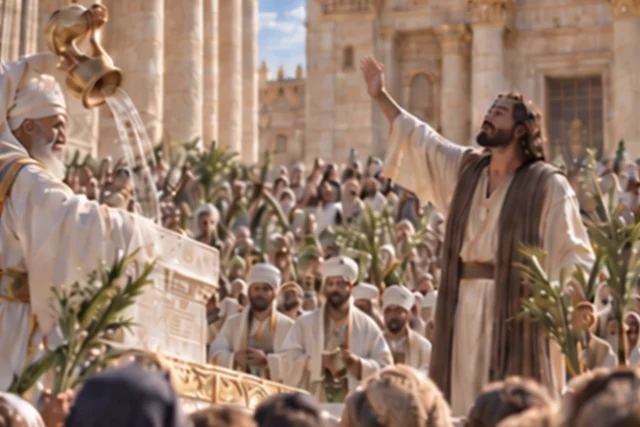
On the great day of the feast, Jesus turns public attention toward thirst. “Come unto me, and drink” echoes the well in Samaria, but the image now expands from living water to rivers. The Book of John supplies the interpretation directly: Jesus is speaking about the Spirit believers would receive in relation to his coming glorification. That explanation keeps “the Holy Ghost was not yet given” from being misread as though the Spirit had never existed or acted. The Gospel has already described the Spirit descending and remaining on Jesus. The promised giving belongs to the completion of Jesus’ mission. Around that invitation, the crowd divides again. Some call him the Prophet, others the Christ, and others object from the expectation that Messiah comes from Bethlehem rather than Galilee. The irony is sharp. They can cite the scriptural requirement and still lack the biographical fact that would complicate their objection. Correct information used with incomplete information can still produce a wrong conclusion.
Deep dive
The great day of the feast brings an invitation spoken publicly rather than whispered through the crowd. Thirst, coming, drinking, and believing recall the well in chapter 4, but the image now expands into rivers of living water. Jesus is not offering another argument over access to a physical source. The promise concerns life supplied through relation to him and expressed as abundance rather than bare survival.
John interprets the water as the Spirit whom believers would receive. The statement that the Holy Ghost was not yet given is tied to Jesus' not yet being glorified. It does not mean that the Spirit did not exist or had never acted: John 1:32–33 already described the Spirit descending and remaining on Jesus. The distinction concerns the promised giving associated with the completed mission.
The precise scriptural formulation does not reproduce one identifiable Old Testament verse, and interpreters differ over whether the river's immediate source in the sentence is the believer or Christ. The stated meaning remains clear: the water promise concerns the Spirit. The response returns to divided identifications and an objection based on Galilee and Bethlehem. The crowd can cite an expectation accurately while assuming it possesses every fact needed to apply it.
Words to trace: Christ, David, Jesus, people, scripture, some
Verse-by-verse path
- John 7:37
At each morning of the feast a priest drew water from the pool of Siloam in a golden pitcher and poured it out at the altar (Mishnah Sukkah 4:9), and the rabbis said that whoever had not seen that rejoicing had never seen joy. Teachers usually sat; Jesus stands and cries out.
- John 7:38
No single verse matches the quotation. Zechariah 14:8 promises living waters flowing out of Jerusalem, and its chapter goes on to name the feast of tabernacles (14:16); Ezekiel 47 sees a river flowing from the temple. “Belly” is koilia, the inner depths of a person.
- John 7:39
The Greek says simply “the Spirit was not yet”; “given” is supplied by the King James from some manuscripts. “Glorified” in this book means the cross and what follows it (12:23, 13:31). The giving comes in 20:22, when the risen Jesus breathes on the disciples.
- John 7:40
Water from the rock was Moses’ great wilderness sign (Exodus 17:6), so it is natural that talk of rivers of water sends the crowd’s thoughts to the prophet like Moses. The identification is the same as after the loaves in 6:14.
- John 7:41
The question expects the answer no: surely not from Galilee. Nathanael made the same objection on a smaller scale in 1:46: “Can there any good thing come out of Nazareth?” Galilee had a mixed population and was looked down on by Judaeans.
- John 7:42
The objection is scripturally sound: the Messiah is of David’s line (2 Samuel 7:12) and from Bethlehem (Micah 5:2), David’s town (1 Samuel 16). The Book of John never mentions where Jesus was born, and leaves readers who know Matthew and Luke to feel the irony.
- John 7:43
“Division” is schisma, a tear, the root of the English schism. The Book of John uses it three times, here, 9:16 and 10:19, and each time the tear runs through a crowd over the same question: who Jesus is.
- John 7:44
Verse 30 gave a reason why no one laid hands on him: his hour had not come. This time no reason is given at all. Some wanted to seize him, and nothing in the account explains why none of them did.
John 7:37-44
King James Version37In the last day, that great day of the feast, Jesus stood and cried, saying, If any man thirst, let him come unto me, and drink.
38He that believeth on me, as the scripture hath said, out of his belly shall flow rivers of living water.
39(But this spake he of the Spirit, which they that believe on him should receive: for the Holy Ghost was not yet given; because that Jesus was not yet glorified.)
40Many of the people therefore, when they heard this saying, said, Of a truth this is the Prophet.
41Others said, This is the Christ. But some said, Shall Christ come out of Galilee?
42Hath not the scripture said, That Christ cometh of the seed of David, and out of the town of Bethlehem, where David was?
43So there was a division among the people because of him.
44And some of them would have taken him; but no man laid hands on him.
John 7:45-53
The Arresting Officers Return with an Assessment
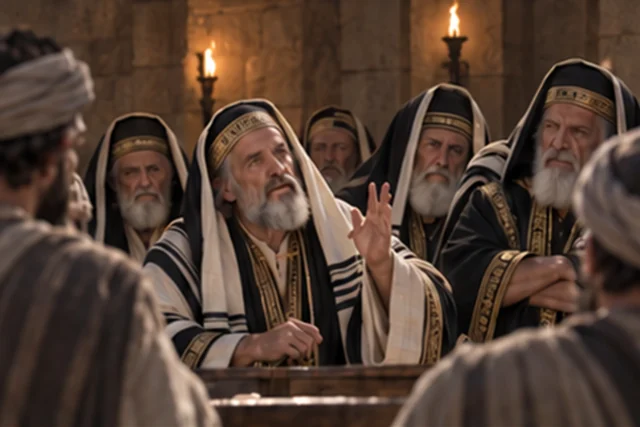
The officers were sent to arrest Jesus and come back with a review of his speech. “Never man spake like this man” is a small reversal with large force: the people assigned to silence him have been stopped by listening. The response from the Pharisees is not an answer to what Jesus said. It appeals to authority, asks whether rulers or Pharisees believe, and dismisses the crowd as ignorant of the law. Then Nicodemus tests that confidence by invoking the law’s own procedure. Does it judge a man before hearing him? The Book of John does not turn Nicodemus into a full public disciple here, but it does let one legal question expose the weakness of a supposedly legal certainty. The reply is an insult about Galilee rather than an answer. The scene ends with everyone going home, not with a reasoned verdict. Confidence has proved easier than a hearing.
Deep dive
The officers were sent to bring back a prisoner. They return with an assessment of his speech instead. Their answer supplies the chapter's neatest reversal: the people assigned to silence Jesus have been stopped by listening to him. The Pharisees respond by questioning whether the officers have been deceived and appealing to the supposed unbelief of the recognized authorities. The crowd's lack of legal knowledge is then invoked as sufficient reason to dismiss it.
Nicodemus interrupts this confidence by appealing to the law's own procedure. His question does not yet amount to a full confession of Jesus' identity. It does, however, expose a contradiction between invoking the law and refusing the hearing it requires. The response shifts from his argument to his presumed association with Galilee. The stated test of legal knowledge has become a test of whether someone sounds sympathetic to the accused.
The chapter ends with people going home rather than with a resolved judgment. Verse 53 also begins the passage extending through John 8:11 whose manuscript history requires attention in the next chapter. In the KJV's received sequence, the dispersal provides the evening before Jesus returns to teach and another attempted trap is placed before him.
Words to trace: Pharisees, Galilee, officers, ariseth, believed, chief
Verse-by-verse path
- John 7:45
The officers were sent in verse 32, about the middle of the feast, and report back only now, on its last day. If the timing is pressed, they had spent days in the crowd listening, though the Book of John does not say so outright.
- John 7:46
The oldest manuscripts read more briefly: “Never man spake thus.” The longer King James wording, “like this man”, came in later. The officers were temple police, not theologians, and their verdict is on the speaking itself.
- John 7:47
“Deceived” is planao, the verb of the crowd’s charge in verse 12 that Jesus “deceiveth the people”. The Pharisees now suspect it has worked on their own officers.
- John 7:48
The question expects the answer no, and two verses later a ruler who is also a Pharisee opens his mouth. Nicodemus was introduced in 3:1 as “a ruler of the Jews”, and 12:42 will admit that “among the chief rulers also many believed on him”.
- John 7:49
“Cursed” is eparatos, a word found only here in the New Testament. Later rabbinic writing used am ha’aretz, “people of the land”, for the unlearned majority, and Hillel said that no such person can be truly pious (Mishnah Avot 2:5).
- John 7:50
The reminder takes the reader back to 3:2. Nicodemus will appear once more, in 19:39, carrying about a hundred pound weight of myrrh and aloes to Jesus’ burial. Here he is still described as “one of them”.
- John 7:51
Deuteronomy 1:16–17 charged Israel’s judges to “hear the causes between your brethren, and judge righteously”, and 17:4 required that an accusation be “inquired diligently”. “Hear him” is literally “hear from him”: the accused must be allowed to speak.
- John 7:52
The claim is untrue: Jonah son of Amittai came from Gath-hepher (2 Kings 14:25), a few miles from Nazareth, and Nahum’s Elkosh may also have been in Galilee. The earliest papyrus of John, P66, reads “the prophet”, which would limit the claim to the prophet like Moses.
- John 7:53
This line begins the passage running to 8:11 that the earliest manuscripts lack. One family of later manuscripts places the passage after Luke 21:38 instead, where the setting of Jesus teaching by day and spending the night on the Mount of Olives also fits.
John 7:45-53
King James Version45Then came the officers to the chief priests and Pharisees; and they said unto them, Why have ye not brought him?
46The officers answered, Never man spake like this man.
47Then answered them the Pharisees, Are ye also deceived?
48Have any of the rulers or of the Pharisees believed on him?
49But this people who knoweth not the law are cursed.
50Nicodemus saith unto them, (he that came to Jesus by night, being one of them,)
51Doth our law judge any man, before it hear him, and know what he doeth?
52They answered and said unto him, Art thou also of Galilee? Search, and look: for out of Galilee ariseth no prophet.
53And every man went unto his own house.
Questions to keep in mind while reading
- Watch what Jesus says and does, and how people respond.
- Trace kingdom, discipleship, opposition, cross, and resurrection in the evangelist’s own sequence.
- Let later doctrine clarify the scene without erasing its immediate setting.
Text first
Where readers differ
The chapter summary begins with what the passage says and how its parts fit together. It does not assume one denomination has already settled every question. Where a conclusion depends on a tradition, literary theory, or historical reconstruction, that dependence is named openly.
The KJV text is presented first. Interpretive conclusions are labeled, and differences are introduced only when they help a reader understand why serious communities do not always reach the same answer.
Why the account appears in brackets or notes
John 7:53-8:11. The KJV includes the account of the woman caught in adultery at John 7:53-8:11. The earliest Greek manuscripts of John do not contain it, and later manuscripts place the account in several different locations. Those facts make its original place in John uncertain.
The account has a long history of being read in Christian worship and teaching. Many readers regard it as an ancient tradition about Jesus even while recognizing that the manuscript evidence does not support it as part of the earliest recoverable text of John at this location. Other readers defend its traditional placement and canonical use.
The passage should not be used to make sin unimportant or to excuse a crowd’s selective condemnation. Within the received account, Jesus exposes the accusers, refuses condemnation, and also tells the woman to leave her life of sin.
View source: United States Conference of Catholic Bishops, John 8 and the account’s textual note ↗ · View source: Center for the Study of New Testament Manuscripts, Manuscript locations of John 7:53-8:11 ↗
Questions beneath the surface
- What account of God, human freedom, responsibility, and the good life emerges from John 7?
- Which tension does the chapter refuse to resolve quickly?
- What changes when the chapter is read as part of the whole canon rather than as an isolated moral lesson?
- Where might a sincere reader confuse a familiar tradition with something the text states directly?
Questions for serious personal contemplation
These open-ended questions make room for tension, honest response, prayer, and conclusions that remain accountable to the chapter.
Observe without rushing
What part of John 7 makes you stop, feel unsettled, or feel surprised, and why?
Which detail in the passage would be easiest to overlook? How does that detail change your understanding?
Where do you see tension between what happens and this focus: John 7 develops its own movement around Jesus, know, people, feast, Christ?
What important question does the passage leave open instead of resolving quickly?
Examine your inner life honestly
Which person, response, fear, or desire in the passage feels most like your own life right now?
What assumption about God, other people, or yourself does this text challenge?
Which part would you rather soften, avoid, or explain away too quickly? What might that reaction reveal?
If this Scripture could ask you one direct question, what do you think it would ask?
Respond with wisdom and courage
What do you need to remember, confess, grieve, thank God for, or trust after reading this passage?
How might another faithful person read this situation differently without ignoring the text?
What obedient response would be costly, uncomfortable, or slow, yet still faithful to Scripture?
What question will you carry into prayer this week, and which verses will you keep in front of you?
Music and video connected to the passage
Related media appears when its Scripture reference overlaps this study. Music and video can illuminate a theme while the biblical text remains the foundation.