The big picture
Bread fills a crowd, a king is refused, a troubled sea is crossed, and then the sign becomes a long argument about what people are really seeking. The crowd wants another provision and eventually asks for a sign after having eaten one. Jesus identifies himself, not merely his supply, as the bread of life. Coming, believing, eating, and drinking all gather around life that comes through him and reaches to resurrection at the last day. His flesh given for the world brings death into the meaning of the bread, making the gift costly rather than merely abundant. The Book of John then allows the discourse to reduce the audience. Many disciples leave because the saying is hard. Peter remains because Jesus has the words of eternal life, yet even the Twelve are not presented as a safe circle. Judas stands inside them as the unresolved betrayer.
In this chapter
- The Arithmetic Is Correct and Still Insufficient John 6:1-15
Philip’s arithmetic is not mocked because it is wrong.
- Across Water, Through Darkness John 6:16-24
After the abundance on land comes darkness, wind, and a boat with Jesus absent.
- Yesterday's Meal Becomes Today's Demand for a Sign John 6:25-34
The crowd finally finds Jesus and asks a travel question.
- The Bread Is a Person, Not a Supply Arrangement John 6:35-40
“I am the bread of life” refuses to leave the gift separate from the giver.
- Familiar Parentage Does Not Settle Heavenly Origin John 6:41-51
The objection begins with ordinary knowledge: they know Jesus’ parents, so how can he claim to have come from heaven?
- The Gift Cannot Be Detached from His Death John 6:52-59
The hearers ask the obvious question: how can this man give his flesh to eat?
- A Smaller Company and an Unresolved Betrayal John 6:60-71
The hardest reaction comes from people already called disciples.
Scripture beside the summary
John · King James Version · 71John 6:1-15
The Arithmetic Is Correct and Still Insufficient
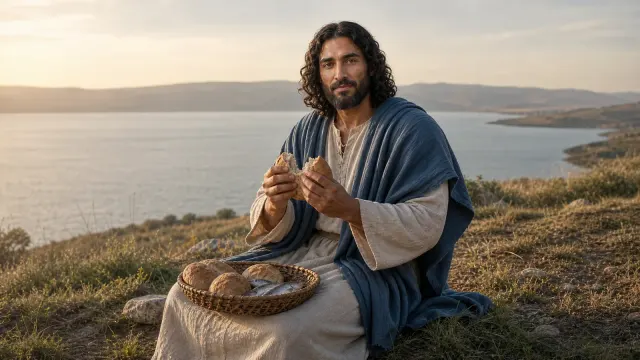
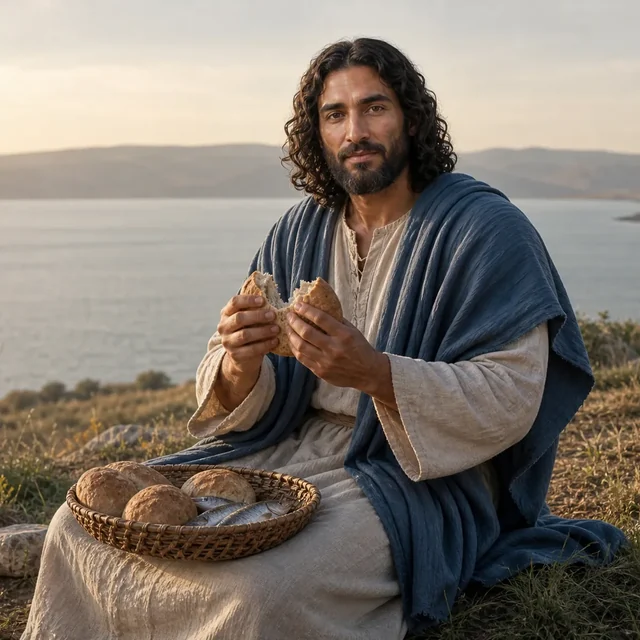
Philip’s arithmetic is not mocked because it is wrong. It is accurate and still useless. Two hundred pennyworth will not feed the crowd, and Andrew’s five barley loaves with two small fish are equally inadequate by ordinary calculation. Jesus allows that insufficiency to be named before acting. The resulting abundance is measured twice, first by everyone eating as much as they want and then by twelve baskets of fragments gathered so nothing is lost. Yet the crowd’s reaction shows that seeing the sign does not guarantee understanding it. They identify Jesus with the expected prophet and immediately plan to make him king by force. The Book of John treats that proposal as a misunderstanding serious enough for Jesus to withdraw alone. The giver of bread will not become an instrument of a political program simply because the crowd has found the correct category. Recognition of power has occurred, but recognition of his purpose has not.
Deep dive
Jesus asks Philip about bread while already knowing what he will do. Philip's calculation is not foolish; it accurately describes the inadequacy of their purchasing power. Andrew's inventory is equally accurate and equally unable to produce a solution. John lets both assessments stand before Jesus acts. The five barley loaves also recall the feeding with barley bread in 2 Kings 4:42–44, where an apparently insufficient supply becomes enough with some remaining. The background makes the event recognizable within Israel's Scriptures without shrinking it to a repetition.
The gathering of fragments establishes abundance without waste. The people then identify Jesus with the expected prophet, but their intended response is to take him and make him king. John distinguishes recognition of a category from understanding the person who fulfills it. They have correctly perceived that something extraordinary has happened and still propose a kingship he refuses.
His withdrawal is therefore part of the sign's meaning, not an awkward interruption after a successful miracle. The giver of bread will not become the instrument of the crowd's program. The next day's conversation will expose the distance between wanting his provision and receiving what he says about himself.
Words to trace: Jesus, disciples, five, loaves, barley, bread
Verse-by-verse path
- John 6:1
Tiberias was the new city Herod Antipas built on the western shore around AD 20 and named for the emperor, and the lake came to be called after it. Only the Book of John uses that name for the lake, here and in 21:1, giving both names perhaps for readers who knew only the later one.
- John 6:2
Both verbs are imperfect: the crowd kept following because it kept watching. The only Galilean healing the book has recorded so far is the nobleman’s son, so “his miracles” implies far more than was written down, as 20:30 openly admits.
- John 6:3
Sitting was the teacher’s posture. Going up a mountain in a chapter full of manna and Moses has made some readers think of Sinai, but that is an inference; the hills rise steeply from the eastern shore and the verse may mean no more than that.
- John 6:4
The Book of John names three Passovers (2:13, here, and 11:55), which is where the common reckoning of a ministry of more than two years comes from. This one sets the chapter in the season of the exodus, when Israel remembered the bread from heaven.
- John 6:5
“Lifted up his eyes” is the phrase of 4:35, looking at a harvest of people. In the other Gospels the disciples raise the problem of food; here Jesus raises it. Philip came from Bethsaida (1:44), and Luke 9:10 places the feeding near that town, so the local man is asked where to shop.
- John 6:6
“Prove” is peirazo, to test, the verb used of God testing Abraham in the Greek of Genesis 22:1. The aside protects Jesus’ knowledge, as the book does in 2:24–25: the question was never a request for advice.
- John 6:7
A penny, the denarius, was a labourer’s wage for a day (Matthew 20:2), so two hundred of them was most of a year’s earnings. Philip’s figure is not what it would take to fill them, only what would give each a mouthful.
- John 6:8
Every time Andrew appears in the Book of John he is bringing someone to Jesus: his brother (1:41), this boy, and the Greeks (12:22). He is identified again by his more famous brother, even though he met Jesus first.
- John 6:9
“Lad” is paidarion, a double diminutive, a young boy or a serving lad. Only John says barley, the cheaper grain eaten by the poor, and barley was ripening at Passover. “Fishes” is opsarion, small dried or pickled fish eaten as relish with bread, the word used again at the charcoal fire in 21:9.
- John 6:10
Grass is green in Galilee in spring, which suits the Passover of verse 4, and Mark 6:39 also mentions it. The verb for sitting is to recline, as at a meal. The count is of men, andres, so women and children were not numbered.
- John 6:11
“Given thanks” is eucharisteo, the verb from which the church later named the Lord’s Supper. The oldest manuscripts lack the words “to the disciples, and the disciples”; in them Jesus himself hands out the bread, and the fuller wording seems to have come in from Matthew 14:19.
- John 6:12
Manna gathered beyond the day’s need bred worms and stank (Exodus 16:19–20). This surplus is gathered on purpose and kept. “Be lost” is apollumi, the verb Jesus will use of those given to him: “I should lose nothing” (verse 39).
- John 6:13
The baskets are kophinoi, stout wicker carrying baskets; the Roman poet Juvenal mocked Jews for always travelling with one. Twelve matches the number of the disciples and of Israel’s tribes. The count is of barley fragments alone; the fish have dropped out of the reckoning.
- John 6:14
“That prophet” is the one the priests asked John the Baptist about in 1:21, “Art thou that prophet?”, the prophet like Moses. The reasoning runs from bread to Moses: Moses fed Israel in the wilderness, so a man who feeds a crowd in a lonely place must be his promised successor.
- John 6:15
“Take by force” is harpazo, to snatch or seize, the verb of the wolf that “catcheth” the sheep (10:12) and of the hand no one can “pluck” them from (10:28). Only John gives this reason for the withdrawal, which explains why Mark 6:45 says Jesus sent the disciples off in a hurry.
John 6:1-15
King James Version1After these things Jesus went over the sea of Galilee, which is the sea of Tiberias.
2And a great multitude followed him, because they saw his miracles which he did on them that were diseased.
3And Jesus went up into a mountain, and there he sat with his disciples.
4And the passover, a feast of the Jews, was nigh.
5When Jesus then lifted up his eyes, and saw a great company come unto him, he saith unto Philip, Whence shall we buy bread, that these may eat?
6And this he said to prove him: for he himself knew what he would do.
7Philip answered him, Two hundred pennyworth of bread is not sufficient for them, that every one of them may take a little.
8One of his disciples, Andrew, Simon Peter’s brother, saith unto him,
9There is a lad here, which hath five barley loaves, and two small fishes: but what are they among so many?
10And Jesus said, Make the men sit down. Now there was much grass in the place. So the men sat down, in number about five thousand.
11And Jesus took the loaves; and when he had given thanks, he distributed to the disciples, and the disciples to them that were set down; and likewise of the fishes as much as they would.
12When they were filled, he said unto his disciples, Gather up the fragments that remain, that nothing be lost.
13Therefore they gathered them together, and filled twelve baskets with the fragments of the five barley loaves, which remained over and above unto them that had eaten.
14Then those men, when they had seen the miracle that Jesus did, said, This is of a truth that prophet that should come into the world.
15When Jesus therefore perceived that they would come and take him by force, to make him a king, he departed again into a mountain himself alone.
John 6:16-24
Across Water, Through Darkness
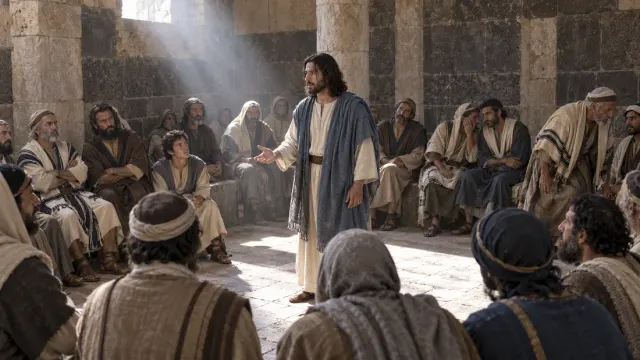
After the abundance on land comes darkness, wind, and a boat with Jesus absent. The disciples’ situation is not a failure of faith arranged for effect; it is simply where the account places them, rowing into a troubled sea. When Jesus approaches on the water, the first response is fear. His words, “It is I; be not afraid,” turn the terrifying figure into the person they know, and receiving him is followed by arrival at the destination. The Book of John gives no mechanism for that final movement and does not need one. The next morning, the crowd performs a remarkably careful reconstruction of the boat traffic. They know the disciples left without Jesus and cannot explain how he reached Capernaum. That logistical intelligence becomes its own kind of irony. They can track vessels and still miss the meaning of what is happening. Their question will be about when Jesus arrived, while his answer will expose why they came looking for him.
Deep dive
The scene changes from a fed multitude to disciples in darkness, facing a rising sea while Jesus has not yet come to them. His approach initially produces fear rather than immediate recognition. The reassurance identifies the approaching figure and addresses that fear. John records their willingness to receive him and the boat's arrival, but gives no explanation of the physical mechanism of the final movement. The emphasis remains on Jesus' presence where the disciples could not have arranged it.
The following verses spend surprising care on boats. The crowd knows that Jesus did not depart with his disciples, sees other boats arrive, and travels to Capernaum seeking him. Those practical observations are not meaningless clutter. They show people able to investigate the movement of a teacher while still missing the significance of his acts. Their first question will concern when he arrived. Jesus answers at the deeper level of why they are looking for him. John has placed a gap between logistical knowledge and recognition, much as Cana separated knowing the wine's quality from knowing its source.
Words to trace: disciples, Jesus, ship, afraid, boat, Capernaum
Verse-by-verse path
- John 6:16
Evening in Greek reckoning covered the late afternoon into dusk. The disciples go down from the hillside of verse 3 to the shore, still without Jesus, who is alone on the mountain above them.
- John 6:17
The best manuscripts read that Jesus had “not yet” come to them, which suggests they expected him to join them somehow. The Book of John opened with light shining in darkness (1:5), and the disciples now set out in the dark without him.
- John 6:18
The easterly winds that come down off the Golan heights can strike the lake suddenly, and a boat heading west to Capernaum would be rowing straight into them. The Greek imperfect describes a sea being steadily roused, not a single gust.
- John 6:19
A furlong, the stadion, was about 607 feet, so they had rowed three miles or a little more, near the middle of a lake about seven miles wide. The same Greek phrase can mean “by the sea”, as in 21:1, and a few modern readers argued he was on the shore, but their fear tells against it.
- John 6:20
“It is I” is ego eimi, the “I am” of 4:26, the form in which God names himself in the Greek of Isaiah 43:10. Job 9:8 praises God, “which alone... treadeth upon the waves of the sea”. These four English words are all Jesus says in the scene.
- John 6:21
“Willingly received” is literally “they were willing to take him”, and the Greek leaves open whether he ever got in before the boat touched land. Psalm 107:29–30 describes God stilling a storm and bringing sailors “unto their desired haven”, and the landing here reads like that line.
- John 6:22
The Greek sentence here is among the most tangled in the book; it breaks off, runs through a parenthesis, and resumes in verse 24. The crowd had spent the night on the eastern shore and reasoned from the boats: one small boat, the disciples gone in it, and Jesus not with them.
- John 6:23
Herod built Tiberias partly over a cemetery, Josephus says, and many observant Jews at first would not live there. The boats may have been blown across by the wind of verse 18, though that is a guess. The meal is remembered by the thanksgiving, not by the multiplying, and Jesus is called “the Lord” again.
- John 6:24
Only as many as the Tiberias boats could carry could make the crossing, a fraction of five thousand. “Seeking” picks up the first words Jesus speaks in the Book of John, “What seek ye?” (1:38), and the next verses will ask what this crowd is seeking.
John 6:16-24
King James Version16And when even was now come, his disciples went down unto the sea,
17And entered into a ship, and went over the sea toward Capernaum. And it was now dark, and Jesus was not come to them.
18And the sea arose by reason of a great wind that blew.
19So when they had rowed about five and twenty or thirty furlongs, they see Jesus walking on the sea, and drawing nigh unto the ship: and they were afraid.
20But he saith unto them, It is I; be not afraid.
21Then they willingly received him into the ship: and immediately the ship was at the land whither they went.
22The day following, when the people which stood on the other side of the sea saw that there was none other boat there, save that one whereinto his disciples were entered, and that Jesus went not with his disciples into the boat, but that his disciples were gone away alone;
23(Howbeit there came other boats from Tiberias nigh unto the place where they did eat bread, after that the Lord had given thanks:)
24When the people therefore saw that Jesus was not there, neither his disciples, they also took shipping, and came to Capernaum, seeking for Jesus.
John 6:25-34
Yesterday's Meal Becomes Today's Demand for a Sign
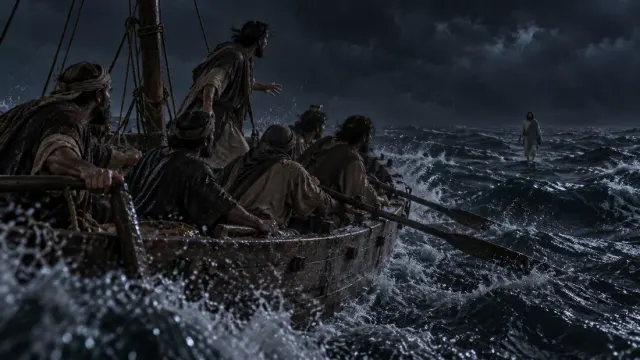
The crowd finally finds Jesus and asks a travel question. He answers a hunger question instead. They are seeking him because they ate and were filled, not because they understood the sign. From there the conversation moves from perishing food to everlasting life, from works they might perform to believing the one God sent, and then astonishingly back to a demand for a sign. People who have just eaten miraculous bread ask what Jesus can do to establish his credentials. The sequence needs no added sarcasm. Their appeal to manna then lets Jesus correct three things at once: Moses is not the ultimate giver, the Father is giving now, and the true bread is not merely a repeated supply of food. It comes from heaven and gives life to the world. The Book of John lets their request, “Lord, evermore give us this bread,” remain sincere but incomplete, much like the Samaritan woman’s first request for living water.
Deep dive
Jesus does not answer the travel question. He names the full stomachs behind the search and distinguishes food that perishes from food enduring into everlasting life. The people then ask about doing God's works, and he directs them toward believing the one God sent. Their next request is for a sign. The conversation has achieved a remarkable turn: people who ate the provided bread are now asking what he can do to establish his credentials. John needs no added joke; the sequence supplies its own irony.
The appeal to manna introduces Moses, but Jesus shifts the emphasis to the Father as giver and to what the Father gives now. The true bread comes from heaven and gives life to the world. Its scope exceeds a wilderness generation, and its identity is about to become personal. Their request for this bread resembles the woman's request for living water in John 4:15. Desire has been awakened, but the gift is still imagined chiefly as an improved provision. The next statement will refuse to leave the bread separate from the giver.
Words to trace: bread, heaven, verily, Jesus, work, believe
Verse-by-verse path
- John 6:25
Yesterday they wanted to make him king; today they call him Rabbi. The question is about timing, “when”, and the perfect tense means “when did you get here”, a question that leaves the more interesting “how” unasked.
- John 6:26
“Filled” here is chortazo, a verb first used of feeding animals with fodder, from chortos, grass, the “much grass” of verse 10. The word is blunt: they were fed full, like cattle at pasture. Seeing the signs would have meant reading them; eating them did not.
- John 6:27
In the ancient world a seal marked ownership and guaranteed contents, and bakers stamped their loaves; carbonised loaves from Pompeii still bear the stamp. “Sealed” here means authenticated by God, and many readers connect it with the Spirit descending on Jesus at his baptism (1:32–33).
- John 6:28
They pick up his verb: he said “labour”, and they ask how to “work the works”, plural, as though a list of deeds could be supplied. The question is sincere and practical, and it assumes that the answer will be something to do.
- John 6:29
The plural “works” becomes a singular: “the work of God” is one thing, and the one thing is believing. Calling faith a work is a deliberate paradox. The phrase “whom he hath sent” keeps Jesus’ identity inside the answer.
- John 6:30
They turn his word back on him: “What dost thou work?” A day after eating bread in the wilderness they ask for a sign. The demand to “see, and believe thee” uses the verb believe with a simple dative, credit his words, rather than the fuller “believe on him” of verse 29.
- John 6:31
The quotation is closest to Psalm 78:24, “the corn of heaven”, with Exodus 16:4 and Nehemiah 9:15 behind it. A later rabbinic saying (Ecclesiastes Rabbah 1:9) held that as the first redeemer brought down manna, so would the last. The crowd is setting a messianic test.
- John 6:32
The answer reads the quoted text closely, correcting its subject and the tense of its verb, the way synagogue teachers expounded a verse. Peder Borgen showed that verses 31 to 58 follow the pattern of such a homily, taking the words of the text one by one.
- John 6:33
“Bread” is masculine in Greek, so “he which cometh down” can equally mean “that which cometh down”. The King James chooses “he”, but the ambiguity lets the bread and the person slide into one before Jesus says so in verse 35. “Cometh down” appears seven times in this chapter.
- John 6:34
The manna came daily for forty years and stopped the day after Israel ate the grain of Canaan (Joshua 5:12). “Evermore” is pantote, always: they are asking for a manna that never stops. “Lord” is kurie, still at the level of “Sir”.
John 6:25-34
King James Version25And when they had found him on the other side of the sea, they said unto him, Rabbi, when camest thou hither?
26Jesus answered them and said, Verily, verily, I say unto you, Ye seek me, not because ye saw the miracles, but because ye did eat of the loaves, and were filled.
27Labour not for the meat which perisheth, but for that meat which endureth unto everlasting life, which the Son of man shall give unto you: for him hath God the Father sealed.
28Then said they unto him, What shall we do, that we might work the works of God?
29Jesus answered and said unto them, This is the work of God, that ye believe on him whom he hath sent.
30They said therefore unto him, What sign shewest thou then, that we may see, and believe thee? what dost thou work?
31Our fathers did eat manna in the desert; as it is written, He gave them bread from heaven to eat.
32Then Jesus said unto them, Verily, verily, I say unto you, Moses gave you not that bread from heaven; but my Father giveth you the true bread from heaven.
33For the bread of God is he which cometh down from heaven, and giveth life unto the world.
34Then said they unto him, Lord, evermore give us this bread.
John 6:35-40
The Bread Is a Person, Not a Supply Arrangement
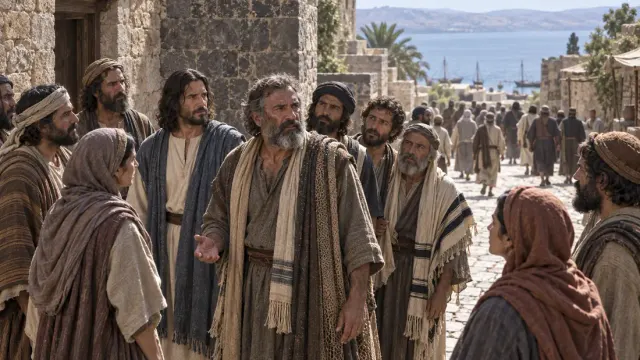
“I am the bread of life” refuses to leave the gift separate from the giver. Jesus is not proposing a permanent distribution system for the loaves people enjoyed yesterday. Hunger and thirst are answered through coming to him and believing in him. The crowd has already seen him, which makes his next statement deliberately uncomfortable: seeing has not produced belief. The Book of John then places the Father’s giving beside the person’s coming without pausing to turn the relation into a philosophical diagram. What matters in the passage is the security of the one who comes. Jesus will not cast that person out, will lose nothing entrusted to him, and will raise the believer at the last day. The repeated resurrection promise prevents “never hunger” from shrinking into a pleasant inward state. The life Jesus gives reaches through death. The bread from heaven therefore concerns both present reception and a future body raised by the Son.
Deep dive
The answer changes the kind of request that can be made. Jesus is not merely the organizer of a continuing bread distribution; he is the bread of life. Hunger and thirst are addressed through coming to him and believing in him. The physical meal was real, but it was not the limit of the sign's meaning. Seeing him has also proved insufficient by itself, since Jesus explicitly names the failure to believe among people who have seen.
The Father's giving and the person's coming are placed together without a digression that resolves every later dispute about divine initiative and human response. Jesus promises not to cast out the one who comes, and grounds his work in the Father's will rather than an independent agenda. The repeated concern is that those given to him should not be lost.
Resurrection at the last day prevents the language of satisfaction from becoming only an inward experience in the present. The Son's keeping reaches through death to a future raising. The passage's confidence belongs to the will and action of Father and Son, while its invitation remains expressed in the active terms of coming, seeing, and believing.
Words to trace: believeth, cometh, last, life, raise, believe
Verse-by-verse path
- John 6:35
This is the first of the seven “I am” sayings in the book with something after them: bread, light, door, shepherd, resurrection, way, vine. In Ecclesiasticus 24:21 Wisdom says “they that eat me shall yet be hungry”; Jesus claims the opposite, that the one who comes to him shall never hunger.
- John 6:36
No earlier saying in the chapter matches these words exactly, unless verse 26 is meant, and some suggest Jesus refers to something not recorded. The crowd has seen him with their own eyes and eaten his bread, and that seeing is exactly what has not been enough.
- John 6:37
The first half is neuter and collective, “all that”, the whole company given as one gift; the second half is singular and personal, “him that cometh”. “In no wise cast out” is emphatic; the same verb is used of the man born blind whom the Pharisees “cast out” in 9:34.
- John 6:38
This is the phrase that provokes the murmuring in verse 41: “I came down from heaven.” The Greek perfect means he has come down and remains the one who came. The words about not doing his own will repeat the claim of 5:30 almost exactly.
- John 6:39
“Lose nothing” picks up the fragments of verse 12, “that nothing be lost”, with the same verb. “The last day” is a phrase only the Book of John uses in the New Testament, four times in this chapter and again at the grave of Lazarus (11:24) and in 12:48.
- John 6:40
The neuter “it” of verse 39 becomes “him”, a person, and the “I” is emphatic in Greek: I myself will raise him. “Seeth” is theoreo, to behold with attention, a stronger verb than the seeing of verse 36 that failed to become faith.
John 6:35-40
King James Version35And Jesus said unto them, I am the bread of life: he that cometh to me shall never hunger; and he that believeth on me shall never thirst.
36But I said unto you, That ye also have seen me, and believe not.
37All that the Father giveth me shall come to me; and him that cometh to me I will in no wise cast out.
38For I came down from heaven, not to do mine own will, but the will of him that sent me.
39And this is the Father’s will which hath sent me, that of all which he hath given me I should lose nothing, but should raise it up again at the last day.
40And this is the will of him that sent me, that every one which seeth the Son, and believeth on him, may have everlasting life: and I will raise him up at the last day.
John 6:41-51
Familiar Parentage Does Not Settle Heavenly Origin
The objection begins with ordinary knowledge: they know Jesus’ parents, so how can he claim to have come from heaven? Familiarity becomes a closed explanation. Jesus does not answer by supplying a birth narrative. He speaks of the Father drawing and teaching, using Scripture to show that recognition of the Son depends on receiving instruction from God rather than on possessing neighborhood information. The manna comparison then becomes sharper. Israel’s ancestors truly received manna, but they still died. That does not make the earlier gift false; it reveals its limits. The bread Jesus gives carries a life death cannot finally keep. Then the discourse becomes costly. The bread is identified as his flesh “for the life of the world.” The Book of John has already said the Word became flesh. Now that flesh is not merely the condition in which teaching is delivered. It is the life that will be given, making death part of the gift rather than an accident interrupting it.
Deep dive
The objection rests on familiar social knowledge: these hearers know Jesus' parents and therefore consider his heavenly claim disqualified. John has already shown how partial knowledge can harden into a total explanation. Their statement is not answered by an account of Jesus' birth. He speaks instead about the Father's drawing and teaching, using Isaiah 54:13. Recognition requires receiving that teaching, not simply possessing neighborhood information.
The comparison with manna now becomes stark. Those who ate it died. That does not make manna fraudulent; it distinguishes sustaining mortal life from the life Jesus gives. The bread from heaven brings a life not finally overcome by death, in keeping with the repeated promise of resurrection.
The final sentence makes the gift costly. The bread Jesus will give is his flesh for the world's life. Until this point, a hearer might try to retain the language of heavenly provision while avoiding his death. John closes that route. The Word's flesh, announced in chapter 1, is not an incidental vehicle through which an otherwise detachable teaching arrives. His own embodied life will be given.
Words to trace: bread, Father, heaven, life, cometh, Jesus
Verse-by-verse path
- John 6:41
“Murmured” is gongyzo, the verb the Greek Old Testament uses for Israel grumbling against Moses over food in the wilderness (Exodus 16:2, 7–8). They murmur about the bread from heaven exactly as their fathers did. These are Galileans in Capernaum, yet the book still calls them “the Jews”.
- John 6:42
Philip had introduced Jesus as “the son of Joseph” in 1:45. The Book of John never names Jesus’ mother; she is always “the mother of Jesus”. Capernaum lies about twenty miles from Nazareth, close enough for his family to be known.
- John 6:43
He answers the grumbling and not their question about his parents, which he leaves untouched. “Among yourselves” is literally “with one another”: the murmuring was passed round the crowd, not addressed to him.
- John 6:44
“Draw” is helko, the verb for hauling a laden net ashore (21:6, 11) and for dragging a man to court (Acts 16:19). The Greek of Jeremiah 31:3 uses it for God: “with lovingkindness have I drawn thee.” In 12:32 Jesus uses it of himself: “I will draw all men unto me.”
- John 6:45
“In the prophets” names the section of Scripture, not a single book. The words are from Isaiah 54:13, “all thy children shall be taught of the LORD”, and Jeremiah 31:34 has the same hope: no one will need to teach his neighbour. Hearing and learning come before coming.
- John 6:46
The verse guards against misreading verse 45: taught by God does not mean having seen God. It picks up 1:18, “No man hath seen God at any time”. “Of God” is para, from beside God, where the one who has seen him has been.
- John 6:47
Several of the oldest manuscripts lack “on me”, leaving the bare statement “He that believeth hath everlasting life”. “Hath” is present tense: the life is possessed now, not only promised.
- John 6:48
The claim of verse 35 is repeated to open the second half of the argument, as a preacher restates his text. “Bread of life” means bread that gives life, not bread that is merely alive, in contrast with the manna of the next verse.
- John 6:49
The crowd said “our fathers” in verse 31; Jesus says “your fathers”. The wilderness generation ate manna for forty years and still died in the desert, as Numbers 14:29–35 decreed. “Are dead” is simply “died” in Greek.
- John 6:50
“Eat thereof, and not die” reverses Genesis 2:17, where the King James also has “eatest thereof” with death as the result. In Eden eating brought death; this bread is offered so that eating brings life. Whether the echo is intended is an inference, but the wording is close.
- John 6:51
“For” is huper, on behalf of, the preposition the Book of John uses for dying for others: the good shepherd gives his life “for the sheep” (10:11), and Caiaphas says one man should die “for the people” (11:50). “Flesh” is sarx, the word of 1:14.
John 6:41-51
King James Version41The Jews then murmured at him, because he said, I am the bread which came down from heaven.
42And they said, Is not this Jesus, the son of Joseph, whose father and mother we know? how is it then that he saith, I came down from heaven?
43Jesus therefore answered and said unto them, Murmur not among yourselves.
44No man can come to me, except the Father which hath sent me draw him: and I will raise him up at the last day.
45It is written in the prophets, And they shall be all taught of God. Every man therefore that hath heard, and hath learned of the Father, cometh unto me.
46Not that any man hath seen the Father, save he which is of God, he hath seen the Father.
47Verily, verily, I say unto you, He that believeth on me hath everlasting life.
48I am that bread of life.
49Your fathers did eat manna in the wilderness, and are dead.
50This is the bread which cometh down from heaven, that a man may eat thereof, and not die.
51I am the living bread which came down from heaven: if any man eat of this bread, he shall live for ever: and the bread that I will give is my flesh, which I will give for the life of the world.
John 6:52-59
The Gift Cannot Be Detached from His Death
The hearers ask the obvious question: how can this man give his flesh to eat? Jesus does not ease the language. He intensifies it, joining flesh with blood and eating with drinking. The result is not curiosity but life, resurrection, and mutual abiding. The difficulty cannot be separated from the death now coming into view. Flesh and blood make Jesus’ self-giving concrete, while eating and drinking describe a reception far more intimate than admiring a teacher from a distance. The Book of John has already used coming and believing for the same gifts, so this language belongs inside that continuing argument. Christians have long differed over how directly it relates to the Lord’s Supper, and the passage itself does not describe a bread-and-cup rite here. What it does make unavoidable is dependence on Jesus’ embodied life given for the world. The bread from heaven cannot be accepted while his death is politely set aside.
Deep dive
The hearers dispute how Jesus can give his flesh to eat, and his answer intensifies rather than softens the language. Flesh and blood bring the coming death into view, while eating and drinking express a reception more intimate than observing a teacher's achievement. The repeated result is life, abiding in him, and resurrection. These are the same gifts already associated with coming and believing earlier in the discourse, so the difficult language belongs within that argument rather than forming an unrelated puzzle.
Christian readings differ over the relationship to the Lord's Supper. Sacramental readings hear a direct connection with receiving his body and blood; other readings emphasize faith's reception of his sacrificial death, with sacramental significance secondary or absent. The passage itself does not describe a bread-and-cup rite at this point. It does unmistakably join the gift of life to Jesus' flesh given for the world.
The comparison with the living Father again grounds the gift in relationship. Jesus lives because of the Father, and the recipient lives through him. John's closing location, the synagogue in Capernaum, places this demanding teaching in a public setting. It is not presented as an explanation reserved for people who had already agreed with it.
Words to trace: flesh, blood, eateth, live, bread, drink
Verse-by-verse path
- John 6:52
“Strove” is emachonto, they fought, a sharp step up from the murmuring of verse 41. The crowd is now divided among itself. “This man” in Greek carries an edge, as when one says “this fellow”.
- John 6:53
Drinking blood was forbidden from Noah onward (Genesis 9:4), and Leviticus 17:10–14 gives the reason: “the life of the flesh is in the blood.” That law makes the saying shocking, and it also supplies the logic: blood is life, and without it “ye have no life”.
- John 6:54
The verb for eating changes here to trogo, a blunt word first used of animals munching, and it continues to verse 58. The Book of John uses it once more, in 13:18: “He that eateth bread with me hath lifted up his heel against me.”
- John 6:55
“Indeed” translates alethes, true or real, the manuscript reading most editors prefer. It recalls “the true bread” of verse 32: the manna was real food for the body, and this is food that deserves the name.
- John 6:56
“Dwelleth” is meno, abide. This is the first time the book speaks of mutual dwelling, “in me, and I in him”, the phrase that will be unfolded in the vine of 15:4–5, “Abide in me, and I in you.”
- John 6:57
“The living Father” occurs nowhere else in the New Testament. The object changes from “my flesh” to simply “me”: he that eateth me. “By” is dia, because of: the Son lives because of the Father, and the eater because of the Son.
- John 6:58
The last sentence returns to the words of verse 31, bread from heaven, the fathers, manna, and closes the circle the argument opened. It ends on the promise without an image: “shall live for ever”.
- John 6:59
The white limestone synagogue that visitors see in Capernaum was built in the fourth or fifth century, but it stands on black basalt foundations that may belong to the first-century building. The Greek says “in synagogue”, without the article, meaning at a synagogue gathering.
John 6:52-59
King James Version52The Jews therefore strove among themselves, saying, How can this man give us his flesh to eat?
53Then Jesus said unto them, Verily, verily, I say unto you, Except ye eat the flesh of the Son of man, and drink his blood, ye have no life in you.
54Whoso eateth my flesh, and drinketh my blood, hath eternal life; and I will raise him up at the last day.
55For my flesh is meat indeed, and my blood is drink indeed.
56He that eateth my flesh, and drinketh my blood, dwelleth in me, and I in him.
57As the living Father hath sent me, and I live by the Father: so he that eateth me, even he shall live by me.
58This is that bread which came down from heaven: not as your fathers did eat manna, and are dead: he that eateth of this bread shall live for ever.
59These things said he in the synagogue, as he taught in Capernaum.
John 6:60-71
A Smaller Company and an Unresolved Betrayal
The hardest reaction comes from people already called disciples. They hear the discourse and begin to withdraw, which means the crisis cannot be assigned only to hostile outsiders. Jesus does not save the crowd by replacing the difficult teaching with a safer version. He speaks of the Son of man’s ascent, the Spirit giving life, and the Father enabling people to come. Peter’s answer to the Twelve is striking because it does not pretend every difficulty has disappeared. “To whom shall we go?” locates trust in the person who has the words of eternal life. The Book of John then refuses a comforting ending in which the smaller group is automatically pure. Jesus names betrayal within the Twelve and identifies Judas as the coming betrayer. Departure outside the circle and treachery inside it stand together. Remaining near Jesus is not itself proof that every heart has received what he has said.
Deep dive
The difficulty now comes from people called disciples, not only from declared opponents. Jesus knows their offense and speaks of the Son of man's ascent, the Spirit's life-giving work, and the Father's enabling. Saying that flesh profits nothing cannot simply cancel the gift of his flesh in verse 51 or the incarnation in John 1:14. The contrast concerns life generated by the Spirit rather than a merely fleshly grasp of his words; the precise relation between those uses of flesh remains a point of interpretation.
The departure is allowed to stand. Jesus does not recover the numbers by offering a less demanding account of himself. His question to the Twelve creates the setting for Peter's confession: Jesus has the words of everlasting life, and they have believed and known his identity. Peter does not claim that every difficulty has been explained. He identifies the person in whom the answer to life is located.
The closing reference to Judas interrupts any comfortable division between a failed outer circle and a wholly faithful inner one. Selection among the Twelve has not made betrayal impossible. John finishes the bread discourse with that unresolved presence at the table of discipleship. The crisis is not safely confined to those who have walked away.
Words to trace: Jesus, disciples, twelve, believe, betray, knew
Verse-by-verse path
- John 6:60
“Hard” is skleros, harsh or offensive, not difficult to understand. They understood well enough. “Who can hear it?” means who can listen to it and accept it. The objection now comes from disciples, not from the crowd.
- John 6:61
“Knew in himself” means without being told. The verb for “offend” is skandalizo, from the trigger stick of a trap. In the Book of John it appears only here and in 16:1, where the farewell words are spoken “that ye should not be offended.”
- John 6:62
The Greek sentence breaks off with no second half, and the King James “What and if” keeps the gap. The ascent recalls 3:13, “no man hath ascended up to heaven, but he that came down”, and the ladder of angels ascending and descending in 1:51.
- John 6:63
“Words” is rhemata, the particular things just said, and Peter picks up the same noun in verse 68: “thou hast the words of eternal life.” The sentence recalls 3:6, “that which is born of the flesh is flesh; and that which is born of the Spirit is spirit.”
- John 6:64
“From the beginning” uses arche, the first noun of the book (1:1). This is the first mention of betrayal in the Book of John. The verb is paradidomi, to hand over, used later of Pilate handing Jesus over to be crucified (19:16).
- John 6:65
Verse 44 said the Father must draw; here it is “given”, a gift rather than a pull. Jesus cites his own earlier saying as the explanation of what is happening before their eyes as disciples murmur and turn away.
- John 6:66
“From that time” can also be read “for this reason”. “Went back” is literally “went away to the things behind”, back to what they had left. The same phrase is used in 18:6 of the arresting band who “went backward, and fell to the ground”.
- John 6:67
This is the first time the Twelve are named in the Book of John, which never records their calling as a group. The question in Greek expects the answer no, “You do not want to go too, do you?”, and leaves it to them to say so.
- John 6:68
These are Peter’s first recorded words in the book. He answers a question with a question and then a statement. “Words of eternal life” has no article in Greek: not a creed, but words that carry life, the noun Jesus used in verse 63.
- John 6:69
The King James “that Christ, the Son of the living God” follows later manuscripts; the oldest read “the Holy One of God”, the title the unclean spirit uses in Mark 1:24. Both verbs are perfect tense: we have believed, and have come to know.
- John 6:70
“Devil” is diabolos, slanderer or accuser, with no article: one of you is a devil. In the other Gospels, after Peter’s confession at Caesarea Philippi, Jesus calls Peter “Satan” (Mark 8:33); in the Book of John the label falls on someone else among the same twelve.
- John 6:71
Only the Book of John names Judas’s father as Simon, and some manuscripts call the father “Simon Iscariot”, which makes the surname a family name. It is often explained as “man of Kerioth”, a town in Judah (Joshua 15:25), which would make Judas a Judean among Galileans, though that is an inference.
John 6:60-71
King James Version60Many therefore of his disciples, when they had heard this, said, This is an hard saying; who can hear it?
61When Jesus knew in himself that his disciples murmured at it, he said unto them, Doth this offend you?
62What and if ye shall see the Son of man ascend up where he was before?
63It is the spirit that quickeneth; the flesh profiteth nothing: the words that I speak unto you, they are spirit, and they are life.
64But there are some of you that believe not. For Jesus knew from the beginning who they were that believed not, and who should betray him.
65And he said, Therefore said I unto you, that no man can come unto me, except it were given unto him of my Father.
66From that time many of his disciples went back, and walked no more with him.
67Then said Jesus unto the twelve, Will ye also go away?
68Then Simon Peter answered him, Lord, to whom shall we go? thou hast the words of eternal life.
69And we believe and are sure that thou art that Christ, the Son of the living God.
70Jesus answered them, Have not I chosen you twelve, and one of you is a devil?
71He spake of Judas Iscariot the son of Simon: for he it was that should betray him, being one of the twelve.
Questions to keep in mind while reading
- Watch what Jesus says and does, and how people respond.
- Trace kingdom, discipleship, opposition, cross, and resurrection in the evangelist’s own sequence.
- Let later doctrine clarify the scene without erasing its immediate setting.
Text first
Where readers differ
The chapter summary begins with what the passage says and how its parts fit together. It does not assume one denomination has already settled every question. Where a conclusion depends on a tradition, literary theory, or historical reconstruction, that dependence is named openly.
The KJV text is presented first. Interpretive conclusions are labeled, and differences are introduced only when they help a reader understand why serious communities do not always reach the same answer.
Comparative interpretive notes for this chapter are in preparation. Until reviewed notes are ready, this page separates the KJV text from summary and application without claiming that serious readers agree on every question.
Questions beneath the surface
- What account of God, human freedom, responsibility, and the good life emerges from John 6?
- Which tension does the chapter refuse to resolve quickly?
- What changes when the chapter is read as part of the whole canon rather than as an isolated moral lesson?
- Where might a sincere reader confuse a familiar tradition with something the text states directly?
Questions for serious personal contemplation
These open-ended questions make room for tension, honest response, prayer, and conclusions that remain accountable to the chapter.
Observe without rushing
What part of John 6 makes you stop, feel unsettled, or feel surprised, and why?
Which detail in the passage would be easiest to overlook? How does that detail change your understanding?
Where do you see tension between what happens and this focus: The crowd fed near the sea, Jesus approaching the boat on the water, and many disciples leaving after the bread-of-life teaching?
What important question does the passage leave open instead of resolving quickly?
Examine your inner life honestly
Which person, response, fear, or desire in the passage feels most like your own life right now?
What assumption about God, other people, or yourself does this text challenge?
Which part would you rather soften, avoid, or explain away too quickly? What might that reaction reveal?
If this Scripture could ask you one direct question, what do you think it would ask?
Respond with wisdom and courage
What do you need to remember, confess, grieve, thank God for, or trust after reading this passage?
How might another faithful person read this situation differently without ignoring the text?
What obedient response would be costly, uncomfortable, or slow, yet still faithful to Scripture?
What question will you carry into prayer this week, and which verses will you keep in front of you?
Music and video connected to the passage
Related media appears when its Scripture reference overlaps this study. Music and video can illuminate a theme while the biblical text remains the foundation.