
The big picture
Luke 14 begins at a Sabbath table where people are watching Jesus and ends with a warning that merely traveling near him does not amount to discipleship. In between, every kind of social position gets unsettled. A man is healed while the lawyers and Pharisees have no answer for a simple comparison with rescuing an animal. Guests reaching for the best seats are told to let the host assign honor, and the host himself is told to invite people who cannot close the circle by repaying him. A confident remark about eating in God's kingdom receives a parable in which the original guests are too occupied to come and the house fills from streets, lanes, roads, and hedges. Then Jesus turns from the meal to the multitudes. The crowd is large, but the terms are not discounted for volume. Family allegiance, possessions, life itself, and the cross all enter the reckoning. The final image of useless salt makes the chapter's distinction sharp: a familiar label cannot substitute for the character that gives the thing its purpose.
In this chapter
- The Observers Have No Answer for the Healed Man Luke 14:1-6
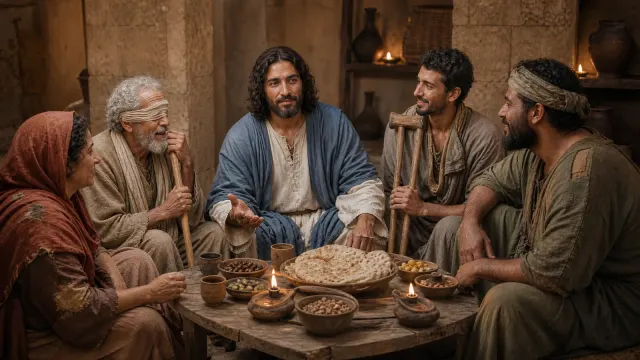
The Sabbath meal begins with surveillance.
- The Seating Plan Reveals More Than the Guest List Luke 14:7-14
Jesus watches guests select the chief rooms, meaning the places of honor, and answers with a scene built for public embarrassment.
- The Banquet Fills While the Invited Guests Stay Busy Luke 14:15-24
A dinner guest blesses the person who will eat bread in God's kingdom, and Jesus answers with a feast that many invited people never taste.
- The Crowd Is Large, but the Terms Are Not Reduced Luke 14:25-33
Great multitudes are moving with Jesus when he turns and says things almost calculated to thin a crowd.
- Salt That No Longer Does Its Work Luke 14:34-35
Salt is good because salt does something.

Scripture beside the summary
Luke · King James Version · 35Luke 14:1-6
The Observers Have No Answer for the Healed Man
The Sabbath meal begins with surveillance. Jesus is being watched, a man with dropsy is present, and Jesus refuses to wait for an objection after the fact. He asks directly whether healing on the Sabbath is lawful. Silence follows, but silence does not keep the man sick. Jesus heals him and lets him go, a small detail that keeps the person from becoming a prop in an argument that continues after his need has been met. Then comes the comparison his observers cannot answer. If an ass or ox falls into a pit, immediate rescue on the Sabbath is accepted without much ceremony. The Book of Luke puts that ordinary exception beside human restoration and lets the inconsistency show itself. The passage does not offer a medical diagnosis behind the swelling or an inventory of every Sabbath dispute. It presents a healed man, an accepted act of rescue, and a room full of experts who cannot explain why mercy should rank lower.

Deep dive
Luke opens with observation: the guests are watching Jesus. He answers by asking about the lawfulness of healing before acting, bringing the issue into the open rather than waiting for a complaint afterward. The man has "dropsy," an older term for a condition involving swelling or retained fluid. The label does not identify a specific underlying disease, and the passage supplies no further medical history.
The silence of the lawyers and Pharisees does not stop the healing. Jesus takes the man, heals him, and lets him go. That last movement matters within the meal's atmosphere: the person whose condition occasions the dispute is released rather than held in place as an exhibit for prolonged argument.
The example of immediately retrieving an animal from a pit again turns accepted Sabbath practice against the proposed restriction. Necessity is already recognized when something belonging to the hearers is at risk. The comparison exposes the inconsistency of treating a human restoration as less admissible. Luke ends with their inability to answer, allowing the accomplished healing and unanswered analogy to stand together.
Words to trace: sabbath, Pharisees, answer, answering, bread, certain
Verse-by-verse path
- Luke 14:1
This is the third Pharisee’s table in the Book of Luke (7:36, 11:37), and the host is a leading man among them. Sabbath food had to be cooked the day before, and the main meal came after the morning synagogue. “Watched” is paratēreō, to watch closely, the verb of the scribes in 6:7 watching whether he would heal on the sabbath.
- Luke 14:2
“Before him” means right in front of Jesus, which has led some readers to suspect the man was placed there as a test; Luke does not say. “Had the dropsy” is one Greek word, hydrōpikos, swollen with water, found nowhere else in the New Testament.
- Luke 14:3
“Answering” comes before anyone has spoken: Jesus replies to their watching. He had put almost the same question in a synagogue in 6:9, and here the lawyers and Pharisees are the ones asked to rule on it.
- Luke 14:4
“Held their peace” is hēsychazō, the verb used when the women “rested the sabbath day” before going to the tomb (23:56). “Let him go” is apolyō, the verb for releasing the bent woman in 13:12. “Took him” is epilambanomai, to take hold of: Jesus lays hands on the man.
- Luke 14:5
Many manuscripts read “a son or an ox” rather than “an ass or an ox”, which makes the argument stronger still. Practice differed: the Qumran community forbade lifting an animal out of a pit on the sabbath, while other Jewish teachers allowed helping it.
- Luke 14:6
“Answer him again” is antapokrinomai, to answer back or reply in return, a word found elsewhere only in Romans 9:20, “who art thou that repliest against God?” The silence of verse 4 now becomes an inability.
Luke 14:1-6
King James Version1And it came to pass, as he went into the house of one of the chief Pharisees to eat bread on the sabbath day, that they watched him.
2And, behold, there was a certain man before him which had the dropsy.
3And Jesus answering spake unto the lawyers and Pharisees, saying, Is it lawful to heal on the sabbath day?
4And they held their peace. And he took him, and healed him, and let him go;
5And answered them, saying, Which of you shall have an ass or an ox fallen into a pit, and will not straightway pull him out on the sabbath day?
6And they could not answer him again to these things.
Luke 14:7-14
The Seating Plan Reveals More Than the Guest List
Jesus watches guests select the chief rooms, meaning the places of honor, and answers with a scene built for public embarrassment. Claim the highest seat too soon and the host may make you move when someone more honored arrives. The chair cannot manufacture the status its occupant hopes it announces. Taking the lower place shifts the decisive word to the host, who may invite a guest upward. Luke then makes sure this is more than etiquette by giving the principle: self-exaltation and humiliation are moving in opposite directions. Jesus turns next to the host. A guest list made of friends, relatives, and rich neighbors can become a tidy exchange system in which every invitation creates a future return. The poor and people with disabilities cannot repay in kind, and that inability breaks the transaction open. Recompense is placed at the resurrection of the just, beyond the immediate social economy of favors, seats, and visible returns.
Deep dive
The KJV's "chief rooms" are places of honor at the meal, not desirable bedrooms. Jesus has watched the guests selecting them. The resulting parable follows an embarrassingly simple chain: someone claims a high place, a more honored guest arrives, and the host must arrange a very public correction. The seat cannot manufacture the standing its occupant wants it to announce.
The alternative of taking a lower place ends with the host's invitation upward. The concluding principle about exaltation and humiliation prevents the passage from remaining merely a clever technique for securing compliments. The decisive assignment of honor belongs to another. A calculated performance of modesty aimed at controlling that assignment would preserve the original problem under better manners.
Jesus then addresses the host, whose guest list may function as an exchange of favors among those able to repay. Naming the poor and people with disabilities breaks that circle. Their inability to return an equivalent invitation is the reason the act ceases to be a closed transaction. Recompense is placed at the resurrection of the just, transferring the horizon of the meal beyond its immediate social returns.
Words to trace: bidden, bade, room, call, lest, lowest
Verse-by-verse path
- Luke 14:7
At formal dinners guests reclined on couches arranged around the tables, and the places nearest the host carried the most honour. “Marked” is epechō, to fix one’s attention: Jesus has been watching the watchers choose their places.
- Luke 14:8
The advice reworks Proverbs 25:6-7: “Put not forth thyself in the presence of the king… for better it is that it be said unto thee, Come up hither; than that thou shouldest be put lower”. A wedding was the feast at which precedence counted most.
- Luke 14:9
The shame is drawn out: by the time the guest is moved, the middle places are already filled and only the lowest is free. “Begin with shame” pictures the long walk down the room in front of everyone.
- Luke 14:10
“Worship” in 1611 meant honour or esteem, the older sense of worth-ship; the Greek is doxa, glory. “Friend, go up higher” echoes the Proverbs line, and the honour is given in front of the same guests who might have watched the humiliation.
- Luke 14:11
The saying returns at the end of the parable of the Pharisee and the tax collector (18:14). Mary had sung that God “hath put down the mighty from their seats, and exalted them of low degree” (1:52), and Ezekiel 21:26 has the same reversal: “exalt him that is low, and abase him that is high”.
- Luke 14:12
“Dinner” and “supper” are ariston and deipnon, the midday and the evening meals, so every kind of meal is covered. The four groups named, friends, brothers, kinsmen and rich neighbours, have one thing in common: all can invite back. “Recompence” is antapodoma, a repayment in kind.
- Luke 14:13
The Qumran rule excluded the lame, blind and maimed from the assembly of the last days, and Leviticus 21:17-23 barred priests with such defects from offering. Jesus names exactly those people as the guests to invite.
- Luke 14:14
“The resurrection of the just” is a phrase found only here; Paul later speaks before Felix of “a resurrection of the dead, both of the just and unjust” (Acts 24:15). “They cannot recompense thee” is given as the reason for the blessing, not as a regret.
Luke 14:7-14
King James Version7And he put forth a parable to those which were bidden, when he marked how they chose out the chief rooms; saying unto them,
8When thou art bidden of any man to a wedding, sit not down in the highest room; lest a more honourable man than thou be bidden of him;
9And he that bade thee and him come and say to thee, Give this man place; and thou begin with shame to take the lowest room.
10But when thou art bidden, go and sit down in the lowest room; that when he that bade thee cometh, he may say unto thee, Friend, go up higher: then shalt thou have worship in the presence of them that sit at meat with thee.
11For whosoever exalteth himself shall be abased; and he that humbleth himself shall be exalted.
12Then said he also to him that bade him, When thou makest a dinner or a supper, call not thy friends, nor thy brethren, neither thy kinsmen, nor thy rich neighbours; lest they also bid thee again, and a recompence be made thee.
13But when thou makest a feast, call the poor, the maimed, the lame, the blind:
14And thou shalt be blessed; for they cannot recompense thee: for thou shalt be recompensed at the resurrection of the just.
Luke 14:15-24
The Banquet Fills While the Invited Guests Stay Busy
A dinner guest blesses the person who will eat bread in God's kingdom, and Jesus answers with a feast that many invited people never taste. The problem is not that they lacked an invitation. The supper is ready, but fields, oxen, and a new marriage become reasons to stay away. These are ordinary commitments, which gives the refusal its edge. Nothing has to look scandalous to become decisive when it repeatedly takes priority over the invitation. The host does not cancel dinner in deference to their schedules. He sends into the city for the poor and disabled, then beyond the usual circle to roads and hedges because there is still room. “Compel them to come in” belongs to the forceful welcome of this feast, not to a license for religious violence. Luke holds expansive hospitality and real exclusion together. Those who treated the prepared supper as indefinitely postponable discover that the table fills without them.

Deep dive
The dinner guest's blessing on those who will eat in God's kingdom sounds agreeable enough. Jesus answers with a feast whose difficulty is not a lack of invitation but the response when everything is ready. A field, oxen, and a marriage supply reasons for declining. These are ordinary interests, not intrinsically criminal activities. Their place in the account shows how ordinary commitments can become final refusals.
The excuses also grow less ceremonious. The first two ask to be excused; the newly married man simply declares that he cannot come. The host does not cancel the supper or leave the prepared room as a monument to their schedules. He sends for the poor and disabled in the city, matching the guest list Jesus has just proposed to his own host.
When room remains, the invitation reaches the roads and hedges. "Compel" describes the forceful urging to enter this prepared feast; the scene contains hospitality, not an authorization for religious violence. The expansive welcome and the exclusion of the original refusers belong to the same conclusion. Those who treated the invitation as dispensable do not retain an indefinite claim upon the table.
Words to trace: servant, lord, supper, bidden, bought, excused
Verse-by-verse path
- Luke 14:15
Eating bread in the kingdom meant sharing the banquet Isaiah 25:6 promised, “a feast of fat things” for all peoples on God’s mountain. The guest’s remark may be a pious effort to ease an awkward table, an inference the timing suggests.
- Luke 14:16
A “great supper” is a deipnon, the main evening meal, on a large scale. “Bade many” means the invitations went out in advance, so everyone invited knew the day and had already accepted.
- Luke 14:17
A second summons when the meal was ready was the custom of the day, as when the king’s chamberlains came to hurry Haman to the banquet Esther had prepared (Esther 6:14). “All things are now ready” means the animals have been slaughtered and cooked, and cannot wait.
- Luke 14:18
“With one consent” is apo mias, literally “from one”, an idiom with a missing noun, voice or mind. No one bought land without inspecting it first, so the first excuse is thin on its face; “have me excused” is paraiteomai, the polite form of a refusal.
- Luke 14:19
Five yoke is ten oxen, a large holding; Elisha was ploughing with twelve yoke when Elijah found him (1 Kings 19:19). “Prove” is dokimazō, to test, as a buyer tests a team before the deal is closed; again, that would come before buying.
- Luke 14:20
Deuteronomy 24:5 freed a newly married man from military service for a year, and he may be stretching that exemption to cover a dinner. He does not ask to be excused as the other two did; he simply says he cannot come.
- Luke 14:21
“Lanes” are rhymai, the narrow alleys, where the plateiai are the broad squares: the servant is sent through every kind of street. “Quickly” matters, since the food is ready. “Halt” is the 1611 word for lame, and the four groups repeat the guest list of verse 13.
- Luke 14:22
“It is done” means the servant has already gone out and brought them in before he reports. “Room” is topos, the same word as the “place” the humbled guest had to give up in verse 9. At this table there is place to spare.
- Luke 14:23
“Highways and hedges” are the country roads and the hedgerows or walls beyond the town, where vagrants sheltered. Courtesy expected a humble guest to decline a first invitation and be urged, as the two at Emmaus “constrained” Jesus to stay (24:29). Augustine later used “compel” to justify coercing the Donatists, a use the parable does not support.
- Luke 14:24
“Taste” is geuomai: not even a mouthful. “Unto you” is plural, which suggests Jesus steps out of the parable and speaks directly to the guests around the table, and “my supper” brings the host of the parable and the speaker very close together.
Luke 14:15-24
King James Version15And when one of them that sat at meat with him heard these things, he said unto him, Blessed is he that shall eat bread in the kingdom of God.
16Then said he unto him, A certain man made a great supper, and bade many:
17And sent his servant at supper time to say to them that were bidden, Come; for all things are now ready.
18And they all with one consent began to make excuse. The first said unto him, I have bought a piece of ground, and I must needs go and see it: I pray thee have me excused.
19And another said, I have bought five yoke of oxen, and I go to prove them: I pray thee have me excused.
20And another said, I have married a wife, and therefore I cannot come.
21So that servant came, and shewed his lord these things. Then the master of the house being angry said to his servant, Go out quickly into the streets and lanes of the city, and bring in hither the poor, and the maimed, and the halt, and the blind.
22And the servant said, Lord, it is done as thou hast commanded, and yet there is room.
23And the lord said unto the servant, Go out into the highways and hedges, and compel them to come in, that my house may be filled.
24For I say unto you, That none of those men which were bidden shall taste of my supper.
Luke 14:25-33
The Crowd Is Large, but the Terms Are Not Reduced
Great multitudes are moving with Jesus when he turns and says things almost calculated to thin a crowd. Family ties, one's own life, the cross, possessions, and the ability to finish what one begins all appear in the terms of discipleship. The language about hating father, mother, wife, children, brothers, sisters, and even one's own life is intentionally severe. Read beside Matthew's language of loving Jesus more, it speaks of allegiance that outranks even the strongest natural claims, not cultivated malice. The builder and the king then make the same point from different angles: reckoning comes before irreversible commitment. An unfinished tower becomes a public monument to beginning without finishing, while a king counts forces before walking into war. Luke does not present discipleship as a burst of enthusiasm that can negotiate the cost later. The repeated “cannot be my disciple” makes surrender part of the definition, not an advanced elective.
Deep dive
Luke identifies great crowds traveling with Jesus before recording words that make that movement harder to mistake for discipleship. The language of hating family and one's own life is deliberately severe. Its comparison with Matthew 10:37 supports understanding it as the subordination of even the strongest natural loyalties, not a command to cultivate personal malice. Yet reducing it to a mild preference would lose the force of the accompanying cross.
The builder and the king both consider an undertaking before committing themselves irretrievably. An unfinished tower exposes the difference between beginning and being able to finish. The king's calculation includes the possibility of seeking peace rather than presuming that courage will double his troops. Neither example praises impulsive confidence.
Jesus' conclusion names relinquishment of possessions, which may initially seem unlike the builder's concern about having enough. The comparison is not a promise that sufficient resources can purchase discipleship. It requires an honest reckoning with the actual terms, including the surrender of claims that would otherwise compete with following him. The repeated "cannot be my disciple" makes these conditions definitional, not an advanced option offered after admission.
Words to trace: able, disciple, finish, build, first, king
Verse-by-verse path
- Luke 14:25
“Went with him” is symporeuomai, travelling together, the road-verb of the journey to Jerusalem. The crowd is walking behind him; he turns round on the road to face them, and what follows is spoken to their faces.
- Luke 14:26
“Hate” in Hebrew idiom can mean to love less, as when “Leah was hated” beside Rachel (Genesis 29:30-31). Luke alone includes “wife” in the list, as he does again in 18:29, and adds “his own life also”, psychē, so the list ends with the self.
- Luke 14:27
“Bear” is bastazō, to carry a load, where 9:23 had “take up”. The phrase “come after me” finds its picture in Simon of Cyrene, on whom they laid the cross “that he might bear it after Jesus” (23:26).
- Luke 14:28
A tower could be a watchtower in a vineyard, like the one in Isaiah 5:2, or a farm building. “Counteth” is psēphizō, from psēphos, the pebble used on a counting board. The builder “sitteth down first”, the posture of someone doing sums before any stone is laid.
- Luke 14:29
The foundation is the one stage that everyone can see. “Mock” is empaizō, the verb Luke uses for the soldiers mocking Jesus (22:63, 23:36), so the builder suffers in miniature what the one speaking will suffer in full.
- Luke 14:30
“This man”, houtos ho anthrōpos, carries contempt, as the neighbours’ taunt names no one. They do not need to: the stump of the tower keeps the builder’s failure on view to every passer-by for years.
- Luke 14:31
The king too “sitteth down first”, the same phrase as the builder in verse 28: two men seated, doing arithmetic. Odds of two to one were not hopeless in ancient warfare, which is what makes this a real decision and not an obvious one.
- Luke 14:32
“Ambassage” is presbeia, an embassy of elders. “Conditions of peace” is literally “the things toward peace”, close to the phrase Jesus uses weeping over Jerusalem, “the things which belong unto thy peace” (19:42). A king who cannot win negotiates while there is still distance between the armies.
- Luke 14:33
“All that he hath” is hyparchonta, property, possessions. The first disciples had done exactly this: Simon and his partners “forsook all” (5:11), and Levi “left all, rose up, and followed him” (5:28).
Luke 14:25-33
King James Version25And there went great multitudes with him: and he turned, and said unto them,
26If any man come to me, and hate not his father, and mother, and wife, and children, and brethren, and sisters, yea, and his own life also, he cannot be my disciple.
27And whosoever doth not bear his cross, and come after me, cannot be my disciple.
28For which of you, intending to build a tower, sitteth not down first, and counteth the cost, whether he have sufficient to finish it?
29Lest haply, after he hath laid the foundation, and is not able to finish it, all that behold it begin to mock him,
30Saying, This man began to build, and was not able to finish.
31Or what king, going to make war against another king, sitteth not down first, and consulteth whether he be able with ten thousand to meet him that cometh against him with twenty thousand?
32Or else, while the other is yet a great way off, he sendeth an ambassage, and desireth conditions of peace.
33So likewise, whosoever he be of you that forsaketh not all that he hath, he cannot be my disciple.
Luke 14:34-35
Salt That No Longer Does Its Work
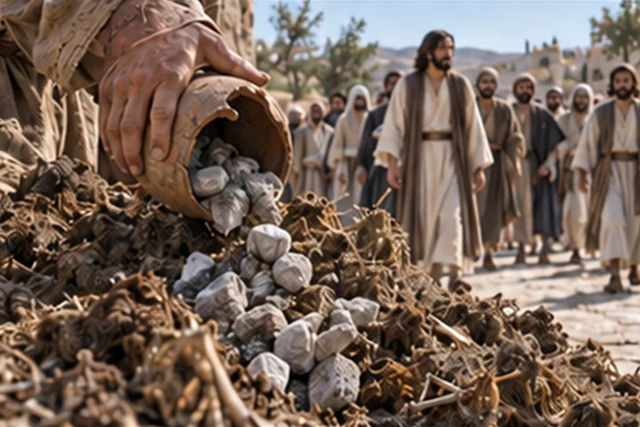
Salt is good because salt does something. That simple observation makes the closing warning sharper than a discussion about labels. If what is called salt no longer performs its characteristic work, the name cannot restore the function. Luke even pushes the image to the point of uselessness: it is not fit for the land or the dung heap. The saying follows a chapter filled with distinctions between appearance and reality. A person can occupy a place at a table, hold an invitation, or move with a large traveling crowd and still fail to embody what that position implies. The Book of Luke does not ask the reader to solve the chemistry of ancient salt deposits or turn the image into an agricultural manual. Its force lies in the absurdity of an identity emptied of its defining character. After Jesus has stated the cost of discipleship plainly, “He that hath ears to hear, let him hear” closes the matter without pretending the terms were hidden.
Deep dive
The salt saying closes the chapter's movement from visible participation to actual fitness. A place in the traveling crowd, like a place on an invitation list, is not enough to establish that the intended purpose is being fulfilled. Salt is described in terms of what it does, and the loss of that function leaves it unsuitable even for the land or manure heap.
The image should not be stretched into an agricultural manual or a lesson in modern chemical purity. Its force is the incongruity of something bearing a familiar identity while no longer performing its characteristic work. After the repeated terms of discipleship, the closing summons to hear places the entire speech back before the accompanying crowds. The difficulty is not that the requirements were left unstated.
Words to trace: hear, salt, dunghill, ears, good, land
Verse-by-verse path
- Luke 14:34
“Lost his savour” is mōrainō, literally to become foolish or insipid, the verb Paul uses in Romans 1:22, “they became fools”. In 1611 “his” was still the usual possessive for things; “its” was just coming into use.
- Luke 14:35
“Cast it out” is literally “throw it outside”, and the same picture returns when the tenants “cast him out of the vineyard” (20:15). The closing summons repeats the words that ended the parable of the sower (8:8).
Luke 14:34-35
King James Version34Salt is good: but if the salt have lost his savour, wherewith shall it be seasoned?
35It is neither fit for the land, nor yet for the dunghill; but men cast it out. He that hath ears to hear, let him hear.
Questions to keep in mind while reading
- Watch what Jesus says and does, and how people respond.
- Trace kingdom, discipleship, opposition, cross, and resurrection in the evangelist’s own sequence.
- Let later doctrine clarify the scene without erasing its immediate setting.
Text first
Where readers differ
The chapter summary begins with what the passage says and how its parts fit together. It does not assume one denomination has already settled every question. Where a conclusion depends on a tradition, literary theory, or historical reconstruction, that dependence is named openly.
The KJV text is presented first. Interpretive conclusions are labeled, and differences are introduced only when they help a reader understand why serious communities do not always reach the same answer.
Comparative interpretive notes for this chapter are in preparation. Until reviewed notes are ready, this page separates the KJV text from summary and application without claiming that serious readers agree on every question.
Questions beneath the surface
- What account of God, human freedom, responsibility, and the good life emerges from Luke 14?
- Which tension does the chapter refuse to resolve quickly?
- What changes when the chapter is read as part of the whole canon rather than as an isolated moral lesson?
- Where might a sincere reader confuse a familiar tradition with something the text states directly?
Questions for serious personal contemplation
These open-ended questions make room for tension, honest response, prayer, and conclusions that remain accountable to the chapter.
Observe without rushing
What part of Luke 14 makes you stop, feel unsettled, or feel surprised, and why?
Which detail in the passage would be easiest to overlook? How does that detail change your understanding?
Where do you see tension between what happens and this focus: Luke 14 develops its own movement around bidden, servant, bade, room, supper?
What important question does the passage leave open instead of resolving quickly?
Examine your inner life honestly
Which person, response, fear, or desire in the passage feels most like your own life right now?
What assumption about God, other people, or yourself does this text challenge?
Which part would you rather soften, avoid, or explain away too quickly? What might that reaction reveal?
If this Scripture could ask you one direct question, what do you think it would ask?
Respond with wisdom and courage
What do you need to remember, confess, grieve, thank God for, or trust after reading this passage?
How might another faithful person read this situation differently without ignoring the text?
What obedient response would be costly, uncomfortable, or slow, yet still faithful to Scripture?
What question will you carry into prayer this week, and which verses will you keep in front of you?
Music and video connected to the passage
Related media appears when its Scripture reference overlaps this study. Music and video can illuminate a theme while the biblical text remains the foundation.