The big picture
Mark 4 is obsessed with hearing, but it refuses to treat sound reaching the ear as the same thing as understanding. From a boat, Jesus speaks of seed, soils, lamps, measures, hidden growth, and harvest. The private explanations do not flatter the insiders, because the people closest to him still need the parables explained. Some reception dies immediately, some starts enthusiastically and collapses, some grows without fruit because competing cares choke it, and some bears in different measures. The chapter then carries that question of perception onto the water. A great storm becomes a great calm, yet the disciples' fear grows rather than disappears. Their final question, "What manner of man is this?", proves that they have witnessed authority without yet knowing how to name it. Hearing and seeing remain unfinished work.
In this chapter
- The Seed Is the Same; the Ground Is Not Mark 4:1-9
The sower's seed is consistent; the ground is not.
- Explanation Does Not Flatter the Insiders Mark 4:10-20
Those closest to Jesus get an explanation only after admitting that the parable did not explain itself to them.
- A Lamp Brought in to Be Seen Mark 4:21-25
A lamp brought into a room belongs where its light can work.
- The Farmer Sleeps; the Seed Does Not Ask Permission Mark 4:26-34
The farmer has real work to do, but Mark refuses to make him the engineer of every stage.
- The Wind Stops, and the Fear Grows Mark 4:35-41
The storm comes on the same day as the teaching, so Mark does not let the boat become a disconnected miracle show.

Scripture beside the summary
Mark · King James Version · 41Mark 4:1-9
The Seed Is the Same; the Ground Is Not
The sower's seed is consistent; the ground is not. Mark gives most of the parable's space to different kinds of failure before the harvest appears, and the failures are not interchangeable. Seed on the path never develops. Seed in shallow ground springs up quickly but has no depth to survive the sun. Seed among thorns grows and still ends fruitless because other growth crowds it out. The fast beginning is especially important because visible enthusiasm can look like success long before endurance is tested. When good ground finally appears, even fruitfulness is not flattened into one identical output: thirty, sixty, and a hundred. The Book of Mark brackets the whole image with the command to hear. A large audience has gathered along the shore, but the parable quietly refuses to treat attendance as the result that matters. The same word can land in very different places.
Deep dive
The boat creates room for teaching that the shoreline crowd would otherwise make difficult. Jesus begins with a sower, but the account follows the seed after it leaves his hand. The different outcomes are not explained by different seed. The path leaves it exposed, shallow ground gives it a quick but rootless beginning, and thorns allow growth without fruit. These are distinct failures, not three decorative ways of saying nothing happens. Especially important is the seed that springs up immediately. Speed and visible promise can precede collapse.
The successful ground produces differing yields, thirty, sixty, and a hundred. Mark does not flatten fruitful hearing into a single output. Nor does the parable give instructions for identifying the soils by looking at people before they hear. It establishes a pattern that the following explanation will connect to reception of the word. The summons to listen surrounds the whole account, so hearing is already more than sitting within range of the speaker. A large audience has assembled, but numerical reach does not settle the question of what the teaching will produce. Mark's earlier crowds make this agricultural image especially pointed: much contact can coexist with very different responses.
Words to trace: some, fell, earth, fruit, ground, hear
Verse-by-verse path
- Mark 4:1
A teacher in Jesus’ day sat to teach, and here the seat is a boat. The crowd stands on the slope of the shore, which works like the tiers of a theatre and carries a voice over water. The boat itself was readied back in 3:9 against the crush of the crowd.
- Mark 4:2
“Doctrine” in 1611 meant teaching, not a formal creed; the Greek is simply didache, instruction. “Parables” translates a word that also covered the Hebrew mashal: proverb, riddle, taunt, comparison, any saying that makes a hearer work.
- Mark 4:3
Jesus opens with two commands, hear and look. “Hearken” echoes the Shema, the daily prayer beginning “Hear, O Israel” (Deuteronomy 6:4). The pair of hearing and seeing will return in verse 12, turned against those who do both and grasp nothing.
- Mark 4:4
The “way side” is the hard footpath trodden along or through the field, where seed cannot sink in. The birds do not have to search; the seed lies on top of packed earth in plain view.
- Mark 4:5
“Stony ground” is not a field full of loose stones but a thin skin of soil over limestone bedrock, common in Galilee. The shallow soil warms quickly, which is exactly why the seed shoots up first.
- Mark 4:6
“Withered” is the verb Mark uses for the man’s withered hand (3:1) and for the cursed fig tree (11:21). A green shoot with no root cannot draw water when the sun climbs, and it dies in the same heat that should have ripened it.
- Mark 4:7
The thorns were in the ground before the sower arrived, their roots hidden when the seed fell. They grow up alongside the crop and win the contest for light and water. This is the only soil of the three failures where the parable says outright “it yielded no fruit”.
- Mark 4:8
A hundredfold harvest is the kind Isaac reaped in the year the LORD blessed him (Genesis 26:12). The Greek verbs for this seed are continuous: it keeps springing up and keeps increasing, the only seed in the parable described as growing over time.
- Mark 4:9
The formula recalls Ezekiel 3:27, “He that heareth, let him hear”. It turns the parable into a test: the listener has to supply something the words alone do not give.
Mark 4:1-9
King James Version1And he began again to teach by the sea side: and there was gathered unto him a great multitude, so that he entered into a ship, and sat in the sea; and the whole multitude was by the sea on the land.
2And he taught them many things by parables, and said unto them in his doctrine,
3Hearken; Behold, there went out a sower to sow:
4And it came to pass, as he sowed, some fell by the way side, and the fowls of the air came and devoured it up.
5And some fell on stony ground, where it had not much earth; and immediately it sprang up, because it had no depth of earth:
6But when the sun was up, it was scorched; and because it had no root, it withered away.
7And some fell among thorns, and the thorns grew up, and choked it, and it yielded no fruit.
8And other fell on good ground, and did yield fruit that sprang up and increased; and brought forth, some thirty, and some sixty, and some an hundred.
9And he said unto them, He that hath ears to hear, let him hear.
Mark 4:10-20
Explanation Does Not Flatter the Insiders
Those closest to Jesus get an explanation only after admitting that the parable did not explain itself to them. That keeps insider status from becoming a certificate of easy understanding. The mystery of the kingdom is given, not awarded for superior intelligence. Mark's use of Isaiah also makes the role of parables harder than the comforting idea that they are merely simple illustrations. Hearing can occur without understanding, and disclosure can expose resistance as well as overcome ignorance. Then the soils are translated into kinds of reception. Satan removes the word from some. Others receive it gladly but have no root when affliction or persecution arrives. Still others are choked by ordinary cares, deceptive riches, and competing desires. The Book of Mark thereby makes both trouble and prosperity possible threats to fruitfulness. The question is not who heard first, but what the hearing becomes over time.
Deep dive
The questioners include those around Jesus as well as the twelve. The contrast between inside and outside follows the house scene of chapter 3, but membership in the inner conversation is not presented as effortless comprehension. Jesus explicitly challenges their failure to understand this parable. The "mystery" of the kingdom is something given, not a trophy for superior intelligence. The citation of Isaiah 6:9–10 introduces a harder matter: hearing can occur without understanding, and revelation can coincide with judgment. Some readings emphasize the judicial concealment expressed by "that" and "lest"; others emphasize the exposure of an already resistant response. Mark's wording should not be softened into the claim that parables are merely illustrations that make everything easier.
The explanation then becomes strikingly concrete. Satan removes the word from one group. Another receives it gladly but has no root when trouble comes because of that word. A third is choked not simply by suffering but by ordinary cares, deceptive riches, and competing desires. Enthusiasm and prosperity can therefore conceal different failures of reception. Fruitful hearers hear, receive, and produce. The sequence gives substance to the opening command to listen. It also explains why Mark can report widespread amazement without treating it as a settled account of discipleship. The test of the seed's reception extends beyond its first visible appearance.
Words to trace: word, sown, hear, immediately, know, some
Verse-by-verse path
- Mark 4:10
In the Greek they ask about “the parables”, plural, though the King James says “the parable”. The circle is wider than the twelve: “they that were about him” is a phrase Mark used in 3:34 of those sitting around him, whom Jesus called his mother and brothers.
- Mark 4:11
“Mystery” in the Bible is not a puzzle that cannot be solved but a secret that God has chosen to reveal. The word is used that way of the king’s dream in Daniel 2, where the secret is made known to Daniel in a night vision.
- Mark 4:12
Isaiah’s Hebrew ends with the people being “healed”. Mark’s wording, “their sins should be forgiven them”, matches the Aramaic paraphrase of Isaiah read in synagogues, the Targum. Jesus seems to quote the prophet in the form his hearers knew from worship.
- Mark 4:13
Only Mark keeps this rebuke. Matthew, at the same point, has Jesus call the disciples’ eyes and ears blessed (Matthew 13:16). The sower is presented as the parable about parables: grasp how the word is received and the others open up.
- Mark 4:14
“The word” is used on its own, with no qualifier, the way the early church spoke of the gospel message. Mark has already said Jesus “preached the word unto them” in the crowded house at Capernaum (2:2).
- Mark 4:15
The birds of verse 4 become Satan. The book of Jubilees, a Jewish writing older than the gospels, tells how the prince of evil spirits sent ravens to eat the seed farmers had sown, so the image of evil as a seed-stealing bird was already familiar.
- Mark 4:16
Gladness is not the fault here. Mark will show a case of it in 6:20, where Herod hears John the Baptist gladly and still ends by giving the order that has John beheaded.
- Mark 4:17
“Offended” is skandalizo, to be tripped by a snare or trap. The same verb comes back on the night of the arrest, when Jesus tells the twelve, “All ye shall be offended because of me this night” (14:27).
- Mark 4:18
This ground does hear. The explanation piles up the phrase “such as hear the word” across these verses, so that in every case the word has reached the ear and the difference lies in what happens next.
- Mark 4:19
Mark will give a face to “the deceitfulness of riches” in 10:22, the man who went away grieved, “for he had great possessions”. The thorns are also said to be “entering in”: the competing desires come from outside and crowd in.
- Mark 4:20
The Greek verbs are in the present tense: they go on hearing, go on receiving, go on bearing fruit. “Receive” is a word for welcoming something and accepting it as your own, not just letting it arrive.
Mark 4:10-20
King James Version10And when he was alone, they that were about him with the twelve asked of him the parable.
11And he said unto them, Unto you it is given to know the mystery of the kingdom of God: but unto them that are without, all these things are done in parables:
12That seeing they may see, and not perceive; and hearing they may hear, and not understand; lest at any time they should be converted, and their sins should be forgiven them.
13And he said unto them, Know ye not this parable? and how then will ye know all parables?
14The sower soweth the word.
15And these are they by the way side, where the word is sown; but when they have heard, Satan cometh immediately, and taketh away the word that was sown in their hearts.
16And these are they likewise which are sown on stony ground; who, when they have heard the word, immediately receive it with gladness;
17And have no root in themselves, and so endure but for a time: afterward, when affliction or persecution ariseth for the word’s sake, immediately they are offended.
18And these are they which are sown among thorns; such as hear the word,
19And the cares of this world, and the deceitfulness of riches, and the lusts of other things entering in, choke the word, and it becometh unfruitful.
20And these are they which are sown on good ground; such as hear the word, and receive it, and bring forth fruit, some thirtyfold, some sixty, and some an hundred.
Mark 4:21-25
A Lamp Brought in to Be Seen
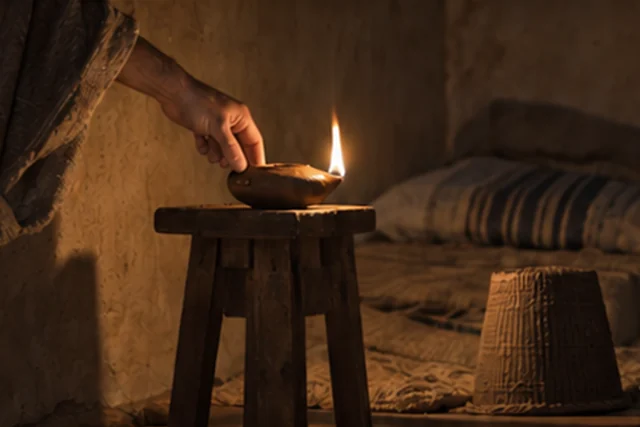
A lamp brought into a room belongs where its light can work. Mark places that simple image directly after difficult language about hiddenness, and the effect is to prevent concealment from becoming the final word. What is hidden is headed toward manifestation. The kingdom can be obscure now without being destined for permanent secrecy. Then the command about ears returns and becomes even sharper: "Take heed what ye hear." That line governs what follows about measure and increase. The Book of Mark is not offering a detached formula about financial giving or material return. It is still talking about reception of the word. What is received can open into more; what is neglected can be lost. The warning sits beside the soils, the private explanation, and the problem of shallow or crowded hearing. Exposure to sound is easy. Possessing what the sound means is the demanding part.
Deep dive
A lamp belongs where its light can do its work. Putting it beneath a measuring basket or a bed defeats the purpose for which it was brought. Coming immediately after the difficult explanation of parables, the image prevents concealment from becoming the chapter's final account of the kingdom. What is hidden is to be manifested. Mark holds present obscurity and eventual disclosure together, rather than forcing the teaching into either permanent secrecy or immediate transparency.
The repeated call about ears leads directly to "Take heed what ye hear." That wording controls the sayings about measure and increase. In this setting, the issue is reception of the teaching, not a promise that a particular payment will produce a larger financial payment. Hearing has consequences: what is received can lead to more, while what is neglected can be lost. The chapter has already supplied the soils, the pressures that choke growth, and the need for explanation. The lamp and measure sayings deepen the same subject from another angle. The word is intended for disclosure, but exposure to its sound is not identical with possessing its meaning.
Words to trace: hear, abroad, bushel, candle, candlestick, ears
Verse-by-verse path
- Mark 4:21
“Candle” is a small clay oil lamp; the “bushel” is a grain measure holding about two gallons. The Greek literally asks “Does the lamp come?”, an odd way to speak of an object, and many readers hear in it the one who has come.
- Mark 4:22
The Greek construction says that nothing is hidden except in order to be revealed. Concealment is given a purpose, and the purpose is disclosure.
- Mark 4:23
The call from verse 9 returns word for word, now attached to the lamp. It brackets the two sayings about light and measure as another test of hearing.
- Mark 4:24
“Mete” is an old verb for measuring out. Matthew 7:2 uses this proverb about judging others; Mark attaches it to hearing, so the measure of attention you give determines what comes back to you.
- Mark 4:25
The saying sounds like a harsh rule of the market, and it appears again in the parable of the talents (Matthew 25:29). In Mark it follows directly on “unto you that hear”, which makes the thing possessed or lost the word itself.
Mark 4:21-25
King James Version21And he said unto them, Is a candle brought to be put under a bushel, or under a bed? and not to be set on a candlestick?
22For there is nothing hid, which shall not be manifested; neither was any thing kept secret, but that it should come abroad.
23If any man have ears to hear, let him hear.
24And he said unto them, Take heed what ye hear: with what measure ye mete, it shall be measured to you: and unto you that hear shall more be given.
25For he that hath, to him shall be given: and he that hath not, from him shall be taken even that which he hath.
Mark 4:26-34
The Farmer Sleeps; the Seed Does Not Ask Permission
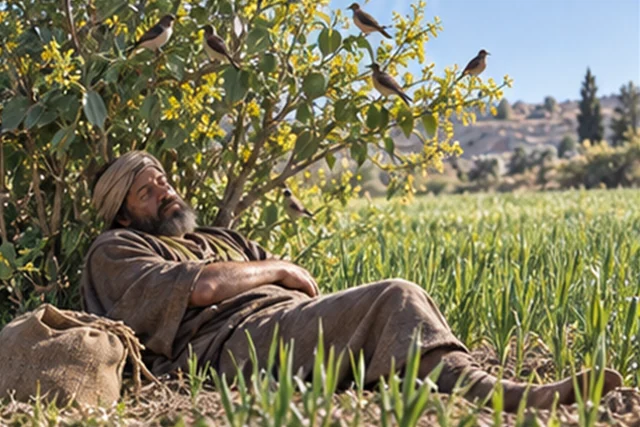
The farmer has real work to do, but Mark refuses to make him the engineer of every stage. He casts seed, sleeps, rises, and later harvests, while the growth from blade to ear to full grain proceeds beyond his control and even beyond his explanation. The kingdom is compared to that hidden development. Unseen does not mean inactive, and human inability to manufacture the process does not mean nothing is happening. The mustard seed then shifts the emphasis from hidden process to disproportion. What begins small produces branches large enough to offer shelter. Together, the images make present appearance a poor guide to eventual scale. The Book of Mark closes the teaching scene by distinguishing public parables from private explanation, but it does not let the disciples congratulate themselves for receiving extra information. The next scene will show that explanation can be heard before its implications are understood.
Deep dive
The farmer sows, sleeps, rises, and eventually harvests. Between sowing and harvest, the growth proceeds beyond his understanding. The detail is not an insult to farmers; it locates the limit of their control. He has a real task at the beginning and a real task at the end, but he cannot manufacture the sequence from blade to ear to full grain by remaining anxiously awake. The kingdom is compared to that process. Its hidden development is not the same as inactivity, and the harvest arrives when the crop is ready rather than when the farmer has solved the mystery of its growth.
The mustard seed shifts attention from hidden process to disproportion. A small beginning produces a plant with branches large enough to offer shade. Jesus calls it greater than the herbs, keeping the comparison within the agricultural image rather than presenting a botanical catalogue. Together the two parables challenge judgments made solely from what is presently visible. Mark then notes that Jesus speaks as the hearers are able to hear and explains matters privately to his disciples. The distinction is not proof that the disciples have mastered the material. The following crossing will show otherwise. Explanation has been given, but its implications still have to reach the people who received it.
Words to trace: earth, seed, fruit, kingdom, sown, spake
Verse-by-verse path
- Mark 4:26
The parable of the seed growing by itself is found only in Mark. It begins without a question or introduction: “So is the kingdom of God”, as though the listener has already been told what it is like.
- Mark 4:27
“Night and day” is the Jewish order, in which the day begins at sunset. The Greek puts emphasis on the man: he himself does not know how. The farmer’s whole contribution in this verse is sleeping and getting up.
- Mark 4:28
“Of herself” is automate, the source of the English word automatic. Acts 12:10 uses it of the iron gate that opens for Peter of its own accord. “Corn” in 1611 meant any grain, here wheat or barley, from blade to ear to the full head.
- Mark 4:29
“Putteth in the sickle, because the harvest is come” is close to the wording of Joel 3:13, “Put ye in the sickle, for the harvest is ripe”, a harvest of judgment at the end of days. The verb for putting in is literally “sends”, the verb from which apostle comes.
- Mark 4:30
Two questions before the comparison, a style used by the rabbis to introduce a parable and heard already in Isaiah 40:18, “To whom then will ye liken God?” Jesus says “we”, drawing the hearers into the search for an image.
- Mark 4:31
The black mustard seed is about a millimetre across. “Less than all the seeds” was proverbial, not a botanist’s ranking; the rabbis also used “as a mustard seed” for the smallest quantity worth speaking of.
- Mark 4:32
Birds lodging in the shade of a great tree is Old Testament language for a kingdom that shelters the nations (Ezekiel 17:23, 31:6, Daniel 4:12). Mustard is a garden shrub that can reach head height or more, a modest tree for such a grand image.
- Mark 4:33
Mark has recorded only four parables in this chapter, but “many such parables” shows he is selecting from far more. The measure of the teaching was the hearers’ capacity, not the teacher’s supply.
- Mark 4:34
“Expounded” is a verb for untying or loosing, the word used for solving a riddle. The disciples receive the answers privately, and the next scene will show how far they still are from understanding them.
Mark 4:26-34
King James Version26And he said, So is the kingdom of God, as if a man should cast seed into the ground;
27And should sleep, and rise night and day, and the seed should spring and grow up, he knoweth not how.
28For the earth bringeth forth fruit of herself; first the blade, then the ear, after that the full corn in the ear.
29But when the fruit is brought forth, immediately he putteth in the sickle, because the harvest is come.
30And he said, Whereunto shall we liken the kingdom of God? or with what comparison shall we compare it?
31It is like a grain of mustard seed, which, when it is sown in the earth, is less than all the seeds that be in the earth:
32But when it is sown, it groweth up, and becometh greater than all herbs, and shooteth out great branches; so that the fowls of the air may lodge under the shadow of it.
33And with many such parables spake he the word unto them, as they were able to hear it.
34But without a parable spake he not unto them: and when they were alone, he expounded all things to his disciples.
Mark 4:35-41
The Wind Stops, and the Fear Grows
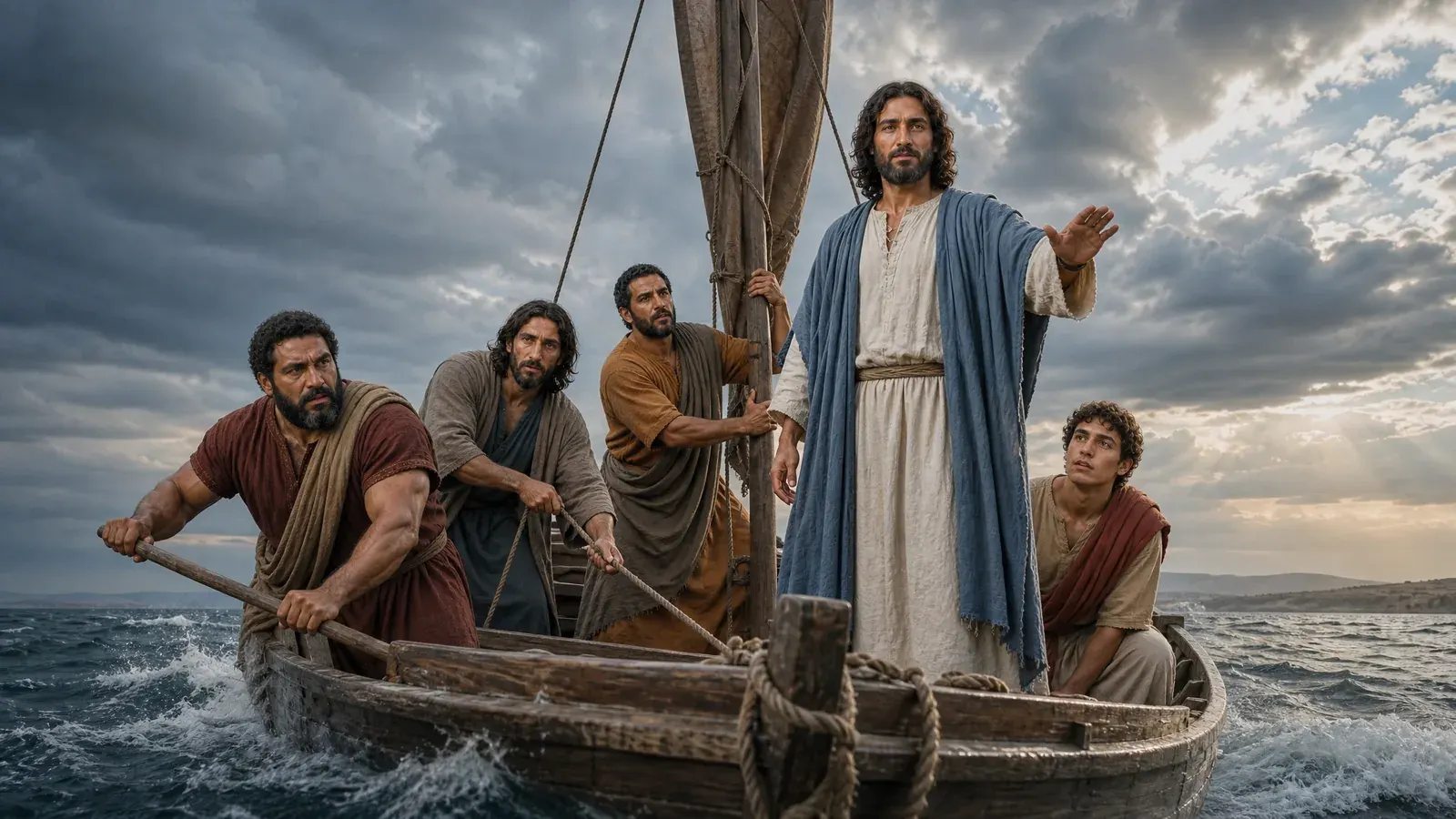
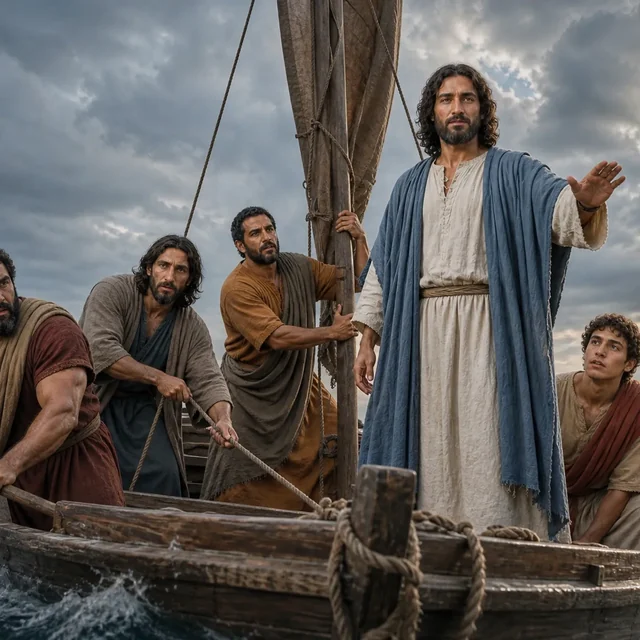
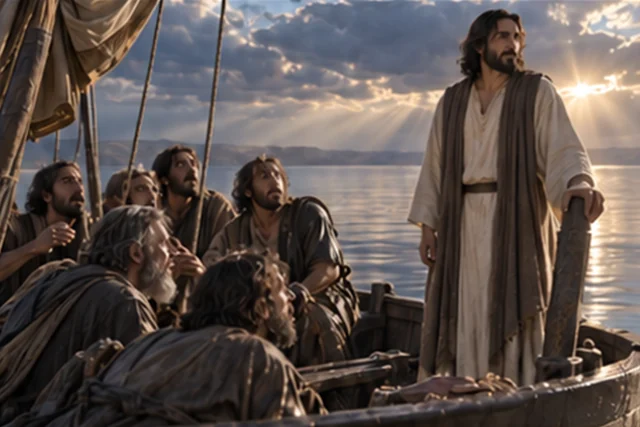
The storm comes on the same day as the teaching, so Mark does not let the boat become a disconnected miracle show. Waves fill the vessel while Jesus sleeps on a cushion in the stern. The disciples wake him with more than a weather report: "carest thou not that we perish?" Their danger is real, but so is the conclusion they draw from his sleep. Jesus rebukes the wind and commands the sea, and a great storm becomes a great calm. Then the emotional temperature rises rather than falls. The disciples fear exceedingly. The Book of Mark turns relief into a deeper question because the immediate threat has revealed an authority they cannot classify. Wind and sea obey him, and Psalm 107 provides a scriptural background in which the Lord stills such danger. Mark leaves the disciples with identity, not meteorology, as the problem they can no longer avoid.
Deep dive
The crossing occurs that same day, tying the storm to the teaching rather than beginning an unrelated collection of wonders. Mark includes other boats, waves filling the vessel, and Jesus asleep on a cushion in the stern. The disciples wake him with an accusation about care, not merely a report of bad weather. Their danger is real in the account. The problem is not that they have invented a storm; it is what they conclude from his sleep while it is happening.
Jesus rebukes the wind and commands the sea, and the great storm gives way to great calm. Mark then records that the disciples fear exceedingly. The disappearance of the immediate danger has not made the scene comfortable. Instead, it has exposed an authority they do not yet know how to describe. Their final question concerns the identity of one whom wind and sea obey. Psalm 107:23–30 provides a relevant scriptural background, where the Lord stills the storm and brings distressed sailors to calm. Mark does not stop for an extended explanation of the connection. The sequence is sufficient: teaching about the kingdom has been followed by an act that forces the hearers to reconsider the teacher.
Words to trace: wind, ship, arose, asleep, awake, beat
Verse-by-verse path
- Mark 4:35
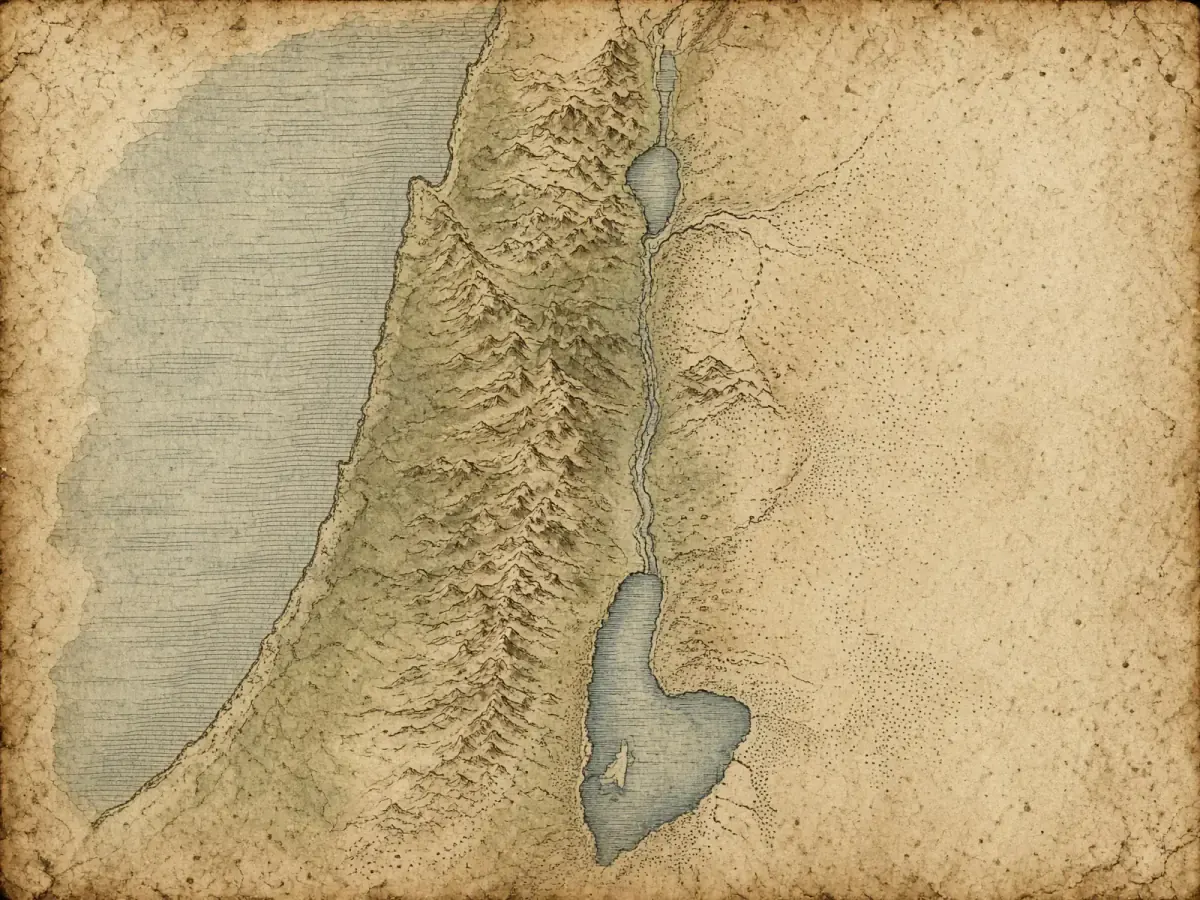
“The other side” is the eastern shore, Gentile country, where the man of the tombs will meet them in chapter 5. It is evening, so the crossing is made in the dark.
- Mark 4:36
“Even as he was” means straight from the teaching seat, without going ashore first. Only Mark mentions “other little ships”, which appear in this verse and are never heard of again.
- Mark 4:37
The Sea of Galilee lies about seven hundred feet below sea level in a basin ringed by hills, and cold air can pour down the valleys and whip it up within minutes. The Greek for “storm of wind” is the word for a squall or whirlwind.
- Mark 4:38
“A pillow” is “the cushion” in Greek, perhaps the one kept for the helmsman at the stern or a sandbag carried as ballast. “Master” is teacher, didaskale, the title of the man who has just spent the day teaching them. They accuse him of not caring.
- Mark 4:39
“Be still” is literally “be muzzled”, the word Jesus used to silence the unclean spirit in the synagogue (1:25). He rebukes the wind in the same terms, as though it were a hostile power rather than weather.
- Mark 4:40
“Fearful” means timid or cowardly. Many early manuscripts read “Have ye not yet faith?”, which puts the stress on a faith still to come rather than one absent altogether.
- Mark 4:41
“They feared exceedingly” is literally “they feared a great fear”, the phrase the Greek Old Testament uses of the sailors in Jonah 1:10 and 1:16. A sleeper in a boat, a storm stilled, a crew more afraid after the calm than before it: the parallel is hard to miss.
Mark 4:35-41
King James Version35And the same day, when the even was come, he saith unto them, Let us pass over unto the other side.
36And when they had sent away the multitude, they took him even as he was in the ship. And there were also with him other little ships.
37And there arose a great storm of wind, and the waves beat into the ship, so that it was now full.
38And he was in the hinder part of the ship, asleep on a pillow: and they awake him, and say unto him, Master, carest thou not that we perish?
39And he arose, and rebuked the wind, and said unto the sea, Peace, be still. And the wind ceased, and there was a great calm.
40And he said unto them, Why are ye so fearful? how is it that ye have no faith?
41And they feared exceedingly, and said one to another, What manner of man is this, that even the wind and the sea obey him?
Questions to keep in mind while reading
- Watch what Jesus says and does, and how people respond.
- Trace kingdom, discipleship, opposition, cross, and resurrection in the evangelist’s own sequence.
- Let later doctrine clarify the scene without erasing its immediate setting.
Text first
Where readers differ
The chapter summary begins with what the passage says and how its parts fit together. It does not assume one denomination has already settled every question. Where a conclusion depends on a tradition, literary theory, or historical reconstruction, that dependence is named openly.
The KJV text is presented first. Interpretive conclusions are labeled, and differences are introduced only when they help a reader understand why serious communities do not always reach the same answer.
Comparative interpretive notes for this chapter are in preparation. Until reviewed notes are ready, this page separates the KJV text from summary and application without claiming that serious readers agree on every question.
Questions beneath the surface
- What account of God, human freedom, responsibility, and the good life emerges from Mark 4?
- Which tension does the chapter refuse to resolve quickly?
- What changes when the chapter is read as part of the whole canon rather than as an isolated moral lesson?
- Where might a sincere reader confuse a familiar tradition with something the text states directly?
Questions for serious personal contemplation
These open-ended questions make room for tension, honest response, prayer, and conclusions that remain accountable to the chapter.
Observe without rushing
What part of Mark 4 makes you stop, feel unsettled, or feel surprised, and why?
Which detail in the passage would be easiest to overlook? How does that detail change your understanding?
Where do you see tension between what happens and this focus: Jesus teaching parables from the boat and later sleeping during the storm before rebuking wind and sea?
What important question does the passage leave open instead of resolving quickly?
Examine your inner life honestly
Which person, response, fear, or desire in the passage feels most like your own life right now?
What assumption about God, other people, or yourself does this text challenge?
Which part would you rather soften, avoid, or explain away too quickly? What might that reaction reveal?
If this Scripture could ask you one direct question, what do you think it would ask?
Respond with wisdom and courage
What do you need to remember, confess, grieve, thank God for, or trust after reading this passage?
How might another faithful person read this situation differently without ignoring the text?
What obedient response would be costly, uncomfortable, or slow, yet still faithful to Scripture?
What question will you carry into prayer this week, and which verses will you keep in front of you?
Music and video connected to the passage
Related media appears when its Scripture reference overlaps this study. Music and video can illuminate a theme while the biblical text remains the foundation.