
The big picture
Mark 5 moves across boundaries that look final until Jesus reaches them. A man living among tombs cannot be restrained even by chains, yet the many spirits within him still have to ask permission. His restoration frightens the surrounding people enough that they ask Jesus to leave. Back across the sea, Jairus asks for help before his daughter dies, and the journey is interrupted by a woman whose suffering has lasted twelve years. Mark braids the two encounters together so that delay, touch, fear, faith, and family language echo between them. The woman is called "Daughter" while Jesus is traveling toward Jairus' daughter. Then death itself arrives as a report meant to end the request. It does not. The chapter closes not on spectacle but on an ordinary command that the restored girl be given something to eat.
In this chapter
- A Name That Speaks in the Plural Mark 5:1-13
Before Jesus says anything to the man among the tombs, Mark has already shown why ordinary control has failed.
- The Restored Man Stays; Jesus Departs Mark 5:14-20
The neighbors come out to find a man they knew through violence and chains now sitting, clothed, and in his right mind.
- A Ruler at the Feet of Jesus Mark 5:21-24
Jairus arrives with social standing, a name, and no trace of official distance.
- One Touch in a Crowd Full of Touching Mark 5:25-34
The woman enters the crowd after twelve years of failed treatment, depleted resources, and worsening health.
- Death Reported, a Hand Taken, Food Requested Mark 5:35-43
The messengers arrive while Jesus is still speaking and present death as the point where the request should stop: why trouble the Master any further?

Scripture beside the summary
Mark · King James Version · 43Mark 5:1-13
A Name That Speaks in the Plural
Before Jesus says anything to the man among the tombs, Mark has already shown why ordinary control has failed. Chains are broken, fetters are shattered, and the man wounds himself among the dead. His strength is not freedom; it is part of his misery. Then the encounter turns on recognition from the wrong side. The unclean spirit knows Jesus as the Son of the most high God and pleads not to be tormented. When the name "Legion" is given, Mark explains the point simply: "for we are many." The military sound increases the scale, but the text never converts the swine into a numerical census of spirits. What matters more is the chain of permission. The spirits beg, and Jesus allows. Their power over the man has looked overwhelming, yet before Jesus even this multitude has to ask where it may go.
Deep dive
Mark gives unusual space to the man's condition before describing the encounter. Broken chains demonstrate that restraint has failed, while crying and self-wounding show that this strength is not freedom. He lives among the dead and cannot be brought under ordinary social control. The arrival of Jesus changes the direction of the scene immediately. The voice that recognizes the Son of the most high God also pleads not to be tormented. Recognition again belongs to opposition rather than allegiance.
"Legion" is explained by the statement that there are many. Its military sound intensifies the scale, but Mark does not specify an exact number of spirits or turn the encounter into an explicit allegory of a particular army. The swine number about two thousand; that is not a count of the spirits. Their requests and Jesus' permission establish the governing relation more clearly than a calculation could. The herd's destruction makes the departure visible and leaves a material loss that the witnesses will report. Mark records the event without explaining ownership, compensation, or the ultimate destination of the spirits after the animals drown. Those unanswered matters should not displace the movement the passage does describe: the destructive power that held the man is being driven out.
Words to trace: chains, Jesus, swine, tombs, unclean, besought
Verse-by-verse path
- Mark 5:1
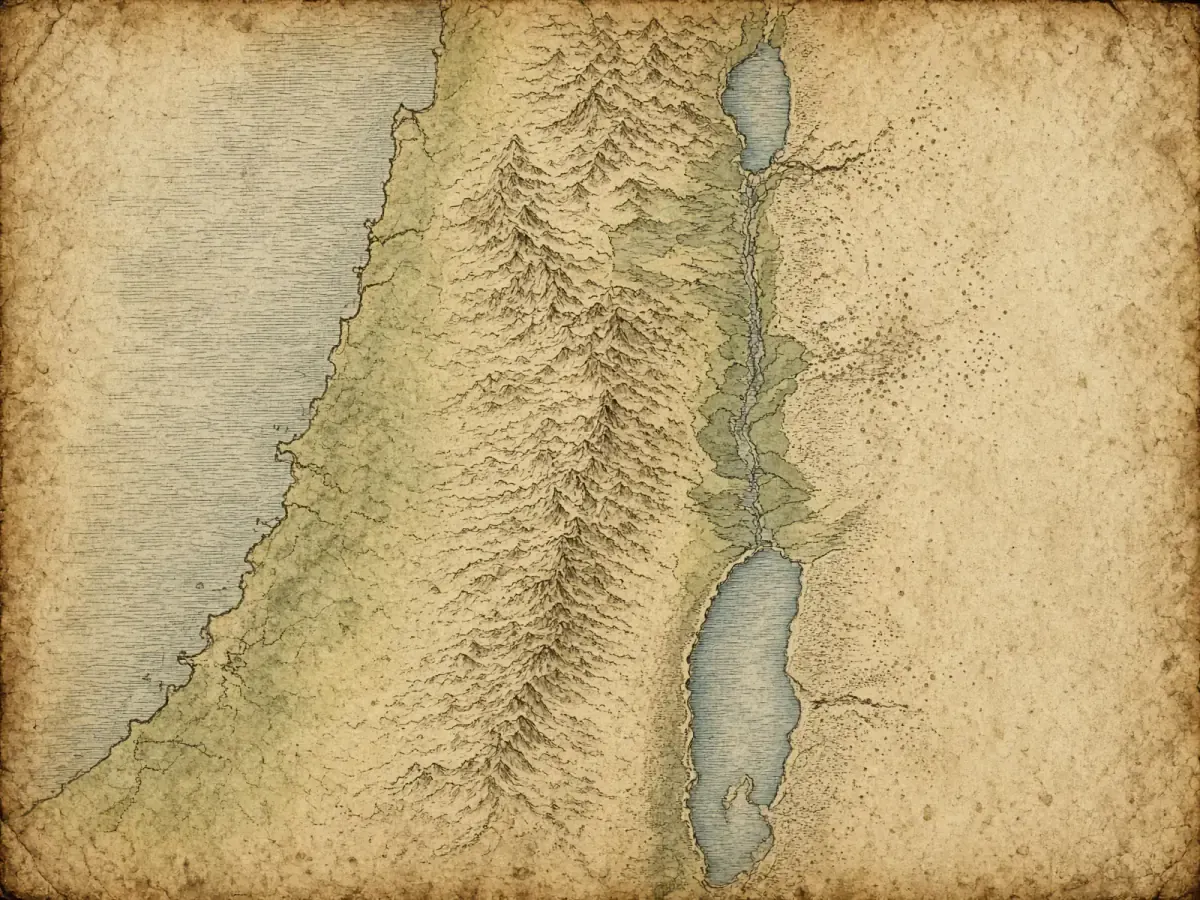
The manuscripts disagree about the place: Gerasenes in the oldest copies of Mark, Gadarenes in the Received Text, Gergesenes in others. Gerasa lay over thirty miles from the lake and Gadara about six. A steep slope at Kursi on the east shore is often proposed as the site. Either way, this is Gentile country.
- Mark 5:2
The man meets Jesus as he steps off the boat, before anyone else can speak. Tombs made a person unclean by contact (Numbers 19:16), and on the eastern shore they were caves cut into the limestone hillsides, the kind of shelter a man driven out of a town might find.
- Mark 5:3
Isaiah 65:4 describes a rebellious people “which remain among the graves” and “eat swine’s flesh”, the same pairing of tombs and pigs this chapter brings together. The Greek piles up negatives, “no one any longer could, not even with a chain”, as if every attempt had been tried and abandoned.
- Mark 5:4
“Fetters” are shackles for the feet and “chains” are for the hands. “Tame” is damasai, the word for breaking in a wild animal, the verb James 3:7–8 uses of beasts and the tongue. The townspeople have treated him as a creature to be subdued, and failed.
- Mark 5:5
“Cutting himself” is katakoptōn, gashing, and the loose flints of the hillside would serve. The Law forbade Israel to cut the body for the dead (Leviticus 19:28), and the prophets of Baal gashed themselves with knives on Carmel (1 Kings 18:28). “Crying” is a raw word for shouting or shrieking.
- Mark 5:6
A man no one could bind runs toward Jesus rather than away. “Worshipped” is prosekynēsen, to prostrate oneself, a gesture of homage that need not mean devotion; the soldiers do the same in mockery in 15:19. “Afar off” suggests the man saw the boat come in and ran down the slope.
- Mark 5:7
“The most high God” is the title for Israel’s God used by or before outsiders in the Old Testament: Melchizedek (Genesis 14:19), Balaam (Numbers 24:16), Nebuchadnezzar (Daniel 4:34). It fits Gentile ground. “I adjure thee” is horkizō, the formula exorcists used to bind a spirit, here turned on the exorcist himself.
- Mark 5:8
“For he said” is an imperfect, “he had been saying”. The Book of Mark explains the spirit’s plea after the fact: the command to come out was already given before the spirit begged not to be tormented. The order of events is reversed in the telling to put the cry first.
- Mark 5:9
A Roman legion numbered about five or six thousand men. The Tenth Legion, Fretensis, stationed in Syria and later in Judaea, carried a boar among its emblems, which some readers link to the pigs in verse 11. Jesus asks the question; the answer comes in a singular that becomes a plural.
- Mark 5:10
“The country” is chōra, the region. The spirits fear being sent out of the district, as though they belonged to it. Luke’s version has them begging not to be sent “into the deep”, the abyss (Luke 8:31). “Besought him much” is the same verb the townspeople and the healed man will use.
- Mark 5:11
Pigs were unclean under Leviticus 11:7, and no Jewish farmer would raise them. A great herd on this hillside shows that the land belongs to the Greek cities of the Decapolis, where pork was eaten and pigs were sacrificed. “Nigh unto the mountains” means on the slope above the shore.
- Mark 5:12
For the first time the spirits speak as a group, “all the devils”, without the man’s voice in the way. “That we may enter into them” shows spirits seeking a body to live in, and asking to move from one host to another rather than be left without any.
- Mark 5:13
Only Mark gives the figure of two thousand, a herd worth a small fortune. “A steep place” is krēmnos, a cliff or bank. “Choked” is epnigonto, imperfect: they drowned one after another. The Book of Mark puts the number in a parenthesis, as if it were a note added for the reader.
Mark 5:1-13
King James Version1And they came over unto the other side of the sea, into the country of the Gadarenes.
2And when he was come out of the ship, immediately there met him out of the tombs a man with an unclean spirit,
3Who had his dwelling among the tombs; and no man could bind him, no, not with chains:
4Because that he had been often bound with fetters and chains, and the chains had been plucked asunder by him, and the fetters broken in pieces: neither could any man tame him.
5And always, night and day, he was in the mountains, and in the tombs, crying, and cutting himself with stones.
6But when he saw Jesus afar off, he ran and worshipped him,
7And cried with a loud voice, and said, What have I to do with thee, Jesus, thou Son of the most high God? I adjure thee by God, that thou torment me not.
8For he said unto him, Come out of the man, thou unclean spirit.
9And he asked him, What is thy name? And he answered, saying, My name is Legion: for we are many.
10And he besought him much that he would not send them away out of the country.
11Now there was there nigh unto the mountains a great herd of swine feeding.
12And all the devils besought him, saying, Send us into the swine, that we may enter into them.
13And forthwith Jesus gave them leave. And the unclean spirits went out, and entered into the swine: and the herd ran violently down a steep place into the sea, (they were about two thousand;) and were choked in the sea.
Mark 5:14-20
The Restored Man Stays; Jesus Departs
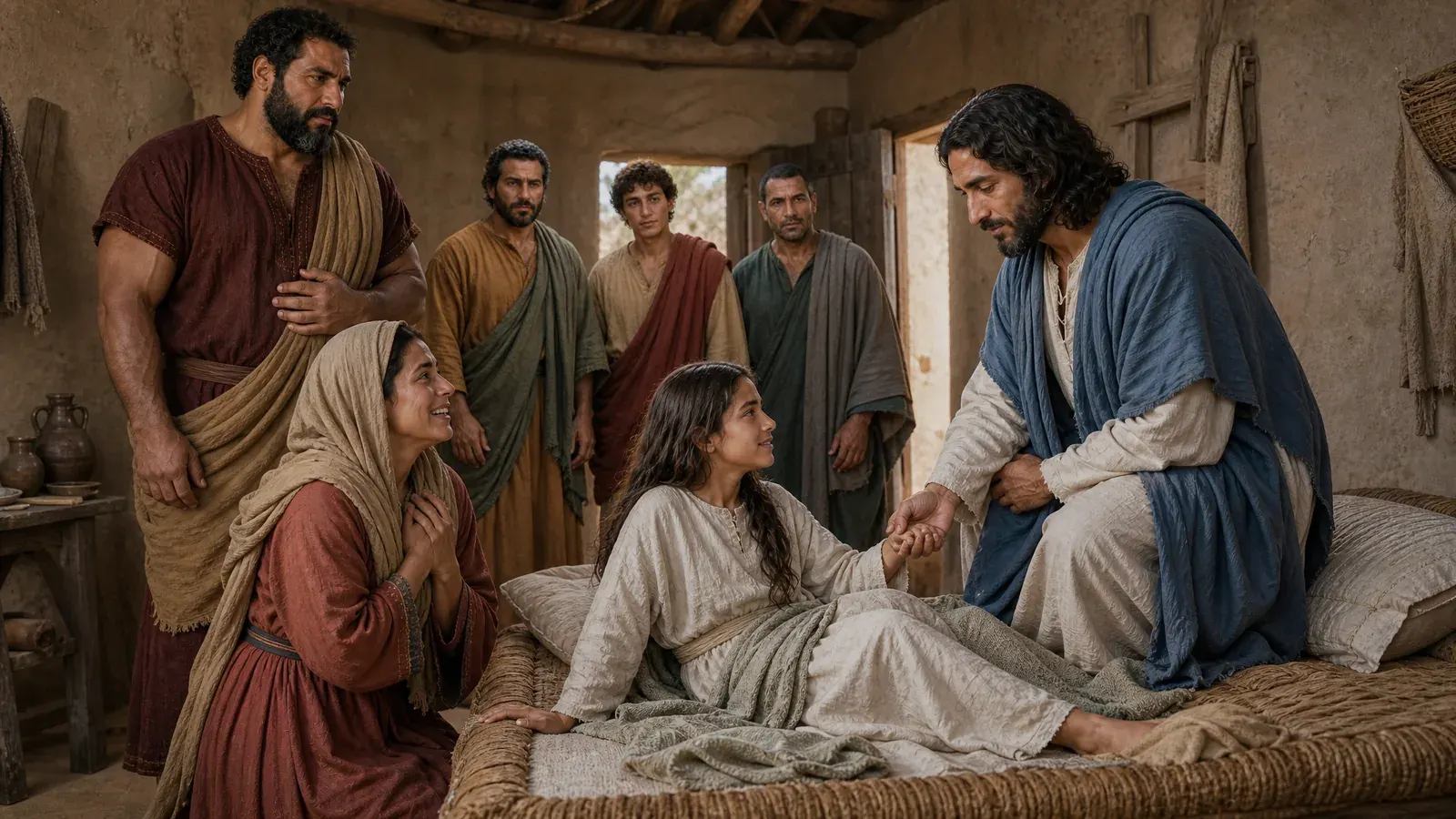
The neighbors come out to find a man they knew through violence and chains now sitting, clothed, and in his right mind. Mark attaches fear to the sight of restoration, not only to the earlier chaos. Reports about the swine are also part of what they hear, but the Book of Mark never states that they value livestock more than a human life. It records their response without inventing their arithmetic: they ask Jesus to leave. The restored man makes the opposite request. He wants to be with Jesus, language that recalls the purpose for which the twelve were appointed. Yet this request is denied in the form he asks. He is sent home instead, commissioned to tell what the Lord has done and how compassion has reached him. Jesus departs, but testimony does not. The man who had been isolated among tombs becomes the voice left behind in Decapolis.
Deep dive
The people find the man sitting, clothed, and in his right mind. He is no longer introduced through chains he breaks or wounds he inflicts. Sitting in his right mind now defines the encounter, while his clothing completes the public picture of restoration. Their fear is attached to this sight. Reports of the swine also reach them, but Mark does not reduce their request to a stated calculation that animals matter more than a person. It records what they see, what they hear, and what they ask. Jesus leaves when they ask him to depart.
Three requests have shaped the episode. The spirits ask to enter the swine, the people ask Jesus to leave, and the restored man asks to be with him. The last request is the one not granted in the form requested. Instead, he is sent home to declare the Lord's compassion. The commission differs sharply from the silencing commands elsewhere in Mark. This man's assignment is to speak. Mark then describes him proclaiming what Jesus has done, immediately after Jesus has told him to tell what the Lord has done. The wording draws the work of Jesus and the Lord's mercy together. Departure does not leave the region without testimony; the restored man becomes its continuing witness.
Words to trace: devil, Jesus, possessed, began, swine, told
Verse-by-verse path
- Mark 5:14
The herdsmen were answerable to owners, so their first job was to report. “The city” is probably Gerasa or Gadara, and “the country” is agrous, the farms around it. The report brings out a second crowd, curious rather than desperate, “to see what it was”.
- Mark 5:15
Three participles: sitting, clothed, sound-minded. “Clothed” implies he had been naked, which Luke 8:27 states and Mark leaves the reader to infer. “In his right mind” is sōphronounta, from sōphrosynē, the Greek virtue of self-control. “Had the legion” is a perfect participle: the one who had had it.
- Mark 5:16
“Told” is diēgēsanto, recounted in full, the verb Jesus uses in 9:9 when he forbids the three to tell anyone of the transfiguration. Here the eyewitnesses, herdsmen and perhaps disciples, give the townspeople the whole sequence, man first and pigs second.
- Mark 5:17
“Coasts” in 1611 meant borders or territory, not seashore. “Pray” is parakalein, to beg, the verb used of the spirits in verses 10 and 12 and of the healed man in verse 18. Three requests are made with one verb; Jesus grants the spirits’ and the townspeople’s, and refuses the healed man’s.
- Mark 5:18
The episode began as Jesus stepped out of the boat (verse 2) and ends as he steps back in. The man who ran to him at the landing is at the water again, this time asking to leave with him and give up his own country.
- Mark 5:19
Elsewhere in Mark those healed are told to keep quiet (1:44, 5:43, 7:36). In Gentile territory, where there is no crowd ready to make Jesus a king, the order is reversed: go and tell. “To thy friends” is literally “to your own people”. “The Lord” here could mean God; verse 20 puts Jesus in its place.
- Mark 5:20
The Decapolis was a league of Greek cities, mostly east of the Jordan; Pliny lists Gadara, Hippos, Gerasa, Scythopolis, Pella and others. “Publish” is kēryssein, to preach. The man preaches in ten cities before the twelve have even been sent out (6:12).
Mark 5:14-20
King James Version14And they that fed the swine fled, and told it in the city, and in the country. And they went out to see what it was that was done.
15And they come to Jesus, and see him that was possessed with the devil, and had the legion, sitting, and clothed, and in his right mind: and they were afraid.
16And they that saw it told them how it befell to him that was possessed with the devil, and also concerning the swine.
17And they began to pray him to depart out of their coasts.
18And when he was come into the ship, he that had been possessed with the devil prayed him that he might be with him.
19Howbeit Jesus suffered him not, but saith unto him, Go home to thy friends, and tell them how great things the Lord hath done for thee, and hath had compassion on thee.
20And he departed, and began to publish in Decapolis how great things Jesus had done for him: and all men did marvel.
Mark 5:21-24
A Ruler at the Feet of Jesus
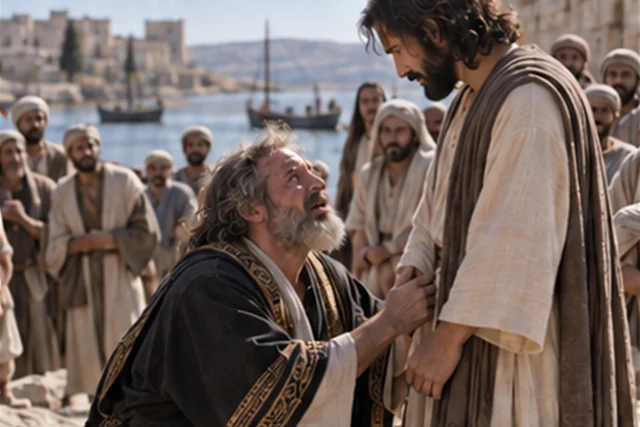
Jairus arrives with social standing, a name, and no trace of official distance. He falls at Jesus' feet and pleads for his little daughter, who is near death. Earlier synagogue scenes have included scrutiny and hostility, so Mark's introduction of a synagogue ruler seeking life prevents every representative of an institution from becoming the same character type. Jairus asks for a particular action: come, lay hands on her, and she will live. Jesus goes with him without recorded debate. That simple movement matters because the chapter is about to interrupt the journey. The crowd presses around them, and another person's crisis will take the center while Jairus' daughter remains near death. The Book of Mark gives the delay weight without putting unrecorded impatience into the father's mouth. Urgency is present because the facts make it urgent, not because Mark has to narrate his private thoughts.
Deep dive
Jairus is identified as one of the synagogue rulers, but his approach is not an official inquiry. He falls at Jesus' feet and pleads for his little daughter. Earlier synagogue encounters have included scrutiny and hostility; this synagogue leader comes seeking life. Mark prevents an institution's representatives from being treated as a single undifferentiated group. Office does not tell the whole account of the person.
His request contains a specific expectation: Jesus can come, lay hands on the child, and bring healing. Jesus sets out with him without a recorded negotiation. At this point the account could proceed directly to the house. Instead, the following crowd presses around Jesus, and Mark turns toward someone else within it. The interruption matters because the daughter is already near death. The next encounter will occupy not empty time but the interval inside another person's urgent appeal. Mark supplies enough information for the delay to carry weight without putting unrecorded words of frustration into Jairus' mouth.
Words to trace: Jesus, people, besought, cometh, daughter, death
Verse-by-verse path
- Mark 5:21
Jesus crosses back to the western, Jewish shore, the lake’s return journey after the storm and the Gentile hillside. Mark sets him “nigh unto the sea”, at the waterline, as he was when he taught from the boat in 4:1.
- Mark 5:22
Jairus is the Greek form of Jair, a name found in Numbers 32:41, and often explained as “he will enlighten” or “he will awaken”; the meaning is debated. A ruler of the synagogue was a lay officer who arranged services and chose readers. An inscription found in Jerusalem honours one, Theodotus, who built a synagogue.
- Mark 5:23
“Little daughter” is thygatrion, a diminutive of affection. “At the point of death” is literally “she has it at the last”. “Healed” is sōthē, saved: the same verb covers rescue, healing and salvation, and Jairus pairs it with “live”.
- Mark 5:24
Here Mark begins one account and sets another inside it, as he did with the family and the scribes in 3:20–35 and will again with the fig tree and the temple in chapter 11. “Thronged” is synethlibon, crushed together: the whole town is pressing against the man who is trying to reach a dying child.
Mark 5:21-24
King James Version21And when Jesus was passed over again by ship unto the other side, much people gathered unto him: and he was nigh unto the sea.
22And, behold, there cometh one of the rulers of the synagogue, Jairus by name; and when he saw him, he fell at his feet,
23And besought him greatly, saying, My little daughter lieth at the point of death: I pray thee, come and lay thy hands on her, that she may be healed; and she shall live.
24And Jesus went with him; and much people followed him, and thronged him.
Mark 5:25-34
One Touch in a Crowd Full of Touching
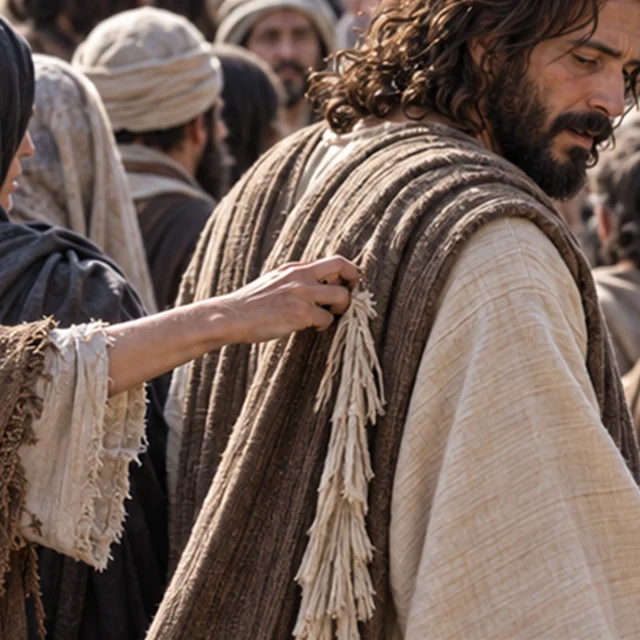
The woman enters the crowd after twelve years of failed treatment, depleted resources, and worsening health. Mark makes the duration costly, not merely long. She approaches from behind intending only to touch Jesus' clothes, and the healing occurs before she makes a public statement. Then Jesus stops. The disciples see a crowd so dense that his question about one touch sounds almost absurd, but Mark uses their practical objection to sharpen the distinction between general contact and this encounter. The Book of Mark does not turn the garment into an independent mechanism. The woman comes forward, tells the whole truth, and hears Jesus address her as "Daughter" while he is still on the way to another daughter. Her restoration is made personal and public after it is already physically real. The interruption gives her more than anonymity in a crowd, even as another household's emergency remains unresolved.
Deep dive
The woman's twelve years of suffering are described through expenditure and worsening, not merely duration. She has spent everything and has not improved. The detail places her at the end of an extended search rather than at the beginning of a casual experiment. Her intention is to touch Jesus' clothing, and she immediately knows that the affliction has stopped. The KJV's "virtue" in Jesus' response refers to power, not moral virtue leaving his character. The healing is already accomplished when he turns to identify the touch.
The disciples' objection has an almost unavoidable practical force: in a crowd this dense, everyone appears to be touching everyone. Mark lets their ordinary observation sharpen the distinction between general pressure and this particular encounter. The woman comes forward in fear and tells the truth. Jesus addresses her as "Daughter," a word with special force while he is on his way to Jairus' daughter. He identifies her faith and speaks peace, making the restoration personal and publicly acknowledged. Mark does not treat the garment as a mechanism that makes her response or his word unnecessary. While the conversation gives this woman room to speak, the unfinished journey to the other household remains present.
Words to trace: touched, whole, blood, clothes, Jesus, knowing
Verse-by-verse path
- Mark 5:25
Under Leviticus 15:25–27 a woman with a flow of blood beyond her time was unclean, and so was anything she lay or sat on. For twelve years she would have been barred from the temple courts and would have made unclean anyone she touched. Mark does not name her.
- Mark 5:26
“Suffered many things of many physicians” has a play in the Greek, polla pathousa hypo pollōn. Luke, called the physician, softens it to “could not be healed of any” (Luke 8:43). The Talmud later lists folk remedies for such a flow, including carrying the ash of an ostrich egg in a cloth.
- Mark 5:27
“Heard of Jesus” is literally heard “the things about Jesus”: she comes because of reports. The garment is the himation, the outer cloak; Matthew 9:20 says she touched its hem, meaning the tassels the Law commanded (Numbers 15:38). She comes from behind, perhaps because her touch would make him unclean.
- Mark 5:28
“She said” is imperfect, she kept saying it, and the saying is most likely to herself. “Whole” is sōthēsomai, the same verb as Jairus’s “healed” in verse 23. “But his clothes” means even his clothes: she does not expect to be noticed, only to reach the edge of him.
- Mark 5:29
“The fountain of her blood” is the phrase used in Leviticus 12:7 for a mother’s bleeding after childbirth, the legal term for the source of the flow. Mark says she “felt in her body”, literally knew in her body, and in the next verse Jesus knows in himself. Two knowings happen at once, one on each side of the touch.
- Mark 5:30
“Virtue” in 1611 meant power, from the Latin virtus; the Greek is dynamis. The sentence is careful: Jesus knows that power went out; he asks who touched. “Turned him about” shows him stopping dead in a moving crowd, on the way to a dying child.
- Mark 5:31
Luke 8:45 gives this remark to Peter; Mark leaves it to the disciples as a group. It is blunt, as their “carest thou not that we perish?” was in the boat (4:38). In Mark the disciples speak to Jesus with a frankness the later Gospels often tone down.
- Mark 5:32
The Greek has a feminine participle, “her that had done this”. The Book of Mark already knows it was a woman, while Jesus is still scanning the crowd. Whether Jesus knew is left open; the look continues until she chooses to come forward.
- Mark 5:33
“All the truth” would include twelve years of bleeding and the fact that she, being unclean, had touched a teacher in a crowd. She confesses it publicly, falling down as Jairus did in verse 22: two people at the same feet, a ruler and a woman with no standing at all.
- Mark 5:34
“Go in peace” is the Hebrew farewell of blessing, the words Eli spoke to Hannah (1 Samuel 1:17). “Hath made thee whole” is sesōken, a perfect tense: you have been saved and remain so. “Be whole of thy plague” uses a different word, hygiēs, healthy, so both her standing and her body are addressed.
Mark 5:25-34
King James Version25And a certain woman, which had an issue of blood twelve years,
26And had suffered many things of many physicians, and had spent all that she had, and was nothing bettered, but rather grew worse,
27When she had heard of Jesus, came in the press behind, and touched his garment.
28For she said, If I may touch but his clothes, I shall be whole.
29And straightway the fountain of her blood was dried up; and she felt in her body that she was healed of that plague.
30And Jesus, immediately knowing in himself that virtue had gone out of him, turned him about in the press, and said, Who touched my clothes?
31And his disciples said unto him, Thou seest the multitude thronging thee, and sayest thou, Who touched me?
32And he looked round about to see her that had done this thing.
33But the woman fearing and trembling, knowing what was done in her, came and fell down before him, and told him all the truth.
34And he said unto her, Daughter, thy faith hath made thee whole; go in peace, and be whole of thy plague.
Mark 5:35-43
Death Reported, a Hand Taken, Food Requested
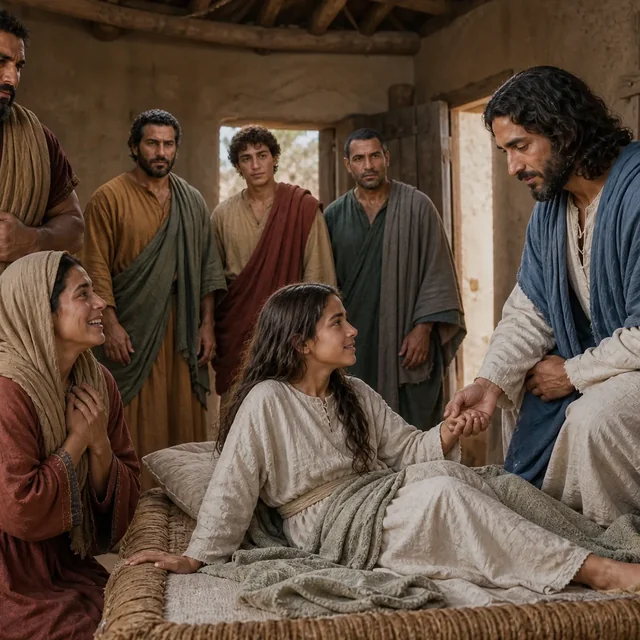
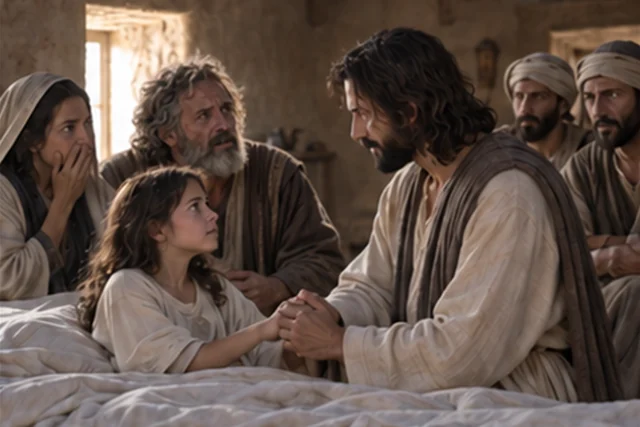
The messengers arrive while Jesus is still speaking and present death as the point where the request should stop: why trouble the Master any further? Mark lets Jesus answer that conclusion before the journey ends. At the house, public mourning turns to ridicule when he speaks of the girl as sleeping. The Book of Mark is not suggesting a medical misunderstanding. The death report, the household's certainty, and what follows all make the issue clear. Jesus narrows the witnesses, takes the girl's hand, and Mark preserves the small Aramaic command, "Talitha cumi," before translating it. The moment is intimate rather than theatrical. Only after she rises does Mark mention that she is twelve, matching the length of the woman's affliction. Then comes the wonderfully ordinary final instruction: feed her. The child is not left as an object of astonishment. She is alive, walking, and hungry.
Deep dive
The messengers treat death as the point beyond which the teacher should no longer be troubled. Jesus addresses Jairus before their conclusion can become the account's conclusion. Mark records the instruction to believe but does not describe Jairus' unspoken emotional response. At the house, mourning turns to scorn when Jesus calls the girl's condition sleep. The account is not suggesting that she has merely been misdiagnosed as dead. The report, the household's reaction, and the act that follows establish the contrast between death as they encounter it and its finality before Jesus.
The witnesses are restricted to the parents and three disciples. Jesus takes the girl's hand, and Mark preserves "Talitha cumi" before translating the command. The small spoken phrase slows the account at precisely the point where a bare report could rush past the encounter. Only after she rises and walks does Mark give her age: twelve, matching the duration of the woman's affliction. One life has lasted as long as the other's suffering. The two accounts illuminate each other without making either person a mere symbol. The closing instruction that she receive food is wonderfully concrete. The restored girl is not left as an object of astonishment. She is a living child who needs to eat.
Words to trace: damsel, ruler, dead, house, James, synagogue
Verse-by-verse path
- Mark 5:35
“Master” is didaskalos, teacher. “Troublest” is skylleis, which first meant to flay, then to harass or pester. The messengers assume the teacher’s help ends where death begins, and they assume it in front of the father.
- Mark 5:36
“Heard” is parakousas, which can mean overhearing, or disregarding; the Greek Old Testament often uses it for refusing to listen, and Matthew 18:17 has it as “neglect to hear”. Mark may mean Jesus overheard the report and ignored it. “Only believe” is a present imperative: keep on believing.
- Mark 5:37
For the first time three disciples are set apart from the twelve. Peter, James and John will be taken alone up the mountain of the transfiguration (9:2) and deeper into Gethsemane (14:33). Each time, what they see is something they cannot yet explain to anyone.
- Mark 5:38
“Tumult” is thorybos, uproar. Matthew 9:23 mentions flute players. The Mishnah later rules that even the poorest man in Israel must hire at least two flutes and one wailing woman for his wife’s funeral, so the noise here was expected and partly professional.
- Mark 5:39
“Ado” is thorybeisthe, the verb from the same root as the tumult. Sleep is already the Bible’s word for death that awaits a waking: “many of them that sleep in the dust of the earth shall awake” (Daniel 12:2). “Damsel” is paidion, a little child.
- Mark 5:40
“Laughed him to scorn” is a 1611 idiom for katagelaō, to laugh down, and the tense means they went on laughing. “Put them all out” is ekbalōn, the verb Mark uses for casting out devils, now used of the mourners. Five witnesses go in: two parents and three disciples.
- Mark 5:41
The Aramaic is talitha qumi; talitha means a lamb and was used for a young girl, much as English says “lamb” to a child. Some manuscripts spell the verb koum, the masculine form, as spoken Aramaic often did. The words “I say unto thee” are Mark’s addition in translating, not part of the Aramaic.
- Mark 5:42
“Arose” is anestē, and “walked” is imperfect, she began walking about. “Astonished with a great astonishment” is a Hebrew way of intensifying by repetition; the noun is ekstasis, the origin of the English word ecstasy, meaning to be put out of one’s senses.
- Mark 5:43
“Charged them straitly” is diesteilato polla, gave strict orders. The order is almost impossible to keep: a houseful of mourners knew she was dead and would soon see her alive. In Mark such commands keep failing, and the Book of Mark records them anyway.
Mark 5:35-43
King James Version35While he yet spake, there came from the ruler of the synagogue’s house certain which said, Thy daughter is dead: why troublest thou the Master any further?
36As soon as Jesus heard the word that was spoken, he saith unto the ruler of the synagogue, Be not afraid, only believe.
37And he suffered no man to follow him, save Peter, and James, and John the brother of James.
38And he cometh to the house of the ruler of the synagogue, and seeth the tumult, and them that wept and wailed greatly.
39And when he was come in, he saith unto them, Why make ye this ado, and weep? the damsel is not dead, but sleepeth.
40And they laughed him to scorn. But when he had put them all out, he taketh the father and the mother of the damsel, and them that were with him, and entereth in where the damsel was lying.
41And he took the damsel by the hand, and said unto her, Talitha cumi; which is, being interpreted, Damsel, I say unto thee, arise.
42And straightway the damsel arose, and walked; for she was of the age of twelve years. And they were astonished with a great astonishment.
43And he charged them straitly that no man should know it; and commanded that something should be given her to eat.
Questions to keep in mind while reading
- Watch what Jesus says and does, and how people respond.
- Trace kingdom, discipleship, opposition, cross, and resurrection in the evangelist’s own sequence.
- Let later doctrine clarify the scene without erasing its immediate setting.
Text first
Where readers differ
The chapter summary begins with what the passage says and how its parts fit together. It does not assume one denomination has already settled every question. Where a conclusion depends on a tradition, literary theory, or historical reconstruction, that dependence is named openly.
The KJV text is presented first. Interpretive conclusions are labeled, and differences are introduced only when they help a reader understand why serious communities do not always reach the same answer.
Comparative interpretive notes for this chapter are in preparation. Until reviewed notes are ready, this page separates the KJV text from summary and application without claiming that serious readers agree on every question.
Questions beneath the surface
- What account of God, human freedom, responsibility, and the good life emerges from Mark 5?
- Which tension does the chapter refuse to resolve quickly?
- What changes when the chapter is read as part of the whole canon rather than as an isolated moral lesson?
- Where might a sincere reader confuse a familiar tradition with something the text states directly?
Questions for serious personal contemplation
These open-ended questions make room for tension, honest response, prayer, and conclusions that remain accountable to the chapter.
Observe without rushing
What part of Mark 5 makes you stop, feel unsettled, or feel surprised, and why?
Which detail in the passage would be easiest to overlook? How does that detail change your understanding?
Where do you see tension between what happens and this focus: The restored man among the tombs, Jairus pleading, the suffering woman touching Jesus’ garment, and the girl raised?
What important question does the passage leave open instead of resolving quickly?
Examine your inner life honestly
Which person, response, fear, or desire in the passage feels most like your own life right now?
What assumption about God, other people, or yourself does this text challenge?
Which part would you rather soften, avoid, or explain away too quickly? What might that reaction reveal?
If this Scripture could ask you one direct question, what do you think it would ask?
Respond with wisdom and courage
What do you need to remember, confess, grieve, thank God for, or trust after reading this passage?
How might another faithful person read this situation differently without ignoring the text?
What obedient response would be costly, uncomfortable, or slow, yet still faithful to Scripture?
What question will you carry into prayer this week, and which verses will you keep in front of you?
Music and video connected to the passage
Related media appears when its Scripture reference overlaps this study. Music and video can illuminate a theme while the biblical text remains the foundation.