The big picture
Exodus 16 turns hunger into a test of memory as much as appetite. Israel remembers Egypt as a place of full bread and cooking pots, leaving the brick quotas out of the recollection, while the LORD answers the real need with quail and unfamiliar bread. Manna is not merely dropped into the camp as a supply. Its gathering is structured by household need, daily limits, and a sixth-day exception that prepares for Sabbath rest. Attempts to redesign the gift fail in opposite directions: ordinary portions kept overnight spoil, while people who go looking on the seventh day find nothing. The chapter then stretches beyond the first week by preserving a measured portion for generations not yet born and by noting that Israel ate manna for forty years. Daily food becomes both discipline and memorial, tangible enough to measure, taste, gather, lose, keep, and remember.
Central truth
The Lord feeds Israel with manna under daily and Sabbath instructions, teaching the rescued congregation to receive enough, obey his word, and remember his provision.
The study notes have a page of their own
The movement by movement analysis, the words to trace, the verse by verse notes and where readers differ are written for someone studying alone. They are on the Deep Personal Reflections page for this chapter. This page is the lesson.
A chapter-specific teaching brief
These anchors come from this chapter itself. They help a teacher use the Level 1 overview, the Level 2 study, and the Scripture text as one lesson.
Open with the chapter’s first image
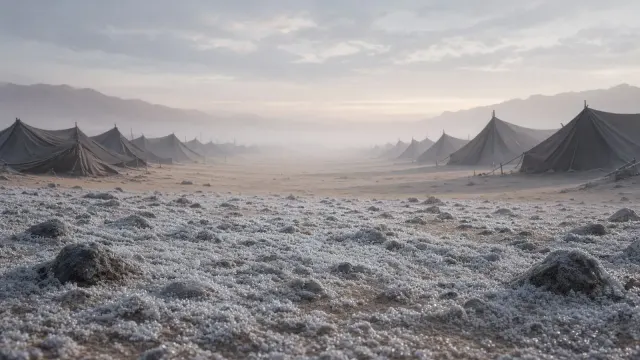
Exodus 16:1: “And they took their journey from Elim, and all the congregation of the children of Israel came unto the wilderness of Sin, which is between Elim and Sinai…”
Slow down at the turning point
Exodus 16:20: “Notwithstanding they hearkened not unto Moses; but some of them left of it until the morning, and it bred worms, and stank: and Moses was wroth with them.”
Keep this word trail visible
LORD, Moses, Israel, children, morning, bread
What to explain, in order
Teach the passage in this order. Each step names the verses it rests on, so every point can be shown in the text before it is applied.
Exodus 16:1-3
Murmuring in the wilderness of Sin
Begin with the date, a month after leaving Egypt, and the place. Explain murmured as grumbling, complaining under the breath or openly. Then read the complaint in 16:3, with its two memories, the flesh pots and full bread, and its accusation that Moses means to kill them. Teach this first, gently. The people are genuinely hungry, and the Book of Exodus does not deny that. But the class needs to hear how quickly the bondage of chapters 1 and 5 has been forgotten, because the rest of the chapter answers this complaint.
Exodus 16:4-12
Bread from heaven, a test and a glory
Read God's answer to Moses in 16:4-5 before the people's leaders speak. God promises bread and a daily rule, with double on the sixth day. Then Moses and Aaron tell the people that their murmuring is "not against us, but against the LORD" (16:8). The glory of the LORD appears in the cloud. Teach that God answers complaint with provision and with his presence, and that the test of 16:4 is whether they will trust his daily word.
Exodus 16:13-21
What is it
Read the quail briefly and then the morning: dew, then a small round thing like frost. Explain the people's question in 16:15, which the King James renders "It is manna: for they wist not what it was"; the Hebrew man hu means what is it. Then the rule of the omer, the gathering of more and less, the even result, and the leftovers that rot. Teach the daily rhythm here as the main lesson of the chapter: enough for today, gathered each morning, no storing.
Exodus 16:22-30
The rest of the holy sabbath
On the sixth day they gather double, and the rulers report it to Moses as though something is wrong. Moses explains, "To morrow is the rest of the holy sabbath unto the LORD". Point out that this is the first time the word sabbath appears in Scripture as a day Israel keeps, before Sinai. Then the empty field on the seventh day and God's rebuke. Teach the sabbath as a provision before it is a prohibition: God gives double so that his people can stop.
Exodus 16:31-36
An omer for your generations
Close with the description of manna, white and sweet, and the command to keep a jar of it before the Testimony. Explain the Testimony as the tablets of the law later placed in the ark, which shows that this note was written looking back. Read 16:35, forty years until the border of Canaan, and 16:36 for the measure. Teach this last so the class sees God's provision stretching over a whole generation, and a memorial that makes it visible to children.
Where learners get stuck
The misreadings this passage tends to produce, and how to answer each from the text.
"God was angry and punished them for complaining."
God's first response is bread: "Behold, I will rain bread from heaven for you" (16:4). Moses points out whom the complaint is really against (16:8), and the glory of the LORD appears (16:10), but there is no punishment in this chapter. Teach learners that God answers his people's hunger with provision even when they complain. The rebuke comes later in 16:28, for refusing to keep his word, not for being hungry.
"Manna was a natural substance that the Israelites learned to find."
Readers have compared it with natural desert products, and teachers may mention that. But Exodus describes it falling daily for forty years (16:35), double on the sixth day, none on the seventh (16:26), rotting overnight except before the sabbath (16:20, 24). Teach that the text presents a gift from God that follows his instructions, whatever its appearance. The pattern of the days is the point.
"Saving for tomorrow is always a lack of faith."
The chapter forbids keeping manna overnight because God provides it daily (16:19), but commands keeping a double portion for the sabbath (16:23) and a jar for future generations (16:32). Teach that obedience to God's word, not a general rule against planning, is the issue. Proverbs 6:6-8 commends wise preparation. This chapter is about trusting God's provision, not condemning prudence.
"The sabbath was invented at Mount Sinai."
In Exodus 16 Israel keeps the sabbath before reaching Sinai: "To morrow is the rest of the holy sabbath unto the LORD" (16:23), and "the people rested on the seventh day" (16:30). The command at Sinai in 20:8-11 grounds it in creation, Genesis 2:2-3. Teach the class that Sinai gives the sabbath its covenant form, but the gift of rest is already in place here.
Learning objectives
- Identify the accusation behind Israel’s hunger complaint.
- Describe the household gathering instruction.
- Compare ordinary overnight storage with Sabbath storage.
- Explain how manna tests obedience.
- Identify the purpose of the preserved omer.
- Distinguish this provision from a universal ban on saving.
Teacher preparation
- Read Exodus 16 fully; divide it into complaint, provision, gathering, Sabbath, and memorial.
- Explain “wist” as knew, “mete” as measure, and “seethe” as boil.
- Use Exodus 16:36 to define an omer relative to an ephah; avoid an unnecessary modern conversion.
- Prepare six gathering cards and a seventh-day rest card, including the double portion.
- Note that Exodus 16:34–35 looks beyond the first morning to the testimony and forty years of provision.
Evidence and interpretation checks
Explicit
Establish from Exodus 16:19–24 that ordinary leftovers spoil while the commanded sixth-day remainder does not.
Scripture-supported
Use 2 Corinthians 8:13–15 alongside Exodus 16:18 to show Paul applying the sufficient provision to mutual material care.
Strong inference
Infer from Exodus 16:16–18 that household need, not competitive accumulation, governs the gathering; do not invent the distribution procedure.
Possible or traditional reading
Treat a symbolic meaning for each feature of manna as proposed interpretation; John 6:32–35 supports the bread connection, not unlimited detail-matching.
Limit
State that Exodus 16:19 does not prohibit every form of food storage; 16:23–24 explicitly commands storing the Sabbath portion.
Discussion with answer guidance
1. How does Israel describe Egypt’s food while accusing Moses and Aaron?
What a good answer contains
They say they were full "when we sat by the flesh pots, and when we did eat bread to the full" (16:3). They remember full pots and plenty of bread, and wish they had "died by the hand of the LORD in the land of Egypt". The same Egypt made them sigh "by reason of the bondage" (2:23). A good answer notices how hunger rewrites the past. A weak answer either mocks the people, when they are a hungry congregation in a desert, or accepts their memory of Egypt as accurate.
Show teacher guidance
Compare 16:3 with the bondage in 2:23. Notice selective remembering without pretending their present hunger is trivial.
2. What is the stated purpose of raining bread from heaven?
What a good answer contains
"I will rain bread from heaven for you; and the people shall go out and gather a certain rate every day, that I may prove them, whether they will walk in my law, or no" (16:4). The bread feeds them and tests them. Verse 12 adds, "ye shall know that I am the LORD your God". A good answer holds provision, testing and knowledge of God together. A weak answer stops at food, or sees only a test and misses the generosity.
Show teacher guidance
Locate both provision and testing in 16:4, then knowledge of the Lord in 16:12. Do not reduce the chapter to menu planning.
3. How much is a household to gather, and what happens when it is measured?
What a good answer contains
The rule is "an omer for every man, according to the number of your persons" (16:16). Some gather more and some less, but "he that gathered much had nothing over, and he that gathered little had no lack" (16:18). Explain an omer as about two litres, a day's ration. A good answer reports what happened and notices Paul's use of this verse about sharing in 2 Corinthians 8:15. A weak answer invents a mechanism, such as people secretly redistributing it, which the text does not describe.
Show teacher guidance
Use 16:16–18: an omer per person and no lack. Distinguish the reported result from an invented explanation of how it occurred.
4. Why does one batch of leftovers stink while another remains usable?
What a good answer contains
Ordinary leftovers "bred worms, and stank" (16:20), because Moses said, "Let no man leave of it till the morning" (16:19). But what is laid up on the sixth day "did not stink, neither was there any worm therein" (16:24), because the LORD commanded it for the sabbath. A good answer locates the difference in God's word, not in the manna or the storage. A weak answer offers a theory about food preservation.
Show teacher guidance
Compare 16:19–20 with 16:22–24. Expect the difference in divine instruction, not a theory about improved storage containers.
5. What do empty fields on the seventh day expose?
What a good answer contains
Some went out to gather "and they found none" (16:27), and the LORD asks, "How long refuse ye to keep my commandments and my laws?" (16:28). Verse 29 explains: "the LORD hath given you the sabbath, therefore he giveth you on the sixth day the bread of two days". A strong answer sees the sabbath as a gift with a boundary: God provides double so they can rest. A weak answer sees only a rule, or only the people's failure, and misses the provision.
Show teacher guidance
Use 16:25–30: some search despite the instruction, and the Lord identifies refusal to obey. Keep Sabbath provision beside Sabbath restriction.
6. Why preserve an omer when ordinary leftovers were forbidden?
What a good answer contains
"Fill an omer of it to be kept for your generations; that they may see the bread wherewith I have fed you in the wilderness" (16:32). The jar is laid up "before the Testimony" (16:34). A good answer sees that this is not hoarding but a memorial, commanded by God, for children who will never see manna fall. A weak answer confuses the jar with the forbidden leftovers, or treats it as a private keepsake rather than a witness to God's care.
Show teacher guidance
Read 16:32–36. Expect a commanded witness for later generations, not private hoarding; distinguish the memorial from each family’s daily ration.
Responsible application
Heart and habits
Ask the class to rewrite an imaginary household’s complaint as an honest request that does not erase its deliverance.
Relationships and community
Design a fictional relief distribution around household need; compare its fairness with Exodus 16:16–18 and 2 Corinthians 8:13–15.
Rest that is provided for
Ask how advance provision changes a fictional worker’s ability to rest; distinguish the principle from importing Israel’s exact manna regulations.
Session plans
Two timings of the same lesson. The shorter keeps the reading, the central discussion and one response; the longer gives the confusions and the application their own time.
45 minutes
Egypt remembered
Read 16:1-3 and ask question one.
Bread with instructions
Read 16:4-12. Ask question two and take confusion one.
The omer
Read 16:13-21. Ask questions three and four and take confusion two briefly.
The seventh day
Read 16:22-30. Ask question five and take confusions three and four.
A jar for remembering
Read 16:31-36 and ask question six.
Handout
Read the key verse together and give out the sheet.
90 minutes
What we remember
Ask how hunger or tiredness changes the way people remember the past. Then read 16:1-3.
Rain bread from heaven
Read 16:4-12. Ask question two and take confusion one.
What is it
Read 16:13-21. Ask questions one and three, explain the omer, and read 2 Corinthians 8:13-15.
Worms and stink
Read 16:19-24 again. Ask question four and take confusion three.
The rest of the holy sabbath
Read 16:22-30 with Genesis 2:2-3. Ask question five and take confusion four.
The jar before the Testimony
Read 16:31-36. Ask question six and take confusion two.
Daily bread
Read Matthew 6:11 and John 6:31-35. Work through the application on rest that is provided for.
Handout and prayer
Read the key verse together and pray the Lord's Prayer slowly.
Adapting the lesson
Children
Scatter white paper circles on the floor before class and let children gather them into cups, one cup each. Explain that God sent food every morning, just enough for each person, and twice as much on the day before the rest day. Show what happened when people kept it overnight, with a frowning face. Let them keep one cup on a shelf as Aaron kept the jar.
Youth
Ask them how they decide when they have enough, of money, food, or anything else. Read 16:16-20 and discuss what it would mean to trust that tomorrow's portion will come. Then talk about the sabbath as a gift of rest and how hard rest is with phones and schedules. Keep it practical and let them choose one small step.
Adults
Explore the themes of daily dependence, the sabbath as gift and boundary, and the jar as memorial. Read Deuteronomy 8:2-3 and John 6. Discuss work, saving and rest without making rules for anyone's finances. Some adults face real scarcity; speak of daily provision carefully and do not suggest that need reflects a lack of faith.
One to one
Read 16:16-21 together and ask what they find hardest to trust God with day by day. Follow that. If rest is hard for them, read 16:29-30 and talk about one way they might stop and receive this week. Pray the line "Give us this day our daily bread" together.
Song and video learning lab
A song or video may interpret, compress, or dramatize the text. Its value becomes clearer when its choices are compared with Scripture.
- Before the media: the exact passage and its central movement.
- During the media: the words, people, events, and emotions the artist emphasizes.
- After the media: what it clarifies, what it leaves out, and what belongs back in the biblical text.
Handout
One page for learners to take home. The print button prints this section alone.
Exodus 16:1–36
The passage in brief
A month after leaving Egypt, the Israelites are hungry and complain that they ate well in Egypt. God promises bread from heaven. Every morning a thin, white food lies on the ground, and they call it manna. Each person gathers enough for the day; leftovers rot. On the sixth day they gather twice as much and it keeps, because the seventh day is a day of rest. A jar of manna is kept so that later generations can see how God fed them.
A verse to keep
Then said the LORD unto Moses, Behold, I will rain bread from heaven for you; and the people shall go out and gather a certain rate every day, that I may prove them, whether they will walk in my law, or no.
Exodus 16:4 · King James Version
Questions to take home
How did the people remember Egypt when they were hungry?
What happened to manna kept overnight, and what was different on the sixth day?
Why did God give the sabbath, according to 16:29?
This week
Each morning this week, thank God for one specific provision for that day before you begin.
Music and video connected to the passage
Related media appears when its Scripture reference overlaps this study. Music and video can illuminate a theme while the biblical text remains the foundation.