The big picture
Exodus 24 turns covenant words into a public ceremony. Moses reports the divine judgments, writes them, reads the covenant aloud, and receives Israel’s assent twice. An altar, twelve pillars, sacrifices, and blood then bind the declared words to an enacted covenant. Selected representatives ascend and experience one of the chapter’s most remarkable moments: they see the God of Israel, are not struck down, and eat and drink in his presence. Yet the privilege does not erase ordered access. Moses is summoned farther for the stone tablets, Joshua accompanies him partway, and Aaron and Hur remain available to handle matters in the camp. The final ascent includes six days of clouded waiting before the call comes on the seventh, while Israel below sees the divine glory like devouring fire. The chapter joins public hearing, written testimony, sacrificial blood, granted fellowship, administrative responsibility, and patient waiting without collapsing them into one undifferentiated encounter.
Central truth
At Sinai, Israel hears and accepts the covenant, Moses confirms it with blood, and invited representatives eat before God while Moses alone is summoned into the glory-cloud.

The study notes have a page of their own
The movement by movement analysis, the words to trace, the verse by verse notes and where readers differ are written for someone studying alone. They are on the Deep Personal Reflections page for this chapter. This page is the lesson.
A chapter-specific teaching brief
These anchors come from this chapter itself. They help a teacher use the Level 1 overview, the Level 2 study, and the Scripture text as one lesson.
Open with the chapter’s first image
Exodus 24:1: “And he said unto Moses, Come up unto the LORD, thou, and Aaron, Nadab, and Abihu, and seventy of the elders of Israel; and worship ye afar off.”
Slow down at the turning point
Exodus 24:9: “Then went up Moses, and Aaron, Nadab, and Abihu, and seventy of the elders of Israel:”
Keep this word trail visible
Moses, LORD, mount, Israel, people, blood
What to explain, in order
Teach the passage in this order. Each step names the verses it rests on, so every point can be shown in the text before it is applied.
Exodus 24:1-2
An invitation with limits
Start with the invitation in 24:1-2, because the chapter opens there and returns to it. God calls Moses, Aaron, Nadab, Abihu and seventy elders to come up and worship “afar off”, while Moses alone comes near. Explain why the order matters: God has just given the covenant laws, and approach to him is still governed by holiness, as at 19:12. Do not resolve how this fits with 24:9-11 yet. Teach this first so the class carries a picture of three groups, the people, the representatives and Moses, before the ceremony begins.
Exodus 24:3-4
Hear, answer, write
Read 24:3-4 and point out the sequence: Moses tells all the words and judgments, the people answer “with one voice”, and Moses writes everything down. Explain that “the words” recalls 20:1-17 and “the judgments” recalls 21:1 onward, so the people are agreeing to what they have heard in 20:22-23:33. Then describe the altar and the twelve pillars. Teach this here because it establishes the covenant as public and known. Nothing in it is hidden, and the whole people stand before God in the twelve pillars.
Exodus 24:5-8
The blood of the covenant
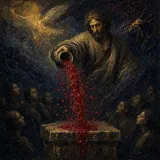
Read 24:5-8 calmly and explain the offerings: young men offer burnt offerings and peace offerings. Then follow the blood. Half goes on the altar; the book of the covenant is read “in the audience of the people”, which means in their hearing; they promise again, “will we do, and be obedient”; and the rest is sprinkled on them. Read Moses’ words, “Behold the blood of the covenant”. Explain that the blood seals a covenant between two parties. Then read Matthew 26:28 and Hebrews 9:19-20 to show how the New Testament takes up these words, while keeping Moses’ rite distinct from Jesus’ words.
Exodus 24:9-11
They saw God, and did eat and drink
Read 24:9-11 slowly and let the surprise land. The same God whose mountain was fenced in 19:12 now receives the elders, and they see him and eat. Explain “paved work of a sapphire stone” as something like a pavement of blue stone, and “the body of heaven in his clearness” as the clear sky. Note that the text describes only what was under God’s feet. Then read 33:20, “there shall no man see me, and live”, and tell the class both statements stand; readers explain the relation differently. Teach the meal as fellowship given by God after the covenant is sealed.
Exodus 24:12-14
Tablets, a minister and those left below
Read 24:12-14. God promises “tables of stone” with the law he has written, so that Moses may teach. Explain “tables” as tablets and “minister” as attendant: Joshua goes with Moses part of the way. Then show the arrangements for those staying below: Aaron and Hur will hear disputes. Teach this step because it sets the scene for chapter 32. Aaron is left in charge, and the people will wait. Point that out without telling what happens next, so the class can feel the weight later.
Exodus 24:15-18
Into the cloud
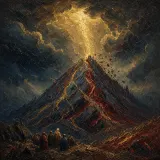
Read 24:15-18 and slow down on the timing: six days of cloud, a call on the seventh, and forty days and nights. Explain “abode” as rested or settled; the glory dwells on the mountain before it dwells in the tabernacle (40:34). Read 24:17 and ask what the people saw from below: fire on the summit. Then read 24:18, Moses walking into the middle of it. Teach this last because it leads straight into the tabernacle instructions of chapters 25 to 31. The God who called Moses into the cloud is about to describe how he will dwell among his people.
Where learners get stuck
The misreadings this passage tends to produce, and how to answer each from the text.
“The people promised to obey without knowing what they were agreeing to.”
Moses told them “all the words of the LORD, and all the judgments” (24:3), wrote them down (24:4), and read the book of the covenant in their hearing (24:7). They answered twice, after the telling and after the reading. Their later failure in chapter 32 is not because they were kept in the dark. The covenant was public, spoken and written, and the people knew what they had said.
“They saw God’s face, so Exodus contradicts itself in 33:20.”
Exodus 24:10 says “they saw the God of Israel”, but the only thing described is what was “under his feet”. Exodus 33:20 says no one can see God’s face and live. Readers explain the relation in different ways: a vision rather than direct sight, a partial seeing, or an appearance God chose to give. What the text clearly marks is the wonder that “he laid not his hand” on them (24:11). Teach both verses and let the tension stay.
“The blood in Exodus 24 is the same thing as the Lord’s Supper.”
Jesus takes up the words when he says “this is my blood of the new testament” (Matthew 26:28), and Hebrews 9:18-22 reflects on Moses’ sprinkling. The New Testament sees a real connection. But Exodus 24 is a covenant ceremony with animal blood at Sinai, and the Supper is something Jesus gives his disciples. Churches understand the Supper differently. Teach the link the New Testament makes without collapsing the two events into one.
“Only Moses mattered; the elders were just spectators.”
The elders were invited by God (24:1), went up (24:9), saw the God of Israel, and ate and drank in his presence (24:11). They represent the people in the covenant meal. Later God gives seventy elders a share of the spirit that was on Moses (Numbers 11:16-17, 25). Moses alone goes into the cloud, but the covenant is shared fellowship, not a private meeting between God and one leader.
Learning objectives
- Trace the covenant’s reading and public acceptance.
- Identify the altar and twelve pillars.
- Describe the two uses of the sacrificial blood.
- Distinguish the groups permitted different degrees of approach.
- Describe the representatives’ meal before God.
- Sequence the cloud, waiting, summons, and forty-day stay.
Teacher preparation
- Read Exodus 24 after 20:22–23:33; identify the covenant words and judgments already delivered.
- Explain “in the audience” as in the hearing, “minister” as attendant, and “tables” as tablets.
- Prepare a mountain diagram with people, representatives, and Moses, without inventing precise distances.
- Read Exodus 33:20 before discussing 24:10–11; preserve both statements rather than supplying an imagined divine portrait.
- Use paper markers for blood on the altar and people; avoid dramatic reenactment or actual food rituals.
Evidence and interpretation checks
Explicit
Establish from Exodus 24:6–8 that Moses puts half the blood on the altar and sprinkles blood on the people after reading the covenant.
Scripture-supported
Compare Exodus 24:8 with Matthew 26:28 to identify the later connection between covenant and blood, while distinguishing Moses’ rite from Jesus’ words.
Strong inference
Infer from Exodus 24:9–11 that the meal expresses granted fellowship; the account emphasizes that God does not strike the invited representatives.
Possible or traditional reading
Treat identifying the visible encounter in Exodus 24:10 with a preincarnate appearance of Christ as a Christian interpretation, not an identity supplied by this verse.
Limit
State that Exodus 24:10–11 describes what is beneath God’s feet but not his facial appearance; 33:20 must also remain in the discussion.
Discussion with answer guidance
1. Why are both speaking and reading included before the people’s promises?
What a good answer contains
Because the people must know what they are promising. Moses first “told the people all the words of the LORD, and all the judgments” (24:3), and they answered with one voice. Then he “wrote all the words of the LORD” (24:4), and before the blood is sprinkled he takes “the book of the covenant, and read in the audience of the people” (24:7). Their promise is given twice, after hearing and after reading. A good answer sees informed consent. A weak answer treats the words of commitment as powerful in themselves.
Show teacher guidance
Follow 24:3–7: words delivered, written, and read aloud. Expect an informed public response, not magical power in repeating a pledge.
2. What do the altar and twelve pillars place before Israel?
What a good answer contains
An altar “under the hill, and twelve pillars, according to the twelve tribes of Israel” (24:4). The altar is where God receives offerings; the pillars stand for the whole people, every tribe present before him. A good answer names that correspondence, which the verse states. A weak answer invents inscriptions on the pillars or a detailed arrangement the text does not give, or misses the point that all twelve tribes, not only the leaders, are bound in this covenant.
Show teacher guidance
Locate the altar and the explicit correspondence between pillars and tribes in 24:4. Do not invent tribal inscriptions or a detailed arrangement.
3. Where does the blood go, and what explanation does Moses give?
What a good answer contains
Half the blood is sprinkled “on the altar” (24:6); the other half, after the reading, Moses “sprinkled it on the people” (24:8). He explains it: “Behold the blood of the covenant, which the LORD hath made with you concerning all these words”. The blood binds both parties, God’s altar and the people, to the covenant and its words. A good answer keeps the explanation Moses gives. A weak answer fixes on how the blood was collected or speculates about its effect beyond what Moses says.
Show teacher guidance
Use 24:6–8: altar, people, and covenant concerning the spoken words. Keep the rite’s covenant meaning ahead of speculation about the equipment.
4. Who sees God and eats, and what extraordinary restraint does verse 11 mention?
What a good answer contains
Moses, Aaron, Nadab, Abihu and seventy elders go up, “And they saw the God of Israel” (24:9-10). Verse 11 adds the restraint: “upon the nobles of the children of Israel he laid not his hand: also they saw God, and did eat and drink”. They see, they survive, and they share a meal. A good answer notices how remarkable that is after the fear of 19:21 and 20:19. A weak answer describes God’s appearance, when the text describes only the pavement “under his feet”.
Show teacher guidance
Name Moses, Aaron, Nadab, Abihu, and seventy elders (24:9–11); note that God does not lay his hand upon the nobles.
5. How do the different invitations prevent the whole assembly from simply climbing together?
What a good answer contains
God sets three levels. The group of seventy four may come up and “worship ye afar off”, but “Moses alone shall come near the LORD” (24:1-2), and “neither shall the people go up with him”. Later Moses goes higher with Joshua, leaving Aaron and Hur with the elders to settle disputes (24:13-14). A good answer sees that access is by God’s invitation and in God’s order. A weak answer imagines everyone climbing together, or reads the levels as favouritism rather than holiness.
Show teacher guidance
Distinguish 24:1–2 from 24:12–14. Moses alone receives the closer summons; Joshua attends him, while Aaron and Hur handle matters below.
6. What happens before Moses enters the cloud, and how long does he remain?
What a good answer contains
A cloud covers the mountain for six days, and “the seventh day he called unto Moses out of the midst of the cloud” (24:16). The people see the glory as “devouring fire on the top of the mount” (24:17). Then “Moses went into the midst of the cloud” and stays “forty days and forty nights” (24:18). A good answer gives the waiting, the call, and the length of the stay. A weak answer invents what Joshua did or where he waited, details the text leaves out.
Show teacher guidance
Trace six days of covering, the seventh-day call, and forty days and nights (24:15–18). Do not invent a detailed itinerary for Joshua.
Responsible application
Heart and habits
Ask learners to revise an imaginary commitment process that demands agreement before explaining what is being promised.
Relationships and community
Design a fictional group agreement with clear terms, shared hearing, and responsible follow-through; distinguish it from Israel’s covenant ceremony.
Access by invitation
Discuss why the representatives’ meal cannot be treated as casual access on anyone’s terms; use the different summonses in Exodus 24.
Session plans
Two timings of the same lesson. The shorter keeps the reading, the central discussion and one response; the longer gives the confusions and the application their own time.
45 minutes
Three groups
Read 24:1-2 and sketch the mountain with the people, the seventy four, and Moses. Take question five briefly.
Hear before promising
Read 24:3-4 and take questions one and two. Clear confusion one from 24:3 and 24:7.
Blood on altar and people
Read 24:5-8 with paper markers and take question three. Mention confusion three briefly with Matthew 26:28.
A meal on the mountain
Read 24:9-11 and take question four and confusion two, reading 33:20 alongside.
Into the cloud
Read 24:12-18 and take question six. Note who is left in charge below.
Handout and prayer
Read the key verse together, give out the sheet and pray for faithfulness to what we have promised.
90 minutes
Promises we have made
Ask the group to name a public promise people make, such as a wedding vow. Then read 24:1-3.
Words, judgments and a book
Read 24:3-4 and 24:7, recalling 20:1 and 21:1. Take questions one and two and confusion one.
The blood of the covenant
Read 24:5-8 with paper markers. Take question three, then read Matthew 26:27-28 and Hebrews 9:18-22 and take confusion three.
They saw God
Read 24:9-11, then 19:21, 20:19 and 33:20. Take question four and confusion two, recording both statements on the board.
Representatives and invitation
Read 24:1-2, 9 and 13-14. Take question five and confusion four, and read Numbers 11:16-17.
Six days and forty
Read 24:15-18. Take question six and look ahead to 25:8 and 32:1.
Application
In pairs, take one application and talk about a commitment they made to God and how they keep it.
Handout and prayer
Read the key verse together, point to the take-home line, and pray the people’s words of 24:7 back to God.
Adapting the lesson
Children
Draw a mountain with three levels and place paper figures: the people at the bottom, the leaders halfway, Moses at the top in a cloud. Explain that God said who could come close. Tell them that Moses read God’s words aloud and the people promised to obey. Say simply that blood was used to show the promise was very serious, without describing sprinkling. Finish with the leaders eating a meal with God, safe in his presence.
Youth
Ask whether they have ever clicked agree without reading the terms. Then read 24:3-7 and show that Israel heard and read before promising. Let them talk about the difference between a promise made in a moment and a promise made after understanding. Give time to 24:9-11 as a scene of friendship with God, and to 24:12-14, where Aaron is left in charge, as a setup for what comes next.
Adults
Adults can study the structure of covenant: words, response, writing, sacrifice, blood, reading, response again, and a meal. Compare Matthew 26:28 and Hebrews 9:18-22, and let different traditions of the Lord’s Supper be named without dispute. Give time to the tension between 24:10-11 and 33:20. Ask how a church keeps the public promises it makes at baptism, membership or ordination.
One to one
Ask the person whether they have ever made a promise to God, and what it was. Read 24:7 and talk about the gap between saying all that the LORD hath said will we do and doing it. Then read 24:11 and let them hear that the covenant brought the elders to a meal with God, not only to a list of duties. If they are ashamed of a broken promise, look ahead to 34:6-7.
Song and video learning lab
A song or video may interpret, compress, or dramatize the text. Its value becomes clearer when its choices are compared with Scripture.
- Before the media: the exact passage and its central movement.
- During the media: the words, people, events, and emotions the artist emphasizes.
- After the media: what it clarifies, what it leaves out, and what belongs back in the biblical text.
Handout
One page for learners to take home. The print button prints this section alone.
Exodus 24:1–18
The passage in brief
At Sinai, Moses tells the people all God’s words and laws, and they promise to obey. He writes them down, builds an altar with twelve pillars for the tribes, and offers sacrifices. He reads the book of the covenant aloud, the people promise again, and he sprinkles the blood of the covenant on the altar and on them. The leaders go up, see the God of Israel, and eat and drink in his presence. Then Moses enters the cloud for forty days.
A verse to keep
And he took the book of the covenant, and read in the audience of the people: and they said, All that the LORD hath said will we do, and be obedient. And Moses took the blood, and sprinkled it on the people, and said, Behold the blood of the covenant, which the LORD hath made with you concerning all these words.
Exodus 24:7-8 · King James Version
Questions to take home
What did the people hear before they made their promise in 24:3 and 24:7?
What did Moses say the blood meant in 24:8?
What surprises you about 24:11?
This week
Write down one promise you have made to God and one step you will take this week to keep it.
Music and video connected to the passage
Related media appears when its Scripture reference overlaps this study. Music and video can illuminate a theme while the biblical text remains the foundation.