The big picture
Jerusalem's entire past is retold as the life of a woman who forgets that everything impressive about her came after rescue. The Book of Ezekiel begins the allegory with an abandoned infant in blood, given life before she possesses beauty, wealth, or status. Covenant, washing, clothing, jewelry, food, and a crown then create the splendor for which she becomes known, and the text immediately says whose comeliness made that beauty possible. The betrayal is therefore traced through the gifts themselves. Garments, silver, gold, oil, incense, food, children, public worship, and foreign relationships are all redirected. Jerusalem even pays the lovers she pursues, only to have those same alliances become agents of exposure and destruction. The comparison with Samaria and Sodom destroys the city's habit of judging others from a position of assumed superiority. Yet "Nevertheless" opens the final movement. God remembers the covenant Jerusalem forgot and promises an everlasting covenant that leaves the restored city ashamed rather than boastful.
Central truth
Through exile signs, exposed lies, covenant accusations, and the dated siege, the Lord dismantles Jerusalem’s excuses for refusing his word while still calling the people to turn. The Lord exposes Jerusalem’s misuse of covenant gifts and imitation of Samaria’s betrayal, announces devastating judgment, and promises to remember his covenant despite Jerusalem’s faithlessness.
The study notes have a page of their own
The movement by movement analysis, the words to trace, the verse by verse notes and where readers differ are written for someone studying alone. They are on the Deep Personal Reflections page for this chapter. This page is the lesson.
A chapter-specific teaching brief
These anchors come from this chapter itself. They help a teacher use the Level 1 overview, the Level 2 study, and the Scripture text as one lesson.
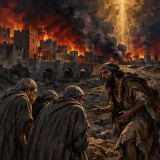
Open with the chapter’s first image
Ezekiel 16:1: “Again the word of the LORD came unto me, saying,”
Slow down at the turning point
Ezekiel 16:32: “But as a wife that committeth adultery, which taketh strangers instead of her husband!”
Keep this word trail visible
daughters, LORD, wast, abominations, blood, whoredoms
What to explain, in order
Teach the passage in this order. Each step names the verses it rests on, so every point can be shown in the text before it is applied.
Ezekiel 12:1–24:27
Ezekiel 12:1-28
The baggage, the hole and the proverb
Open the section with Ezekiel packing a bag "by day in their sight" (12:3), digging through the wall at evening, and going out with his face covered. Explain "stuff for removing" as an exile's bundle. Then read the explanation in 12:10-13: the prince in Jerusalem will flee the same way and be taken blind to Babylon. Add the trembling meal of 12:17-20. End with the two proverbs of 12:22 and 12:27, both of which say the warnings are for later. Teach this first because the whole section answers that excuse.
Ezekiel 13:1-14:11
Whitewash and idols in the heart
Read 13:10-14 and draw a wall with cracks and a thick white coat over it. Explain "untempered morter" as a coating that looks solid and is not. The prophets cry "Peace" when there is no peace, and they "have seen nothing" of God's word. Mention briefly the women of 13:17-23 who traded false comfort for handfuls of barley. Then turn to 14:1-6: elders sit before Ezekiel with idols in their hearts. Explain the hard line in 14:9 carefully: God gives the false prophet over to his own deception and judges him (14:10). Teach these together because speaker and hearer share the blame.
Ezekiel 14:12-15:8
Noah, Daniel, Job and the useless vine
Read 14:14: even "Noah, Daniel, and Job" would "deliver but their own souls". Explain that no one can lean on another's righteousness; the Daniel here may be Ezekiel's contemporary or an ancient righteous man known in the region, and readers differ. Then read chapter 15. Ask what a vine is good for if it bears no fruit; the answer in 15:3-5 is nothing, not even a peg. So Jerusalem, chosen to bear fruit, has become fuel. Teach this step here because it removes two false hopes: righteous friends and special status.
Ezekiel 16-19
Betrayal, eagles and a lament for princes
Cover this stretch as a map, not a reading. Say that chapter 16 is the long indictment of Jerusalem as an unfaithful wife, to be taught in its own unit with care. Read 17:12-21, where the riddle of the eagles is explained: Babylon set up a king, the king rebelled and turned to Egypt, and he will die in Babylon for breaking his oath. Then read 17:22-24, God planting a tender shoot. Note chapter 18 as its own unit. End with the lament of chapter 19: the lions and the vine are the kings of Judah, now without a sceptre.
Ezekiel 20-23
History retold, the sword, the bloody city
Again give the shape rather than every verse. Chapter 20 retells Israel's rebellion from Egypt to the present and refuses the elders' enquiry; chapter 21 is the drawn sword of Babylon; chapter 22 lists the sins of "the bloody city"; chapter 23 is the account of the two sisters. Read only 22:30, God's search for "a man among them, that should make up the hedge, and stand in the gap", and the answer "but I found none". These chapters receive fuller study in the next units, so here show how they press toward a single point: the siege is certain.
Ezekiel 24:1-27
The day is written down
Close with the date. Ezekiel writes "the name of the day" (24:2), the day Babylon's siege began, and every excuse about the distant future is gone. Read 24:15-18 gently. His wife dies at evening; he is told not to mourn publicly. Explain that this is a sign for that moment and that people, not a rule for grieving: the temple, the people's delight, is about to fall, and grief will be too great for the usual rites (24:21-24). End with 24:27: when the news comes, his mouth will be opened. Teach this last because it ties the whole section to its fulfilment.
Ezekiel 16 and 23
Ezekiel 16:1-3 and 23:1-4
Say first who the women are
Before reading any imagery, tell the class what these chapters are. They are prophetic parables in which cities are pictured as women. Read 16:2, "cause Jerusalem to know her abominations", and 23:4, "Samaria is Aholah, and Jerusalem Aholibah." Explain that the names likely mean her tent and my tent is in her, a pointer to worship. Then give a clear notice: these chapters include sexual imagery, violence and child sacrifice, and anyone may listen without speaking. Explain 16:3 as a charge about Jerusalem's Canaanite past, not a family tree. Teach this first so no one hears the chapters as being about a real woman.
Ezekiel 16:4-14
Found, made alive, covenanted, adorned
Read 16:4-6 and let the class feel the abandonment: no one pitied the child. Then read the double "Live" of 16:6. Read 16:8 as the covenant moment, with the skirt explained from Ruth 3:9. Summarise 16:9-13 as washing, clothing, jewels and food, and stop on 16:14, "perfect through my comeliness, which I had put upon thee." Teach this before any accusation, because the whole weight of the chapter depends on how much was given. If you skip it, the judgment sounds arbitrary; with it, the judgment sounds like grief.
Ezekiel 16:15-34
Trusting her own beauty
Read 16:15, "thou didst trust in thine own beauty", as the turning point; the gifts were taken as possessions. Then read 16:17-21 for the charge: God's gold, oil, food and children turned to idols. Summarise 16:23-34 without reading it aloud: shrines on every street, and alliances with Egypt, Assyria and Chaldea pictured as lovers. Point out the bitter irony of 16:31-34: she pays rather than being paid. Explain that the language is shocking on purpose, to show how God sees idolatry and faithless treaties. Keep your own words plain and brief.
Ezekiel 16:35-58
Judgment, and the sisters
Summarise 16:35-43 without reading the details of exposure and violence. Say clearly that this is the language of a city's fall to its enemies, the very nations it courted, and that it is never a pattern for any human relationship. Then read 16:44-52, where Jerusalem is compared with Samaria and Sodom. Read 16:49 aloud and write its list on the board: pride, plenty, idleness, neglect of the poor. Teach this here so the class sees that Jerusalem's sin is measured against others and found worse, and that its root includes neglect of the needy.
Ezekiel 23:5-49
Two sisters and the alliances
Treat chapter 23 as a summary, reading only 23:4, 23:11, 23:22-23, 23:35 and 23:37-39. Explain the history: Samaria trusted Assyria and fell; Jerusalem trusted Assyria, then Babylon, then Egypt. The charge of 23:37-39 joins idolatry, bloodshed and child sacrifice with worship in the temple on the same day. Point to 23:35, "thou hast forgotten me, and cast me behind thy back", as the heart of it. Do not read 23:3, 23:8, 23:20 or 23:46-48 aloud. Name the imagery as severe and move on.
Ezekiel 16:59-63
Nevertheless, the remembered covenant
End with the word "Nevertheless" (16:60). Chapter 23 ends in judgment; chapter 16 does not. Read 16:60-63 slowly. God remembers the covenant Jerusalem forgot (16:22, 16:43), and promises "an everlasting covenant". Explain that the result is shame of the healthy kind: Jerusalem will "remember" and "never open thy mouth any more" in boasting (16:63). Teach this last because it is the last word of the long chapter, and because it shows that the God who judges is the God who keeps covenant. Close in prayer, not discussion.
Where learners get stuck
The misreadings this passage tends to produce, and how to answer each from the text.
Ezekiel 12:1–24:27
"God's warnings are for some far-off future, not for us now."
That is the proverb God rejects: "The vision that he seeth is for many days to come, and he prophesieth of the times that are far off" (12:27). The answer is, "There shall none of my words be prolonged any more" (12:28), and twelve chapters later the siege has a date (24:2). Some prophecies do look far ahead, but the habit of filing every warning under later is exactly what this section exposes. Ask learners what warning in their own lives they have postponed, but do not make anyone answer aloud.
"If my parents or a godly friend are righteous, God will spare me for their sake."
The Book of Ezekiel says the opposite: "Though these three men, Noah, Daniel, and Job, were in it, they should deliver but their own souls by their righteousness" (14:14). Chapter 18 says the same from the other side: "The son shall not bear the iniquity of the father" (18:20). No one rides on another's faith. This is hard news for some and good news for others; those from godless homes are not doomed, and those from godly homes are not covered.
"Ezekiel's wife's death shows that grieving is a lack of faith."
God's instruction in 24:16-17 is given to Ezekiel alone, and it is explained as a sign: "Thus Ezekiel is unto you a sign" (24:24). The point is that Jerusalem's fall will be a grief beyond the usual mourning customs. Elsewhere Scripture honours mourning; Jesus wept at Lazarus' tomb (John 11:35). Never use this passage to silence a grieving person. Notice too the tenderness of the phrase "the desire of thine eyes" (24:16): Ezekiel loved his wife, and the sign cost him that love.
"False prophets are always obvious and easy to spot."
The prophets of chapter 13 said "The LORD saith" (13:6) and offered "visions of peace" (13:16). They were popular because they said what people wanted to hear, and the elders of 14:3 came to the prophet while holding idols in their hearts. The test the passage gives is whether the word matches God's actual warning, not whether it sounds spiritual. Teach learners to ask what a message leaves out, especially when it promises peace without repentance.
Ezekiel 16 and 23
"These chapters are about women, and they show how God thinks women should be treated."
The text names its subject. Chapter 16 is addressed to "Jerusalem" (16:2), and chapter 23 says, "Samaria is Aholah, and Jerusalem Aholibah" (23:4). The women are cities, and their lovers are nations. The punishment pictured is the city's conquest by its allies. These chapters give no permission to any husband or anyone else to punish, shame or harm a woman, and any use of them to excuse abuse is a grave misuse of Scripture. Say this plainly in the room, because someone there may need to hear it.
"Ezekiel 16 shows that Sodom's only sin was being rich and lazy."
Ezekiel 16:49 names "pride, fulness of bread, and abundance of idleness", and that "neither did she strengthen the hand of the poor and needy." The next verse adds that they "were haughty, and committed abomination before me" (16:50). Genesis 19 and Jude 7 give further charges. Do not reduce Sodom to one sin from either side. The point Ezekiel makes is that Jerusalem, God's own city, was worse, and that neglect of the poor belongs on the list.
"God's love here is like an abusive husband's, so he can't be trusted."
This is a real and serious objection, and it deserves a gentle answer. The parable uses the strongest picture available in its world, a husband's rightful claim on a faithful wife, to show the horror of covenant betrayal, which included killing children (16:20-21). The judgment pictured is military conquest by the nations Jerusalem chose. And the chapter ends with God's own faithfulness: "I will remember my covenant with thee" (16:60). Do not argue anyone out of their pain; acknowledge it, point to the end of the chapter, and offer to talk further.
"After all that, God just forgave Jerusalem as if nothing happened."
The forgiveness is real, but it is not forgetting. God says, "Then thou shalt remember thy ways, and be ashamed" (16:61), and the purpose is "That thou mayest remember, and be confounded" (16:63). Jerusalem receives the covenant as a gift she could never claim, and with it a humility that ends her boasting. Grace in this chapter takes sin with full seriousness. This matters for anyone who thinks forgiveness either cancels consequences or cannot reach them.
Learning objectives
- Explain Ezekiel’s baggage and covered-face sign.
- Connect false peace with the badly coated wall.
- Identify idols concealed in the elders’ hearts.
- Trace royal failure through the vine, eagles, and lament.
- Distinguish covenant privilege from permission to betray it.
- Follow postponed warnings to the dated siege announcement.
- Identify Jerusalem, Samaria, Aholah, and Aholibah correctly.
- Trace chapter 16 from rescue to covenant to betrayal.
- Explain how the given gifts become instruments of idolatry.
- Connect the marriage imagery with political and religious unfaithfulness.
- Identify Jerusalem’s failed claim to moral superiority.
- Explain the unexpected covenant promise in 16:60–63.
Teacher preparation
- Read chapters 12–24 fully; prepare a passage map and selected readings, not a thirteen-chapter classroom read-through.
- Map 12–14 as rejected warning, 15–19 as exposed confidence, and 20–24 as indictment reaching siege.
- Explain “stuff for removing” as exile belongings and “untempered morter” as an inadequate wall coating.
- Prepare 14:9 with 13:6–7 and 14:10; retain its difficult judicial-deception language without excusing false prophets.
- Plan restrained summaries of chapters 16 and 23 and 24:15–24; avoid graphic detail, reenactment, or required disclosure.
- Read chapters 16 and 23 fully; plan selected, non-graphic readings while acknowledging the severity of the language.
- Explain that the women personify cities; use 16:2 and 23:4 as the controlling identifications.
- Give advance notice of sexual violence and child sacrifice in the text; allow silent participation and opting out.
- Prepare the sequence rescue, gifts, betrayal, judgment, covenant remembrance; do not force chapter 23 into an identical ending.
- State that prophetic judgment imagery does not authorize human domestic violence, humiliation, or blaming victims of abuse.
Evidence and interpretation checks
Explicit
Anchor the baggage sign in 12:10–13: it concerns Jerusalem’s prince and people, including captivity in Babylon and the prince’s inability to see it. Let 23:4 name the cities: Aholah is Samaria and Aholibah is Jerusalem; 16:2 explicitly addresses Jerusalem.
Scripture-supported
Compare 13:10–16 with 22:28: unsupported peace and false prophetic speech cover danger instead of repairing it. Use 16:17–21 and 23:37–39 to connect betrayal with diverted gifts, idols, bloodshed, and sanctuary defilement, not sexuality detached from the covenant accusation.
Strong inference
Infer from 14:1–6 that seeking religious advice can coexist with refusing correction; approaching a prophet is not proof of an undivided heart. Infer from 16:14–15 that Jerusalem turns received beauty into self-sufficient pride; the crucial shift is from given splendor to trusting itself.
Possible or traditional reading
Present the tender cedar planting in 17:22–24 as traditionally read messianically alongside Isaiah 11:1–10; distinguish that connection from the explicitly explained political eagles. Present extending the sisters’ restored fortunes in 16:53–55 into a detailed future timetable as an interpretive proposal; the verses do not explain its mechanism.
Limit
Do not treat 24:16–24 as a general command against mourning or use chapter 14 to claim automatic immunity through association with righteous people. Do not make 16:3 a literal genealogy of every Israelite or treat 16:37–41 and 23:22–29 as permission for spouses to punish one another.
Discussion with answer guidance
1. What does the audience learn when Ezekiel explains his packed belongings and covered face?
What a good answer contains
That the sign is about Jerusalem, not about Ezekiel. When they ask, "What doest thou?" (12:9), he answers, "This burden concerneth the prince in Jerusalem, and all the house of Israel that are among them" (12:10), and, "I am your sign: like as I have done, so shall it be done unto them: they shall remove and go into captivity" (12:11). The prince will dig through the wall, cover his face, and be brought "to Babylon to the land of the Chaldeans; yet shall he not see it, though he shall die there" (12:13), which came true when Zedekiah was blinded (2 Kings 25:7). A good answer ties every action to its meaning. A weak answer thinks Ezekiel is moving house or offering a way of escape.
Show teacher guidance
Use 12:3–13: exile concerns Jerusalem and its prince. Distinguish the enacted warning from a voluntary move or escape guarantee.
2. How do the coated wall and heart-idols expose two sides of false reassurance?
What a good answer contains
The wall shows the speakers' side and the heart-idols show the hearers'. The false prophets "seduced my people, saying, Peace; and there was no peace" (13:10); one man builds a flimsy wall and "others daubed it with untempered morter", plaster that hides the cracks but cannot hold. The storm will expose it (13:11-14). In 14:3 the elders who come to enquire have "set up their idols in their heart", and the LORD answers by calling them to "Repent, and turn yourselves from your idols" (14:6). A good answer keeps both: lying prophets and divided listeners feed each other. A weak answer blames only the prophets.
Show teacher guidance
Read 13:10–16 and 14:1–6. Expect invented peace from speakers and concealed allegiance in hearers; responsibility is not one-sided.
3. What happens to confidence in royal strength across the vine, eagles, and lament?
What a good answer contains
It is burned, broken and uprooted. The vine is useless wood, good only for fuel, and "so will I give the inhabitants of Jerusalem" (15:6). In chapter 17 the king who broke his oath to Babylon will die there: "mine oath that he hath despised, and my covenant that he hath broken, even it will I recompense upon his own head" (17:19). The lament of chapter 19 ends with the vine "planted in the wilderness" and with "no strong rod to be a sceptre to rule" (19:13-14). A good answer also reads 17:22-24, where God himself plants "a tender one" on a high mountain. A weak answer misses that promise.
Show teacher guidance
Use 15:6–8, 17:12–21, and 19:9–14. Trace judgment, broken oath, and lost rule; preserve 17:22–24’s distinct promise.
4. How do chapters 16 and 23 identify the betrayal beneath impressive alliances?
What a good answer contains
By naming what the gifts were turned into. Jerusalem took "thy fair jewels of my gold and of my silver, which I had given thee, and madest to thyself images" (16:17), set "mine oil and mine incense" before them (16:18), and sacrificed "thy sons and thy daughters, whom thou hast borne unto me" (16:20). Chapter 23 names the sisters, "Samaria is Aholah, and Jerusalem Aholibah" (23:4), and the charge, "thou hast forgotten me, and cast me behind thy back" (23:35). A good answer names stolen gifts, idols, child sacrifice and a forgotten covenant. A weak answer retells the imagery and loses the charge. The full treatment belongs to the unit on chapters 16 and 23.
Show teacher guidance
Use 16:15–22 and 23:4–7,35–39. Name misused gifts, idols, bloodshed, and forgotten covenant, rather than retelling the explicit imagery.
5. Why does repeated ancestral rebellion not eliminate the call to turn?
What a good answer contains
Because each generation stands before God for itself. "The soul that sinneth, it shall die. The son shall not bear the iniquity of the father" (18:20), and the wicked who turns "shall surely live, he shall not die" (18:21). God asks, "Have I any pleasure at all that the wicked should die?" (18:23), and appeals, "wherefore turn yourselves, and live ye" (18:32). Then in 20:30-31 the present generation is found doing what its fathers did. A good answer says both: they are not doomed by the past, and not excused by it either. A weak answer chooses one.
Show teacher guidance
Place 18:20–23,30–32 beside 20:30–31. Present conduct matters; reject both inherited innocence and the excuse that the past makes change pointless.
6. What becomes of the claim that Ezekiel’s warnings concern a remote future?
What a good answer contains
It collapses. The people said, "The vision that he seeth is for many days to come" (12:27), and God replied, "There shall none of my words be prolonged any more" (12:28). In 24:1-2 Ezekiel is told, "write thee the name of the day, even of this same day: the king of Babylon set himself against Jerusalem this same day." The siege has begun. Then his wife, "the desire of thine eyes" (24:16), dies, and he is forbidden to mourn as a sign that the temple, the people's own "desire of your eyes" (24:21), will be profaned. A good answer marks the date and the cost. A weak answer either skips the bereavement or makes it a spectacle.
Show teacher guidance
Read 12:27–28 beside 24:1–2,13–14. The siege is dated; include 24:18–24’s costly sign without making bereavement a classroom illustration to perform.
7. What changes between Jerusalem’s helpless beginning and its covenant relationship?
What a good answer contains
Everything, and all of it from God's side. The infant is abandoned, unwashed, "cast out in the open field" (16:4-5). Then the LORD passes by and says, "Live" (16:6). Later he comes again: "thy time was the time of love; and I spread my skirt over thee", and "entered into a covenant with thee, saith the Lord GOD, and thou becamest mine" (16:8). Explain the spread skirt as a pledge of marriage and protection, as in Ruth 3:9. He washes, clothes and adorns her until her beauty "was perfect through my comeliness, which I had put upon thee" (16:14). A good answer sees grace before any merit. A weak answer suggests Jerusalem earned the covenant.
Show teacher guidance
Trace 16:4–14, especially 16:8. Expect unearned rescue and bestowed splendor; do not claim Jerusalem first earned its acceptance.
8. Whose gold, garments, food, and children are named in the indictment?
What a good answer contains
God's. The repeated possessive is the charge: "my gold and of my silver, which I had given thee" (16:17), "mine oil and mine incense" (16:18), "My meat also which I gave thee, fine flour, and oil, and honey" (16:19), and "thy sons and thy daughters, whom thou hast borne unto me" (16:20). Verse 21 says, "thou hast slain my children". A good answer sees that everything given in 16:9-13 is now offered to idols, even the children. Name child sacrifice soberly as the gravest charge. A weak answer moves past it, or dwells on the imagery instead of the gifts.
Show teacher guidance
Read 16:17–21. Repeated possessive language exposes gifts turned against their giver; retain the gravity without elaborating the violence.
9. Why does Samaria’s experience make Jerusalem’s conduct more culpable?
What a good answer contains
Because Jerusalem watched and did not learn. Samaria, called Aholah, was given into the hand of the Assyrians she had courted (23:9-10). "And when her sister Aholibah saw this, she was more corrupt in her inordinate love than she" (23:11). Jerusalem had seen the northern kingdom fall in 722 BC, and still went further. A good answer stresses the knowledge: sin committed with an example in plain sight is heavier. A weak answer thinks Jerusalem is less guilty because her sister did it first.
Show teacher guidance
Use 23:4–11. Jerusalem sees her sister’s outcome and persists; reject the idea that shared wrongdoing supplies an excuse.
10. How do the desired allies become agents of ruin?
What a good answer contains
The very nations Jerusalem courted come against her. She "doted upon the Assyrians" (23:12) and then turned to the Chaldeans (23:14-17). Now God says, "I will raise up thy lovers against thee, from whom thy mind is alienated" (23:22), and names them, "The Babylonians, and all the Chaldeans", with "all the Assyrians with them" (23:23). The alliances sought for security become the instruments of ruin. A good answer names the powers and the politics behind the imagery. A weak answer reads the chapter as private morality only and misses the treaties.
Show teacher guidance
Compare 23:12–17 with 23:22–30. The same powers sought for satisfaction return against Jerusalem; keep the political identities visible.
11. What specifically undermines Jerusalem’s superiority over Sodom and Samaria?
What a good answer contains
Her conduct is worse than theirs. "Sodom thy sister hath not done, she nor her daughters, as thou hast done" (16:48). Then 16:49 names Sodom's sin: "pride, fulness of bread, and abundance of idleness was in her and in her daughters, neither did she strengthen the hand of the poor and needy", and 16:50 adds that they were haughty "and committed abomination before me". Samaria did not commit "half of thy sins" (16:51). A good answer keeps the whole list, including neglect of the poor. A weak answer reduces Sodom to one sin or drops 16:49 altogether.
Show teacher guidance
Read 16:48–52. Name pride, plenty, neglect of the needy, and abomination; neither reduce Sodom’s sins to one item nor omit this list.
12. Who remembers the covenant when Jerusalem has broken it?
What a good answer contains
The LORD does. "Nevertheless I will remember my covenant with thee in the days of thy youth, and I will establish unto thee an everlasting covenant" (16:60). Jerusalem "despised the oath in breaking the covenant" (16:59), but God remembers it. The result is not pride but humbled memory: "That thou mayest remember, and be confounded, and never open thy mouth any more because of thy shame, when I am pacified toward thee" (16:63). A good answer holds both: God's initiative and Jerusalem's lasting humility. A weak answer jumps to the promise as if the betrayal had never mattered.
Show teacher guidance
Read 16:59–63. The Lord initiates its establishment; restored relationship includes humbled remembrance, not a claim that betrayal never mattered.
Responsible application
Heart and habits
Ask learners to revise a fictional teacher’s reassuring message that omits the wrongdoing the passage actually names.
Relationships and community
Use 22:25–29 to discuss shared institutional responsibility when religious speech conceals exploitation of poor people and strangers.
Follow images into explanations
Have pairs attach the baggage, wall, and eagle images to their interpreting verses; resist decoding what the Book of Ezekiel already explains.
Handle severe imagery responsibly
Ask the class to draft an explanatory note that names covenant betrayal, refuses abusive applications, and preserves 16:60–63’s promise without minimizing judgment.
Session plans
Two timings of the same lesson. The shorter keeps the reading, the central discussion and one response; the longer gives the confusions and the application their own time.
Ezekiel 12:1–24:27
45 minutes
The packed bag
Read 12:3-7 and act out the sign briefly with a small bag. Ask what the people thought he was doing.
The meaning
Read 12:10-13 and 12:27-28. Take questions one and six in part, and confusion one.
Whitewash and heart idols
Read 13:10-14 and 14:1-6. Take question two and confusion four.
Vine, eagles and turning
Read 15:6, 17:19-24 and 18:20-23. Take questions three and five, and confusion two.
The written day
Read 24:1-2 and 24:15-18 with care. Finish question six and use confusion three.
Handout
Read the key verse together and give out the sheet. Point to the passage map for further reading at home.
90 minutes
The passage map
Hand out a one-page map of chapters 12 to 24 in three sections. Ask the group to guess why the chapters are full of excuses.
Signs of exile
Read chapter 12 in selected verses and take question one. Read the two proverbs and confusion one.
Wall and heart
Read 13:1-16 and 14:1-11. Take question two and confusion four, and handle 14:9 carefully.
No borrowed righteousness
Read 14:12-23 and chapter 15. Take confusion two and discuss Noah, Daniel and Job.
Kings, oaths and a tender shoot
Read 17:11-24 and 19:10-14. Take question three and draw out the promise of 17:22-24.
Betrayal and turning
Summarise chapters 16 and 23 without detail, then read 18:20-32 and 20:30-31. Take questions four and five.
The day is written
Read 22:30, 24:1-2 and 24:15-24 slowly. Take question six and confusion three. Allow silence.
Application and prayer
Use the application on revising a reassuring message that omits the wrong. Read the key verse together and pray.
Ezekiel 16 and 23
45 minutes
Notice and the names
Give the advance notice of difficult content. Read 16:2 and 23:4 and say plainly that the women are cities.
What was given
Read 16:4-14, summarising 16:9-13. Take question one.
What was taken
Read 16:15-21. Take question two, and confusion one immediately after.
Sisters and allies
Summarise chapter 23 and read 16:48-52. Take questions three and five, and confusion two.
Nevertheless
Read 16:59-63. Take question six and confusion four, read the key verse together, and close in prayer.
90 minutes
How to read this
Give the advance notice. Explain prophetic parable and personified cities with 16:2 and 23:4. Offer the option to listen silently.
The abandoned child
Read 16:1-14. Take question one and dwell on the double Live of 16:6.
Gifts turned to idols
Read 16:15-22 and summarise 16:23-34. Take question two.
Never a licence
Take confusions one and three together with care. Leave room for silence and do not invite personal testimony.
Sodom and Samaria
Read 16:44-52 and take question five and confusion two. Use the application on contempt for outsiders while neglecting the poor.
Two sisters
Summarise chapter 23 from selected verses. Take questions three and four, and keep the history of the alliances visible.
The everlasting covenant
Read 16:59-63. Take question six and confusion four.
Handout and prayer
Read the key verse together and pray for those who have known betrayal and for those who have betrayed.
Adapting the lesson
Ezekiel 12:1–24:27
Children
Use the packed bag sign: let a child carry a small bag across the room while you explain that Ezekiel did this so the people would understand they were going to be taken far away. Use the wall and whitewash with a drawing: a wall that looks strong but falls in rain. Say God wants true words, not nice-sounding untrue ones. Leave out chapters 16 and 23, the sword, and the death of Ezekiel's wife.
Youth
Ask how people react when someone warns them about something that seems far off. Read the two proverbs of chapter 12. Use the whitewashed wall to talk about voices that tell us everything is fine. Read 14:14 and 18:20 and talk about faith that is your own, not your family's. Mention Ezekiel's wife with care, and do not let anyone joke about it. Skip the details of chapters 16 and 23.
Adults
Use the passage map and choose depth over coverage. Give time to the false prophets and to 14:9, which is hard, and let the group wrestle with it beside 14:10 and 1 Kings 22. Discuss Zedekiah's broken oath and why God holds a king to an oath made to a pagan ruler. Handle 24:15-24 with great tenderness; some adults will have lost a spouse. Point ahead to the units on chapters 16, 18, 20 and 23.
One to one
Ask the person which excuse in these chapters sounds most like their own: it is for later, my family will cover me, someone told me it was fine. Read the matching verse together. If they are grieving, read 24:16 and say plainly that Ezekiel's restriction was a unique sign, and that God sees their sorrow. Pray together for honest ears.
Ezekiel 16 and 23
Children
Do not teach these chapters to children. If a unit plan requires it, give only 16:6 and 16:8-14 as a picture: God found a city that no one cared for, said Live, and made it beautiful, and the city forgot him and loved idols instead. Leave out all sexual imagery, violence and child sacrifice. Then read 16:60 and say God still kept his promise.
Youth
Teach this only to older youth, and with parents informed. Say at the start that the women are cities and the lovers are nations. Focus on 16:14-15, beauty given and then trusted, and on 16:49, pride and neglect of the poor. Name plainly that this passage never excuses abuse, and tell them where to go if they need help. Do not read the explicit verses aloud, and give a written question option.
Adults
Give advance notice and allow anyone to leave or listen silently. Read selected verses only. Discuss the history of Judah's alliances, the place of child sacrifice in the charge, and why prophets used marriage imagery for covenant. State clearly that the imagery does not license domestic violence or the shaming of women, and know the support available locally. Give real time to 16:60-63 and to the shape of grace that does not forget sin.
One to one
Ask before you begin whether the person is comfortable reading a hard passage about betrayal. If they have known abuse, do not read chapters 16 or 23 with them unless they ask; begin with 16:6 and 16:60 instead. If they carry shame for their own unfaithfulness, read 16:60-63 slowly and let the promise and the humility both be heard. Offer pastoral help.
Song and video learning lab
A song or video may interpret, compress, or dramatize the text. Its value becomes clearer when its choices are compared with Scripture.
- Before the media: the exact passage and its central movement.
- During the media: the words, people, events, and emotions the artist emphasizes.
- After the media: what it clarifies, what it leaves out, and what belongs back in the biblical text.
Handout
One page for learners to take home. The print button prints this section alone.
Ezekiel 12:1–24:27
The passage in brief
In these chapters Ezekiel acts out the coming exile by packing a bag and digging through a wall. God exposes prophets who promised peace when there was none, and leaders who came to ask God's advice while keeping idols in their hearts. Jerusalem is compared to a useless vine and its kings to broken branches, yet God promises to plant a new shoot. Each person is called to turn and live. Finally the siege of Jerusalem begins on a day Ezekiel writes down, and his own grief becomes a sign.
A verse to keep
Therefore say unto them, Thus saith the Lord GOD; There shall none of my words be prolonged any more, but the word which I have spoken shall be done, saith the Lord GOD.
Ezekiel 12:28 · King James Version
Questions to take home
What did the people say about Ezekiel's visions in 12:27, and how did God answer?
What is wrong with a wall covered in untempered morter (13:10-14)?
Why can Noah, Daniel and Job not save anyone but themselves (14:14)?
What did Ezekiel write down in 24:2, and why did it matter?
This week
Name one warning from God's word you have been putting off, and act on it before the week is out.
Ezekiel 16 and 23
The passage in brief
In Ezekiel 16 and 23 God pictures Jerusalem and Samaria as women, to show how deeply his people had betrayed him. He found Jerusalem like an abandoned baby, gave her life, made a covenant with her and gave her every good gift. But she trusted her own beauty, gave his gifts to idols, sacrificed children, and sought help from foreign nations instead of God. Those nations would destroy her. Yet God promised to remember his covenant and make an everlasting one, so that Jerusalem would remember and be humbled.
A verse to keep
Nevertheless I will remember my covenant with thee in the days of thy youth, and I will establish unto thee an everlasting covenant.
Ezekiel 16:60 · King James Version
Questions to take home
What does God do for Jerusalem in 16:6-14 before any accusation is made?
What does 16:49 say were the sins of Sodom?
What does God promise in 16:60, even after Jerusalem broke the covenant?
This week
Thank God this week for three gifts he has given you, and ask him to keep you from treating any of them as your own.
Music and video connected to the passage
Related media appears when its Scripture reference overlaps this study. Music and video can illuminate a theme while the biblical text remains the foundation.