The big picture
God calls Abram to leave familiar securities for a land he will show him. The promises concern descendants, a name, land and blessing for others. Abram obeys, but famine soon exposes fear and places Sarai at risk.
Central truth
The LORD calls Abram toward land and worldwide blessing, but famine exposes a fear-driven deception that endangers Sarai and requires God's intervention in Pharaoh's household.

The study notes have a page of their own
The movement by movement analysis, the words to trace, the verse by verse notes and where readers differ are written for someone studying alone. They are on the Deep Personal Reflections page for this chapter. This page is the lesson.
A chapter-specific teaching brief
These anchors come from this chapter itself. They help a teacher use the Level 1 overview, the Level 2 study, and the Scripture text as one lesson.
Open with the chapter’s first image
Genesis 12:1: “Now the LORD had said unto Abram, Get thee out of thy country, and from thy kindred, and from thy father’s house, unto a land that I will shew thee:”
Slow down at the turning point
Genesis 12:11: “And it came to pass, when he was come near to enter into Egypt, that he said unto Sarai his wife, Behold now, I know that thou art a fair woman to look…”
Keep this word trail visible
Abram, land, wife, LORD, Pharaoh, bless
What to explain, in order
Teach the passage in this order. Each step names the verses it rests on, so every point can be shown in the text before it is applied.
Genesis 12:1-3
The call into the unknown
Begin by placing this call after 11:27-32: a childless couple, a father dead, a journey stalled. Into that situation God speaks. Read 12:1 and notice the three things Abram must leave, country, kindred and father's house, and the land not yet shown. Explain "had said" and mention Acts 7:2, which places the first call in Ur. Then read the promises of 12:2-3 slowly and count them: nation, blessing, name, being a blessing, blessing and curse, all families blessed. Teach this first because the rest of Genesis unfolds from it.
Genesis 12:4-9
Obedience and altars
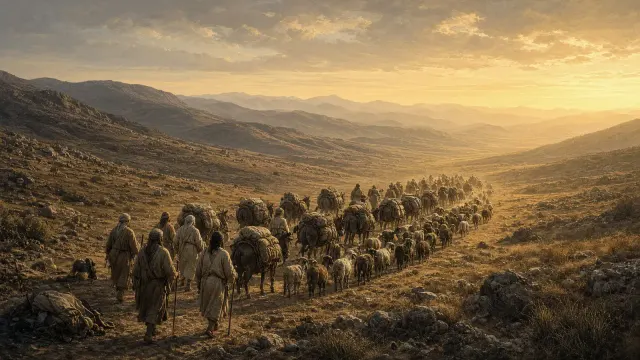
Read 12:4 and show the plain obedience: "So Abram departed, as the LORD had spoken unto him." Note his age, seventy-five, and Lot's company. Follow the route on a simple map through Sichem, Beth-el and Hai, toward the south. Point out "the Canaanite was then in the land" and the promise of the land to his seed. Explain "seed" as descendants, a word that matters all through Genesis. Then show the two altars as worship along the way. Hebrews 11:8 says he went out "not knowing whither he went".
Genesis 12:10-13
Famine and fear
Read the famine and the descent into Egypt. Explain "sojourn" as staying temporarily as a foreigner. Then read Abram's speech to Sarai in full. Do not soften it: he asks her to say she is his sister so that he will live. Note that 20:12 later says she was his half sister, so it was a half truth that hid the whole truth. Teach this step plainly, because the chapter itself does not excuse it. The man of faith in 12:4 is now a man of fear.
Genesis 12:14-16
Sarai taken, Abram enriched
Read what happens: Sarai is praised to Pharaoh and taken into his house, and Abram is treated well and given livestock and servants. Keep the two facts side by side. Name Sarai's vulnerability seriously, as a woman taken into a ruler's household because her husband did not protect her. Do not make it comic. This step matters because it shows how a plan that protects one person can shift danger onto another with less power.
Genesis 12:17-20
God intervenes and Pharaoh rebukes
Read verse 17: the LORD plagues Pharaoh and his house "because of Sarai Abram's wife". God protects the woman Abram had exposed, and keeps the promise intact. Then read Pharaoh's three questions and his order to leave. Point out that Abram says nothing. Some readers see in this a preview of Israel's later time in Egypt, with plagues and a departure with wealth; present it as a literary echo. End the exposition by holding both: God's call is real, and Abram's failure is real.
Where learners get stuck
The misreadings this passage tends to produce, and how to answer each from the text.
"God blessed Abram so he would be rich and successful."
Genesis 12:2 ends "thou shalt be a blessing", and 12:3 says all families of the earth will be blessed in him. The blessing is meant to flow outward. Abram does become wealthy in this chapter, but 12:16 shows that some of that wealth came through a deception that endangered Sarai. Teach blessing as God's favour for the sake of others, not a prosperity guarantee.
"Abram didn't lie, because Sarai really was his half sister."
Genesis 20:12 says she was his father's daughter, so the words were technically true. But the purpose of the words, in 12:12-13, was to hide that she was his wife, so that he would be safe. Pharaoh's rebuke in 12:18-19 treats it as deception. A half truth used to deceive is still deception; the chapter does not excuse it.
"Since God protected Abram, God must have approved of his plan."
God acted "because of Sarai Abram's wife" (12:17), to protect her and his own promise, not to reward Abram's plan. The rebuke comes from Pharaoh, and Abram is sent away. God's faithfulness to his promise does not mean approval of every act of the person he has called. That is good news and also a warning.
Learning objectives
- Identify the commands and promises in Abram's call.
- Explain how the promised blessing extends beyond Abram.
- Trace the journey through Canaan to Egypt.
- Locate worship within Abram's movements through the land.
- Describe Sarai's danger and Abram's stated calculation.
- Distinguish divine preservation from approval of Abram's deception.
Teacher preparation
- Read Genesis 11:27–32 to retain Sarai's childlessness, Lot's kinship, and the journey already underway.
- Notice "had said" in 12:1; compare Acts 7:2–4 before locating the initial call solely at Haran.
- Prepare a route through Sichem, Bethel and Hai, the south, and Egypt using verses 6–10.
- Explain "seed" as descendants here and "sojourn" as living temporarily away from home.
- Plan to name Sarai's vulnerability plainly; do not make her removal into Pharaoh's household a comic mishap.
Evidence and interpretation checks
Explicit
Locate Genesis 12:1–3: God commands departure and promises nationhood, blessing, a great name, and blessing for all earth's families.
Scripture-supported
Use Hebrews 11:8 with Genesis 12:4 to support understanding Abram's departure as obedient faith.
Strong inference
Compare Genesis 12:13 and 15–17: Abram's strategy protects his interests while placing Sarai in danger; intervention should not be mistaken for endorsement.
Possible or traditional reading
Treat a preview of Israel's later Egyptian departure in Genesis 12:10–20 as a literary connection, supported by Exodus 12:31–36 rather than stated here.
Limit
State that Genesis 12:10–20 does not identify Pharaoh, explain the plagues medically, or report Sarai's private thoughts and conversations.
Discussion with answer guidance
1. How far does the purpose of Abram's blessing reach?
What a good answer contains
To the whole world. God promises Abram "a great nation", blessing, and a great name, and then "thou shalt be a blessing" (12:2). Verse 3 widens it: "in thee shall all families of the earth be blessed." The families of chapter 10, scattered in chapter 11, are now the horizon of one man's call. A good answer reaches that last line and sees that Abram is blessed in order to bless. A weak answer stops at "I will bless thee" and makes the call about one family's prosperity. Galatians 3:8 calls verse 3 the gospel preached beforehand.
Show teacher guidance
Read verses 2–3 through to "all families of the earth". Correct an answer that makes the calling only about Abram's prosperity.
2. What does Abram find in the land besides a promise?
What a good answer contains
Other people and a famine. Verse 6 notes "And the Canaanite was then in the land", so the promised land is already occupied. Verse 10 says "there was a famine in the land", grievous enough that Abram leaves it. A good answer sees that the promise is real but not yet visible, and that obstacles arrive at once. A weak answer assumes that obeying God's call should have made everything easy, and is surprised that the land God promised could not feed him.
Show teacher guidance
Note the Canaanites in verse 6 and famine in verse 10. The promise does not make every obstacle disappear on arrival.
3. What do Abram's altars mark along the route?
What a good answer contains
Each altar marks a place where God met Abram and Abram answered. At Sichem "the LORD appeared unto Abram, and said, Unto thy seed will I give this land: and there builded he an altar" (12:7). Near Beth-el he built another and "called upon the name of the LORD" (12:8). A good answer sees the altars as worship and as a quiet claim on the land God promised, made by a man who owned none of it. A weak answer invents ritual details the verses do not give.
Show teacher guidance
Trace verses 7–8: divine appearance, the land promise, and calling on the LORD. Do not invent instructions about each altar's construction.
4. Whose safety is central to Abram's proposal about Sarai?
What a good answer contains
His own: "they will kill me, but they will save thee alive. Say, I pray thee, thou art my sister: that it may be well with me for thy sake; and my soul shall live because of thee" (12:12-13). Count the first-person words: me, me, my soul. A good answer sees that Abram's plan protects himself and places Sarai in danger, and that the chapter does not tell us what she thought. A weak answer calls it a clever half truth, ignoring who carries the risk.
Show teacher guidance
Use his words in verses 11–13. Let the repeated concern for his own life expose the calculation without pretending Sarai's view is reported.
5. What happens to Sarai while Abram acquires goods?
What a good answer contains
She is taken: "the woman was taken into Pharaoh's house" (12:15), while Pharaoh "entreated Abram well for her sake" and Abram gains sheep, oxen, asses, servants and camels (12:16). Her loss and his gain sit in two consecutive verses. A good answer keeps them together and sees that wealth gained this way is not God's approval. A weak answer celebrates Abram's growing flocks and forgets where Sarai is.
Show teacher guidance
Read verses 15–17 together. Keep her being taken into Pharaoh's house beside his material benefit rather than treating wealth as God's approval.
6. How do Pharaoh's questions expose the wrong in Abram's strategy about Sarai?
What a good answer contains
Pharaoh asks three questions: "What is this that thou hast done unto me? why didst thou not tell me that she was thy wife? Why saidst thou, She is my sister?" (12:18-19). The man who received the promise is rebuked by a foreign king, and he has no answer recorded. A good answer notices that God acted to protect Sarai (12:17) and that the outsider sees the wrong more clearly than Abram did. A weak answer makes Pharaoh the villain.
Show teacher guidance
Locate Pharaoh's rebuke in verses 18–19. The chosen recipient of promise is corrected by the foreign ruler he deceived.
Responsible application
Heart and habits
Assess a fictional plan that secures one person's comfort by shifting danger to someone with less power.
Relationships and community
Ask a community to describe blessing as something meant to reach others, using verses 2–3 rather than a prosperity slogan.
Faithful criticism
Rewrite a fictional biography that hides a respected leader's wrongdoing; preserve both Abram's call and the Egyptian failure.
Session plans
Two timings of the same lesson. The shorter keeps the reading, the central discussion and one response; the longer gives the confusions and the application their own time.
45 minutes
Before the call
Read 11:30-32 and then 12:1-3. Count the promises on the board.
All families
Take question one and confusion one. Read Galatians 3:8 beside 12:3.
Departure and altars
Read 12:4-9 with a map. Take questions two and three.
Fear in Egypt
Read 12:10-16. Take questions four and five and confusion two. Keep Sarai's danger in view.
God and Pharaoh
Read 12:17-20. Take question six and confusion three. Read the key verse together and give out the handout.
90 minutes
Leaving home
Ask who has moved somewhere without knowing what it would be like. Read 11:27-32 to set the scene.
The call and the promises
Read 12:1-3. Count the promises and take question one. Read Acts 7:2-4 and Galatians 3:8.
So Abram departed
Read 12:4-9 and Hebrews 11:8. Take questions two and three, tracing the route.
Famine
Read 12:10 and talk about what happens when obedience leads to hardship. Take confusion one.
Abram's plan
Read 12:11-16. Take questions four and five and confusion two. Use the first application on shifting danger.
Pharaoh's questions
Read 12:17-20. Take question six and confusion three.
Honest biography
Use the third application to write a fair account of Abram that keeps both his call and his failure.
Handout and prayer
Read the key verse together and pray to be a blessing to someone this week.
Adapting the lesson
Children
Tell how God called Abram to go to a new land and promised to bless him so that he could bless everyone. Let children pack a pretend bag for a journey. Then say simply that Abram got scared in Egypt and did not tell the truth, and God still kept Sarai safe. Teach that God keeps his promises even when we fail, and that we should tell the truth when we are afraid.
Youth
Ask young people about a time fear made them do something they regretted. Read 12:10-13 and talk honestly about Abram's choice and who paid for it. Then read 12:2-3 and ask what it would look like for them to be a blessing to others. Treat Sarai's situation with seriousness, not jokes.
Adults
Adults can engage with the call's scope, the debate about Ur and Haran, and the literary echo of the exodus. Spend time on 12:10-20 as a portrait of a leader who protects himself at someone else's cost. Ask where that happens in families, churches and workplaces. Keep the discussion on the text, and be careful of anyone who has been placed in danger by another's choices.
One to one
Read 12:1-4 together and ask what God might be asking them to leave or to trust him with. Then read 12:10-20 and ask whether fear has ever led them to protect themselves at another's expense. If they have been the one exposed, like Sarai, show them that God acted on her behalf in 12:17.
Song and video learning lab
A song or video may interpret, compress, or dramatize the text. Its value becomes clearer when its choices are compared with Scripture.
- Before the media: the exact passage and its central movement.
- During the media: the words, people, events, and emotions the artist emphasizes.
- After the media: what it clarifies, what it leaves out, and what belongs back in the biblical text.
Handout
One page for learners to take home. The print button prints this section alone.
Genesis 12:1-20
The passage in brief
In Genesis 12 God calls Abram to leave his country and family and go to a land God will show him. God promises to make him a great nation, to bless him, and to bless all the families of the earth through him. Abram obeys and travels to Canaan, building altars to the LORD. But when famine comes he goes to Egypt and, afraid for his life, tells Sarai to say she is his sister. She is taken into Pharaoh's house until God sends plagues and Pharaoh sends them away.
A verse to keep
And I will make of thee a great nation, and I will bless thee, and make thy name great; and thou shalt be a blessing: And I will bless them that bless thee, and curse him that curseth thee: and in thee shall all families of the earth be blessed.
Genesis 12:2-3 · King James Version
Questions to take home
What did God promise Abram in 12:2-3, and who would be blessed through him?
What did Abram build wherever he stopped in the land?
How did Abram's plan in Egypt put Sarai in danger?
This week
Look for one way to be a blessing to someone outside your own family this week.
Music and video connected to the passage
Related media appears when its Scripture reference overlaps this study. Music and video can illuminate a theme while the biblical text remains the foundation.