The big picture
The Book of Hebrews carries the witnesses of chapter 11 into a race whose decisive focus is Jesus. The surrounding examples matter, but the eyes are directed to the one who endured the cross, disregarded its shame, and sat down at God's right hand. The chapter then interprets present hardship through the language of fatherly discipline, carefully admitting that chastening is grievous while it happens. Endurance is not built by renaming pain as pleasure. Communal responsibility follows: weak hands and knees are to be strengthened, straight paths made, and bitter roots watched before they spread. Esau shows the irreversible cost that can follow when inheritance is traded for immediate appetite. The final movement contrasts Sinai and Sion without turning holiness into softness. The heavenly city includes God as Judge as well as Jesus the mediator. A promised shaking removes what can be moved so that the enduring kingdom remains, and the chapter ends with the same God described as "a consuming fire."
Central truth
Hebrews calls weary believers to run with attention fixed on Jesus, receive God's holy training, strengthen one another, and guard against the destructive exchange illustrated by Esau. Believers approach the heavenly Zion through Jesus and his covenant blood, yet this greater welcome intensifies their responsibility to hear God and serve reverently within his unshakable kingdom.
The study notes have a page of their own
The movement by movement analysis, the words to trace, the verse by verse notes and where readers differ are written for someone studying alone. They are on the Deep Personal Reflections page for this chapter. This page is the lesson.
A chapter-specific teaching brief
These anchors come from this chapter itself. They help a teacher use the Level 1 overview, the Level 2 study, and the Scripture text as one lesson.
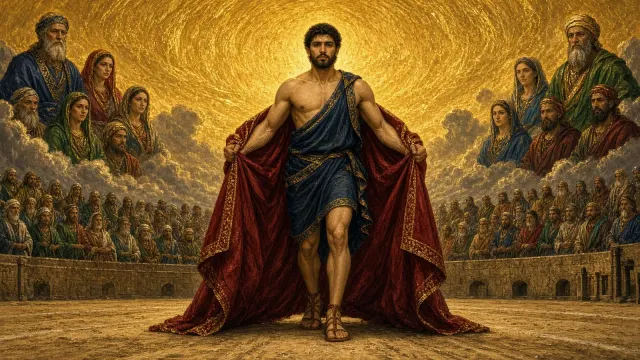
Open with the chapter’s first image
Hebrews 12:1: “Wherefore seeing we also are compassed about with so great a cloud of witnesses, let us lay aside every weight, and the sin which doth so easily beset us…”
Slow down at the turning point
Hebrews 12:11: “Now no chastening for the present seemeth to be joyous, but grievous: nevertheless afterward it yieldeth the peaceable fruit of righteousness unto them…”
Keep this word trail visible
lest, speaketh, chastening, earth, heaven, Lord
What to explain, in order
Teach the passage in this order. Each step names the verses it rests on, so every point can be shown in the text before it is applied.
Hebrews 12:1–17
Hebrews 12:1
The cloud and the race
Begin with “Wherefore”, which ties this chapter to chapter 11: the people just listed are the “cloud of witnesses”. Explain that they are witnesses first because they bore witness by faith; whether they also watch is a question readers answer differently. Then picture a runner: setting aside “every weight” and the sin that clings like a long robe. Explain “with patience” as with endurance, since this is a long race, not a sprint. Teach this first because the rest of the passage is coaching for the race.
Hebrews 12:2-4
Looking unto Jesus
Explain “author and finisher” as the one who starts faith and brings it to completion, the pioneer who ran the course first. Read 12:2 slowly and point to the joy set before him: he endured the cross because of what lay beyond it. Explain “despising the shame” as counting it as nothing compared with that joy. Then 12:3: considering him is the cure for weariness. Read 12:4 carefully. The hearers had not yet been killed for their faith, as Jesus and some of chapter 11 had been. Let the room hear that gently.
Hebrews 12:5-8
The exhortation they had forgotten
Read Proverbs 3:11-12 and show that Hebrews calls it an exhortation that “speaketh unto you as unto children”. Explain “chastening” as training and correction, the upbringing of a child, not only punishment. Name the two errors of 12:5: making light of it and giving up under it. Then read 12:7-8 and explain the hard word “bastards” as children without a father's care. Be aware that some in the room may have grown up without a father; the point is that God's training is the mark that he has not abandoned them.
Hebrews 12:9-11
For our profit
Explain the comparison: human fathers corrected for a short time and “after their own pleasure”, meaning as seemed best to them, sometimes wrongly. God disciplines “for our profit, that we might be partakers of his holiness”. Make clear the contrast includes the imperfection of human fathers; this passage does not bless every human discipline. Then read 12:11 and stress “afterward”. Explain “exercised” as trained, the same word picture as the gymnasium. The fruit is peace and righteousness, and it grows in those who let the training work.
Hebrews 12:12-15
Make the path passable
Read Isaiah 35:3 and Proverbs 4:26 so the class hears where the images come from. Explain that the hands and knees belong to tired runners, and straight paths are smoothed so that the lame can walk without being turned aside. Show that this is a community task. Then read 12:14-15: pursue peace and holiness, watch that no one falls short of the grace of God. Read Deuteronomy 29:18 for the root of bitterness, a person or attitude that spreads poison through the whole community.
Hebrews 12:16-17
The costly meal
Read Genesis 25:29-34 and 27:30-40. Explain “profane” as treating something holy as ordinary; Esau traded what God had attached to the firstborn for one meal. Then read 12:17 and set out the readings honestly. Some take the repentance he could not find as Isaac's change of mind, since the blessing could not be withdrawn. Others take it as Esau's own inability to undo the choice. Note “though he sought it carefully with tears”: the tears were for the blessing. Do not let anyone leave thinking God refuses those who turn to him.
Hebrews 12:18–29
Hebrews 12:18-21
The mountain you have not come to
Read Exodus 19:10-19 and 20:18-19 so the class hears Sinai as Israel heard it. Then read 12:18-21 and list every sound and sight: fire, blackness, darkness, storm, trumpet, voice. Explain the boundary of 12:20, that no one could even touch the mountain. Show that Moses' words in 12:21 echo Deuteronomy 9:19. Make clear that Sinai was not a mistake; it was the holy God giving his law. Teach this first because the whole passage is a contrast, and the class must feel the first mountain before it can see the second.
Hebrews 12:22-23
But ye are come unto mount Sion
Read 12:22 aloud with weight on “But ye are come”. List the places and people: mount Sion, the city of the living God, the heavenly Jerusalem, innumerable angels, the assembly of the firstborn. Explain “church of the firstborn” as God's people, who share the inheritance of the firstborn Son and whose names are recorded in heaven. Then name the two hard companions, God the Judge of all and the spirits of just men made perfect. Explain that worship on earth joins this assembly already.
Hebrews 12:24
Jesus and the blood that speaks
Give this verse its own step, because it is the reason sinners can stand in that assembly. Explain “mediator of the new covenant”, recalling 8:6 and 9:15. Then explain “the blood of sprinkling”, recalling the covenant blood sprinkled by Moses in 9:19. Read Genesis 4:10: Abel's blood cried out from the ground. Christ's blood “speaketh better things”, cleansing instead of accusation. Mention that some readers link the comparison to Abel's offering in 11:4 instead, and let the class see both.
Hebrews 12:25-27
Refuse not him that speaketh
Read 12:25 and connect it with 2:1-3: the letter ends where it began, with a voice that must be heard. If those who refused the voice on earth did not escape, how much less those who turn from the voice from heaven. Then read Haggai 2:6-7 and 12:26-27. Explain “Yet once more” as the final shaking, which removes what is made and leaves what cannot be shaken. Warn against attaching dates, disasters or nations to this verse; Hebrews does not, and its concern is what remains.
Hebrews 12:28-29
Grace, reverence and a consuming fire
Read 12:28 and explain “let us have grace” as let us be grateful, and through that grace serve God acceptably. Name the two qualities, reverence and godly fear, and explain that they are the posture of people who know whom they are approaching. Then read Deuteronomy 4:24 and Hebrews 12:29 together. The God of Zion is the God of Sinai. End the lesson with both truths in view: a kingdom we receive as a gift, and a holy God we serve with awe.
Where learners get stuck
The misreadings this passage tends to produce, and how to answer each from the text.
Hebrews 12:1–17
“Every hard thing in my life is God punishing me for a particular sin.”
The word “chastening” in 12:5-11 means training as well as correction, the way a father raises a son. Its purpose is “for our profit, that we might be partakers of his holiness” (12:10). Hebrews does not tell its readers to trace each hardship to a specific sin, and the sufferers of 11:35-38 were commended, not condemned. The right question in hardship is not only what did I do but what is God growing in me.
“Hebrews 12 means children or wives should accept abuse as God's discipline.”
Hebrews contrasts God's discipline with that of human fathers, who corrected “after their own pleasure” (12:10), admitting their discipline could be flawed. God's discipline aims at holiness and peace. Nothing here permits cruelty, and abuse is not holy training. The same chapter tells the church to heal the lame and make straight paths (12:13). If anyone is being harmed, the church's duty is to protect them and help them reach safety.
“Esau proves that God turns away people who sincerely want to repent.”
Hebrews says Esau “found no place of repentance, though he sought it carefully with tears” (12:17), and Genesis 27:34-38 shows him begging for the blessing. Readers differ on whose change of mind he could not obtain, his father's or his own. Either reading concerns the blessing he had traded away, not forgiveness for everyone who turns to God. The same letter invites all to the throne of grace (4:16). Present the readings and keep that invitation in view.
“The cloud of witnesses means my loved ones in heaven are watching everything I do.”
The witnesses of 12:1 are the people of chapter 11, who “obtained a good report through faith” (11:39). They are witnesses first because they testify to God's faithfulness by their lives. Some traditions also understand them as present and aware; others do not. Hebrews does not develop the point, and its stress is elsewhere: “Looking unto Jesus” (12:2). Be gentle with grieving learners, and keep the focus where the passage puts it.
Hebrews 12:18–29
“The God of the Old Testament was frightening, but the God of the New Testament is gentle.”
Hebrews ends this very passage with “For our God is a consuming fire” (12:29), quoting Deuteronomy 4:24. The contrast in 12:18-24 is between two approaches to the same God: one through fear at a boundary, one through a mediator and his blood. Verse 25 even says the warning is greater now: “much more shall not we escape, if we turn away from him that speaketh from heaven”. God has not changed; the way to him has been opened.
“We only come to the heavenly Jerusalem after we die.”
The verse says “ye are come” (12:22), already, not ye shall come. Believers have been brought into this assembly now, by faith, through Jesus the mediator. The full experience still lies ahead, as 13:14 says, “we seek one to come”. Both are true: we have arrived and we are still travelling. Teach the present reality, which changes how Christians understand their gatherings for worship.
“The shaking of 12:26 is about a particular earthquake, war or nation in our time.”
Hebrews quotes Haggai 2:6 and explains it itself: the shaking removes “things that are made” so that “those things which cannot be shaken may remain” (12:27). It gives no date and names no nation. The thing that remains is “a kingdom which cannot be moved” (12:28), God's kingdom, not any earthly state or institution. Do not map current events onto this verse; Hebrews uses it to call for reverent service.
“Jesus' blood cries out for vengeance like Abel's.”
Hebrews says the opposite: the blood of sprinkling “speaketh better things than that of Abel” (12:24). Abel's blood cried out from the ground against his murderer (Genesis 4:10). Christ's blood is the blood of the covenant that cleanses the conscience (9:14) and opens the way to God (10:19). Some readers connect the comparison to Abel's offering in 11:4 instead. On either reading, Christ's blood speaks mercy.
Learning objectives
- Connect the witnesses with the race in Hebrews 12:1.
- Identify Jesus' endurance as the runner's focus.
- Distinguish divine training from rejection in 12:5-11.
- Explain the communal work of strengthening weak limbs.
- Trace the warning about a spreading root of bitterness.
- Explain Esau's exchange without overstating 12:17.
- Identify the terrifying features of the first mountain.
- List the company assembled at heavenly Zion.
- Explain why God remains Judge within the welcome.
- Describe Jesus' mediating place in Hebrews 12:24.
- Connect divine shaking with the kingdom that remains.
- Distinguish reverent access from casual refusal.
Teacher preparation
- Read Hebrews 11:35-12:17; preserve the suffering context behind the race and training images.
- Read Proverbs 3:11-12 and Isaiah 35:3; prepare the parental correction and weak-hands connections.
- Read Genesis 25:29-34 and 27:34-38; distinguish selling the birthright from later seeking the blessing.
- Explain 'chastening' as corrective training and 'profane' in 12:16 as treating sacred privilege as common; handle 12:8's family-status language without insulting actual children.
- Clarify that God's training does not authorize human abuse or identify every affliction's cause.
- Read Hebrews 12:14-29; connect the call to holiness with the two mountains rather than treating them as travel destinations.
- Read Exodus 19:12-19 and 20:18-21 for Sinai's boundaries, fire, trumpet, and frightened hearers.
- Read Genesis 4:10, Haggai 2:6-9, and Deuteronomy 4:24 for blood, shaking, and consuming-fire connections.
- Explain 'Sion' as the KJV spelling of Zion in 12:22, and 'firstborn' in 12:23 within the assembly's registered heavenly belonging.
- Prepare two columns, 'not come' and 'are come'; do not draw God's appearance or turn the contrast into hostile caricatures of Judaism.
Evidence and interpretation checks
Explicit
Establish from Hebrews 12:2-3 that Jesus endured cross, shame, and opposition, and that considering him addresses weary minds. Establish from Hebrews 12:22-24 that the hearers approach heavenly Zion, its assembled company, God the Judge, Jesus the mediator, and covenant blood.
Scripture-supported
Compare Proverbs 3:11-12 with Hebrews 12:5-11; discipline is connected to belonging, holiness, and eventual righteous fruit. Compare Deuteronomy 4:24 with Hebrews 12:29; the consuming-fire description belongs to the God whom the welcomed community now serves.
Strong inference
Infer from Hebrews 12:12-15 that straight paths and strengthened knees include responsibility for the community's vulnerable members, not athletic improvement alone. Infer from Hebrews 12:25 that greater access increases accountability; the contrast does not divide a formerly severe God from a now-indifferent God.
Possible or traditional reading
Compare readings of Hebrews 12:17's unavailable repentance as an irreversible decision about the blessing or an inability to undo Esau's choice; note the reference to seeking with tears. Compare Hebrews 12:24's better-speaking blood with Abel's blood in Genesis 4:10 and Abel's offering in Hebrews 11:4; identify which comparison a proposed reading uses.
Limit
Do not use Hebrews 12:5-11 to excuse abuse or 12:17 to declare that God rejects every repentant person who once made a disastrous choice. Do not use Hebrews 12:26-28 to date the final shaking, certify a modern nation's permanence, or promise protection from every earthquake.
Discussion with answer guidance
1. Why distinguish weight from sin in Hebrews 12:1?
What a good answer contains
Because not every hindrance is wrong in itself. Hebrews says “let us lay aside every weight, and the sin which doth so easily beset us” (12:1). A weight slows a runner even when it is harmless, like a heavy coat in a race; sin entangles and trips. A good answer sees that the runner must drop both, and that some things are put down not because they are evil but because they hold us back. A weak answer either turns every weight into a sin or ignores the weights altogether.
Show teacher guidance
Observe that both hinder the race, but the wording does not call every encumbrance a moral offense; avoid inventing a universal forbidden-habits list.
2. What does looking to Jesus in verses 2-3 require learners to consider?
What a good answer contains
His whole course, not just his kindness. He is “the author and finisher of our faith”, who “for the joy that was set before him endured the cross, despising the shame”, and who “is set down at the right hand of the throne of God” (12:2). We are to “consider him that endured such contradiction of sinners against himself” (12:3). A strong answer names endurance, shame, opposition and enthronement. A weak answer reduces looking to Jesus to having pleasant thoughts about him.
Show teacher guidance
Name endurance, shame, opposition, and enthronement; reject an account limited to pleasant thoughts about him.
3. Which two wrong responses to chastening appear in verse 5?
What a good answer contains
The verse quotes Proverbs 3:11: “despise not thou the chastening of the Lord, nor faint when thou art rebuked of him” (12:5). One wrong response treats discipline as nothing; the other is crushed by it. Both miss its purpose, which verse 10 states: “that we might be partakers of his holiness”. A good answer names both errors and sets them against that aim. A weak answer names only one, usually fainting, and so turns the passage into comfort without challenge.
Show teacher guidance
Identify despising it and fainting under it; compare the stated aim of sharing God's holiness in verse 10.
4. Why does verse 11 admit that discipline is grievous before speaking of fruit?
What a good answer contains
Because Hebrews is honest. “Now no chastening for the present seemeth to be joyous, but grievous” (12:11). The fruit comes “afterward”, as “the peaceable fruit of righteousness unto them which are exercised thereby”. A good answer keeps both halves: present pain is real and should not be denied, and it is not the end. The word “exercised” is the language of training. A weak answer tells suffering people to pretend they are happy, which the verse refuses to do.
Show teacher guidance
Retain the honest account of present pain and later righteousness; do not command sufferers to pretend the process feels pleasant.
5. Who benefits from lifted hands, strengthened knees, and straight paths in verses 12-15?
What a good answer contains
The weakest in the community: “lift up the hands which hang down, and the feeble knees; And make straight paths for your feet, lest that which is lame be turned out of the way; but let it rather be healed” (12:12-13). The paths are made straight for the sake of the lame. Then the warning: “lest any root of bitterness springing up trouble you, and thereby many be defiled” (12:15). A good answer sees that the whole church is responsible for each member. A weak answer reads only individual self-improvement.
Show teacher guidance
Include the weak and the wider community; connect healing with the warning that a harmful root can defile many.
6. What does Esau exchange in verse 16, and what must remain uncertain when explaining verse 17?
What a good answer contains
Esau sold “his birthright” for “one morsel of meat” (12:16). Afterward, “when he would have inherited the blessing, he was rejected: for he found no place of repentance, though he sought it carefully with tears” (12:17). A good answer names the trade clearly and then admits the uncertainty: readers differ on whether the repentance he could not find was his father's change of mind about the blessing or his own. Either way, he could not undo the choice. A weak answer makes the verse a verdict on all repentance.
Show teacher guidance
Name the birthright for one meal; distinguish the later blessing and disputed repentance wording from a blanket verdict on all repentance.
7. Which details make the first mountain in Hebrews 12:18-21 inaccessible and frightening?
What a good answer contains
Hebrews piles up what made Sinai terrifying: “the mount that might be touched, and that burned with fire”, “blackness, and darkness, and tempest”, “the sound of a trumpet, and the voice of words” (12:18-19). The people begged that the word “should not be spoken to them any more”. A boundary was set, so that even a beast that touched the mountain was to be stoned (12:20), and Moses said, “I exceedingly fear and quake” (12:21). A good answer gathers these details from the text and adds no scenery of its own.
Show teacher guidance
Gather fire, darkness, tempest, trumpet, voice, boundaries, and Moses' fear; avoid adding scenery not supplied by Hebrews or Exodus.
8. What changes when verse 22 says 'ye are come'?
What a good answer contains
The tense. “But ye are come unto mount Sion, and unto the city of the living God, the heavenly Jerusalem” (12:22). It does not say ye shall come. Believers have already arrived, by faith, in the company of “an innumerable company of angels” and “the general assembly and church of the firstborn, which are written in heaven” (12:22-23). A good answer notices that worship now joins this heavenly assembly. A weak answer postpones all of it until after death.
Show teacher guidance
Identify present approach to heavenly Zion and an assembled people; do not postpone every aspect of access until after death.
9. Why include 'God the Judge of all' in verse 23's welcome?
What a good answer contains
Because welcome does not mean God has stopped being holy. Among those we have come to is “God the Judge of all” (12:23). The same assembly includes “the spirits of just men made perfect”, people made right before that judge. A strong answer says that the heavenly city is a place of joy because judgement there has already been met through the mediator. A weak answer imagines a welcome that requires no holiness, which the next verses rule out with their warning.
Show teacher guidance
Preserve holiness within access; challenge the idea that welcome means moral indifference.
10. What makes the approach in verse 24 more than entrance to an impressive gathering?
What a good answer contains
Two things make it more than an impressive gathering: “Jesus the mediator of the new covenant” and “the blood of sprinkling, that speaketh better things than that of Abel” (12:24). Abel's blood cried out from the ground (Genesis 4:10); Christ's blood speaks of cleansing and peace. A good answer puts Jesus and his blood at the centre of the scene. A weak answer is dazzled by the angels and the city and forgets who makes it possible for sinners to stand there.
Show teacher guidance
Name Jesus' mediation and covenant blood; explain their role rather than concentrating only on angels or the city's grandeur.
11. What is removed and what remains in verses 26-28?
What a good answer contains
God promised, “Yet once more I shake not the earth only, but also heaven” (12:26), quoting Haggai 2:6. Hebrews explains that this signifies “the removing of those things that are shaken, as of things that are made, that those things which cannot be shaken may remain” (12:27). What remains is “a kingdom which cannot be moved” (12:28). A good answer distinguishes created things from God's kingdom. A weak answer identifies that kingdom with a church building, a nation or any human institution.
Show teacher guidance
Distinguish created, shakable things from the unmovable kingdom; do not identify the latter with a favored institution.
12. Why conclude this welcome with reverence, godly fear, and consuming fire?
What a good answer contains
Because the God who welcomes is still holy. Verse 25 warns, “See that ye refuse not him that speaketh”. Verse 28 calls us to “serve God acceptably with reverence and godly fear”, and verse 29 gives the reason: “For our God is a consuming fire”, quoting Deuteronomy 4:24. A good answer says that grace leads to grateful, attentive worship, not to carelessness. A weak answer splits God into a frightening God of Sinai and a comfortable God of Zion.
Show teacher guidance
Connect verses 25 and 28-29; access through the mediator calls for grateful, attentive service rather than refusal.
Responsible application
Heart and habits
Ask learners to identify a fictional runner's unnecessary burden and explain its removal without automatically labeling it sinful.
Relationships and community
Have groups redesign a congregation's expectations so they help a weary member continue rather than making the path harder.
Protect sacred responsibility
Ask the class to examine an invented exchange of lasting responsibility for immediate convenience, using Esau's bargain without demanding private admissions.
Do not confuse kingdoms
Ask the class to test a claim that a building, government, or organization cannot fail because Hebrews 12:28 promises an unshakable kingdom.
Session plans
Two timings of the same lesson. The shorter keeps the reading, the central discussion and one response; the longer gives the confusions and the application their own time.
Hebrews 12:1–17
45 minutes
Set down the extra baggage
Read 12:1 with a light bag in hand. Take question one and confusion four.
Look at the finisher
Read 12:2-4 and take question two.
Training without denial
Read Proverbs 3:11-12 and Hebrews 12:5-11. Take questions three and four, and confusions one and two.
Make the path passable
Read 12:12-15 and take question five.
The costly meal
Read 12:16-17 and Genesis 25:29-34. Take question six and confusion three. Hand out the sheet, read the key verse together and pray.
90 minutes
A long race
Ask who has run or watched a long race and what made runners drop out. Read 12:1 and take question one.
The cloud
Link 12:1 back to chapter 11. Take confusion four with care for anyone grieving.
Looking unto Jesus
Read 12:2-4. Take question two. Ask what joy was set before Jesus and how considering him helps a tired mind.
The Father's training
Read Proverbs 3:11-12 and Hebrews 12:5-11. Take questions three and four and confusion one.
What discipline is not
Read confusion two aloud. Say plainly that abuse is not God's discipline and that anyone at risk can speak with you privately.
Straight paths for the lame
Read Isaiah 35:3-6 and Hebrews 12:12-15 with Deuteronomy 29:18. Take question five. Ask who in this church is limping and how paths could be made straight for them.
Esau
Read Genesis 25:29-34 and 27:30-38, then Hebrews 12:16-17. Take question six and confusion three, giving both readings fairly.
Handout and prayer
Read the key verse together, point to the take-home line, and pray for tired runners in the group.
Hebrews 12:18–29
45 minutes
The mountain with a boundary
Read Exodus 19:16-19, then Hebrews 12:18-21. Take question one.
Ye are come
Read 12:22-23. Take questions two and three and confusion two.
Better things
Read 12:24 and Genesis 4:10. Take question four and confusion four.
Refuse not him that speaketh
Read 12:25-27 with Haggai 2:6. Take question five and confusion three.
Reverence
Read 12:28-29. Take question six and confusion one. Hand out the sheet, read the key verse together and pray.
90 minutes
Two approaches
Draw two mountains on the board. Ask how people approach someone they fear and someone who has welcomed them.
Sinai
Read Exodus 19:10-19, 20:18-19 and Deuteronomy 9:19, then Hebrews 12:18-21. Take question one.
Zion
Read 12:22-23. Take questions two and three and confusion two. Ask how this changes the way they come to worship.
The mediator and the blood
Read 12:24 with Genesis 4:10 and 9:19-20. Take question four and confusion four.
The voice from heaven
Read 12:25 and 2:1-3 together. Discuss how the letter ends where it began. Take confusion one.
What cannot be shaken
Read Haggai 2:6-7 and Hebrews 12:26-28. Take question five and confusion three. Ask what in their lives feels shaken.
A consuming fire
Read Deuteronomy 4:24 and Hebrews 12:28-29. Take question six. Ask what reverence and gratitude look like on Sunday morning.
Handout and prayer
Read the key verse together and pray with thanks for an unshakable kingdom.
Adapting the lesson
Hebrews 12:1–17
Children
Let one child try to run a short distance carrying a heavy bag, then without it, and read 12:1. Talk about running God's way and looking at Jesus. Speak of God as a loving father who helps us grow. Never stage punishment as an object lesson, and do not dwell on the word bastards or on Esau's tears.
Youth
Ask what weights slow them down that are not exactly sins: screens, friendships, ambitions. Then read 12:2 and talk about Jesus enduring shame. Many teenagers feel crushed by correction or brush it off, so put the two errors of 12:5 to them and ask which they tend toward. Be alert to anyone who may be harmed at home.
Adults
Spend time on discipline: what it is, what it is not, and how to tell God's training from human cruelty. Discuss the readings of 12:17 fairly. Then press the community question of 12:12-15: who is limping in this congregation, where is bitterness taking root, and what would making straight paths require of them.
One to one
Ask whether they are tired in the race at present, and what is weighing on them. Read 12:2-3 and let them consider Jesus before you give any advice. If they are going through a hard season, read 12:11 and be honest that it is grievous. If they fear they have thrown something away like Esau, read 4:16 together.
Hebrews 12:18–29
Children
Draw two hills, one dark and stormy with a fence around it, one bright with a city and many people. Explain that God is so holy that people were afraid, but Jesus welcomes us into God's family. Speak of thunder and fire simply, without trying to frighten them, and end by saying we come to God through Jesus.
Youth
Ask whether worship ever feels small or boring. Read 12:22-24 and help them see what is really happening when believers gather: they join angels and saints before God. Then read 12:29 and talk about awe. Keep them away from end-times speculation about the shaking and on what cannot be shaken.
Adults
Trace the Old Testament behind the passage: Exodus 19, Deuteronomy 4 and 9, Genesis 4 and Haggai 2. Discuss the readings of 12:24. Then ask honestly whether the congregation's worship shows both the joy of Zion and the reverence of a consuming fire, and which one it tends to lose.
One to one
Ask how they picture God when they pray: distant and frightening, or near and welcoming. Read 12:18-24 together and show that through Jesus both holiness and welcome are true. If their life feels shaken, read 12:27-28 and pray for a settled heart in a kingdom that cannot be moved.
Song and video learning lab
A song or video may interpret, compress, or dramatize the text. Its value becomes clearer when its choices are compared with Scripture.
- Before the media: the exact passage and its central movement.
- During the media: the words, people, events, and emotions the artist emphasizes.
- After the media: what it clarifies, what it leaves out, and what belongs back in the biblical text.
Handout
One page for learners to take home. The print button prints this section alone.
Hebrews 12:1–17
The passage in brief
With the faithful people of Hebrews 11 as witnesses, we are to run our race with endurance, putting aside everything that slows us down and the sin that trips us. We keep our eyes on Jesus, who endured the cross for the joy ahead and now sits at God's right hand. God trains his children like a good father, and though it hurts at the time, it produces peace and righteousness. We are to strengthen tired believers, pursue peace and holiness, and not throw away God's gifts as Esau did.
A verse to keep
Looking unto Jesus the author and finisher of our faith; who for the joy that was set before him endured the cross, despising the shame, and is set down at the right hand of the throne of God.
Hebrews 12:2 · King James Version
Questions to take home
What two things should we lay aside in 12:1?
Why does God discipline his children, according to 12:10?
What did Esau trade away in 12:16?
This week
Name one weight to set down this week, and one tired believer whose knees you could help strengthen.
Hebrews 12:18–29
The passage in brief
When God gave the law at Mount Sinai, the mountain burned with fire and storm, and the people were so afraid that they begged God to stop speaking. Believers have come to a different mountain: the heavenly Jerusalem, with angels, God's people, God the Judge, and Jesus, whose blood speaks better things than Abel's. So we must listen to God when he speaks. He will shake everything that can be shaken, but his kingdom cannot be moved. We receive it with gratitude and worship him with reverence, because our God is a consuming fire.
A verse to keep
Wherefore we receiving a kingdom which cannot be moved, let us have grace, whereby we may serve God acceptably with reverence and godly fear: For our God is a consuming fire.
Hebrews 12:28-29 · King James Version
Questions to take home
What made Mount Sinai so frightening in 12:18-21?
Who is at the heavenly Jerusalem, according to 12:22-24?
What cannot be shaken, according to 12:28?
This week
Before worship this Sunday, read Hebrews 12:22-24 and remember whom you are joining.
Music and video connected to the passage
Related media appears when its Scripture reference overlaps this study. Music and video can illuminate a theme while the biblical text remains the foundation.