The big picture
Lazarus’ illness brings love and delay into the same sentence. Jesus does not hurry to Bethany, yet the Book of John repeatedly affirms his love for the household and refuses to pretend the death is unreal. Martha confesses Jesus as Christ before the tomb opens, Mary’s grief draws tears from him even though he knows the outcome, and the stone is removed only after Martha names the physical reality of four days in the grave. Jesus then calls Lazarus out, and the man who was dead returns still wrapped in burial cloths. The sign produces belief, but it also accelerates the plan to kill Jesus. Caiaphas argues that one man should die for the nation, while the Gospel identifies a saving meaning beyond his political calculation. The chapter closes with Passover approaching, an arrest order in place, and Jesus withdrawn from public view.
Central truth
John 11 lets Jesus delay, grieve, command a tomb opened, and call Lazarus out alive, so that the sign bringing many to belief also moves the council toward Jesus' death.

The study notes have a page of their own
The movement by movement analysis, the words to trace, the verse by verse notes and where readers differ are written for someone studying alone. They are on the Deep Personal Reflections page for this chapter. This page is the lesson.
A chapter-specific teaching brief
These anchors come from this chapter itself. They help a teacher use the Level 1 overview, the Level 2 study, and the Scripture text as one lesson.
Open with the chapter’s first image
John 11:1: “Now a certain man was sick, named Lazarus, of Bethany, the town of Mary and her sister Martha.”
Slow down at the turning point
John 11:30: “Now Jesus was not yet come into the town, but was in that place where Martha met him.”
Keep this word trail visible
Jesus, Jews, Lord, Martha, Mary, dead
What to explain, in order
Teach the passage in this order. Each step names the verses it rests on, so every point can be shown in the text before it is applied.
John 11:1-16
Love and a deliberate delay
Begin with the family: Lazarus, Martha and Mary of Bethany, friends Jesus loved. Their message does not even ask him to come: "he whom thou lovest is sick." Read verses 4 to 6 together and stay on the word therefore in verse 6. Explain that Jesus' delay is purposeful, for the glory of God and for faith, but do not make it painless. Then the disciples' fear, since Judaea means danger, and Jesus' saying about walking in the day. Explain sleep as a gentle word for death that the disciples misunderstand. End with Thomas' brave, grim loyalty. Teach this first so the tension is felt before it is resolved.
John 11:17-27
Martha and the resurrection
Explain the four days: Lazarus is truly dead, and Jewish mourning customs mean a crowd of comforters from Jerusalem, two miles away. Martha goes out. Read her words as faith mixed with grief, not as accusation. Then trace the exchange: Jesus says her brother will rise, she agrees about the last day, and Jesus says, "I am the resurrection, and the life." Explain the two promises: the believer who dies will live, and the one who lives and believes will never die, in the sense of never being cut off from life with God. Then her confession, one of the fullest in the Book of John. Teach it as the theological heart.
John 11:28-37
Mary's tears and Jesus' tears
Mary comes, falls at his feet and says what Martha said. Jesus does not answer with teaching. Explain groaned in the spirit as a word of deep, even angry, emotion; scholars debate whether he is angry at death, at unbelief, or simply overwhelmed, and the text does not settle it. Do not overdefine it. Then read verse 35 aloud and pause. Show the two reactions in verses 36 and 37. Teach this step slowly, because many learners have stood at graves, and they need to see that Jesus' power over death does not make him impatient with grief.
John 11:38-44
Take away the stone; Lazarus, come forth
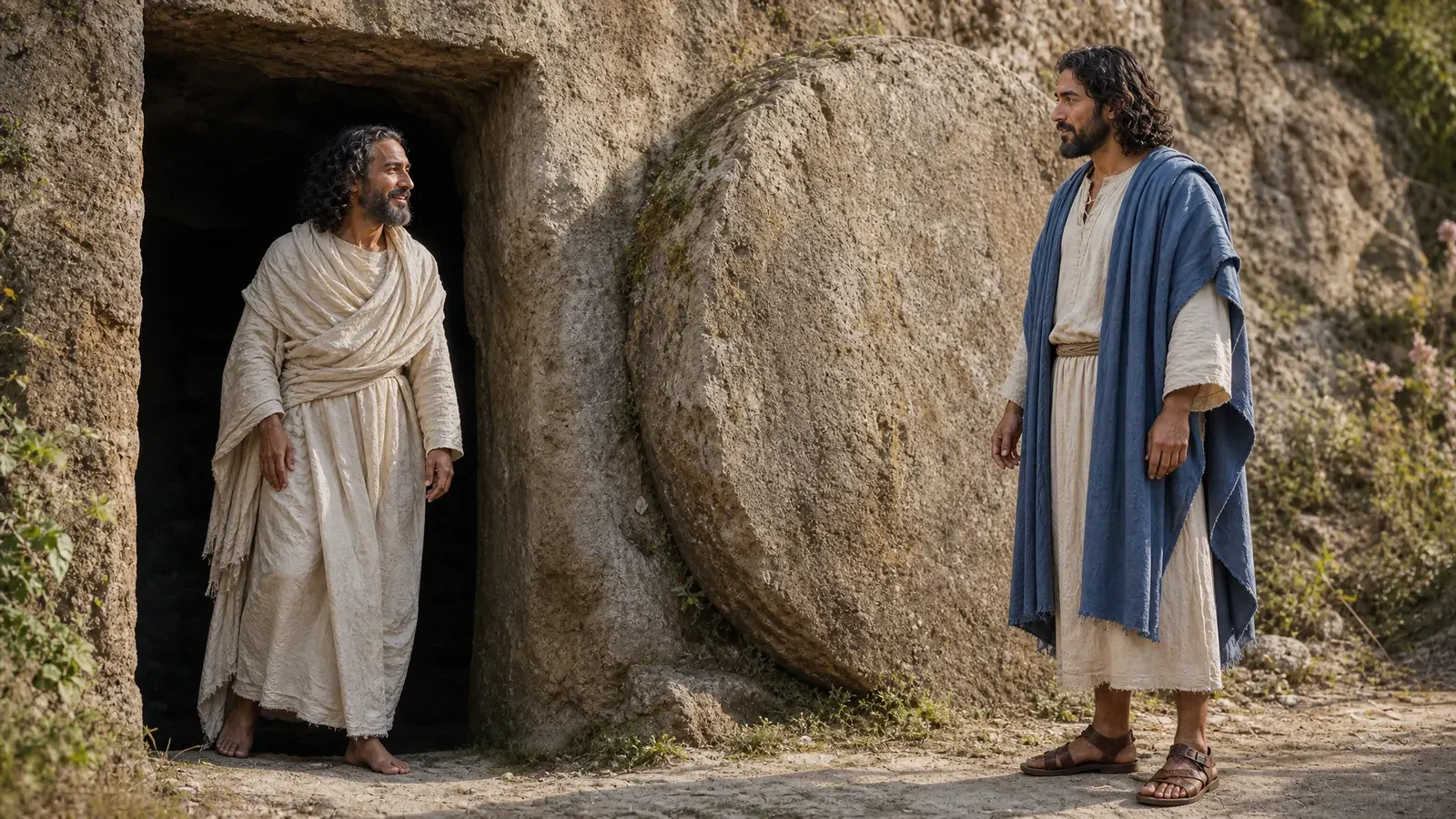
Describe the tomb: a cave with a stone across it. Read Martha's objection and Jesus' reply about seeing the glory of God. Then the stone is moved and Jesus prays. Explain that his prayer is thanks, already sure he is heard, spoken aloud for those standing by. Then the loud cry, Lazarus, come forth, and the dead man walks out bound in graveclothes. Point out the last command, loose him, given to the community. Explain that Lazarus returns to ordinary mortal life and will die again, unlike Jesus' own resurrection in chapter 20, where the graveclothes are left behind. Teach this as the sign that points to Jesus' identity.
John 11:45-57
One man should die for the people
The sign divides again. Many believe; some report to the Pharisees. Explain the council, the Sanhedrin, under Roman rule, fearing that a popular movement would bring Roman force on the temple and the nation. Caiaphas' logic is political: better one man than all. Then read the Book of John's comment in verses 51 and 52: without knowing it, he spoke the truth of the gospel, that Jesus would die for the nation and to gather God's scattered children into one. Explain the irony. Teach this last because the gift of life to Lazarus leads directly to the plan to take Jesus' life.
Where learners get stuck
The misreadings this passage tends to produce, and how to answer each from the text.
"Jesus waited because he didn't care enough to come straight away."
Verse 5 says he loved all three, and verse 6 begins with therefore, tying the delay to that love. His tears in 11:35 and his groaning in 11:33 and 11:38 show how deeply he cared. He explains the purpose: God's glory and their faith (11:4, 15, 40). Teach that delay is not indifference, while honouring the pain that real delays cause.
"Christians shouldn't cry at funerals if they believe in the resurrection."
Jesus himself believes in the resurrection more than anyone, he is the resurrection (11:25), and still he weeps (11:35). Martha's faith in the last day (11:24) did not stop her grieving. Paul says believers grieve, though not as those without hope (1 Thessalonians 4:13). Grief and hope belong together. Give grieving learners permission to weep.
"Lazarus was raised the same way Jesus was raised, so he never died again."
Lazarus comes out still bound in his graveclothes (11:44), and in 12:10 the chief priests plan to kill him, which assumes he is mortal. He was restored to ordinary life. When Jesus rises, the graveclothes are left neatly in the tomb (20:6-7) and he appears through locked doors (20:19). Lazarus' raising is a sign pointing to Jesus, who is the resurrection.
"The Jews killed Jesus because Caiaphas said one man should die."
The plan is made by a council of chief priests and Pharisees (11:47), not by a whole people, and many Jews in the same chapter believe on Jesus (11:45). The council is driven by fear of Rome (11:48). The Book of John also says Jesus lays down his life of himself (10:18). Do not use this chapter to blame Jewish people; it shows human fear and God's purpose working through it.
Learning objectives
- Explain why Jesus' delay cannot be reduced to indifference.
- Trace Martha's confession from resurrection hope to Jesus' identity.
- Describe how Jesus responds differently to Martha and Mary.
- Explain the importance of Jesus weeping within the larger scene.
- Reconstruct the sequence at Lazarus's tomb.
- Show how the raising of Lazarus produces both belief and lethal opposition.
Teacher preparation
- Locate Bethany near Jerusalem so verse 18 and the mourners make sense.
- Mark love, believe, glory, resurrection, life, weep, stone, and come forth.
- Keep Martha's 'last day' expectation as the immediate resurrection frame.
- Do not overdefine the exact emotions behind Jesus' groaning and tears.
- Read verses 45 to 53 so Caiaphas's reasoning and John's interpretation stay distinct.
Evidence and interpretation checks
Explicit
Jesus deliberately waits two days after hearing of Lazarus's sickness, then goes after Lazarus has died.
Scripture-supported
Martha confesses resurrection at the last day; Jesus locates resurrection and life in himself.
Strong inference
Jesus' tears show real grief, but John never reduces them to one explained emotion.
Possible or traditional reading
The four days have received later symbolic explanations; John chiefly uses the detail to underscore death's reality.
Limit
Lazarus returns to mortal life; John does not describe his later life or final death.
Discussion with answer guidance
1. How can verse 5 say Jesus loves Martha, Mary, and Lazarus, while verse 6 says he stays two more days?
What a good answer contains
By keeping both verses and reading the word therefore that joins them: "Now Jesus loved Martha, and her sister, and Lazarus. When he had heard therefore that he was sick, he abode two days still" (11:5-6). The delay flows from love, not against it. Jesus has said, "This sickness is not unto death, but for the glory of God" (11:4), and later, "I am glad for your sakes that I was not there, to the intent ye may believe" (11:15). A good answer holds the tension honestly and lets 11:40 show the purpose. A weak answer deletes the love or explains away the delay.
Show teacher guidance
Do not solve the tension by deleting either statement. Let verses 4, 11, 14, 15, and 40 show that Jesus understands the delay within glory and belief.
2. What does Martha already believe before Jesus says, 'I am the resurrection, and the life'?
What a good answer contains
A great deal. She believes Jesus could have prevented the death, "Lord, if thou hadst been here, my brother had not died" (11:21), she trusts his prayers, "whatsoever thou wilt ask of God, God will give it thee" (11:22), and she believes in the final resurrection: "I know that he shall rise again in the resurrection at the last day" (11:24). A good answer gives her credit for real faith. Then Jesus moves it from an event at the end to a person in front of her: "I am the resurrection, and the life" (11:25). A weak answer makes Martha faithless.
Show teacher guidance
Verses 22 to 24 show confidence in prayer and resurrection at the last day. Jesus then moves the conversation from an event to himself.
3. What is different about Jesus' exchanges with Martha and Mary?
What a good answer contains
Martha talks and is taught; Mary weeps and is wept with. Martha goes out to meet him and receives the great I am saying and makes her confession (11:20-27). Mary "fell down at his feet" and repeats the same words, "Lord, if thou hadst been here, my brother had not died" (11:32), but Jesus does not teach her. He sees her weeping, "groaned in the spirit, and was troubled" (11:33), asks where Lazarus lies, and weeps. A good answer sees Jesus meeting each sister as she comes. A weak answer ranks one sister above the other.
Show teacher guidance
Martha receives extended teaching and confession; Mary falls at his feet, repeats the lament, and the scene moves into groaning and tears.
4. Why does verse 35 matter when Jesus is about to raise Lazarus?
What a good answer contains
Because Jesus knows he will raise Lazarus within minutes, and still "Jesus wept" (11:35). His tears are not for lack of hope; they show that death is an enemy and grief is real, and that he enters it with those he loves. Onlookers read it as love (11:36), and some as a failure (11:37). A good answer keeps the tears and the resurrection power in the same person. A weak answer rushes past verse 35 to verse 43, which teaches grieving people that tears are a lack of faith.
Show teacher guidance
The coming miracle does not make grief unreal. Jesus weeps in the same account that presents him as resurrection and life.
5. What commands does Jesus give at the tomb, and who must act on each one?
What a good answer contains
Three commands. "Take ye away the stone" (11:39) is for the bystanders, and Martha objects that the body will stink after four days. "Lazarus, come forth" (11:43) is spoken to the dead man, and only Jesus' voice can reach him. "Loose him, and let him go" (11:44) is for the community again, unwinding the graveclothes. A good answer sees the pattern: people do what they can, Jesus does what only he can. It also notes the prayer in 11:41-42, said aloud so that people would believe the Father sent him.
Show teacher guidance
Trace 'Take ye away the stone,' 'Lazarus, come forth,' and 'Loose him, and let him go.' Notice where human hands act and where only Jesus' call reaches the dead.
6. How does the council interpret a sign that has led many to believe?
What a good answer contains
As a threat. "What do we? for this man doeth many miracles. If we let him thus alone, all men will believe on him: and the Romans shall come and take away both our place and nation" (11:47-48). Caiaphas then argues "that one man should die for the people, and that the whole nation perish not" (11:50). A good answer notices the Book of John's comment that Caiaphas unknowingly prophesied Jesus would die for the nation and for the scattered children of God (11:51-52). A weak answer blames a whole people rather than a council's fearful calculation.
Show teacher guidance
Verses 47 and 48 focus on fear that continued signs will draw everyone after Jesus and bring Roman action against their place and nation.
Responsible application
Do not mistake delay for absence
Use verses 5 to 7 to discuss how a passage can hold love and delay together without granting the reader a simple timetable explanation.
Make room for tears beside doctrine
Use Martha's confession and Jesus' weeping to keep clear theological claims from becoming an excuse to hurry grieving people past grief.
Move the stone you were actually told to move
Use the tomb commands to distinguish faithful human participation from pretending human effort can perform the life-giving act only Jesus performs here.
Session plans
Two timings of the same lesson. The shorter keeps the reading, the central discussion and one response; the longer gives the confusions and the application their own time.
45 minutes
He whom thou lovest
Read 11:1-16. Take question one and the first confusion.
I am the resurrection
Read 11:17-27. Take question two and ask learners to repeat Martha's confession.
Jesus wept
Read 11:28-37. Take questions three and four, and the second confusion with care.
Come forth
Read 11:38-44. Take question five and the third confusion.
The council and the handout
Read 11:47-53 and take question six briefly. Read the key verse and hand out the sheet.
90 minutes
Waiting for help
Ask if anyone has prayed for help that seemed late. Let silence be allowed. Then read 11:1-6.
Love and delay
Read 11:7-16. Take question one and the first confusion.
Martha meets Jesus
Read 11:17-27. Take question two. Explain the two promises in 11:25-26.
Mary and the tears
Read 11:28-37. Take questions three and four, then the second confusion. Read 1 Thessalonians 4:13.
The stone and the voice
Read 11:38-44. Take question five and the third confusion, comparing 20:6-7.
Expedient for us
Read 11:45-57. Take question six and the fourth confusion, then the irony of 11:51-52.
Applications
In pairs, take the application on tears beside doctrine or on moving the stone.
Handout and prayer
Read the key verse together, point to the take-home line, and pray for those who are grieving.
Adapting the lesson
Children
Tell the account with a box for the tomb and a doll wrapped in cloth for Lazarus. Let children roll a cushion away for the stone and call out the words, Lazarus, come forth. Let them unwrap the doll. Explain that Jesus cried because he loved his friends, and that it is fine to cry when we are sad. Keep death language gentle and be alert to any child who has lost someone.
Youth
Ask how they react when God seems slow. Read 11:5-6 and talk about love and delay. Read 11:35 and ask what it means that Jesus cried. Many youth have grieved grandparents, friends or pets; give space. Use the council's reaction to show how people can see the same event and respond with belief or fear.
Adults
This passage often meets real grief in the room. Give time to the sisters' words, which are the words many adults have said, and to Jesus' tears. Talk about the difference between Martha's future hope and Jesus' present claim. Discuss the council's political reasoning and how fear makes people calculate who is expendable. Be ready to pray with anyone afterwards.
One to one
If the person is grieving, read only 11:17-36 at first and let them talk. Do not hurry to verse 44. Let them hear Jesus' tears. Then read 11:25-26 and ask Jesus' question gently, Believest thou this, without demanding an answer. If they are not grieving, ask what stone they think Jesus might be asking them to move.
Song and video learning lab
A song or video may interpret, compress, or dramatize the text. Its value becomes clearer when its choices are compared with Scripture.
- Before the media: the exact passage and its central movement.
- During the media: the words, people, events, and emotions the artist emphasizes.
- After the media: what it clarifies, what it leaves out, and what belongs back in the biblical text.
Handout
One page for learners to take home. The print button prints this section alone.
John 11
The passage in brief
Lazarus, the brother of Martha and Mary, is very ill, and the sisters send word to Jesus, whom they know loves them. Jesus waits two days, and Lazarus dies. When Jesus arrives, Martha meets him, and he tells her, I am the resurrection and the life. Mary falls at his feet weeping, and Jesus weeps too. At the tomb he has the stone moved, prays, and calls Lazarus out, and he comes. Many believe, but the council plans to kill Jesus.
A verse to keep
Jesus said unto her, I am the resurrection, and the life: he that believeth in me, though he were dead, yet shall he live: And whosoever liveth and believeth in me shall never die. Believest thou this?
John 11:25-26 · King James Version
Questions to take home
Why do you think Jesus waited two days before going to Bethany?
What did Martha believe before Jesus spoke to her?
Why does it matter that Jesus wept?
This week
Read John 11:25-26 aloud this week and answer Jesus' question honestly in prayer.
Music and video connected to the passage
Related media appears when its Scripture reference overlaps this study. Music and video can illuminate a theme while the biblical text remains the foundation.