The big picture
Lazarus’ illness brings love and delay into the same sentence. Jesus does not hurry to Bethany, yet the Book of John repeatedly affirms his love for the household and refuses to pretend the death is unreal. Martha confesses Jesus as Christ before the tomb opens, Mary’s grief draws tears from him even though he knows the outcome, and the stone is removed only after Martha names the physical reality of four days in the grave. Jesus then calls Lazarus out, and the man who was dead returns still wrapped in burial cloths. The sign produces belief, but it also accelerates the plan to kill Jesus. Caiaphas argues that one man should die for the nation, while the Gospel identifies a saving meaning beyond his political calculation. The chapter closes with Passover approaching, an arrest order in place, and Jesus withdrawn from public view.
In this chapter
- Love and Delay Occupy the Same Sentence John 11:1-16
The message about Lazarus appeals to love, and the Book of John immediately confirms that Jesus loves Martha, Mary, and Lazarus.
- Resurrection Moves from a Date to a Person John 11:17-27
Martha meets Jesus with two convictions that might seem difficult to hold together: if he had been there, her brother would not have died, and even now God will hear him.
- His Knowledge of the Outcome Does Not Cancel His Tears John 11:28-37
Mary reaches Jesus with the same sentence Martha used: if he had been there, Lazarus would not have died.
- The Stone Is Removed Before the Voice Is Heard John 11:38-44
Martha’s protest at the tomb forces the physical fact of death into the open.
- The Council Answers a Restored Life with a Death Plan John 11:45-53
The raised Lazarus does not settle the public argument in one direction.
- Passover Approaches Under an Order to Report Him John 11:54-57
Jesus withdraws from open movement among the hostile authorities and remains with his disciples near the wilderness.

Scripture beside the summary
John · King James Version · 57John 11:1-16
Love and Delay Occupy the Same Sentence
The message about Lazarus appeals to love, and the Book of John immediately confirms that Jesus loves Martha, Mary, and Lazarus. Then Jesus stays where he is for two more days. Love and delay are placed together so closely that the reader cannot separate them without rewriting the account. The delay does not mean Lazarus only appears to die. Jesus eventually says plainly, “Lazarus is dead.” His earlier statement that the sickness is not unto death concerns the final outcome rather than denying the burial that has already occurred. Returning to Judea also means moving back toward people who recently tried to stone him, so the journey carries risk for Jesus as well as grief for the household. Even the disciples misunderstand the word “sleep” and have to be told what has happened. Thomas then proposes going with Jesus even if it means dying with him. Before any tomb is opened, the chapter has already bound love, danger, misunderstanding, loyalty, and death together.
Deep dive
The message appeals to Jesus' love, and John expressly affirms his love for Martha, Mary, and Lazarus. Then comes the delay. The sequence refuses the easy assumption that immediate arrival would be the only possible expression of that love. Yet John does not soften the cost by pretending that Lazarus merely appears to die. Jesus will state his death plainly. The illness not being "unto death" concerns its ultimate outcome in God's glory, not the absence of a real burial.
Returning to Judea means returning toward people who recently sought to stone Jesus. The daylight image describes his work within its appointed opportunity, answering the disciples' concern without denying the danger. When he speaks of Lazarus sleeping, they hear a sign of recovery and must be told directly that he is dead. Their misunderstanding keeps the coming action from looking like something they had already anticipated.
Thomas responds by proposing that they go and die with Jesus. The account gives him this willingness before the later scene that has so often reduced his identity to doubt. His understanding of the outcome is incomplete, but his readiness to accompany Jesus is explicit. The chapter begins with a threatened journey in which love, risk, misunderstanding, and trust are already present before the tomb comes into view.
Words to trace: Jesus, Lazarus, sick, disciples, Lord, sleep
Verse-by-verse path
- John 11:1
Lazarus is the Greek form of Eleazar, “God has helped”. The only other Lazarus in the New Testament is the beggar of Luke 16, of whom Abraham says that the living will not be persuaded “though one rose from the dead”. Naming Bethany by its women distinguishes it from the Bethany beyond Jordan where Jesus is staying (1:28).
- John 11:2
The anointing is told only in the next chapter (12:3), yet the Book of John identifies Mary by it here, as if readers already knew her by that act. Mark 14:9 says the deed would be told wherever the gospel was preached, and this aside assumes it had been.
- John 11:3
The sisters do not ask him to come; they tell him the need, as his mother did at Cana: “They have no wine” (2:3). “He whom thou lovest” uses phileo. Some scholars have argued from this that Lazarus is the disciple whom Jesus loved, but the book never makes the identification.
- John 11:4
“Not unto death” means not ending in death, the phrase of 1 John 5:16, “a sin unto death”. There is a second edge to “glorified thereby”: the raising will set in motion the council’s plot (verse 53), and the Book of John calls the cross itself his glorifying.
- John 11:5
The verb changes to agapao, and the sisters are named in an unexpected order: Martha first, with Mary as “her sister”. Martha is the one who received Jesus into her house in Luke 10:38, and she is likely the elder.
- John 11:6
A messenger needed about a day to reach him, he waited two, and the return took about a day; Lazarus had lain in the grave four days when Jesus arrived (verse 17). On that reckoning Lazarus was already dead by the time the message came, though the book does not do the arithmetic.
- John 11:7
He does not say “Let us go to Bethany” but “into Judaea again”, naming the region where he was nearly stoned. The disciples hear the danger in the word at once.
- John 11:8
“Of late” is literally “just now”, the stones of 10:31 still fresh. “Master” is rabbi. Their question carries fear for themselves as well as for him, which Thomas will voice in verse 16.
- John 11:9
Daylight was divided into twelve hours whatever the season, so an hour was longer in summer than in winter. The saying is a proverb about working while the light lasts, the image of 9:4, “the night cometh, when no man can work.”
- John 11:10
The Greek says the light is not “in him”, not around him. The ancient idea was that the eye is a lamp and sight comes from a light within, as in Matthew 6:22–23, “The light of the body is the eye.”
- John 11:11
“Our friend” includes the disciples: Lazarus is friend to them all. “Sleepeth” is a perfect tense, “has fallen asleep”, a familiar way of speaking of death (Daniel 12:2; 1 Thessalonians 4:13). From the same verb comes koimeterion, sleeping place, the origin of the word cemetery.
- John 11:12
“He shall do well” is sothesetai, he will be saved, the ordinary word for recovering from illness and the book’s word for salvation. The disciples mean the fever will break; the verb says more than they know.
- John 11:13
“Taking of rest in sleep” is a doubled phrase, literally “the sleep of slumber”. This is one of the book’s explanatory asides, like 2:21 and 12:33, pointing out that the hearers took a figure literally.
- John 11:14
“Plainly” is parresia, the openness the crowd demanded at the feast of dedication: “tell us plainly” (10:24). He gives it to his disciples in two words.
- John 11:15
“That I was not there” implies what both sisters will say: had he been present, Lazarus would not have died (verses 21 and 32). His gladness is for the disciples’ faith, and it is spoken about a friend already four days dead.
- John 11:16
Thomas is Aramaic for twin, and Didymus is the Greek for the same word. His twin is never named; later Syrian tradition called him Judas Thomas. “With him” most naturally means with Jesus, heading back towards the stones, rather than with Lazarus.
John 11:1-16
King James Version1Now a certain man was sick, named Lazarus, of Bethany, the town of Mary and her sister Martha.
2(It was that Mary which anointed the Lord with ointment, and wiped his feet with her hair, whose brother Lazarus was sick.)
3Therefore his sisters sent unto him, saying, Lord, behold, he whom thou lovest is sick.
4When Jesus heard that, he said, This sickness is not unto death, but for the glory of God, that the Son of God might be glorified thereby.
5Now Jesus loved Martha, and her sister, and Lazarus.
6When he had heard therefore that he was sick, he abode two days still in the same place where he was.
7Then after that saith he to his disciples, Let us go into Judæa again.
8His disciples say unto him, Master, the Jews of late sought to stone thee; and goest thou thither again?
9Jesus answered, Are there not twelve hours in the day? If any man walk in the day, he stumbleth not, because he seeth the light of this world.
10But if a man walk in the night, he stumbleth, because there is no light in him.
11These things said he: and after that he saith unto them, Our friend Lazarus sleepeth; but I go, that I may awake him out of sleep.
12Then said his disciples, Lord, if he sleep, he shall do well.
13Howbeit Jesus spake of his death: but they thought that he had spoken of taking of rest in sleep.
14Then said Jesus unto them plainly, Lazarus is dead.
15And I am glad for your sakes that I was not there, to the intent ye may believe; nevertheless let us go unto him.
16Then said Thomas, which is called Didymus, unto his fellowdisciples, Let us also go, that we may die with him.
John 11:17-27
Resurrection Moves from a Date to a Person
Martha meets Jesus with two convictions that might seem difficult to hold together: if he had been there, her brother would not have died, and even now God will hear him. The Book of John lets both stand. Jesus’ promise that Lazarus will rise first sounds to Martha like the resurrection she already expects at the last day. He does not correct that future hope. He brings it into direct relation with himself. “I am the resurrection, and the life” turns resurrection from a date on the horizon into a reality located in the person speaking to her. A believer may still die, yet death will not have final possession. Martha’s confession then arrives before the stone is moved and before she sees any reversal at the grave. She identifies Jesus as the Christ and the Son of God who should come into the world. Her later concern about the decomposing body will not cancel this confession. Faith and grief are allowed to occupy the same person.
Deep dive
Four days in the grave places Lazarus' death beyond a scene of immediate resuscitation at a bedside. Martha's first words join regret over Jesus' absence with confidence that God will hear him. The account does not require choosing one as genuine and the other as mere convention. Both belong to her speech. Jesus' promise that her brother will rise initially receives the answer of someone who already believes in resurrection at the last day.
Jesus does not deny that future hope. He locates its power in himself. Resurrection and life are not only events he can describe or blessings he can obtain from elsewhere. The person before Martha is their source. His paired statements hold bodily death and enduring life together: a believer may die, yet death does not have final possession.
Martha's confession names Jesus as the Christ and God's Son, the one coming into the world. Those titles closely anticipate the Gospel's stated purpose in John 20:31. This substantial confession is given before she sees the grave opened. Her later concern about the condition of the body will not erase it. John portrays recognition developing under the weight of actual bereavement, not a character who must stop noticing death in order to speak truthfully about life.
Words to trace: Jesus, Martha, brother, believeth, know, Lord
Verse-by-verse path
- John 11:17
Later rabbinic tradition held that the soul hovered near the body for three days and left when the face began to change (Leviticus Rabbah 18:1). If that belief was already current, the fourth day meant death beyond any hope of revival.
- John 11:18
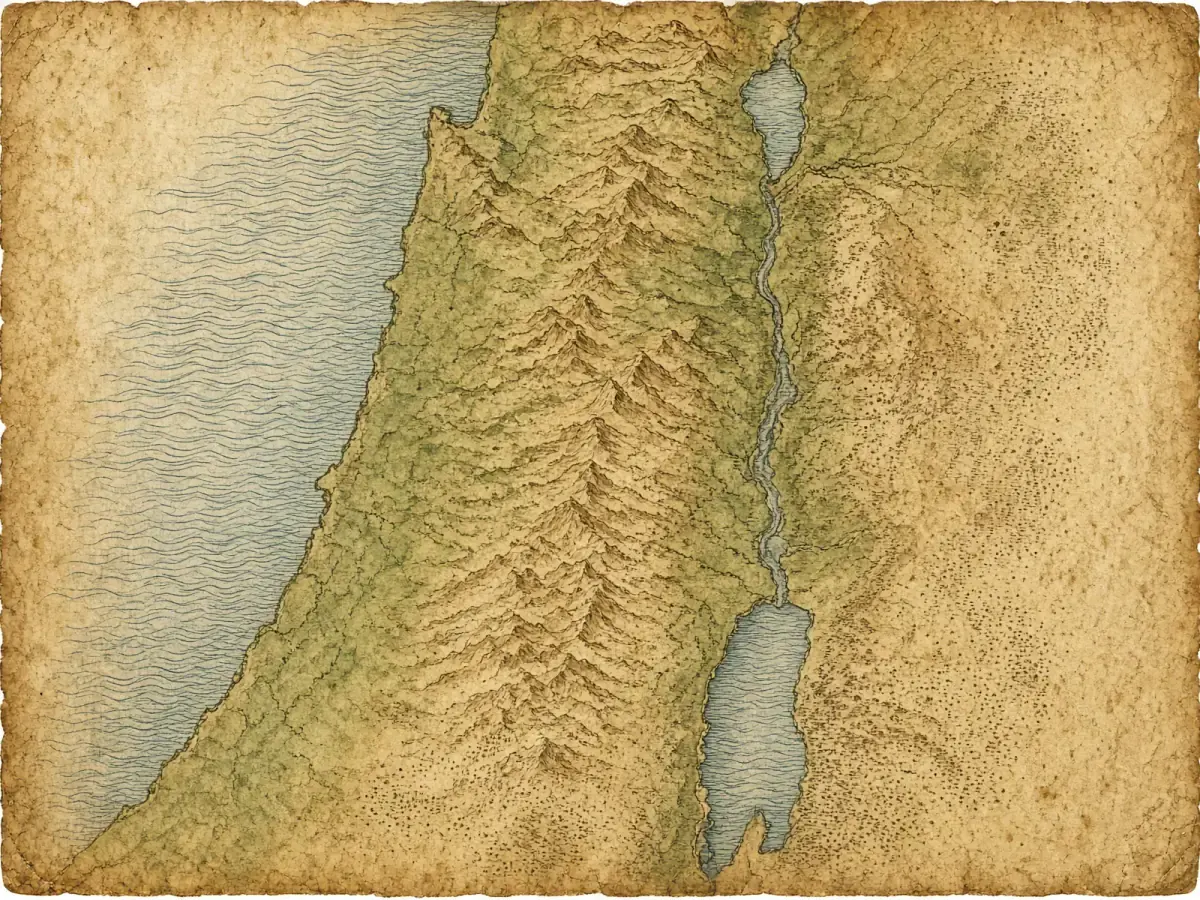
Fifteen furlongs is a little under two miles. Bethany lay on the eastern slope of the Mount of Olives, and the Arabic village there today is al-Eizariya, a name taken from Lazarus. The distance explains how mourners from the city could come and go.
- John 11:19
Comforting the bereaved was a religious duty, and mourning was kept for seven days, as Joseph mourned his father seven days (Genesis 50:10). The number of mourners from Jerusalem suggests the family was known in the city.
- John 11:20
Mourners sat during the days of mourning, as Job’s friends sat with him seven days on the ground (Job 2:13). The contrast matches Luke 10:38–42, where Martha serves and Mary sits at Jesus’ feet, though the Book of John makes no reference to that scene.
- John 11:21
The sentence is a condition contrary to fact: had you been here, he would not have died. The sisters will say it in almost the same words (verse 32), which suggests it had been said between them many times in four days, though that is an inference.
- John 11:22
“Ask” is aiteo, the ordinary verb for a petitioner asking a superior. When Jesus speaks of his own requests to the Father he uses a different verb, erotao, the asking of an equal (14:16; 17:9). Martha uses a word he never uses of himself.
- John 11:23
The words are ambiguous, and could be heard as the standard comfort that mourners offered, that the dead will rise at the end. Martha hears them exactly that way in the next verse.
- John 11:24
Resurrection at the last day was the belief of the Pharisees and denied by the Sadducees (Acts 23:8), with roots in Daniel 12:2 and 2 Maccabees 7:9. “The last day” is Jesus’ own phrase from 6:39–54, repeated back to him.
- John 11:25
This is the fifth of the book’s “I am” sayings with an image: after bread, light, door and shepherd comes resurrection. A few early witnesses, including the papyrus P45 and the Old Syriac, lack “and the life”. “Though he were dead” means even if he dies.
- John 11:26
“Shall never die” is the emphatic double negative, “shall not die, not ever”. “Believest thou this?” is asked of one person; to the man born blind Jesus asked, “Dost thou believe on the Son of God?” (9:35).
- John 11:27
“I believe” is a perfect tense, pepisteuka, I have come to believe and do believe. “Which should come into the world” is ho erchomenos, the Coming One, the title of Psalm 118:26 that the crowd will shout at the entry into Jerusalem (12:13).
John 11:17-27
King James Version17Then when Jesus came, he found that he had lain in the grave four days already.
18Now Bethany was nigh unto Jerusalem, about fifteen furlongs off:
19And many of the Jews came to Martha and Mary, to comfort them concerning their brother.
20Then Martha, as soon as she heard that Jesus was coming, went and met him: but Mary sat still in the house.
21Then said Martha unto Jesus, Lord, if thou hadst been here, my brother had not died.
22But I know, that even now, whatsoever thou wilt ask of God, God will give it thee.
23Jesus saith unto her, Thy brother shall rise again.
24Martha saith unto him, I know that he shall rise again in the resurrection at the last day.
25Jesus said unto her, I am the resurrection, and the life: he that believeth in me, though he were dead, yet shall he live:
26And whosoever liveth and believeth in me shall never die. Believest thou this?
27She saith unto him, Yea, Lord: I believe that thou art the Christ, the Son of God, which should come into the world.
John 11:28-37
His Knowledge of the Outcome Does Not Cancel His Tears
Mary reaches Jesus with the same sentence Martha used: if he had been there, Lazarus would not have died. This time the scene fills with mourners, tears, and Jesus’ own disturbance. The Book of John slows down instead of rushing to the miracle. Jesus groans in spirit, asks where Lazarus has been laid, and weeps. The text does not provide a private explanation that settles whether the disturbance is grief, anger at death, or several things at once, so the strength of the response should remain larger than any single guess. His tears are especially important because he already knows what he intends to do. Foreknowledge does not function as emotional anesthesia. People around him read the tears as evidence of love, while others ask why the man who opened blind eyes did not prevent this death. That question is allowed to stand. The coming sign will answer through action, but it will not make the sorrow that precedes it unreal.
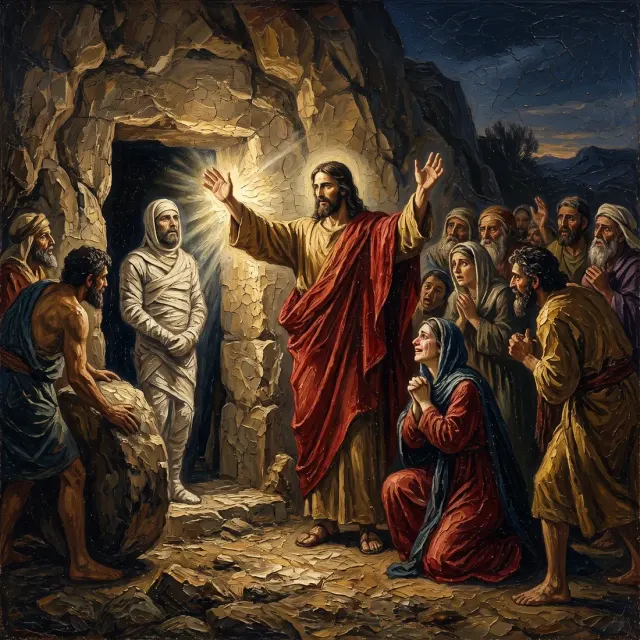
Deep dive
Mary reaches Jesus with the same statement Martha made about his absence, but the scene develops differently. She falls at his feet, and those accompanying her are weeping. John slows the action to record Jesus' response before the movement to the tomb. The KJV's language of groaning and being troubled conveys a strong disturbance, not detached observation. The precise object of that disturbance has been interpreted in different ways; the passage does not supply a private explanation that settles whether grief, indignation at death, or several elements are in view.
His tears stand beside his earlier declaration of purpose. John does not treat foreknowledge of resurrection as emotional anesthesia. The loss and mourning are real even in the presence of the one who will reverse this death. The observers interpret his tears as evidence of love, while some ask why the opener of blind eyes did not prevent Lazarus from dying.
That question connects this chapter with the preceding sign and with the sisters' grief. Power to heal does not make the delay easy to understand. John allows the objection to be heard rather than stepping around it. The movement toward the tomb will answer through action, but it does not retrospectively make the tears unnecessary.
Words to trace: Jesus, Jews, Mary, died, Lord, weeping
Verse-by-verse path
- John 11:28
“Secretly” is lathra, quietly, perhaps to keep the news from the Jerusalem mourners. “The Master” is ho didaskalos, the Teacher. The book has not recorded Jesus asking for Mary, so Martha’s message tells us something done offstage.
- John 11:29
“She arose” is egeiro, the same verb used for being raised from the dead. The Greek makes her rising quick and the coming continuous: she got up at once and was on her way.
- John 11:30
He has stayed where Martha met him, outside the village. Tombs lay outside towns, as at Nain, where the widow’s son was carried out of the gate (Luke 7:12), so he may be waiting near the grave, though the verse does not say so.
- John 11:31
The mourners follow her, thinking she is going to wail at the grave. Without meaning to, she brings the crowd that Jesus will speak of in verse 42 as “the people which stand by”, the witnesses of what follows.
- John 11:32
Martha met him standing; Mary falls at his feet, where she is found in Luke 10:39 and in the anointing of 12:3. Her words match Martha’s, but in Greek the word “my” comes forward: it was my brother who died.
- John 11:33
“Groaned” is embrimaomai, a word first used of horses snorting, and in Mark 1:43 and 14:5 it means stern indignation. “Was troubled” is literally “troubled himself”. The weeping of Mary and the mourners is klaio, loud lament, the way mourners wept.
- John 11:34
“Come and see” is the invitation Jesus gave the first disciples when they asked where he lived (1:39). The same words are now spoken to him, and they lead to a grave.
- John 11:35
The shortest verse in the English Bible is two words in Greek too. “Wept” is dakruo, to shed tears, a word used only here in the New Testament. It is quieter than the klaio of Mary and the mourners, and quieter than his weeping over Jerusalem in Luke 19:41.
- John 11:36
The verb is imperfect, “how he used to love him”, as if speaking of a friendship now ended. The mourners read the tears as grief for a friend lost, not knowing what he is about to do.
- John 11:37
The blind man of chapter 9 is still the talk of Jerusalem months later. The objection is correct in its premise: Jesus himself said in verse 15 that he was glad not to have been there, implying his presence would have prevented the death.
John 11:28-37
King James Version28And when she had so said, she went her way, and called Mary her sister secretly, saying, The Master is come, and calleth for thee.
29As soon as she heard that, she arose quickly, and came unto him.
30Now Jesus was not yet come into the town, but was in that place where Martha met him.
31The Jews then which were with her in the house, and comforted her, when they saw Mary, that she rose up hastily and went out, followed her, saying, She goeth unto the grave to weep there.
32Then when Mary was come where Jesus was, and saw him, she fell down at his feet, saying unto him, Lord, if thou hadst been here, my brother had not died.
33When Jesus therefore saw her weeping, and the Jews also weeping which came with her, he groaned in the spirit, and was troubled,
34And said, Where have ye laid him? They said unto him, Lord, come and see.
35Jesus wept.
36Then said the Jews, Behold how he loved him!
37And some of them said, Could not this man, which opened the eyes of the blind, have caused that even this man should not have died?
John 11:38-44
The Stone Is Removed Before the Voice Is Heard
Martha’s protest at the tomb forces the physical fact of death into the open. Four days means more than a sad interval. She expects the smell of decomposition. Jesus answers by recalling the promise of God’s glory, and only then is the stone removed. His prayer is not a negotiation with a reluctant Father. He thanks the Father for hearing him and says aloud that the surrounding people are the reason for the public prayer, so they may recognize the Father’s sending. Then comes the loud call: “Lazarus, come forth.” The Book of John gives no reason to imagine that every grave would have opened without the name. The force lies in the particular dead man being addressed and responding. Lazarus emerges still wrapped, and other people must loosen him. This is restored mortal life, not yet the resurrection scene that will leave Jesus’ own grave clothes behind. The tomb is reversed, but the two raisings are not identical.
Deep dive
Martha's objection brings the physical reality of death directly into the conversation. Four days means corruption, not merely an interval on a calendar. Jesus answers by recalling the promise of seeing God's glory. The stone is then taken away, and his prayer identifies the act's source before it occurs. He does not need to persuade a reluctant Father. His spoken thanks serves the surrounding people, that they may recognize the Father's sending.
The loud call addresses Lazarus by name. John gives no basis for the familiar speculation that every dead person would otherwise have emerged. The particularity already has sufficient force: the one described as dead is summoned as someone who can hear and respond. The voice that chapter 5 associated with giving life now speaks at an occupied tomb.
Lazarus comes out still bound, and Jesus directs others to loosen him. The sign restores him to the company that can now assist him. His exit will also differ from the account of Jesus' own resurrection, where burial cloths are left behind. John does not turn the two raisings into interchangeable scenes. Here, a man returns from the grave into mortal life, and his very presence will become intolerable to those seeking to suppress belief in Jesus.
Words to trace: Jesus, dead, stone, believe, bound, always
Verse-by-verse path
- John 11:38
Tombs near Jerusalem were caves cut in the rock. “Lay upon it” suggests either a stone over a shaft going down or a stone set against a door; the tomb shown as Lazarus’s today is reached by steps down into the rock. “Groaning” is the snorting verb of verse 33 again.
- John 11:39
“Stinketh” is ozei, a word found only here in the New Testament. The Jews did not embalm; spices were laid with the body to mask the smell, which after four days in the heat would be strong. Martha is named again as “the sister of him that was dead” at the moment she objects.
- John 11:40
No earlier words to Martha match this exactly. He may mean the message of verse 4, “for the glory of God”, or the promise of verses 25 and 26 in substance. Seeing is promised on condition of believing, the reverse of the order the crowd has asked for all along.
- John 11:41
The words “from the place where the dead was laid” are absent from the oldest manuscripts. “Lifted up his eyes” is the posture of prayer he takes again in 17:1. The thanks are in the past tense, spoken before anything has happened at the tomb.
- John 11:42
The prayer is said aloud for the bystanders, as the voice from heaven in 12:30 comes “not because of me, but for your sakes”. He thanks the Father where the crowd can hear, so that the coming sign will be credited to the one who sent him.
- John 11:43
“Cried” is kraugazo, a shout, the verb the crowd will use for “Hosanna” (12:13) and for “Crucify him” (19:6, 15). “Come forth” is two words in Greek, deuro exo, “Here! Out!”, with no verb at all.
- John 11:44
“Graveclothes” are keiriai, linen strips wound round the body. “Napkin” is soudarion, a sweat cloth, the same word used for the cloth found folded apart in Jesus’ empty tomb (20:7). “Loose” is luo, to untie, the same verb the book uses for breaking the Sabbath.
John 11:38-44
King James Version38Jesus therefore again groaning in himself cometh to the grave. It was a cave, and a stone lay upon it.
39Jesus said, Take ye away the stone. Martha, the sister of him that was dead, saith unto him, Lord, by this time he stinketh: for he hath been dead four days.
40Jesus saith unto her, Said I not unto thee, that, if thou wouldest believe, thou shouldest see the glory of God?
41Then they took away the stone from the place where the dead was laid. And Jesus lifted up his eyes, and said, Father, I thank thee that thou hast heard me.
42And I knew that thou hearest me always: but because of the people which stand by I said it, that they may believe that thou hast sent me.
43And when he thus had spoken, he cried with a loud voice, Lazarus, come forth.
44And he that was dead came forth, bound hand and foot with graveclothes: and his face was bound about with a napkin. Jesus saith unto them, Loose him, and let him go.
John 11:45-53
The Council Answers a Restored Life with a Death Plan
The raised Lazarus does not settle the public argument in one direction. Many witnesses believe, while others report what happened to the Pharisees. At the council, the signs themselves are not denied. The concern is what growing belief might provoke from Rome and what the leaders fear losing. The question has shifted from whether Jesus can do these works to how his influence can be contained. Caiaphas proposes the practical solution of one man dying so the nation does not perish. The Book of John then assigns his words a meaning beyond the policy he intends. As high priest, Caiaphas speaks prophetically about Jesus dying for the nation and gathering God’s scattered children into one. The irony does not make the council’s plan righteous. From that day they deliberately plan Jesus’ death. A restored life has become the occasion for organizing the death of the life-giver, even as the Gospel says that death will accomplish something far wider than the planners imagine.
Deep dive
The response divides without disputing that Jesus has performed signs. The council's stated concern is what widespread belief may provoke from Rome and what may be lost. Its discussion therefore shifts from whether the act happened to how Jesus' growing influence can be contained. The raising of a man does not compel every witness to receive the giver of life.
Caiaphas argues that one man should die for the people rather than the whole nation perish. John does not adopt that reasoning as a righteous calculation. He identifies a prophetic significance that exceeds the speaker's intended solution: Jesus will die for the nation and gather God's scattered children into one. The same words therefore operate at two levels. Caiaphas proposes eliminating a perceived danger; John sees the saving reach of the death being proposed.
The distinction does not excuse the decision. The council begins planning to put Jesus to death. The irony is severe enough without added denunciation: a sign that restores life becomes the occasion for organizing the death of its giver. At the same time, the proposed death will not finally accomplish the confinement its planners desire. John's explanation has already widened its effect beyond the boundaries of their calculation.
Words to trace: nation, Jesus, high, Pharisees, priest, year
Verse-by-verse path
- John 11:45
They are described as those who “came to Mary”, which makes her the centre of the mourning household. “Had seen” is theaomai, to behold with attention, the verb of 1:14, “we beheld his glory”.
- John 11:46
The Book of John records their report without a motive, as it recorded the healed man’s report to the authorities in 5:15. Within one verse the report reaches the council, and the consequence is sealed.
- John 11:47
“Council” is sunedrion, the Sanhedrin, which the Mishnah numbers at seventy-one members (Sanhedrin 1:6). “What do we?” is present tense, “What are we doing?”, a complaint at their own inaction.
- John 11:48
“Place” most likely means the temple, the holy place (compare Acts 6:13–14). Second Maccabees 5:19 says God “did not choose the people for the place’s sake, but the place for the people’s sake.” In AD 70 the Romans did come and take away both.
- John 11:49
Caiaphas held the office from about AD 18 to 36 and was son-in-law of Annas (18:13); an ossuary inscribed “Joseph son of Caiaphas” was found in Jerusalem in 1990. “That same year” means that fateful year. Josephus remarked that Sadducees were rough even with one another, and “Ye know nothing at all” fits.
- John 11:50
“Expedient” is sumpherei, it is to your advantage, the word Jesus uses in 16:7, “It is expedient for you that I go away.” Caiaphas speaks of “the people”, laos, and then “the whole nation”, ethnos. The book will quote the saying again when Jesus is brought to him (18:14).
- John 11:51
The high priest had once carried the Urim and Thummim by which Israel sought God’s decision (Exodus 28:30; Numbers 27:21), and Josephus credited the high priest John Hyrcanus with the gift of prophecy. The Book of John treats the office as speaking beyond the man.
- John 11:52
“Scattered abroad” uses the verb of the wolf that “scattereth the sheep” in 10:12, and the prophets speak of God gathering a scattered flock (Jeremiah 23:3; Ezekiel 34:12). “Children of God” recalls 1:12, “to them gave he power to become the sons of God”.
- John 11:53
The intention of 5:18 has become a formal decision, with a date: “from that day forth”. No hearing has been held, which is exactly the question Nicodemus asked in 7:51: “Doth our law judge any man, before it hear him?”
John 11:45-53
King James Version45Then many of the Jews which came to Mary, and had seen the things which Jesus did, believed on him.
46But some of them went their ways to the Pharisees, and told them what things Jesus had done.
47Then gathered the chief priests and the Pharisees a council, and said, What do we? for this man doeth many miracles.
48If we let him thus alone, all men will believe on him: and the Romans shall come and take away both our place and nation.
49And one of them, named Caiaphas, being the high priest that same year, said unto them, Ye know nothing at all,
50Nor consider that it is expedient for us, that one man should die for the people, and that the whole nation perish not.
51And this spake he not of himself: but being high priest that year, he prophesied that Jesus should die for that nation;
52And not for that nation only, but that also he should gather together in one the children of God that were scattered abroad.
53Then from that day forth they took counsel together for to put him to death.
John 11:54-57
Passover Approaches Under an Order to Report Him
Jesus withdraws from open movement among the hostile authorities and remains with his disciples near the wilderness. The shift is strategic, not an abandonment of the mission. Passover is approaching, and people are already going to Jerusalem for purification. The Book of John keeps that ordinary religious preparation in the same frame as the official order to report Jesus’ whereabouts. Not everyone in the city is doing the same thing or thinking the same thought. Pilgrims wonder whether he will come to the feast; chief priests and Pharisees have instructed people to disclose where he is so they can arrest him. Curiosity, expectation, worship preparation, and organized pursuit all coexist. The chapter closes before the question is answered. Jesus has stepped out of public view, but Lazarus is alive in Bethany, the death plan has been formed, and the Passover clock is now running. The next movement toward Jerusalem will happen under all of those pressures at once.
Deep dive
Withdrawal to the region near the wilderness marks a change in public exposure, not the abandonment of the mission. Jesus remains with his disciples while the approaching Passover draws other people toward Jerusalem. John's attention to their purification keeps the feast's religious preparation visible alongside the developing plan for arrest. The entire city is not reduced to a single murderous intention.
The pilgrims' discussion concerns whether Jesus will come. The authorities' order concerns what anyone who knows his whereabouts must do. These are distinct voices within the same tense setting: curiosity and expectation among those gathering, organized pursuit among the leaders named in verse 57. John closes the chapter before resolving their speculation. The next account will bring Jesus to Bethany, where Lazarus is alive at a meal, and then toward Jerusalem. The restored man and the threatened healer remain linked as the Passover draws near.
Words to trace: country, Jesus, Jews, passover, both, chief
Verse-by-verse path
- John 11:54
Ephraim is usually identified with et-Taiyibeh, about fifteen miles north-east of Jerusalem on the edge of the wilderness, perhaps the Ephrain of 2 Chronicles 13:19. “Openly” is parresia again: the public speaking of the last three chapters now stops.
- John 11:55
Anyone made unclean by contact with the dead could not keep the Passover (Numbers 9:6), and purification from corpse uncleanness took seven days (Numbers 19:11–12), so pilgrims came up a week early. The priests will guard their own purity in 18:28 while handing Jesus over.
- John 11:56
“Sought” is imperfect, they kept looking, and “stood” describes people standing about in the temple courts. The question expects no: “Surely he will not come to the feast?” It is the same speculation as at Tabernacles (7:11).
- John 11:57
“Shew” is menuo, to lay information, a legal word for reporting to the authorities. The order turns every pilgrim into a potential informer. The one who in the end knows the place and leads them to it is Judas (18:2).
John 11:54-57
King James Version54Jesus therefore walked no more openly among the Jews; but went thence unto a country near to the wilderness, into a city called Ephraim, and there continued with his disciples.
55And the Jews’ passover was nigh at hand: and many went out of the country up to Jerusalem before the passover, to purify themselves.
56Then sought they for Jesus, and spake among themselves, as they stood in the temple, What think ye, that he will not come to the feast?
57Now both the chief priests and the Pharisees had given a commandment, that, if any man knew where he were, he should shew it, that they might take him.
Questions to keep in mind while reading
- Watch what Jesus says and does, and how people respond.
- Trace kingdom, discipleship, opposition, cross, and resurrection in the evangelist’s own sequence.
- Let later doctrine clarify the scene without erasing its immediate setting.
Text first
Where readers differ
The chapter summary begins with what the passage says and how its parts fit together. It does not assume one denomination has already settled every question. Where a conclusion depends on a tradition, literary theory, or historical reconstruction, that dependence is named openly.
The KJV text is presented first. Interpretive conclusions are labeled, and differences are introduced only when they help a reader understand why serious communities do not always reach the same answer.
Comparative interpretive notes for this chapter are in preparation. Until reviewed notes are ready, this page separates the KJV text from summary and application without claiming that serious readers agree on every question.
Questions beneath the surface
- What account of God, human freedom, responsibility, and the good life emerges from John 11?
- Which tension does the chapter refuse to resolve quickly?
- What changes when the chapter is read as part of the whole canon rather than as an isolated moral lesson?
- Where might a sincere reader confuse a familiar tradition with something the text states directly?
Questions for serious personal contemplation
These open-ended questions make room for tension, honest response, prayer, and conclusions that remain accountable to the chapter.
Observe without rushing
What part of John 11 makes you stop, feel unsettled, or feel surprised, and why?
Which detail in the passage would be easiest to overlook? How does that detail change your understanding?
Where do you see tension between what happens and this focus: Martha meeting Jesus outside Bethany, Jesus weeping, and Lazarus emerging from the opened tomb?
What important question does the passage leave open instead of resolving quickly?
Examine your inner life honestly
Which person, response, fear, or desire in the passage feels most like your own life right now?
What assumption about God, other people, or yourself does this text challenge?
Which part would you rather soften, avoid, or explain away too quickly? What might that reaction reveal?
If this Scripture could ask you one direct question, what do you think it would ask?
Respond with wisdom and courage
What do you need to remember, confess, grieve, thank God for, or trust after reading this passage?
How might another faithful person read this situation differently without ignoring the text?
What obedient response would be costly, uncomfortable, or slow, yet still faithful to Scripture?
What question will you carry into prayer this week, and which verses will you keep in front of you?
Music and video connected to the passage
Related media appears when its Scripture reference overlaps this study. Music and video can illuminate a theme while the biblical text remains the foundation.