The big picture
A meal with living Lazarus, Mary’s burial anointing, a royal entrance, and the arrival of Greeks all drive the Book of John toward one announcement: “The hour is come.” Glory is now explained through a grain that falls into the ground and dies so that it can bear much fruit. Jesus does not treat that death as painless. His soul is troubled, yet he identifies the hour as the purpose for which he came and speaks of being lifted up as the means of drawing others. The public response remains divided. Isaiah is used to interpret persistent unbelief, while rulers who believe secretly are criticized for loving human praise more than God’s. Jesus’ final public words return everything to the Father who sent him. Light, salvation, judgment, and everlasting life meet in the words he has faithfully spoken.
In this chapter
- The House Smells of the Gift; Judas Calculates Its Price John 12:1-11
The Bethany table is almost impossible to read without remembering the tomb.
- A King Enters on Terms Understood Only Afterward John 12:12-19
The crowd receives Jesus with palm branches and royal language drawn from Scripture: “Blessed is the King of Israel.” Jesus does not reject the kingship, but his chosen mount gives it a particular shape.
- The Grain's Death Explains the Widening Invitation John 12:20-26
Certain Greeks arrive with a modest request: “we would see Jesus.” They approach Philip, Philip goes to Andrew, and together they bring the request to Jesus.
- Trouble Is Not a Retreat from the Hour John 12:27-36
Jesus’ announcement of glory does not make the coming death emotionally easy.
- Unbelief Is Explained Without Making Hidden Belief Heroic John 12:37-43
Many signs have been done in public, yet unbelief remains.
- His Final Public Words Return to the Sender John 12:44-50
The final public proclamation gathers the book’s major themes into one last statement before the focus narrows to the disciples.

Scripture beside the summary
John · King James Version · 50John 12:1-11
The House Smells of the Gift; Judas Calculates Its Price
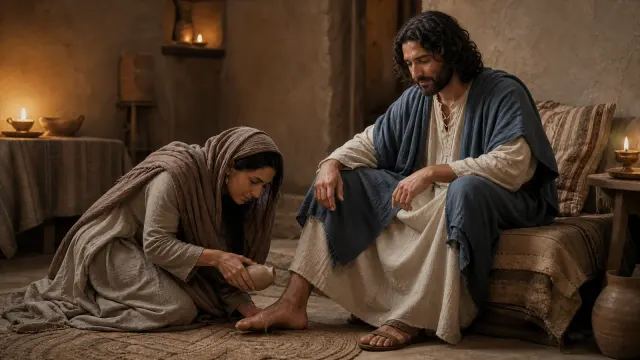
The Bethany table is almost impossible to read without remembering the tomb. Lazarus, formerly dead, is now reclining at supper while Martha serves and Mary pours costly spikenard on Jesus’ feet. The house fills with the perfume, making her gift impossible to keep private. Judas answers with arithmetic and the language of charity, but the Book of John does not require readers to guess his motive. It says he is a thief and that concern for the poor is not driving the objection. Jesus connects Mary’s action with his burial, placing his coming death beside Lazarus’ restored life at the same meal. His statement about the poor does not revoke concern for them; the scriptural background treats their continuing presence as a reason for generosity. The contrast here is the limited time of Jesus’ bodily presence. Meanwhile Lazarus has become dangerous evidence. He needs no speech. Simply sitting alive at the table is enough to make leaders consider killing him too.
Deep dive
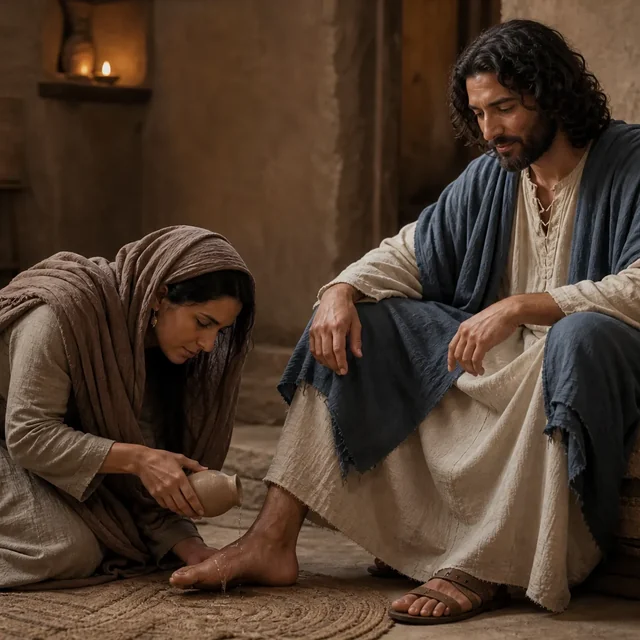
The household is encountered again, but the arrangements have changed dramatically since chapter 11. Martha serves, Lazarus sits at the table, and Mary anoints Jesus' feet. The formerly occupied tomb is now represented by a living guest. The perfume fills the house, giving Mary's action a sensory reach before anyone debates its value.
Judas supplies the calculation and invokes the poor. In this case, motive need not be guessed: John explicitly calls him a thief and denies that concern for the poor governs the objection. Jesus connects Mary's action with his burial, placing the coming death beside Lazarus' restored life. His statement that the poor remain present is not permission to disregard them. Deuteronomy 15:11 uses their continuing presence as the reason for openhanded care, and Jesus' contrast here concerns the limited time of his bodily presence.
The chief priests' plan to kill Lazarus extends the council's response to the evidence itself. Lazarus has become a reason for people to believe in Jesus. His danger requires no recorded speech or campaign on his part. Sitting alive at the table is enough to make him an inconvenient witness.
Words to trace: Jesus, Lazarus, dead, ointment, poor, always
Verse-by-verse path
- John 12:1
The Book of John has begun counting days to the Passover, as it counted the days of the first week in chapters 1 and 2. If the next day’s entry fell on the tenth of the month, it matched the day on which each household chose its Passover lamb (Exodus 12:3), a link many readers draw.
- John 12:2
“Supper” is deipnon, the main evening meal. Mark 14:3 sets a similar anointing in the house of Simon the leper. “Served” is diakoneo, the root of the word deacon, and “sat at the table” means reclined, the posture of a festive meal.
- John 12:3
A Roman pound was about twelve ounces. Spikenard came from a plant of the Himalayas and was carried all the way from India. The Song of Solomon has the bride say, “While the king sitteth at his table, my spikenard sendeth forth the smell thereof” (1:12). For a woman to loosen her hair in company was itself remarkable.
- John 12:4
This is the only time Judas Iscariot speaks in the Book of John. He is introduced by the act he has not yet done, “which should betray him”, so the reader never hears him without that label attached.
- John 12:5
Three hundred pence was about a year’s wages for a labourer. Philip’s two hundred pennyworth (6:7) would not have given five thousand a bite each; this jar was worth half as much again. Gifts to the poor were customary at Passover, which is why the disciples misread Judas’s errand in 13:29.
- John 12:6
“The bag” is glossokomon, originally a case for the reed of a flute and later any box for money; the Greek Old Testament uses it for Joash’s collection chest in the temple (2 Chronicles 24:8). “Bare” is bastazo, to carry, which could also mean to carry off, much as English says “lift”.
- John 12:7
The best manuscripts read “Let her alone, that she may keep it for the day of my burying”, which is puzzling if the whole pound has just been poured out. Some take it to mean she kept it until now for this purpose; the King James smooths the grammar into that sense.
- John 12:8
The words match Mark 14:7 and Matthew 26:11 almost exactly. A few ancient witnesses, including Codex Bezae and the Old Syriac, lack this whole verse, perhaps because a copyist’s eye skipped from one line to the next.
- John 12:9
The crowd comes to look at a living proof. Lazarus himself never says a word anywhere in the Bible, before his death or after it. His silence makes him the evidence rather than the witness.
- John 12:10
“Consulted” is the verb of 11:53, where the council “took counsel” against Jesus. The chief priests were mostly Sadducees, who denied the resurrection of the dead (Acts 23:8), so a man walking about after four days in the grave was an awkward fact for their doctrine as well as their politics, though the book does not say so.
- John 12:11
“Went away” is imperfect: people were steadily going over, a drain rather than a single event. The raising of one man had become a cause of belief that could not be argued away, only removed.
John 12:1-11
King James Version1Then Jesus six days before the passover came to Bethany, where Lazarus was which had been dead, whom he raised from the dead.
2There they made him a supper; and Martha served: but Lazarus was one of them that sat at the table with him.
3Then took Mary a pound of ointment of spikenard, very costly, and anointed the feet of Jesus, and wiped his feet with her hair: and the house was filled with the odour of the ointment.
4Then saith one of his disciples, Judas Iscariot, Simon’s son, which should betray him,
5Why was not this ointment sold for three hundred pence, and given to the poor?
6This he said, not that he cared for the poor; but because he was a thief, and had the bag, and bare what was put therein.
7Then said Jesus, Let her alone: against the day of my burying hath she kept this.
8For the poor always ye have with you; but me ye have not always.
9Much people of the Jews therefore knew that he was there: and they came not for Jesus’ sake only, but that they might see Lazarus also, whom he had raised from the dead.
10But the chief priests consulted that they might put Lazarus also to death;
11Because that by reason of him many of the Jews went away, and believed on Jesus.
John 12:12-19
A King Enters on Terms Understood Only Afterward
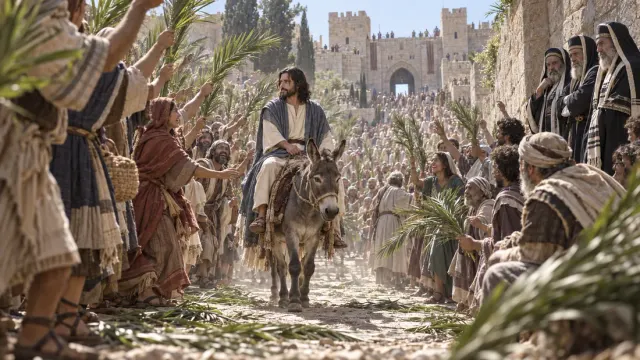
The crowd receives Jesus with palm branches and royal language drawn from Scripture: “Blessed is the King of Israel.” Jesus does not reject the kingship, but his chosen mount gives it a particular shape. The young donkey places the entry beside Zechariah’s humble king rather than a display of military force. The Book of John then makes an important confession about the disciples: they do not understand the event at first. Only after Jesus is glorified do they remember what Scripture said and recognize what they had participated in. Presence is not the same as comprehension. The raising of Lazarus also helps explain the crowd’s size and expectation, since witnesses have been talking about the sign. The Pharisees respond with the frustrated line, “the world is gone after him.” It is an exaggeration, not a statistical report. Yet the next scene will bring Greeks seeking Jesus, giving their complaint an irony they could not have intended.
Deep dive
The branches and the words drawn from Psalm 118:25–26 make the welcome public and expectant. Jesus is greeted as Israel's King. Yet the small donkey places the entry within Zechariah 9:9 rather than a display of the force the crowd might associate with securing a kingdom. The action does not deny kingship; it gives the royal claim its scriptural shape.
John pauses to say that the disciples did not understand these things at first. Only after Jesus was glorified did they recognize the relationship between what had been written and what had been done. Their presence at an event is again distinguished from mature understanding of it. Later testimony is allowed to remember earlier incomprehension.
The witnesses to Lazarus' raising help explain the crowd's interest. The Pharisees' complaint that the world has gone after Jesus is their frustrated generalization, not John's claim that everyone has believed. The very next scene introduces Greeks seeking him, so the complaint acquires an irony beyond its intended exaggeration. The reach of his mission is about to come into view precisely when the opponents speak as though its widening were a disaster.
Words to trace: Jesus, people, cometh, King, written, ass’s
Verse-by-verse path
- John 12:12
These are pilgrims, not residents of Jerusalem. Josephus reckoned the Passover crowds in the hundreds of thousands or more, and although his figures are inflated the city swelled many times over. “The next day” continues the count begun in verse 1.
- John 12:13
Only John mentions palms. They were a national symbol: Simon Maccabeus entered the citadel “with thanksgiving, and branches of palm trees” (1 Maccabees 13:51), and Jewish rebels later struck palms on their coins. “Hosanna” is Hebrew for “save, we pray” (Psalm 118:25). “King of Israel” is Nathanael’s title from 1:49.
- John 12:14
The Book of John does not tell how the animal was fetched, which the other Gospels relate in detail (Mark 11:1–7). “Young ass” is onarion, a diminutive, a little donkey. The quotation follows the action rather than preceding it.
- John 12:15
Zechariah 9:9 begins “Rejoice greatly”; here it begins “Fear not”, words found in Zephaniah 3:16, “Fear thou not: and to Zion, Let not thine hands be slack.” The quotation also drops Zechariah’s “just, and having salvation; lowly”, keeping only the king and his mount.
- John 12:16
The same after-the-fact remembering is noted in 2:22, when the disciples recalled Jesus’ words about the temple after the resurrection. Twice the Book of John admits that its own witnesses understood only in hindsight.
- John 12:17
“Bare record” is imperfect: they kept telling it. Some early manuscripts read “that he called Lazarus”, making the verse the content of their testimony rather than a description of who was testifying.
- John 12:18
The raising of Lazarus is called a “sign”, and it is the last of the seven usually counted in the book: the wine, the nobleman’s son, the pool, the loaves, the walking on the sea, the blind man, and Lazarus.
- John 12:19
“Ye prevail nothing” is “you gain nothing”, the verb of 6:63, “the flesh profiteth nothing”. The Pharisees speak “among themselves”, a private admission of failure, the counterpart of the council’s “What do we?” in 11:47.
John 12:12-19
King James Version12On the next day much people that were come to the feast, when they heard that Jesus was coming to Jerusalem,
13Took branches of palm trees, and went forth to meet him, and cried, Hosanna: Blessed is the King of Israel that cometh in the name of the Lord.
14And Jesus, when he had found a young ass, sat thereon; as it is written,
15Fear not, daughter of Sion: behold, thy King cometh, sitting on an ass’s colt.
16These things understood not his disciples at the first: but when Jesus was glorified, then remembered they that these things were written of him, and that they had done these things unto him.
17The people therefore that was with him when he called Lazarus out of his grave, and raised him from the dead, bare record.
18For this cause the people also met him, for that they heard that he had done this miracle.
19The Pharisees therefore said among themselves, Perceive ye how ye prevail nothing? behold, the world is gone after him.
John 12:20-26
The Grain's Death Explains the Widening Invitation
Certain Greeks arrive with a modest request: “we would see Jesus.” They approach Philip, Philip goes to Andrew, and together they bring the request to Jesus. The Book of John never narrates the meeting itself. Instead, the request becomes the signal for Jesus to say that his hour has come. The widening audience is interpreted through death, not through a plan for broader public exposure. A grain that refuses the ground remains alone; a grain that falls and dies bears much fruit. The image does not glorify destruction for its own sake. It explains how one life given can become fruitful beyond itself. The presence of people from outside Israel’s immediate circle stands beside that promise of multiplication. Jesus then extends the pattern to servants who follow him, but the point remains specifically tied to allegiance and his path. Glory will not arrive by avoiding the earth. It will be revealed through the death that opens the way to fruit.
Deep dive
The Greeks approach Philip, Philip speaks with Andrew, and the two bring the request to Jesus. John records this chain of access but does not describe the actual meeting the visitors requested. Instead, their arrival occasions an announcement: the hour for the Son of man's glorification has come. The Gospel's expanding horizon is answered through the approaching death, not through plans for a safer international platform.
The grain image explains the connection. Remaining alone preserves the single grain in its present condition; falling into the earth and dying is the way it bears fruit. Jesus is not praising destruction for its own sake. He describes a death whose outcome is life beyond the solitary seed. The arrival of people beyond Israel's immediate circle stands beside that promise of multiplied fruit.
His words about losing or keeping life and about a servant following him extend the pattern to those associated with him. These are instructions within Jesus' address, not a warrant to romanticize every suffering. The point is allegiance to his path and presence with him, joined to the Father's honor. The forthcoming glory will be recognized through the grain's costly fruitfulness rather than by avoiding the earth.
Words to trace: Jesus, life, Philip, Andrew, serve, verily
Verse-by-verse path
- John 12:20
“Greeks” here are Gentiles, probably God-fearers who worshipped Israel’s God without becoming Jews. They could enter only the outer court; two stone notices have been found that warned foreigners, on pain of death, not to go further into the temple.
- John 12:21
Philip bears a Greek name and came from Bethsaida, a town in a heavily Greek-speaking district, which may be why Greeks came to him first. “Sir” is kurie. “We would see” means we wish to meet, not merely catch sight of him.
- John 12:22
Philip does not go straight to Jesus but consults Andrew, the other disciple with a Greek name. The two appear together at the call in 1:43–44 and at the loaves in 6:7–8, and here once more.
- John 12:23
Until now the hour has always been “not yet” (2:4, 7:30, 8:20). From this sentence on it has come: “his hour was come” (13:1), and “Father, the hour is come” (17:1). The request of Gentiles is the moment the clock strikes.
- John 12:24
“Corn” in 1611 meant any grain, and “a corn of wheat” is a single kernel. Paul uses the same image for the resurrection body: “that which thou sowest is not quickened, except it die” (1 Corinthians 15:36). “Abideth” is meno, remains.
- John 12:25
Two different Greek words lie behind “life”: psuche, the natural life one can love or hate, and zoe, the life eternal. “Hateth” is a Hebrew way of saying “loves less”, as Leah was “hated” (Genesis 29:31), meaning less loved than Rachel.
- John 12:26
“Serve” is diakoneo, the verb used of Martha in verse 2, so the service Jesus describes has just been shown at the Bethany table. “Honour” from the Father answers verse 43, where rulers prefer the praise of men.
John 12:20-26
King James Version20And there were certain Greeks among them that came up to worship at the feast:
21The same came therefore to Philip, which was of Bethsaida of Galilee, and desired him, saying, Sir, we would see Jesus.
22Philip cometh and telleth Andrew: and again Andrew and Philip tell Jesus.
23And Jesus answered them, saying, The hour is come, that the Son of man should be glorified.
24Verily, verily, I say unto you, Except a corn of wheat fall into the ground and die, it abideth alone: but if it die, it bringeth forth much fruit.
25He that loveth his life shall lose it; and he that hateth his life in this world shall keep it unto life eternal.
26If any man serve me, let him follow me; and where I am, there shall also my servant be: if any man serve me, him will my Father honour.
John 12:27-36
Trouble Is Not a Retreat from the Hour
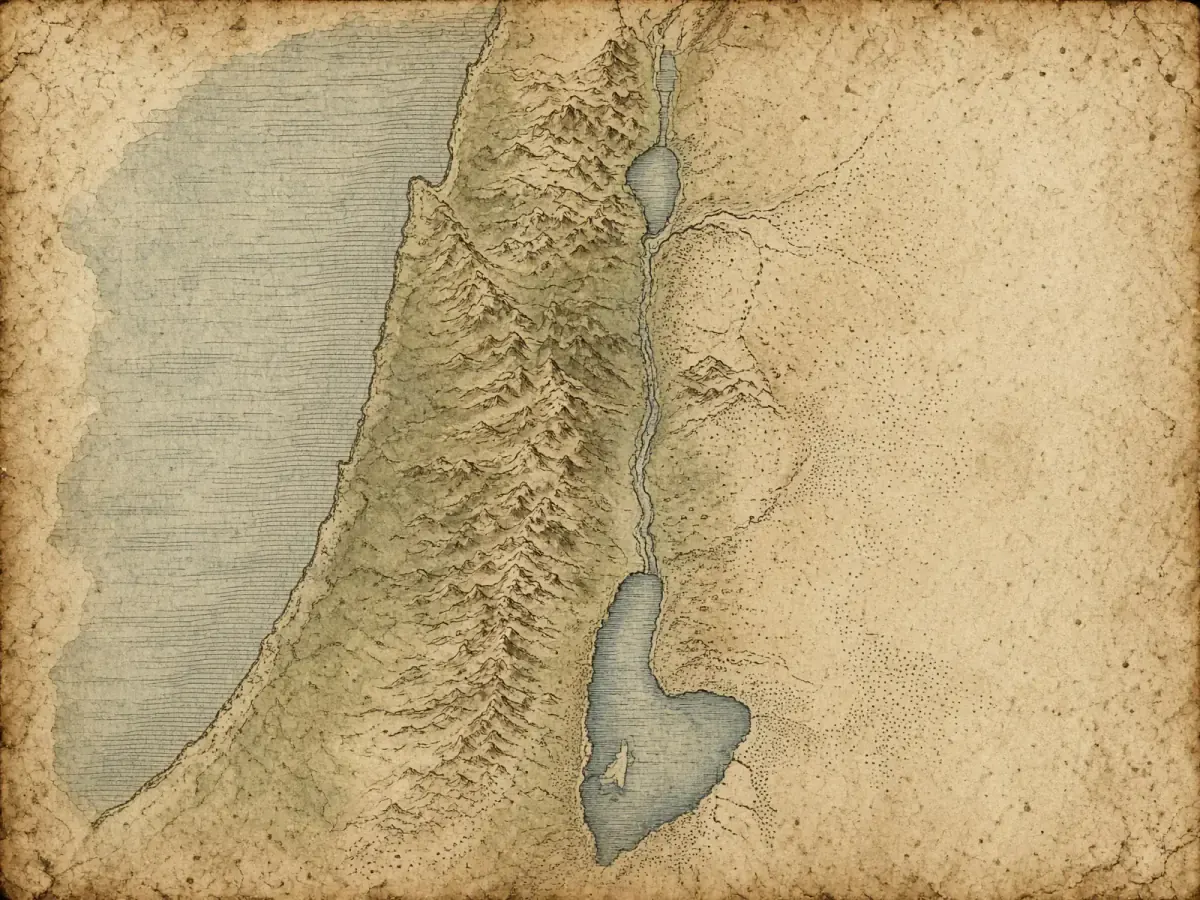
Jesus’ announcement of glory does not make the coming death emotionally easy. “Now is my soul troubled” keeps suffering inside the meaning of the hour rather than treating the cross as a painless illustration. He can name the desire to be saved from the hour and still say that this is the hour for which he came. The request finally becomes, “Father, glorify thy name,” and the heavenly response is heard differently by the crowd, some calling it thunder and others an angel. Recognition remains divided even when a voice comes from heaven. Jesus then describes judgment on the world, the casting out of its prince, and his own lifting up. The Book of John removes ambiguity by saying the lifting up signifies the death he will die. The promised drawing of all belongs to the chapter’s widening horizon without settling every later debate about individual response. Light remains for a little while, and the public ministry moves toward its close under the shadow of departure.
Deep dive
Jesus' troubled soul prevents the announcement of glory from making the approaching suffering unreal. He does not speak as someone for whom death has become a painless theological illustration. The question of rescue from the hour is set beside the purpose for which he came to it, and the request becomes the glorification of the Father's name. Purpose and distress remain in the same passage.
The voice from heaven produces different explanations among those who hear it. Jesus identifies its relevance to the surrounding people, again connecting disclosure with the problem of recognition. The judgment of this world and the casting out of its prince mean that the apparent judgment of Jesus will itself become judgment upon hostile power.
John explicitly interprets the lifting up as Jesus' manner of death. The drawing of all is placed within the chapter's widening horizon, but the statement does not settle every question about the eventual response of every individual. The crowd objects from its expectation of an abiding Christ. Jesus answers with the limited remaining time of the light. The public ministry ends its immediate scene not with every question resolved but with a call, spoken to that audience, to respond while the light is present.
Words to trace: light, Jesus, darkness, Father, glorify, hour
Verse-by-verse path
- John 12:27
“Troubled” is the verb of 11:33, and the Greek of Psalm 6:3 and 42:6 uses it too: “my soul is troubled”. The Book of John has no scene of agony in the garden; this verse is where it lets that anguish be heard.
- John 12:28
This is the only voice from heaven in the Book of John, which does not narrate the baptism or the transfiguration. Later rabbis spoke of the bat qol, “the daughter of a voice”, a heavenly voice heard after the age of prophecy had closed.
- John 12:29
In the Old Testament God’s voice is often heard as thunder: “the God of glory thundereth” (Psalm 29:3), and at Sinai there were “thunders” and a voice (Exodus 19:16, 19). Hearers who say “it thundered” are closer than they know.
- John 12:30
In 5:37 Jesus told his opponents, “Ye have neither heard his voice at any time.” Now the Father’s voice has sounded in their hearing, and some of them took it for thunder.
- John 12:31
“The prince of this world” is a title found only in the Book of John (here, 14:30 and 16:11). “Cast out” is ekballo, the verb used of the man thrown out by the Pharisees in 9:34. The one who is expelled now is the ruler himself.
- John 12:32
“From the earth” is literally “out of the earth”. Some early manuscripts, including the papyrus P66, read “I will draw all things unto me”, neuter, which widens the claim beyond people to all creation.
- John 12:33
“Signifying” is semaino, to indicate by a sign, the root of the book’s word semeion. “What death” means what kind of death: raised off the ground on a cross. The same phrase is used of Peter in 21:19, “signifying by what death he should glorify God”.
- John 12:34
“The law” here means Scripture: Psalm 89:36–37, “His seed shall endure for ever”, and Ezekiel 37:25, “my servant David shall be their prince for ever”. Jesus said “I” in verse 32; the crowd supplies “Son of man” from verse 23 and asks who he is. It is the last question the crowd puts to him.
- John 12:35
“Come upon you” is katalambano, to overtake, the verb of 1:5, “the darkness comprehended it not”. The prologue said darkness did not overcome the light; now the warning is that it may overtake those who do not walk while the light is with them.
- John 12:36
“Children of light” is a Hebrew way of speaking; the Dead Sea Scrolls include a text called The War of the Sons of Light against the Sons of Darkness. With these words the public teaching ends, and he hides himself, as in 8:59.
John 12:27-36
King James Version27Now is my soul troubled; and what shall I say? Father, save me from this hour: but for this cause came I unto this hour.
28Father, glorify thy name. Then came there a voice from heaven, saying, I have both glorified it, and will glorify it again.
29The people therefore, that stood by, and heard it, said that it thundered: others said, An angel spake to him.
30Jesus answered and said, This voice came not because of me, but for your sakes.
31Now is the judgment of this world: now shall the prince of this world be cast out.
32And I, if I be lifted up from the earth, will draw all men unto me.
33This he said, signifying what death he should die.
34The people answered him, We have heard out of the law that Christ abideth for ever: and how sayest thou, The Son of man must be lifted up? who is this Son of man?
35Then Jesus said unto them, Yet a little while is the light with you. Walk while ye have the light, lest darkness come upon you: for he that walketh in darkness knoweth not whither he goeth.
36While ye have light, believe in the light, that ye may be the children of light. These things spake Jesus, and departed, and did hide himself from them.
John 12:37-43
Unbelief Is Explained Without Making Hidden Belief Heroic
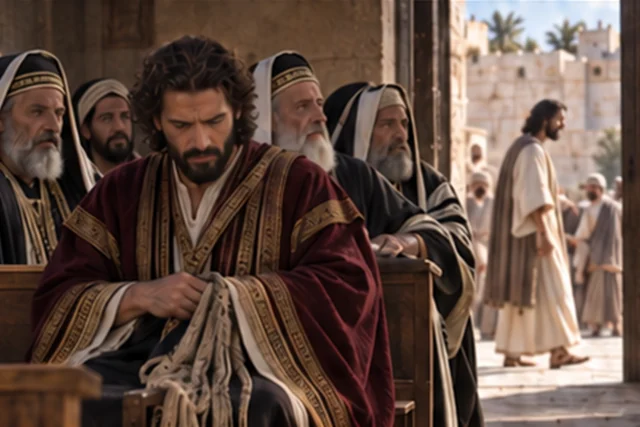
Many signs have been done in public, yet unbelief remains. The Book of John does not respond by assuming that one more miracle would necessarily settle the issue. Instead it reads the resistance through Isaiah, first the unreceived report and then the harder language of blinded eyes and hardened heart. Human refusal and divine judgment appear together without a philosophical detour that dissolves one into the other. John then says Isaiah saw Jesus’ glory, drawing the prophetic Scriptures directly into the Gospel’s argument about recognition. Those writings repeatedly invoked in disputes about Jesus are presented as testimony to him. A second kind of failure follows. Some rulers believe but will not confess because they fear synagogue exclusion and love human praise more than God’s praise. Their hidden belief is not celebrated as a quiet victory. Recognition that never becomes public acknowledgment is still placed under scrutiny. The chapter distinguishes unbelief from belief without treating every form of belief as complete.
Deep dive
The transition from so many signs to continued unbelief states the problem without pretending that a greater quantity of evidence automatically produces recognition. Isaiah 53:1 supplies the language of an unreceived report and an unrecognized divine arm. Isaiah 6:10 supplies the harder language of blindness and hardening. John presents both the refusal to believe and an inability described in terms of divine judgment. He does not provide a separate philosophical explanation that dissolves either element into the other.
The statement that Isaiah saw Jesus' glory brings the prophetic vision into the Gospel's central question of recognition. The Scriptures invoked against Jesus throughout the public disputes are now said to have borne witness to his glory. The argument is not that the past must be discarded, but that its testimony has not been received.
The rulers who do believe introduce a different failure. Fear of exclusion prevents confession, and John identifies love of human praise as the governing preference. Their position is not simply counted as a quiet success after the preceding unbelief. Recognition that will not become public acknowledgment remains under scrutiny. The chapter can distinguish belief from unbelief without treating every occurrence of belief as the end of the account.
Words to trace: believed, Esaias, eyes, heart, Lord, praise
Verse-by-verse path
- John 12:37
Moses said much the same to Israel in the plains of Moab: “Ye have seen all that the LORD did before your eyes... Yet the LORD hath not given you an heart to perceive” (Deuteronomy 29:2–4). Many signs, and no belief, is an old pattern in Israel’s Scriptures.
- John 12:38
The quotation is Isaiah 53:1 in the Greek version, which adds “Lord” at the beginning. Paul quotes the same verse about unbelief in Romans 10:16. “Report” is akoe, what was heard; “the arm of the Lord” is God’s power put forth (Isaiah 52:10).
- John 12:39
Chrysostom read the logic carefully: Isaiah did not cause their unbelief by prophesying it; he prophesied it because it would be so (Homilies on John 68). Others take “could not” at full strength as a judicial hardening. The verse holds a “therefore” and a “because” in tension.
- John 12:40
The wording of Isaiah 6:10 here matches neither the Hebrew nor the Greek. In the Hebrew the prophet is told to make the heart fat; in the Greek the people’s heart has grown fat; here “he” blinds. The same passage is quoted in Matthew 13:15, Mark 4:12 and Acts 28:27.
- John 12:41
Isaiah 6:1–3 describes the prophet seeing the Lord on his throne and hearing “the whole earth is full of his glory”. The Aramaic Targum renders what Isaiah saw as “the glory of the Shekinah”. “When he saw” appears in some copies as “because he saw”.
- John 12:42
The “chief rulers” are members of the council. Nicodemus is one, and Joseph of Arimathea is later called a disciple “secretly for fear of the Jews” (19:38). “Put out of the synagogue” repeats the threat of 9:22.
- John 12:43
“Praise” in both halves is doxa, glory: they loved the glory of men more than the glory of God. The verse follows at once on Isaiah seeing “his glory” in verse 41, so the same word frames two opposite ways of looking.
John 12:37-43
King James Version37But though he had done so many miracles before them, yet they believed not on him:
38That the saying of Esaias the prophet might be fulfilled, which he spake, Lord, who hath believed our report? and to whom hath the arm of the Lord been revealed?
39Therefore they could not believe, because that Esaias said again,
40He hath blinded their eyes, and hardened their heart; that they should not see with their eyes, nor understand with their heart, and be converted, and I should heal them.
41These things said Esaias, when he saw his glory, and spake of him.
42Nevertheless among the chief rulers also many believed on him; but because of the Pharisees they did not confess him, lest they should be put out of the synagogue:
43For they loved the praise of men more than the praise of God.
John 12:44-50
His Final Public Words Return to the Sender
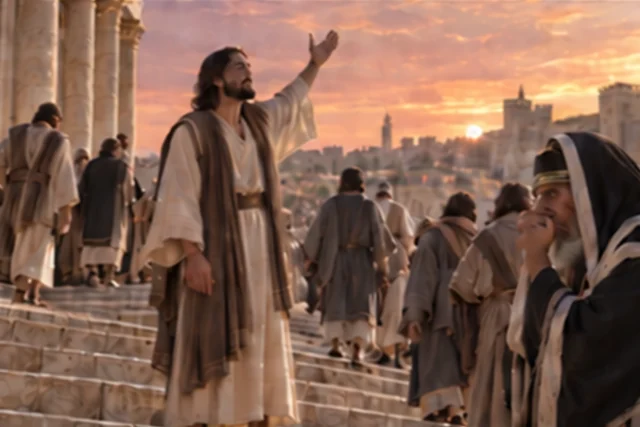
The final public proclamation gathers the book’s major themes into one last statement before the focus narrows to the disciples. Believing in Jesus reaches the Father who sent him, and seeing Jesus discloses that sender. Light has come so that believers need not remain in darkness. The Book of John then holds saving purpose and judgment together without confusing them. Jesus says he came to save the world rather than to judge it, yet the word people reject will judge at the last day. The future judgment is therefore not an unrelated penalty added after the fact. It concerns the treatment of the same testimony through which life was offered. The last emphasis falls on Jesus’ speech as obedient speech. He has not invented his message independently, and the Father’s commandment is everlasting life. Public ministry closes where it began, with Jesus making the unseen Father known through faithful words and works that demand a response.
Deep dive
This closing proclamation gathers themes rather than introducing a new sign. Believing in Jesus reaches the Father who sent him, and seeing him discloses that sender. Light again names the purpose of his coming into the world. These claims return the public ministry to the opening's account of the Word making God known, now after the works, disputes, and divided responses have given that claim a public history.
Jesus distinguishes the saving purpose of his coming from the final judgment attached to rejecting his word. That distinction does not make rejection inconsequential. The word spoken now will judge at the last day, so the present encounter has a future reach. The judgment is not an unrelated sentence added after the offer of life has expired; it concerns the treatment of the very testimony through which life was offered.
The final emphasis falls upon the Father's commandment as everlasting life and upon Jesus' faithful speech. His authority is not presented as independent invention. With that affirmation, the Gospel turns from public proclamation toward the intimate instruction of the disciples, whose coming failures will make the subject of abiding in his word anything but theoretical.
Words to trace: believeth, judge, world, commandment, Father, seeth
Verse-by-verse path
- John 12:44
The book said in verse 36 that Jesus hid himself, and gives no setting or audience for these last public words. They read as a summary of everything he has cried out in the temple since chapter 7. “Cried” is krazo, a loud proclamation.
- John 12:45
“Seeth” is theoreo, to look at attentively. The saying anticipates his answer to Philip in 14:9: “he that hath seen me hath seen the Father.” The Greek puts the one sent and the sender almost side by side in a single short sentence.
- John 12:46
“I am come... into the world” is his account of his own mission, and before Pilate he says “for this cause came I into the world, that I should bear witness unto the truth” (18:37). “Abide” is meno, to remain: darkness is described as a place one might stay.
- John 12:47
The best manuscripts read “and keep them not” where the King James has “and believe not”, so the contrast is between hearing and keeping. The verse restates 3:17: the Son was not sent to condemn the world.
- John 12:48
“Rejecteth” is atheteo, to set aside or treat as void. Behind the verse stands Deuteronomy 18:19, about the prophet like Moses: “whosoever will not hearken unto my words which he shall speak in my name, I will require it of him.” The spoken word itself becomes the witness at the last day.
- John 12:49
Two verbs are set side by side, what to say and what to speak, covering both the content and the utterance. Deuteronomy 18:18 promised a prophet who “shall speak unto them all that I shall command him”, and Jesus claims exactly that.
- John 12:50
Moses closed his last address by saying of the law, “it is not a vain thing for you; because it is your life” (Deuteronomy 32:47). Jesus’ last public words say the same of the Father’s commandment, and then the public ministry is over.
John 12:44-50
King James Version44Jesus cried and said, He that believeth on me, believeth not on me, but on him that sent me.
45And he that seeth me seeth him that sent me.
46I am come a light into the world, that whosoever believeth on me should not abide in darkness.
47And if any man hear my words, and believe not, I judge him not: for I came not to judge the world, but to save the world.
48He that rejecteth me, and receiveth not my words, hath one that judgeth him: the word that I have spoken, the same shall judge him in the last day.
49For I have not spoken of myself; but the Father which sent me, he gave me a commandment, what I should say, and what I should speak.
50And I know that his commandment is life everlasting: whatsoever I speak therefore, even as the Father said unto me, so I speak.
Questions to keep in mind while reading
- Watch what Jesus says and does, and how people respond.
- Trace kingdom, discipleship, opposition, cross, and resurrection in the evangelist’s own sequence.
- Let later doctrine clarify the scene without erasing its immediate setting.
Text first
Where readers differ
The chapter summary begins with what the passage says and how its parts fit together. It does not assume one denomination has already settled every question. Where a conclusion depends on a tradition, literary theory, or historical reconstruction, that dependence is named openly.
The KJV text is presented first. Interpretive conclusions are labeled, and differences are introduced only when they help a reader understand why serious communities do not always reach the same answer.
Comparative interpretive notes for this chapter are in preparation. Until reviewed notes are ready, this page separates the KJV text from summary and application without claiming that serious readers agree on every question.
Questions beneath the surface
- What account of God, human freedom, responsibility, and the good life emerges from John 12?
- Which tension does the chapter refuse to resolve quickly?
- What changes when the chapter is read as part of the whole canon rather than as an isolated moral lesson?
- Where might a sincere reader confuse a familiar tradition with something the text states directly?
Questions for serious personal contemplation
These open-ended questions make room for tension, honest response, prayer, and conclusions that remain accountable to the chapter.
Observe without rushing
What part of John 12 makes you stop, feel unsettled, or feel surprised, and why?
Which detail in the passage would be easiest to overlook? How does that detail change your understanding?
Where do you see tension between what happens and this focus: Mary anointing Jesus’ feet, Jesus entering Jerusalem, and the grain-of-wheat teaching before the final public appeal?
What important question does the passage leave open instead of resolving quickly?
Examine your inner life honestly
Which person, response, fear, or desire in the passage feels most like your own life right now?
What assumption about God, other people, or yourself does this text challenge?
Which part would you rather soften, avoid, or explain away too quickly? What might that reaction reveal?
If this Scripture could ask you one direct question, what do you think it would ask?
Respond with wisdom and courage
What do you need to remember, confess, grieve, thank God for, or trust after reading this passage?
How might another faithful person read this situation differently without ignoring the text?
What obedient response would be costly, uncomfortable, or slow, yet still faithful to Scripture?
What question will you carry into prayer this week, and which verses will you keep in front of you?
Music and video connected to the passage
Related media appears when its Scripture reference overlaps this study. Music and video can illuminate a theme while the biblical text remains the foundation.