
New · FreePlay The Witnesses The in-depth puzzle battle quest through Bible history

People of the Bible

Joseph of Arimathea

A rich councillor who had kept quiet, and then asked the governor for a body in front of everyone.

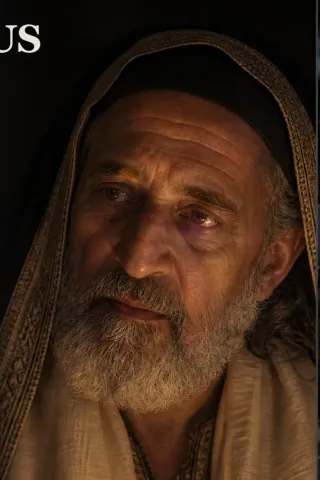
All four gospels name him and each adds a detail. Matthew says he was rich. Mark says he was an honourable counsellor who waited for the kingdom of God, and that he went in boldly. Luke says he was a good man and a just, and that he had not consented to the counsel and deed of them, which means he sat in the room where the vote was taken and did not raise his hand. John says he was a disciple, but secretly, for fear of the Jews.

Where he appearsMatthew 27 · Mark 15 · Luke 23 · John 19

Scroll down to the account
Joseph of Arimathea

The movements, in the order the text gives them.

The Account of Joseph of Arimathea

  1. 01

    Mark 15:42-43

    He went in boldly unto Pilate

    The evening before a sabbath, a member of the council asks an occupying governor for the body of a man his own colleagues have just condemned.

    The man waiting for God's kingdom now asks a Roman governor for a dead body. Mark leaves those two facts beside each other without softening either. Joseph's expectation has not become a victory speech. It has become a burial request.

    His standing matters. An honourable counsellor is not an anonymous passerby, and approaching Pilate identifies him with a man the governor has just had crucified. Mark supplies the word boldly. The Greek describes daring to act, not a personality permanently free of fear. There is courage here because something is being done, not because the Gospel has opened Joseph's mind for inspection.

    The clock is also running. Mark explains preparation as the day before the sabbath, so even a generous intention must become practical quickly. Permission, a body, linen, a place: the following verses are full of things that must actually be obtained or handled. Joseph enters late in the account, but he does not arrive empty-handed in the larger sense. His position becomes access, and his waiting becomes action. The kingdom he awaits is named in the same sentence as the body he requests.

    Verse by verse

    1. 15:42

      Mark defines preparation for his readers as the day before the sabbath. The explanation makes the burial's time pressure visible.

    2. 15:43

      Counsellor translates bouleutes, a member of a council, rather than merely a personal adviser.

    3. 15:43

      The Greek behind went in boldly describes daring to approach. Mark records Joseph's request but does not reproduce its wording.
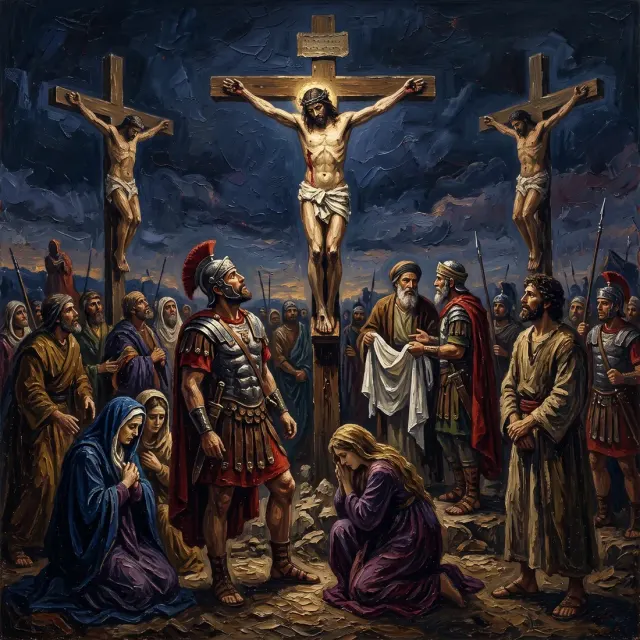
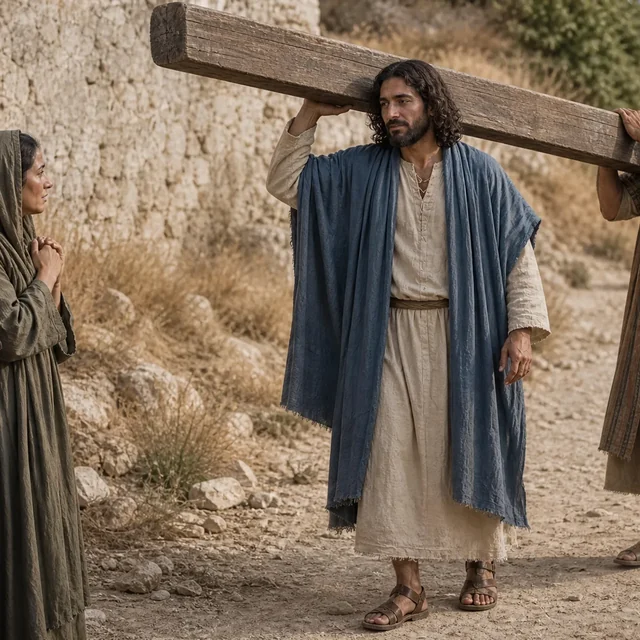
    Mark 15:42-43

    King James Version · 2 verses

    15:42And now when the even was come, because it was the preparation, that is, the day before the sabbath,

    15:43Joseph of Arimathaea, an honourable counsellor, which also waited for the kingdom of God, came, and went in boldly unto Pilate, and craved the body of Jesus.

    Mark 15:42-43: He went in boldly unto Pilate
  2. 02

    Luke 23:50-51

    He had not consented

    Luke goes out of his way to clear him of the verdict. The dissent was silent while it was safe and becomes visible only now.

    The parenthesis prevents a council from swallowing a man. Luke has just named Joseph as a member, then immediately distinguishes him from its decision and its deed. Membership is not consent. That qualification is part of the evidence, not a courtesy added to make the burial less awkward.

    Good and just are equally deliberate. Luke does not leave Joseph's character to be guessed from the fact that he owns linen or knows how to reach Pilate. He states an assessment and gives it a specific setting: this man had not agreed to what was done. Yet the sentence does not provide minutes of a meeting. It supplies no recorded vote, no speech of protest, and no explanation of Joseph's whereabouts during every stage of the proceedings.

    The final detail is his expectation of God's kingdom. That keeps Joseph from being reduced to a dissenting official who happens to arrange a funeral. His hope belongs within Israel's hope, and his subsequent care for Jesus belongs beside that expectation. Luke's distinction is exact and substantial. Joseph came from the council. Its consent did not come from him.

    Verse by verse

    1. 23:50

      Good and just are Luke's explicit descriptions of Joseph, not conclusions inferred solely from his position.

    2. 23:51

      The statement denies Joseph's consent to both the counsel and the deed. It does not specify a formal vote or describe a public protest.

    3. 23:51

      Waiting for the kingdom also appears in Mark 15:43. Luke places that expectation alongside Joseph's stated dissent.

    Luke 23:50-51

    King James Version · 2 verses

    23:50And, behold, there was a man named Joseph, a counsellor; and he was a good man, and a just:

    23:51(The same had not consented to the counsel and deed of them;) he was of Arimathæa, a city of the Jews: who also himself waited for the kingdom of God.

    Luke 23:50-51: He had not consented
  3. 03

    Matthew 27:59-60

    His own new tomb

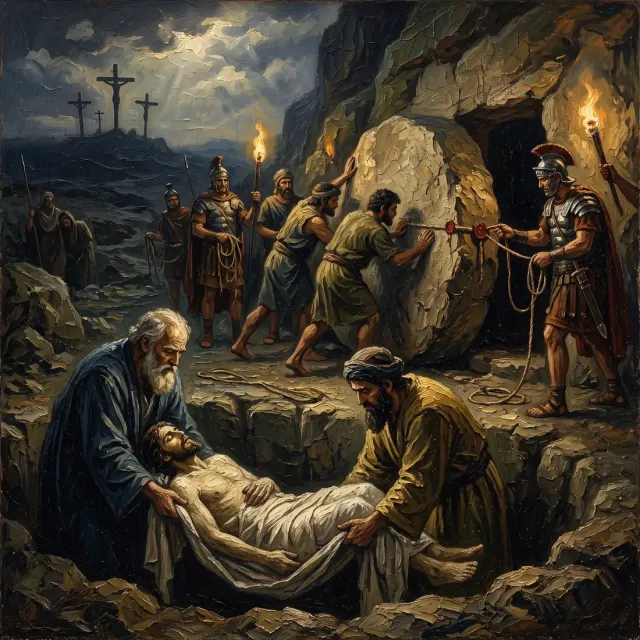
    He wraps the body in clean linen and puts it in a grave he had cut for himself. The stone he rolls to the door is the one the women will worry about.

    His own is the detail that gives the tomb an owner and the burial a cost. Joseph does not merely discover an available hollow. Matthew has already called him rich, and now identifies the place as his own new tomb, cut into rock. What belongs to Joseph is used for Jesus.

    The contrast with the soldiers' handling of the body is physical rather than decorative. Earlier in the chapter, garments are removed, mockery is staged, and clothing is divided. Here the material is clean linen, and the action is wrapping. Matthew does not need to describe Joseph's feelings to make the difference unmistakable. The same dead body that has been exposed to public violence receives deliberate care.

    The great stone and the departure bring the burial to its proper conclusion. Joseph is not described as arranging a temporary exhibition or expecting to retrieve his property in three days. Those would be thoughts imported into his head. Matthew gives something firmer: a particular man, a particular tomb, and an act completed. The women sitting opposite in the next verse also know the place. The grave has an owner and witnesses.

    Verse by verse

    1. 27:59

      Clean describes the linen cloth. The verse records careful handling without reporting Joseph's inner thoughts.

    2. 27:60

      Matthew 27:57 identifies Joseph as rich; this verse identifies the new tomb as his property.

    3. 27:60

      Luke 23:53 and John 19:41 specify that no one had previously been laid in the tomb. Matthew 27:61 places two women opposite it.

    Matthew 27:59-60

    King James Version · 2 verses

    27:59And when Joseph had taken the body, he wrapped it in a clean linen cloth,

    27:60And laid it in his own new tomb, which he had hewn out in the rock: and he rolled a great stone to the door of the sepulchre, and departed.

    Matthew 27:59-60: His own new tomb
  4. 04

    John 19:38

    A disciple, but secretly

    John names the fear plainly and then records the act anyway, so the reader gets both the cowardice and the end of it in one verse.

    John calls Joseph a disciple before he calls him a secret one. Both parts belong. The fear is not a later accusation invented against him, and the discipleship is not an honorary title awarded only after the burial. The Gospel places attachment and concealment in the same description.

    Then comes a request that cannot remain private in the same way. Joseph approaches the governor who controls the body. Pilate gives permission, and Joseph takes Jesus away. The change is visible in an action, not announced through a speech about having conquered every fear. John neither erases the previous secrecy nor supplies a complete account of what Joseph's colleagues subsequently did to him.

    The phrase for fear of the Jews requires its own context. Jesus, Joseph, and Nicodemus belong to the Jewish people themselves. Elsewhere John identifies pressure from authorities against confessing Jesus, including the threat of exclusion from the synagogue. This is a conflict within that world, not a statement that an entire people share one attitude. The verse ends with the body being taken into Joseph's care. What had been hidden in his allegiance now has a public consequence.

    Verse by verse

    1. 19:38

      John explicitly identifies Joseph as a disciple and explicitly attributes his secrecy to fear. Neither detail should cancel the other.

    2. 19:38

      The surrounding Gospel locates opposition and fear in particular disputes involving leaders; John 12:42 names the threat of synagogue exclusion.

    3. 19:38

      Pilate authorizes removal of the body. John 19:39-40 then names Nicodemus and describes their shared burial preparations.

    John 19:38

    King James Version · 1 verse

    19:38And after this Joseph of Arimathaea, being a disciple of Jesus, but secretly for fear of the Jews, besought Pilate that he might take away the body of Jesus: and Pilate gave him leave. He came therefore, and took the body of Jesus.

    John 19:38: A disciple, but secretly

Why it matters

Crucified men were normally left or thrown into a common grave, and asking for the body meant declaring an association at the worst possible hour. He goes to Pilate, who is surprised the man is already dead, and he is given the corpse. Then he spends his own new tomb on it, hewn out of rock, wherein never man before was laid, and rolls a stone across the door. The secrecy ends exactly when it costs the most, and the empty tomb the women find is his.

10 songs

The music

Every song in the catalogue whose passage falls inside these chapters.

  1. Matthew 27:57-66; Mark 15:42-47; Luke 23:50-56; John 19:38-42

    A Stone at the Door

  2. Matthew 27:1-31; Mark 15:1-20; Luke 22:63-23:25; John 18:28-19:16

    Behold the Man

  3. Matthew 27:32-56; Mark 15:21-41; Luke 23:26-49; John 19:16-37

    It Is Finished

  4. Matthew 27:57-66

    Sealed until the Third Day

  5. Matthew 27:27-56

    The Veil Was Torn

  6. Mark 15:1-20

    Before Pilate

  7. Mark 15:21-47

    Truly This Man Was the Son of God

  8. Luke 23:6-12

    Before Herod

    Play here
    Open song pageRead lyrics
  9. Luke 23:32-43

    Remember Me

    Play here
    Open song pageRead lyrics
  10. John 19:1-37

    It is Finished

    Play here
    Open song pageRead lyrics

Nearby

All the people

Report an error on this page