The big picture
Babylon's fall is announced as settled before the chapter allows kings, merchants, and seafarers to describe what the city meant to them. A heavenly voice calls God's people out of complicity with her sins, and her claim to permanent queenly security is answered by sudden death, mourning, famine, and fire. The mourners stand at a distance. Kings grieve lost luxury, merchants grieve vanished buyers, and sailors grieve a trading center whose wealth enriched them. Revelation's detailed cargo list finally reaches slaves and "souls of men," exposing human beings inside the inventory. Heaven then tells a different account. Babylon's end is vindication for apostles, prophets, and saints, and the city's sounds disappear one by one until music, crafts, mills, lamps, and wedding voices are gone. The Book of Revelation closes the chapter by naming the blood found in her, a cost none of the commercial mourners included.
Central truth
Revelation 18 announces Babylon's collapse as the ruin of an exploitative luxury system whose rulers, merchants, and sailors mourn lost profit while heaven is told to rejoice over God's judgment.
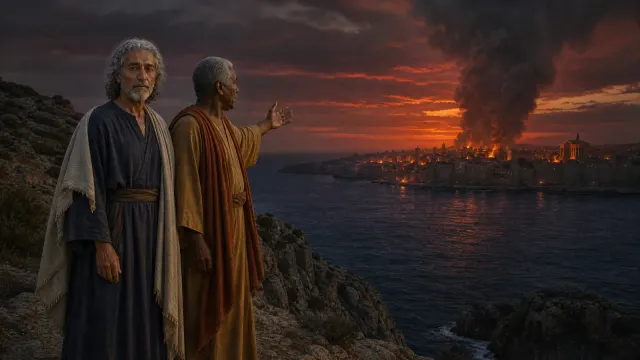

The study notes have a page of their own
The movement by movement analysis, the words to trace, the verse by verse notes and where readers differ are written for someone studying alone. They are on the Deep Personal Reflections page for this chapter. This page is the lesson.
A chapter-specific teaching brief
These anchors come from this chapter itself. They help a teacher use the Level 1 overview, the Level 2 study, and the Scripture text as one lesson.
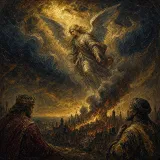
Open with the chapter’s first image
Revelation 18:1: “And after these things I saw another angel come down from heaven, having great power; and the earth was lightened with his glory.”
Slow down at the turning point
Revelation 18:8: “Therefore shall her plagues come in one day, death, and mourning, and famine; and she shall be utterly burned with fire: for strong is the Lord God who…”
Keep this word trail visible
city, earth, alas, heaven, merchants, voice
What to explain, in order
Teach the passage in this order. Each step names the verses it rests on, so every point can be shown in the text before it is applied.
Revelation 18:1-3
Babylon the great is fallen
Open with the angel whose glory lights the earth and whose cry repeats 14:8. Explain the prophetic past tense, "is fallen", as certainty: it is announced as already done. Read Isaiah 21:9 and 13:19-22, where ruined Babylon becomes a home for wild creatures and unclean birds. Then read the three charges of verse 3: nations drunk on her wine, kings in alliance with her, merchants rich from her luxury. Tell the group that this chapter is mostly lament, and is built from the prophets' songs over fallen cities, especially Jeremiah 50 and 51 and Ezekiel 26 and 27.
Revelation 18:4-8
Come out of her
This is the chapter's word to the church, and it should come early. Explain that God's people are not told to attack Babylon but to separate from her sins. Ask what that would have meant for believers in Ephesus or Laodicea, cities proud of their trade, and connect it to the letters, especially 2:14, 2:20 and 3:17. Then read Babylon's boast and its answer, with Isaiah 47:7-9. Explain "double" in verse 6 as full and fitting repayment, the language of Jeremiah 16:18. Make the point that pride and self-sufficiency are what bring her down in one day.
Revelation 18:9-19
Three laments from afar
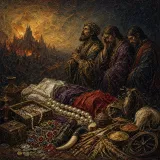
Read the three laments as one movement: kings, merchants, sailors. Point out the refrain: they stand afar off, cry alas, and say it happened in one hour. Read Ezekiel 27:26-36, the lament over Tyre, which supplies much of this language. Then slow down on the cargo list and its ending in verse 13. Explain that trade itself is not condemned, but a system that enriched the powerful and treated people as merchandise. Readers see first-century Rome, a future city, or the recurring pattern of economic power that sets itself against God. Do not identify it with any modern nation or economy.
Revelation 18:20
Heaven answers the lament
Give verse 20 its own step, because it reverses the mourning. Earth laments lost profit; heaven is told to rejoice. Explain that the joy is over justice, "God hath avenged you on her", and recall the souls under the altar in 6:10 who asked how long. Help the group see that rejoicing at the end of oppression is not cruelty; the Exodus song of 15:3 and Psalm 98:8-9 rejoice in God's judgement for the same reason. Teach this with care, and acknowledge that it can feel hard to hear.
Revelation 18:21-24
The millstone and the silence
Read Jeremiah 51:63-64, where a stone is thrown into the Euphrates as a sign that Babylon will sink. Then read the angel's act and the litany of silence slowly: music, craft, grinding, lamplight, weddings. Let the sorrow of it be felt; even in judgement the text grieves the loss of ordinary goods. End with verse 24, the last charge, which explains everything: the blood of prophets, saints and all the slain. Tell the group that the next chapter will answer the silence of Babylon's weddings with the marriage supper of the Lamb.
Where learners get stuck
The misreadings this passage tends to produce, and how to answer each from the text.
"This chapter shows that business and wealth are evil."
The chapter condemns a city whose merchants grew rich "through the abundance of her delicacies" (18:3), whose trade included "slaves, and souls of men" (18:13), and in whom the blood of the slain was found (18:24). The charge is luxury bought by exploitation and violence, joined to idolatry. Scripture elsewhere honours honest work and trade (Proverbs 31:16-24). The question the chapter presses is whether wealth has been gained or used at the cost of people and of loyalty to God.
"'Come out of her' means Christians should withdraw completely from society."
The reason given is "that ye be not partakers of her sins" (18:4). John's readers lived in the cities of Asia and could not leave the empire. The call is to refuse participation in idolatry, exploitation and pride while still living in the world, which is how Jesus prayed in John 17:15. Different traditions apply this differently, from simple living to political separation, but the core is moral separation, not geographical retreat.
"Rejoicing over Babylon's fall is un-Christian, because we should love our enemies."
Verse 20 calls heaven, apostles and prophets to rejoice "for God hath avenged you on her". Believers do not take revenge themselves (Romans 12:19); they leave it to God, and here God has acted. The joy is that oppression is over and the blood of the innocent (18:24) has been answered. Loving enemies and rejoicing in the end of injustice belong together. Let learners voice their discomfort, and answer it from the text.
"Babylon is a particular modern country or city."
The chapter describes Babylon's character, its pride (18:7), its luxury (18:3), its slave trade (18:13), its sorceries (18:23) and its violence (18:24), but it does not name a modern city. First-century readers would have heard Rome. Other readers expect a future city, or see the recurring system in every age. Applying it to one modern nation turns a searching word to the church into a political accusation, and the teacher should avoid it.
Learning objectives
- Identify the announcements that Babylon is fallen.
- Explain why God's people must come out.
- Trace the kings, merchants, and sailors' laments.
- Examine the merchandise list's human cost.
- Explain the millstone and 'no more' statements.
- Contrast heaven's response with commercial mourning.
Teacher preparation
- Read selected city-fall passages in Isaiah, Jeremiah, and Ezekiel.
- Mark fallen, come out, merchants, rich, hour, no more, blood, and sorceries.
- Prepare separate columns for kings, merchants, and sailors.
- Pause over 'slaves, and souls of men' in verse 13.
- Keep the luxury list concrete; respectable invoices can hide ugly systems.
Evidence and interpretation checks
Explicit
Verses 1 to 3 announce Babylon fallen and connect her corruption with kings, nations, and merchants made rich through excessive luxury.
Scripture-supported
Verse 4 explicitly calls God's people to come out of Babylon so they do not participate in her sins or receive her plagues.
Strong inference
The three laments by kings, merchants, and sea-traders all stand afar off, suggesting that their grief is mixed with self-protection and economic loss rather than repentance for Babylon's violence.
Possible or traditional reading
Babylon has been read as first-century Rome, a future city, an enduring world-economic order, or a composite symbol of imperial luxury and exploitation; chapter 18 gives economic and moral traits but does not name a modern metropolis.
Limit
The chapter does not condemn commerce itself, does not say every luxury item is sinful, and does not permit its judgment language to become contempt for ordinary people who live inside powerful economies.
Discussion with answer guidance
1. Why does the heavenly voice tell God's people to leave Babylon in verse 4?
What a good answer contains
The voice says, "Come out of her, my people, that ye be not partakers of her sins, and that ye receive not of her plagues" (18:4). Two reasons: not to share her sins and not to share her judgement. A strong answer sees that the call is first moral, a refusal to take part in Babylon's ways, since believers in John's churches lived inside the Roman world and could not simply move away. It recalls Jeremiah 51:6 and 45, where God's people are told to flee Babylon. A weak answer reads the verse only as a call to change address.
Show teacher guidance
Require both reasons: do not partake in her sins and do not receive of her plagues; separation is moral before it is geographical.
2. What does Babylon say about herself in verse 7, and what judgment answers that boast?
What a good answer contains
Verse 7 says "she saith in her heart, I sit a queen, and am no widow, and shall see no sorrow" (18:7). She claims permanence, security and freedom from grief. Verse 8 answers: "Therefore shall her plagues come in one day, death, and mourning, and famine; and she shall be utterly burned with fire: for strong is the Lord God who judgeth her." A good answer notes that the boast echoes Isaiah 47:7-9, spoken against ancient Babylon, and that each part of her boast is overturned. A weak answer misses that pride is the root of her fall.
Show teacher guidance
She says she sits a queen, is no widow, and shall see no sorrow; verse 8 answers with sudden plagues, death, mourning, famine, and burning.
3. What do kings, merchants, and sailors have in common when they lament?
What a good answer contains
Each group "stood afar off" or will stand "afar off for the fear of her torment" (18:10, 18:15, 18:17). Each says "Alas, alas, that great city" and each mourns how suddenly, "in one hour", it has ended. The kings lived deliciously with her (18:9); the merchants grieve that "no man buyeth their merchandise any more" (18:11); the shipmasters grieve the costliness that made them rich (18:19). A strong answer sees that none of them mourns her victims or repents. They mourn their losses, and they keep their distance.
Show teacher guidance
All stand afar off, all react to sudden loss, and all focus heavily on the system whose collapse damages their status or trade.
4. Which item at the end of the merchant list changes how the whole inventory feels?
What a good answer contains
The list runs through gold, silver, jewels, cloth, wood, ivory, spices, wine, oil, flour, cattle, horses and chariots, and then ends with "slaves, and souls of men" (18:13). The last item reveals what the whole economy rested on: human beings bought and sold. A good answer lets that final phrase change the feeling of the list, and notes that Ezekiel 27:13 lists the same trade in Tyre. A weak answer treats the list as a catalogue of luxury and misses the human cost hidden at the end of it.
Show teacher guidance
Verse 13 ends with slaves and souls of men; do not let spices, jewels, cloth, animals, and vehicles hide the human cost.
5. Why is heaven told to rejoice in verse 20 when earth's commercial powers mourn?
What a good answer contains
"Rejoice over her, thou heaven, and ye holy apostles and prophets; for God hath avenged you on her" (18:20). The reason is justice for her victims. Verse 24 makes it plain: "in her was found the blood of prophets, and of saints, and of all that were slain upon the earth". A strong answer sees that heaven's joy is not delight in suffering but relief that oppression has ended and innocent blood has been answered. It notices that the victims include "all that were slain upon the earth", not only believers.
Show teacher guidance
The verse gives the reason: God has avenged apostles and prophets on Babylon; the perspective is justice for victims, not delight in arbitrary ruin.
6. What disappears after the millstone sign in verses 21 to 23?
What a good answer contains
After the millstone is cast into the sea (18:21), everything that made a city alive is silenced: "the voice of harpers, and musicians, and of pipers, and trumpeters", every craftsman, "the sound of a millstone", "the light of a candle", and "the voice of the bridegroom and of the bride" (18:22-23). The reason follows: "thy merchants were the great men of the earth; for by thy sorceries were all nations deceived" (18:23). A good answer feels the sorrow of the silence and sees that the city's ordinary life was bound up with its corruption.
Show teacher guidance
Trace music, craftsmen, millstone sound, candlelight, bridegroom and bride voices, then connect the silence with merchant greatness and sorceries.
Responsible application
Audit the human cost of prosperity
Use verse 13 to ask what exploitation may hide beneath impressive prosperity.
Come out means refuse participation
Apply verse 4 first to complicity in sin, not merely physical relocation.
Mourn what God mourns
Compare commercial grief with heaven's concern for prophets and saints who suffered.
Session plans
Two timings of the same lesson. The shorter keeps the reading, the central discussion and one response; the longer gives the confusions and the application their own time.
45 minutes
Fallen
Read 18:1-3 with Isaiah 21:9. Explain the three charges of verse 3.
Come out of her
Read 18:4-8. Ask questions one and two, and take the confusion about withdrawing from society.
Three laments
Read 18:9-19. Ask questions three and four, and take the confusion about business and wealth.
Heaven rejoices
Read 18:20 and 18:24. Ask question five and take the confusion about rejoicing.
Silence and the handout
Read 18:21-23 and ask question six. Read the key verse together, give out the handout and pray.
90 minutes
What a city promises
Ask the group what makes a city attractive. List their answers and return to them.
Fallen
Read 18:1-3 with Isaiah 13:19-22. Take the Babylon confusion and present the readings.
Come out of her
Read 18:4-8 with Jeremiah 51:6, 45 and Isaiah 47:7-9. Ask questions one and two, and take the confusion about withdrawing from society.
The laments and the cargo
Read 18:9-19 with Ezekiel 27:12-36. Ask questions three and four, and take the confusion about business and wealth.
Justice for the slain
Read 18:20 and 18:24 with 6:9-10. Ask question five and take the confusion about rejoicing.
The millstone
Read 18:21-23 with Jeremiah 51:63-64. Ask question six and return to the opening list.
Application
Choose one application on separation from Babylon's ways. Read the key verse, give out the handout and pray.
Adapting the lesson
Children
Tell the children that Babylon was a proud city that cared about money and things more than about people or God, and that God stopped its cruelty. Read 18:4 and talk about saying no to doing wrong even when others do it. Leave out the burning and the laments, and end with the promise that God cares for people who are treated unfairly.
Youth
Ask what they buy and whether they ever wonder who made it. Read the cargo list and its last words in 18:13. Talk about Babylon's boast in 18:7 and the pride that thinks it can never fall. Discuss what it would mean to come out of her in their own world without leaving it.
Adults
Work through the prophetic laments of Isaiah 47, Jeremiah 51 and Ezekiel 27. Discuss how economic systems can draw believers into complicity, and how the church can live inside them without sharing their sins. Present the readings of Babylon fairly, and keep current politics and nations out of the discussion.
One to one
Ask the person where they feel pulled to share in things they know are wrong in order to get ahead. Read 18:4 together and talk about one practical step of coming out. If they have been wronged by powerful people, read 18:20 and 18:24 and pray with them.
Song and video learning lab
A song or video may interpret, compress, or dramatize the text. Its value becomes clearer when its choices are compared with Scripture.
- Before the media: the exact passage and its central movement.
- During the media: the words, people, events, and emotions the artist emphasizes.
- After the media: what it clarifies, what it leaves out, and what belongs back in the biblical text.
Handout
One page for learners to take home. The print button prints this section alone.
Revelation 18
The passage in brief
Revelation 18 announces that Babylon, the proud and wealthy city, has fallen. A voice calls God's people to come out of her so they do not share her sins or her punishment. Kings, merchants and sailors stand far off and mourn, not for her victims but for their lost wealth, and the list of her trade ends with human beings. Heaven is told to rejoice, because God has judged the city where the blood of his people was found.
A verse to keep
And I heard another voice from heaven, saying, Come out of her, my people, that ye be not partakers of her sins, and that ye receive not of her plagues.
Revelation 18:4 · King James Version
Questions to take home
Why are God's people told to come out of Babylon (18:4)?
What does Babylon say about herself (18:7)?
What is the last item on the merchants' list, and why does it matter (18:13)?
This week
Choose one habit of spending or getting this week, ask whether it shares in Babylon's ways, and change it if it does.
Music and video connected to the passage
Related media appears when its Scripture reference overlaps this study. Music and video can illuminate a theme while the biblical text remains the foundation.