The big picture
Isaiah 5 begins as a love song about careful cultivation and turns into a courtroom trap. The vineyard has received everything it needs, yet its fruit is wild, and Jerusalem is invited to judge the case before discovering that it is the vineyard. The rest of the chapter names the crop: land accumulation that empties neighborhoods, feasting that notices everything except the LORD's work, moral language turned upside down, self-congratulation, bribed verdicts, and strength wasted at the wine jar. The chapter's imagery repeatedly reverses appetite and possession. Great estates yield almost nothing, drinkers become the swallowed, and people who haul sin like a cart eventually face fire at root and blossom. Then a distant army arrives with terrifying readiness, down to the unbroken sandal strap. The vineyard song ends not in harvest celebration but in roaring, darkness, and a land from which light itself seems to withdraw.
In this chapter
- The Audience Discovers It Is the Vineyard Isaiah 5:1-7
The vineyard song works because Isaiah lets the audience settle into the owner's side of the dispute before revealing whose field they are judging.
- All That Land, and Almost Nothing to Harvest Isaiah 5:8-10
The first woe takes the failed vineyard out of song and puts it into property records.
- The Banquet Acquires a Larger Guest Isaiah 5:11-17
These revellers give indulgence the discipline of a full-time occupation.
- Strong Men at the Wine Jar, Weak Justice at the Gate Isaiah 5:18-25
Isaiah pictures sin not as something accidentally tripped over but as cargo deliberately hauled.
- An Army Without a Loose Sandal Strap Isaiah 5:26-30
The final army is frightening partly because Isaiah inventories the tiny failures that never happen.


Scripture beside the summary
Isaiah · King James Version · 30Isaiah 5:1-7
The Audience Discovers It Is the Vineyard
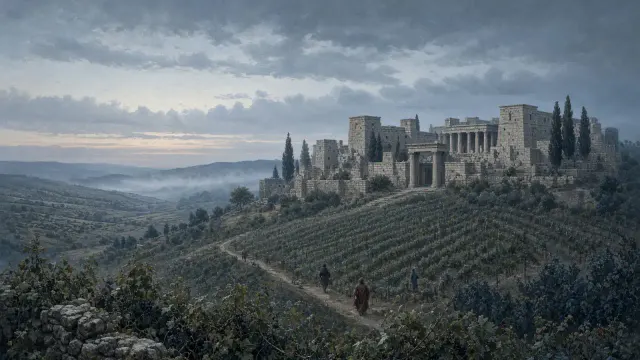
The vineyard song works because Isaiah lets the audience settle into the owner's side of the dispute before revealing whose field they are judging. The hillside is good, the stones are removed, the vine is choice, the hedge is built, and a winepress waits for a harvest expected to be worth pressing. Nothing about the preparation explains wild grapes. When Jerusalem and Judah are asked what more the owner could have done, they are effectively invited to rule on their own case without knowing it. Verse 7 then turns the song into an indictment: Israel is the vineyard and Judah the pleasant plant. The final Hebrew wordplay sharpens the disappointment. The sounds for judgment and oppression, righteousness and a cry, sit close together while their meanings stand terribly far apart. Isaiah's point is not simply that the crop was disappointing. The expected fruit was public justice, and the actual harvest can be heard in the people crying under what replaced it.
Deep dive
The opening sounds affectionate and agricultural: a beloved owner, a fruitful hillside, stones removed, a chosen vine, a tower, and a winepress. The preparations establish expectation before failure is named. A winepress has been made before the harvest, so the owner's provision includes confidence in what the planting should produce. Wild grapes are not the result of an owner who never bothered to cultivate.
The voice then shifts into the owner's appeal to Jerusalem and Judah. They are asked to judge the case before verse 7 identifies them as the vineyard. The song has brought its audience to the bench only to place it in the dock. Its final wordplay gives the verdict an audible edge. Hebrew mishpat, judgment, is set against mispach, the oppression named in the KJV; tsedaqah, righteousness, is set against tseaqah, a cry. Similar sounds contain a dreadful difference in substance. The expected harvest was justice; the actual harvest is heard in those who suffer.
The threatened removal of wall, cultivation, and rain reverses the opening provision item by item. Matthew 21:33 later uses the hedge, winepress, and tower in Jesus' vineyard parable. That later use develops the image, but Isaiah's own identification is already explicit: the crop exposes the condition of Israel and Judah.
Words to trace: vineyard, grapes, looked, Judah, rain, wellbeloved
Verse-by-verse path
- Isaiah 5:1
“Wellbeloved” is yedid and “beloved” is dod, the vocabulary of the Song of Solomon; the prophet begins like a friend of the bridegroom singing a love song. “A very fruitful hill” is literally “a horn, son of oil”, a spur of hill with rich soil.
- Isaiah 5:2
“Fenced” is a verb found only here, probably to dig or hoe. “The choicest vine” is sorek, a red grape named from the valley of Sorek where Delilah lived (Judges 16:4); Jeremiah 2:21 uses it: “I had planted thee a noble vine.” “Wild grapes” is be’ushim, from ba’ash, to stink: rotten berries.
- Isaiah 5:3
The singer suddenly speaks as the owner, “betwixt me and my vineyard”. It is the trap Nathan set for David in 2 Samuel 12: tell a case, let the hearer pronounce judgment, and only then say who the case is about.
- Isaiah 5:4
“Looked” is qavah, to wait in hope, the verb of Isaiah 40:31, “they that wait upon the LORD”. It comes twice here and twice again in verse 7. The question “what could have been done more?” has no answer, which is the point of asking it.
- Isaiah 5:5
“Eaten up” is the grazing verb ba’ar again, and “trodden down” is mirmas, a place for trampling. Psalm 80:12–13 laments the same fate for Israel as God’s vine: “Why hast thou then broken down her hedges... The boar out of the wood doth waste it.”
- Isaiah 5:6
“Briers and thorns”, shamir vashayit, is a pair found only in Isaiah, and it comes back three times in 7:23–25. Then the mask slips: no farmer can “command the clouds that they rain no rain”. Before verse 7 names the owner, the owner has given himself away.
- Isaiah 5:7
“Pleasant plant” is literally “the planting of his delights”, from sha’ashu’im, the word Wisdom uses in Proverbs 8:30, “I was daily his delight.” Isaiah returns to the image in 27:2–6 with a second vineyard song, one the LORD keeps and waters every moment.
Isaiah 5:1-7
King James Version1Now will I sing to my wellbeloved a song of my beloved touching his vineyard. My wellbeloved hath a vineyard in a very fruitful hill:
2And he fenced it, and gathered out the stones thereof, and planted it with the choicest vine, and built a tower in the midst of it, and also made a winepress therein: and he looked that it should bring forth grapes, and it brought forth wild grapes.
3And now, O inhabitants of Jerusalem, and men of Judah, judge, I pray you, betwixt me and my vineyard.
4What could have been done more to my vineyard, that I have not done in it? wherefore, when I looked that it should bring forth grapes, brought it forth wild grapes?
5And now go to; I will tell you what I will do to my vineyard: I will take away the hedge thereof, and it shall be eaten up; and break down the wall thereof, and it shall be trodden down:
6And I will lay it waste: it shall not be pruned, nor digged; but there shall come up briers and thorns: I will also command the clouds that they rain no rain upon it.
7For the vineyard of the LORD of hosts is the house of Israel, and the men of Judah his pleasant plant: and he looked for judgment, but behold oppression; for righteousness, but behold a cry.
Isaiah 5:8-10
All That Land, and Almost Nothing to Harvest
The first woe takes the failed vineyard out of song and puts it into property records. House is joined to house and field to field until the successful accumulators have achieved a peculiar triumph: they can sit alone in the middle of what they own because everyone else has been crowded out. Isaiah answers expansion with emptiness. Fine houses become uninhabited, and enormous cultivated holdings return absurdly small yields. The proportions are the point. More land has not produced the abundance it promised. A large vineyard gives scarcely any wine, and seed returns only a fraction of itself. Coming immediately after the vineyard song, the images make social arrangement part of the failed harvest rather than a separate economic footnote. The people who kept adding acreage expected possession to multiply security. Isaiah pictures the opposite. Their estates widen while the neighborhood disappears, their houses improve while inhabitants vanish, and the ground itself refuses to reward the scale of acquisition.

Deep dive
The first woe turns the vineyard's failed produce into a recognizable social practice. Houses join houses and fields join fields until others have no place. The concluding phrase imagines the accumulators living alone in the land. Their success has a built-in emptiness: possession expands by removing the people around it. Isaiah then announces a still more severe emptiness, with large and attractive houses left without inhabitants.
The agricultural figures press the reversal into yield. A vast vineyard supplies a meager amount of wine, and the grain harvested is only a fraction of what was sown. The contrast exposes a collapse between the scale of the holdings and what they yield. More acreage does not produce the expected abundance. Coming immediately after the vineyard song, the woe makes the relation between social arrangement and failed harvest unmistakable. Judah's preferred method of increasing prosperity is answered through the very houses and fields it has gathered.
Words to trace: field, house, yield, acres, bath, desolate
Verse-by-verse path
- Isaiah 5:8
Micah, Isaiah’s contemporary, makes the same charge: “they covet fields, and take them by violence; and houses, and take them away” (Micah 2:2). The law held that land could not be sold for ever, “for the land is mine” (Leviticus 25:23). Naboth died for refusing to sell his vineyard (1 Kings 21).
- Isaiah 5:9
The Hebrew has no “said”: “In my ears, the LORD of hosts.” It is a compressed oath, and “of a truth” is the oath formula “surely”. Isaiah uses the same phrasing in 22:14: “it was revealed in mine ears by the LORD of hosts.”
- Isaiah 5:10
“Ten acres” is literally ten yokes, the land ten teams of oxen could plough in a day; a bath was a single jar’s measure, perhaps twenty-two litres. A homer, the load a donkey carried, was ten ephahs (Ezekiel 45:11). So the harvest returns a tenth of the seed sown.
Isaiah 5:8-10
King James Version8Woe unto them that join house to house, that lay field to field, till there be no place, that they may be placed alone in the midst of the earth!
9In mine ears said the LORD of hosts, Of a truth many houses shall be desolate, even great and fair, without inhabitant.
10Yea, ten acres of vineyard shall yield one bath, and the seed of an homer shall yield an ephah.
Isaiah 5:11-17
The Banquet Acquires a Larger Guest
These revellers give indulgence the discipline of a full-time occupation. They rise early to pursue strong drink and remain at it until night, surrounded by harp, viol, tabret, pipe, and wine. The problem is not a shortage of sights or sounds. Their attention has been carefully furnished so they do not "regard the work of the LORD." Isaiah answers the banquet by reversing its appetites. The honorable go hungry, the multitude dries with thirst, and hell opens a mouth large enough to swallow glory, pomp, noise, and rejoicing together. Those who consumed without measure become what is consumed. Then the land changes owners. Lambs graze where the powerful once organized life, and strangers feed in abandoned places. The movement is almost cinematic: a loud, well-stocked feast gives way to an emptied landscape with animals wandering through it. Human height is brought low while the LORD is exalted in judgment, repeating the vertical logic of chapter 2.


Deep dive
The drinkers rise early and continue late, giving the indulgence the shape of a working day. Instruments and wine fill the feast, while the work of the LORD receives no attention. Isaiah does not accuse the guests of having no available sights or sounds. They have arranged their attention around a celebration that excludes what is happening beyond it. Their eventual hunger and thirst answer the abundance on the table.
The imagery then produces an enormous reversal of appetite. Hell opens its mouth without measure, swallowing rank, noise, and festivity together. The people who consumed so confidently become what is consumed. Great and small are brought low, while the LORD is exalted in judgment, repeating the vertical pattern of chapter 2. The final appearance of grazing lambs makes the abandoned land visible without another catalogue of ruined buildings. Places once marked by the powerful are now open to animals and strangers. The passage moves from a carefully furnished banquet to an environment no longer organized around its hosts.
Words to trace: humbled, LORD, multitude, wine, captivity, consider
Verse-by-verse path
- Isaiah 5:11
“Strong drink” is shekhar, beer or other fermented drink not made from grapes. “Inflame” is to set on fire: they drink from dawn until the wine heats them at night. Isaiah names a working day and fills it with nothing but drinking.
- Isaiah 5:12
Four instruments: the kinnor, David’s lyre; the nevel, a larger harp; the tof, the hand drum Miriam played at the sea (Exodus 15:20); and the chalil, the pipe played at Solomon’s coronation (1 Kings 1:40). “The operation of his hands” is set against idols, “the work of their own hands” (2:8).
- Isaiah 5:13
“Are gone into captivity” is a past tense for a future event, the prophet speaking of it as already done. Hosea 4:6 says the same: “My people are destroyed for lack of knowledge.” The Greek read the vowels differently and has the nobles “dead of hunger” rather than “famished”.
- Isaiah 5:14
“Hell” is she’ol, the grave pictured as a gaping throat. Proverbs 30:15–16 lists the grave first among things that never say “It is enough”, and Habakkuk 2:5 compares greed to Sheol, which “cannot be satisfied”. The pronouns are feminine: Jerusalem’s glory and noise go down into it.
- Isaiah 5:15
The refrain of chapter 2 surfaces in the middle of the woes: the pair from 2:9, the mean man and the mighty man, and the lofty eyes of 2:11. The drinkers of verse 11 are placed under the same levelling as the proud of chapter 2.
- Isaiah 5:16
Judgment and righteousness are the pair God looked for from his vineyard in verse 7 and did not find; now he shows them himself. “Shall be sanctified” recalls Leviticus 10:3, spoken after fire consumed Nadab and Abihu: “I will be sanctified in them that come nigh me.”
- Isaiah 5:17
“After their manner” means as in their own pasture. “The fat ones” are the rich, the men who joined field to field in verse 8. Their estates, emptied of people, become grazing for lambs and wanderers. The land they gathered ends with no owner at all.
Isaiah 5:11-17
King James Version11Woe unto them that rise up early in the morning, that they may follow strong drink; that continue until night, till wine inflame them!
12And the harp, and the viol, the tabret, and pipe, and wine, are in their feasts: but they regard not the work of the LORD, neither consider the operation of his hands.
13Therefore my people are gone into captivity, because they have no knowledge: and their honourable men are famished, and their multitude dried up with thirst.
14Therefore hell hath enlarged herself, and opened her mouth without measure: and their glory, and their multitude, and their pomp, and he that rejoiceth, shall descend into it.
15And the mean man shall be brought down, and the mighty man shall be humbled, and the eyes of the lofty shall be humbled:
16But the LORD of hosts shall be exalted in judgment, and God that is holy shall be sanctified in righteousness.
17Then shall the lambs feed after their manner, and the waste places of the fat ones shall strangers eat.
Isaiah 5:18-25
Strong Men at the Wine Jar, Weak Justice at the Gate
Isaiah pictures sin not as something accidentally tripped over but as cargo deliberately hauled. Vanity becomes a cord, the cord thickens into a cart rope, and people drag iniquity while daring the Holy One to hurry up and show his work. The next woes expose the language that makes such resistance feel respectable. Evil is relabeled good, darkness is called light, bitterness becomes sweetness, and self-estimation supplies the wisdom certificate. Then comes one of the chapter's sharper jokes: the "mighty" men are mighty at drinking and the men of "strength" excel at mixing strong drink, while justice at the gate can be purchased. Heroic vocabulary has been spent at the wine jar. Fire finally attacks both root and blossom, leaving neither hidden foundation nor visible future untouched. Isaiah explicitly connects that destruction to rejection of the LORD's instruction, and the refrain about the still-outstretched hand makes clear that the judgment has not yet reached its final period.

Deep dive
The opening image gives sin weight and traction. People haul it with cords that become a cart rope, suggesting not an accidental stumble but sustained attachment. Their demand that the Holy One hurry his work turns the language of expectation into a taunt. The next woes expose the verbal machinery supporting the same resistance: evil is renamed good, darkness light, bitterness sweetness. A changed label is being used to conceal an unchanged reality.
Isaiah's description of drinking champions is pointed. They possess heroic vocabulary and impressive strength, but the feat is mixing and consuming wine. In the next breath, judicial acquittal is bought and the righteous lose their rights. The contrast is not a general sneer at human ability; it identifies where these figures exercise strength and where their public responsibilities fail.
Fire attacks both root and blossom, so the threatened loss reaches beneath appearances and beyond the present season. Verse 24 explicitly names rejection of the LORD's instruction as the cause. The closing refrain, with the hand still stretched out, will recur through 9:12–10:4. Its first appearance here leaves the indictment open rather than giving the chapter a neat sense of completion.
Words to trace: anger, bitter, darkness, draw, drink, evil
Verse-by-verse path
- Isaiah 5:18
A cart rope is the heavy line by which a draught animal hauls a wagon. The people are harnessed to their sin like oxen and pulling it along behind them. “Vanity” is shav, emptiness or falsehood, the “vain” of the vain oblations in 1:13.
- Isaiah 5:19
“Make speed, and hasten” are mahar and chush, the two verbs Isaiah will build into his second son’s name, Maher-shalal-hash-baz, “hasten the spoil, hurry the prey” (8:1–3). The scoffers use Isaiah’s own title, “the Holy One of Israel”, as a taunt.
- Isaiah 5:20
Three pairs, each reversed both ways: evil and good, darkness and light, bitter and sweet. Amos 5:7 makes the same charge against Israel’s courts: “Ye who turn judgment to wormwood.” The verse moves from ethics to perception to taste, as if the corruption reaches the senses.
- Isaiah 5:21
Proverbs 3:7 gives the command this woe presumes broken: “Be not wise in thine own eyes.” Proverbs 26:12 goes further: “there is more hope of a fool than of him.” Isaiah 29:14 promises that “the wisdom of their wise men shall perish”.
- Isaiah 5:22
“Mighty” is gibborim, the title of David’s warriors, and “men of strength” is anshe chayil, men of valour, a military phrase. “Mingle” means mixing wine with spices to strengthen it, the “mixed wine” of Proverbs 23:30. Their only campaign is at the table.
- Isaiah 5:23
Exodus 23:7–8 sets the two commands side by side: “I will not justify the wicked”, and “thou shalt take no gift”. “Justify” means to declare innocent in court. The drinkers of verse 22 are the same men who sit on the bench.
- Isaiah 5:24
The Hebrew reads “as the tongue of fire devoureth the stubble”, the phrase later used at Pentecost (Acts 2:3). Root and blossom are the whole plant, as Malachi 4:1 threatens to leave “neither root nor branch”. Torah and word are paired, both “cast away”.
- Isaiah 5:25
“The hills did tremble” may recall the great earthquake of Uzziah’s reign, which Amos dates his book by (Amos 1:1) and Zechariah 14:5 still remembers centuries later. “Torn in the midst of the streets” is literally lying like refuse in the streets.
Isaiah 5:18-25
King James Version18Woe unto them that draw iniquity with cords of vanity, and sin as it were with a cart rope:
19That say, Let him make speed, and hasten his work, that we may see it: and let the counsel of the Holy One of Israel draw nigh and come, that we may know it!
20Woe unto them that call evil good, and good evil; that put darkness for light, and light for darkness; that put bitter for sweet, and sweet for bitter!
21Woe unto them that are wise in their own eyes, and prudent in their own sight!
22Woe unto them that are mighty to drink wine, and men of strength to mingle strong drink:
23Which justify the wicked for reward, and take away the righteousness of the righteous from him!
24Therefore as the fire devoureth the stubble, and the flame consumeth the chaff, so their root shall be as rottenness, and their blossom shall go up as dust: because they have cast away the law of the LORD of hosts, and despised the word of the Holy One of Israel.
25Therefore is the anger of the LORD kindled against his people, and he hath stretched forth his hand against them, and hath smitten them: and the hills did tremble, and their carcases were torn in the midst of the streets. For all this his anger is not turned away, but his hand is stretched out still.
Isaiah 5:26-30
An Army Without a Loose Sandal Strap
The final army is frightening partly because Isaiah inventories the tiny failures that never happen. No soldier grows weary, nobody stumbles, nobody sleeps at the wrong moment, no belt loosens, and not even a sandal strap breaks. The distant force answers a simple signal with immediate, disciplined motion. Against Judah's distracted feasting stands an enemy prepared down to the fastening on its feet. The imagery then accelerates: arrows are sharp, bows already bent, hooves strike like flint, wheels move like a whirlwind, and the host begins to sound like lions closing on prey. By the end the roar has expanded into the sea itself. There is no rescuer in the scene and no convenient mechanical failure to slow the advance. Isaiah began the chapter on a carefully prepared hillside waiting for fruit. He ends it with a land looked at through darkness and sorrow, the light overhead dimmed as though the failed vineyard has swallowed its own day.
Deep dive
The nations respond to a raised signal and a hiss or whistle. The summons is effortless; the arriving force is not. Isaiah lists the small failures that do not occur: no weariness, stumbling, sleep, loose belt, or broken sandal fastening. The cumulative precision is unsettling because it denies every ordinary interruption that might slow the advance. The people absorbed in their feast face an enemy whose preparations are complete down to the straps.
The imagery accelerates through sharp arrows, ready bows, flint-like hooves, whirlwind wheels, and lions taking prey. It then expands again into the roar of the sea. No particular battle has to be reconstructed for the movement to register. The force advances, seizes, and carries away without an effective rescuer appearing. The final glance toward the land finds darkness rather than a route out. The chapter began with a planted hillside awaiting fruit and ends with a landscape in which even the light has failed. The transition is the full consequence of the vineyard's exposed condition.
Words to trace: roar, roaring, arrows, bent, bows, broken
Verse-by-verse path
- Isaiah 5:26
An “ensign” is nes, a signal pole raised on a bare height. “Hiss” is sharaq, to whistle, as a beekeeper whistles bees out of the hive; Isaiah 7:18 uses it of the LORD whistling for the fly of Egypt and the bee of Assyria. The nation is not yet named.
- Isaiah 5:27
Soldiers girded up their long garments at the waist to march and fight. The “latchet” is the thong of a sandal, the least valuable thing Abram would take from the king of Sodom (Genesis 14:23). Assyrian reliefs show their infantry in laced boots.
- Isaiah 5:28
Before horseshoes, a cavalry horse was only as good as its hooves, and these are hard as flint. “Whirlwind” is sufah, the storm wind. Assyria’s chariot corps was the terror of the age, and Isaiah describes it without naming it.
- Isaiah 5:29
“Roar” is naham, the low growl a lion makes over prey already caught. Amos 3:4 asks, “Will a lion roar in the forest, when he hath no prey?” The picture moves from the chase to the growl over the carcass, the moment when nothing can be taken back.
- Isaiah 5:30
“Roaring of the sea” uses the same growl word as verse 29, so the lion’s snarl swells into the noise of the ocean. “Heavens thereof” is a rare word probably meaning clouds. Isaiah 8:22 returns to this scene: “trouble and darkness, dimness of anguish.”
Isaiah 5:26-30
King James Version26And he will lift up an ensign to the nations from far, and will hiss unto them from the end of the earth: and, behold, they shall come with speed swiftly:
27None shall be weary nor stumble among them; none shall slumber nor sleep; neither shall the girdle of their loins be loosed, nor the latchet of their shoes be broken:
28Whose arrows are sharp, and all their bows bent, their horses’ hoofs shall be counted like flint, and their wheels like a whirlwind:
29Their roaring shall be like a lion, they shall roar like young lions: yea, they shall roar, and lay hold of the prey, and shall carry it away safe, and none shall deliver it.
30And in that day they shall roar against them like the roaring of the sea: and if one look unto the land, behold darkness and sorrow, and the light is darkened in the heavens thereof.
Questions to keep in mind while reading
- Identify the historical crisis, covenant failure, warning, and promised hope.
- Distinguish the prophet’s immediate audience from later biblical connections.
- Do not turn present-day headlines into confident fulfillment claims without textual evidence.
Text first
Where readers differ
The chapter summary begins with what the passage says and how its parts fit together. It does not assume one denomination has already settled every question. Where a conclusion depends on a tradition, literary theory, or historical reconstruction, that dependence is named openly.
The KJV text is presented first. Interpretive conclusions are labeled, and differences are introduced only when they help a reader understand why serious communities do not always reach the same answer.
Comparative interpretive notes for this chapter are in preparation. Until reviewed notes are ready, this page separates the KJV text from summary and application without claiming that serious readers agree on every question.
Questions beneath the surface
- What account of God, human freedom, responsibility, and the good life emerges from Isaiah 5?
- Which tension does the chapter refuse to resolve quickly?
- What changes when the chapter is read as part of the whole canon rather than as an isolated moral lesson?
- Where might a sincere reader confuse a familiar tradition with something the text states directly?
Questions for serious personal contemplation
These open-ended questions make room for tension, honest response, prayer, and conclusions that remain accountable to the chapter.
Observe without rushing
What part of Isaiah 5 makes you stop, feel unsettled, or feel surprised, and why?
Which detail in the passage would be easiest to overlook? How does that detail change your understanding?
Where do you see tension between what happens and this focus: A carefully tended vineyard producing wild grapes as leaders gather field to field and injustice spreads?
What important question does the passage leave open instead of resolving quickly?
Examine your inner life honestly
Which person, response, fear, or desire in the passage feels most like your own life right now?
What assumption about God, other people, or yourself does this text challenge?
Which part would you rather soften, avoid, or explain away too quickly? What might that reaction reveal?
If this Scripture could ask you one direct question, what do you think it would ask?
Respond with wisdom and courage
What do you need to remember, confess, grieve, thank God for, or trust after reading this passage?
How might another faithful person read this situation differently without ignoring the text?
What obedient response would be costly, uncomfortable, or slow, yet still faithful to Scripture?
What question will you carry into prayer this week, and which verses will you keep in front of you?
Music and video connected to the passage
Related media appears when its Scripture reference overlaps this study. Music and video can illuminate a theme while the biblical text remains the foundation.