The big picture
Psalm 89 constructs the problem before it complains about it. The opening celebrates mercy and faithfulness “for ever,” then places God’s covenant with David in direct speech: the chosen servant, his seed, and his throne will be established through generations. The psalm expands that promise through divine sovereignty, justice, protection, royal sonship, enduring mercy, and even explicit provision for disciplining disobedient descendants without cancelling the covenant. Only after all of that does the great reversal arrive: “But thou hast cast off.” Crown, defenses, sword, glory, and throne are described in ruins, and the same God who promised establishment is addressed as the one who has allowed collapse. The final prayer asks how long a mortal generation must live inside that contradiction. It ends with a doxology, but not with a repaired throne, leaving praise and unresolved covenant protest side by side.
In this chapter
- The Promise Is Built Into the Opening Song Psalms 89:1-4
The opening is built around duration.
- The Throne Rests on More Than Superior Force Psalms 89:5-18
Before the psalm speaks again about David, it establishes the character and scale of the one who made the promise.
- The King’s Strength Is Explicitly Given Psalms 89:19-29
David’s strength is presented as received strength from beginning to end.
- Discipline Is Distinguished from Covenant Cancellation Psalms 89:30-37
The covenant does not promise that David’s descendants can do anything without consequence.
- The Verbs of Promise Are Answered by Verbs of Ruin Psalms 89:38-45
Then comes the sentence the whole psalm has been preparing: “But thou hast cast off.” The verbs of establishment are answered by verbs of ruin.
- A Short Human Life Waits Beneath a Long Promise Psalms 89:46-52
The word “for ever” returns, but now it sounds almost unbearable: “wilt thou hide thyself for ever?” Psalm 89 sets the long horizon of the covenant beside the short span of a human life.
Scripture beside the summary
Psalms · King James Version · 52Psalms 89:1-4
The Promise Is Built Into the Opening Song
The opening is built around duration. The singer will declare mercy “for ever,” faithfulness will reach “all generations,” and God’s promise to David uses the same long horizon for seed and throne. Psalm 89 does not begin with vague optimism. It begins with words the later lament will be able to quote back. Even the imagery is architectural: mercy is “built up,” the throne is established, and the covenant sounds like something designed to endure rather than flash briefly and disappear. Then God’s own voice enters, naming David as chosen servant and speaking the oath directly. That ordering matters. The psalm lets the promise be heard before the complaint, so the eventual distress cannot be dismissed as disappointment over something God never said. The later ruined crown will be measured against these opening terms. The song is therefore already laying the evidence for its own argument, and every repeated “for ever” will become heavier once the visible throne appears not to match it.
Deep dive
The opening joins the singer’s future speech to God’s promised future action. Mercy will be sung "for ever," faithfulness declared to generations, and David’s seed and throne established across generations. The repeated duration is not background decoration. It states the measure against which the later royal disaster will be assessed.
Building language also matters. Mercy is to be built up, and the throne is to be built and established. These are images of durable construction rather than a brief burst of favor. God’s own voice enters in verses 3–4, naming his chosen servant and his oath. The psalm gives the promise direct speech before it gives the complaint direct speech. That arrangement makes the eventual lament an argument from the covenant’s terms, not an expression of disappointment at a benefit God never offered.
Words to trace: establish, faithfulness, generations, build, built, chosen
Verse-by-verse path
- Psalms 89:1
The heading gives the psalm to Ethan the Ezrahite, one of the wise men whom 1 Kings 4:31 says Solomon surpassed. It opens with a vow of praise though most of what follows is complaint. “Mercies” is the plural of chesed, loyal covenant love, and the same plural returns in verse 49 as “former lovingkindnesses”, so the psalm begins and ends on that word.
- Psalms 89:2
“Built up” is banah, the verb of 2 Samuel 7, where God promises to build David a house. Faithfulness is fixed “in the very heavens”, the permanent part of the world, which prepares the sun and moon that will stand as witnesses in verses 36 and 37.
- Psalms 89:3
God’s voice cuts in with no “thus saith the LORD” to announce it. The prophecy of Nathan in 2 Samuel 7 never uses the word oath, yet this psalm and Psalm 132:11 both call it a sworn promise, which raises its weight: an oath binds the one who swears.
- Psalms 89:4
Seed and throne are the two halves of 2 Samuel 7:12–16, a line of descendants and a seat for them to sit on. “To all generations” picks up verse 1 exactly, so the singer’s praise and the king’s dynasty are measured on the same scale. The first of four Selahs falls here.
Psalms 89:1-4
King James Version1I will sing of the mercies of the LORD for ever: with my mouth will I make known thy faithfulness to all generations.
2For I have said, Mercy shall be built up for ever: thy faithfulness shalt thou establish in the very heavens.
3I have made a covenant with my chosen, I have sworn unto David my servant,
4Thy seed will I establish for ever, and build up thy throne to all generations. Selah.
Psalms 89:5-18
The Throne Rests on More Than Superior Force
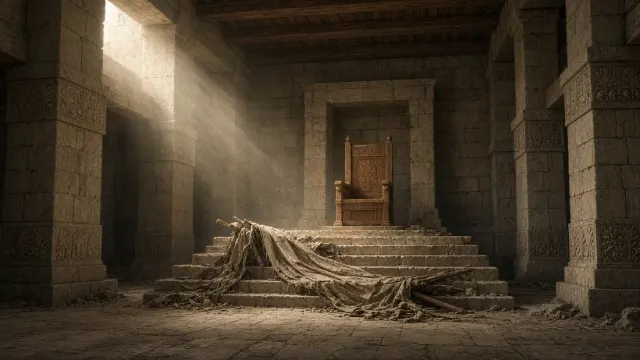
Before the psalm speaks again about David, it establishes the character and scale of the one who made the promise. Heaven cannot supply an equal. The raging sea is ruled, hostile power figured as Rahab is broken, and the whole world belongs to its founder. Yet Psalm 89 refuses to make sheer force the center of the throne. “Justice and judgment are the habitation of thy throne: mercy and truth shall go before thy face.” Those words will matter when the covenant appears contradicted, because the appeal is made not only to someone able to restore a king but to someone whose rule has already been described as faithful and just. The people’s strength is likewise derivative. They walk in the light of God’s countenance, rejoice in his name, and have their horn exalted through his favor. Even their defense and kingship are traced back to the Holy One of Israel. The coming royal crisis therefore threatens more than national prestige. It presses on the very qualities the psalm has attached to God’s own throne.
Deep dive
The heavenly assembly cannot supply a rival equal to the Lord. The raging sea likewise does not exceed his rule. Rahab appears as a defeated figure of hostile power, with the surrounding sea imagery giving the name a cosmic resonance. The poem’s concern is not to give a separate account of this figure’s biography, but to place every apparently overwhelming force beneath God’s authority.
Verse 14 is the center of this description of power. Justice and judgment belong to the throne’s foundation, while mercy and truth go before God. The later appeal will therefore be directed not merely to someone strong enough to help but to someone whose rule has been described in these terms. The people’s blessedness is to walk in the light of his face and rejoice in his name. Their strength is derivative. It rests on his favor, a point that becomes painful when the visible signs of that favor seem to collapse.
Words to trace: LORD, strong, exalted, faithfulness, hand, heavens
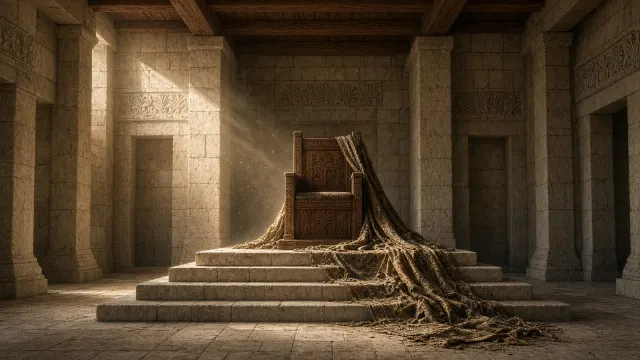
Verse-by-verse path
- Psalms 89:5
“Saints” here are not people on earth. The Hebrew qedoshim, holy ones, are heavenly beings, and “congregation” pictures them gathered as a court. Praise of God’s faithfulness begins above before it is argued over below.
- Psalms 89:6
“Sons of the mighty” is bene elim, the same phrase Psalm 29:1 addresses as “ye mighty”, members of the heavenly council. The two questions expect the answer nobody, and they borrow the form of Exodus 15:11, “Who is like unto thee, O LORD, among the gods?”
- Psalms 89:7
“Assembly” is sod, the inner council where decisions are taken, the word Jeremiah 23:18 uses when it asks who has “stood in the counsel of the LORD”. Even the beings closest to the throne stand in fear of the one who sits on it.
- Psalms 89:8
“Strong LORD” renders the short form of the divine name, Yah, beside a word for mighty. Faithfulness is placed “round about thee” like a retinue or a garment, as if it were the company God keeps.
- Psalms 89:9
“Raging” is literally the swelling or pride of the sea. In the Canaanite texts from Ugarit, Baal must fight Yam, the sea god, to win his throne. In this verse no fight is described at all: the waves rise and God stills them.
- Psalms 89:10
This Rahab is not the woman of Jericho; the Hebrew spellings differ. Rahab here is a sea monster of arrogance, a name Isaiah 30:7 and Psalm 87:4 also use for Egypt. “As one that is slain” uses chalal, the word for a corpse lying on a battlefield.
- Psalms 89:11
“The world and the fulness thereof” is the phrase of Psalm 24:1, where it also answers who owns everything. “Founded” is yasad, the verb for laying a foundation stone, so the cosmos is imagined as a building with God as its builder.
- Psalms 89:12
The south is yamin, the right hand, because the Hebrew orientation faces east. Tabor is the lone dome rising out of the Jezreel valley and Hermon the snowbound peak on the northern border. Mountains that the nations treated as holy places are pictured here cheering for the LORD.
- Psalms 89:13
Arm, hand and right hand stack three words for the same power. A hand held “high” is the gesture of victory, as in Exodus 14:8, where Israel went out of Egypt “with an high hand”. Verse 42 will say this raised right hand has changed sides.
- Psalms 89:14
The line recurs almost word for word in Psalm 97:2. Egyptian royal thrones were carved to stand on a plinth shaped like the sign for maat, justice, so the image of justice as the base of the throne would have been familiar. Mercy and truth walk ahead like heralds before a king.
- Psalms 89:15
“Joyful sound” is teruah, the trumpet blast and shout of acclamation raised at festivals and at a king’s enthronement; Numbers 23:21 calls it “the shout of a king”. “The light of thy countenance” echoes the priestly blessing of Numbers 6:25, the LORD making his face shine.
- Psalms 89:16
Rejoicing “all the day” is continuous, not a festival moment. “Exalted” is rum, to be raised, the verb that will run through the psalm: the people’s horn in verse 17, the chosen king in verse 19, and, bitterly, the enemies’ right hand in verse 42.
- Psalms 89:17
A horn is the wild ox’s weapon, a picture of strength held high. Hannah’s song closes with God exalting “the horn of his anointed” (1 Samuel 2:10), the first time the Bible calls the king the anointed, and this psalm moves in the same direction toward its king.
- Psalms 89:18
“Defence” is magen, shield, a word often used of the king himself, as in Psalm 84:9: “O God our shield, and look upon the face of thine anointed.” Many modern versions read the Hebrew as “our shield belongs to the LORD, our king to the Holy One of Israel”, which makes the human king God’s possession.
Psalms 89:5-18
King James Version5And the heavens shall praise thy wonders, O LORD: thy faithfulness also in the congregation of the saints.
6For who in the heaven can be compared unto the LORD? who among the sons of the mighty can be likened unto the LORD?
7God is greatly to be feared in the assembly of the saints, and to be had in reverence of all them that are about him.
8O LORD God of hosts, who is a strong LORD like unto thee? or to thy faithfulness round about thee?
9Thou rulest the raging of the sea: when the waves thereof arise, thou stillest them.
10Thou hast broken Rahab in pieces, as one that is slain; thou hast scattered thine enemies with thy strong arm.
11The heavens are thine, the earth also is thine: as for the world and the fulness thereof, thou hast founded them.
12The north and the south thou hast created them: Tabor and Hermon shall rejoice in thy name.
13Thou hast a mighty arm: strong is thy hand, and high is thy right hand.
14Justice and judgment are the habitation of thy throne: mercy and truth shall go before thy face.
15Blessed is the people that know the joyful sound: they shall walk, O LORD, in the light of thy countenance.
16In thy name shall they rejoice all the day: and in thy righteousness shall they be exalted.
17For thou art the glory of their strength: and in thy favour our horn shall be exalted.
18For the LORD is our defence; and the Holy One of Israel is our king.
Psalms 89:19-29
The King’s Strength Is Explicitly Given
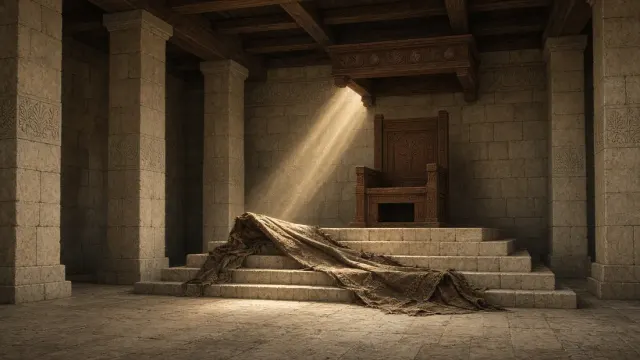
David’s strength is presented as received strength from beginning to end. God finds him, chooses him, anoints him, establishes him, strengthens him, protects him, and subdues enemies before him. Psalm 89 leaves little room for royal self-invention. Even the widening reach toward sea and rivers follows the promise that divine faithfulness and mercy will remain with him. The relationship then becomes familial. David calls God “my father, my God, and the rock of my salvation,” while God makes him “my firstborn, higher than the kings of the earth.” The firstborn language is about appointed rank, as the next phrase makes clear, not the biological order of Jesse’s sons. Covenant, mercy, seed, and throne all return to the language of endurance. His descendants are to last, and the throne is compared with “the days of heaven.” The assurances keep getting larger, preparing the reader to feel the later collapse not as a small setback but as a direct challenge to the scale of what has been promised.
Deep dive
David’s strength is introduced as something supplied by God. He is found, chosen, anointed, upheld, and protected. The repeated divine hand and arm prevent royal power from appearing self-created. Even the enlargement of the king’s reach toward sea and rivers follows the declaration of divine faithfulness and mercy.
The language of father and firstborn defines a royal relationship. "I will make him my firstborn" concerns appointed rank, as the immediately following description, "higher than the kings of the earth," makes plain. It is not a statement about David being the first child physically born in his family. The king’s cry to God as father, God, and saving rock is matched by God’s enduring covenant. The section closes with the same long horizon established at the beginning: seed, throne, and the days of heaven. The scale of the assurance prepares the scale of the complaint.
Words to trace: hand, exalted, holy, mercy, afflict, anointed
Verse-by-verse path
- Psalms 89:19
Many Hebrew manuscripts have the plural, “thy holy ones”. The vision is Nathan’s, since 2 Samuel 7:17 calls the promise “all this vision”. “Chosen out of the people” means David came up from the ranks, a shepherd rather than a prince born to a throne.
- Psalms 89:20
“Found” suggests a search completed, the sense of 1 Samuel 13:14, where the LORD “hath sought him a man after his own heart”. Paul’s sermon in Acts 13:22 quotes this line. The “holy oil” is the sacred compound of Exodus 30:25, which Samuel poured from a horn over David in 1 Samuel 16:13.
- Psalms 89:21
“Established” is from the same root as the throne that will be established in verse 4. God’s hand and arm, praised in verse 13, are now promised to the king: the power that stills the sea is the power that holds him up.
- Psalms 89:22
“Exact upon him” is a creditor’s verb, nasha, to press a debtor for payment, the sense of “exact” in Deuteronomy 15:2. The second half repeats 2 Samuel 7:10 almost exactly, where the children of wickedness shall not “afflict them any more”.
- Psalms 89:23
“Beat down” is katat, to crush fine, as pottery is broken to pieces; “plague” is nagaph, to strike, the verb of the blows on Egypt. God does the fighting and the king merely watches his enemies fall “before his face”.
- Psalms 89:24
The pair that went before God’s face in verse 14, mercy and faithfulness, are now assigned to accompany the king. The horn exalted “in my name” repeats the people’s hope of verse 17, making the king the place where their strength is lifted.
- Psalms 89:25
Sea and rivers are the limits of the promised land in Exodus 23:31, from the sea of the Philistines to “the river”, the Euphrates. The king’s hand is placed over the very waters God was praised for ruling in verse 9, a delegated share in that rule.
- Psalms 89:26
2 Samuel 7:14 had God say “I will be his father”; here the king answers the other way round. No king in Samuel or Kings is recorded addressing God as “my father”, which makes the words given to him here unusually intimate. “Rock of my salvation” is David’s phrase in 2 Samuel 22:47.
- Psalms 89:27
“Higher” is elyon, the word used as God’s own title, the Most High. The king is made elyon over earthly kings, a remarkable borrowing. Israel as a nation was called God’s firstborn in Exodus 4:22; the title is now concentrated in one man.
- Psalms 89:28
“Stand fast” is ne’emenet, from the same root as emunah, faithfulness: the covenant will prove reliable, the way a faithful person does. The verbs are keep and stand, both promises of something that will not be taken back.
- Psalms 89:29
“The days of heaven” means as long as the sky lasts, the phrase Deuteronomy 11:21 uses for Israel’s tenure in the land. The singer measures the dynasty against the sky he could see above him every day.
Psalms 89:19-29
King James Version19Then thou spakest in vision to thy holy one, and saidst, I have laid help upon one that is mighty; I have exalted one chosen out of the people.
20I have found David my servant; with my holy oil have I anointed him:
21With whom my hand shall be established: mine arm also shall strengthen him.
22The enemy shall not exact upon him; nor the son of wickedness afflict him.
23And I will beat down his foes before his face, and plague them that hate him.
24But my faithfulness and my mercy shall be with him: and in my name shall his horn be exalted.
25I will set his hand also in the sea, and his right hand in the rivers.
26He shall cry unto me, Thou art my father, my God, and the rock of my salvation.
27Also I will make him my firstborn, higher than the kings of the earth.
28My mercy will I keep for him for evermore, and my covenant shall stand fast with him.
29His seed also will I make to endure for ever, and his throne as the days of heaven.
Psalms 89:30-37
Discipline Is Distinguished from Covenant Cancellation
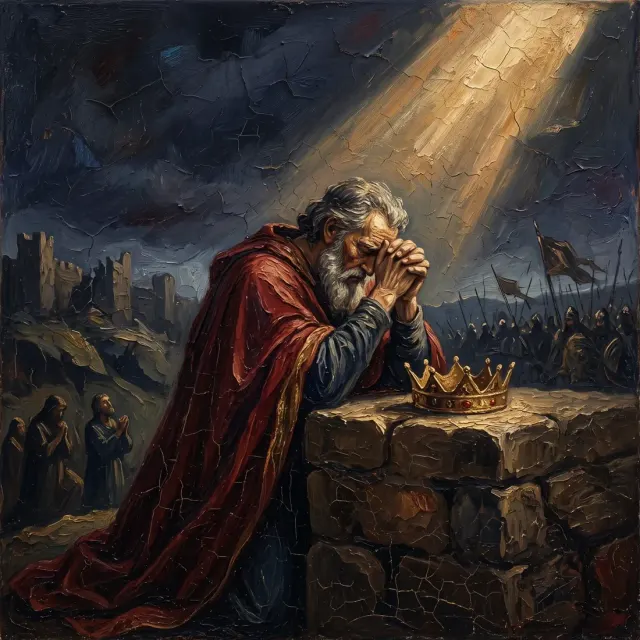
The covenant does not promise that David’s descendants can do anything without consequence. Psalm 89 explicitly imagines them forsaking law, judgments, statutes, and commandments, then answers disobedience with rod and stripes. Royal lineage is no exemption from correction. The hinge is “Nevertheless.” Punishment is allowed, but the utter removal of lovingkindness is denied; faithfulness will not fail, the covenant will not be broken, and what has gone from God’s lips will not be altered. The oath is attached to God’s holiness and illustrated by sun and moon, objects whose continuing presence makes the promised duration visible. This distinction is crucial for the complaint that follows. The singer is not naive about discipline. He has just recited it as part of the covenant’s own terms. What troubles him is that the present looks like something more severe, almost like the cancellation the speech said would not happen. The psalm has carefully made room for chastening before it describes a throne in the dust.
Deep dive
The covenant speech does not portray David’s descendants as incapable of disobedience. It names abandonment of law, judgments, statutes, and commandments, then states the consequence in the imagery of rod and stripes. Royal descent is not treated as exemption from correction.
The decisive turn is "Nevertheless." Punishment is distinguished from the utter removal of lovingkindness, the failure of faithfulness, or the breaking of the covenant. The oath is grounded in God’s holiness, and sun and moon become images of its duration. This distinction makes the following lament harder to dismiss. The singer knows that discipline belongs within the promise; he has just recited that provision at length. His complaint is that the present appears to go beyond discipline into the very cancellation the promise denied. The poem has carefully supplied the terms of its own difficulty before naming the shattered throne.
Words to trace: break, alter, children, commandments, covenant, David
Verse-by-verse path
- Psalms 89:30
The conditional clauses stretch Nathan’s promise to a whole line of heirs; 2 Samuel 7:14 spoke only of the son who would build the temple. Law and judgments are the first two of four terms for God’s instruction gathered across these two verses.
- Psalms 89:31
Statutes and commandments complete the list of four. “Break” is chalal, to profane, to treat a holy thing as common. The verb will return in verse 34, when God swears not to profane his covenant, and in verse 39, when the crown is profaned.
- Psalms 89:32
“Visit” is paqad, to attend to, here in the sense of calling a debt to account. The rod and stripes are corporal punishment, the discipline of a father or a court (Deuteronomy 25:2–3). 2 Samuel 7:14 said the rod would be “the rod of men”, punishment through human hands.
- Psalms 89:33
2 Samuel 7:15 adds a name this psalm leaves out: God’s mercy shall not depart from David’s son “as I took it from Saul”. Saul is the case of a king from whom favour was withdrawn entirely, and that is exactly what is ruled out here.
- Psalms 89:34
Verse 31 said “if they break my statutes”; here, with the same verb chalal, “my covenant will I not break”. They may profane what God gave; God will not profane what he promised. “The thing that is gone out of my lips” is the language of Numbers 30:2 for a binding vow.
- Psalms 89:35
“Once” means once for all, an oath that needs no renewal. God swears “by my holiness”, as in Amos 4:2, since there is nothing greater to swear by. The Hebrew uses the oath formula “if I lie unto David”, with the curse left unspoken.
- Psalms 89:36
Sun and moon were set in the sky in Genesis 1:16 to rule day and night and to mark seasons. Psalm 72:5 and 72:17 use the sun in the same way for the king’s endurance. The throne is said to stand “before me”, in God’s own sight.
- Psalms 89:37
Ancient treaties invoked heaven and earth as witnesses, as Moses does in Deuteronomy 30:19. Whether the “faithful witness” is the moon or God himself is disputed. “Faithful” is ne’eman again, the root of this psalm’s repeated faithfulness.
Psalms 89:30-37
King James Version30If his children forsake my law, and walk not in my judgments;
31If they break my statutes, and keep not my commandments;
32Then will I visit their transgression with the rod, and their iniquity with stripes.
33Nevertheless my lovingkindness will I not utterly take from him, nor suffer my faithfulness to fail.
34My covenant will I not break, nor alter the thing that is gone out of my lips.
35Once have I sworn by my holiness that I will not lie unto David.
36His seed shall endure for ever, and his throne as the sun before me.
37It shall be established for ever as the moon, and as a faithful witness in heaven. Selah.
Psalms 89:38-45
The Verbs of Promise Are Answered by Verbs of Ruin
Then comes the sentence the whole psalm has been preparing: “But thou hast cast off.” The verbs of establishment are answered by verbs of ruin. The anointed is rejected, the covenant appears made void, the crown is thrown to the ground, hedges and strongholds are broken, passersby spoil what remains, enemies rejoice, the sword fails, glory ceases, and the throne itself is cast down. Psalm 89 does not explain this only as the superior strategy of hostile armies. The repeated “thou hast” carries the crisis directly into the relationship with the God who made the covenant. No king is named with enough precision to remove every historical uncertainty, but the exact reign is not necessary for the poem’s argument. Promise said established; experience says collapsed. Even “made void” is the lament’s charge about how events now appear, not a detached divine announcement that the oath has actually been revoked. The prayer is allowed to say how complete the contradiction feels before any resolution is supplied.
Deep dive
"But thou" produces the psalm’s great reversal. The same God who promised to uphold the king is addressed as the one who has cast him off. The complaint then answers the earlier assurances point by point: covenant appears void, crown is profaned, defenses are broken, enemies rejoice, the sword fails, and the throne lies on the ground.
The speaker does not attribute this simply to superior enemy tactics. His repeated "thou hast" makes the theological contradiction explicit. The text supplies no named king whose fall can be identified with complete certainty, and the loss need not be pinned to an exact reign to understand the argument. What was promised establishment is now described through collapse. "Made void" is the lament’s charge about the apparent state of affairs, not a detached divine announcement that the oath has been revoked. The distinction preserves the force of the protest without turning its perception into a final resolution.
Words to trace: ground, abhorred, adversaries, anointed, battle, broken
Verse-by-verse path
- Psalms 89:38
“Abhorred” is ma’as, reject, the verb Samuel used of Saul: “he hath also rejected thee from being king” (1 Samuel 15:23). The fear is exactly the one verse 33 ruled out, that David’s line should go the way of Saul’s. “Anointed” is mashiach, the king.
- Psalms 89:39
“Made void” is a rare verb, found elsewhere only in Lamentations 2:7, where the Lord has “abhorred his sanctuary”. “Profaned” is chalal once more, the verb God swore in verse 34 not to use of his covenant. The crown is the nezer, a consecrated diadem, now lying in the dirt.
- Psalms 89:40
Hedges are the stone walls that kept animals out of a vineyard, and Psalm 80:12 uses the same image of Israel: “Why hast thou then broken down her hedges?” The king, like the vine, has been left without a fence.
- Psalms 89:41
Psalm 80:12 continues, “all they which pass by the way do pluck her”, and this line takes up those passers-by. The second half is almost the wording of Psalm 79:4. Psalms 79, 80 and 89 share a single vocabulary of loss.
- Psalms 89:42
“Set up” is rum, to raise, the verb that exalted the people in verse 16, their horn in 17 and 24, and the chosen king in 19. Now it is the adversaries’ right hand that God has lifted, the right hand that verse 13 called high.
- Psalms 89:43
“Edge” is tsur, literally rock or flint, the same word as “the rock of my salvation” in verse 26. The king who called God his rock now finds the rock of his own sword blunted. The complaint is not that he fought badly but that he was “not made to stand”.
- Psalms 89:44
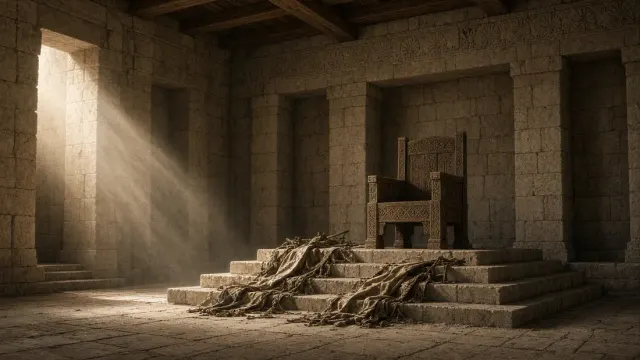
The first half is obscure in Hebrew, probably “thou hast ended his brightness” or splendour. The throne that verse 29 compared to the days of heaven and verse 36 to the sun is thrown to the ground, as far down as it had been placed high.
- Psalms 89:45
The line could describe a king cut off young, and some have thought of Jehoiachin, taken to Babylon at eighteen (2 Kings 24:8); others read it of a dynasty aged before its time. Either way it is an inference. Shame is pictured as a garment wrapped round him in place of a royal robe.
Psalms 89:38-45
King James Version38But thou hast cast off and abhorred, thou hast been wroth with thine anointed.
39Thou hast made void the covenant of thy servant: thou hast profaned his crown by casting it to the ground.
40Thou hast broken down all his hedges; thou hast brought his strong holds to ruin.
41All that pass by the way spoil him: he is a reproach to his neighbours.
42Thou hast set up the right hand of his adversaries; thou hast made all his enemies to rejoice.
43Thou hast also turned the edge of his sword, and hast not made him to stand in the battle.
44Thou hast made his glory to cease, and cast his throne down to the ground.
45The days of his youth hast thou shortened: thou hast covered him with shame. Selah.
Psalms 89:46-52
A Short Human Life Waits Beneath a Long Promise
The word “for ever” returns, but now it sounds almost unbearable: “wilt thou hide thyself for ever?” Psalm 89 sets the long horizon of the covenant beside the short span of a human life. The singer cannot simply wait outside history until the problem sorts itself out. Mortality gives the question its urgency. Everyone dies, the grave cannot be escaped by human strength, and one generation may live and die while a promise still appears reversed. So the prayer asks where the former lovingkindnesses are, specifically invoking what God swore to David “in thy truth.” Reproach is also brought into the appeal, because the fallen anointed has become a public target. Then the psalm ends, “Blessed be the LORD for evermore. Amen, and Amen.” The doxology closes this book of the Psalter, but it does not report a restored crown. Praise stands next to unresolved protest, not because the contradiction has vanished, but because the singer still directs it to the God whose faithfulness he has spent the psalm naming.
Deep dive
The duration language returns in a different register. "For ever" now appears in the fear that God may remain hidden, while the speaker emphasizes how short human life is. An enduring promise can still become an agonizing question for a mortal generation that sees only its apparent reversal. Death gives the petition urgency: the singer cannot simply stand outside time until the contradiction resolves.
The final appeal asks where the former lovingkindnesses are and repeats the oath to David. It also brings the servants’ reproach and the anointed one’s humiliation before God. Verse 52 then blesses the Lord with a double Amen. This doxology closes the third book of Psalms, but it does not narrate a repaired crown or a restored throne. Praise and unanswered covenantal protest remain adjacent. The ending should not be made to report a solution that the preceding prayer still seeks.
Words to trace: LORD, Amen, Remember, reproach, reproached, anointed
Verse-by-verse path
- Psalms 89:46
The line is close to Psalm 79:5, “How long, LORD? wilt thou be angry for ever? shall thy jealousy burn like fire?” The phrase “hide thyself” names the worst of it: not an enemy’s strength, but God apparently absent.
- Psalms 89:47
“Time” is cheled, a lifespan, the word of Psalm 39:5, “mine age is as nothing before thee”. “All men” is literally “all the sons of Adam”. “In vain” is shav, emptiness: if the promise waits beyond a lifetime, what was a human life made for?
- Psalms 89:48
“Man” is gever, the strong man, the warrior, so even the mightiest cannot bargain with death. “The hand of the grave” gives Sheol a grip. The fourth and last Selah falls on this unanswered question.
- Psalms 89:49
“Lovingkindnesses” is the same plural chesed as “mercies” in verse 1, now asked for rather than sung about. “Truth” is emunah, the psalm’s seventh use of the word the King James elsewhere in the psalm renders faithfulness.
- Psalms 89:50
The Hebrew is difficult; it reads roughly “I bear in my bosom all the many peoples”. The bosom is where a shepherd carries lambs in Isaiah 40:11; the speaker carries insults there instead. Manuscripts differ between “thy servant” and “thy servants”.
- Psalms 89:51
The “footsteps” are the heels or tracks of the anointed: the enemies mock him wherever he goes. The Aramaic Targum took the phrase as scorn at the slowness of the Messiah’s coming, reading the lament as a question about delay.
- Psalms 89:52
This blessing probably belongs to the arrangement of the Psalter rather than to Ethan’s psalm, closing the third book as 41:13 closes the first and 72:19 the second, each with “Amen, and Amen”. The last word of Book III is praise, set directly after the mocked footsteps of the king.
Psalms 89:46-52
King James Version46How long, LORD? wilt thou hide thyself for ever? shall thy wrath burn like fire?
47Remember how short my time is: wherefore hast thou made all men in vain?
48What man is he that liveth, and shall not see death? shall he deliver his soul from the hand of the grave? Selah.
49Lord, where are thy former lovingkindnesses, which thou swarest unto David in thy truth?
50Remember, Lord, the reproach of thy servants; how I do bear in my bosom the reproach of all the mighty people;
51Wherewith thine enemies have reproached, O LORD; wherewith they have reproached the footsteps of thine anointed.
52Blessed be the LORD for evermore. Amen, and Amen.
Questions to keep in mind while reading
- Follow the speaker, images, parallel lines, questions, and emotional movement.
- Notice where tension or suffering resists an easy answer.
- Read a saying as wisdom for faithful discernment, not as a mechanical promise detached from context.
Text first
Where readers differ
The chapter summary begins with what the passage says and how its parts fit together. It does not assume one denomination has already settled every question. Where a conclusion depends on a tradition, literary theory, or historical reconstruction, that dependence is named openly.
The KJV text is presented first. Interpretive conclusions are labeled, and differences are introduced only when they help a reader understand why serious communities do not always reach the same answer.
Comparative interpretive notes for this chapter are in preparation. Until reviewed notes are ready, this page separates the KJV text from summary and application without claiming that serious readers agree on every question.
Questions beneath the surface
- What account of God, human freedom, responsibility, and the good life emerges from Psalms 89?
- Which tension does the chapter refuse to resolve quickly?
- What changes when the chapter is read as part of the whole canon rather than as an isolated moral lesson?
- Where might a sincere reader confuse a familiar tradition with something the text states directly?
Questions for serious personal contemplation
These open-ended questions make room for tension, honest response, prayer, and conclusions that remain accountable to the chapter.
Observe without rushing
What part of Psalms 89 makes you stop, feel unsettled, or feel surprised, and why?
Which detail in the passage would be easiest to overlook? How does that detail change your understanding?
Where do you see tension between what happens and this focus: Psalms 89:1–52 completes a passage that was not covered by the original study-unit map. Its own wording and immediate context supply the focus.?
What important question does the passage leave open instead of resolving quickly?
Examine your inner life honestly
Which person, response, fear, or desire in the passage feels most like your own life right now?
What assumption about God, other people, or yourself does this text challenge?
Which part would you rather soften, avoid, or explain away too quickly? What might that reaction reveal?
If this Scripture could ask you one direct question, what do you think it would ask?
Respond with wisdom and courage
What do you need to remember, confess, grieve, thank God for, or trust after reading this passage?
How might another faithful person read this situation differently without ignoring the text?
What obedient response would be costly, uncomfortable, or slow, yet still faithful to Scripture?
What question will you carry into prayer this week, and which verses will you keep in front of you?
Music and video connected to the passage
Related media appears when its Scripture reference overlaps this study. Music and video can illuminate a theme while the biblical text remains the foundation.