
The big picture
Song Of Solomon 7 begins with another extended portrait, this time rising from the woman's feet upward through jewellery, grain, lilies, young roes, pools, towers, Carmel, and hair that can hold a king captive. The comparisons mix craftsmanship, abundance, landscape, and royal reversal without functioning as anatomical measurements. Admiration then becomes explicit desire through palm, fruit, scent, and wine. Within that flow the woman's own voice emerges, and her declaration develops the book's repeated language of belonging by placing the beloved's desire directly toward her. She then takes the initiative. The invitation to go into fields, villages, and vineyards comes from her, not from the man who issued a similar call earlier in the book. Budding pomegranates, tender grapes, mandrakes, and stored fruit make the countryside a language of expectation, preparation, and a love she intends to give.
In this chapter
- The Portrait Rises from Feet to Hair Song of Solomon 7:1-5
This portrait begins at the woman's feet and rises upward, giving the praise a different movement from earlier descriptions.
- The Voice Changes Within the Wine Image Song of Solomon 7:6-10
Admiration turns openly toward desire.
- She Supplies the Invitation and the Provisions Song of Solomon 7:11-13
The invitation now comes from the woman.


Scripture beside the summary
Song of Solomon · King James Version · 13Song of Solomon 7:1-5
The Portrait Rises from Feet to Hair
This portrait begins at the woman's feet and rises upward, giving the praise a different movement from earlier descriptions. Sandals suggest motion, while the address "prince's daughter" gives dignity without supplying a literal royal genealogy. Jewels and the work of a skilled craftsman bring artistry into the comparison, followed by a goblet, wheat ringed with lilies, twin young roes, pools, towers, Carmel, and purple-like hair. The Song Of Solomon moves freely between crafted beauty, food, animals, water, architecture, and landscape because no single comparison is expected to function as a measurement. Eyes like pools suggest depth and calm, while towers contribute stature and presence. The closing image reverses royal power in miniature: a king is held by the woman's hair. However the difficult KJV wording is understood in detail, the effect is clear. The one who might command a kingdom is portrayed as captivated by attraction.

Deep dive
Beginning with sandalled feet gives this description a different movement from the portrait in chapter 4. The preceding reference to a dance makes motion a possible setting, but the poem does not furnish complete staging instructions. The title prince’s daughter confers dignity without supplying a royal genealogy. The phrase about a cunning workman refers to skill: the woman’s form is compared with crafted jewellery, not with a deceitful artisan’s trick.
The goblet, grain surrounded by lilies, and paired young roes associate her body with abundance and living symmetry. The description is openly bodily without becoming a clinical inventory. Eyes like pools suggest depth and stillness; towers and Carmel contribute stature and presence. These comparisons do not function as measurements. The final line’s wording about the king being held in galleries is obscure in English and is commonly understood as a king captivated in the woman’s tresses. Its reversal is wonderfully small in scale: the king can be held by hair. Royal command gives way to the force of attraction, continuing the pattern of the man overcome by a glance.
Words to trace: head, tower, Bath, beautiful, belly, breasts
Verse-by-verse path
- Song of Solomon 7:1
“Prince’s daughter” is bat nadiv, and nadiv is the word inside “Amminadib” in 6:12. “Joints” is chammuqim, the curves of the thighs, from chamaq, the verb of turning away in 5:6; here the turning is the curve itself. “Cunning workman” is omman, a master craftsman, a word related to amen, firm or reliable.
- Song of Solomon 7:2
“Goblet” is aggan, a large mixing bowl, and “liquor” is mezeg, mixed wine, found only here. “Heap” is aremah, the same word as the “heap of corn” at the end of which Boaz lay down on the threshing floor (Ruth 3:7). Grain and wine, the harvest’s two gifts, are both in the verse.
- Song of Solomon 7:3
The comparison of 4:5 is repeated, but without its closing phrase, “which feed among the lilies”. The lilies have just appeared around the heap of wheat in verse 2, so the poem does not need them twice.
- Song of Solomon 7:4
Ivory was the luxury of kings; Ahab built an “ivory house” (1 Kings 22:39). Heshbon was the old Amorite capital of Sihon east of the Jordan (Numbers 21:26), and large reservoirs have been excavated there. Bath-rabbim, “daughter of many”, is the name of one of its gates.
- Song of Solomon 7:5
Carmel is the wooded headland above the sea, and karmel also means a garden or orchard land (Isaiah 35:2, “the excellency of Carmel”). “Galleries” is rehatim, the word for Jacob’s watering troughs in Genesis 30:38: the king is caught in her tresses as in running channels.
Song of Solomon 7:1-5
King James Version1How beautiful are thy feet with shoes, O prince’s daughter! the joints of thy thighs are like jewels, the work of the hands of a cunning workman.
2Thy navel is like a round goblet, which wanteth not liquor: thy belly is like an heap of wheat set about with lilies.
3Thy two breasts are like two young roes that are twins.
4Thy neck is as a tower of ivory; thine eyes like the fishpools in Heshbon, by the gate of Bath-rabbim: thy nose is as the tower of Lebanon which looketh toward Damascus.
5Thine head upon thee is like Carmel, and the hair of thine head like purple; the king is held in the galleries.
Song of Solomon 7:6-10
The Voice Changes Within the Wine Image
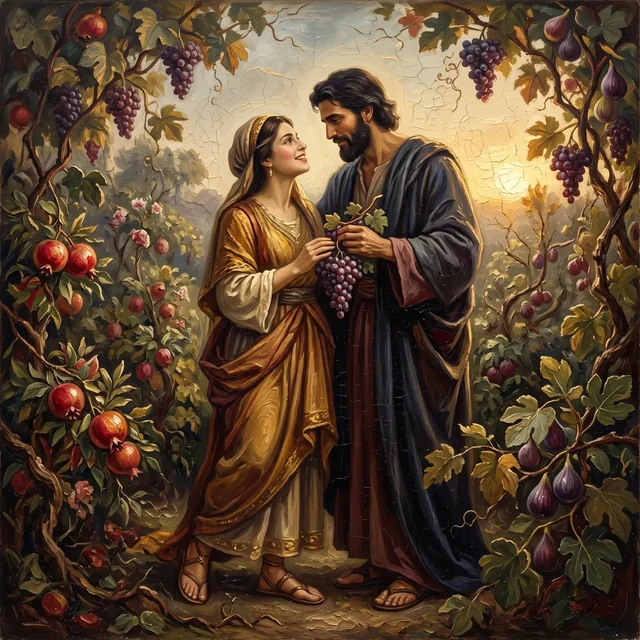
Admiration turns openly toward desire. The woman's stature is compared with a palm tree and her breasts with its fruit, so beauty and approach are gathered into one living image. The speaker says he will go up to the palm and take hold of its branches, language that belongs to erotic poetry without requiring every fruit or branch to be translated into a separate physical act. Scent and wine continue the movement of delight. Then the voice appears to shift within the wine image, though the exact point of transition is debated. That uncertainty matters less than the result: the woman speaks for herself. "I am my beloved's, and his desire is toward me" develops earlier declarations of mutual belonging by placing his desire at the centre of her own statement. The Song Of Solomon has spent many lines showing his attention to her. Here she names that attention as directed, personal, and welcomed within the relationship.
Deep dive
The movement from declaring beauty to desiring nearness is explicit. A palm and its fruit gather the woman’s stature and bodily beauty into one living image, and the speaker describes an intention to approach. The language belongs to erotic love poetry rather than to an instruction manual: fruit, branches, scent, and wine communicate delight through analogy. The comparisons carry desire without requiring every phrase to be converted into a separately named physical act.
The wine image contains a likely change of voice as the words turn toward the woman’s beloved, though the exact point of that transition is debated. This matters because the exchange is not simply a long speech imposed on someone who never answers. Her declaration in verse 10 affirms that she belongs to her beloved and that his desire is toward her. It develops the reciprocal formulas of 2:16 and 6:3 by placing his desire at the centre of her statement. The beloved’s attention has been described at length; she now speaks of it as directed, personal, and welcomed within the relation the poem has established.
Words to trace: breasts, clusters, palm, tree, apples, asleep
Verse-by-verse path
- Song of Solomon 7:6
“O love, for delights” may mean love among all delights; the Greek translator Aquila and a few manuscripts read “daughter of delights”, which makes the line an address to the woman. “Delights” is ta’anugim, luxuries, the soft life of the wealthy.
- Song of Solomon 7:7
The palm is tamar, the name given to women in the families of Judah and of David (Genesis 38:6, 2 Samuel 13:1). “Of grapes” is the King James’s addition; the Hebrew says only “clusters”, which on a palm are clusters of dates.
- Song of Solomon 7:8
“Boughs” is sansinnim, the fruit stalks of the date palm, a word found only here. Date growers climbed the palm by hand to tend and harvest the high clusters. “The smell of thy nose” means her breath, and the apples are the tappuchim of 2:3 and 2:5.
- Song of Solomon 7:9
“The roof of thy mouth” is chekh, the palate, the same word she used of his “mouth” in 5:16. The Hebrew of the last clause reads “gliding over the lips of sleepers”; the Greek and Syriac read “over my lips and teeth”, a small difference in the consonants.
- Song of Solomon 7:10
“Desire” is teshuqah, a word found in only two other places: Genesis 3:16, “thy desire shall be to thy husband”, and Genesis 4:7, where sin’s desire is toward Cain. Here the direction runs the other way. His desire is toward her, and she says it as a delight.
Song of Solomon 7:6-10
King James Version6How fair and how pleasant art thou, O love, for delights!
7This thy stature is like to a palm tree, and thy breasts to clusters of grapes.
8I said, I will go up to the palm tree, I will take hold of the boughs thereof: now also thy breasts shall be as clusters of the vine, and the smell of thy nose like apples;
9And the roof of thy mouth like the best wine for my beloved, that goeth down sweetly, causing the lips of those that are asleep to speak.
10I am my beloved’s, and his desire is toward me.
Song of Solomon 7:11-13
She Supplies the Invitation and the Provisions
The invitation now comes from the woman. Earlier, the man called her into the spring landscape; here she says, "Come, my beloved," and proposes fields, villages, an early rising, and a visit to the vineyards. The repeated agricultural signs are familiar: flourishing vines, tender grapes, budding pomegranates. They are not random scenery. Growth in the landscape gives the lovers a vocabulary for expectation and readiness. Her promise to give her love there makes her initiative explicit. She is not merely consenting to someone else's destination. The mandrakes add fragrance and possible associations with fertility, but the verse does not report pregnancy or depend on a medical claim about the plant. At the gates, pleasant fruits both new and old have been stored for the beloved. That preparation gives the passage a quiet specificity. Desire is not vague abundance. It is directed toward a chosen companion, a chosen meeting, and gifts deliberately kept for him.

Deep dive
The invitation to come away, earlier spoken by the man in chapter 2, now comes from the woman. Fields, villages, an early departure, vineyards, tender growth, and budding pomegranates build a shared excursion. The repeated attention to whether growth has appeared does more than supply seasonal scenery. The lovers’ expectation is expressed in the same vocabulary as a landscape moving toward fruitfulness.
Her promise to give her love there makes her initiative unmistakable. She is not merely agreeing to a destination already chosen by someone else. The fragrant mandrakes and the stores of new and old fruit complete the picture of anticipation with preparation. The mention of mandrakes can carry associations of fertility, but this verse does not report a pregnancy or a plan that depends on their medicinal effectiveness. Its stated feature is fragrance. The fruit has been laid up for the beloved, bringing intentional provision into the poetry of desire. The invitation is warm because it is particular: a chosen companion, a chosen place, and something already kept for him.
Words to trace: beloved, appear, early, field, flourish, fruits
Verse-by-verse path
- Song of Solomon 7:11
“Villages” is kefarim, hamlets, the word inside Capernaum, Kefar Nachum. The same consonants also spell the plural of kopher, henna, the “camphire” of 1:14, so the line may mean “let us lodge among the henna blossoms”. Either reading takes them out of the city.
- Song of Solomon 7:12
“Get up early” is hashkim, the verb for rising early to do something that matters, as Abraham did in Genesis 22:3. “My loves” is dodai, the plural dodim of 1:2, where the book opened with “thy love is better than wine”. The first word for love comes back as her gift.
- Song of Solomon 7:13
“Mandrakes” is duda’im, which sounds like dodai, “my loves”, at the end of verse 12. They are the plant Reuben found in the field and Rachel traded with Leah in Genesis 30:14–16. Fruits “new and old” are this year’s and last year’s, stored against a season.
Song of Solomon 7:11-13
King James Version11Come, my beloved, let us go forth into the field; let us lodge in the villages.
12Let us get up early to the vineyards; let us see if the vine flourish, whether the tender grape appear, and the pomegranates bud forth: there will I give thee my loves.
13The mandrakes give a smell, and at our gates are all manner of pleasant fruits, new and old, which I have laid up for thee, O my beloved.
Questions to keep in mind while reading
- Follow the speaker, images, parallel lines, questions, and emotional movement.
- Notice where tension or suffering resists an easy answer.
- Read a saying as wisdom for faithful discernment, not as a mechanical promise detached from context.
Text first
Where readers differ
The chapter summary begins with what the passage says and how its parts fit together. It does not assume one denomination has already settled every question. Where a conclusion depends on a tradition, literary theory, or historical reconstruction, that dependence is named openly.
The KJV text is presented first. Interpretive conclusions are labeled, and differences are introduced only when they help a reader understand why serious communities do not always reach the same answer.
Comparative interpretive notes for this chapter are in preparation. Until reviewed notes are ready, this page separates the KJV text from summary and application without claiming that serious readers agree on every question.
Questions beneath the surface
- What account of God, human freedom, responsibility, and the good life emerges from Song of Solomon 7?
- Which tension does the chapter refuse to resolve quickly?
- What changes when the chapter is read as part of the whole canon rather than as an isolated moral lesson?
- Where might a sincere reader confuse a familiar tradition with something the text states directly?
Questions for serious personal contemplation
These open-ended questions make room for tension, honest response, prayer, and conclusions that remain accountable to the chapter.
Observe without rushing
What part of Song of Solomon 7 makes you stop, feel unsettled, or feel surprised, and why?
Which detail in the passage would be easiest to overlook? How does that detail change your understanding?
Where do you see tension between what happens and this focus: Song of Solomon 7 develops its own movement around beloved, breasts, clusters, head, nose?
What important question does the passage leave open instead of resolving quickly?
Examine your inner life honestly
Which person, response, fear, or desire in the passage feels most like your own life right now?
What assumption about God, other people, or yourself does this text challenge?
Which part would you rather soften, avoid, or explain away too quickly? What might that reaction reveal?
If this Scripture could ask you one direct question, what do you think it would ask?
Respond with wisdom and courage
What do you need to remember, confess, grieve, thank God for, or trust after reading this passage?
How might another faithful person read this situation differently without ignoring the text?
What obedient response would be costly, uncomfortable, or slow, yet still faithful to Scripture?
What question will you carry into prayer this week, and which verses will you keep in front of you?
Music and video connected to the passage
Related media appears when its Scripture reference overlaps this study. Music and video can illuminate a theme while the biblical text remains the foundation.