
The big picture
Jehu's destruction of Ahab's house widens from Jezreel to Samaria and from the royal family to Baal's institutional presence. He begins with letters that force the guardians of Ahab's descendants to choose between resistance and complicity, and their submission ends with seventy severed heads at Jezreel's gate. Relatives of Ahaziah are killed on the road, while Jehonadab is welcomed into Jehu's chariot as a witness to his declared zeal. Jehu then uses deception and religious ceremony to gather Baal's worshippers into one place, kills them, destroys the images, and turns the temple into a latrine. Yet the chapter's own evaluation refuses to let this become a simple portrait of complete faithfulness. The calves at Bethel and Dan remain, and Jehu does not walk in the law of the LORD with all his heart. He receives a promise of four generations on Israel's throne even as Hazael begins cutting away Israel's territory.
Central truth
The Lord preserves the Shunammite’s livelihood and fulfills judgment against Ahab’s house, while Elisha’s tears and Jehu’s divided obedience forbid celebrating power without moral scrutiny.
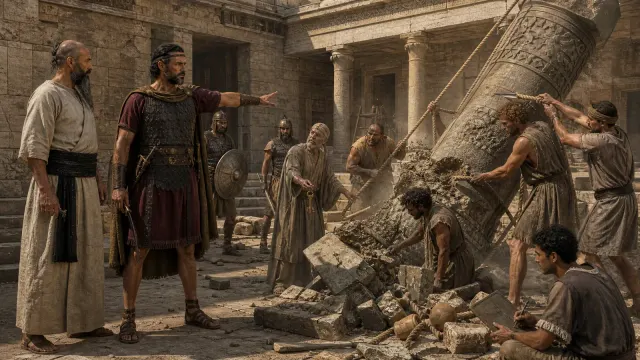

The study notes have a page of their own
The movement by movement analysis, the words to trace, the verse by verse notes and where readers differ are written for someone studying alone. They are on the Deep Personal Reflections page for this chapter. This page is the lesson.
A chapter-specific teaching brief
These anchors come from this chapter itself. They help a teacher use the Level 1 overview, the Level 2 study, and the Scripture text as one lesson.
Open with the chapter’s first image
2 Kings 10:1: “And Ahab had seventy sons in Samaria. And Jehu wrote letters, and sent to Samaria, unto the rulers of Jezreel, to the elders, and to them that brought up…”
Slow down at the turning point
2 Kings 10:19: “Now therefore call unto me all the prophets of Baal, all his servants, and all his priests; let none be wanting: for I have a great sacrifice to do to…”
Keep this word trail visible
Jehu, Baal, house, Israel, LORD, Samaria
What to explain, in order
Teach the passage in this order. Each step names the verses it rests on, so every point can be shown in the text before it is applied.
2 Kings 8:1-6
A widow's land restored
Open with the Shunammite of chapter 4, because the unit begins with mercy before it turns to violence. Elisha warns her of a seven-year famine and she leaves for the Philistines. When she returns, her land has been taken over. Note the timing: she arrives just as Gehazi is telling the king about the boy raised from death. Do not invent an explanation of why Gehazi is at court after chapter 5; the text does not say. Teach this first as a picture of the LORD's care holding steady through years of absence, and of a word received and obeyed.
2 Kings 8:7-15
Elisha weeps before Hazael
Move to Damascus. Ben-hadad is sick and sends Hazael with forty camels' load of gifts. Explain Elisha's reply in 8:10 carefully: the illness is not fatal, but the king will die anyway. Then the long stare, Hazael's shame, and Elisha's tears. Read 8:12 once and do not elaborate the atrocities. Hazael's "is thy servant a dog" is false modesty, and the next day he smothers his master. Teach this step to set the tone for the unit: the prophet who sees the coming violence grieves over it.
2 Kings 8:16-29
Judah drawn into Ahab's house
Introduce the two kings of Judah in this section, Jehoram and his son Ahaziah, and distinguish them from Joram, Ahab's son, king of Israel. Use a simple chart. Explain that Jehoram married Ahab's daughter and that Ahaziah's mother is Athaliah, so Ahab's house now reaches into Jerusalem. Then read 8:19, the promise to David that keeps a lamp burning. Teach this before Jehu because it explains why Ahaziah of Judah will die alongside Joram: by marriage and alliance he belongs to the house under judgement.
2 Kings 9:1-13
Anointed in a back room
A young prophet runs to Ramoth-gilead, takes Jehu into an inner room, pours oil on his head and delivers the commission: strike the house of Ahab, "that I may avenge the blood of my servants the prophets" (9:7), and the dogs will eat Jezebel. Then he runs. Explain the captains' "mad fellow" as their contempt for prophets, and the cloaks on the steps as a hasty coronation. Teach the commission here so that the class can measure everything Jehu does afterwards against what the LORD actually said, which was about Ahab's house and the blood of the prophets.
2 Kings 9:14-37
Naboth's field and Jezebel's window
Read this section at a steady pace, with restraint. Jehu drives furiously to Jezreel; Joram asks three times, Is it peace, and is shot in Naboth's field; Ahaziah of Judah flees and is killed. Then Jezebel paints her face and taunts Jehu from the window, calling him Zimri, a king-killer who lasted seven days (1 Kings 16:9-18). She is thrown down. Explain that the dogs and the field fulfil Elijah's word in 1 Kings 21:23. Keep the description brief; the Book of 2 Kings uses it to say that the word of the LORD was not empty.
2 Kings 10:1-28
Letters, heads and the house of Baal
Summarise the killings rather than reading every verse aloud, unless the group is mature. Jehu uses letters to make Samaria's leaders destroy Ahab's sons, kills Ahaziah's relatives at the shearing house, recruits Jehonadab with "see my zeal for the LORD", and lures Baal's worshippers into one house and kills them. Explain "subtilty" as cunning. Ask learners to notice where the text says "according to the saying of the LORD" (10:17) and where it does not, such as the forty-two brothers of Ahaziah. Teach the difference between what was commanded and how it was done.
2 Kings 10:29-36
Well done, but not with all his heart
End with the verdict, and read 10:29, 30 and 31 as one unit. Jehu keeps Jeroboam's calves at Bethel and Dan. He receives the LORD's approval for carrying out judgement on Ahab's house and a dynasty of four generations. But he does not walk in the LORD's law with all his heart, and "In those days the LORD began to cut Israel short" through Hazael (10:32). Mention that Hosea 1:4 later speaks of avenging the blood of Jezreel on Jehu's house, and that readers weigh that verse differently. Leave the class with a mixed verdict, as the text does.
Where learners get stuck
The misreadings this passage tends to produce, and how to answer each from the text.
"Jehu was a great hero of faith because God praised him."
Read 10:30 and 10:31 together. The LORD says Jehu did well in executing judgement on Ahab's house; the next verse says he "took no heed to walk in the law of the LORD God of Israel with all his heart". He destroyed Baal and kept the golden calves (10:29). Zeal for one command is not the same as a whole life given to God. Teach Jehu as a tool of judgement whose own heart remained divided.
"Elisha told Hazael to kill the king."
Elisha says the LORD has shown him that Ben-hadad will die and that Hazael will be king (8:10, 13). He does not tell Hazael to do anything, and he weeps over what Hazael will do (8:11-12). Hazael then lies to his master (8:14) and smothers him (8:15). Foreknowledge is not instruction. The text puts the murder on Hazael's hands.
"Jezebel put on makeup to seduce Jehu."
The text says only that "she painted her face, and tired her head, and looked out at a window" (9:30), then taunted him: "Had Zimri peace, who slew his master?" (9:31). Many readers see a queen dressing to meet death with dignity and defiance, not seduction. Do not invent a motive the Book of 2 Kings does not give. Her words are a challenge, not an invitation.
"Because God commanded judgement on Ahab's house, everything Jehu did was right."
The commission in 9:6-10 concerns Ahab's house and the blood of the prophets. Some of Jehu's killings go beyond it, such as the forty-two relatives of Ahaziah of Judah (10:12-14), and his methods include deception (10:19). The Book of 2 Kings reports, and its final verdict in 10:31 is mixed. Let learners see that a divine purpose behind events does not sanctify every human act within them.
"The violence in this chapter shows God approves of political revolutions."
This is a particular judgement on a particular royal house, announced by Elijah and carried out under a prophetic commission. The text does not offer it as a pattern for overthrowing rulers, and even here it questions the man who did it. Keep the discussion on what this text says about Ahab's house, Jehu's heart and the LORD's word, and avoid mapping it onto modern politics.
Learning objectives
- Explain the Shunammite’s restoration of property.
- Distinguish Hazael’s forecast rise from moral approval.
- Trace Ahab’s influence into Judah’s royal family.
- Connect Joram’s death with Naboth’s land.
- Describe Jehu’s removal of Ahab’s house and Baal worship.
- Contrast Jehu’s commission with his incomplete obedience.
Teacher preparation
- Prepare a three-column outline: restored household, Hazael’s rise, Jehu’s overthrow of Ahab’s house.
- Distinguish Joram of Israel from Jehoram of Judah and identify Ahaziah as Judah’s king.
- Read 1 Kings 21:1–24 before teaching Naboth’s field in 9:21–26.
- Do not explain Gehazi’s appearance in 8:4 by inventing a healing or an exact chronology.
- Plan restrained treatment of murders and atrocities; let Elisha’s tears set the tone.
Evidence and interpretation checks
Explicit
Read 8:6, 12–15 and 10:28–31: property is restored, Hazael’s violence is foreseen, Baal worship is removed, and Jehu retains the calves.
Scripture-supported
Use 9:25–26, 36–37 and 10:10 to connect the dynasty’s fall with previously declared judgment, rather than mere political opportunity.
Strong inference
Contrast Jehu’s public claim of zeal in 10:16 with his failure of wholehearted obedience in 10:31; infer that self-description is insufficient evidence of faithfulness.
Possible or traditional reading
Present explanations relating Hosea 1:4 to Jehu’s motives or excessive bloodshed as interpretations; 10:30–31 does not identify every act being commended or condemned.
Limit
Do not make 9:6–10 a standing permission for religious violence; 8:12 explicitly calls Hazael’s coming atrocities evil, although his kingship is foretold.
Discussion with answer guidance
1. What does the king restore when the Shunammite returns?
What a good answer contains
Everything she lost. The king appoints an officer and says, "Restore all that was hers, and all the fruits of the field since the day that she left the land, even until now" (8:6). She had left for seven years at Elisha's word because "the LORD hath called for a famine" (8:1), and she returns to cry for "her house and for her land" (8:3). A good answer includes both the property and its produce for the whole absence. A weak answer reduces it to a general royal kindness.
Show teacher guidance
Use 8:1–6: her property and the field’s produce during her absence; distinguish restoration of livelihood from an unspecified royal favor.
2. Why does Elisha weep when speaking with Hazael?
What a good answer contains
Because he sees what Hazael will do: "Because I know the evil that thou wilt do unto the children of Israel" (8:12), and he names burned strongholds, slain young men and atrocities against children and women. He weeps before it happens. A good answer separates the prediction from approval, and the king's illness from Hazael's act, since Ben-hadad dies when Hazael "took a thick cloth, and dipped it in water, and spread it on his face" (8:15). A weak answer says Elisha caused the murder.
Show teacher guidance
Read 8:10–15: he foresees harm to Israel; distinguish the illness from Hazael’s lethal act and prediction from authorization.
3. Why is Judah not destroyed despite Jehoram’s alliance with Ahab’s house?
What a good answer contains
Because of a promise. Jehoram of Judah "walked in the way of the kings of Israel, as did the house of Ahab: for the daughter of Ahab was his wife" (8:18). "Yet the LORD would not destroy Judah for David his servant's sake, as he promised him to give him alway a light, and to his children" (8:19). A good answer names the marriage as the channel of Ahab's influence and the promise to David as the reason Judah survives. A weak answer gives Judah credit for being better.
Show teacher guidance
Follow 8:18–19: his marriage and conduct spread Ahab’s influence, but the Lord remembers the promise concerning David.
4. Why is Naboth’s field the named destination for Joram’s body?
What a good answer contains
Because of Naboth. Joram meets Jehu "in the portion of Naboth the Jezreelite" (9:21), and Jehu has the body thrown there, recalling the LORD's word: "Surely I have seen yesterday the blood of Naboth, and the blood of his sons, saith the LORD; and I will requite thee in this plat" (9:26). A good answer links this to 1 Kings 21, where Ahab and Jezebel had Naboth killed for his vineyard. A weak answer treats the field as mere scenery.
Show teacher guidance
Use 9:21, 25–26: the location connects royal bloodshed with an earlier injustice; do not treat it as incidental scenery.
5. How does Jehu dismantle both a dynasty and Baal’s public worship?
What a good answer contains
By letters and by deception. He writes to Samaria challenging Ahab's guardians to crown a son and fight, and they surrender; a second letter brings the heads of seventy sons (10:1-7). Then he proclaims, "Ahab served Baal a little; but Jehu shall serve him much" (10:18), gathers Baal's worshippers, and has them killed (10:25), and "Jehu destroyed Baal out of Israel" (10:28). A good answer reports this soberly and notes that "Jehu did it in subtilty" (10:19). A weak answer treats every method as righteous.
Show teacher guidance
Trace the letters in 10:1–11 and deception in 10:18–28; describe the killings soberly, without equating every tactic with righteousness.
6. Why must Jehu’s favorable verdict be read beside the next verse?
What a good answer contains
Because the commendation is limited. The LORD says, "Because thou hast done well in executing that which is right in mine eyes", and promises four generations (10:30). But the next verse says, "But Jehu took no heed to walk in the law of the LORD God of Israel with all his heart" (10:31), and 10:29 notes he kept the golden calves. A good answer holds both verses: approval of one task, judgement on the whole life. A weak answer reads only 10:30 and makes Jehu a model.
Show teacher guidance
Compare 10:30–31 and the retained calves in 10:29; approval concerning Ahab’s house does not become approval of Jehu’s whole reign.
Responsible application
Heart and habits
Test a fictional leader’s claim of zeal against actual conduct, using 10:16 and 10:31 rather than applause or effectiveness.
Relationships and community
Consider concrete restoration after displacement using 8:6: include property access and lost livelihood, not merely a welcoming speech.
Reading judgment without enjoying cruelty
Ask learners to frame a responsible explanation of 8:12 and 9:7 that preserves both named evil and stated judgment.
Session plans
Two timings of the same lesson. The shorter keeps the reading, the central discussion and one response; the longer gives the confusions and the application their own time.
45 minutes
The widow's land
Read 8:1-6 and ask question one.
Elisha's tears
Read 8:7-15. Ask question two and take confusion two.
Two Jehorams
Read 8:16-19 with a king chart on the board. Ask question three.
Naboth's field
Read 9:1-13 briefly, then summarise 9:14-37. Ask question four. Take confusion three.
Jehu's zeal
Summarise 10:1-28. Ask question five and take confusion four.
The verdict
Read 10:28-31. Ask question six and take confusion one.
Handout
Read the key verse together and give out the sheet. Pray.
90 minutes
Opening
Draw three columns: a restored home, a new king in Syria, the fall of Ahab's house. Ask what the group expects each to show.
Restored
Read 8:1-6. Ask question one. Connect to 4:8-37.
The weeping prophet
Read 8:7-15. Ask question two. Take confusion two.
Judah and the promise
Read 8:16-29. Ask question three. Build the king chart.
The commission
Read 9:1-13. Write the terms of 9:7-10 on the board.
Field and window
Read 9:14-37 with care. Ask question four. Read 1 Kings 21:17-24. Take confusion three.
Zeal
Read 10:15-28. Ask question five. Take confusions four and five.
All his heart
Read 10:29-36. Ask question six and take confusion one. Mention Hosea 1:4.
Response and handout
Ask what it would mean to obey God in one thing but not with all your heart. Read the key verse and pray.
Adapting the lesson
Children
Focus on the woman whose home and field were given back after seven years away, and use a simple house and field drawing. Tell that wicked king Ahab's family was punished as God had warned, and that the new king Jehu did some things God asked but did not love God with all his heart. Leave out Jezebel's death, the heads and the killings entirely.
Youth
Use a dynasty chart rather than battle descriptions. Read Jehu's slogan in 10:16, see my zeal for the LORD, and set it beside 10:31. Ask how someone can be zealous for God and still not walk with him. Discuss why the text includes Elisha weeping. Keep the violent details brief and give a written option for anyone uncomfortable.
Adults
Work through the evaluation: commission, method, outcome and character. Let the group test each of Jehu's acts against the commission in 9:7-10. Discuss Hosea 1:4 without forcing a resolution. Keep the discussion on the text and away from modern political figures. Note that some adults will find this passage disturbing, and say so; Elisha's tears in 8:11 give permission.
One to one
Read 8:1-6 and 10:29-31 together, the beginning and the end. Ask where in their life they are zealous for God in one area while holding something back in another. Let 10:31 be a gentle mirror. If they are troubled by the violence in Scripture, read Elisha's tears in 8:11 and let them know that grief over such things is not unbelief.
Song and video learning lab
A song or video may interpret, compress, or dramatize the text. Its value becomes clearer when its choices are compared with Scripture.
- Before the media: the exact passage and its central movement.
- During the media: the words, people, events, and emotions the artist emphasizes.
- After the media: what it clarifies, what it leaves out, and what belongs back in the biblical text.
Handout
One page for learners to take home. The print button prints this section alone.
2 Kings 8:1–10:36
The passage in brief
Elisha warns the Shunammite woman of a famine, and when she returns after seven years the king gives back her land and its harvests. In Damascus, Elisha weeps as he tells Hazael he will be king and will harm Israel; Hazael murders his master. Jehoram of Judah marries into Ahab's family, but God keeps Judah for David's sake. A prophet anoints Jehu, who kills Joram, Ahaziah and Jezebel, wipes out Ahab's house and Baal's worshippers, but keeps the golden calves and does not follow the LORD with all his heart.
A verse to keep
But Jehu took no heed to walk in the law of the LORD God of Israel with all his heart: for he departed not from the sins of Jeroboam, which made Israel to sin.
2 Kings 10:31 · King James Version
Questions to take home
What did the king give back to the Shunammite woman?
Why did Elisha weep when he looked at Hazael?
What did God approve in Jehu, and what was still wrong in his heart?
This week
Ask God this week to show you one area where you obey him only partly, and give it to him.
Music and video connected to the passage
Related media appears when its Scripture reference overlaps this study. Music and video can illuminate a theme while the biblical text remains the foundation.