The big picture
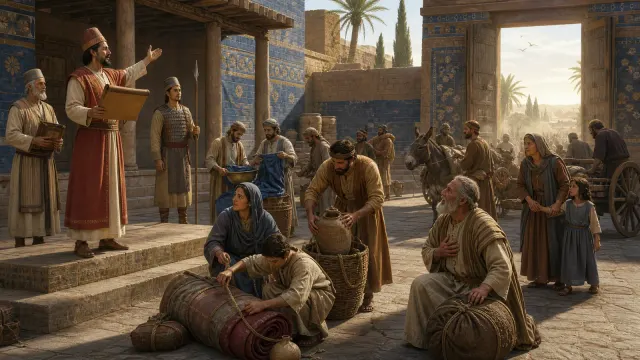
Ezra 2 turns the return into a register. Families are counted by ancestral names, other groups by towns, and temple servants by their particular work. The Book of Ezra also preserves what the records cannot settle: some households cannot demonstrate Israelite descent, and some priestly claimants cannot locate the genealogy required for service. The chapter refuses to turn those missing documents into invented certainty. Its totals, servants, singers, transport animals, and offerings make the migration practical as well as communal. By the end, the people are not gathered forever in one camp around Jerusalem. Priests, Levites, singers, porters, Nethinims, and others settle in their cities, so the long list becomes a map of a people taking up life in the land again.
Central truth
The Book of Ezra records the returning community by families, towns, and service, preserving its shared identity while distinguishing documented priestly eligibility and gifts given according to ability.
The study notes have a page of their own
The movement by movement analysis, the words to trace, the verse by verse notes and where readers differ are written for someone studying alone. They are on the Deep Personal Reflections page for this chapter. This page is the lesson.
A chapter-specific teaching brief
These anchors come from this chapter itself. They help a teacher use the Level 1 overview, the Level 2 study, and the Scripture text as one lesson.
Open with the chapter’s first image
Ezra 2:1: “Now these are the children of the province that went up out of the captivity, of those which had been carried away, whom Nebuchadnezzar the king of Babylon…”
Slow down at the turning point
Ezra 2:1: “Now these are the children of the province that went up out of the captivity, of those which had been carried away, whom Nebuchadnezzar the king of Babylon…”
Keep this word trail visible
children, twenty, fifty, seven, five, forty
What to explain, in order
Teach the passage in this order. Each step names the verses it rests on, so every point can be shown in the text before it is applied.
Ezra 2:1-2
Frame the list as a homecoming
Before reading any names, read the frame: "every one unto his city" (2:1). These are people who were carried away and have come again, each to a particular place. Explain province as the Persian province of Judah, now a small district of a vast empire. Then read the leaders who came with Zerubbabel in 2:2. Warn the class that the Nehemiah and Mordecai named here are almost certainly not the men of the books that carry those names; the names were common. Teach the frame first so that what follows is heard as a roll call of people coming home, not a ledger.
Ezra 2:3-35
Families, then towns
Read a handful of entries rather than all thirty-three. Start with "The children of Parosh" and listen for the pattern, then read 2:21-23 and hear the change to Bethlehem, Netophah and Anathoth. Some groups are remembered by an ancestor, some by a home town. Point out that Anathoth was Jeremiah's town and Bethlehem David's, without building more on that than it holds. The point to make is memory: after two generations in Babylon these people still know where they belong, and that is why the list exists at all.
Ezra 2:36-58
The people who serve
Now the register sorts people by work. Read the four priestly houses (2:36-39) and add them: 4,289. Then read 2:40, where the Levites number seventy-four. Explain the difference between priests, who offered sacrifice, and Levites, who assisted, taught and guarded (Numbers 3:5-10). Then come the singers of Asaph, the porters who kept the gates, and the Nethinims, temple servants, with the children of Solomon's servants. Teach the proportions here because the Book of Ezra will return to the Levite shortage in 8:15, and because the worship of God needs many kinds of hands.
Ezra 2:59-63
Those who could not prove it
Slow down here; this is the passage most likely to be misheard. Two groups lack records. The first, from Tel-melah and nearby places, cannot show their descent, yet they are counted (2:60) and go up with everyone. The second are priestly families whose register was not found, and they are kept from the priesthood "as polluted", which means ritually unfit, not morally filthy. Explain the Tirshatha as the governor's title and Urim and Thummim as the priestly means of seeking God's decision (Exodus 28:30). The ruling is provisional: wait until such a priest stands up. Teach care with records, not suspicion of people.
Ezra 2:64-67
Count the whole company
Read the total in 2:64 and the word beside in 2:65. The servants and maids, 7,337, and the two hundred singers are added, not included. Then read the animals: horses, mules, camels and 6,720 asses. Let learners picture a caravan mostly on foot, with the asses carrying loads and small children. Mention, briefly and without anxiety, that the separate figures add up to 29,818 and that the total of 42,360 is larger; Nehemiah 7 gives the same total with some different entries. The Book of Ezra does not explain this, and the teacher should not invent an answer.
Ezra 2:68-70
Gifts given and homes taken up
End with arrival. Some of the chief of the fathers come to the site of the house and offer freely, and "They gave after their ability" (2:69): sixty-one thousand drams of gold, five thousand pounds of silver and a hundred priests' garments. Explain dram as a weight of gold, often taken as the Persian daric. Then read 2:70: everyone settles in their own towns. Teach this last because it closes the homecoming and sets up chapter 3, where these scattered households will gather again for worship.
Where learners get stuck
The misreadings this passage tends to produce, and how to answer each from the text.
"This chapter is just a list of names and has nothing to teach."
The Book of Ezra spends seventy verses on this list because it answers a question every exile carried: do we still belong. Names, families and towns are remembered after two generations away. Show learners 2:1 and 2:70, which frame the list with homes, and let them see that God's restoration comes to particular people with particular places. Teaching does not need every name read aloud, but it should never treat the names as filler.
"The people without records were thrown out of Israel."
Read 2:59-60 carefully: the families who could not show their descent are counted, 652 of them, and they go up with the rest. Only the priestly claimants of 2:61-63 are restricted, and only from priestly service and the most holy food, until a priest with Urim and Thummim can decide. The text is guarding the priesthood, not shutting people out of the community. A lesson that turns this into rejection says more than the verses do.
"Ezra and Nehemiah give different numbers, so one of them is wrong and the Bible cannot be trusted."
Nehemiah 7:6-73 gives the same list with some different figures, and both give the total of 42,360 while their separate entries add up to less. Grant that this is real, and that readers explain it in different ways: copying of numerals, lists made at different times, or groups counted in the total but not itemised. The text gives no explanation. What both lists plainly agree on is the shape of the community, and that is what this chapter asks the teacher to teach.
"Only the priests really mattered to the temple."
The register gives distinct places to priests, Levites, singers, gatekeepers, Nethinims and the children of Solomon's servants (2:36-58), and 2:70 names them again as they settle. The gifts in 2:68-69 come from heads of families. Worship in this chapter depends on many kinds of service and many givers. Use this to resist any ranking of ministries in the room, and point ahead to 8:15-20, where Ezra will not set out without Levites.
Learning objectives
- Distinguish family entries from town entries in the register.
- Identify the different groups serving the sanctuary.
- Explain the problem facing priests without genealogical records.
- Distinguish the congregation's total from the additional servants.
- Describe the stated measure for voluntary offerings.
- Explain why missing credentials do not establish personal worthlessness.
Teacher preparation
- Read the full register, then select 2:1-2, 36-42, 59-70 for classroom reading so the names remain people rather than an endurance test.
- Prepare headings for families, towns, priests, Levites, singers, gatekeepers, and other temple servants; do not collapse every role into priesthood.
- Explain Nethinims as temple servants, porters as gatekeepers, and Tirshatha as a governing title rather than a personal name.
- Read Exodus 28:30 for Urim and Thummim; explain their priestly association without claiming this passage describes their operation.
- Compare Nehemiah 7's parallel register beforehand; acknowledge differing figures and avoid inventing a complete reconciliation or identifying familiar names solely by spelling.
Evidence and interpretation checks
Explicit
Read 2:64-65 carefully: 42,360 is the stated congregation total, with 7,337 servants and 200 singing men and women mentioned beside that total.
Scripture-supported
Compare 2:61-63 with Exodus 28:1, 30: priestly descent and priestly judgment explain why this case differs from an ordinary missing address.
Strong inference
Infer from 2:1, 21-35, and 70 that remembered towns and resettlement help reconnect a displaced community with its earlier life.
Possible or traditional reading
Identify the Tirshatha with Zerubbabel only as a possible identification; 2:63 gives a title, while 2:2 lists Zerubbabel without explicitly equating the two.
Limit
Observe that 2:59-63 reports missing records and restrictions, not the eventual decision; neither this chapter nor its total explains every difference from Nehemiah 7.
Discussion with answer guidance
1. How does the register move between families and places?
What a good answer contains
It begins with families: "The children of Parosh" (2:3) and similar headings through 2:20. Then it shifts to places: "The children of Beth-lehem" (2:21), "The men of Netophah" (2:22), Anathoth, Michmas, Beth-el and Ai, and on to Jericho (2:34). Some are remembered by an ancestor, some by a home town. A good answer notices the shift and that most of the towns lie in Judah and Benjamin. A weak answer reads every heading as a man's name.
Show teacher guidance
Compare the sons of Parosh in 2:3 with Bethlehem and Netophah in 2:21-22; do not label every heading a father's name.
2. Why are the priests, Levites, singers, and porters listed separately?
What a good answer contains
Because the work is different and the Book of Ezra keeps it distinct: priests of four houses (2:36-39), Levites (2:40), singers of the sons of Asaph (2:41), porters or gatekeepers (2:42), and the Nethinims with the children of Solomon's servants (2:43-58). A strong answer notices the proportions, over four thousand priests and only seventy-four Levites, a shortage that returns in 8:15. A weak answer flattens all of them into priests.
Show teacher guidance
Use 2:36-42 to identify distinct service groups; resist treating all sanctuary work as one interchangeable position.
3. What exactly is uncertain in 2:59-63?
What a good answer contains
There are two cases. Families from Tel-melah and the other places "could not shew their father's house, and their seed, whether they were of Israel" (2:59), yet they are counted and travel with everyone. Priestly families sought their register "but they were not found" (2:62), so they were kept from priestly service and from "the most holy things" until a priest could stand up with Urim and Thummim (2:63). The question is fitness to serve, and the decision waits. A weak answer says these people were expelled from Israel.
Show teacher guidance
Separate the ancestry questions in 2:59 from the priestly records in 2:62; the latter case concerns eligibility and holy food, not a verdict on human value.
4. What does the word beside prevent us from doing with the totals?
What a good answer contains
It stops us folding everyone into one figure. The congregation is "forty and two thousand three hundred and threescore" (2:64), and the servants and maids, 7,337, are beside that, with two hundred singers among them (2:65). The whole company was larger than the headline number. A careful answer also notes that the separate figures in the register add up to 29,818, and that the text does not explain the difference from 42,360.
Show teacher guidance
Read 2:64-65; do not include the additional servants within 42,360 merely because one tidy number feels easier.
5. How do the offerings avoid demanding identical amounts?
What a good answer contains
The giving comes from "some of the chief of the fathers" (2:68), not from everyone, and "They gave after their ability" (2:69). The gift is freely offered, for the house of God "to set it up in his place", and its size depends on what each could give. A strong answer notices that a total is reported but no share is assigned to anyone. A weak answer turns the list into a fixed rate that everyone owed.
Show teacher guidance
Use 2:68-69: willingness and ability govern the giving; do not turn the listed total into an individual quota.
6. Where are the people when the chapter closes?
What a good answer contains
They are home: the priests, Levites, singers, porters, Nethinims and some of the people "dwelt in their cities, and all Israel in their cities" (2:70). The return is to towns and fields as well as to the temple site. A good answer connects this to 3:1, where the people gather from those cities to Jerusalem. A weak answer pictures one camp around the ruins, waiting for something to happen.
Show teacher guidance
Read 2:70: groups settle in their cities, preparing for the gathering in 3:1 rather than remaining permanently in one camp.
Responsible application
Heart and habits
Ask learners to design a giving principle for an imaginary community using willingness and ability, without discussing anyone's finances.
Relationships and community
Build a recognition board that includes singers, gatekeepers, servants, and households rather than only the opening leaders.
Credentials without contempt
Present a fictional applicant with incomplete records; distinguish a temporary role restriction from assumptions about character or belonging.
Session plans
Two timings of the same lesson. The shorter keeps the reading, the central discussion and one response; the longer gives the confusions and the application their own time.
45 minutes
Frame the homecoming
Read 2:1-2 and 2:70 aloud. Ask the class what kind of document begins and ends like this, and take confusion one in a sentence.
Families and towns
Read 2:3-8 and 2:21-28. Ask question one and mark family headings and town headings in two colours.
Those who serve
Read 2:36-42. Ask question two, add the priestly figures and set them beside the seventy-four Levites. Use confusion four.
Missing records
Read 2:59-63. Ask question three and work through confusion two with the verses open.
Totals and gifts
Read 2:64-69 and take questions four and five.
Handout
Ask question six from 2:70, read the key verse together, give out the handout and pray.
90 minutes
Where do you belong
Ask learners how a person proves where they come from. Keep it light; no one has to say anything about their own family.
The frame
Read 2:1-2 and 2:70. Take confusion one, explain province, and warn about the common names Nehemiah and Mordecai.
Families and towns
Read selected entries from 2:3-35 and ask question one. Mark the towns on a simple map of Judah and Benjamin.
Those who serve
Read 2:36-58 in part. Ask question two, read Numbers 3:5-10, take confusion four and look ahead to 8:15.
Missing records
Read 2:59-63 with Exodus 28:30. Ask question three and work through confusion two.
The whole company
Read 2:64-67 and ask question four. Set Nehemiah 7:66-67 beside it and take confusion three.
Gifts and homes
Read 2:68-70 and take questions five and six.
Response and handout
Complete one application, read the key verse together, give out the handout and pray.
Adapting the lesson
Children
Give each child a family card or a town card from the list and have them line up when their name is called. Count the line together. For the families with no records, let them still walk in the line and say that they came too. Keep the priests' question simple: some jobs needed proof, and those people waited for an answer. Skip the arithmetic.
Youth
Ask what records prove who they are today: birth certificates, passports, school files. Then read 2:59-63 and talk about people who could not prove their family line, and how the community still took them along. Let them find the Levite figure in 2:40 and guess why it might matter later. Keep any talk of modern immigration out of it and stay with the text.
Adults
Give real time to Nehemiah 7 and to the arithmetic, so adults see a teacher handle a hard text honestly. Discuss what it meant for a community to rebuild its identity after displacement, and why registers, roles and giving according to ability belong to that. Adults who have migrated, lost records or been adopted may hear this personally; make room without asking anyone to share.
One to one
Read 2:1-2, 2:59-63 and 2:68-70 together rather than the whole list. Ask the person which group they would have been in: those with names, those without records, or those who gave. If belonging is a painful question for them, let 2:60 show people counted in even without paperwork, and do not turn the passage into a test of anyone's background.
Song and video learning lab
A song or video may interpret, compress, or dramatize the text. Its value becomes clearer when its choices are compared with Scripture.
- Before the media: the exact passage and its central movement.
- During the media: the words, people, events, and emotions the artist emphasizes.
- After the media: what it clarifies, what it leaves out, and what belongs back in the biblical text.
Handout
One page for learners to take home. The print button prints this section alone.
Ezra 2:1–70
The passage in brief
Ezra 2 lists the people who came back from Babylon with Zerubbabel, family by family and town by town. It names the priests, the few Levites, the singers, the gatekeepers and the temple servants. Some families could not prove their descent; they still came, and some priests waited for a ruling before they could serve. The whole company numbered 42,360, besides servants and singers. Some leaders gave freely to rebuild the house of God, each as he was able, and everyone settled in their own towns.
A verse to keep
And some of the chief of the fathers, when they came to the house of the LORD which is at Jerusalem, offered freely for the house of God to set it up in his place: They gave after their ability unto the treasure of the work threescore and one thousand drams of gold, and five thousand pound of silver, and one hundred priests’ garments.
Ezra 2:68-69 · King James Version
Questions to take home
Find one family name and one town name in 2:3-35.
What did the priests without records in 2:61-63 have to wait for?
What does 2:69 tell you about how the people gave?
This week
This week, give something toward God's work according to what you actually have, not what someone else gives.
Music and video connected to the passage
Related media appears when its Scripture reference overlaps this study. Music and video can illuminate a theme while the biblical text remains the foundation.