
The big picture
The Book of Galatians extends the image of a supervised child into the status of an heir. At the appointed time God sends his Son to redeem those under the law and sends the Spirit of his Son into believers’ hearts, so the servant’s position gives way to sonship and inheritance. That makes the Galatians’ movement back toward bondage especially jarring. Paul even corrects his own wording from knowing God to being known by God, keeping divine initiative at the center. The argument then becomes personal. He remembers their remarkable welcome during his bodily weakness and contrasts it with teachers who, in his account, seek the Galatians’ dependence. Finally Paul turns to Abraham’s two sons. Hagar and Sarah become an allegorical contrast between bondage and freedom, while Isaiah’s barren woman supplies the surprising image of abundant children. The Galatians are identified with Isaac as children of promise, not with the inheritance of slavery.
Central truth
Galatians 4 contrasts the heir’s former life under guardians with sonship through Christ and the Spirit, then warns the Galatians not to return voluntarily to bondage after being received as heirs.

The study notes have a page of their own
The movement by movement analysis, the words to trace, the verse by verse notes and where readers differ are written for someone studying alone. They are on the Deep Personal Reflections page for this chapter. This page is the lesson.
A chapter-specific teaching brief
These anchors come from this chapter itself. They help a teacher use the Level 1 overview, the Level 2 study, and the Scripture text as one lesson.
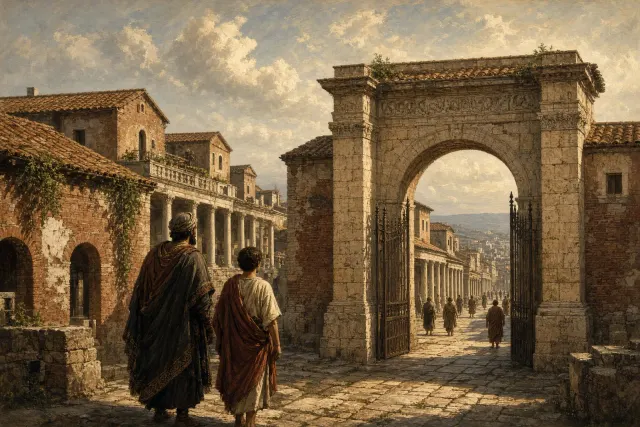
Open with the chapter’s first image
Galatians 4:1: “Now I say, That the heir, as long as he is a child, differeth nothing from a servant, though he be lord of all;”
Slow down at the turning point
Galatians 4:16: “Am I therefore become your enemy, because I tell you the truth?”
Keep this word trail visible
children, bondage, bondwoman, flesh, born, brethren
What to explain, in order
Teach the passage in this order. Each step names the verses it rests on, so every point can be shown in the text before it is applied.
Galatians 4:1-3
The heir who is still a child
Begin with a family picture the Galatians knew well. A wealthy man's young son owns everything in law but controls nothing in practice; guardians manage him and his estate until the date his father has set. Paul says that is what life under the law was like. Explain “the elements of the world” honestly: it may mean the basic principles of religion, or the spiritual powers behind them, and the chapter does not stop to define it. Teach this first because verses 4 to 7 only make sense as the moment the child comes of age.
Galatians 4:4-7
The fulness of the time: Son and Spirit sent
Read verses 4 and 5 slowly, marking each phrase. The phrase “the fulness of the time” is the date the Father set. The Son was “made of a woman”, truly human, and “made under the law”, so that he could redeem those under it. The aim is “the adoption of sons”. Then verse 6: God sent the Spirit of his Son into our hearts, and the Spirit cries “Abba, Father”. Explain Abba as the Aramaic word for father, the word Jesus used in Gethsemane. Close on verse 7, where the slave becomes a son and the son an heir.
Galatians 4:8-11
Why go back to bondage
Now Paul turns the picture on the Galatians. Before they knew God they served “them which by nature are no gods”. Now they know God, “or rather are known of God”, and they want to go back. Make the shock clear: Paul puts law-keeping as a way of standing before God in the same column as their old paganism, because both are bondage to “weak and beggarly elements”. Verse 10 shows the symptom, a calendar of “days, and months, and times, and years”. Teach this after the adoption paragraph so the class feels how strange it is to leave sonship for slavery.
Galatians 4:12-16
Remember how you received me
Here the letter changes voice from argument to appeal. Paul pleads, “be as I am; for I am as ye are”: he had lived like a Gentile among them, free from the law as a way to God, and asks them to stand with him. Then he remembers their first meeting. He came to them ill, and his condition was a trial to them, yet they welcomed him “as an angel of God, even as Christ Jesus”. They would have given him their eyes. Read verse 16 slowly. Truth-telling had turned their friend into an enemy in their eyes.
Galatians 4:17-20
False zeal and a mother's labour
Contrast two kinds of attention. The troublers “zealously affect you, but not well”; their aim is to exclude, so the Galatians will need them. Paul's attention is different: “My little children, of whom I travail in birth again until Christ be formed in you”. Explain the image as the pain of childbirth. He went through it once when they came to faith and is going through it again. His goal is not followers for himself but Christ formed in them. Verse 20 shows his honesty: he wishes he could be present and “change my voice”, because he does not know how they will respond.
Galatians 4:21-31
Two mothers, two covenants
Paul answers those who “desire to be under the law” from the law itself, from Genesis 16 and 21. Put two columns on the board: Hagar, the bondwoman, the flesh, Sinai, present Jerusalem, bondage; Sarah, the freewoman, promise, Jerusalem above, freedom. Paul says plainly “Which things are an allegory”, so build only his columns. Read Isaiah 54:1, quoted in verse 27, about the barren woman with many children. Then verses 28 to 31: believers are children of promise like Isaac, should expect opposition as he did, and are “not children of the bondwoman, but of the free”. This leads straight into 5:1.
Where learners get stuck
The misreadings this passage tends to produce, and how to answer each from the text.
“Paul is saying the Jewish people are Hagar's children and God has rejected them.”
Paul aims the allegory at “ye that desire to be under the law” (4:21), which in Galatia meant Gentile believers being pressed to adopt circumcision. The contrast is between two ways of relating to God, by the flesh or by promise, not between two ethnic groups. Paul himself is a Jew, and Isaac, the child of promise, is the father of Israel. In Romans 11:1-2 he says plainly that God has not cast away his people. Teach the passage with that care.
“Verse 10 means Christians must not keep any special days, such as the Lord's Day or Easter.”
In context Paul is alarmed that the Galatians are observing days as part of a return to bondage, a way of securing standing with God (4:9-11). In Romans 14:5-6 he allows that one person esteems one day above another and tells both to act to the Lord. The problem in Galatia was not a calendar as such but a calendar treated as a condition of belonging. Help the class see the difference rather than turning the verse into a rule against all observance.
“Adopted means we are second-class children, not really God's own.”
In Paul's world adoption gave a son the full name, rights and inheritance of the family, and Paul draws exactly that conclusion: “if a son, then an heir of God through Christ” (4:7). Nothing about adoption is second rate here. The Spirit in the believer's heart cries “Abba, Father” (4:6), the same intimate word Jesus used in prayer. Adoption describes how sons are made, not a lower kind of sonship.
“Paul's illness was an eye disease, which is why he mentions their eyes.”
Verse 13 says Paul first preached to them “through infirmity of the flesh”, and verse 15 says they would have given him their eyes. Some readers connect the two and suggest an eye condition; others take verse 15 as a common way of speaking of great devotion. The text does not name the illness. Teach what Paul stresses, that they welcomed him despite a condition that tested them, and leave the diagnosis open.
Learning objectives
- Explain the child-heir comparison in verses 1 to 3.
- Trace God, the Son, and the Spirit in verses 4 to 7.
- Identify the return to bondage feared in verses 8 to 11.
- Describe Paul’s changed relationship with the Galatians in verses 12 to 20.
- Explain the Hagar and Sarah allegory in verses 21 to 31.
- Separate the chapter’s claims from disputed interpretations of “elements” and calendar observance.
Teacher preparation
- Mark child, heir, adoption, sons, Father, servant, and heir in verses 1 to 7.
- Explain “Abba” in verse 6 as an address to the Father carried into Paul’s wording.
- Set verses 8 to 11 beside verses 1 to 7 so the return to bondage lands with full force.
- Read verses 12 to 20 for tone: appeal, remembered welcome, wounded questions, and travail until Christ is formed.
- Prepare a simple Hagar-Sarah chart. Verse 24 calls the comparison an allegory; too many extra arrows will bury Paul’s contrast.
Evidence and interpretation checks
Explicit
Verses 4 to 7 say God sends his Son for redemption and adoption, then sends the Spirit of his Son into believers’ hearts.
Scripture-supported
Verses 21 to 31 use Abraham’s two sons, bondwoman and freewoman, flesh and promise, to support Paul’s bondage-versus-freedom contrast.
Strong inference
Because verses 8 to 11 follow the sonship paragraph, returning to the “elements” is presented as reversal, not spiritual progress.
Possible or traditional reading
“Elements of the world” in verses 3 and 9 has several interpretations; the chapter does not pause to define the term.
Limit
Verses 10 to 11 mention days, months, times, and years but do not catalog every calendar practice in every setting.
Discussion with answer guidance
1. How can the heir in verses 1 to 3 be “lord of all” yet like a servant?
What a good answer contains
Because ownership and freedom are not the same thing. The heir is “lord of all” by right, yet as a child he “differeth nothing from a servant” (4:1). He is “under tutors and governors until the time appointed of the father” (4:2). The inheritance is real, but he cannot yet use it; others decide for him. Paul applies this to “we, when we were children”, who were “in bondage under the elements of the world” (4:3). A good answer sees that the father sets the time, and that the picture prepares for verse 4, when that time arrives.
Show teacher guidance
The inheritance is real, but tutors and governors remain until the father’s appointed time.
2. What happens when “the fulness of the time” comes in verses 4 to 7?
What a good answer contains
God acts twice. First, “God sent forth his Son, made of a woman, made under the law” (4:4), to redeem those under the law, “that we might receive the adoption of sons” (4:5). Second, “God hath sent forth the Spirit of his Son into your hearts, crying, Abba, Father” (4:6). The result is a change of status: “thou art no more a servant, but a son; and if a son, then an heir of God through Christ” (4:7). A strong answer notices the two sendings, the Son for us and the Spirit into us, and that the Father, Son and Spirit are all at work.
Show teacher guidance
Trace sending, birth under law, redemption, adoption, the Spirit’s cry, and the move from servant to heir.
3. Why is Paul’s question in verse 9 sharper than a complaint about changed habits?
What a good answer contains
Because Paul treats going back under the law as going back to bondage, the same bondage they knew as pagans. Once they “did service unto them which by nature are no gods” (4:8). Now they have “known God, or rather are known of God” (4:9), yet they turn again “to the weak and beggarly elements”. That is shocking language to apply to a calendar of holy days (4:10). A good answer catches Paul's self-correction, “or rather are known of God”: their standing rests on God's knowing them, which makes returning to bondage all the more senseless.
Show teacher guidance
They know God, or rather are known by God, yet turn again toward weak elements and bondage.
4. How do verses 13 to 16 show the change between Paul and the Galatians?
What a good answer contains
At first they received him when he came “through infirmity of the flesh” (4:13). His condition was a trial to them, yet they “despised not, nor rejected” him, but “received me as an angel of God, even as Christ Jesus” (4:14). They would have “plucked out your own eyes, and have given them to me” (4:15). Now he asks, “Am I therefore become your enemy, because I tell you the truth?” (4:16). A strong answer sees that nothing in Paul has changed except that he told them an unwelcome truth; the change is in them.
Show teacher guidance
Recall his infirmity, their welcome, their willingness to give their eyes, and his enemy question.
5. What is wrong with the zeal in verses 17 to 18?
What a good answer contains
Their zeal is real but its aim is wrong. “They zealously affect you, but not well; yea, they would exclude you, that ye might affect them” (4:17). They court the Galatians in order to shut them out from Paul and from the gospel, so that the Galatians will depend on and court them in return. Paul does not condemn zeal itself: “it is good to be zealously affected always in a good thing” (4:18). A good answer names the test: zeal that isolates people to bind them to a leader is not zeal for Christ.
Show teacher guidance
The rivals zealously affect them “not well” and seek exclusion so the Galatians will pursue them.
6. How does Paul distinguish Abraham’s two sons in verses 22 to 31?
What a good answer contains
Paul follows the line from Genesis: “Abraham had two sons, the one by a bondmaid, the other by a freewoman” (4:22). The son of the bondwoman was “born after the flesh”, the son of the freewoman “by promise” (4:23). The two women stand for two covenants: Sinai, which brings bondage, and “Jerusalem which is above”, which “is free, which is the mother of us all” (4:26). Then Paul places the readers: “Now we, brethren, as Isaac was, are the children of promise” (4:28). A strong answer keeps the contrast to the pairs Paul names and does not invent further symbols.
Show teacher guidance
Follow bondwoman/freewoman, flesh/promise, bondage/freedom, then verse 28’s identification of the readers as children of promise.
Responsible application
Teach from status, not nostalgia
Use verses 4 to 9 to answer a fictional believer who treats former bondage as safer than adopted sonship.
Recognize manipulative zeal
Use verses 17 to 18 to evaluate leadership that creates dependence by excluding people from healthier relationships.
Keep promise and bondage distinct
Use verses 21 to 31 to build Paul’s two-column contrast and remove claims the verses do not make.
Session plans
Two timings of the same lesson. The shorter keeps the reading, the central discussion and one response; the longer gives the confusions and the application their own time.
45 minutes
The heir under guardians
Read 4:1-3 and ask question one. Explain the elements of the world briefly and leave the debate open.
The fulness of the time
Read 4:4-7, marking each sending. Take question two and confusion three, and explain Abba.
Back to bondage
Read 4:8-11. Take question three and confusion two, keeping verse 10 in its setting.
Paul's appeal
Read 4:12-20. Take questions four and five, and read verse 19 aloud a second time.
Two mothers
Read 4:21-31 and build the two columns. Take question six and confusion one with care.
Handout and prayer
Read the key verse together, point to the take-home line, and pray using the words Abba, Father.
90 minutes
An heir who owns nothing yet
Ask what it would be like to inherit a fortune at age six. Read 4:1-3, take question one and explain the elements of the world.
Son and Spirit sent
Read 4:4-7, then Mark 14:36 and Romans 8:15. Take question two and confusion three.
Known of God
Read 4:8-11 and Romans 14:5-6. Take question three and confusion two.
As an angel of God
Read 4:12-16. Take question four and confusion four, and ask why truth-telling can turn a friend into an enemy.
Until Christ be formed in you
Read 4:17-20. Take question five and contrast zeal that excludes with the labour of verse 19.
Hagar and Sarah
Read Genesis 21:1-10 and Isaiah 54:1, then Galatians 4:21-31. Build the two columns, take question six and confusion one.
Living as heirs
Ask what someone who knows they are an heir would stop doing. Let each person name one thing that pulls them back toward bondage.
Handout and prayer
Read the key verse together, go over the handout questions, and close with a prayer that begins Abba, Father.
Adapting the lesson
Children
Use an envelope marked Inheritance and a calendar with a date circled. Explain that a child heir has to wait until the day the father chose, and that God chose the right day to send Jesus. Read 4:6 and teach that God's children can call him Father. Leave out the allegory of Hagar and Sarah, or tell only that Isaac was born because God kept a promise.
Youth
Follow verses 12 to 20 as a relationship that went wrong: who changed, who influenced them, what Paul feels. Ask them to name leaders or groups who make people feel they must stay close to be accepted, and test them with verse 17. Then go back to verses 4 to 7, since knowing you are a son or daughter and heir is the answer to that pull.
Adults
Give time to verses 4 to 7, where the Father, Son and Spirit act together, and to the debated phrase elements of the world. Handle the allegory of verses 21 to 31 carefully, keeping it to Paul's own columns and guarding against reading it as a verdict on the Jewish people. Discuss how a church's calendar or customs can quietly become conditions of acceptance.
One to one
Ask whether the person relates to God more like a servant waiting for orders or a child who belongs. Read 4:6-7 and let the word Abba do its work. If they have been hurt by a leader who made them dependent, read 4:17-19 and contrast that zeal with Paul's labour for Christ to be formed in them, not for loyalty to himself.
Song and video learning lab
A song or video may interpret, compress, or dramatize the text. Its value becomes clearer when its choices are compared with Scripture.
- Before the media: the exact passage and its central movement.
- During the media: the words, people, events, and emotions the artist emphasizes.
- After the media: what it clarifies, what it leaves out, and what belongs back in the biblical text.
Handout
One page for learners to take home. The print button prints this section alone.
Galatians 4
The passage in brief
Paul says that before Christ came, God's people were like a young heir who owns everything but is still under guardians. When the right time came, God sent his Son to set them free and make them his sons and daughters, and sent his Spirit into their hearts so they can call him Father. So why go back to slavery? Paul reminds the Galatians how warmly they once welcomed him, and uses Abraham's two sons to show that believers are children of promise and free.
A verse to keep
But when the fulness of the time was come, God sent forth his Son, made of a woman, made under the law, To redeem them that were under the law, that we might receive the adoption of sons.
Galatians 4:4-5 · King James Version
Questions to take home
What did God send in 4:4 and in 4:6, and why?
What does the Spirit cry in our hearts, according to 4:6?
Whose children are believers, according to 4:28 and 4:31?
This week
Pray this week beginning with the words Abba, Father, and thank God that you are his child and heir.
Music and video connected to the passage
Related media appears when its Scripture reference overlaps this study. Music and video can illuminate a theme while the biblical text remains the foundation.