The big picture
Mark 14 places costly devotion, betrayal, covenant language, confident promises, exhausted failure, and open confession inside one tightening night. An unnamed woman pours out what others call waste while Judas arranges payment for handing Jesus over. At the Passover table, Jesus names the betrayal and gives the coming death its meaning through bread and cup before anyone else can define it for him. He predicts that all will scatter and that Peter will deny him, yet he also promises a meeting in Galilee after he is risen. Gethsemane exposes the distance between promised loyalty and actual strength. Arrest follows a kiss, the disciples flee, witnesses fail to agree, and Jesus answers the direct question about his identity. Outside, Peter does exactly what he had insisted he would never do.
Central truth
Mark 14:1–31 sets costly devotion at Bethany against calculated betrayal, then places both inside Jesus’ deliberate Passover preparation, his interpretation of bread and cup around his impending death, and his prediction that all the disciples will stumble while Peter insists he will not. Mark 14:32–72 places Jesus’ anguished obedience in Gethsemane beside sleeping disciples, a betrayer’s kiss, a hurried arrest, hostile testimony, Jesus’ confession before the council, and Peter’s three denials ending in remembered words and bitter weeping.

The study notes have a page of their own
The movement by movement analysis, the words to trace, the verse by verse notes and where readers differ are written for someone studying alone. They are on the Deep Personal Reflections page for this chapter. This page is the lesson.
A chapter-specific teaching brief
These anchors come from this chapter itself. They help a teacher use the Level 1 overview, the Level 2 study, and the Scripture text as one lesson.
Open with the chapter’s first image
Mark 14:1: “After two days was the feast of the passover, and of unleavened bread: and the chief priests and the scribes sought how they might take him by craft, and…”
Slow down at the turning point
Mark 14:37: “And he cometh, and findeth them sleeping, and saith unto Peter, Simon, sleepest thou? couldest not thou watch one hour?”
Keep this word trail visible
Jesus, Peter, high, priest, witness, began
What to explain, in order
Teach the passage in this order. Each step names the verses it rests on, so every point can be shown in the text before it is applied.
Mark 14:1–31
Mark 14:1-2
Two days before Passover
Begin with the calendar. Explain Passover as the feast remembering Israel's rescue from Egypt, when the lamb's blood protected the firstborn, followed by the week of unleavened bread. Jerusalem swelled with pilgrims. The leaders want Jesus dead but fear the people. Teach this first because it sets the frame: the deliverance feast is the backdrop for Jesus' death, and the leaders' plot meets Judas' offer in verse 10, another of Mark's sandwiches around the anointing.
Mark 14:3-9
Anointed for burial
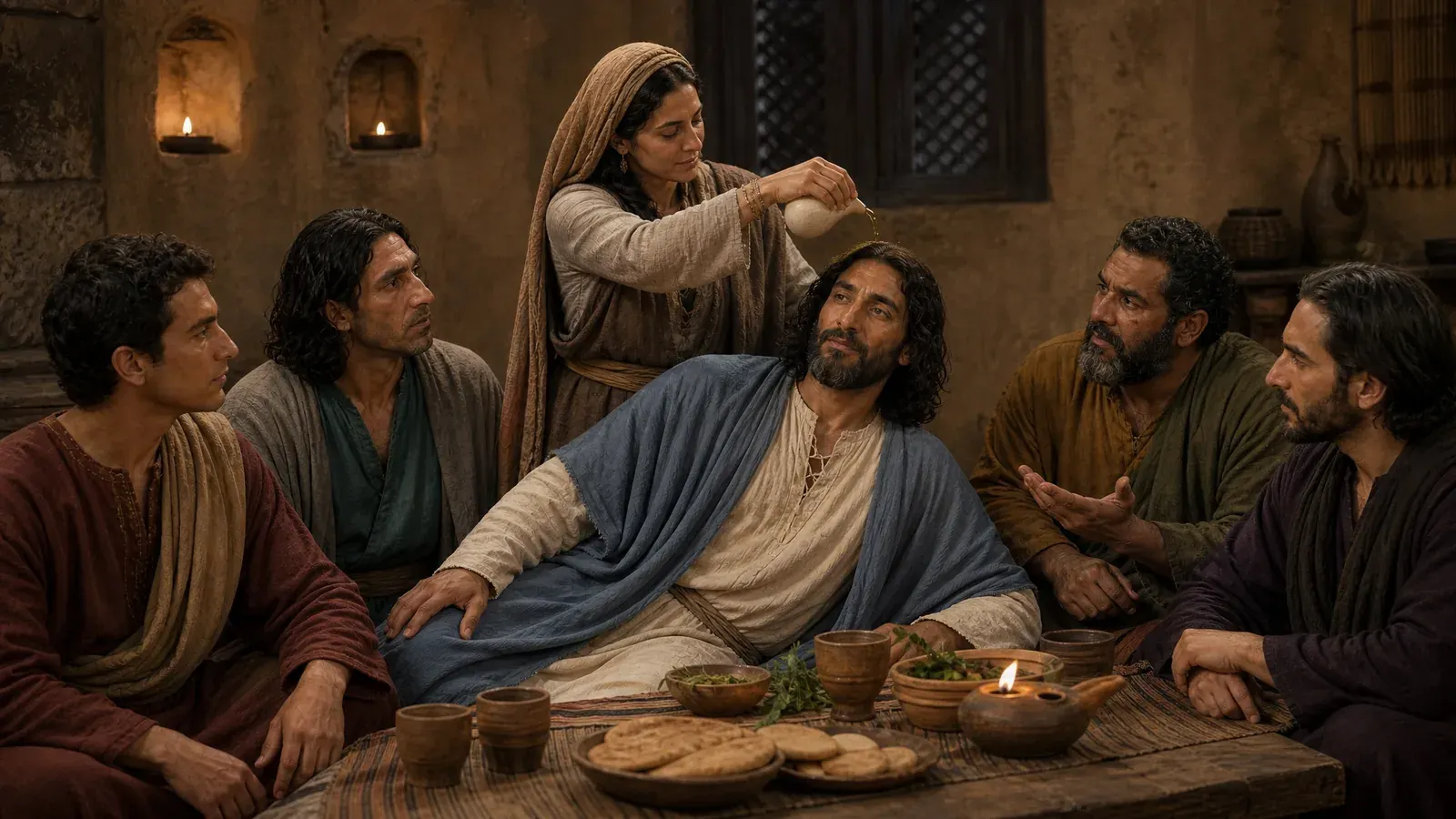
In Simon the leper's house a woman breaks an alabaster box of spikenard, an expensive perfumed oil from India, and pours it on Jesus' head. Explain that kings were anointed on the head, and the dead were anointed for burial. Her act carries both meanings. Some are indignant about the waste. Explain Jesus' reply: the poor are always there to be helped, as Deuteronomy 15:11 says, but this moment is unrepeatable. Teach it as the contrast with Judas, who will sell Jesus for money.
Mark 14:10-11
Judas goes to the chief priests
Read these two verses plainly and slowly. Judas, “one of the twelve”, goes to betray him. The priests are glad and promise money. Mark gives no motive, unlike other Gospels, and you should not invent one. Explain that the phrase one of the twelve is repeated to stress the closeness of the betrayer. Teach this between the anointing and the supper so the class sees the woman's costly love and Judas' sale side by side.
Mark 14:12-21
Preparing the Passover and naming the betrayer
On the day the lambs were sacrificed, Jesus sends disciples to the prepared room. Explain the meal briefly: lamb, bread without yeast, bitter herbs, cups of wine, retelling of the exodus. During the meal Jesus says one of them will betray him, using the image of dipping bread in the same bowl from Psalm 41:9. Explain woe as a cry of lament and warning. Teach this before the bread and cup so the class sees that Jesus gives himself knowing he is betrayed.
Mark 14:22-25
This is my body, this is my blood
Read Jesus' actions: took, blessed, brake, gave, the same as at the feedings in 6:41 and 8:6. Then the words, this is my body and this is my blood of the new testament, shed for many. Explain the new testament as the new covenant of Jeremiah 31:31-34 and the blood of the covenant in Exodus 24:8. Note that Christian traditions understand the presence of Christ in the supper in different ways; do not settle that here. Point to the promise of the kingdom in verse 25.
Mark 14:26-31
The hymn and Peter's boast
They sing a hymn, traditionally the Psalms 113 to 118 sung at Passover, and go to the Mount of Olives. Jesus quotes Zechariah 13:7, the smitten shepherd and the scattered sheep. Then the promise of Galilee. Peter insists he will never fall away, and Jesus predicts three denials before the cock crows twice. Peter insists more strongly, and so do they all. Teach this last because it prepares the night of failure, and because the promise of verse 28 is already given before they fail.
Mark 14:32–72
Mark 14:32-42
Gethsemane
Begin in the garden whose name means oil press. Jesus takes the three who saw the transfiguration. Explain sore amazed and very heavy as words of deep distress. He falls to the ground. Explain the cup as the cup of God's wrath in the prophets, as in Isaiah 51:17. Read his prayer slowly and his three returns to sleeping disciples. Teach this first, because it shows that Jesus goes to the cross knowing what it costs and by choosing the Father's will.
Mark 14:43-50
The kiss and the flight
Judas comes while Jesus is speaking. Explain the kiss as the usual greeting of a disciple to his teacher, here turned into a signal. The crowd comes from the chief priests, scribes and elders. The sword stroke is wild and useless. Jesus points out the darkness of their method, since he taught openly. Then the bleakest line so far: they all forsook him. Teach this as the fulfilment of 14:27, the shepherd struck and the sheep scattered.
Mark 14:51-52
The young man who fled naked
Only Mark includes this detail. Explain that some think the young man may be Mark himself, though the text does not say. The point in the passage is clear enough: even this last follower flees, leaving everything behind, in shame. Contrast the disciples who left their nets to follow (1:18) with this young man who leaves his garment to escape. Teach it briefly, as a picture of total abandonment, before the trial.
Mark 14:53-65
Before the council
Explain the council, the Sanhedrin, the highest Jewish court in Jerusalem, meeting at night in the high priest's house. Note the sandwich again: Peter at the fire in verse 54, the trial, then Peter again in verse 66. The witnesses contradict each other. Jesus is silent until asked directly. Explain the Son of the Blessed as a reverent way to say Son of God. Jesus' answer joins Psalm 110 and Daniel 7. Then the mocking: prophesy, they say, while outside his prophecy about Peter comes true.
Mark 14:66-72
Peter's denials and tears
Bring the class back to the courtyard. A servant girl recognises Peter, then says it again to the bystanders, and finally others say his Galilean accent gives him away. Each denial is stronger, ending with curses and oaths. Explain that to curse here probably means calling down curses on himself if he lies. The cock crows the second time. Teach this last because the trial and the denial run side by side: Jesus confesses the truth and is condemned; Peter denies it and escapes, and then weeps.
Where learners get stuck
The misreadings this passage tends to produce, and how to answer each from the text.
Mark 14:1–31
“The woman wasted money that should have gone to the poor, so Jesus did not care about the poor.”
Jesus says, “whensoever ye will ye may do them good” (14:7), echoing Deuteronomy 15:11, which commands generosity to the poor. His point is that this moment, before his burial, is unique. He has fed the hungry and healed the poor throughout Mark. Devotion to Jesus and care for the poor do not compete; the passage shows that worship of him has its own place.
“Judas was a victim because it was written that Jesus must be betrayed.”
Verse 21 holds both truths together: the Son of man goes “as it is written of him”, and woe to the betrayer. Scripture's foreknowledge does not remove Judas' responsibility; Jesus speaks of woe because Judas acts freely. Traditions explain how God's purpose and human choice relate in different ways. Let the verse stand with both halves and do not reduce it to either.
“The Jews killed Jesus, so they are to blame.”
Mark names specific leaders: “the chief priests and the scribes” (14:1), not a people. Jesus' disciples, the crowds who welcomed him and Jesus himself were all Jews. Roman soldiers will carry out the execution. Christian teaching holds that Jesus gave his life for many (10:45, 14:24), and that all sinners share the need for it. Never let this passage feed contempt for Jewish people.
“The Lord's Supper is just a reminder and does not matter much.”
Jesus' words, “This is my blood of the new testament, which is shed for many” (14:24), tie the meal to his death and the new covenant. Traditions understand what happens in the supper differently, and you need not resolve that here. But all agree that Jesus commanded it, and that it is a central act of Christian worship. Teach its weight from the text.
Mark 14:32–72
“Jesus was afraid to die, so he was not really the Son of God.”
His sorrow is real: “My soul is exceeding sorrowful unto death” (14:34). But he prays “not what I will, but what thou wilt” (14:36) and goes forward to meet Judas (14:42). The cup he dreads is not only physical death but the weight of what he bears. His anguish shows both his true humanity and his obedience. It is the one who trembles and goes on who shows what faithfulness is.
“Peter's denial means he was never a real disciple.”
Peter followed when others fled, even into the high priest's palace (14:54), and he weeps when he remembers (14:72). Jesus foretold the failure and promised to go before them into Galilee (14:28). The angel will name Peter in 16:7. His failure is grievous, but it is not the end. Use this to give hope to learners who have failed Jesus, without making denial seem small.
“The disciple with the sword did the right thing in defending Jesus.”
Mark does not praise the blow; Jesus immediately says the Scriptures must be fulfilled (14:49). He goes willingly. The sword is a misunderstanding of his mission, like Peter's rebuke in 8:32. Jesus' kingdom does not advance by violence. Teach this without turning it into a lecture on modern questions of defence.
“Jesus said nothing at the trial because he had no defence.”
His silence before false witnesses fulfils Isaiah 53:7 and shows that their charges collapse on their own (14:56-59). When asked directly who he is, he speaks: “I am” (14:62). He is not silenced; he chooses when to speak. The only charge that sticks is the truth about his identity.
Learning objectives
- Explain the leaders’ concern about arresting Jesus during the feast and how Judas’s offer changes their opportunity.
- Describe the woman’s action at Bethany, the criticism directed at her, and the reasons Jesus gives for defending her.
- Explain what Jesus means when he says the woman has anointed his body beforehand for burial.
- Trace the Passover preparation instructions and identify how the disciples find the place.
- State what Jesus says about the betrayer at the meal without claiming the passage names Judas at the table in this section.
- Explain the bread, cup, covenant, and kingdom language in verses 22–25 and connect it with the predicted scattering in verses 26–31.
- Describe Jesus’ emotional language and repeated prayer in Gethsemane without weakening either his anguish or his submission to the Father.
- Explain the disciples’ repeated failure to watch and pray and how Jesus links prayer with entering into temptation.
- Trace the arrest scene from Judas’s signal through the disciples’ flight, including what Mark does and does not identify about the sword wielder and the fleeing young man.
- Evaluate the testimony before the council by distinguishing false or inconsistent witnesses from the high priest’s direct question.
- Explain Jesus’ answer concerning his identity and the Son of man language that leads to the blasphemy charge.
- Reconstruct Peter’s three denials, the two cock-crow references in the KJV text, and the moment he remembers Jesus’ prediction.
Teacher preparation
- Review Passover timing and the Feast of Unleavened Bread so verses 1, 12, and 16 are understandable without burying the lesson in calendar reconstruction.
- Identify Bethany and the house of Simon the leper. Mark does not name the woman here, so do not import a name from another Gospel account into this lesson.
- Prepare a realistic sense of three hundred pence as a very large valuation, commonly understood as roughly a laborer’s annual earnings. Present the estimate as scale, not as a precise modern conversion.
- Read Exodus 24:8 and Zechariah 13:7 for covenant-blood and smitten-shepherd background. Jesus explicitly cites the shepherd text in verse 27.
- Mark the predictions Jesus makes in this unit: burial, betrayal, poured-out blood, future kingdom drinking, scattering, resurrection and Galilee, Peter’s three denials. The scene looks backward to Passover and forward to the passion at the same time.
- Read Psalm 42–43 and selected lament language only as background for deep sorrow. Do not make Jesus’ words in Gethsemane merely an example of generic anxiety.
- Prepare to explain 'Abba' as an Aramaic address to the Father without reducing it to sentimental claims that it simply means 'Daddy.'
- Review Daniel 7:13–14 and Psalm 110:1 because Jesus combines Son of man coming language with sitting at the right hand of power in verse 62.
- Note that Mark does not name the disciple who cuts off the servant’s ear and does not identify the naked young man in verses 51–52. Resist importing names or confident autobiographical theories.
- Mark the denial predictions from verses 29–31 before teaching verses 66–72. Peter’s collapse lands with greater force when the exact earlier claim and Jesus’ wording are still fresh.
Evidence and interpretation checks
Explicit
Mark 14:3–9 reports the costly anointing and Jesus’ burial interpretation; verses 10–11 report Judas’s agreement with the chief priests; verses 12–16 report Passover preparation; verses 17–25 interpret betrayal, bread, and cup; verses 26–31 predict scattering and denial. Mark 14:34 records Jesus as exceeding sorrowful unto death; verses 35–36 give his prayer; verses 37–42 report three returns to sleeping disciples; verses 43–52 report arrest and flight; verses 53–65 report the hearing; verses 66–72 report Peter’s denials.
Scripture-supported
Exodus 24:8 provides covenant-blood language relevant to verse 24, and Zechariah 13:7 is directly cited in verse 27. Passover itself is grounded in Exodus 12. Mark 14:62 combines imagery strongly rooted in Psalm 110:1 and Daniel 7:13–14. Those texts clarify why Jesus’ answer carries such weight in the council scene.
Strong inference
Mark’s placement of the Bethany woman between murderous plotting and Judas’s betrayal invites comparison: she gives something extraordinarily costly to Jesus while Judas seeks money by handing him over. Mark’s placement of Jesus’ faithful confession above and Peter’s fearful denials below creates a deliberate contrast between the one under formal accusation and the disciple questioned by servants and bystanders.
Possible or traditional reading
Readers often identify Mark’s unnamed woman with named women in other Gospel anointing accounts. Because Mark does not name her here, teach this passage without asserting an identification it does not supply. The fleeing young man in verses 51–52 has often been identified with Mark himself. The passage never names him. Present autobiographical identification only as a traditional suggestion, not as established fact.
Limit
The statement 'ye have the poor with you always' does not dismiss care for the poor. Jesus explicitly says they may do good to the poor whenever they will, while identifying this anointing as a unique preparation for his burial. The passage does not identify every legal irregularity in the hearing, name the sword wielder, or explain Peter’s inner motives beyond what his words and actions show. Do not fill those gaps with certainty.
Discussion with answer guidance
1. Why do the chief priests and scribes initially say 'Not on the feast day'?
What a good answer contains
They want to take him “by craft, and put him to death” (14:1), but say, “Not on the feast day, lest there be an uproar of the people” (14:2). Jerusalem was crowded with pilgrims at Passover, many of them Galileans who had welcomed Jesus. A strong answer sees that their hesitation is about timing and public order, not conscience. A weak answer reads it as a pause in their intention. Notice that Judas' offer in verse 10 solves their problem: a quiet arrest away from the crowds.
Show teacher guidance
Verse 2 gives their stated concern: lest there be an uproar of the people. Their motive is tactical, not a sudden hesitation about killing Jesus.
2. What makes the criticism of the Bethany woman sound reasonable at first, and how does Jesus answer it?
What a good answer contains
The objection sounds sensible: the ointment “might have been sold for more than three hundred pence, and have been given to the poor” (14:5), close to a year's wages. Jesus answers, “Let her alone”, for “she hath wrought a good work on me” (14:6), and says that the poor are always with them, “but me ye have not always” (14:7). She “is come aforehand to anoint my body to the burying” (14:8). A strong answer sees that the uniqueness of this moment, his coming death, makes her act fitting, not wasteful.
Show teacher guidance
Verses 4–5 cite the perfume’s great value and possible gift to the poor. Jesus calls her act a good work toward him, says the opportunity is unique, and connects it to his burial.
3. What does Jesus promise concerning the woman’s action in verse 9?
What a good answer contains
“Wheresoever this gospel shall be preached throughout the whole world, this also that she hath done shall be spoken of for a memorial of her” (14:9). A good answer notices how remarkable this is: an unnamed woman's act of devotion is joined to the preaching of the gospel itself. While the men argue about money, she understands that he is going to die. A weak answer moves quickly past the verse without letting the class feel the honour Jesus gives her.
Show teacher guidance
Wherever the gospel is preached throughout the whole world, what she has done will be spoken of for a memorial of her. Let the force of that promise stand.
4. How do the disciples know which room to prepare for Passover?
What a good answer contains
Jesus sends two disciples into the city, telling them, “there shall meet you a man bearing a pitcher of water: follow him” (14:13), which was unusual, since women normally carried water. They are to ask the master of the house for the guestchamber, and he will show them “a large upper room furnished and prepared” (14:15). They found it “as he had said unto them” (14:16). A strong answer sees, as with the colt in 11:2-6, that Jesus is in command of these events, not overtaken by them.
Show teacher guidance
Verses 13–16 give a specific chain: a man carrying a pitcher of water, the house he enters, a question to the goodman, and a large upper room furnished and prepared.
5. What does Jesus say about the betrayer before identifying any individual?
What a good answer contains
He says, “One of you which eateth with me shall betray me” (14:18). Eating together made the betrayal worse, since a shared meal meant friendship. Then: “The Son of man indeed goeth, as it is written of him: but woe to that man by whom the Son of man is betrayed” (14:21). A good answer holds both: God's purpose written in Scripture and full human responsibility. The disciples answer “Is it I?” one by one (14:19), each aware he might fail.
Show teacher guidance
Verses 18–21 say one eating with him will betray him, the Son of man goes as written, and woe belongs to the betrayer. The disciples respond sorrowfully by asking whether it is they.
6. What future notes appear even while Jesus speaks about betrayal and death?
What a good answer contains
At the cup Jesus says, “I will drink no more of the fruit of the vine, until that day that I drink it new in the kingdom of God” (14:25). On the way to the Mount of Olives he says, “after that I am risen, I will go before you into Galilee” (14:28). A strong answer sees that even as he speaks of death, betrayal and scattering, he looks past them to resurrection, reunion and the kingdom. A weak answer hears only the darkness of the evening.
Show teacher guidance
Verse 25 looks to drinking new in God’s kingdom, and verse 28 says that after Jesus is risen he will go before them into Galilee. Death is not the last note in the meal or the scattering prediction.
7. What does Jesus ask from Peter, James, and John in Gethsemane?
What a good answer contains
He tells them, “My soul is exceeding sorrowful unto death: tarry ye here, and watch” (14:34). When he finds them asleep he adds, “Watch ye and pray, lest ye enter into temptation. The spirit truly is ready, but the flesh is weak” (14:38). A strong answer sees that he asks for their presence and their prayer, not for help in his task. Watch recalls the doorkeeper of 13:35-37, and they fail to keep it. A weak answer makes the command a mere request to stay awake.
Show teacher guidance
Verses 33–34 say he tells them of his overwhelming sorrow and commands them to tarry and watch. Later he adds the command to watch and pray lest they enter into temptation.
8. What remains constant through Jesus’ repeated prayer?
What a good answer contains
He prays, “Abba, Father, all things are possible unto thee; take away this cup from me: nevertheless not what I will, but what thou wilt” (14:36). He returns to pray “the same words” (14:39). A good answer keeps both sides constant: real desire that the cup pass, and real submission to the Father. Explain Abba as the intimate Aramaic word for father. A weak answer erases the anguish, as if Jesus did not truly want to avoid it, or erases the submission.
Show teacher guidance
Verse 36 holds desire and submission together: the Father is able, Jesus asks that the cup be taken away, yet he yields to the Father’s will. Do not erase either side.
9. What happens when the arresting party arrives and the disciples’ earlier confidence is tested?
What a good answer contains
Judas arrives with “a great multitude with swords and staves” (14:43) and kisses him, saying “Master, master” (14:45). They seize him. One bystander strikes the high priest's servant with a sword and cuts off his ear (14:47). Jesus asks, “Are ye come out, as against a thief, with swords and with staves to take me?” and says “the scriptures must be fulfilled” (14:48-49). Then “they all forsook him, and fled” (14:50). A strong answer sets this against 14:31, “Likewise also said they all”.
Show teacher guidance
Verses 43–50 report Judas’s kiss, seizure of Jesus, one sword blow, Jesus’ protest about being taken like a thief, fulfillment of Scripture, and all the disciples forsaking him and fleeing.
10. Why does the council struggle to establish testimony against Jesus?
What a good answer contains
Verse 55 says that “the chief priests and all the council sought for witness against Jesus to put him to death; and found none”. Many bore false witness, “but their witness agreed not together” (14:56). Even the claim about destroying the temple fails: “neither so did their witness agree together” (14:59). A good answer sees that the trial has its verdict before its evidence. Deuteronomy 19:15 required agreement of two or three witnesses, and they cannot find it.
Show teacher guidance
Verses 55–59 say many bear false witness but their witness does not agree. Even the temple-related testimony is reported as inconsistent.
11. What answer finally brings the high priest’s charge of blasphemy?
What a good answer contains
After his silence (14:61, as in Isaiah 53:7), the high priest asks, “Art thou the Christ, the Son of the Blessed?” Jesus answers, “I am: and ye shall see the Son of man sitting on the right hand of power, and coming in the clouds of heaven” (14:62), joining Psalm 110:1 and Daniel 7:13. The high priest tears his clothes and calls it blasphemy (14:63-64). A strong answer notices that Jesus, who silenced others, now openly declares who he is, and that this answer condemns him.
Show teacher guidance
Verses 61–64 move from silence to the direct question about Christ, Son of the Blessed. Jesus answers 'I am' and speaks of the Son of man at the right hand of power and coming in the clouds.
12. How does Peter’s memory change the end of the unit?
What a good answer contains
After the third denial “the second time the cock crew. And Peter called to mind the word that Jesus said unto him, Before the cock crow twice, thou shalt deny me thrice” (14:72). “And when he thought thereon, he wept”. A good answer sees that memory of Jesus' word breaks him, and that his tears are the beginning of repentance, not the end of his discipleship. Jesus had already promised to go before them into Galilee (14:28), and the angel will name Peter in 16:7.
Show teacher guidance
After the third denial and second cock crow, verse 72 says Peter calls to mind Jesus’ exact prediction that he would deny him three times before the cock crow twice, and he weeps.
Responsible application
Heart and habits
Compare the woman’s costly action, Judas’s bargain, and Peter’s confident promise. Ask what the passage reveals about devotion, betrayal, and self-estimation before any later outcome is discussed.
Relationships and community
Examine the meal table as a community under pressure: one will betray, all will stumble, one will deny repeatedly, yet Jesus gives bread and cup and speaks of a future gathering in Galilee.
Earned by this passage
Create two columns labeled 'What Jesus says will happen' and 'What others think will happen.' Fill them from verses 3–31 and let the mismatch prepare the class for Gethsemane.
Session plans
Two timings of the same lesson. The shorter keeps the reading, the central discussion and one response; the longer gives the confusions and the application their own time.
Mark 14:1–31
45 minutes
Read the passage
Read 14:1-31 aloud. Ask the class to watch who gives and who takes.
The plot and the anointing
Read 14:1-11. Take questions one, two and three. Address confusion one.
The room and the betrayer
Read 14:12-21. Take questions four and five and confusion two.
The bread and cup
Read 14:22-25. Explain the covenant background briefly and handle confusion four with respect for differing traditions.
The hymn and the boast
Read 14:26-31 and take question six.
Handout
Read the key verse together, give out the sheet and pray.
90 minutes
The most precious gift
Ask the group what they own that is most precious to them. Then read 14:3.
The plot
Read 14:1-2 and 14:10-11 and take question one. Address confusion three carefully.
The anointing
Read 14:3-9 with Deuteronomy 15:11. Take questions two and three and confusion one.
The upper room
Read 14:12-21 with Psalm 41:9. Take questions four and five and confusion two.
The new covenant
Read 14:22-25 with Exodus 24:8 and Jeremiah 31:31-34. Take confusion four, honouring the traditions in the room.
The shepherd struck
Read 14:26-31 with Zechariah 13:7. Take question six.
Application
Use the first application. Ask what costly devotion to Jesus might look like for them.
Handout and prayer
Read the key verse together, hand out the sheet, and pray.
Mark 14:32–72
45 minutes
Read the passage
Read 14:32-72 aloud. Ask the class to note every time someone watches, sleeps, flees or remembers.
Gethsemane
Read 14:32-42. Take questions one and two and confusion one.
Arrest and flight
Read 14:43-52. Take question three and confusion three.
The trial
Read 14:53-65. Take questions four and five and confusion four.
Peter
Read 14:66-72. Take question six and confusion two. Pause before moving on.
Handout
Read the key verse together, give out the sheet and pray.
90 minutes
Staying awake
Ask the group about a time they let someone down when they were needed. Keep it brief, then read 14:32-34.
The cup
Read 14:32-42 with Isaiah 51:17 and Hebrews 5:7. Take questions one and two and confusion one.
The kiss
Read 14:43-52. Take question three and confusion three. Discuss the young man who fled.
Before the high priest
Read 14:53-65 with Isaiah 53:7 and Daniel 7:13. Take questions four and five and confusion four.
The cock crows
Read 14:66-72. Take question six and confusion two. Give time for silence.
Hope after failure
Read 14:28 and 16:7 together. Ask how these verses change the meaning of Peter's tears.
Application
Use the first application: practise watching and praying together in two minutes of silence.
Handout and prayer
Read the key verse together, hand out the sheet, and pray the prayer of 14:36.
Adapting the lesson
Mark 14:1–31
Children
Bring a small bottle of perfume and let the children smell it, then tell how a woman poured hers on Jesus because she loved him. Explain that Jesus shared a special meal with bread and a cup and said it was about his body and blood given for them. Keep Judas' betrayal simple and avoid making them fear they will betray Jesus.
Youth
Ask what they would give up for someone they love. Contrast the woman's gift with Judas' price. Talk about Peter's confidence and how easy it is to say we will never fail. Explain the Lord's Supper with the covenant background. Let them ask questions about why their church practises it as it does.
Adults
Spend time on the Passover and covenant background, and on Jesus' words over bread and cup. Acknowledge that traditions understand the supper differently, and keep the focus on its link to Jesus' death. Discuss the woman as an example of costly worship. Treat the question of Judas and responsibility with care.
One to one
Ask whether they have ever been criticised for devotion to Jesus. Read 14:6-9. If they feel unworthy to take the Lord's Supper, read 14:24 and the disciples' Is it I. Note that Jesus gave the cup to all of them, knowing they would fail. Pray together.
Mark 14:32–72
Children
Tell the garden scene simply: Jesus was very sad and prayed to his Father, saying he would do what God wanted. His friends fell asleep. Teach them the words not what I will, but what thou wilt. Tell Peter's denial gently and end with his tears and Jesus' forgiveness later. Leave out the mocking and the soldiers' violence.
Youth
Ask whether they have ever said they would never do something and then did. Peter is their friend in this passage. Talk about the pressure of the courtyard and a servant girl's question. Read Jesus' prayer as a model for wrestling with God. Give space for anyone carrying guilt, and point forward to 16:7.
Adults
Explore the Old Testament background of the cup, the smitten shepherd and Daniel's Son of man. Discuss the irony of the trial: Jesus confesses and is condemned, Peter denies and goes free. Let adults speak about their own failures and about praying when God's will is hard. Do not rush past the darkness of this passage.
One to one
Ask which moment in the passage is hardest for them to read. If they are facing something they dread, pray Jesus' prayer together. If they carry the memory of failing Jesus, read 14:72 and then 16:7, and speak of forgiveness plainly. Stay with them in the sorrow before offering hope.
Song and video learning lab
A song or video may interpret, compress, or dramatize the text. Its value becomes clearer when its choices are compared with Scripture.
- Before the media: the exact passage and its central movement.
- During the media: the words, people, events, and emotions the artist emphasizes.
- After the media: what it clarifies, what it leaves out, and what belongs back in the biblical text.
Handout
One page for learners to take home. The print button prints this section alone.
Mark 14:1–31
The passage in brief
Two days before Passover the religious leaders plot to kill Jesus quietly. In Bethany, a woman pours very expensive perfume on his head. Some say it was wasted, but Jesus says she has prepared his body for burial and will be remembered. Judas agrees to betray him for money. At the Passover meal Jesus says one of the twelve will betray him. He gives them bread and a cup, saying this is his body and his blood of the new covenant. He warns that they will all fall away, and that Peter will deny him three times.
A verse to keep
And as they did eat, Jesus took bread, and blessed, and brake it, and gave to them, and said, Take, eat: this is my body. And he took the cup, and when he had given thanks, he gave it to them: and they all drank of it. And he said unto them, This is my blood of the new testament, which is shed for many.
Mark 14:22-24 · King James Version
Questions to take home
Why did Jesus defend the woman who poured perfume on him (14:6-8)?
What did Jesus say about the bread and the cup in 14:22-24?
What promise did Jesus give in 14:28, even before the disciples failed?
This week
Give Jesus something costly this week, your time, your attention or a gift, as an act of love for him.
Mark 14:32–72
The passage in brief
In Gethsemane, Jesus is deeply distressed and prays that the cup might pass from him, yet says, Not what I will, but what you will. His closest disciples fall asleep. Judas arrives with an armed crowd and betrays him with a kiss, and all the disciples run away. At night the high priest and council look for evidence against him and find none that agrees. When asked if he is the Christ, Jesus says, I am, and is condemned. In the courtyard Peter denies him three times, then weeps.
A verse to keep
And he said, Abba, Father, all things are possible unto thee; take away this cup from me: nevertheless not what I will, but what thou wilt.
Mark 14:36 · King James Version
Questions to take home
What did Jesus pray in Gethsemane, and what does his prayer teach you (14:36)?
What did the disciples do when Jesus was arrested (14:50)?
What happened to Peter when he remembered Jesus' words (14:72)?
This week
When you face something hard this week, pray Jesus' words: not what I will, but what thou wilt.
Music and video connected to the passage
Related media appears when its Scripture reference overlaps this study. Music and video can illuminate a theme while the biblical text remains the foundation.