The big picture
Mark 6 sets recognition and misunderstanding side by side until neither can be mistaken for the other. Jesus' own country knows his family and work history but stumbles over what they think they already know. The twelve are then sent with delegated authority and minimal provisions, only for the account to interrupt their mission with John's execution at Herod's feast. When they return, an attempted retreat becomes a second meal scene of a very different kind as Jesus teaches and feeds a multitude. Yet abundance does not automatically become understanding. The disciples distribute bread, gather baskets, and then panic when Jesus approaches across the sea. Mark explicitly says they had not understood the loaves. The chapter closes with people onshore recognizing Jesus immediately and carrying the sick toward him, leaving the disciples' deeper confusion unresolved.
Central truth
Mark 6 sets unbelief in Jesus’ hometown beside the commissioned work of the twelve, the violent death of John, and two large public signs in which Jesus feeds a wilderness crowd and walks upon the sea while the disciples still fail to understand.

The study notes have a page of their own
The movement by movement analysis, the words to trace, the verse by verse notes and where readers differ are written for someone studying alone. They are on the Deep Personal Reflections page for this chapter. This page is the lesson.
A chapter-specific teaching brief
These anchors come from this chapter itself. They help a teacher use the Level 1 overview, the Level 2 study, and the Scripture text as one lesson.
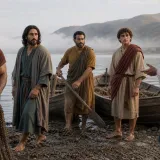
Open with the chapter’s first image
Mark 6:1: “And he went out from thence, and came into his own country; and his disciples follow him.”
Slow down at the turning point
Mark 6:24: “And she went forth, and said unto her mother, What shall I ask? And she said, The head of John the Baptist.”
Keep this word trail visible
Herod, John, disciples, king, loaves, place
What to explain, in order
Teach the passage in this order. Each step names the verses it rests on, so every point can be shown in the text before it is applied.
Mark 6:1-6
Offended at the carpenter
Begin at Nazareth. The people are amazed but offended. Explain carpenter as a builder who worked in wood and stone, and note they call him son of Mary, an unusual way to name a man in a culture that named sons by fathers. Jesus quotes a proverb about prophets without honour at home. Then the striking verse 5: he could do no mighty work there, except heal a few. Explain that Mark links mighty works to faith, and Jesus marvels at their unbelief.
Mark 6:7-13
Sent out two by two
Now the twelve are sent, fulfilling the purpose of 3:14. Explain two by two: testimony was confirmed by two witnesses. The instructions strip away supplies so that they rely on welcome. Shaking off dust was what Jews did leaving Gentile land, so it is a sharp warning. Then their work: preaching repentance, casting out devils, and anointing with oil. Teach this first in the mission section because it sets up the long account of John that follows.
Mark 6:14-29
The death of John
Mark interrupts the mission with a flashback. Explain that Herod here is Herod Antipas, ruler of Galilee, not the king of the nativity. He had married Herodias, his brother's wife, and John had told him it was not lawful. Read the banquet carefully and briefly. Do not dwell on the gruesome detail. Explain that John's death foreshadows Jesus': a just man, a weak ruler who knows he is innocent, and a decision made to please others. Note John's disciples bury him, as Jesus' friends will bury him.
Mark 6:30-44
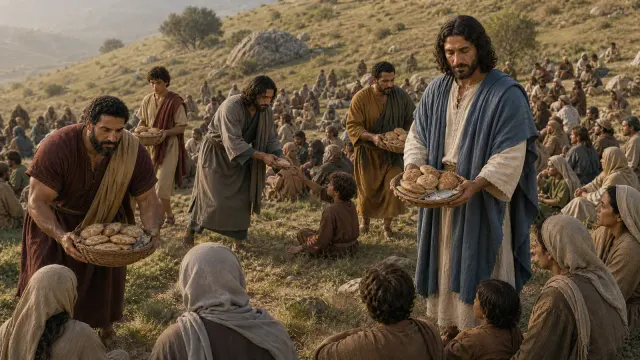
The shepherd feeds his flock
The apostles return, and Jesus invites them to rest. The crowd gets there first, and Jesus sees them “as sheep not having a shepherd”. Explain the echo of Numbers 27:17 and Ezekiel 34, where God promises to shepherd his people. He teaches them first, then feeds them. Walk through the actions: looked up, blessed, brake, gave. Explain that these are the same actions he will use at the Last Supper in 14:22. Note the green grass and the companies, like Israel in the wilderness.
Mark 6:45-52
Walking on the sea
Jesus sends the disciples ahead and goes up the mountain to pray. In the fourth watch, between three and six in the morning, he comes to them on the water and “would have passed by them”. Explain this phrase through Exodus 33:19-22 and Job 9:8, where God passes by and walks on the sea. They think he is a ghost. His words reassure them, and the wind ceases. End on verse 52, the Book of Mark's diagnosis of hardened hearts, because it links the two miracles.
Mark 6:53-56
The hem of his garment
Close with the summary at Gennesaret. People run to bring the sick on mats, wherever he goes, and beg to touch even the border of his garment. Recall the woman of 5:27. Explain that the response of the ordinary people contrasts with the disciples' hardened hearts just described. Teach this briefly at the end to show that while the disciples are slow, the need of the crowd is relentless, and his compassion meets it.
Where learners get stuck
The misreadings this passage tends to produce, and how to answer each from the text.
“Jesus could not do miracles at Nazareth, so his power depends on us.”
Verse 5 says he could do no mighty work there, “save that he laid his hands upon a few sick folk, and healed them”. So he still healed. The point is not that he lacked power but that unbelief closes people off from receiving what he offers. The Book of Mark ties faith and miracles together throughout (5:34, 9:23). Do not turn this into a claim that unhealed people lacked faith.
“Herod was forced to kill John because of his oath.”
The oath was rash and the request evil, but Herod was the king and could have refused. Verse 26 gives his reasons: his oath and “their sakes which sat with him”. That is fear of shame. Leviticus 5:4-6 provides for rash oaths. Let learners see that keeping face is not the same as keeping faith, and that the man who heard John gladly still killed him.
“The feeding of five thousand was really just people sharing their lunches.”
Mark reports five loaves, two fishes, thousands fed, “and were filled”, and twelve baskets of leftovers (6:42-43). Verse 52 calls it “the miracle of the loaves” and treats it as a revelation the disciples failed to grasp. A sharing explanation would leave nothing to be hardened against. Let the text say what it says and ask what the disciples should have understood.
“The disciples were good men, so their hearts could not have been hard.”
Verse 52 says their heart was hardened, using the language Mark uses of opponents. They are faithful in many ways, yet they still do not understand. This is a warning for every believer: closeness to Jesus does not guarantee understanding. Mark will keep showing them slow until the resurrection. Let this be an encouragement too, since he does not abandon them.
Learning objectives
- Explain why the people of Nazareth move from astonishment at Jesus’ wisdom and works to offense at him in verses 1–6.
- List the instructions Jesus gives the twelve for their mission and explain the significance of depending on hospitality rather than carrying extensive provisions.
- Reconstruct the account of John the Baptist’s death and distinguish Herod’s fear of John from Herodias’s hostility toward him.
- Identify the practical details Mark gives before the feeding of the five thousand, including the disciples’ proposed solution, the available food, the organized groups, and the leftovers.
- Trace what the disciples see and misunderstand when Jesus walks on the sea.
- Explain why Mark links their astonishment on the sea with their failure to consider the loaves in verse 52.
Teacher preparation
- Locate Nazareth, the surrounding villages, the Sea of Galilee, the deserted place, and Gennesaret on a map. Mark 6 moves repeatedly, and the geography helps the class see the pace.
- Review the social force of a hometown identifying Jesus by family and trade in verse 3. Avoid making contempt for manual work the only issue, since the text emphasizes familiarity and offense.
- Prepare a short note on Herod Antipas, Herodias, and Philip so the family relationships in verses 17–29 are clear without turning the lesson into a dynasty lecture.
- Count the mission instructions in verses 8–11 and the feeding details in verses 38–44. Mark is concrete here, and precision will keep the lesson from becoming a vague discussion of trust or generosity.
- Read verse 52 before teaching the sea scene. Mark himself interprets the disciples’ reaction by saying they had not considered the loaves and that their heart was hardened.
Evidence and interpretation checks
Explicit
Mark 6:5–6 links Nazareth’s unbelief with Jesus’ marveling; verses 7–13 record the sending of the twelve; verses 17–29 recount John’s death; verses 34–44 report the feeding; verses 45–52 report Jesus walking on the sea.
Scripture-supported
The wilderness provision theme has strong biblical precedent in Exodus 16 and 2 Kings 4:42–44. Those texts support hearing the feeding scene against Israel’s Scriptures without claiming Mark explicitly names either passage.
Strong inference
The arrangement of the twelve in mission around the account of John’s death places successful ministry beside the cost borne by a faithful messenger. Mark does not allow mission enthusiasm to erase the reality of rejection and violence.
Possible or traditional reading
Some readers assign symbolic meanings to every feeding number, including five loaves, two fishes, groups of fifties and hundreds, and twelve baskets. Mark reports the numbers clearly, but he does not decode each one. Distinguish observation from symbolic reconstruction.
Limit
Mark 6 does not say Jesus was absolutely unable to perform any work at Nazareth; verse 5 notes that he did heal a few sick people. It also does not state that every storm or need is deliberately arranged as a test.
Discussion with answer guidance
1. What reasons do the people of Nazareth give for taking offense at Jesus?
What a good answer contains
They are astonished at his wisdom and mighty works, then ask, “Is not this the carpenter, the son of Mary, the brother of James, and Joses, and of Juda, and Simon?” (6:3). Their objection is familiarity: they know his trade, his family, his sisters. “And they were offended at him”. A strong answer sees that they do not deny the works; they cannot fit them to someone so ordinary. A weak answer says they simply had not heard of his miracles, which verse 2 contradicts.
Show teacher guidance
Use verses 2–3. They know his family and identify him as the carpenter and son of Mary. Their question is not whether remarkable things are happening but how such things belong to someone they think they already know.
2. What are the twelve told to take, leave behind, and do when a place will not receive them?
What a good answer contains
They take “a staff only”, no scrip, no bread, “no money in their purse”, sandals, and not two coats (6:8-9). They stay in whatever house receives them until they leave the place (6:10). Where they are rejected, they “shake off the dust under your feet for a testimony against them” (6:11). A good answer sees that travelling light makes them depend on God and on hospitality. A weak answer turns the list into a rule for all missionaries in all times.
Show teacher guidance
Read verses 8–11 closely. Expect staff, sandals, one coat, dependence on a house that receives them, and shaking dust from their feet as a testimony where they are rejected.
3. Why does Herod execute John even though verse 20 says he feared him and heard him gladly?
What a good answer contains
Herod respected John: he “feared John, knowing that he was a just man and an holy”, and “heard him gladly” (6:20). But he had made a rash public oath at a feast, and the girl asked for John's head. The king was “exceeding sorry; yet for his oath's sake, and for their sakes which sat with him, he would not reject her” (6:26). A strong answer names the real cause: fear of losing face before his guests outweighed his conscience.
Show teacher guidance
Trace verses 19–29. Herodias seeks John’s death, the banquet promise creates public pressure, the daughter asks for John’s head, and Herod chooses his oath and guests over protecting the man he knows to be just and holy.
4. What does Jesus tell the disciples when they propose sending the hungry crowd away?
What a good answer contains
The disciples say, “Send them away”, so that the crowd can buy bread in the villages, and Jesus answers, “Give ye them to eat” (6:37). They count the cost, two hundred pennyworth, most of a year's wages. He asks what they have: five loaves and two fishes. He has the crowd sit in companies, blesses, breaks and gives the bread to the disciples to distribute. All eat and are filled, and twelve baskets remain. A good answer sees that he makes the disciples part of the provision.
Show teacher guidance
Verse 37 gives the jolt: 'Give ye them to eat.' Then follow the exchange about money, available food, organization of the crowd, blessing, distribution, satisfaction, and leftovers.
5. What do the disciples first think when they see Jesus walking on the sea?
What a good answer contains
Verse 49: “they supposed it had been a spirit, and cried out”. They are frightened at a figure on the water in the night, and think it is a ghost. A good answer keeps that fear distinct from what follows: Jesus speaks at once, “Be of good cheer: it is I; be not afraid” (6:50), and they are amazed when the wind ceases (6:51). Note that “it is I” can be heard as I am, the name God gave Moses, though the text leaves that for the reader to notice.
Show teacher guidance
Verse 49 says they suppose it is a spirit and cry out. Keep that reaction distinct from what Jesus then says and from their later amazement.
6. How does Mark explain their amazement in verse 52?
What a good answer contains
Verse 52 is the Book of Mark's own comment: “For they considered not the miracle of the loaves: for their heart was hardened”. Having watched him feed thousands from five loaves, they should have known that he was more than a teacher. A strong answer takes the word hardened seriously, the same condition the Pharisees showed in 3:5, and sees that the disciples are not exempt. A weak answer says they were just tired, which Mark does not say.
Show teacher guidance
Do not replace Mark’s explanation with a softer one. He says they considered not the miracle of the loaves because their heart was hardened. Ask what connection between the feeding and the sea scene they have failed to make.
Responsible application
Heart and habits
Compare the assumptions of Nazareth with the disciples’ failure to consider the loaves. Ask what kinds of prior expectations can prevent people in the passage from interpreting evidence already in front of them.
Relationships and community
Study the mission instructions as a community practice of dependence, hospitality, and witness. Keep attention on how the twelve are told to receive lodging rather than on modern travel preferences.
Earned by this passage
Place John’s banquet death beside the wilderness feeding. Ask the class to list what each table scene reveals about the ruler at its center, using only details Mark supplies.
Session plans
Two timings of the same lesson. The shorter keeps the reading, the central discussion and one response; the longer gives the confusions and the application their own time.
45 minutes
Read the chapter
Read 6:1-56 in parts, with different readers for each section, and ask the class to listen for responses to Jesus.
Nazareth and the mission
Read 6:1-13. Take questions one and two and confusion one.
John's death
Read 6:14-29 briefly and with care. Take question three and confusion two.
The feeding
Read 6:30-44 and take question four. Address confusion three.
The sea and the hardened heart
Read 6:45-52. Take questions five and six, and confusion four.
Handout
Read the key verse together, give out the sheet, and close in prayer.
90 minutes
Too familiar
Ask the group whether it is harder to listen to someone they grew up with. Then read 6:1-6.
Nazareth
Take question one and confusion one. Discuss the difference between being amazed and believing.
Two by two
Read 6:7-13 and take question two. Ask what travelling light would mean for them.
Herod's banquet
Read 6:14-29 with care and take question three and confusion two. Compare it briefly with 15:15.
The shepherd feeds
Read 6:30-44 with Ezekiel 34:11-15. Take question four and confusion three. Note the actions in 6:41 and 14:22.
On the sea
Read 6:45-52 with Job 9:8. Take questions five and six and confusion four.
Application
Use the third application. What do we have in our hands that Jesus might use?
Handout and prayer
Read the key verse together, hand out the sheet and pray.
Adapting the lesson
Children
Act out the feeding: give each child a small piece of bread from one basket and keep refilling it from behind a cloth while you say how many people ate. Ask them what they would give to Jesus. For the sea, turn off the lights and let them pretend to row. Tell John's death only as Herod putting John in prison and John dying for telling the truth; leave out the head and the dance.
Youth
Ask whether peer pressure has ever made them do something they knew was wrong. Herod's banquet is the clearest example of that in Mark. Then the feeding: the disciples thought they had nothing; Jesus said, Give ye them to eat. Ask what they have that could feed someone else. Keep the violence of John's death brief.
Adults
Discuss the Nazareth rejection and how familiarity can dull faith. Explore Herod as a tragic figure who respected truth and still killed it. Spend time on the shepherd imagery and the Last Supper echoes. Let adults talk about their own hardened hearts, the places where they have seen God provide and still not trusted him.
One to one
Ask which scene they would most like to talk about. If they feel overlooked or underrated, read Nazareth. If they feel they have too little to give, read 6:37-38. If they are afraid, read 6:50 and its words, it is I; be not afraid. Pray with them.
Song and video learning lab
A song or video may interpret, compress, or dramatize the text. Its value becomes clearer when its choices are compared with Scripture.
- Before the media: the exact passage and its central movement.
- During the media: the words, people, events, and emotions the artist emphasizes.
- After the media: what it clarifies, what it leaves out, and what belongs back in the biblical text.
Handout
One page for learners to take home. The print button prints this section alone.
Mark 6
The passage in brief
In his hometown, people take offence at Jesus because they know his family, and he does few miracles there. He sends the twelve out two by two to preach and heal. Herod hears about Jesus and fears that John the Baptist, whom he had beheaded, has come back to life. Jesus has compassion on a huge crowd, teaches them, and feeds five thousand men with five loaves and two fish. That night he walks on the sea to his disciples, who are frightened, and calms the wind.
A verse to keep
And Jesus, when he came out, saw much people, and was moved with compassion toward them, because they were as sheep not having a shepherd: and he began to teach them many things.
Mark 6:34 · King James Version
Questions to take home
Why were the people of Nazareth offended at Jesus (6:2-3)?
What did Jesus see when he looked at the crowd in 6:34, and what did he do first?
What did the disciples fail to understand, according to 6:52?
This week
Bring Jesus something small you have this week, whether time, money or a skill, and ask him to use it.
Music and video connected to the passage
Related media appears when its Scripture reference overlaps this study. Music and video can illuminate a theme while the biblical text remains the foundation.