The big picture
2 Chronicles 35 opens with one of the most carefully coordinated acts of worship in the book. Josiah keeps Passover on its appointed date, organizes priests and Levites according to received instructions, supplies animals from his own substance, and presides over a system detailed enough to make sure singers and gatekeepers can remain at their posts while others prepare food for them. The celebration is measured back to the days of Samuel and sits beside the discovery of the law and covenant renewal in Josiah's eighteenth year. Then the chapter changes direction with almost brutal speed. Necho moves toward Carchemish and warns Josiah not to interfere, and 2 Chronicles itself identifies those words as coming from God. The king who listened to the recovered book refuses this warning, disguises himself for battle, and is mortally wounded. The chapter closes not by erasing his goodness, but by placing it beside national lamentation and the act that ended his reign.
In this chapter
- The Ark Rests; the Levites Still Have Work to Do 2 Chronicles 35:1-6
Josiah's Passover begins with timing, order, and inherited instruction.
- Someone Makes Sure the Singers Get Their Supper 2 Chronicles 35:7-15
The scale of this Passover is visible in its supply chain as much as in its ceremony.
- A Passover Measured Back to Samuel 2 Chronicles 35:16-19
All the repeated preparation now reaches completion.
- The King Who Heard the Book Does Not Hear This Warning 2 Chronicles 35:20-24
"After all this" is a devastating opening because it refuses to erase everything that came before.
- The Voices That Celebrated Now Preserve the Loss 2 Chronicles 35:25-27
The singers who filled the Passover with ordered service now belong to the sound of loss.

Scripture beside the summary
2 Chronicles · King James Version · 272 Chronicles 35:1-6
The Ark Rests; the Levites Still Have Work to Do
Josiah's Passover begins with timing, order, and inherited instruction. Unlike Hezekiah's delayed observance, this celebration starts on the fourteenth day of the first month. Priests are set in their charges, Levites are encouraged and addressed as teachers of Israel, and preparation extends beyond animals to the people responsible for guiding the service. Josiah tells the Levites to put the ark in the house Solomon built, while also saying that carrying it is no longer their burden. The chapter does not explain why the ark needed to be placed there at this moment, so theories about its earlier displacement remain theories. What is clear is the new focus of Levitical service in the established temple. Josiah also appeals to the written arrangements associated with David and Solomon while grounding Passover itself in "the word of the LORD by the hand of Moses." The king is coordinating received authorities, not inventing a ceremony to display royal creativity.
Deep dive
Unlike Hezekiah's delayed observance, this Passover begins on the fourteenth day of the first month. The priests are assigned their duties and encouraged, and the Levites are addressed as teachers of Israel. Preparation includes instruction and ordered service, not only the provision of animals.
The command to put the ark in Solomon's house raises a question the account does not answer: why it needed to be placed there at this point. Suggestions include displacement during earlier idolatry or removal during repairs, but neither circumstance is stated here. The following words are clearer. Carrying the ark is no longer to be a burden upon their shoulders; their service now concerns the LORD and his people in the established house.
Josiah's directions name written arrangements from David and Solomon while grounding the Passover in the word delivered through Moses. These authorities concern related but distinct aspects of the service. The passage does not present the king as inventing a grand ceremony; it depicts him bringing the received requirements and the appointed workers together.
Words to trace: LORD, Israel, holy, passover, brethren, David
Verse-by-verse path
- 2 Chronicles 35:1
2 Kings 23:21-23 gives this Passover three verses; the Book of 2 Chronicles gives it nineteen. The date is the one fixed in Exodus 12:6, the fourteenth of the first month, and it is stated because Hezekiah’s Passover had to be held a month late (30:2).
- 2 Chronicles 35:2
“Encouraged” is the verb for strengthening, the same one Hezekiah used on the people in 32:5 and 32:7. The priests are not accused of anything; the verse suggests they needed stiffening after half a century of Manasseh and Amon.
- 2 Chronicles 35:3
This is the last mention of the ark in the historical books. Why it needed putting back is not explained; many suppose Manasseh or Amon had removed it. “It shall not be a burden upon your shoulders” releases the Levites from their oldest duty and redirects them to serve God and people.
- 2 Chronicles 35:4
“The writing of David” and “the writing of Solomon” are the courses of Levites and priests set out in 1 Chronicles 23 to 26 and applied by Solomon in 8:14. Josiah appeals to documents, fittingly for a king whose reform began with a found book.
- 2 Chronicles 35:5
Each Levite group is paired with a group of lay families, so every household knew whose hands would prepare its lamb. “The holy place” here is the temple court, where the Passover animals were killed.
- 2 Chronicles 35:6
“Sanctify yourselves” comes between killing and preparing. The Levites are to be ritually clean for the handling of blood and meat, and “prepare your brethren” means doing the work for the laity who could not all be purified in time.
2 Chronicles 35:1-6
King James Version1Moreover Josiah kept a passover unto the LORD in Jerusalem: and they killed the passover on the fourteenth day of the first month.
2And he set the priests in their charges, and encouraged them to the service of the house of the LORD,
3And said unto the Levites that taught all Israel, which were holy unto the LORD, Put the holy ark in the house which Solomon the son of David king of Israel did build; it shall not be a burden upon your shoulders: serve now the LORD your God, and his people Israel,
4And prepare yourselves by the houses of your fathers, after your courses, according to the writing of David king of Israel, and according to the writing of Solomon his son.
5And stand in the holy place according to the divisions of the families of the fathers of your brethren the people, and after the division of the families of the Levites.
6So kill the passover, and sanctify yourselves, and prepare your brethren, that they may do according to the word of the LORD by the hand of Moses.
2 Chronicles 35:7-15
Someone Makes Sure the Singers Get Their Supper
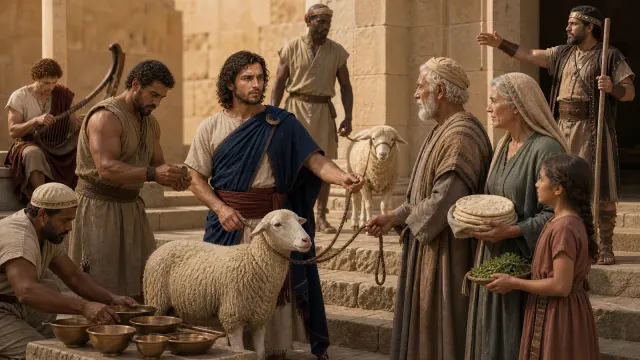
The scale of this Passover is visible in its supply chain as much as in its ceremony. Josiah contributes tens of thousands of animals from his own substance, and princes, temple rulers, and Levitical leaders give willingly so that people and ministers alike are provided for. 2 Chronicles then slows down to distinguish tasks. Passover animals are roasted according to the ordinance, other holy offerings are boiled in pots, cauldrons, and pans, food is distributed quickly, and the Levites eventually prepare for themselves and for priests who remain occupied at the altar until night. Even the singers and gatekeepers are accounted for. They do not have to leave their assigned places because other Levites prepare food for them. The detail is almost domestic inside a massive national observance, and that is precisely why it works. The chapter is not interested only in spectacle. It notices the quiet coordination that allows public worship to continue without abandoning the people whose posts make it possible.
Deep dive
The contributions distinguish lambs and kids for Passover from the oxen supplied for the wider sacrificial service. The large numbers describe provision for the people as well as for priests and Levites. Josiah's gift comes from his own substance, and the other leaders give willingly. The scale of the gathering has an identifiable source of support.
The preparation is equally differentiated. Passover animals are roasted with fire according to the ordinance; other holy offerings are boiled in pots, cauldrons, and pans. These are not two incompatible instructions for the same dish. The Levites distribute the food quickly, then prepare for themselves and the priests, whose altar work continues until night.
The singers and gatekeepers also receive food from their Levitical brethren. The choir does not have to abandon its place to find supper, and the gates do not have to be left unattended. It is a small, thoroughly practical detail within an immense occasion. The Book of 2 Chronicles notices not only the public sound and spectacle, but the coordination that allows those responsible for them to remain at their posts.
Words to trace: Levites, priests, offerings, passover, gave, people
Verse-by-verse path
- 2 Chronicles 35:7
Thirty thousand lambs and kids and three thousand bullocks, all “of the king’s substance”. Hezekiah had given a thousand bullocks and seven thousand sheep (30:24). The Passover animal could be a lamb or a young goat, as Exodus 12:5 allows.
- 2 Chronicles 35:8
Hilkiah, who found the book, gives here as high priest alongside two other temple chiefs, Zechariah and Jehiel. Their gift goes to the priests. Josiah gave to the people; each rank of leader provides for the rank below it.
- 2 Chronicles 35:9
Conaniah, Shemaiah, Nethaneel, Hashabiah, Jeiel and Jozabad are Levite names, several of which recur among Hezekiah’s Levites in 31:12-15, suggesting family offices handed down. Their five thousand head is the largest gift after the king’s. Adding the verses, 37,600 small cattle and 3,800 oxen.
- 2 Chronicles 35:10
“Stood in their place” is a phrase of order, each person at his post. The phrase “according to the king’s commandment” is set beside the earlier appeals to Moses and David, as though the king’s part was to put their instructions into effect.
- 2 Chronicles 35:11
The division of labour follows 30:16-17: priests handle the blood at the altar, Levites skin the animals. Under Moses each household killed its own lamb; here the Levites have taken on that work for the whole assembly.
- 2 Chronicles 35:12
“Removed the burnt offerings” means setting aside the parts meant for burning, to be handed to each family group to present. The oxen follow the same procedure. The Book of Moses in view is probably Leviticus 3, the portions for the altar.
- 2 Chronicles 35:13
The Hebrew literally says “they boiled the passover in fire”, using the verb for cooking from Deuteronomy 16:7 and the fire of Exodus 12:9, which forbids boiling. The phrase appears to reconcile the two laws. The other offerings really were boiled, and served fast.
- 2 Chronicles 35:14
The Levites cook last, for themselves and for the priests, who were at the altar “until night” burning fat. The detail explains why the priests did not eat when everyone else did, and shows the Levites covering for them.
- 2 Chronicles 35:15
“Jeduthun the king’s seer” gives a musician the prophetic title, as 1 Chronicles 25:1 speaks of prophesying with harps. Singers and gatekeepers stay at their posts because other Levites bring them their meals, a small act of care the book thought worth recording.
2 Chronicles 35:7-15
King James Version7And Josiah gave to the people, of the flock, lambs and kids, all for the passover offerings, for all that were present, to the number of thirty thousand, and three thousand bullocks: these were of the king’s substance.
8And his princes gave willingly unto the people, to the priests, and to the Levites: Hilkiah and Zechariah and Jehiel, rulers of the house of God, gave unto the priests for the passover offerings two thousand and six hundred small cattle, and three hundred oxen.
9Conaniah also, and Shemaiah and Nethaneel, his brethren, and Hashabiah and Jeiel and Jozabad, chief of the Levites, gave unto the Levites for passover offerings five thousand small cattle, and five hundred oxen.
10So the service was prepared, and the priests stood in their place, and the Levites in their courses, according to the king’s commandment.
11And they killed the passover, and the priests sprinkled the blood from their hands, and the Levites flayed them.
12And they removed the burnt offerings, that they might give according to the divisions of the families of the people, to offer unto the LORD, as it is written in the book of Moses. And so did they with the oxen.
13And they roasted the passover with fire according to the ordinance: but the other holy offerings sod they in pots, and in caldrons, and in pans, and divided them speedily among all the people.
14And afterward they made ready for themselves, and for the priests: because the priests the sons of Aaron were busied in offering of burnt offerings and the fat until night; therefore the Levites prepared for themselves, and for the priests the sons of Aaron.
15And the singers the sons of Asaph were in their place, according to the commandment of David, and Asaph, and Heman, and Jeduthun the king’s seer; and the porters waited at every gate; they might not depart from their service; for their brethren the Levites prepared for them.
2 Chronicles 35:16-19
A Passover Measured Back to Samuel
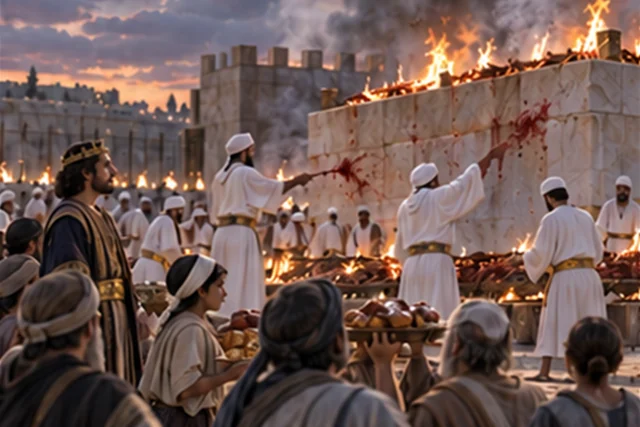
All the repeated preparation now reaches completion. The service is readied, Passover is kept, burnt offerings are made, and those present continue with the feast of unleavened bread for seven days. The organizational detail has not been included merely to admire a well-managed plan. It results in an actual observance carried out in its appointed order. Then 2 Chronicles gives the celebration its scale by measuring it back to Samuel: no Passover like this one had been kept in Israel since his days, and the claim gathers king, priests, Levites, Judah, Israelites present, and the inhabitants of Jerusalem into one description. That does not mean Israel has observed no Passover in the intervening centuries. Hezekiah's celebration has already been recorded. The point is the exceptional character of this one. The date matters too. It occurs in Josiah's eighteenth year, joining the recovered book, covenant renewal, and fulfilled worship into one concentrated season of reform.

Deep dive
The repeated emphasis on preparation reaches its result: the service is ready, Passover is kept, and burnt offerings are offered. The people then observe the feast of unleavened bread for seven days. The sequence connects readiness to actual performance; the organizational detail has not been included merely to admire Josiah's plans.
The comparison reaches back beyond the monarchy to Samuel. No Passover like this one has been kept by the kings of Israel. That does not mean no Passover has occurred, as Hezekiah's celebration in chapter 30 already demonstrates. The claim concerns its exceptional character, including king, priests, Levites, Judah, the Israelites present, and Jerusalem's inhabitants. The eighteenth-year date also places it alongside the recovered book and covenant renewal of chapter 34. Written words, public commitment, and a completed observance now belong together. The account has reached the fullest description of Josiah's restoration before changing direction.
Words to trace: passover, Israel, kept, Josiah, days, keep
Verse-by-verse path
- 2 Chronicles 35:16
“The same day” compresses the whole enormous effort into one sunset. The sentence ties Passover and burnt offerings together under “the commandment of king Josiah”, the phrase used again from verse 10.
- 2 Chronicles 35:17
Unleavened Bread follows Passover for seven days, as Leviticus 23:6 sets out. “That were present” is a small realism: not all Israel came, and those who did kept it.
- 2 Chronicles 35:18
2 Kings 23:22 says no such Passover since “the days of the judges”; the Book of 2 Chronicles names Samuel, the last judge. Hezekiah’s Passover was compared only to Solomon (30:26); this one is set above every king, Hezekiah included.
- 2 Chronicles 35:19
The eighteenth year, the year the book was found. So everything from 34:8 to 35:19 falls within twelve months: repairs, discovery, Huldah, covenant, and this Passover in the first month of the religious year.
2 Chronicles 35:16-19
King James Version16So all the service of the LORD was prepared the same day, to keep the passover, and to offer burnt offerings upon the altar of the LORD, according to the commandment of king Josiah.
17And the children of Israel that were present kept the passover at that time, and the feast of unleavened bread seven days.
18And there was no passover like to that kept in Israel from the days of Samuel the prophet; neither did all the kings of Israel keep such a passover as Josiah kept, and the priests, and the Levites, and all Judah and Israel that were present, and the inhabitants of Jerusalem.
19In the eighteenth year of the reign of Josiah was this passover kept.
2 Chronicles 35:20-24
The King Who Heard the Book Does Not Hear This Warning
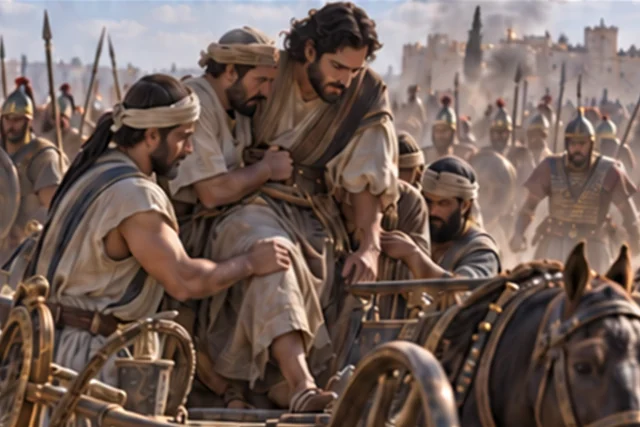
"After all this" is a devastating opening because it refuses to erase everything that came before. Josiah has prepared the temple and led the great Passover, yet the next episode turns on his refusal to listen. Necho is marching toward Carchemish and tells the king of Judah that the campaign is not against him. More importantly, 2 Chronicles does not leave Necho's appeal as self-serving Egyptian rhetoric. Verse 22 states that Josiah "hearkened not unto the words of Necho from the mouth of God." The king who tore his clothes when the law was read now resists a warning the book itself attributes to God. Josiah disguises himself, enters battle, is struck by archers, and asks to be taken away. Those details recall Ahab's last battle without making their reigns morally identical. Josiah's servants transfer him to another chariot, carry him to Jerusalem, and the ruler who organized a national gathering returns to the city to die.
Deep dive
The transition begins "After all this" and specifically recalls Josiah's preparation of the temple. The battle is not introduced by erasing that good work. Necho says that his campaign is not directed against Judah and warns Josiah against interfering with a mission God has commanded. The decisive line is verse 22: the Book of 2 Chronicles itself identifies Necho's words as coming from God's mouth. They are not left merely as an Egyptian king's unverified claim.
Josiah's failure to hear contrasts with the response to the recovered law. The king who tore his clothes when Shaphan read does not turn aside when the warning arrives through Necho. His disguise, the archers' shot, and his request to be taken away also recall Ahab's last battle in 2 Chronicles 18:29–34. The resemblance concerns these actions and their outcome; it does not make the two reigns morally interchangeable.
Josiah is transferred to another chariot and taken to Jerusalem, where he dies. The passage supplies no political motive for his intervention that resolves its difficulty. His servants must now carry the king who organized the great assembly. The chapter moves from a gathering fed and served under his direction to the burial and lamentation that his death brings upon Jerusalem.
Words to trace: Josiah, king, fight, chariot, Jerusalem, Judah
Verse-by-verse path
- 2 Chronicles 35:20
Thirteen years pass unmentioned between this verse and the last. “After all this” leads to 609 BC, when Pharaoh Necho II marched north to support the last Assyrian king against Babylon. Carchemish on the Euphrates is where Babylon finally broke Egypt four years later (Jeremiah 46:2).
- 2 Chronicles 35:21
“What have I to do with thee” is literally “what to me and to you”, the idiom of refusing involvement. “The house wherewith I have war” means a royal house, Babylon. Necho claims divine urgency, and the Book of 2 Chronicles will endorse the claim.
- 2 Chronicles 35:22
“Disguised himself” is the same verb used of Ahab at Ramoth-gilead in 18:29, who also went into battle incognito against a prophetic warning and was also killed by an archer. The parallel with Israel’s worst king is uncomfortable, and seems intended. Megiddo guarded the pass through the Carmel ridge.
- 2 Chronicles 35:23
“Have me away; for I am sore wounded” echoes the dying Ahab of 18:33 almost word for word. “Sore wounded” is literally “I am made very sick”, the arrow wound that will kill him.
- 2 Chronicles 35:24
The “second chariot” was probably a reserve or command car kept behind the lines. 2 Kings 23:30 says he was dead when he arrived in Jerusalem; this verse places the death after the journey. Both agree on the burial in his own tomb.
2 Chronicles 35:20-24
King James Version20After all this, when Josiah had prepared the temple, Necho king of Egypt came up to fight against Carchemish by Euphrates: and Josiah went out against him.
21But he sent ambassadors to him, saying, What have I to do with thee, thou king of Judah? I come not against thee this day, but against the house wherewith I have war: for God commanded me to make haste: forbear thee from meddling with God, who is with me, that he destroy thee not.
22Nevertheless Josiah would not turn his face from him, but disguised himself, that he might fight with him, and hearkened not unto the words of Necho from the mouth of God, and came to fight in the valley of Megiddo.
23And the archers shot at king Josiah; and the king said to his servants, Have me away; for I am sore wounded.
24His servants therefore took him out of that chariot, and put him in the second chariot that he had; and they brought him to Jerusalem, and he died, and was buried in one of the sepulchres of his fathers. And all Judah and Jerusalem mourned for Josiah.
2 Chronicles 35:25-27
The Voices That Celebrated Now Preserve the Loss
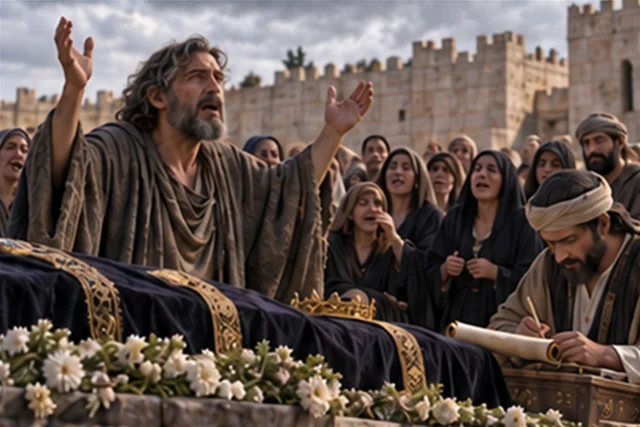
The singers who filled the Passover with ordered service now belong to the sound of loss. Jeremiah laments Josiah, and singing men and women preserve that grief as an established remembrance in Israel. The chapter says the lamentations were written, but it does not give their words or require the written collection to be identified with the biblical Book of Lamentations. What matters here is the public duration of mourning. Josiah's death is not treated as a brief military footnote after a successful reform. His goodness "according to that which was written in the law of the LORD" remains part of the closing record, even after the chapter has described his fatal refusal at Megiddo. That balance is deliberate. The final battle is not excused, but it does not rewrite the whole reign into failure. 2 Chronicles lets Judah mourn a king whose reforms mattered while still preserving the act through which his reign came to an abrupt and painful end.
Deep dive
The chapter began with singers in their appointed places during Passover. It ends with singing men and women carrying Josiah's memory in lamentations. The change in musical setting gives the loss a public duration: grief is not confined to the day the body returns. Jeremiah is named among those who lament, but the words of his lament are not reproduced here. The reference to a written collection does not by itself establish that it is identical with the biblical Book of Lamentations.
The final evaluation still includes Josiah's goodness according to the law of the LORD. His refusal at Megiddo is not excused, but neither does it erase the conduct already recorded. This is why the ending has more weight than a simple reversal from good king to bad king. The nation mourns a ruler whose restoration mattered, while the account retains the act that brought his reign to its end. The next chapter will move quickly through the kings who follow him.
Words to trace: Josiah, written, Israel, lamentations, singing, acts
Verse-by-verse path
- 2 Chronicles 35:25
Jeremiah 22:10 later tells Judah to weep not for the dead but for the exiled. The lamentations for Josiah became an annual custom, and Zechariah 12:11 compares a future mourning to “the mourning of Hadadrimmon in the valley of Megiddon”, which many take to recall this death.
- 2 Chronicles 35:26
“His goodness” is the word for covenant loyalty, measured not by general virtue but “according to that which was written in the law of the LORD”, the same standard Josiah read aloud in 34:30.
- 2 Chronicles 35:27
“First and last” means the whole of his deeds, early and late, including the final campaign. The book declines to trim the ending away, and the next chapter shows how quickly everything after him unravels.
2 Chronicles 35:25-27
King James Version25And Jeremiah lamented for Josiah: and all the singing men and the singing women spake of Josiah in their lamentations to this day, and made them an ordinance in Israel: and, behold, they are written in the lamentations.
26Now the rest of the acts of Josiah, and his goodness, according to that which was written in the law of the LORD,
27And his deeds, first and last, behold, they are written in the book of the kings of Israel and Judah.
Questions to keep in mind while reading
- Track who acts, who speaks, who is affected, and what changes.
- Notice repeated promises, failures, rescues, and consequences.
- Do not assume the account approves every action that is reported.
Text first
Where readers differ
The chapter summary begins with what the passage says and how its parts fit together. It does not assume one denomination has already settled every question. Where a conclusion depends on a tradition, literary theory, or historical reconstruction, that dependence is named openly.
The KJV text is presented first. Interpretive conclusions are labeled, and differences are introduced only when they help a reader understand why serious communities do not always reach the same answer.
Comparative interpretive notes for this chapter are in preparation. Until reviewed notes are ready, this page separates the KJV text from summary and application without claiming that serious readers agree on every question.
Questions beneath the surface
- What account of God, human freedom, responsibility, and the good life emerges from 2 Chronicles 35?
- Which tension does the chapter refuse to resolve quickly?
- What changes when the chapter is read as part of the whole canon rather than as an isolated moral lesson?
- Where might a sincere reader confuse a familiar tradition with something the text states directly?
Questions for serious personal contemplation
These open-ended questions make room for tension, honest response, prayer, and conclusions that remain accountable to the chapter.
Observe without rushing
What part of 2 Chronicles 35 makes you stop, feel unsettled, or feel surprised, and why?
Which detail in the passage would be easiest to overlook? How does that detail change your understanding?
Where do you see tension between what happens and this focus: 2 Chronicles 35 develops its own movement around Josiah, passover, Israel, Levites, LORD?
What important question does the passage leave open instead of resolving quickly?
Examine your inner life honestly
Which person, response, fear, or desire in the passage feels most like your own life right now?
What assumption about God, other people, or yourself does this text challenge?
Which part would you rather soften, avoid, or explain away too quickly? What might that reaction reveal?
If this Scripture could ask you one direct question, what do you think it would ask?
Respond with wisdom and courage
What do you need to remember, confess, grieve, thank God for, or trust after reading this passage?
How might another faithful person read this situation differently without ignoring the text?
What obedient response would be costly, uncomfortable, or slow, yet still faithful to Scripture?
What question will you carry into prayer this week, and which verses will you keep in front of you?
Music and video connected to the passage
Related media appears when its Scripture reference overlaps this study. Music and video can illuminate a theme while the biblical text remains the foundation.